Category Archives: Feast Days

On The Presentation of Our Lord

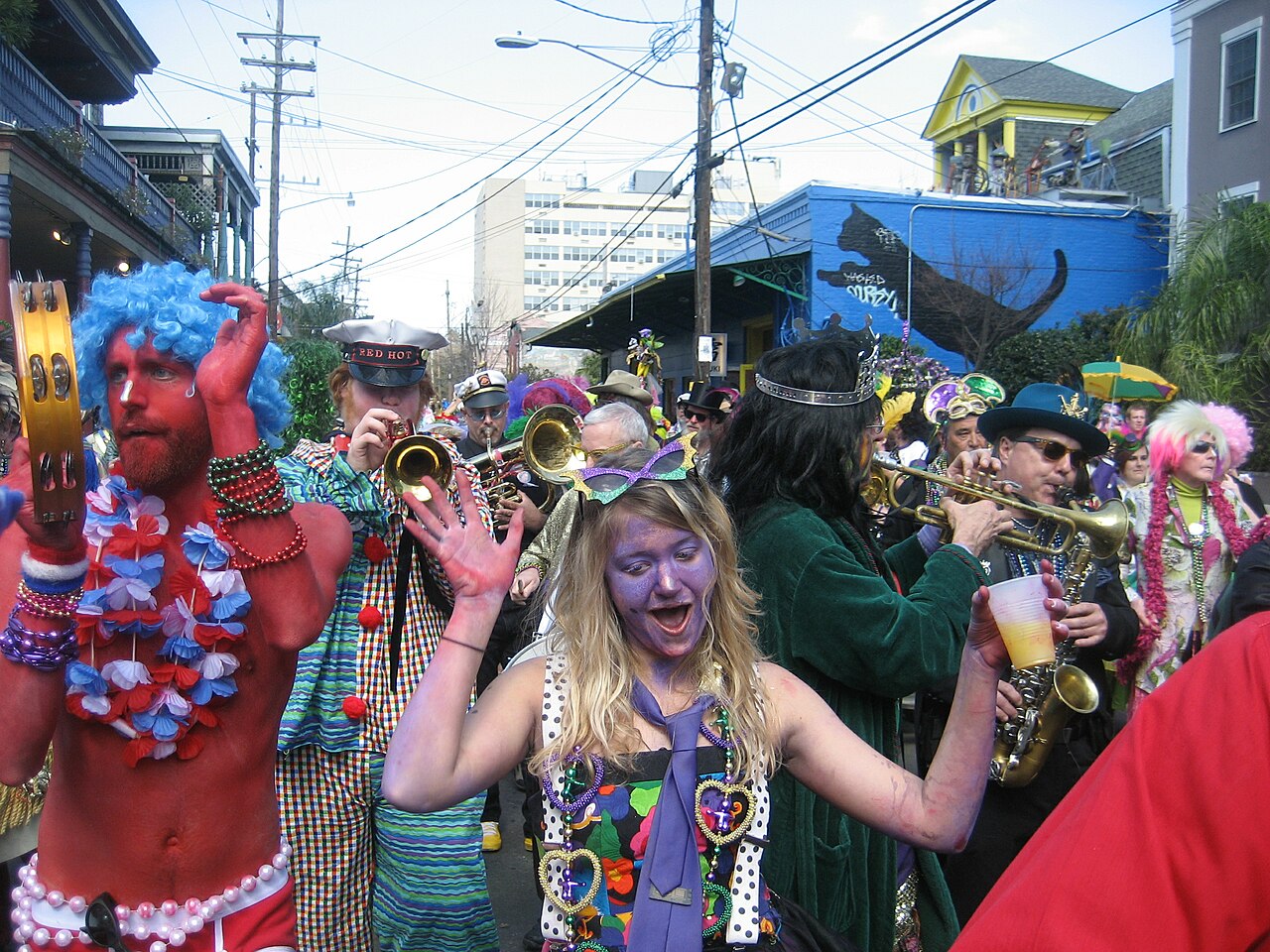
KosmicFrenchmenPurpleFaceMardiGras2009.JPG

 “Revelers” at Mardi Gras…

*   *   *   *

February 4, 2015 – First the good news.  Mardi Gras is less than two weeks away.  (The image above is captioned “Mardi Gras Day, New Orleans: Krewe of Kosmic Debris revelers on Frenchmen Street.”)  The bad news – as some people say – is that Mardi Gras is followed immediately by Lent, a “solemn religious observance” involving some 40 days of “prayer, penance, repentance of sins, almsgiving, atonement and self-denial.” (Wikipedia.)

And incidentally, that’s not 40 days straight of “self-denial.”  You get Sundays off to enjoy whatever it is you’ll be giving up for Lent.  (Chocolate, rye whiskey, two dollar cigars, whatever.)  That will be explained in a later post during Lent itself…

In the meantime (again), I haven’t done a post on Sunday Bible readings for awhile.  Aside from Jesus “cracking wise” and Jonah and the bra-burners, the last one I did was On the Bible readings for January 18.   That last post noted the end of the 12 Days of Christmas, on January 6th.  January 6 also marked the start of the Season of Epiphany.  See Christian Resource:

For many Protestant church traditions, the season of Epiphany extends from January 6th until Ash Wednesday, which begins the season of Lent leading to Easter.  Depending on the timing of Easter, this longer period of Epiphany includes from four to nine Sundays.  Other traditions, especially the Roman Catholic tradition, observe Epiphany as a single day, with the Sundays following Epiphany counted as Ordinary Time

As I noted in January 18, “That means the Bible readings for Sundays from now until February 15 will be those readings ‘after the Epiphany.'”  There are some exceptions however, and one of those celebrates the Presentation of Jesus at the Temple.

This Feast Day – which actually falls on February 2 – celebrates the episode in Jesus’ life described in the Luke 2:22–40.   Luke indicated that “Mary and Joseph took the Infant Jesus to the Temple in Jerusalem . . . to complete Mary’s ritual purification after childbirth.” They were also there “in obedience to the Torah (Leviticus 12, Exodus 13:12–15.”

Luke explicitly says that Joseph and Mary take the option provided for poor people (those who could not afford a lamb) (Leviticus 12:8), sacrificing “a pair of turtledoves, or two young pigeons.”  Leviticus 12:1–4 indicates that this event should take place forty days after birth for a male child, hence the Presentation is celebrated forty days after Christmas.

See Presentation of Jesus at the Temple – Wikipedia, the free encyclopedia.  But by church rule, a Feast Day can’t be  moved back, it can only be moved ahead.  So the February 2d Presentation couldn’t be moved back to Sunday February 1.  It had to be moved forward, to February 8.

Accordingly, the Bible readings for Sunday February 8 are those for the Presentation, not the Fifth Sunday after the Epiphany.  Those readings are:  Malachi 3:1-4, Psalm 84 (or Psalm 24:7-10), Hebrews 2:14-18, and – as noted – Luke 2:22-40:

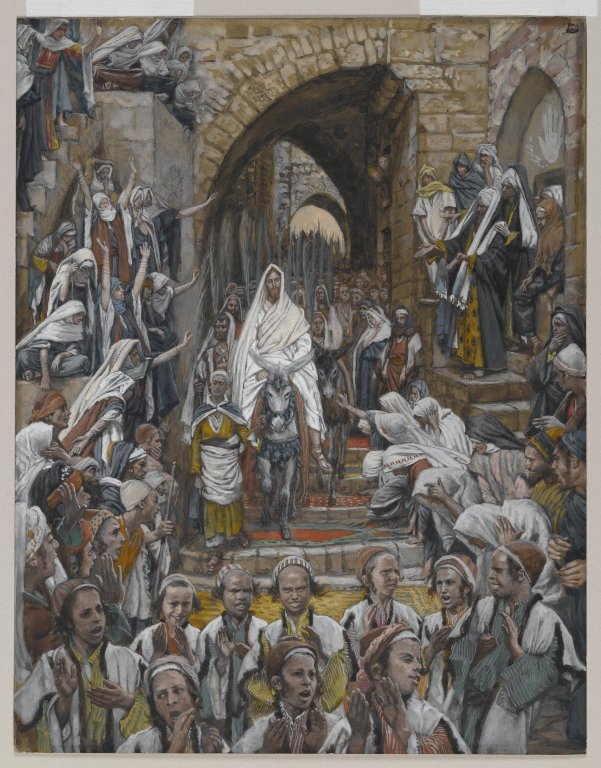
Forty days after the birth of Jesus, the Holy Family travels to Jerusalem to initiate the child into the service of God at the Temple and to offer a modest sacrifice:  the caged pigeons or turtledoves held here by Joseph [shown below, a la James Tissot].  Taking the infant into his arms, the aged priest Simeon acknowledges the child as the Christ, or Messiah.

See Brooklyn Museum: European Art: The Presentation of Jesus.  See also Feast of the Presentation of the Lord – February 02, 2015, which told of the Old Testament reading – Malachi 3:1-4 – foretelling the coming of John the Baptist:  “I am sending my messenger to prepare the way before me.”  Note also that the New Testament reading – Hebrews 2 – said that through His death on the Cross Jesus would “destroy the one who has the power of death … and free those who all their lives were held in slavery by the fear of death.”  (Something else to think about.)

In the meantime (a third time), there’s the upcoming season of Lent to think about.  It starts with Ash Wednesday, February 18, and as I noted in On the readings for Advent Sunday:

… for a time – starting about 300 A.D. – Advent was “kept as a period of fasting as strict as in Lent.”  And just as Lent today is preceded by the celebration of Mardi Gras, so back in the olden days … Advent was preceded by the “feast day of St. Martin of Tours,” in many places “a time of frolic and heavy eating, since the 40-day fast began the next day.”

As Wikipedia noted, tradition says that Lent lasts 40 days “in commemoration of the forty days” that Jesus spent, “before beginning his public ministry, fasting in the desert, where he endured temptation by the Devil.”  But again, that Lenten period of fasting and penance is preceded by the “blow-out” of Mardi Gras, thus reflecting the “rhythmic movement between the poles of fast and feast, Lent and Easter, renunciation and affirmation.”  See To Fast Again by Eamon Duffy.

Or in the words of an old-timey (1962) hit tune:  “To every thing there is a season…  A time to weep, and a time to laugh.  A time to mourn, and a time to dance…

*   *   *   *

The upper image is courtesy of  Mardi Gras – Wikipedia:

Mardi Gras is French for “Fat Tuesday”, reflecting the practice of the last night of eating richer, fatty foods before the ritual fasting of the Lenten season…  Popular practices on Mardi Gras include wearing masks and costumes, overturning social conventions, dancing, sports competitions, parades, debauchery, etc.

The original post had a lower image  courtesy of Brooklyn Museum: European Art: The Presentation of Jesus in the Temple, which added a commentary on some predecessors including Tintoretto:

Throughout his commentaries, Tissot refers to both historical and modern sources to demonstrate his extensive knowledge of the Temple precinct in ancient Jerusalem.  He locates the Presentation at the top of the steps that led to the altar of burnt sacrifice.  Further, he takes to task the sixteenth-century Venetian painter Tintoretto, one of his most illustrious art-historical predecessors, for inaccurately rendering the stairway, instead insisting very specifically on a shallow rise for the individual steps, as documented by the historical writers he consulted.

Re: Old-timey hit tune.  See Turn! Turn! Turn! – Wikipedia, the free encyclopedia, describing the 1962 hit by the “American folk rock band The Byrds…   The lyrics are taken almost verbatim from the Book of Ecclesiastes (late 3rd century BC), as found in the King James Version (1611) of the Bible (Ecclesiastes 3:1-8), though the sequence of the words was rearranged for the song.”  See also TURN! TURN! TURN! (Lyrics) – THE BYRDS – YouTube.

*   *   *   *

On St. Agnes and 12-year-old girls

2872-saint-agnes-domenichino.jpg

Saint Agnes by Domenichino


Today – January 21st – is the Feast Day of St. Agnes, “martyred at Rome.”   She’s one of the lesser-known saints, but her story deserves some notoriety, in a good way.

Agnes was born into a wealthy Roman family in 291 and was martyred when she was 12 or 13. (The dates are a little iffy.)   This happened in large part because her wealthy Roman family was secretly Christian.  At the time, Christianity was an illegal “cult.”

(At least it was a cult to the powers that be; the authorities of the Imperial Roman Empire.  It wasn’t until 313 – some 22 years later – that the new Emperor Constantine converted and then issued “the Edict of Milan decriminalizing Christian worship.”)

But Agnes was also martyred in part because she wouldn’t “put out” for the local hotspurs:

Agnes, whose name means “chaste” in Greek, was a beautiful young girl of wealthy family and therefore had many suitors of high rank…  [T]he young men, slighted by Agnes’s resolute devotion to religious purity, submitted her name to the authorities as a follower of Christianity.

See Agnes of Rome – Wikipedia.  But that wasn’t the worst part.

The worst part was the “Prefect Sempronius condemned her to be dragged naked through the streets to a brothel,” where the local Roman troops would have their way with her.   But one legend said “as she prayed, her hair grew and covered her body.”  In another legend all the men who tried to “rape her were immediately struck blind.”  Then for some reason Sempronius excused himself, and another judge sentenced her to die.  Then this happened:

[S]he was tied to a stake, but the bundle of wood would not burn, or the flames parted away from her, whereupon the officer in charge of the troops drew his sword and beheaded her, or, in some other texts, stabbed her in the throat.

So for reasons that by now should be readily apparent, the 12-year-old Agnes was deemed the patron saint of [chaste] young girls.  “Folk custom called for them to practice rituals on Saint Agnes’ Eve (20–21 January) with a view to discovering their future husbands.

This superstition has been immortalised in John Keats‘s poem, ‘The Eve of Saint Agnes.'”

Incidentally, the article on Keats’ poem added an interesting twist (shown in the painting below):

Keats based his poem on the superstition that a girl could see her future husband in a dream if she performed certain rites on the eve of St. Agnes;  that is she would go to bed without any supper, undress herself so that she was completely naked and lie on her bed with her hands under the pillow and looking up to the heavens and not to look behind.  Then the proposed husband would appear in her dream, kiss her, and feast with her.

All of which is fascinating, but we digress…

The fact that Agnes is one of the lesser-known leads to a reasonable question.  What’s all this patron-saint business anyhow?  On that note see Patron saint – Wikipedia:

A patron saint [is] regarded as the tutelary spirit or heavenly advocate of a nation, place, craft, activity, class, clan, family, or person…  [A]lready transcended to the metaphysical, [they] are able to intercede effectively for the needs of their special charges.

See also Patron Saints – American Catholic:  “Certain Catholic saints are associated with certain life situations.  These patron saints intercede to God for us.  We can take our special needs to them and know they will listen to our prayers, and pray to God with us.”  (Wikipedia said such practices are deemed “a form of idolatry” by “branches of Protestantism such as Calvinism.”)

Be that as it may, patron saints are remembered each year by celebrating Feast Days:

The calendar of saints is [a] Christian method of organizing a liturgical year by associating each day with one or more saints and referring to the day as the feast day or feast of said saint.  (The word “feast” [here] does not mean “a large meal, typically a celebratory one”, but instead “an annual religious celebration, a day dedicated to a particular saint”.)

See also CATHOLIC ENCYCLOPEDIA: Ecclesiastical Feasts:  “Feast Days, or Holy Days [‘holidays’] are days [commemorating] the sacred mysteries and events recorded in the history of our redemption…   A feast not only commemorates an event or person, but also serves to excite the spiritual life by reminding us of the event it commemorates.”

Which is also what this blog tries to do:  “excite the spiritual life.”

In today’s case we remember Saint Agnes, patron saint of young girls.  (In folk custom, young girls lying abed, awaiting a vision of their future husbands…)


Madeleine undressing, painting by John Everett Millais…”


The upper image is courtesy of Agnes of Rome – Wikipedia.

Re: “hotspurs.”  See Henry Percy (Hotspur) – Wikipedia, which noted: “Henry Percy, ‘Hotspur’, is one of [William] Shakespeare’s best-known characters,” based on a real-life “Sir Henry Percy KG (1364-1403), commonly known as Sir Harry Hotspur, or simply Hotspur.”  Sir Henry was known as “one of the most valiant knights of his day, and was a significant captain during the Anglo-Scottish wars.  He later led successive rebellions against Henry IV of England, and was slain at the Battle of Shrewsbury in 1403 at the height of his career.”

Today a hotspur is generally defined as “an impetuous or fiery person  an impetuous or reckless person; a hothead,” or someone “who is rash, impetuous or impulsive.”  In other words, “a typical [young] guy.”  There is also the Tottenham Hotspur, an “English football club whose home ground is at White Hart Lane in the north London district of Tottenham.  It was established in 1882 and has had many successes. In 1961 it became the first club in the 20th century to win both the League Championship and the FA Cup in the same season. It has won the FA Cup eight times and the League Championship twice.”

The lower image is courtesy of in “John Keats‘s poem, ‘The Eve of Saint Agnes.'”  The latter site provided the caption, referring to Madeline, one of the two main characters in the poem.  “Madeline pines for the love of Porphyro, sworn enemy to her kin…  In the original version of his poem, Keats emphasized the young lovers’ sexuality, but his publishers, who feared public reaction, forced him to tone down the eroticism.”


On the 12 Days of Christmas

“Twelfth Night (The King Drinks)…”


The Scribe left town at 5:00 on the afternoon of Sunday December 21, thinking that he had already published this post on the “12 Days of Christmas.”  But somewhere along the line he dropped the ball – metaphorically or otherwise – and here it is, Sunday, January 4th.

So here in its original form is the post I planned to publish two weeks ago…

*   *   *   *

I’m heading north to face the icy arctic blasts of Yankee-land for Christmas.  I need to cover the week or so until my return, so here’s an ode to the “12 days of Christmas.”  That’s both a festive Christian season and title of a host of songs and spin-offs (including one on a Mustang GT):

The Twelve Days of Christmas is the festive Christian season, beginning on Christmas Day (25 December), that celebrates the birth of Jesus Christ, as the Son of God.  This period is also known as Christmastide…   The Feast of the Epiphany is on 6 January [and] celebrates the visit of the Wise Men (Magi) and their bringing of gifts to the child Jesus.  In some traditions, the feast of Epiphany and Twelfth Day overlap.

See Twelve days of Christmas, which is included within the article The Twelve Days of Christmas (song) – Wikipedia.  The song began as an English Christmas Carol – thought to be of French origin – first published in 1780.  It’s a “cumulative song,” meaning each verse “is built on top of the previous verses.”   Each verse describes a gift from “my true love” on one of the 12 days of Christmas.   And as most people know – by hearing them ad nauseum starting weeks before Thanksgiving – there are “many variations in the lyrics.”

One common theory is that the original lyrics were part of a “secret Catholic code:”

In 1979, a Canadian hymnologist, Hugh D. McKellar, published an article, “How to Decode the Twelve Days of Christmas”, claiming that [the] lyrics were intended as a catechism song to help young Catholics learn their faith…  McKellar offered no evidence for his claim and subsequently admitted that the purported associations were his own invention.  The idea was further popularized by a Catholic priest, Fr. Hal Stockert, in an article he wrote in 1982…   In 1987 and 1992, Fr. James Gilhooley, chaplain of Mount Saint Mary College of Newburgh, New York, repeated these claims.   None of the enumerated items would distinguish Catholics from Protestants, and so would hardly need to be secretly encoded.

See Twelve Days (above), and also 12 Things You Might Not Know About “The Twelve Days”.  The latter noted the story that “from the 16th to the 19th century, when being a Catholic was a crime in Protestant England,” Catholic children used the song to learn their faith.

But for one thing, all 12 gifts in the code – “the books of the Bible, the six days of creation, etc.” – were revered by Protestants as much as they were by Catholics.  “For another thing, this rumor seems to have popped up in the last 25 years, and then spread like wildfire, as such things do, on the interwebs [sic], without reference to any original sources.”  (On a related noted, see On “Gone Girl” and Lazy Cusses – Part I, about things “spreading like wildfire” in today’s media, with the Biblical example of the Apostle Paul almost being lynched by rioters in Jerusalem.)

I discussed the festival of the 12 Days of Christmas back on November 21, in On coming home from a pilgrimage and the coming holidays.  That post included such topics as the “old-time winter festival that started on Halloween and ends on January 6, also called Plough Monday.”  It also discussed the fact that Shakespeare’s play Twelfth Night “expanded on the musical interludes and riotous disorder expected of the occasion,” that is, the “occasion of the ‘drunken revelry’ of 12th Night,” as shown by the King drinks painting above.


So here’s wishing you a happy and prosperous 12th Night, Plough Monday, and/or whole New Year!


“Plough Monday,” which ends the full Season of Christmas, on January 6…


The upper image is courtesy of The Twelve days of Christmas, with caption, “Twelfth Night (The King Drinks) by David Teniers c. 1634-1640.”

The lower image is courtesy of Plough Monday – The Hymns and Carols of Christmas.  See also Plough Monday – Wikipedia.

*  On the subject of meditating on the Bible, see for example Psalm 1:2, “Their delight is in the law of the Lordand they meditate on His law day and night;”  Psalm 77:12, “I will consider all your works and meditate on all your mighty deeds;”  Psalm 119:15, “I meditate on your precepts and consider your ways;”  Psalm 119:23, “The evil have been sitting and plotting against me, but I have been meditating upon your commandments;”  and Psalm 119:48, “I will lift up my hands toward your commandments, which I love, and I will meditate on your statutes.”

Incidentally, Psalm 119 – where three of the five quotes above came from – “is the longest psalm as well as the longest chapter in the Bible…    It is the prayer of one who delights in and lives by the Torah, the sacred law.  With its 176 verses, Psalm 119 has more verses than 14 Old Testament Books and 17 New Testament Books.”  See Psalm 119 – Wikipedia.


Sources for this post include Twelve Days of Christmas (song) – Wikipedia and The Twelve days of Christmas added that many different saint feast days fall within the twelve days of Christmas, “but they are not part of the Twelve Days themselves…   St. Stephen’s Day, for example, is 26 December in the Western Church and 27 December in the Eastern Church.  28 December is Childermas/Feast of the Holy Innocents.”  In Great Britain and it’s “former colonies, 26 December is also known as Boxing Day, a secular holiday.”  Finally, the “12 Days” are celebrated differently throughout the world:  “Some give gifts only on Christmas Day, some only on Twelfth Night, and some each of the twelve nights.” 

See also December solstice – Time and Date:  “Even Christmas celebrations are closely linked to the observance of the December solstice.”  For example, “Although winter was regarded as the season of dormancy, darkness and cold, the coming of lighter days after the winter solstice brought on a more festive mood.  To many people, this return of the light was a reason to celebrate that nature’s cycle was continuing.”  Further, “Some believe that celebrating the birth of the ‘true light of the world’ was set in synchronization with the December solstice because from that point onwards, the days began to have more daylight in the Northern Hemisphere.”  Note too that the term Yule “may have derived from the Norse word jól, referring to the pre-Christian winter solstice festival.”

And finally – for the sake of completeness – see Jeff Foxworthy – Redneck 12 Days Of Christmas Lyrics, and/or 12 Redneck Days of Christmas by Jeff Foxworthy – YouTube.


On the original St. Nicholas

*   *   *   *

Saint Nicholas Saves Three Innocents from Death…”

*   *   *   *

Normally at this point in the week – by Wednesday afternoon – I publish a post on the readings for the next upcoming Sunday.  (As for example On the readings for December 7.)   However, I just got back late last night (Tuesday night) from a funeral in Florida (which wasn’t so sunny), and now am struggling to get back up to “game speed.”

So for a change of pace (and a bit of CYA), this week I’ll do a post on the original St. Nicholas, “also called Nikolaos of Myra … a historic 4th-century Christian saint and Greek Bishop of Myra (Demre, part of modern-day Turkey) in Lycia[, who b]ecause of the many miracles attributed to his intercession, he is also known as Nikolaos the Wonderworker.”  See Saint Nicholas – Wikipedia, and also Saint Nicholas (bishop of Myra) | Encyclopedia Britannica:

Saint Nicholas, also called Nicholas of Bari or Nicholas of Myra [is] one of the most popular minor saints commemorated in the Eastern and Western churches and now traditionally associated with the festival of Christmas.  In many countries children receive gifts on December 6, Saint Nicholas Day.

Which is being interpreted:  December 6 is the Feast for “Nicholas, Bishop of Myra” in the Episcopal Church and Anglican Communion, not to mention numerous other denominations, as noted below.  But that gives rise to a reasonable question:  Why do we celebrate Christmas on December 25, if Saint Nicholas Day is December 6?

There are any number of theories, but the most reasonable seems to be that December 25 is exactly nine months after March 25, traditionally celebrated as the date of The Annunciation, the date of the “announcement by the angel Gabriel to the Virgin Mary that she would conceive and become the mother of Jesus, the Son of God.”  See Annunciation – Wikipedia, and also Why is Christmas celebrated on December 25? — Ask HISTORY,Why December 25? | Christian History, and/or How December 25 Became Christmas – Biblical Archaeology Society.

There were some notes in those sites about about the “pagan origins of the Christmas date,” and also about the confusion caused by the changeover to the Gregorian Calendar:

Another wrinkle was added in the sixteenth century when Pope Gregory devised a new calendar, which was unevenly adopted.  The Eastern Orthodox and some Protestants retained the Julian calendar, which meant they celebrated Christmas 13 days later than their Gregorian counterparts.  Most – but not all – of the Christian world now agrees on the Gregorian calendar and the December 25 date.

But before the digression we were talking about the original St. Nicholas, who eventually became the prototype for the modern-day Santa Claus, not to mention being the patron saint for sailors, pawnbrokers and “repentant thieves:”

He had a reputation for secret gift-giving, such as putting coins in the shoes of those who left them out for him, a practice celebrated on his feast day … and thus became the model for Santa Claus, whose modern name comes from the Dutch Sinterklaas, itself from a series of elisions and corruptions of the transliteration of “Saint Nikolaos…”   The historical Saint Nicholas is commemorated and revered among Anglican,Catholic, Lutheran, and Orthodox Christians [and others].  Saint Nicholas is the patron saint of sailors, merchants, archers, repentant thieves, children, brewers, pawnbrokers and students in various cities and countries around Europe.

Incidentally, you can see the full set of Bible readings – in the Anglican Church – for this original prototype of Santa Claus at Nicholas, Bishop, but here’s the Collect for the Feast Day:  “Almighty God, in your love you gave your servant Nicholas of Myra a perpetual name for deeds of kindness both on land and sea:  Grant, we pray, that your Church may never cease to work for the happiness of children, the safety of sailors, the relief of the poor, and the help of those tossed by tempests of doubt or grief…”

But this “Saint Nicholas” wasn’t always so popular, especially after the Reformation.  (See Protestant Reformation – Wikipedia.)   Most of the new “Protestant countries of Europe” abandoned the idea of praying to saints, except for Holland:

Dutch colonists took this tradition [of St. Nicholas] with them to New Amsterdam (now New York City) in the American colonies in the 17th century.  Sinterklaas was adopted by the country’s English-speaking majority under the name Santa Claus, and his legend of a kindly old man was united with old Nordic folktales of a magician who punished naughty children and rewarded good children with presents.  The resulting image of Santa Claus in the United States crystallized in the 19th century, and he has ever since remained the patron of the gift-giving festival of Christmas.

See Saint Nicholas … Encyclopedia Britannica.   So there you have the rest of the story…

*   *   *   *

*   *   *   *

The upper image is courtesy of Saint Nicholas – Wikipedia, with the caption:  “Saint Nicholas Saves Three Innocents from Death (oil painting by Ilya Repin, 1888, State Russian Museum).”   See also St. Nicholas Center ::: Saint Who Stopped an Execution:

[W]hile Nicholas was visiting a remote part of his diocese, several citizens from Myra came to him with urgent news: the ruler of the city, Eustathius, had condemned three innocent men to death.  Nicholas set out immediately for home.  Reaching the outskirts of the city, he asked those he met on the road if they had news of the prisoners.  Informed that their execution was to be carried out that morning, he hurried to the executioner’s field.  Here he found a large crowd of people and the three men kneeling with their arms bound, awaiting the fatal blow.  Nicholas passed through the crowd, took the sword from the executioner’s hands and threw it to the ground, then ordered that the condemned men be freed from their bonds.  His authority was such that the executioner left his sword where it fell…

 The lower image is courtesy of Santa Claus – Wikipedia, with the caption, “1881 illustration by Thomas Nast who, along with Clement Clarke Moore’s poem ‘A Visit from St. Nicholas,’ helped to create the modern image of Santa Claus.”

*   *   *   *

On St. Andrew, the “First Apostle”

Caravaggio: The calling of Sts Peter and Andrew

The Calling of Saints Peter and Andrew,” by Caravaggio

*   *   *   *

Here’s a hint:  The church I attend has “St. Andrew” in its title, but that can present a problem.

For example, the Feast Day for St. Andrew is November 30, but this year November 30 is also the First Sunday of Advent.  (See St Andrew, Apostle and First Sunday of Advent .)   So there’s always a question of which readings to use, if for example you’re doing the bulletins for your church.  This year “the rules” say that we’ll be doing the readings for the First Sunday of Advent on November 30, and transfer the readings for St. Andrew’s Feast Day to December 7, thus superseding the readings for the Second Sunday of Advent.  (Hey, rules are rules…)

According to the National Catholic Register, “St. Andrew was one of Jesus’ closest disciples, but many people know little about him.”  He was St. Peter’s brother, and so would have been known as Andrew bar-Jonah (“son of Jonah”).   He’s regularly mentioned after Peter, which suggests Andrew was the younger brother.  Like Peter and their partners James and John, Andrew was a fisherman on the Sea of Galilee.   The article noted the name Andrew is Greek, and that that reflected the “mixed Jewish-Gentile environment of Galilee” at the time of Jesus. (Jonah gave his older son Simon an Aramaic name, but his younger son Andrew a Greek name.) See www.ncregister.com/blog/st.-andrew-the-apostle-11-things-to-know and share.

The article continued that Andrew was “one of the four disciples closest to Jesus, but he seems to have been the least close of the four.” (E.A.)   That’s ironic because Andrew was one of the first followers of Jesus; “In fact, he discovered Jesus before his brother Peter did.”  (He was one of the two initial disciples of John the Baptist who encountered Jesus at the beginning of John’s Gospel.”)   And so – because he followed Jesus before St. Peter and the others – he is called the Protoklete or ‘First Called’ apostle.”  Then there’s the matter of how he died:

A later tradition … tells of Andrew’s death at Patras [in Greece], where he too suffered the torture of crucifixion.   At that supreme moment, however, like his brother Peter, he asked to be nailed to a cross different from the Cross of Jesus.   In his case it was a diagonal or X-shaped cross, which has thus come to be known as “St Andrew’s cross.”

The x-shaped cross – also known as a saltire – is a “heraldic symbol in the form of a diagonal cross, like the shape of the letter X in Roman type.   Saint Andrew is said to have been martyred on such a cross.”  See Saltire – Wikipedia, which added that the saltire is featured in the national flags of Scotland and other countries.

*   *   *   *

See also Andrew the Apostle – Wikipedia, which added this:

Andrew is said to have been martyred by crucifixion at the city of Patras (Patræ)…   [He was] bound, not nailed, to a Latin cross of the kind on which Jesus is said to have been crucified; yet a tradition developed that Andrew had been crucified on a cross of the form called Crux decussata (X-shaped cross, or “saltire”), now commonly known as a “Saint Andrew’s Cross” — supposedly at his own request, as he deemed himself unworthy to be crucified on the same type of cross as Jesus had been.

(Emphasis added.)  St. Andrew is the patron saint of Scotland, as well as several other countries and cities including BarbadosRomaniaRussiaScotland and the Ukraine, as well as cities like Patras in Greece.   He was also the patron saint of Prussia and of the Order of the Golden Fleece.   He is considered the founder and the first bishop of the Church of Byzantium and … patron saint of the Ecumenical Patriarchate of Constantinople.”

So there you have it.  St. Andrew was the first Apostle and yet now is one of the least-known of the Apostles.  (There’s probably some kind of lesson there.)   On that note see John 1:35-42:

The next day John [the Baptist] was … with two of his disciples, when he saw Jesus walking by.  “There is the Lamb of God!” he said.  The two disciples heard him say this and went with Jesus.  Jesus turned, saw them following him, and asked, “What are you looking for?”  They answered, “Where do you live, Rabbi?”  (This word means “Teacher.”)   “Come and see,” he answered.  (It was then about four o’clock in the afternoon.)  So they went with him and saw where he lived, and spent the rest of that day with him.  One of them was Andrew, Simon Peter’s brother.  At once he found his brother Simon and told him, “We have found the Messiah.”  (This word means “Christ.”)   Then he took Simon to Jesus.  [E.A.]

So, you might say Andrew was the Catholic Church’s sine qua non;  “without which there is none.”

*   *   *   *

The upper image is courtesy of Caravaggio: The calling of Sts Peter and Andrew – Art, which added:

A beardless Jesus gestures Peter (who was still called Simon at the time) and his brother Andrew to follow him:  “Come ye after me, and I will make you to become fishers of men.”  According to the gospel Peter and Andrew were out fishing on the lake when they were called.  Caravaggio gives his own interpretation. Because of his prominence, the man on the left is thought to be Peter.  It is only since 2006 that this painting is attributed to Caravaggio…    One of the details that shows this work must be the original is a carving in the ground layer under Peter’s ear.  Caravaggio often used such incissions, and they are very uncommon in copies.

See also, The Calling of Saints Peter and Andrew – Wikipedia.

Re: “rules are rules.”  See rule – Macmillan English Dictionaries, noting the phrase “used for telling someone that they have to obey a rule, even if they do not want to.”

On St. Andrew, see also www.ncregister.com/blog/st.-andrew-the-apostle-11-things-to-know and share, which included the full text of St. Andrew’s words before he died, thus showing “a very profound Christian spirituality.  [He] does not view the Cross as an instrument of torture but rather as the incomparable means for perfect configuration to the Redeemer, to the grain of wheat that fell into the earth.   Here we have a very important lesson to learn: Our own crosses acquire value if we consider them and accept them as a part of the Cross of Christ…”   See also Andrew the Apostle – Wikipedia.

Re: “sine qua non.”   See Sine qua non – Wikipedia, explaining that the Latin phrase “refers to an indispensable and essential action, condition, or ingredient.  It was originally a Latin legal term for ‘[a condition] without which it could not be,’ or ‘but for..’ or ‘without which [there is] nothing.'”  See also sine qua non – The Free Dictionary, defining the term as an “essential element or condition: ‘The perfect cake is the sine qua non of the carefully planned modern wedding’ (J.M. Hilary).”

*   *   *   *

On returning from a pilgrimage – and the coming holidays

*   *   *   *

November 22, 2014 – I last posted on November 1, with a nod to the upcoming Thanksgiving holiday.  (See On the first Thanksgiving – Part I and Part II.)

Since then I – The Scribe – have been on a pilgrimage of my own.  My brother and I took eight days to canoe out to some offshore islands in the Gulf of Mexico.  Those islands – 10 or 12 miles offshore – included Half-moon Island, Cat Island and the Ship Islands.  (I.e., both East and West Ship Island.  “WSI” is in the foreground at right.)

I drove down to Biloxi on Sunday November 2, and we left Slidell LA – north of the I-10 bridge – on Lake Ponchartrain on Wednesday November 5.

It took us eight days – through the morning of Wednesday November 12 – to get through the Rigolets (“pronounced “RIG-uh-leez”) out to the Gulf islands noted above, and back to Biloxi.   (Formerly known as “Fort Maurepas.” See Rigolets and Fort Maurepas – Wikipedia.)

But it’s taken more than the eight days to get back home.  And to get back up to game speed.

And to get used to such luxuries as indoor plumbing and more than one-and-a-half granola bars for breakfast at 3:00 in the morning.  (That’s the best time to “hit the water,” before the wind and contrary tides pick up.)  I’ll be “waxing poetic” on that spiritual pilgrimage in later posts.

However, for now you may want to revisit “pilgrimages in general, and ‘St. James the Greater,’ the patron saint of pilgrims and pilgrimages.”   See also First Thanksgiving – Part II:

The post on St. James included this:  “In the spiritual literature of Christianity, the concept of pilgrim and pilgrimage may refer to the experience of life in the world (considered as a period of exile) or to the inner path of the spiritual aspirant from a state of wretchedness to a state of beatitude.”

Other sites include Life is a Pilgrimage – teosofia.com, A Different Kind of Pilgrimage [Can] Change Your Life – which included the image at left – and/or Our lives are a pilgrimage to the Kingdom of God.

The latter post is from The Catholic Herald.  It talks about such things as the upcoming Last Sunday After Pentecost – on November 23.  (2014.)  That’s also known as “Christ the King Sunday.”   That Sunday also focuses on the “kingdom of the heart, whose inner struggle ultimately determines the direction of our lives.”

(Put another way, the “direction our earthly pilgrimage will take…”)

See also Hebrews 13:16, which first noted the faith of our spiritual forebears, then said:

These all died in faith … having acknowledged that they were strangers and exiles on the earth.  For people who speak thus make it clear that they are seeking a homeland.  If they had been thinking of that land from which they had gone out, they would have had opportunity to return.  But as it is, they desire a better country, that is, a heavenly one.

(Emphasis added.)  See also 2d Corinthians 5.  In one version:  “For we know that when this earthly tent we live in is taken down (that is, when we die and leave this earthly body), we will have a house in heaven, an eternal body made for us by God himself and not by human hands.”  And of course there’s the well-known John 14:2, where Jesus said:  “In my Father’s house are many mansions…   I go to prepare a place for you.

http://godw1nz.files.wordpress.com/2010/06/a-prosperous-wind1.jpgSo the theme here – in case I’m being too subtle – is one of “coming home in general.”

For example, from an extended pilgrimage like I just went through.  (Or like the one on the Mayflower, as shown at right.)  And especially in the sense that such a “coming home” serves as a kind of dress rehearsal for our heavenly “coming home for good.”

That’s the end-of-earthly-pilgrimage “coming home for good” in which we depart this “vale of tears” earthly incarnation and get reunited with the loved ones who died before us.

(See also Psalm 119:19, “I am a stranger here on earth…”)

Now, getting back to that upcoming holiday season…

In its simplest form, Advent is a time of getting ready for Christmas.  This year the season of Advent starts on November 30, the First Sunday of Advent, and ends on Christmas itself:

Advent is a season observed in many Western Christian churches as a time of expectant waiting and preparation for the celebration of the Nativity of Jesus at Christmas.  The term is an anglicized version of the Latin word adventus, meaning “coming…”  [The] Latin adventus is the translation of the Greek word parousia, commonly used to refer to the Second Coming of Christ.  For Christians, the season of Advent anticipates the coming of Christ from two different perspectives.  The season offers the opportunity to share in the ancient longing for the coming of the Messiah, and to be alert for his Second Coming.

See Advent – Wikipedia.   And as if you didn’t know already, Christmas – a holiday “central to the Christian year” – comes on December 25.

Christmas ends the season of Advent and begins the 12 days of Christmas.  Those 12 Days end on 12th Night, which marks the start of The Epiphany.  “12th Night” in 2015 is the evening of January 5, also called the Eve of 12th Day.   It’s also called the Eve of Epiphany, and was formerly known as the last day of the Christmas season, “observed [also] as a time of merrymaking.”

Note also that in medieval times, 12th Night marked the end of a winter festival that started on All Hallows Eve – now called Halloween – back on October 31.   See the notes below on Shakespeare’s Twelfth Night, a play that immortalized the occasion for revelry.  See also Christmas – Wikipedia, which added the following:

In the Early Middle Ages, Christmas Day was overshadowed by Epiphany, which in western Christianity focused on the visit of the magi.  But [by] the 12th century, these traditions transferred again to the Twelve Days of Christmas (December 25 – January 5); a time that appears in the liturgical calendars as Christmastide or Twelve Holy Days…   The prominence of Christmas Day increased gradually after Charlemagne was crowned Emperor on Christmas Day in 800.  King Edmund the Martyr was anointed on Christmas in 855 and King William I of England was crowned on Christmas Day 1066.

And finally, the Epiphany falls on January 6 and celebrates the revelation of God as a human being in Jesus Christ (Jesus’ physical manifestation to “us”).  See Epiphany (holiday) – Wikipedia, which also noted, “Western Christians commemorate principally (but not solely) the visit of the Magi to the Baby Jesus, and thus Jesus’ physical manifestation to the Gentiles.”

So there you have it.  We’re now smack dab  in the middle of an old-time winter festival that started on Halloween and ends on January 6, also called Plough Monday.  See Plough Monday – Wikipedia, which noted January 6 is the “traditional start of the English agricultural year“:

The day traditionally saw the resumption of work after the Christmas period.  In some areas, particularly in northern England and East England, a plough was hauled from house to house in a procession, collecting money.  They were often accompanied by musicians, an old woman or a boy dressed as an old woman, called the “Bessy”, and a man in the role of the “fool.”  “Plough Pudding” is a boiled suet pudding, containing meat and onions.  It is from Norfolk and is eaten on Plough Monday.   [See below.]

*   *   *   *

 “Plough Monday,” which ends the full Season of Christmas, on January 6…

 *   *   *   *

The original post had a upper image related to there being “no place like home.” With a link to No Place Like Home – Wikipedia, which noted that – aside from the famous line in the movie Wizard of Oz – the phrase may also refer to “the last line of the 1822 song ‘Home! Sweet Home!,’ words by John Howard Payne and music by Sir Henry Bishop; the source of inspiration for the other references here: ‘Be it ever so humble, there’s no place like home,'” and/or “‘(There’s No Place Like) Home for the Holidays,’ a 1954 Christmas song most famously sung by Perry Como.”  For a “live” version, see also There’s No Place Like Home – YouTube.

The canoe trip noted above sought to follow – for the most part and in segments- the water path established in 1699 by the French explorer “d’Iberville,” from Biloxi, through Lake Ponchartrain and various bayous to the Mississippi, then up the Red River to Natchitoches Louisiana.  See e.g. Pierre Le Moyne d’Iberville – Wikipedia.

As to the idea of life as a spiritual pilgrimage, the teosofia.com  site said this:

Those who are students of religions and mysticism of the East as of the West, will be familiar with two similes used for the human soul: that of the traveller, and that of the pilgrim…  In more profound and truer mystical traditions man is compared to a pilgrim…    The human soul is on a journey; all human souls are seeing sights, learning lessons and gathering experience; all are moving from stage to stage of evolution.  But many souls do not recognize that they are bound for a particular destination, that there is a purpose to life, and that purpose is holy and sacred…

As to Christ the King Sunday, see All About Christ the King Sunday | Prayers, History, Customs:

Christ the King Sunday celebrates the all-embracing authority of Christ as King and Lord of the cosmos.  Officially called the Feast of Our Lord Jesus Christ the King, it is celebrated on the final Sunday of Ordinary Time, the Sunday before Advent.  In 2014, the feast falls on November 23rd.

The lower image is courtesy of Plough Monday – Hymns and Carols of Christmas.  See also Plough Monday – Wikipedia, which said in “the Church of England, the eve of Epiphany used to be celebrated as Twelfth Night.  The Monday after Epiphany is known as Plough Monday…  Plough Monday is the traditional start of the English agricultural year[, ] usually the first Monday after Twelfth Day (Epiphany), January 6.  References to Plough Monday date back to the late 15th century.”

One final note (courtesy of “Mi Dulce”), regarding the title of Shakespeare’s play Twelfth Night:

“Twelfth Night” is a reference to the twelfth night after Christmas Day, called the Eve of the Feast of Epiphany.  It was originally a Catholic holiday but, prior to Shakespeare’s play, had become a day of revelry.  Servants often dressed up as their masters, men as women and so forth.  This history of festive ritual and Carnivalesque reversal, based on the ancient Roman festival of Saturnalia at the same time of year (characterized by drunken revelry and inversion of the social order; masters became slaves for a day, and vice versa), is the cultural origin of the play’s gender confusion-driven plot. [E.A.]

See Twelfth Night – Wikipedia, which added that the play “centers on the twins Viola and Sebastian,” separated in a shipwreck, followed by a Countess Olivia falling in love with Viola (disguised as a boy), and “Sebastian in turn falling in love with Olivia.”  In turn Olivia “falls in love with ‘Cesario’, as she does not realise ‘he’ is Viola in disguise.  In the meantime, Viola has fallen in love with the Duke,” Orsino.  Finally, Wikipedia noted that the play “expanded on the musical interludes and riotous disorder expected of the occasion,” that is, the occasion of the “drunken revelry” of 12th Night.

*   *   *   *

On the first Thanksgiving – Part I

 The Mayflower Pilgrims, leaving behind their homeland for a “whole New Wo-o-o-orld…*”

*   *   *   *

The Scribe is about to embark on a spiritual pilgrimage of his own, of a type noted in On “St. James the Greater”.  It could last two weeks or more and – to cut to the chase – that means he won’t be doing a new post until he gets back, some time before the Feast Day of Thanksgiving.  So this ode to the original Thanksgiving – and its full meaning – will be a two-parter.

For the full Thanksgiving-day Bible readings, see Thanksgiving Day, which includes this from the Collect:  “Almighty and gracious Father, we give you thanks for the fruits of the earth in their season and for the labors of those who harvest them.”   The first reading for the day continues that theme and is from the Old Testament, Deuteronomy 8:7-18.  It begins like this:

Moses said to all Israel:  For the LORD your God is bringing you into a good land, a land with flowing streams, with springs and underground waters welling up in valleys and hills, a land of wheat and barley, of vines and fig trees and pomegranates, a land of olive trees and honey, a land where you may eat bread without scarcity, where you will lack nothing

(Emphasis added.)   But of course we all know things are never that simple.

See for example the site, Freedom isn’t free – Wikipedia, about the “popular American idiom, used widely in the United States to express gratitude to the military for defending personal freedoms…   [T]he freedoms enjoyed by many citizens in many democracies are only possible through the risks taken and sacrifices made by those in the military.”  But see also Eternal vigilance is the price of liberty (Quotation), attributed to Thomas Jefferson.

These days that could also mean taking full heed of Proverbs 4:27   Do not turn to the right or the left.  See also The Ultimate Meaning of the Middle Way and Centrism – Wikipedia:

But we digress…

We were talking about the First-ever Thanksgiving.  It was celebrated by the Mayflower Pilgrims, who – after a rough trip across the North Atlantic – first set foot on land on November 11,1620.

Here’s the timeline.  Before it set sail for the New World (disambiguation), the Mayflower was docked at SouthamptonHampshire, waiting to hook up with a smaller ship, Speedwell.   Speedwell sailed over from Holland and met up with Mayflower, and both ships left for America on what we would call August 15, 1620.  (See “Old Style” on the differences in dating.)

Unfortunately Speedwell proved unseaworthy, so both ships had to put in at Dartmouth, Devon, meaning they got about 90 or 100 miles at sea – “as the crow flies” from Southhampton – before stopping for repairs.  (It’s 149 miles by road.)  At the harbor in Dartmouth, Speedwell was “inspected for leaks and sealed, but a second attempt to depart also failed, bringing them only so far as Plymouth, Devon.”  (Meaning on their second try they made about 31 miles by road, but a bit more than that around Start Point, Devon – Wikipedia and the South Devon coast.)

So at that point the group ended up selling the smaller ship and transferring as many of its passengers and goods as possible to Mayflower, which then had to go it alone.

Incidentally, Plymouth in England is the present-day site of the Mayflower Steps, “the spot close to the site … from which it is believed the Pilgrim Fathers set sail for North America in 1620.  The Mayflower Steps are flanked by the British and American flags and mark the final English departure point … from which the Pilgrim Fathers are believed to have finally left England aboard the Mayflower, before crossing the Atlantic Ocean to settle in North America on 6 September 1620.”  See Mayflower Steps – Historic Site in Plymouth and Mayflower Steps – Wikipedia.  It also provided the name of the spot where – according to tradition – the Pilgrims first landed in America.  See Plymouth Rock – Wikipedia.

But we’re getting ahead of ourselves.  To get back on track, Mayflower left Plymouth – alone – on or about September 6, 1620.  The crew and passengers had before them some 65 days of sailing the North Atlantic, and at first there was nothing but smooth sailing…

*   *   *   *

http://godw1nz.files.wordpress.com/2010/06/a-prosperous-wind1.jpg

*   *   *   *

The upper image is courtesy of Pilgrim Fathers – Wikipedia, with the caption, The Embarkation of the Pilgrims (1857) by the American painter Robert Walter Weir at the Brooklyn Museum in New York City.”

The lower image is courtesy of Mayflower Collection – Mike Haywood’s Artwork – Mayflower HMS, with the caption, “A prosperous wind  The Mayflower leaving English shores.”   The home-page of the site notes “Mike Haywood has a growing International reputation as a marine and portrait painter.  He has a Doctorate in Oceanography and loves painting rough or lively seas.  He has a Doctorate in Oceanography and loves painting rough or lively seas.  Each painting is painstakingly researched to ensure accuracy.”   The site’s “Mayflower Collection” includes more images of the voyage.   (Note that the lower image shows Speedwell in the background, indicating that is shows either the first or the second attempt to reach the New World.)

The asterisk –  “*” –  signifies, “with a nod to the song by that name in the movie Aladdin.”  See Aladdin – A whole new world [Lyrics] – YouTube.  See also Aladdin – A Whole New World Lyrics, including:  “A whole new world, A new fantastic point of view, No one to tell us no, Or where to go…  Unbelievable sights, Indescribable feeling, Soaring, tumbling, freewheeling, Through an endless diamond sky…”  All of which could describe the feelings of any pilgrim setting out for any “new world,” before reality sets in and the real work begins…

See also Cut to the chase – Wikipedia, which explained that the phrase meaning “to get to the point without wasting time” originated from early silent films.

The article Centrism – Wikipedia indicated that Americans today are fed up with the political status quo and are looking for a “New Political Center,” intermixing liberal instincts and conservative values; “tolerant traditionalists” who believe in “conventional social morality that ensure family stability,” while being “tolerant within reason” of those who challenge such traditional morality, “and as pragmatically supportive of government intervention in spheres such as education, child care, health care as long as budgets are balanced.”  See also On Jesus: Liberal or Fundamentalist?

*   *   *   *

On the first Thanksgiving – Part II

*   *   *   *

In Part I we talked about “the feelings of any pilgrim setting out for any ‘new world,'” often a time of high hopes and nothing by smooth sailing, before reality sets in and the real work begins.

A part of that reality setting in involves one of the Mayflower passengers – John Howland – falling overboard during the voyage, at a time of particular weather distress; “winds so fierce and the seas so high,” as discussed further in the notes below.

But even before leaving for the New World on the Mayflower in 1620, the Pilgrim leaders had to consider what they might find when they got there (here), things like the “savage and brutish men” said to live in America, and their possible tortures.

Thus on the one hand the Pilgrims faced the prospect of going to America only to be flayed alive “with the shells of fishes,” after capture and torture by the natives.  On the other hand, they could stay in Holland, which at the time was threatened with invasion by Spain, then the most powerful empire in the world.  Thus to the Pilgrims, the “cruel Spaniards” were arguably as bad as the New World’s “savage and brutish men.”

A side note:  Before going to America, the Pilgrims spent some years in Holland, trying to escape persecution from “the Established Church” in England.  Yet even though the Netherlands offered tolerance and security, there were some troubling issues aside from the threat of invasion by Spain, which then owned Holland as a colony:

The Netherlands was … a land whose culture and language were strange and difficult for the English congregation to understand or learn.  They found the Dutch morals much too libertine.  Their children were becoming more and more Dutch as the years passed by.  The congregation came to believe that they faced eventual extinction if they remained there. (E.A.)

See Pilgrim Fathers – Wikipedia.  So one of the Pilgrim Fathers – William Bradford, who ultimately served 30 years as Governor of the Plymouth Colony – thought long and hard about the dilemma they faced.  He came up with the following advice, which could stand us in good stead “even to this day:”

All great and honorable actions are accompanied with great difficulties, and must be both enterprised and overcome with answerable courages.   The dangers were great, but not desperate; the difficulties were many, but not invincible.   For though there were many of them likely, yet they were not certain; it might be sundry of the things feared might never befall; others with provident care and the use of good means might in a great measure be prevented; and all of them, through the help of God, by fortitude and patience, might either be borne or overcome.   Such attempts were not to be made or undertaken without good ground and reason; not rashly or lightly as many have done for curiosity or hope of gain.    But their condition was not ordinary; their ends were good and honorable, their calling lawful, and urgent; and therefore they might expect the blessing of God in their proceeding.

Thus Bradford’s answer: Do the best you can, and – after taking all due and sensible precautions – trust God to help you with the rest.  Some of those bad things might not happen, and some bad things might be prevented with foresight and preparation.  Then too, if you’re “on a mission from God,” you might reasonably expect His help.

Or it could be summed up this way, “If it was easy, anybody could do it!”  And here’s another BTW:   History.com had this to say: “Lacking the dogmatic temper and religious enthusiasm of the Puritans of the Great Migration, Bradford steered a middle course for Plymouth Colony…”

Which is another way of saying the Pilgrims who founded Plymouth Colony were way different from the Puritans who founded the Massachusetts Bay Colony.  For more on the differences see Plymouth Colony and Massachusetts Bay Colony.

But again we digress…  The point is that after a treacherous ocean crossing – with incidents like the one shown above involving John Howland – the Pilgrims finally arrived at the New-World Promised Land, as memorialized by soon-to-be Governor Bradford, who wrote this account of their landing a year before that first Thanksgiving,  in his classic Of Plymouth Plantation:

“Being thus arrived in a good harbor, and brought safe to land, they fell upon their knees and blessed the God of Heaven who had brought them over the vast and furious ocean, and delivered them from the perils and miseries thereof, again to set their feet on the firm and stable earth.” (E.A.)

Wikipedia added that the “passengers who had endured miserable conditions for about sixty-five days were led by William Brewster in Psalm 100 as a prayer of thanksgiving.”

But even then their ordeal was far from over. 102 people landed in November 1620 on the Mayflower, but in the year between that 1620 landing and the first Thanksgiving in November 1621, 49 of the original 102 died.  That is, only 53 of the original Mayflower passengers survived that first year, and of the 18 adult women who came over on the Mayflower, only four survived that first year in much-vaunted, much-anticipated “New World.”

As Wikipedia noted, “During the worst of the sickness, only six or seven of the group were able and willing to feed and care for the rest.”  Then too the colonists had to let the graves in the new cemetary “overgrow with grass for fear the Indians would discover how weakened the settlement had actually become.”

So freedom isn’t free, and it isn’t cheap either.  Sometimes the price is paid in human lives,  military and civilian.  See also Thanksgiving (United States) – Wikipedia, which detailed reality setting in and the real work beginning.   For one thing, “Squanto, a Patuxet Native American … taught the Pilgrims how to catch eel and grow corn.”  (Mmmmm.  Squanto also served as an interpreter, having learned English during his travels in England.)  “Additionally the Wampanoag leader Massasoit had donated food stores to the fledgling colony during the first winter when supplies brought from England were insufficient.”

So somehow the fledgling band of colonists survived, and celebrated their first Thanks-giving:

The first Thanksgiving feast lasted three days, providing enough food for 53 Pilgrims and 90 Native Americans.  The feast consisted of fish (cod, eels, and bass) and shellfish (clams, lobster, and mussels), wild fowl (ducks, geese, swans, and turkey), venison, berries and fruit, vegetables (peas, pumpkin, beetroot and possibly, wild or cultivated onion), harvest grains (barley and wheat), and the Three Sisters: beans, dried Indian maize or corn, and squash.

Which brings us back to pilgrimages in general, and to “St. James the Greater”, the patron saint of pilgrims and pilgrimages.  The post on St. James included this:  “In the spiritual literature of Christianity, the concept of pilgrim and pilgrimage may refer to the experience of life in the world (considered as a period of exile) or to the inner path of the spiritual aspirant from a state of wretchedness to a state of beatitude.”

So you could say that – in a sensewe’re all Pilgrims

*   *   *   *

*   *   *   *

For more on John Howland see the web article, Biographies – Society of Mayflower Descendants. It noted that Howland arrived as a servant to John Carver, the first Governor of Plymouth Colony, yet went on to sign the Mayflower Compact (see below).  He went on to serve the colony as selectman, assistant and deputy governor, and surveyor of highways, and died “over 80” in 1672 (no one was quite sure when he was born).  But that long and productive life was almost cut short on the voyage over, in 1620, as described by Governor Bradford:

“In sundry of these storms the winds were so fierce and the seas so high, as they could not bear a knot of sail…   And in one of them … a lusty young man called John Howland, coming upon some occasion above the gratings was … thrown into the sea; but it pleased God that he caught hold of the topsail halyards which hung overboard…   Yet he held his hold [and] got into the ship again[,] his life saved.   And though he was something ill with it, yet he lived many years after and became a profitable member both in church and commonwealth.”

The lower image is courtesy of Thanksgiving – Wikipedia, with the caption, “Jennie Augusta BrownscombeThe First Thanksgiving at Plymouth, 1914, Pilgrim Hall Museum, Plymouth, Massachusetts.”

Note that Psalm 100 is a short (five verse) psalm of ardent thanksgiving: “Make a joyful noise unto the LORD, all ye lands.  Serve the LORD with gladness: come before his presence with singing…    For the LORD is good; his mercy is everlasting; and his truth endureth to all generations.”  (That was from the King James Version, the one God uses, as did the original Pilgrims.) 

*   *   *   *

Here’s how Governor Bradford described the first Thanksgiving, in Of Plymouth Plantation::

They began now to gather in the small harvest they had, and to fit up their houses and dwellings against winter, being all well recovered in health and strength and had all things in good plenty.  For as some were thus employed in affairs abroad, others were exercised in fishing, about cod and bass and other fish, of which they took good store, of which every family had their portion.  All the summer there was no want; and now began to come in store of fowl, as winter approached, of which this place did abound when they came first (but afterward decreased by degrees).  And besides waterfowl there was great store of wild turkeys, of which they took many, besides venison, etc.  Besides, they had about a peck a meal a week to a person, or now since harvest, Indian corn to the proportion.  Which made many afterwards write so largely of their plenty here to their friends in England, which were not feigned but true reports.

Note also that shortly after they made landfall in the New World, the colonists wrote the Mayflower Compact, “the first written framework of government established in what is now the United States.”  The compact (or agreement), “signed by 41 English colonists on the ship Mayflower on November 11, 1620 … was drafted to prevent dissent amongst Puritans and non-separatist Pilgrims who had landed at Plymouth a few days earlier.”  (The passengers on the ship included a number of adventurers who were not “Pilgrims.”)  See Mayflower Compact – Facts & Summary – HISTORY.com, and also Mayflower Compact – Wikipedia.

The notes in the post on St. James included a reference to the book Passages of the Soul[:] Ritual Today, by James Roose-Evans (Element Books Ltd. 1994), which noted that a pilgrimage “may be described as a ritual on the move,”  and that in doing so – that is through “the raw experience of hunger, cold, lack of sleep” – we can quite often find a sense of our fragility as mere human beings, especially when compared with the majesty and permanence of God and His creation.   The book said such a pilgrimage can be  “one of the most chastening, but also one of the most liberating” of personal experiences,” and closed with a picture of Clint Eastwood as Dirty Harry, asking:

“So, punk, do you feel like getting chastened and liberated?”

 (Image courtesy of Dirty Harry – Wikipedia.)

*   *   *   *

On “All Hallows E’en” – Part II

Snap-Apple Night, by Daniel Maclise (1832)


Since the last post was so obtuse, so full of esoteric information and/or so hard to digest  – that would be On Ecclesiasticus (NOT “Ecclesiastes”) – I thought I’d give the Faithful Reader a break with a short and sweet “Part II” to the first post on Halloween, On “All Hallows E’en” – Part I.

As noted earlier, back in the olden days each November 1st was celebrated as All Saints Day, and the Old English word for “saints” was halig, which eventually became “hallow.”  So the Old English “All Haligs’ Day” became “All Hallows,” and the evening before it became “All Hallows Evening,” which got shortened to “All Hallows E’en,” then just plain Halloween.

One thing to point out is that this particular Feast Day started many, many years ago.

A long, long time ago, our ancestors celebrated New Year’s Day on November 1.  That meant that New Year’s Eve came on October 31.  (Which was one excuse for the revelry).  Then about 835 AD, the Church made November 1 a feast day for “all saints,” to honor those practicing Christians (and it does take a lifetime of practice) who had died before them.

Back in those long-ago days, people thought evil spirits were most prevalent during long winter nights, and especially the long winter nights that started at the end of October.  They also believed the “barriers between our world and the spirit world” were weakest on All Hallows E’en, and therefore that it was then that the “spirits were most likely to be seen on earth.”  (This time of year was seen “as a liminal time, when the spirits or fairies (the Aos Sí) could more easily come into our world and were particularly active.”)

So our ancestors developed a custom designed to frighten away those spirits.  They built bonfires, then feasted and danced around them.  “The fires were thought to bring comfort to the souls in purgatory and people prayed for them as they held burning straw up high.”  (The idea came from pagan times, when evil spirits had to be driven away with noise and fire.)

In another old-time custom, travelers carried candles from 11:00 p.m. until midnight on All Hallows E’en.  The theory was that if the candles kept burning steadily that was a good omen,  and indicated the candle-holder would be safe during the upcoming “season of darkness.”  But if the candles went out – the thought was that they were blown out by witches – “the omen was bad indeed.”  (Which sounds a bit like the theory behind Groundhog Day…)

On another note, in England Halloween was also called “Snap Apple Night,” from a game with apples tied on a  string, somewhat related to Apple bobbing – Wikipedia:

Apple bobbing, also known as bobbing for apples, is a game often played on Halloween [by] filling a tub or a large basin with water and putting apples in the water.  Because apples are less dense than water, they will float at the surface.  Players … try to catch one with their teeth.  Use of arms is not allowed, and often are tied behind the back to prevent cheating… The current game dates back to when the Romans conquered Britain, bringing with them the apple tree, a representation of the goddess of fruit trees, Pomona.  The combination of Pomona, a fertility goddess, and the Celts‘ belief that the pentagram was a fertility symbol began the origins of bobbing for apples. 

The article indicated that the game developed out of a belief that the apple could be used to “determine marriages during this time of year.”  That is, young unmarried people would try to bite into an apple – floating in water or hanging from a string – and “the first person to bite into the apple would be the next one to be allowed to marry.”  Also, unmarried girls who placed “the apple they bobbed under their pillows are said to dream of their future lover.”

Another feature of All Hallow’s E’en was the Jack-o’-lantern.  Today they’re made from pumpkins, but they were originally carved from large turnips.  The term had a common ancestor with “Will-o’-the-wisp,” which used a generic name, Will[iam], and wisp, a bundle of sticks or paper, often used as a torch.  Another term developed, “Jack-o’-the-lantern,” and its application to carved pumpkins started in 19th century America.

Both terms are associated with a strange light that used to flicker over peat bogs, “back in the old country.”  This strange light was called ignis fatuus, Medieval Latin for “foolish fire.” Tradition had it that this ghostly light – seen by travelers at night and “especially over bogs, swamps or marshes” – resembled a flickering lamp.  The flickering lamp then receded if you approached it, and so it “drew travelers from their safe paths,” to their doom


The upper image is courtesy of Halloween – Wikipedia, the free encyclopedia, with the caption, “Snap-Apple Night, painted by Daniel Maclise in 1833, shows people feasting and playing divination games on Halloween in Ireland.”

The lower image is courtesy of Apple bobbing – Wikipedia, with the caption, “Halloween (Howard Chandler Christy), 1915.”  The article added:  Due to the nature of the game, whereupon a number of individuals each place their entire head into a bowl of water, it is thought to be a somewhat unsanitary game…  A potentially more sanitary variation of the game exists, with the apples hung on string on a line, rather than in a bowl of water,” like the Snap-Apple game above.   Finally, “Agatha Christie‘s mystery novel Hallowe’en Party, is about a girl who is drowned in an apple-bobbing tub.”

The text was gleaned from Allhallowtide – Wikipedia,  Halloween – Wikipedia (and articles therein), as well as History of Halloween – Halloween HistoryHalloween – Library of CongressHallow’s Eve – American Catholic, and/or BBC – Religions – Christianity: All Hallows‘ Eve


One final note:  I just edited On the readings for October 26, post publication, to clarify how Moses finally entered the Promised Land – by appearing to Jesus at the Transfiguration – albeit a Millennium after he expected.  In modern terms, Moses died some seven miles due east of the northern end of the Sea of Galilee, inside Jordan, while in the Transfiguration he “met up” with Jesus on Mount Tabor, inside Israel and 11 miles west of the Sea of Galilee.


On “All Hallows E’en” – Part I

“A graveyard outside a Lutheran church in Röke, Sweden on the feast of All Hallows…”


All Saints Day is a major feast in the Christian calendar, and comes each year on November 1.  Note that the Old English word for “saints” was halig, which eventually became “hallow.”  (Possibly because it was easier to say.)

So the Old English “All Haligs’ Day” became “All Hallows,” and in turn the evening before that Feast Day became “All Hallows Evening.”  In time that got shortened, to “All Hallows E’en,” then “Hallowe’en,” and then just plain Halloween.

And here’s another note:  There are three days in the Hallowmas triduum.  (A triduum is a “traditional religious observance lasting three days.”)

The main Feast Day of the triduum is All Saints’ Day, which this year falls on a Saturday (10/1/14), which brings up the matter of the early Church absorbing “native practices:”

According to many scholars, All Hallows’ Eve is a Christianized feast initially influenced by Celtic harvest festivals, with possible pagan roots, particularly the Gaelic Samhain…  On All Hallows’ Eve, Christians traditionally believed that the veil between the material world and the afterlife thinned.

See Halloween – Wikipedia, emphasis added.  (Samhain was an age-old Celtic festival “marking the end of the harvest season and the beginning of winter or the ‘darker half’ of the year.”)

As originally practiced, on the Eve of All Hallows, people would wear masks or put on costumes in order to disguise their identities.  The idea was to keep the afterlife “hallows” from recognizing the people in this, the “material world.”   (Hallows being another name for the “souls” or “ghosts” of the dear departed, and especially those recently departed):

The Celts believed that at the time of Samhain, more so than any other time of the year, the ghosts of the dead were able to mingle with the living, because at Samhain the souls of those who had died during the year traveled into the otherworld.

So to review, Halloween is just one day of the three-day religious observance known as Hallowmas, also known as the Triduum of All Hallows.  And again, that three-day celebration includes:  1) All Hallows’ Eve (Hallowe’en),  2) All Saints’ Day (All Hallows’ Day), and  3) All Soul’s Day, to form the triduum that lasts from October 31 to November 2.

Wikipedia added that “Hallowmas is a time to remember the dead, including martyrs, saints, and all faithful departed Christians.  The dates of Hallowmas were established in the 8th century,” over 1,200 years ago, and the liturgical color of All Saints Day is white, a color which symbolizes “victory and life.”    [Which is, after all, the whole idea…]

Christians who celebrate All Saints’ Day and All Souls’ Day do so in the fundamental belief that there is a prayerful spiritual bond between those in heaven (the “Church triumphant“), and the living (the “Church militant“).

Further, while honoring the “Church Triumphant,” All Hallows Day seeks especially to “honor the blessed who have not been canonized and who have no special feast day.”

As for All Souls’ Day, in Western Christianity the day is also known as “the Commemoration of All Faithful Departed.”   It’s the third day of Hallowmas and falls on November 2.

In the Anglican Communion, the intermediate state is known as Hades … and as a result ‘the Church has always held that it is right and proper for us to pray [for] the souls of the departed, that they may go from grace to grace until they are finally received in Heaven,’ which will occur after the Resurrection of the Dead and the General Judgment.

And a word of explanation, as to that intermediate state:

That’s the state of being that “we” are in right now, that is, in our present earthly incarnation while moving toward our “heavenly” goal.  (Which leads to the wisdom stated in Psalm 119:19, “I am a stranger here on earth.“)  As to the practice of “trick or treating,” it’s based on that old Celtic practice of wearing a disguise to keep the hallows or ghosts from recognizing you.  See Trick-or-treating – Wikipedia:

The “trick” is a (usually idle) threat to perform mischief on the homeowners or their property if no treat is given to them.  In North America, trick-or-treating has been a customary Halloween tradition since the late 1940s…   Trick-or-treating resembles the late medieval practice of souling, when poor folk would go door to door on Hallowmas (November 1), receiving food in return for prayers for the dead on All Souls Day (November 2).  It originated in Ireland and Britain, although similar practices for the souls of the dead were found as far south as Italy.

Souling became a regular observance in the country towns of England, where “small companies [went] about from parish to parish at Halloween, begging soul-cakes” and singing a song, “Soul, soul, for a soul-cake:  Pray you, good mistress, a soul-cake!’”   (The rich “gave soul cakes to the poor on Halloween” in return for prayers for “the souls of the givers and their friends…”)

A soul-cake is small round cake “traditionally made for All Saints Day or All Souls’ Day to celebrate the dead.  The cakes, often simply referred to as souls, were given out to soulers,” (mainly children and the poor), who went “from door to door on Halloween singing and saying prayers for the dead.  Each cake eaten would represent a soul being freed from Purgatory.  The practice of giving and eating soul cakes is often seen as the origin of modern trick-or-treating.”

And of images like the one below.


The upper image is courtesy of Allhallowtide – Wikipedia, the free encyclopedia, with the caption:  “A graveyard outside a Lutheran church in Röke, Sweden on the feast of All Hallows. Flowers and lighted candles are placed by relatives on the graves of their deceased loved ones.”

The text was gleaned from that online article and others including Halloween – Wikipedia (and articles therein), as is the lower image, with the caption:  “jack-o’-lantern, one of the symbols of Halloween representing the souls of the dead.”  See also History of Halloween – Halloween HistoryHalloween – Library of Congress, Hallow’s Eve – American Catholic, and/or BBC – Religions – Christianity: All Hallows’ Eve

“The term jack-o’-lantern is in origin a term for the visual phenomenon ignis fatuus (lit., “foolish fire”) known as a will-o’-the-wisp in English folklore.  Used especially in East Anglia, its earliest known use dates to the 1660s.   The term ‘will-o’-the-wisp’ uses ‘wisp’ (a bundle of sticks or paper sometimes used as a torch) and the proper name ‘Will:’ thus, ‘Will-of-the-torch.’   The term jack-o’-lantern is of the same construction: ‘Jack of [the] lantern.'”

According to some accounts, jack-o’-lanterns “represented Christian souls in purgatory,” while others say “they were sometimes set on windowsills to keep the harmful spirits out of one’s home.”