* * * *

* * * *
March 25, 2026 – Today is the Feast of the Annunciation. The full title is the Annunciation to the Blessed Virgin Mary, and it all started with the birth of Jesus. The early Church Fathers decided first that the birth of Jesus would be celebrated on December 25, then figured back nine months. And since they said Jesus was born on December 25, He had to have been conceived the previous March 25. That’s where the Annunciation comes in.
It celebrates “the announcement by the angel Gabriel to Mary that she would conceive and become the mother of Jesus … marking his Incarnation.” From there it’s not much of a leap to say that the Annunciation and Conception had to have happened on the same day. (She would conceive” became in effect “she did conceive.”) But there’s a fly in the ointment.
These days there are theories “all over the place” about which day, which month or indeed which year was Jesus born. For example, some say June, some say March, or some other date somewhere between 4 and 6 Anno Domini. (“The Year of Our Lord.”) But for the sake of tradition this post will use December 25 as the starting point. (Since Tradition is second only to Scripture in the Wesleyan Quadrilateral.) So, back to the Annunciation.
Which leads to the question: Were there any other reasons why the early Church Fathers picked December 25? Answer: Yes, there is: Nowadays we know all about the winter solstice, which marks the shortest day and the longest night of the year. We also know that from that date onward, the days do start getting longer and the nights start getting shorter. But back before the Church got started “there was never any certainty that the sinking Sun would ever return.” (As Isaac Asimov noted.) So around mid-December those old-time people kept worrying the days would keep getting shorter and shorter, until there was nothing but eternal night.
But then around December 25 they noted the cycle had stopped and the days started getting slightly longer and longer. They always felt great joy and gladness at the return of more and more hours of sunlight. So they made a “great feast in honor of what one might call the ‘birth of the sun.’” In Roman times that raucous celebration became known as Saturnalia.
At the Saturnalia, joy was unrestrained, as befitted a holiday that celebrated a reprieve from death and a return to life… It was a season of peace and good will to all men… Naturally, the joy easily turned to the extremes of licentiousness and debauchery, and there were, no doubt, many pious people who deplored the uglier aspects of the festival.
Those “pious people” included early Church Fathers. They felt the festival was “a great stumbling block to conversions to Christianity.” So, the Church “adapted itself to pagan customs” like Saturnalia. In essence they transmogrified the pagan feast. They said Christians needed only “to joyfully greet the birth of the Son rather than the Sun.” (Emphasis added. See the Notes.)
Incidentally, for a traditional view of the Annunciation – and Mary’s “Faithful Response” – see 10 Things to Know About the Solemnity of the Annunciation and Its Significance.
For an alternate view consider what Garry Wills said. (And Wills has been a devout Catholic for 90 of his 92 years.) “For me, the most convincing pictures or sculptures of the Annunciation to Mary show her in a state of panic … shrinking off from the angel, looking cornered by him.” He noted especially some 14th century paintings “where Mary is made so faint by the angel’s words that she sways back and must grab a pillar to keep herself upright.”
On that note see Luke 1:29, which in most translations has Mary “deeply troubled” by the announcement. Other translations have her “confused and disturbed,” or agitated, perplexed or alarmed. Which led Wills to ask – about Mary’s hearing that she had “found favor” with God – “Did she know already how dangerous is such a favor? God’s chosen people are commonly chosen to suffer.” (Certainly a sobering thought for good and proper Christians.)
This reaction seems supported by what Simeon said when Mary presented the newborn Jesus to the Temple. She heard him say, “you, Mary, will suffer as though you had been stabbed by a dagger.” (Luke 2:35.) Or that “a sword will run through this woman’s heart.” Thus, in some views, Mary’s “look almost of horror at what she has just been told.” Which brings up Dante Gabriel Rossetti‘s interpretation of the event, shown above. We might meditate on that during this Lent 2026. If we feel alarmed, agitated or perplexed at the world events going on around us…
Just know that we are in good company.
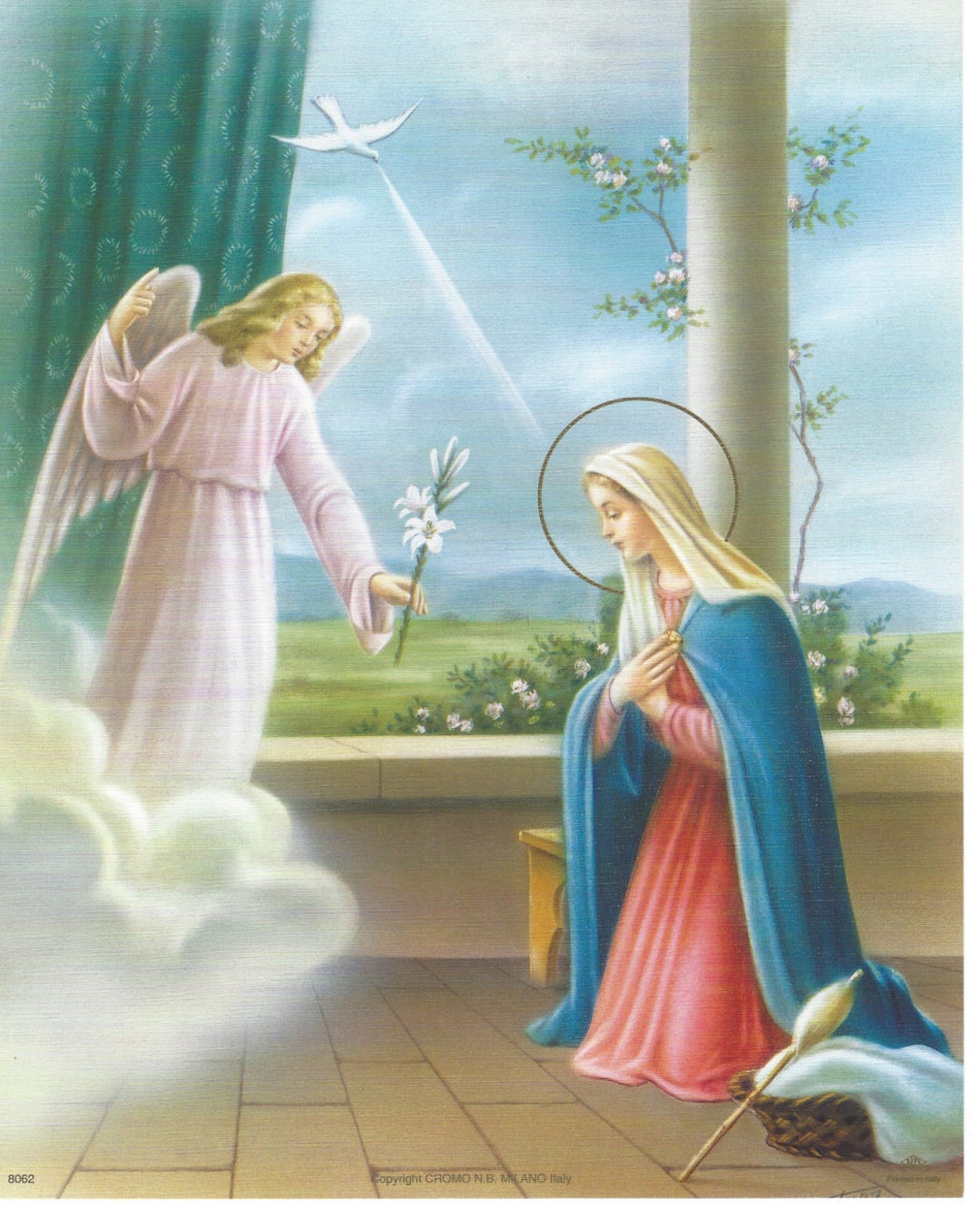
In the meantime, since tradition is second only to Scripture in the Wesleyan Quadrilateral, here’s a traditional view of how Mary reacted to Gabriel’s message.
* * * *
* * * *
The upper image is courtesy of Rossetti Annunciation – Image Results. See also The Annunciation by Dante Gabriel Rossetti – my daily art display:
Take a while and look at Mary’s expression. How do you read Rossetti’s depiction of this young woman? Look at her facial expression. This is not one of acquiescence or pleasure. This is a look almost of horror at what she has just been told. This terrified look adds a great deal of power to Rossetti’s painting. Mary herself … looks much younger than we are used to seeing in similar scenes. She exudes a youthful beauty but only seems to be a mere adolescent with her long un-brushed auburn hair contrasting sharply with her white dress. She is painfully thin and her hesitance and sad look tinged with fear endears her to us.
The Book of Common Prayer reference: The “corporate-mystical” prayer is on page 339, the post-communion prayer for Holy Eucharist, Rite I.
Feast days are designated days on the liturgical (church) calendar “set aside to commemorate events, saints, or doctrines that are important in the life of the Church. These can range from Solemnities, which are the highest-ranking feast days like Easter and Christmas, to optional memorials that celebrate lesser-known saints.” Feast Days: Celebrating the Church’s Calendar. See also Wikipedia’s Calendar of saints. “The calendar of saints is the traditional Christian method of organizing a liturgical year by associating each day with one or more saints and referring to the day as the feast day or feast of said saint. The word ‘feast’ in this context does not mean ‘a large meal, typically a celebratory one,’ but instead ‘an annual religious celebration, a day dedicated to a particular saint.'”
For this post I borrowed from 2015’s The Annunciation “gets the ball rolling,” On the Annunciation (2022) – and Mary “shrinking back,” and On the Annunciation and the end of Lent – 2023.
On when was Jesus born, see Christianity, Christmas, Calendar, When Was Jesus Born? Here’s What The Evidence Says, or When Was Jesus Christ Born? – CBCG.
The Wesleyan Quadrilateral is the method of theological reflection credited to John Wesley. It uses four sources as the basis of theological and doctrinal development, Scripture, tradition, reason, and Christian experience. (Wikipedia.)
Re: Isaac Asimov. The quotes about the dating of Christmas and the “olden days” are from Asimov’s Guide to the Bible (Two Volumes in One), Avenel Books (1981), at pages 930-34.
And as an aside, Asimov (1920-1992) was an author and professor of biochemistry at Boston University, best known for his works of science fiction and for his popular science books. He was one of the most prolific writers of all time, having written or edited more than 500 books and an estimated 90,000 letters and postcards.” His list of books included those on “astronomy, mathematics, the Bible, William Shakespeare’s writing, and chemistry.” He was a long-time member of Mensa, “albeit reluctantly; he described some members of that organization as ‘brain-proud and aggressive about their IQs.’” See Isaac Asimov – Wikipedia.
Re: “What Garry Wills said.” See What Jesus Meant: Wills, the 2007 book, an “illuminating analysis for believers and nonbelievers alike … a brilliant addition to our national conversation on religion.” (Said Goodreads.) The quote is from page 1 of my Penguin Books edition, “The Hidden Years.” Also, the Wikipedia article notes that up until 2024 he prayed the rosary every day and wrote a book about it.” He now calls himself an “Augustinian Christian.” As for public appraisal:
The New York Times literary critic John Leonard said in 1970 that Wills “reads like a combination of H. L. Mencken, John Locke and Albert Camus.” The Catholic journalist John L. Allen Jr. considers Wills to be “perhaps the most distinguished Catholic intellectual in America over the last 50 years” (as of 2008). Martin Gardner in “The Strange Case of Garry Wills” states there is a “mystery and strangeness that hovers like a gray fog over everything Wills has written about his faith.”
Re: Luke 2:35. The “sword will run through this woman’s heart” quote came from the translation Wills used. Most other “Bible Hub” translations say the sword will pierce Mary’s “own soul;” that includes the King James Bible. (The one God uses.) As to feeling alarmed, agitated or perplexed at world events, see 1st Corinthians 10:13, “The temptations in your life are no different from what others experience. And God is faithful. He will not allow the temptation to be more than you can stand. When you are tempted, he will show you a way out so that you can endure.” (Well, almost “no different from what others experience.” Mary was after all in a class by herself.)
The lower image is courtesy of Annunciation Mary Image – Image Results.
* * * *