* * * *
* * * *
April 4, 2026 – It’s that time of year again, after 46 days of Lent. (40 days mirroring the ones Jesus spent in the Wilderness, plus six Sundays “off,” as detailed in the Notes.)
Meaning it’s time to celebrate another Happy Easter Sunday. That is, the “festival and holiday celebrating the resurrection of Jesus from the dead, described in the New Testament as having occurred on the third day of his burial after his crucifixion.”
But note first that before Jesus rose from the tomb he had to go through the Harrowing of Hell; between His Crucifixion and resurrection. “In triumphant descent, Christ brought salvation to the souls held captive there since the beginning of the world.” Which leads to a note: A harrow can be an “agricultural implement with spikelike teeth or upright disks, drawn chiefly over plowed land to level it, break up clods, root up weeds, etc.” But to harrow can also refer to causing “worry and upset, the way a truly scary movie might harrow you, making it hard to sleep:”
Harrow is an uncommon verb that was originally used in a religious context. You’re much more likely to hear the adjective harrowing used for things that are extremely distressing. But if your cat torments you nightly with her incessant meowing, you might try yelling, “Why do you harrow me?”
Which means that in this case too Jesus acted as “pioneer and perfecter of our faith.” (Hebrews 12:2.) And stands ready to help us through any harrowing we might be experiencing today.
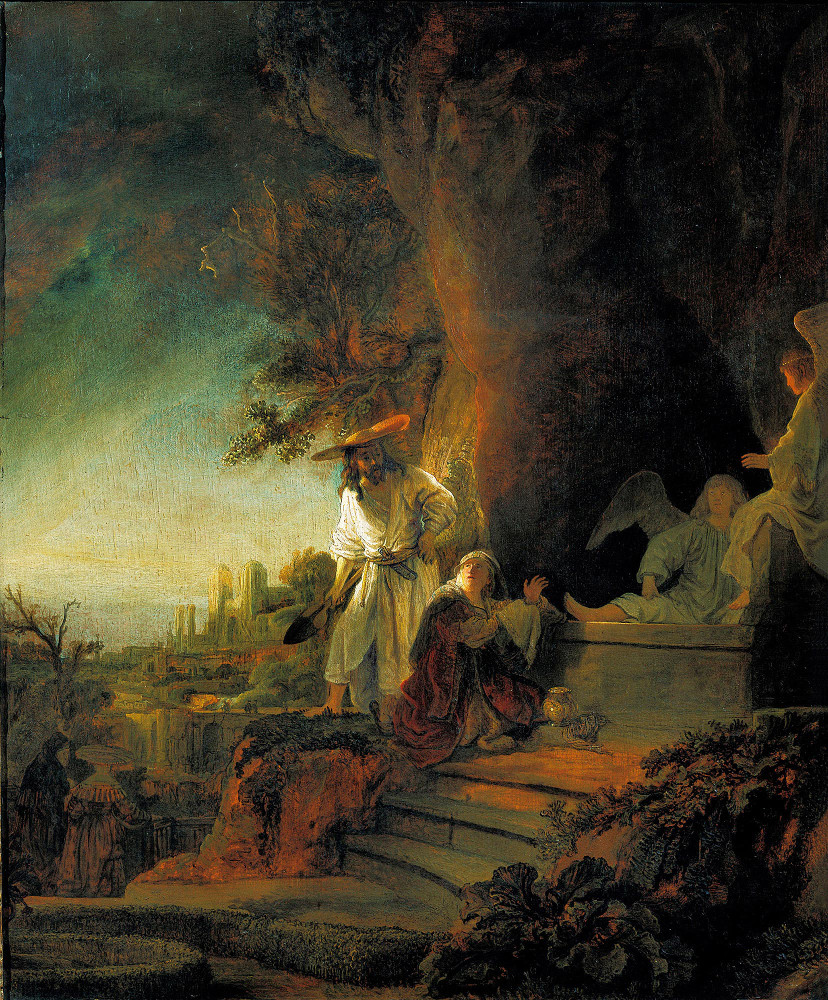
But back to the reason for the season, the Resurrection. As told in John 20:1, “Early on the first day of the week, while it was still dark, Mary Magdalene went to the tomb and saw that the stone had been removed from the entrance.” So this Mary was both the first person to see the empty tomb of Jesus, and one of the first – if not the first – to see the risen Jesus.
She then went to tell Peter and the “disciple whom Jesus loved.” They both got there, looked inside and saw the burial clothes lying there. (And no body.) Then they “went back to where they were staying.” But Mary – faithful Mary, who ended up with such a terrible reputation – stayed there. (As noted in the Gospel for her feast day, John 20:11-18.) She saw two angels, who asked why she was crying. Then she turned to see another man she took to be a caretaker:
Supposing him to be the gardener, she said to him, “Sir, if you have carried him away, tell me where you have laid him, and I will take him away.” Jesus said to her, “Mary!” She turned and said to him in Hebrew, “Rabbouni!” (which means Teacher). Jesus said to her, “Do not hold on to me, because I have not yet ascended to the Father. But go to my brothers and say to them, `I am ascending to my Father and your Father, to my God and your God.’” Mary Magdalene went and announced to the disciples, “I have seen the Lord;” and she told them that he had said these things to her.
Which is why this Mary – from Magdala – is rightly called the “Apostle to the Apostles.”
* * * *
There’s more on Easter later – including the Easter bunny – but last Tuesday, March 31, I came across Proverbs 9:8. (For reasons detailed in the Notes.) And for the first time I can remember, this passage gave me a jolt. (Despite the fact that I started the Daily Office in 1992, which means I am now on my 16th trip through the Bible.) But to get to the point, the Amplified Bible translation of Proverbs 9:8 reads like this, “Do not correct a scoffer [who foolishly ridicules and takes no responsibility for his error] or he will hate you; Correct a wise man [who learns from his error], and he will love you.” Which took a load off my mind.
For the past few years I’ve been consumed by the demands of Ezekiel 3:16-27, better known as Ezekiel’s Task as Watchman. “Zeke” wrote about a Believer’s duty to warn others of the error of their ways. Briefly, if you don’t warn a fellow citizen of the error of his ways, and he keeps sinning, God will punish both of you. But if you warn him and he keeps on sinning you will at least have saved your own spiritual butt: “They will die for their sin; but you will have saved yourself.” Which seemed to mean I was duty-bound to somehow convince people who don’t want to be convinced that they may have been wrong in – say for example – voting in a certain person.
So, if Proverbs 9:8 outranks Ezekiel 3:16-27, that means I don’t have worry about wasting a lot of time and effort Talking to a Brick Wall. (An idiom “Commonly used in conflicts or disputes where dialogue seems pointless.”) And what a relief that would be. Which goes to show why it pays to read and study the Bible. (Or to check this Blog from time to time.)
* * * *
Meanwhile, “What’s all this about the Easter Bunny?”
For starters, the name Easter came from a pagan figure called Eastre (or Ēostre), “celebrated as the goddess of spring by the Saxons of Northern Europe. Her earthly symbol was the rabbit, known as a symbol of fertility.” And that’s how we got the Easter Bunny and Easter egg hunts. That tradition – first noted around 1682 – was based on folklore that had already been around awhile, and as practiced by German Lutherans. In turn, the Easter Bunny – or more precisely, the Easter Hare – “played the role of a judge,” evaluating whether children were good or bad, especially in the days leading up to “the start of the season of Eastertide.”
In legend, the creature carries colored eggs in his basket, candy, and sometimes also toys to the homes of children, and as such shows similarities to Santa Claus or the Christkind, as they both bring gifts to children on the night before their respective holidays.
One author noted that the “hare was the sacred beast of Eastre (or Eostre).” In turn, “Ēostre is attested solely by Bede in his 8th-century work The Reckoning of Time.” There Bede stated that during Ēosturmōnaþ (“Easter-month,” or the month of April), pagan Anglo-Saxons had held feasts in Ēostre’s honor, but that this tradition was eventually “replaced by the Christian Paschal month, a celebration of the resurrection of Jesus.” (Another case of subsumation?)
And finally, a heads up. Next Sunday – aside from having a multitude of other names – is also known as “Quasimodo Sunday,” for reasons to be explained next week. Stay tuned…
* * * *

* * * *
The upper image is courtesy of File: Rembrandt – The Risen Christ Appearing to Mary Magdalen. See also On Easter Season – AND BEYOND, and Easter – Wikipedia.
The Book of Common Prayer reference: The “corporate-mystical” prayer is on page 339, the post-communion prayer for Holy Eucharist, Rite I.
Feast days are designated days on the liturgical (church) calendar “set aside to commemorate events, saints, or doctrines that are important in the life of the Church. These can range from Solemnities, which are the highest-ranking feast days like Easter and Christmas, to optional memorials that celebrate lesser-known saints.” Feast Days … the Church’s Calendar. See also Wikipedia’s Calendar of saints. “The calendar of saints is the traditional Christian method of organizing a liturgical year by associating each day with one or more saints and referring to the day as the feast day or feast of said saint. The word ‘feast’ in this context does not mean ‘a large meal, typically a celebratory one,’ but instead ‘an annual religious celebration, a day dedicated to a particular saint.’”
For this post I reviewed 2015’s On Mary Magdalene, “Apostle to the Apostles,” 2017’s Frohliche Ostern – “Happy Easter!,” 2019’s On Easter, Doubting Thomas Sunday – and a Metaphor, “Happy Quasimodo Sunday” – 2022, and 2025’s ” If anyone serves Me, the Father will honor him” – Easter ’25.
Re: Mary Magdalene at the Tomb. The account in John 20:1-18 has Mary going there alone. The account in Mark 16 has Mary going with two other women: “Mary Magdalene, Mary the mother of James, and Salome bought spices so that they might go to anoint Jesus’ body.”
On coming across Proverbs 9:8 “last Tuesday.” Proverbs 9:1-12 is the Old Testament reading for Sunday in the week of 8 Epiphany. But as noted in The Lectionary – Satucket, the readings for Epiphany end at the Fifth Sunday after the Epiphany. Meaning the readings for the Sixth through Eighth weeks after the Epiphany got skipped this year. But I don’t like to skip those readings, so I go back over them after I start doing the readings for Lent, beginning on February 22. (I don’t like to leave that gap.) And that’s how I came across Proverbs 9:8 last Tuesday, March 31
For more on “Ezekiel’s task,” see On Peter, Paul, and the Bible’s “Dynamic Tension” – 2025.
Re: Days off during Lent. See 40 Days and 40 Nights [film] – Wikipedia, the 2002 film about “a San Francisco web designer who has chosen to abstain from any sexual contact for the duration of Lent.” See Why Sundays Don’t Count During Lent | Guideposts. Apparently the Hollywood writers didn’t do their Biblical homework.
Re: “Another case of subsumation.” A wide-spread theory says that early Church Fathers subsumed Saturnalia by celebrating Christmas on December 25, but others dispute the claim. See for example Did Christmas Come From Saturnalia Historical Analysis.
The lower image is courtesy of Easter – Wikipedia
* * * *