* * * *
* * * *
Welcome to “read the Bible – expand your mind:”
The Book of Common Prayer says that by taking part in Holy Communion, Christians become “very members incorporate in the mystical body” of Jesus. The words “corporate” and “mystical” are key. They show that a healthy church has two sides, with the often-overlooked “mystic” side asking the question, “How do I experience God?” This blog tries to answer that.
It has four main themes. The first is that God will accept anyone. (John 6:37.) The second is that God wants us to live lives of abundance.(John 10:10.) The third is that Jesus wants us to read the Bible with an open mind. (As Luke 24:45 says: “Then He [Jesus] opened their minds so they could understand the Scriptures.”) The fourth theme – another one often overlooked – is that Jesus wants us to do even greater miracles than He did. (John 14:12.)
And this thought ties them together:
The best way to live abundantly and do greater miracles than Jesus is: Read, study and apply the Bible with an open mind. For more see the notes or – to expand your mind – see the Intro.
In the meantime:
April 25, 2026 – Today is the Feast Day for Saint Mark, who wrote the first and shortest of the four Gospels. “In Christian tradition, Mark the Evangelist, the author of the second gospel is symbolized by a lion – a figure of courage and monarchy.” (Wikipedia.) But that “second Gospel” doesn’t mean his wasn’t the first account of the life of Jesus. As Isaac Asimov noted:
Matthew is [listed as the] first of the gospels in the New Testament because, according to early tradition, it was the first to be written. This, however, is now doubted by nearly everyone. The honor of primacy is generally granted to Mark, which is the second gospel in the Bible as it stands.
The writer of this first-in-time Gospel is generally identified as the same John Mark who “carried water to the house where the Last Supper took place” in Mark 14:13, or the “young man who ran away naked when Jesus was arrested” in Mark 14:51. See also Acts 12:25: “Barnabas and Saul returned from Jerusalem when they had completed their service, bringing with them John, whose other name was Mark.“ Now about the lion being his symbol.
The lion is traditionally “a figure of courage and monarchy.” See also Lion of Saint Mark, which said the symbolism began with Revelation 4:7, “The first living creature was like a lion, the second was like an ox, the third had a face like a man, the fourth was like a flying eagle.” The lion also symbolizes “the power of the Evangelist’s word, the wings symbolize the spiritual elevation, while the halo is the traditional Christian symbol of holiness.” And so to summarize:
In Christianity, the four living creatures are Cherubim. A prominent early interpretation has been to equate the four creatures as a tetramorph of the Four Evangelists where the lion represents Mark the Evangelist, the calf [or “ox”] is Luke the Evangelist, the man is Matthew the Apostle, and the eagle symbolizes John the Evangelist. This interpretation originated with Irenaeus and was adopted by Victorinus. Its influence has been on art and sculpture and is still prevalent in Catholicism and Anglicanism.
Then there’s that question of “the honor of primacy.” If Mark wrote the first Gospel, why is his listed after Matthew? It’s a story of being “disrespected,” but eventually recognized for his singular contribution. (Thanks to Bible scholars who became open-minded enough to “dig deeper.”) In other words, Mark presents a “Cinderella story,” of success after a lowly beginning.
One reason for his being dissed early on could have been that his was the shortest Gospel. Another reason might be his Koine Greek, not at all elegant. (What Garry Wills called a marketplace or pidgin Greek, a “simplified means of linguistic communication … constructed impromptu, or by convention, between individuals or groups of people.”)
In other words, his written Greek was “short and clumsy.” For this reason and others St. Augustine for one called Mark “the drudge and condenser” of Matthew. And since his Greek was “clumsier and more awkward” – clumsier than the more-polished writing of Matthew, Luke and John – his was the “least cited Gospel” in the early Christian period.
But “this Cinderella finally got the glass slipper,” even though Mark had to wait until the 19th century to get his. (Metaphorically or otherwise.) That’s when scholars finally noticed that the other three Gospels all cited material from Mark, but “he does not do the same for them.” Their conclusion? He started the process and set the pattern of and for the other three Gospels. Since that time Mark’s Gospel “has become the most studied and influential.”
Another note: It seems that Mark wrote his Gospel at a time of great suffering in the early church. As Asimov noted, Mark’s Gospel was designed “to circulate among Christians the story of the sufferings of Jesus and his steadfastness under affliction. Perhaps this was in order to encourage Christians at a time when they, generally, were undergoing persecution.”
In turn, and as I wrote in 2020, that earthly suffering may well have been mirrored in the unforeseen and largely inexplicable “end times” of the 2020 coronavirus pandemic. And if nothing else, that Covid-19 (or the 2020 extension) reminded us of our “fragility as human beings.” Which brings us to The Plague by Camus, and a quote from Part 1, early in the book:
Everybody knows that pestilences have a way of recurring in the world; yet somehow we find it hard to believe in ones that crash down on our heads from a blue sky. There have been as many plagues as wars in history; yet always plagues and wars take people equally by surprise.
Which certainly seems true of whatever latest pestilence we may be going through. (“Let the reader understand,” from Mark 13:14.) Which brings up a Salt Lake Tribune review of “The Plague” (the Camus novel) with this point: “Being alive always was and will always remain an emergency; it is truly an inescapable ‘underlying condition.'” But there could be a silver lining: The “absurdity” of life – with all its despair at times – could lead to a “tragicomic redemption, a softening of the heart, a turning away from judgment and moralizing to joy and gratitude.”
Which brings us to the old saying noted in the Peanuts cartoon below, reminding us that in “bad times or hopelessness, it is more worthwhile to do some good, however small, in response than to complain about the situation.” See also Better to light a single candle.
Put another way, April 25 celebrates the man the other three Gospel-writers followed and borrowed so freely from. The man whose work – for 18 long centuries – was largely disregarded and disrespected. The man who finally – after 1,800 years – got the recognition he deserved.
I think there’s an object lesson there…
* * * *

* * * *
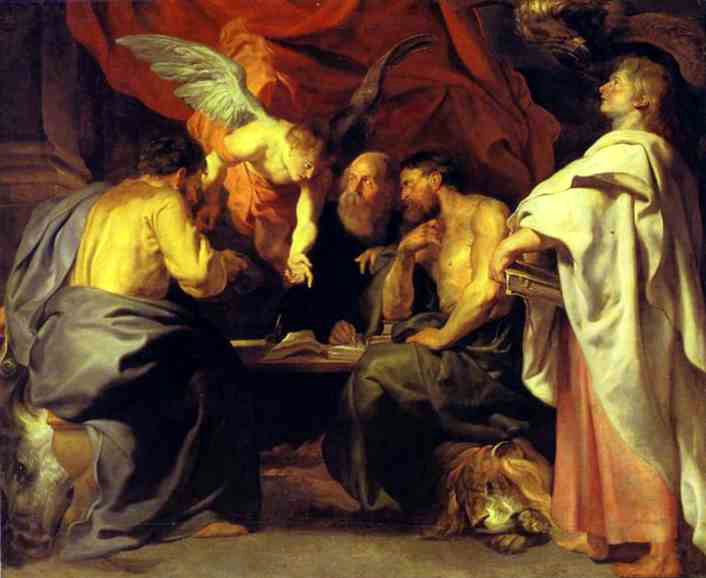
The upper image is courtesy of Peter Paul Rubens: The Four Evangelists: “Rubens portrayed the four evangelists while working together on their texts. An angel helps them… Each gospel author can be identified by an attribute. The attributes were derived from the opening verses of the gospels. From left to right: Luke (bull), Matthew (man [angel]), Mark (lion), and John (eagle).” See also Four Evangelists – Wikipedia.
The Book of Common Prayer reference: The “corporate-mystical” prayer is on page 339, the post-communion prayer for Holy Eucharist, Rite I.
Feast days are designated days on the liturgical (church) calendar “set aside to commemorate events, saints, or doctrines that are important in the life of the Church. These can range from Solemnities, which are the highest-ranking feast days like Easter and Christmas, to optional memorials that celebrate lesser-known saints.” Feast Days … the Church’s Calendar. See also Wikipedia’s Calendar of saints. “The calendar of saints is the traditional Christian method of organizing a liturgical year by associating each day with one or more saints and referring to the day as the feast day or feast of said saint. The word ‘feast’ in this context does not mean ‘a large meal, typically a celebratory one,’ but instead ‘an annual religious celebration, a day dedicated to a particular saint.’”
For this post I reviewed 2015’s On St. Mark’s “Cinderella story,” 2016’s More on “arguing with God” – and St. Mark as Cinderella, and later from On St. Mark, 2020 – and today’s “plague” – the Plague being the height of the COVID-19 pandemic in the U.S. – and On St. Mark – 2024.
The Garry Wills reference to Koine Greek is from What Jesus Meant: Wills, the 2007 book offering an “illuminating analysis for believers and nonbelievers alike.” (Said Goodreads.) The quote is from pages xi-xiii of my Penguin Books edition. See also Pidgin – Wikipedia.
Re: Isaac Asimov. The quotes cited above are from Asimov’s Guide to the Bible (Two Volumes in One), Avenel Books (1981), at pages 770 and 902.
From the link Why does Mark say, “Let the reader understand” in Mark 13:14:
The comment to “let the reader understand” in Mark 13:14 could be taken different ways, depending on whose comment it is. It could be a parenthetical comment, inserted by Mark, to signal his readers that Jesus’ prophecy requires discernment and careful consideration. Alternatively, the comment to “let the reader understand” could be part of Jesus’ own words… Either way, the call to “understand” highlights the need for spiritual discernment and preparedness
The “stupid darkness” cartoon is courtesy of You Stupid Darkness! | Kurtis Scaletta’s Site, which links to comics.com/peanuts, “one of the most amazing but little-known Internet resources.” See also lightasinglecandle … com, and The 5 Greatest (newspaper) Comic Strips Of All Time.
* * * *
As noted in the opening blurb, this blog has four main themes. The first is that God will accept anyone. (See John 6:37, with the added, “Anyone who comes to Him.”) This is a consistent theme throughout the Bible. From the Old Testament, Psalm 9:10, “You never forsake those who seek you, O Lord.” (In the Book of Common Prayer version.) The second is that God wants us to live abundantly. (John 10:10.) The third is that we should do greater miracles than Jesus. (John 14:12). A fourth theme: The only way to do all that is read the Bible with an open mind:
…closed-mindedness, or an unwillingness to consider new ideas, can result from the brain’s natural dislike for ambiguity. According to this view, the brain has a “search and destroy” relationship with ambiguity and evidence contradictory to people’s current beliefs tends to make them uncomfortable… Research confirms that belief-discrepant-closed-minded persons have less tolerance for cognitive inconsistency…
So in plain words, I take issue with what I call “Christian first graders.” Those who choose to stay in a kind of elementary-school first grade. See John the Baptist, ’24 – and “Christian First Graders,” for more. But the key point: “The Bible was designed to expand your mind,” not make it narrow. Also, there’s the idea that “Jesus was anything but negative. His goal was for you to grow and develop into all that you can be.” (For more on that see ABOUT THE BLOG, above.)
I’ve written on boot-camp Christians, the Literalists who never go “beyond the fundamentals.” But the Bible offers so much more than a narrow reading gives… (Unless you want to stay a buck private all your life…) Now, about “Boot-camp Christians” see Conservative Christian – “Career buck private?” The gist of that post: Starting the Bible is like Army Basic Training. You begin by“learning the fundamentals.” But after boot camp, you move on to Advanced Individual Training.”

And as noted in “Buck private,” one of this blog’s themes is that if you want to be all that you can be, you need to go on and explore the “mystical side of Bible reading.*” In other words, exploring the mystical side of the Bible helps you “be all that you can be.” See Slogans of the U.S. Army – Wikipedia, re: the recruiting slogan from 1980 to 2001. The related image at left is courtesy of: “toywonders.com/productcart/pc/catalog/aw30.jpg.”
Re: “mystical.” Originally the “liturgical, spiritual, and contemplative dimensions of early and medieval Christianity.” Mysticism – Wikipedia, and the post On originalism. (“What the Bible was originally about!”) See also Christian mysticism – Wikipedia, “In early Christianity the term ‘mystikos’ referred to three dimensions, which soon became intertwined, namely the biblical, the liturgical and the spiritual or contemplative… The third dimension is the contemplative or experiential knowledge of God.” As to that “experiential” aspect, see also Wesleyan Quadrilateral – Wikipedia, on the theological reflection method using four sources of spiritual development: scripture, tradition, reason, and “Christian experience.”
For an explanation of the Daily Office – where “Dorscribe” came from – see What’s a DOR?
* * * *