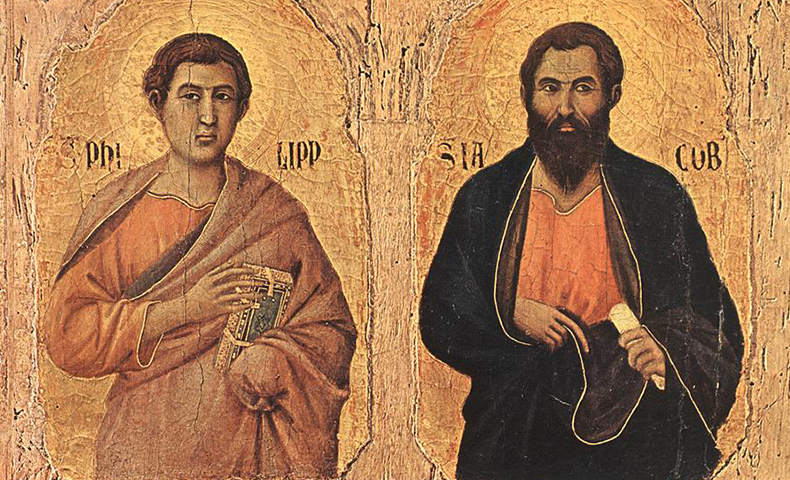
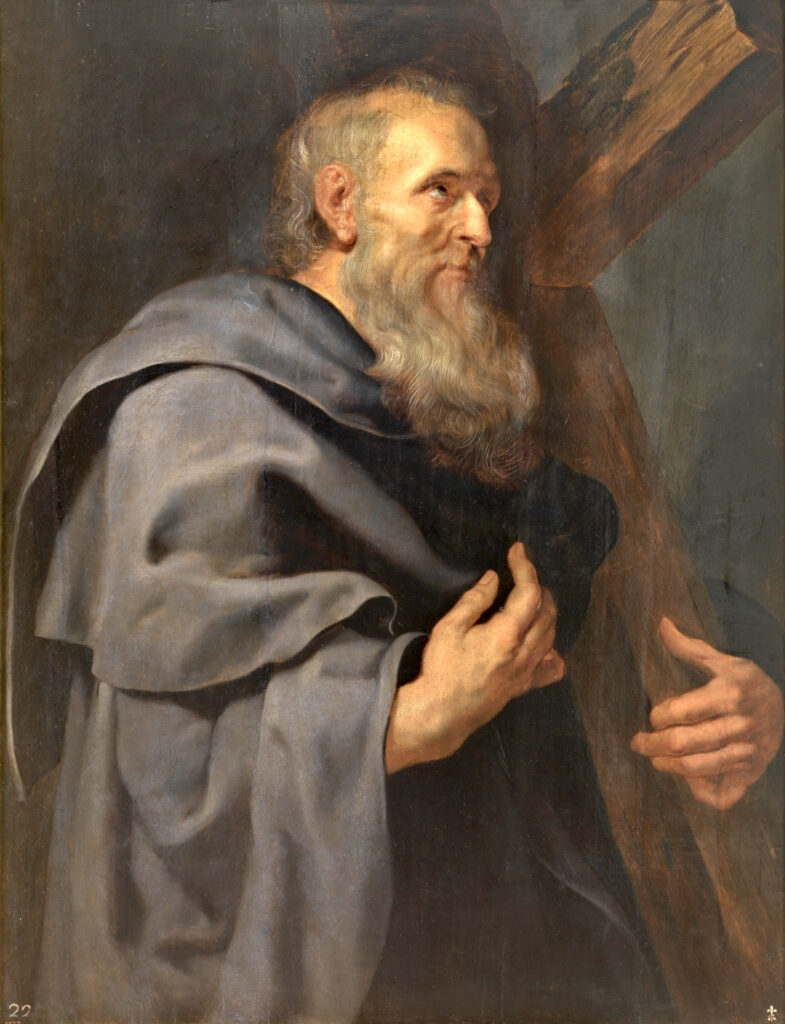
April 30, 2026 – Friday, May 1, is the Feast Day for St. Philip and St. James. (The link is to the 2020 meditation on these two, with a note: “we are now in the eighth full week of the COVID-19 pandemic. And since wisdom begins with the definition of terms – said Socrates – I’ll clarify. To me, the pandemic hit full swing – the “stuff really hit the fan” – back on Thursday, March 12.”
But we digress. We have other fish to fry these days. So, back to Saints Philip and James. One problem is, we’re not sure who they are. “James” was a popular and widespread name in Jesus’ time. It was associated with Jacob, who became “Israel” by wresting with the angel in Genesis 32:24-32. The English name “James” is a variant of “Jacob,” or in Hebrew, “Ya’akov.” And the New Testament lists at least three “James” who could fit the bill, and possibly as many as eight.
Our best guess is that the James remembered on May 1 is James the Lesser, also called James the Son of Alphaeus. (Not to be confused with James the Greater, called “James the Elder.”) This lesser James “appears only four times in the New Testament, each time in a list of the twelve apostles.” But he gets his own feast day, as does St. Philip.
The best guess here is that thisPhilip is Philip the Apostle, but there was also a Philip the Deacon: “One of the seven men chosen by the Apostles to perform certain administrative tasks for the poor in the early Christian community at Jerusalem (Acts 6:5-7). Because of his zeal in preaching the gospel he became known as Philip the Evangelist (Acts 21:8).”
But again, our best guess is that the Philip remembered on May 1 is Philip the Apostle. Wikipedia said this Philip was a disciple from Bethsaida, and that Andrew and Peter were from the same town. Jesus tested him in John 6:6, and later he and Andrew told Jesus about some Greeks who wanted to see Him in John 12:20-22. And as noted, Wikipedia distinguished this Philip from “Philip the Deacon.” See Philip the Evangelist – Wikipedia: “He preached and performed miracles in Samaria, and met and baptised [sic] an Ethiopian man, a eunuch, on the road from Jerusalem to Gaza, traditionally marking the start of the Ethiopian Church (Acts 8:26–39).” (Confused? In past posts I’ve been confused as well.)
As to why these two saints are celebrated together:
The two apostles Philip and James the Lesser are remembered with a single liturgical feast because their relics, transferred respectively from Hierapolis and Jerusalem, were placed together in the Basilica of the Twelve Holy Apostles [“Santi Apostoli“] in Rome.
Another note on this Philip. He was a link to the Greek community. He had a Greek name, could speak Greek, probably knew the Greek pilgrims in Jerusalem, as shown by is advising Andrew “that certain Greeks wish to meet Jesus.” (John 12:21.) Also, during the Last Supper, “when Philip asked Jesus to show them the Father, he provides Jesus the opportunity to teach his disciples about the unity of the Father and the Son.” (And we could use some of that unity today.)
The Book of Common Prayer reference: The “corporate-mystical” prayer is on page 339, the post-communion prayer for Holy Eucharist, Rite I.
Feast days are designated days on the liturgical (church) calendar “set aside to commemorate events, saints, or doctrines that are important in the life of the Church. These can range from Solemnities, which are the highest-ranking feast days like Easter and Christmas, to optional memorials that celebrate lesser-known saints.” Feast Days … the Church’s Calendar. See alsoWikipedia’s Calendar of saints. “The calendar of saints is the traditional Christian method of organizing a liturgical year by associating each day with one or more saints and referring to the day as the feast day or feast of said saint. The word ‘feast’ in this context does not mean ‘a large meal, typically a celebratory one,’ but instead ‘an annual religious celebration, a day dedicated to a particular saint.’”
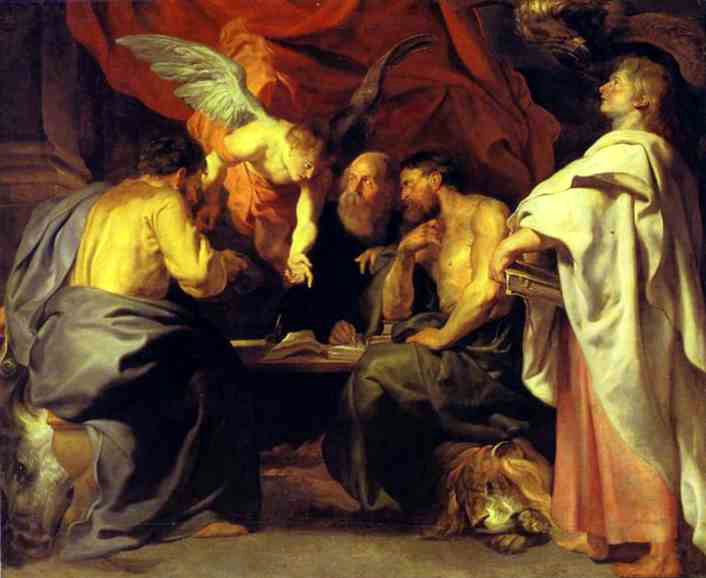
St. Mark, second from the right. (His symbol – a lion – sleeps in the right foreground…)
* * * *
Welcome to “read the Bible – expand your mind:”
The Book of Common Prayer says that by taking part in Holy Communion, Christians become “very members incorporate in the mystical body” of Jesus. The words “corporate” and “mystical” are key. They show that a healthy church has two sides, with the often-overlooked “mystic” side asking the question, “How do I experience God?” This blog tries to answer that.
It has four main themes. The first is that God will accept anyone. (John 6:37.) The second is that God wants us to live lives of abundance.(John 10:10.) The third is that Jesus wants us to read the Bible with an open mind. (As Luke 24:45 says: “Then He [Jesus] opened their minds so they could understand the Scriptures.”) The fourth theme – another one often overlooked – is that Jesus wants us to do even greater miracles than He did. (John 14:12.)
And this thought ties them together:
The best way to live abundantlyanddo greater miracles than Jesus is: Read, study and apply the Bible with an open mind. For more see the notes or – to expand your mind – see the Intro.
In the meantime:
April 25, 2026 – Today is the Feast Day for Saint Mark, who wrote the first and shortest of the four Gospels. “In Christian tradition, Mark the Evangelist, the author of the second gospel is symbolized by a lion – a figure of courage and monarchy.” (Wikipedia.) But that “second Gospel” doesn’t mean his wasn’t the first account of the life of Jesus. As Isaac Asimov noted:
Matthew is [listed as the] first of the gospels in the New Testament because, according to early tradition, it was the first to be written. This, however, is now doubted by nearly everyone. The honor of primacy is generally granted to Mark, which is the second gospel in the Bible as it stands.
The writer of this first-in-time Gospel is generally identified as the same John Mark who “carried water to the house where the Last Supper took place” in Mark 14:13, or the “young man who ran away naked when Jesus was arrested” in Mark 14:51. See also Acts 12:25: “Barnabas and Saul returned from Jerusalem when they had completed their service, bringing with them John, whose other name was Mark.“ Now about the lion being his symbol.
The lion is traditionally “a figure of courage and monarchy.” See also Lion of Saint Mark, which said the symbolism began with Revelation 4:7, “The first living creature was like a lion, the second was like an ox, the third had a face like a man, the fourth was like a flying eagle.” The lion also symbolizes “the power of the Evangelist’s word, the wings symbolize the spiritual elevation, while the halo is the traditional Christian symbol of holiness.” And so to summarize:
Then there’s that question of “the honor of primacy.” If Mark wrote the firstGospel, why is his listed after Matthew? It’s a story of being “disrespected,” but eventually recognized for his singular contribution. (Thanks to Bible scholars who became open-minded enough to “dig deeper.”) In other words, Mark presents a “Cinderella story,” of success after a lowly beginning.
One reason for his being dissed early on could have been that his was the shortest Gospel. Another reason might be his Koine Greek, not at all elegant. (What Garry Wills called a marketplace or pidgin Greek, a “simplified means of linguistic communication … constructed impromptu, or by convention, between individuals or groups of people.”)
In other words, his written Greek was “short and clumsy.” For this reason and others St. Augustine for one called Mark “the drudge and condenser” of Matthew. And since his Greek was “clumsier and more awkward” – clumsier than the more-polished writing of Matthew, Luke and John – his was the “least cited Gospel” in the early Christian period.
But “this Cinderella finally got the glass slipper,” even though Mark had to wait until the 19th century to get his. (Metaphorically or otherwise.) That’s when scholars finally noticed that the other three Gospels all cited material from Mark, but “he does not do the same for them.” Their conclusion? He started the process and set the pattern of and for the other three Gospels. Since that time Mark’s Gospel “has become the most studied and influential.”
Another note: It seems that Mark wrote his Gospel at a time of great suffering in the early church. As Asimov noted, Mark’s Gospel was designed “to circulate among Christians the story of the sufferings of Jesus and his steadfastness under affliction. Perhaps this was in order to encourage Christians at a time when they, generally, were undergoing persecution.”
In turn, and as I wrote in 2020, that earthly suffering may well have been mirrored in the unforeseen and largely inexplicable “end times” of the 2020 coronavirus pandemic. And if nothing else, that Covid-19 (or the 2020 extension) reminded us of our “fragility as human beings.” Which brings us to The Plague by Camus, and a quote from Part 1, early in the book:
Everybody knows that pestilences have a way of recurring in the world; yet somehow we find it hard to believe in ones that crash down on our heads from a blue sky. There have been as many plagues as wars in history; yet always plagues and wars take people equally by surprise.
Which certainly seems true of whatever latest pestilence we may be going through. (“Let the reader understand,” from Mark 13:14.) Which brings up a Salt Lake Tribune review of “The Plague” (the Camus novel) with this point: “Being alive always was and will always remain an emergency; it is truly an inescapable ‘underlying condition.'” But there could be a silver lining: The “absurdity” of life – with all its despair at times – could lead to a “tragicomic redemption, a softening of the heart, a turning away from judgment and moralizing to joy and gratitude.”
Which brings us to the old saying noted in the Peanuts cartoon below, reminding us that in “bad times or hopelessness, it is more worthwhile to do some good, however small, in response than to complain about the situation.” See also Better to light a single candle.
Put another way, April 25 celebrates the man the other three Gospel-writers followed and borrowed so freely from. The man whose work – for 18 long centuries – was largely disregarded and disrespected. The man who finally – after 1,800 years – got the recognition he deserved.
The upper image is courtesy of Peter Paul Rubens: The Four Evangelists: “Rubens portrayed the four evangelists while working together on their texts. An angel helps them… Each gospel author can be identified by an attribute. The attributes were derived from the opening verses of the gospels. From left to right: Luke (bull), Matthew (man [angel]), Mark (lion), and John (eagle).” See also Four Evangelists – Wikipedia.
The Book of Common Prayer reference: The “corporate-mystical” prayer is on page 339, the post-communion prayer for Holy Eucharist, Rite I.
Feast days are designated days on the liturgical (church) calendar “set aside to commemorate events, saints, or doctrines that are important in the life of the Church. These can range from Solemnities, which are the highest-ranking feast days like Easter and Christmas, to optional memorials that celebrate lesser-known saints.” Feast Days … the Church’s Calendar. See alsoWikipedia’s Calendar of saints. “The calendar of saints is the traditional Christian method of organizing a liturgical year by associating each day with one or more saints and referring to the day as the feast day or feast of said saint. The word ‘feast’ in this context does not mean ‘a large meal, typically a celebratory one,’ but instead ‘an annual religious celebration, a day dedicated to a particular saint.’”
TheGarry Wills reference to Koine Greek is from What Jesus Meant: Wills, the 2007 book offering an “illuminating analysis for believers and nonbelievers alike.” (Said Goodreads.) The quote is from pages xi-xiii of my Penguin Books edition. See also Pidgin – Wikipedia.
Re: Isaac Asimov.The quotes cited above are from Asimov’s Guide to the Bible (Two Volumes in One), Avenel Books (1981), at pages 770 and 902.
The comment to “let the reader understand” in Mark 13:14 could be taken different ways, depending on whose comment it is. It could be a parenthetical comment, inserted by Mark, to signal his readers that Jesus’ prophecy requires discernment and careful consideration. Alternatively, the comment to “let the reader understand” could be part of Jesus’ own words… Either way, the call to “understand” highlights the need for spiritual discernment and preparedness
As noted in the opening blurb, this blog has four main themes. The first is that God will accept anyone. (See John 6:37, with the added, “Anyone who comes to Him.”) This is a consistent theme throughout the Bible. From the Old Testament, Psalm 9:10, “You never forsake those who seek you, O Lord.” (In the Book of Common Prayer version.)The second is that God wants us to live abundantly. (John 10:10.) The third is that we should do greater miracles than Jesus. (John 14:12). A fourth theme: The only way to do all that is read the Bible with an open mind:
…closed-mindedness, or an unwillingness to consider new ideas, can result from the brain’s natural dislike for ambiguity. According to this view, the brain has a “search and destroy” relationship with ambiguity and evidence contradictory to people’s current beliefs tends to make them uncomfortable… Research confirms that belief-discrepant-closed-minded persons have less tolerance for cognitive inconsistency…
So in plain words, I take issue withwhat I call “Christian first graders.” Those who choose to stay in a kind of elementary-school first grade. See John the Baptist, ’24 – and “Christian First Graders,” for more. But the key point: “The Bible was designed to expand your mind,” not make it narrow.Also, there’s the idea that “Jesus was anything but negative. His goal was for you to grow and develop into all that you can be.” (For more on that see ABOUT THE BLOG, above.)
And as noted in “Buck private,” one of this blog’s themes is that if you want to be all that you can be, you need to go on and explore the “mystical side of Bible reading.*”In other words, exploring the mystical side of the Bible helps you “be all that you can be.” See Slogans of the U.S. Army – Wikipedia, re: the recruiting slogan from 1980 to 2001. The related image at left is courtesy of: “toywonders.com/productcart/pc/catalog/aw30.jpg.”
Re: “mystical.” Originally the “liturgical, spiritual,and contemplative dimensions of early and medieval Christianity.” Mysticism – Wikipedia, and the post On originalism. (“What the Bible was originally about!”)See also Christian mysticism – Wikipedia, “In early Christianity theterm ‘mystikos’ referred to three dimensions, which soonbecameintertwined, namely the biblical, the liturgical and the spiritual or contemplative… The third dimension is the contemplative or experiential knowledge of God.” As to that “experiential” aspect, see also Wesleyan Quadrilateral – Wikipedia, on the theological reflection method using four sources of spiritualdevelopment: scripture, tradition, reason, and “Christian experience.”
For an explanation of the Daily Office – where “Dorscribe” came from – see What’s a DOR?
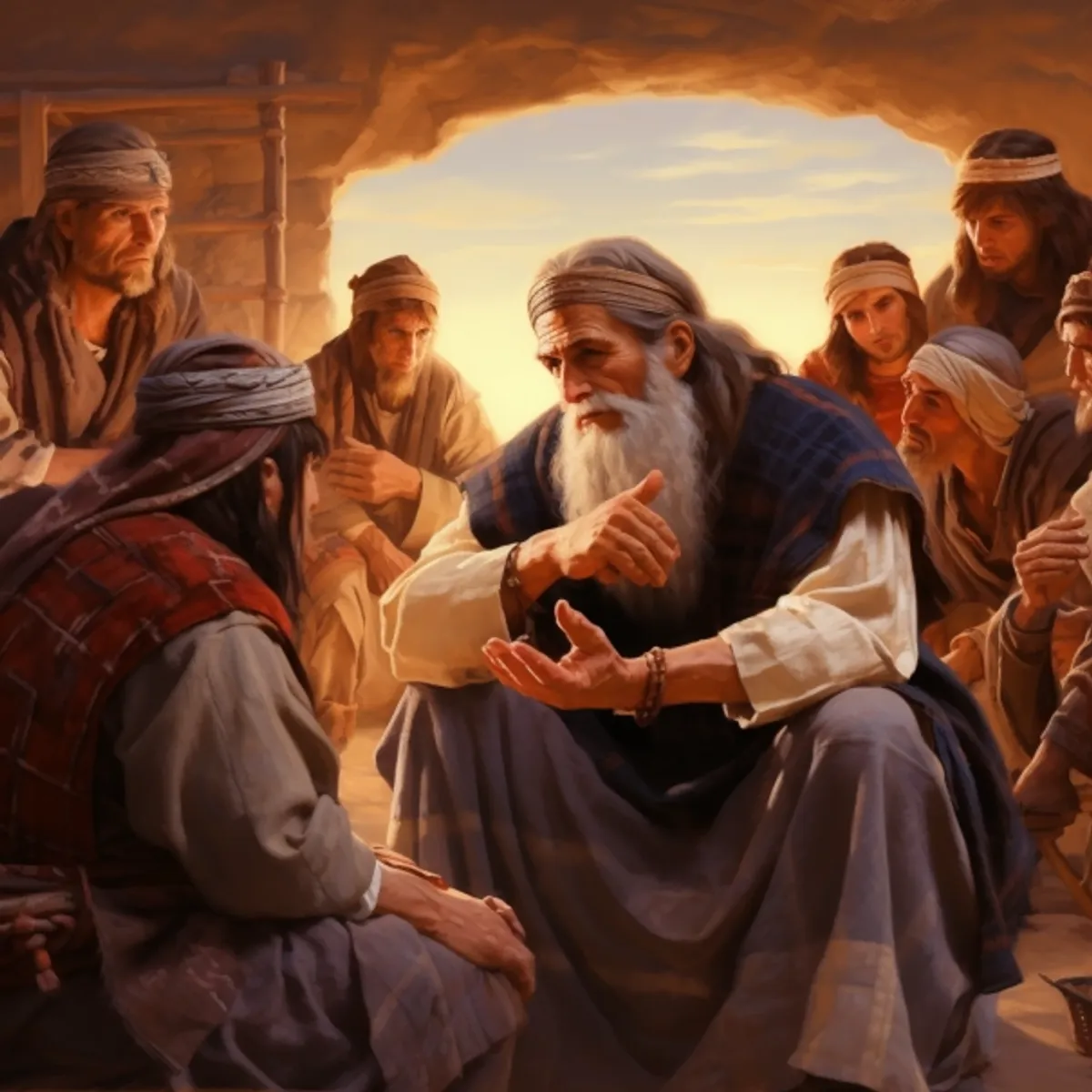
“Moses‘ father-in-law Jethro … advises him to appoint leaders to help him govern…”
* * * *
April 22, 2026 – And no, it wasn’tJethro Bodinefrom the TV show “Beverly Hillbillies” who invented the idea of a Supreme Court. And it wasn’tJethro Tull either. (The British rock band formed in Blackpool, Lancashire in 1967.) Instead, it was Jethro, the father-in-law of Moses, as detailed in the Daily Office readings for last Monday, April 20. But first, a note.
The last post told how this Blog‘s name came from the Daily Office Readings. (The set of readings by which you can read the whole Bible in two years, and the Psalms and Gospels three to four times.) But that post also noted that in recent years I’ve written mostly about Feast Days, those days set aside to remember people and things “important in the life of the Church.” Then came the part, “Until yesterday.” Meaning the DOR Old Testament reading for Saturday, April 18, was Exodus 17, about Moses at the Battle of Rephidim. Which meant for the first time in a long time I did a post about a Daily Office reading, instead of a Feast Day.
Anyway, Exodus 17 details how Moses became the first guy in history to say, “It’s only weird if it doesn’t work.” So again, I broke the pattern and wrote about a “DOR” for the first time in years. Then it happened again on Monday, April 20. The DOR OT reading was Exodus 18:13-27, and it talked about howJethro invent[ed] the supreme court. The link refers to a post I did back in May 2014, so figured it was time to revisit, and once again be a “DOR Scribe.”
But first a bit of background.
For starters, Moses had been a Prince of Egypt for the first 40 years of his life, before he killed the overseer who was beating an Israelite slave. Then he had to hightail it out of Egypt after: 1) learning that he was not a prince of Egypt, as he’d been led to believe all his life, 2) learning that he was actually a member of Hebrew people, who were then slaves in Egypt, and 3) after killing that Egyptian overlord. He ended up in Midian, somewhere in the deserts of the Sinai on the Arabian Peninsula. That’s where he met Jethro, a priest of Midian in his own right, and here Moses married Jethro’s daughter Zipporah.
But in the fullness of time Moses went back to Egypt after a ten-year exile. Then eventually – after persuasions including the Ten Plagues – he got the Pharaoh to “let my people go.” In Exodus 18, the Children of Israel are still wandering in wilderness before getting to The Promised Land. (After incidents of God providing water-from-the-rock at Massah and/or Meribah, and manna and quail to eat.) Then Moses – upon his return to the land of Midian – “told his father-in-law all that the Lord had done to Pharaoh and to the Egyptians for Israel’s sake, all the hardship that had beset them on the way, and how the Lord had delivered them.” In plain words, Jethro welcomed his son-in-law back to Midian with open arms.
Then, in last Monday’s reading, Jethro watched as Moses tried to settle all the disputes coming up as the Children of Israel were still wandering (near Midian, with tempers no doubt getting extremely short). And he could see that Moses was wearing himself out in the process. In today’s lingo, Moses was suffering burnout, referring to “someone who has become very physically and emotionally tired after doing a difficult job for a long time.” So, Jethro told Moses:
“What you are doing is not good. You will surely wear yourself out, both you and these people with you. For the task is too heavy for you; you cannot do it alone.”
He advised Moses to appoint officers – in effect, lower-court judges – to settle the easier cases after teaching them the basic tenets of the law. (The law that was even then evolving in the wilderness, either as conditions dictated or as Moses had the law revealed to him by God, or perhaps a combination of both.) The passage continues: “Let them sit as judges for the people at all times; let them bring every important case to you, but decide every minor case themselves. So it will be easier for you, and they will bear the burden with you:”
“So Moses listened to his father-in-law and . . . chose able men from all Israel and appointed them as heads over the people, as officers over thousands, hundreds, fifties, and tens. And they judged the people at all times; hard cases they brought to Moses, but any minor case they decided themselves.”
In other words, Jethro advised Moses on the idea of delegating authority. And that is the basic idea behind the Supreme Court of the United States, as set out in Article III, section 1 of the Constitution: “The judicial power of the United States, shall be vested in one Supreme Court, and in such inferior courts as the Congress may from time to time ordain and establish.”
In other words, the U.S. Supreme Court – like Moses – was designed to deal with “hard cases,” leaving minor cases for lower courts. Which brings up the question of judicial interpretation. How does our Supreme Court interpret the Constitution, and for that matter: “How do we as Christians interpret the Bible as we read it from day to day?”
Some think of the as Bible “frozen in time.” Others think of it as a living breathing document whose story continues “even to this day.” Put another way: Is the Bible “grand and eternal” because it provides us with an anchor in a sea of shifting values? Or is the Bible great because of its flexibility and ambiguity, which to some people attests to its ability to “grow and progress” along with society’s evolving sense of justice?
Put yet another way, does the Bible provide us with a set of “rock-ribbed rules” that must be followed every single day, on pain of suffering hellfire-and-damnation? Or does the Bible provide a set of general principles that provide guidance from the past, and which should be adapted to the challenges of the present? Or put simply, does the Bible inspire fear, or hope?
I asked those questions back in the original 2014 post but ended it with this: That’s a subject for future posts. So, this is a future post, and since 2014 I’ve added the “four main themes” paragraph above, which I suppose answers the question, at least partly. Then too I’ve re-discovered Romans 10:9, “if you confess with your mouth that Jesus is Lord and believe in your heart that God raised him from the dead, you will be saved.” No ifs, ands or buts. Case closed. And if I took 11 years to resolve that issue, “I’m not the only one slow to answer those hard questions!”
* * * *
Note the “may.” These issues seem to have been “hanging fire” for years…
* * * *
The upper image is courtesy of biblepics … Bible AI Chat and Inspiring Images. Captions: “Exodus 18 Jethro Visits Moses in the Wilderness.” Also, “Moses‘ father-in-law Jethro visits him and advises him to appoint leaders to help him govern the Israelites.” See alsoJethro (biblical figure) – Wikipedia, which includes a painting, “Detail from Jethro advising Moses by Jan Gerritsz van Bronckhorst, 1659.” (And just as an aside, the Bronckhorst link added that “Unlike his work for churches, his secular paintings show the influence of Caravaggio, and also show a striking appeal to sensuality.”) For the full painting see Jethro advising Moses – Artvee, and compare it with the “detail” in Wikipedia.
The Book of Common Prayer reference: The “corporate-mystical” prayer is on page 339, the post-communion prayer for Holy Eucharist, Rite I.
Feast days are designated days on the liturgical (church) calendar “set aside to commemorate events, saints, or doctrines that are important in the life of the Church. These can range from Solemnities, which are the highest-ranking feast days like Easter and Christmas, to optional memorials that celebrate lesser-known saints.” Feast Days … the Church’s Calendar. See alsoWikipedia’s Calendar of saints. “The calendar of saints is the traditional Christian method of organizing a liturgical year by associating each day with one or more saints and referring to the day as the feast day or feast of said saint. The word ‘feast’ in this context does not mean ‘a large meal, typically a celebratory one,’ but instead ‘an annual religious celebration, a day dedicated to a particular saint.’”
The Book of Common Prayer, at page 934, explains that the Daily Office Lectionary is arranged in a two-year cycle, meaning that if you read the Daily Office on a daily basis you will cover the entire Bible in those two years, and the Psalms and Gospels three to four times. See also Daily Office (Anglican) – Wikipedia. See also Daily Office (Anglican) – Wikipedia.
Re: Jethro inventing the supreme court, from May 2014. I went back and tried to correct it – dress it up a bit – but the interested reader can see the difference between posts then and now. Like those two “disappearing images” in the middle, one long and skinny as a bean pole. See also Life of Moses Timeline! – Bible Study, on his being 40 years oldwhen he whacked that Egyptian.
The lower image is courtesy of Images. “Judicial interpretation images.)
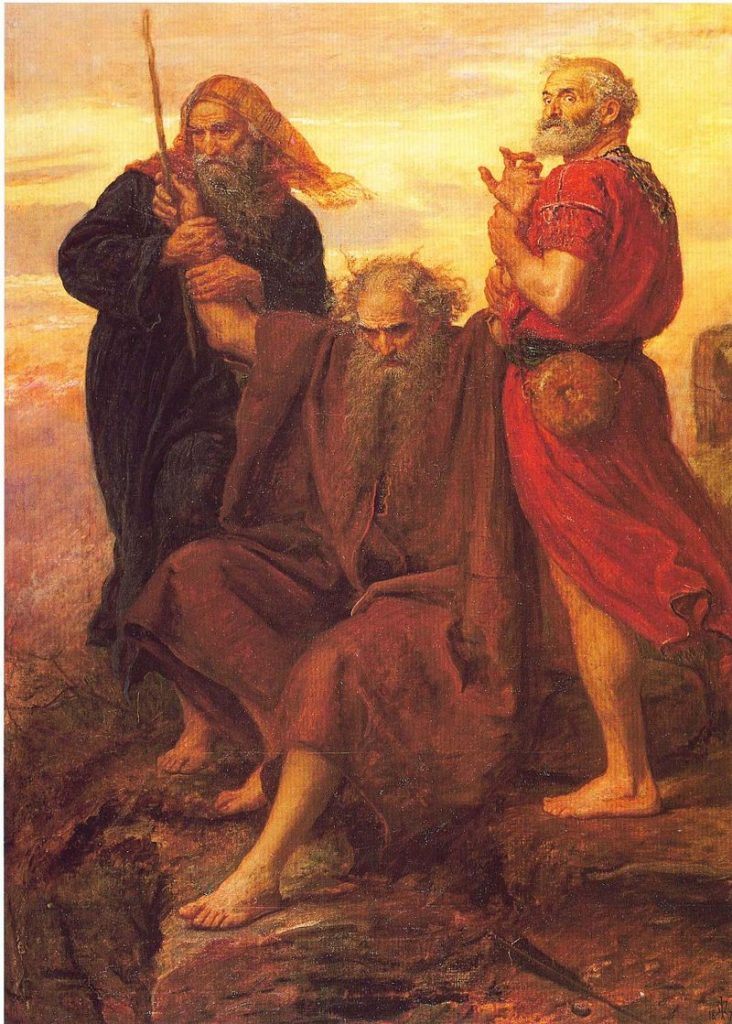
Was Moses (at center)the first guy to ever say, “It’s only weird if it doesn’t work?”
* * * *
Sunday, April 19, 2026 – I came up with the name for this this blog by adding “scribe” to the acronym DOR. (It stands for Daily Office Readings.) But over the years I’ve focused mainly on Feast Days, those days “set aside to commemorate events, saints, or doctrines that are important in the life of the Church.” Until yesterday. That’s when I again came across Exodus 17.
Verses 1-7 talk about the “Water from the Rock” episode. It came right after Moses said, “they are almost ready to stone me.” (The Israelites, just freed from slavery, were very thirsty.) So, at God’s command Moses struck the Rock and water came miraculously flowing out. But verses 8-16 talk about an event – Amalekites Defeated – that most Bible-readers don’t know about. The part about how Moses was the first to ever say, “it’s only weird if it doesn’t work.”
There’s more on that later, but first a word about the next major Feast Day, for St. Mark coming up next Saturday, April 25. It offers a classic “Cinderella story,” a tale of overcoming a flood of disrespect and on to eventual exoneration and triumph. For one thing, early Church Fathers put Matthew before Mark, assuming his account was first. For another, St. Augustine called Mark “the drudge and condenser” of Matthew, a view that prevailed until scholars finally noticed something. Other Gospels all quoted Mark, but “he does not do the same for them.” As a result – and explained later this week – Mark became “the most studied and influential Gospel.”)
Back to Moses and the Battle of Rephidim. The gist of it – at Exodus 17:8-16 – was how Moses “helped his team win.” The trouble started when the Amalekites launched a sneak attack – not unlike Pearl Harbor – on the Israelites. (They’d just arrived at Rephidim near Mount Sinai.) While Joshua commanded the army, Moses and two buddies went up to the top of a hill to watch:
Moses, Aaron, and Hur went up to the top of the hill. Whenever Moses held up his hand, Israel prevailed; and whenever he lowered his hand, Am′alek prevailed. But Moses’ hands grew weary; so they took a stone and put it under him, and he sat upon it, and Aaron and Hur held up his hands, one on one side, and the other on the other side; so his hands were steady until the going down of the sun.
Put bluntly, Moses and his “team” started winningwhen he held his arms up but losing when he let his arms down. (Which sounds a bit like a sports fan today.) But suppose as he did this his wife Zipporah came up the mountain and said, “Moses, you look ridiculous. Do you honestly think holding your hands up like that is going to change the outcome of the battle?”
Short answer? The world as we know it would be much different. If nothing else, if the Amalekites had won, world history would be “worse, much worse.” Moses might never have had the chance to write – or at least finish – the first five books of the Bible, that “most influential, most published, most widely read book in the history of the world.” All of which brings up that famous – or infamous, to some – Bud Light commercial, shown in the image below.
“It’s only weird if it doesn’t work.” And notwithstanding what Zipporah might have said, Moses holding his arms up during the Battle of Rephidim did in fact “work.” But of course, there are opposing views, exemplified by True American Stories: It’s Weird Even If It Works:
Beer companies are notorious for using logical fallacy in their commercials, and Bud Light tried to exploit the superstition… The commercial focuses on football fans doing outlandish rituals that supposedly help their teams win. [It] takes advantage of the post hoc ergo propter hoc fallacy, which falsely attributes a result to an action after the fact… Bud Light ends their commercial with the line, “It’s only weird if it doesn’t work.” This sentence is a strong example of the post hoc fallacy.
Of course, a devout Christian might say, “Hey pal, tell that to Moses!” Or, “Okay, granted, it was weird. But itdidwork.” Then there’s the early Christian author Tertullian, who once famously said – of the Christian faith in general –Credo quia absurdum, “I believe because it is absurd.”
Sometimes you just have to go with your heart – and believe.
The Book of Common Prayer reference: The “corporate-mystical”
prayer is on page 339, the post-communion prayer for Holy Eucharist,
Rite I.
Feast days are designated days on the liturgical (church) calendar “set aside to commemorate events, saints, or doctrines that are important in the life of the Church. These can range from Solemnities, which are the highest-ranking feast days like Easter and Christmas, to optional memorials that celebrate lesser-known saints.” Feast Days … the Church’s Calendar. See alsoWikipedia’s Calendar of saints. “The calendar of saints is the traditional Christian method of organizing a liturgical year by associating each day with one or more saints and referring to the day as the feast day or feast of said saint. The word ‘feast’ in this context does not mean ‘a large meal, typically a celebratory one,’ but instead ‘an annual religious celebration, a day dedicated to a particular saint.’”
The Book of Common Prayer, at page 934, explains that the Daily Office Lectionary is arranged in a two-year cycle, meaning that if you read the Daily Office on a daily basis you will cover the entire Bible in those two years, and the Psalms and Gospels three to four times. See also Daily Office (Anglican) – Wikipedia. See also Daily Office (Anglican) – Wikipedia.
Re: “I again came across Exodus 17.” I learned about the Battle of Rephidim from a separate source. But before Saturday, April 18, I don’t remember coming across it in the Daily Office.
Re: Moses striking the Rock. The link – Moses Strikes the Rock in Exodus and Numbers: One Story or Two? – said his doing so was “described in the Torah twice: first soon after the splitting of the Sea (Exod 17:1–7), and again at the end of the forty years of wandering in the wilderness (Num 20:1–13).”
As noted in the top post at right, this blog has been out of circulation since last July, mostly due to a techno-error on my part. I tried to add a “Donations” plug-in, and it cut me off, leaving only a “fatal error” message in its wake. And for now clicking on “Dorscribe” brings up to past posts like this. I hope to fix the situation in the future, but in the meantime check “Recent Posts” for all the latest…
* * * *
Not this Quasimodo (Charles Laughton); In Latin 1st Peter 2:2, “Quasi modo geniti infantes…”
Note the “of,” not “after.” That’s because Easter is “not just one day, but an entire season.” A season of 50 days called Eastertide that runs from Easter Sunday to Pentecost. It’s also called Low Sunday, because church attendance falls so drastically after the high attendance on Easter Sunday. (On that note see “CEOs;” Christians who only attend church on Christmas and Easter. “Christmas and Easter Only.”) But aside from being “low,” it’s also called the Sunday of Many Names! That includes Doubting Thomas Sunday – the Gospel that day always talks about “Doubting Thomas” – and the Octave of Easter. (Because it comes eight days after Easter.)
And as noted, it’s also called “Quasimodo Sunday.” But that’s not because of Quasimodo – the guy shown in the image above – better known as the “Hunchback of Notre Dame:”
Instead, the name comes from a Latin translation of the beginning of First Peter 2:2 , a traditional “introit” used in churches on this day. First Peter 2:2 begins – in English and depending on the translation – “As newborn babes, desire the rational milk without guile…” In Latin the verse starts out: “Quasi modo geniti infantes…” Literally, the quasi modo translates in English “as if in [this] manner.”
The NIV translation of 1st Peter 2:2 reads, “Like newborn babies, crave pure spiritual milk, so that by it you may grow up in your salvation.” In turn, in Latin “geniti” translates as “newborn” and the “infantes” meaning seems self-evident. Thus the “quasi modo” in question, roughly translated, reads “As if in the manner” (of newborn babes).
Wikipedia went on to say that Thomas – a.k.a. Didymus, meaning “The Twin” – was best known from John 20. He questioned the Resurrection at first, because he wasn’t there. But then came his direct experience, seeing and touching Jesus’ wounds. That led him to proclaim his awe-struck, “My Lord and my God.” Of course, we can’t have such a direct experience with Jesus – not in this life anyway – but there’s something to be said for admitting our doubts, but then working to overcome them. (“Improvise, Adapt, Overcome.”) See also Wesleyan Quadrilateral: “Apart from scripture, experience is the most substantial proof of Christianity.”
So, you could say there are two kinds of faith. The first kind is blindly believing, without asking questions, without having doubts and without asking anyone else how they interpret the Bible. (Like Bible scholars and priests who’ve devoted years of study.) The second type does ask questions, does dig deeper and as a result sometimes comes across a reason to doubt. But that’s how we get stronger, resistance training. The first type of Christian lifts the same 10-pound weight over and over, throughout his life. The result? This type of Christian never gets stronger; he never moves beyond the same level of fitness he started with.
The Blind Faith Christian doesn’t like resistance. He does the same boring spiritual exercise, over and over again, and stays at the same low level. The Healthy-Doubt Christian welcomes resistance and asks the probing questions that often lead to doubt. But in the process, he ultimately grows spiritually stronger by overcoming that resistance, by overcoming those doubts.
But back to Thomas. According to one tradition he was sent as a missionary to India, arriving there in the year 52 AD. He spread the Faith but was eventually martyred 20 years later:
St. Thomas was killed in 72 AD … at Mylapore near Chennai in India… This is the earliest known record of his martyrdom… Some Patristic literature state[s] that St. Thomas died a martyr, in east of Persia or in North India by the wounds of the four spears pierced into his body by the local soldiers.
Put another way, Thomas carried the Faith to the Malabar Coast – on the southwestern coast of India – “which still boasts a large native population calling themselves ‘Christians of St. Thomas.’” And where stands today the St. Thomas Cathedral Basilica, Chennai, which includes a number of relics, including the “Spearhead said to have killed Saint Thomas,” shown below.
The Book of Common Prayer reference: The “corporate-mystical” prayer is on page 339, the post-communion prayer for Holy Eucharist, Rite I.
Feast days are designated days on the liturgical (church) calendar “set aside to commemorate events, saints, or doctrines that are important in the life of the Church. These can range from Solemnities, which are the highest-ranking feast days like Easter and Christmas, to optional memorials that celebrate lesser-known saints.” Feast Days … the Church’s Calendar. See alsoWikipedia’s Calendar of saints. “The calendar of saints is the traditional Christian method of organizing a liturgical year by associating each day with one or more saints and referring to the day as the feast day or feast of said saint. The word ‘feast’ in this context does not mean ‘a large meal, typically a celebratory one,’ but instead ‘an annual religious celebration, a day dedicated to a particular saint.’”
Improvise, adapt, and overcome. Those three words are paramount to fighting and winning battles, but what happens when you finally overcome? You keep improvising, and you keep adapting. The enemy won’t rest and neither should you.
(Advice that seems especially relevant in times of polarization and weaponizing Christianity.)
In 1521, the Portuguese in Goa and Bombay-Bassein sent missionaries to Madras (now Chennai) in search of the tomb of Thomas the Apostle, who by local tradition had come to South Asia to preach the Gospel and spread the teachings of Jesus Christ. The site they found was neglected and the Portuguese decided to rebuild the shrine over the tomb.
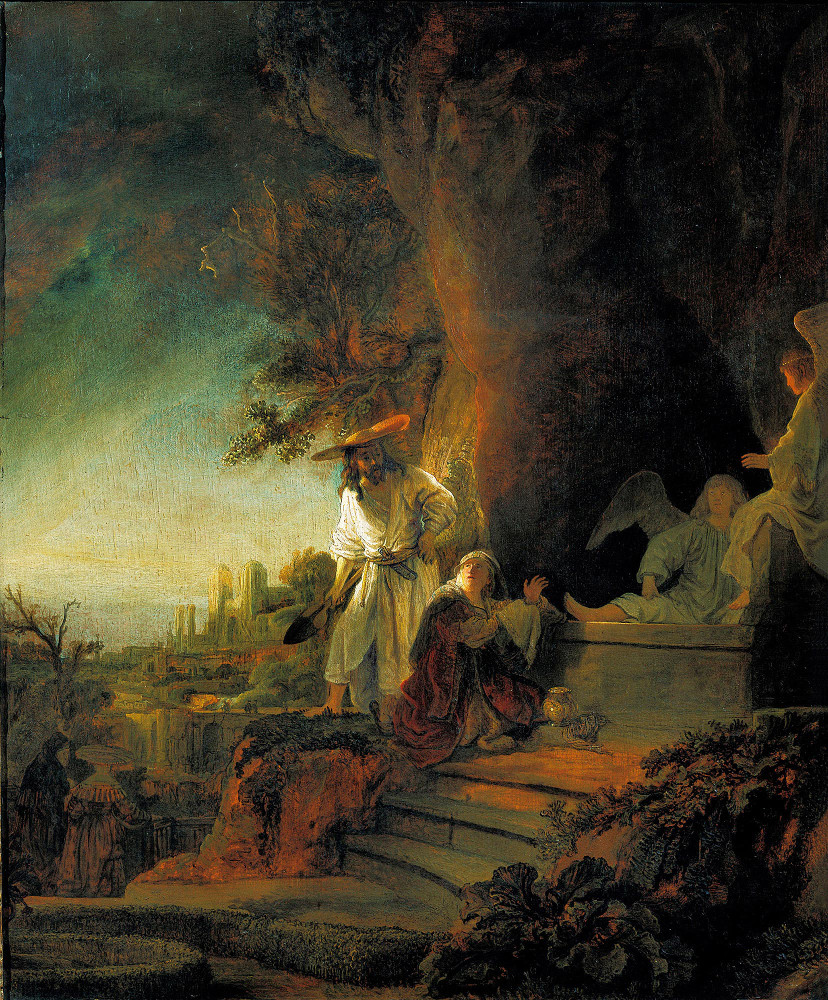
The Risen Christ Appearing to Mary Magdalen, by Rembrandt(1638)…
* * * *
April 4, 2026 – It’s that time of year again, after 46 days of Lent. (40 days mirroring the ones Jesus spent in the Wilderness, plus six Sundays “off,” as detailed in the Notes.)
But note first that before Jesus rose from the tomb he had to go through the Harrowing of Hell; between His Crucifixion and resurrection. “In triumphant descent, Christ brought salvation to the souls held captive there since the beginning of the world.” Which leads to a note: A harrow can be an “agricultural implement with spikelike teeth or upright disks, drawn chiefly over plowed land to level it, break up clods, root up weeds, etc.” But to harrow can also refer to causing “worry and upset, the way a truly scary movie might harrow you, making it hard to sleep:”
Harrow is an uncommon verb that was originally used in a religious context. You’re much more likely to hear the adjective harrowing used for things that are extremely distressing. But if your cat torments you nightly with her incessant meowing, you might try yelling, “Why do you harrow me?”
Which means that in this case too Jesus acted as “pioneer and perfecter of our faith.” (Hebrews 12:2.) And stands ready to help us through any harrowing we might be experiencing today.
But back to the reason for the season, the Resurrection. As told in John 20:1, “Early on the first day of the week, while it was still dark, Mary Magdalene went to the tomb and saw that the stone had been removed from the entrance.” So this Mary was both the first person to see the empty tomb of Jesus, and one of the first – if not the first – to see the risen Jesus.
She then went to tell Peter and the “disciple whom Jesus loved.” They both got there, looked inside and saw the burial clothes lying there. (And no body.) Then they “went back to where they were staying.” But Mary – faithful Mary, who ended up with such a terrible reputation – stayed there. (As noted in the Gospel for her feast day, John 20:11-18.) She saw two angels, who asked why she was crying. Then she turned to see another man she took to be a caretaker:
Supposing him to be the gardener, she said to him, “Sir, if you have carried him away, tell me where you have laid him, and I will take him away.” Jesus said to her, “Mary!” She turned and said to him in Hebrew, “Rabbouni!” (which means Teacher). Jesus said to her, “Do not hold on to me, because I have not yet ascended to the Father. But go to my brothers and say to them, `I am ascending to my Father and your Father, to my God and your God.’” Mary Magdalene went and announced to the disciples, “I have seen the Lord;” and she told them that he had said these things to her.
Which is why this Mary – from Magdala – is rightly called the “Apostle to the Apostles.”
* * * *
There’s more on Easter later – including the Easter bunny – but last Tuesday, March 31, I came across Proverbs 9:8. (For reasons detailed in the Notes.) And for the first time I can remember, this passage gave me a jolt. (Despite the fact that I started the Daily Office in 1992, which means I am now on my 16th trip through the Bible.) But to get to the point, the Amplified Bible translation of Proverbs 9:8 reads like this, “Do not correct a scoffer [who foolishly ridicules and takes no responsibility for his error] or he will hate you; Correct a wise man [who learns from his error], and he will love you.” Which took a load off my mind.
For the past few years I’ve been consumed by the demands of Ezekiel 3:16-27, better known as Ezekiel’s Task as Watchman. “Zeke” wrote about a Believer’s duty to warn others of the error of their ways. Briefly, if you don’t warn a fellow citizen of the error of his ways, and he keeps sinning, God will punish both of you. But if you warn him and he keeps on sinning you will at least have saved your own spiritual butt: “They will die for their sin; but you will have saved yourself.” Which seemed to mean I was duty-bound to somehow convince people who don’t want to be convinced that they may have been wrong in – say for example – voting in a certain person.
So, if Proverbs 9:8 outranks Ezekiel 3:16-27, that means I don’t have worry about wasting a lot of time and effort Talking to a Brick Wall. (An idiom “Commonly used in conflicts or disputes where dialogue seems pointless.”) And what a relief that would be. Which goes to show why it pays to read and study the Bible. (Or to check this Blog from time to time.)
* * * *
Meanwhile, “What’s all this about the Easter Bunny?”
For starters, the name Easter came from a pagan figure called Eastre (or Ēostre), “celebrated as the goddess of spring by the Saxons of Northern Europe. Her earthly symbol was the rabbit, known as a symbol of fertility.” And that’s how we got the Easter Bunny and Easter egg hunts. That tradition – first noted around 1682 – was based on folklore that had already been around awhile, and as practiced by German Lutherans. In turn, the Easter Bunny – or more precisely, the Easter Hare – “played the role of a judge,” evaluating whether children were good or bad, especially in the days leading up to “the start of the season of Eastertide.”
In legend, the creature carries colored eggs in his basket, candy, and sometimes also toys to the homes of children, and as such shows similarities to Santa Claus or the Christkind, as they both bring gifts to children on the night before their respective holidays.
One author noted that the “hare was the sacred beast of Eastre (or Eostre).” In turn, “Ēostre is attested solely by Bede in his 8th-century work The Reckoning of Time.” There Bede stated that during Ēosturmōnaþ (“Easter-month,” or the month of April), pagan Anglo-Saxons had held feasts in Ēostre’s honor, but that this tradition was eventually “replaced by the Christian Paschal month, a celebration of the resurrection of Jesus.” (Another case of subsumation?)
And finally, a heads up. Next Sunday – aside from having a multitude of other names – is also known as “Quasimodo Sunday,” for reasons to be explained next week. Stay tuned…
* * * *
“An Easter postcard depicting the Easter Bunny.” (The eggs were an old-timey symbol of new life and rebirth.)
The Book of Common Prayer reference: The “corporate-mystical” prayer is on page 339, the post-communion prayer for Holy Eucharist, Rite I.
Feast days are designated days on the liturgical (church) calendar “set aside to commemorate events, saints, or doctrines that are important in the life of the Church. These can range from Solemnities, which are the highest-ranking feast days like Easter and Christmas, to optional memorials that celebrate lesser-known saints.” Feast Days … the Church’s Calendar. See alsoWikipedia’s Calendar of saints. “The calendar of saints is the traditional Christian method of organizing a liturgical year by associating each day with one or more saints and referring to the day as the feast day or feast of said saint. The word ‘feast’ in this context does not mean ‘a large meal, typically a celebratory one,’ but instead ‘an annual religious celebration, a day dedicated to a particular saint.’”
Re: Mary Magdalene at the Tomb. The account in John 20:1-18 has Mary going there alone. The account in Mark 16 has Mary going with two other women: “Mary Magdalene, Mary the mother of James, and Salome bought spices so that they might go to anoint Jesus’ body.”
On coming across Proverbs 9:8 “last Tuesday.” Proverbs 9:1-12 is the Old Testament reading for Sunday in the week of 8 Epiphany. But as noted in The Lectionary – Satucket, the readings for Epiphany end at the Fifth Sunday after the Epiphany. Meaning the readings for the Sixth through Eighth weeks after the Epiphany got skipped this year. But I don’t like to skip those readings, so I go back over them after I start doing the readings for Lent, beginning on February 22. (I don’t like to leave that gap.) And that’s how I came across Proverbs 9:8 last Tuesday, March 31