Monthly Archives: June 2026

Saints Peter, Paul and John – 2026

*   *   *   *

Salome, who beguiled her dad – Herod II – into beheading John the Baptist…

*   *   *   *

June 19, 2026 – Next Wednesday, June 24, is the feast day for the Nativity (Birth) of John the Baptist. The following Monday, June 29, is the feast day for remembering St. Peter and St. Paul, Apostles. Specifically, for remembering how they were both martyred in Rome at about the same time, and more specifically how their relics” – their bodily remains – were moved together to a safe place 200 years later, during another of several Roman persecutions.

Which means John comes first in this post, but I thought a title Peter, Paul and John would resonate with those of a certain age. (I.e., who actually remember Peter, Paul and Mary, the folk group “formed in New York City in 1961 during the American folk music revival.”)

That trio broke up in 1970 to pursue solo careers but then reunited in 1978. Their reunion tour was “so popular that the group decided to reunite more or less permanently in 1981,” and they continued recording and touring together until Mary died in 2009. But Saint John didn’t have such a happy end. (In the form of a reunion and continued popularity.) He fell victim to Salome, daughter of Herodias, who hated John. And so she got Salome to beguile her dad – Herod II – into beheading John the Baptist. But we’re getting ahead of ourselves.

The July 24 feast day celebrates the birth of John the Baptist, “who foretold the coming of the Messiah in the person of Jesus, whom he later baptised.” The readings include Isaiah 40:1-11, Psalm 85, Acts 13:14b-26, and Luke 1:57-80. Luke tells how Elizabeth – the cousin of Mary (mother of Jesus) – came to be a mother, and how her husband got struck dumb.

The time came for Elizabeth to give birth, and she bore a son. Her neighbors and relatives heard that the Lord had shown his great mercy to her, and they rejoiced…  [T]hey were going to name him Zechariah after his father. But his mother said, “No; he is to be called John.” They said to her, “None of your relatives has this name.” Then they began motioning to his father to find out what name he wanted to give him. He asked for a writing tablet and wrote, “His name is John…”

Note that Isaiah 40:1-11 – in the day’s readings – says in one translation of verse 3: “A voice cries out in the desert: ‘Clear a way for the LORD. Make a straight highway in the wilderness for our God.’” Thus, the Baptist became that voice in the wilderness, as noted in Matthew 3:3: This is he who was spoken of through the prophet Isaiah: “A voice of one calling in the wilderness, ‘Prepare the way for the Lord, make straight paths for him.’” Which is another way of saying John served as precursor, forerunner or advance man for Jesus. (As in, “News Flash:  Jesus is on the way!“) 

Turning to the other feast day, June 29 remembers Saints Peter and Paul, who died together. But the date itself recalls the day when – somewhere around 258 during the Valerian Persecution – what were believed to be the remains of the two were moved to prevent them from falling into the hands of the persecutors. In formal terms that was the “translation of their relics,” referring to the “ceremonial removal of holy objects from one place to another.” (Another note: They could not have been killed during the Valerian Persecution itself because they would have had to be over 200 years old.) Anyway, as Wikipedia noted:

The Feast of Saints Peter and Paul or Solemnity of Saints Peter and Paul honors the martyrdom of the apostles … in Rome and is liturgically observed on 29 June. The celebration is of ancient Christian origin, the date selected being the anniversary of either their death or the translation of their relics. (Emphasis added.)

So the day does in part honor the martyrdom in Rome of the apostles Peter and Paul, but unfortunately, the Bible doesn’t give details about the deaths of either, “or indeed any of the Apostles except for James the son of Zebedee.” (See Acts 12:2.) But early tradition said they were martyred at Rome, at the command of the emperor and were buried there:

As a Roman citizen, Paul would probably have been beheaded with a sword. It is said of Peter that he was crucified head downward[. And thus as St. Augustine wrote,] “even though they suffered on different days, they were as one. Peter went first, and Paul followed. And so we celebrate this day made holy for us by the apostles’ blood…”

Of course they didn’t always agree. There was for example the Incident at Antioch, a dispute between them about how much Old Testament law binds Christians following the New Testament. (It’s a question – including that of requiring male circumcision – that remains unsolved “even to this day.”) But to me the main point of the Feast of Peter and Paul – together – is that it’s okay to have such differences of opinion among Christians. Or even to “squabble” from time to time. So, here’s to two scholars disputing but still managing to work together.

*   *   *   *

http://www.canvasreplicas.com/images/Two%20Scholars%20Disputing%20Peter%20and%20Paul%20Rembrandt%20van%20Rijn.jpg
“Scholars Disputing (Peter and Paul)” – but they still worked together… 

*   *   *   *

The upper image is courtesy of Salome – Wikipedia. The caption: “‘Salomé,’ by Henri Regnault (1870).” The article added that this Salome (III) was…

…a Jewish princess, the daughter of Herod II, who was the son of Herod the Great, with princess Herodias. She was granddaughter of Herod the Great, and stepdaughter of Herod Antipas. She is known from the New Testament, where she is not named, and from an account by Flavius Josephus. In the New Testament, the stepdaughter of Herod Antipas demands and receives the head of John the Baptist.

The Book of Common Prayer reference: The “corporate-mystical” prayer is on page 339, the post-communion prayer for Holy Eucharist, Rite I.

Feast days are designated days on the liturgical (church) calendar “set aside to commemorate events, saints, or doctrines that are important in the life of the Church. These can range from Solemnities, which are the highest-ranking feast days like Easter and Christmas, to optional memorials that celebrate lesser-known saints.” Feast Days … the Church’s Calendar. See also Wikipedia’s Calendar of saints. “The calendar of saints is the traditional Christian method of organizing a liturgical year by associating each day with one or more saints and referring to the day as the feast day or feast of said saint. The word ‘feast’ in this context does not mean ‘a large meal, typically a celebratory one,’ but instead ‘an annual religious celebration, a day dedicated to a particular saint.’”

Note also: Feast days falling on a Sunday get transferred to the next Monday. Precedence, Rules of – The Episcopal Church: “Sunday takes precedence over all other feasts and observances of the church year. When a feast of our Lord or other major feast appointed cannot be observed because it occurs on a Sunday, the feast is normally transferred to the first convenient open day in the following week.”

For this post I reviewed On the Nativity of John the Baptist – 2015, On Peter, Paul – and other “relics” (also from 2015), John the Baptist, Peter and Paul – 2016, On “John T. Baptist,” Peter and Paul – 2021, John the Baptist, ’24 – and “Christian First Graders,” and Nativity of St. John the Baptist – 2025.

The lower image is courtesy of Two Scholars Disputing by REMBRANDT Harmenszoon … (web gallery of art.) The explanatory section added that the most likely explanation of the painting is that it “represents St Peter and St Paul in conversation,” or even Argument:

Rembrandt omits the attributes by which the two apostles were traditionally identified, he relies only on their physical characteristics … and on what they are seen to be doing, that is earnestly discussing a text which the one (St Peter) is explaining to the other.

See also the painting courtesy of Saints Peter and Paul by GRECO, El – Web Gallery of Art:

The two saints[,] the most influential leaders of the early Church[, are shown here] engaged in an animated discussion.  The older, white-haired Peter … inclines his head thoughtfully to one side as he looks towards the text being expounded.  In his left hand he holds his attribute, the key to the kingdom of Heaven.  His right hand is cupped as if weighing up an idea.  Paul presses his left hand down firmly on the open volume on the table, his right hand raised in a gesture of explanation as he looks directly at the viewer.

The article noted that El Greco painted the two together several times “with remarkable consistency.” Peter always has white hair and a beard, while “Paul is always shown slightly balding, with dark hair and beard, wearing a red mantle…” See also Feast of Peter and Paul – Wikipedia, with caption: “Saint Peter and Saint Paul. Oil on canvas by El Greco. circa 16th-century. Hermitage Museum, Russia.”

*   *   *   *
On St. Barnabas 2026 – A “model for ministry?”

*   *   *   *

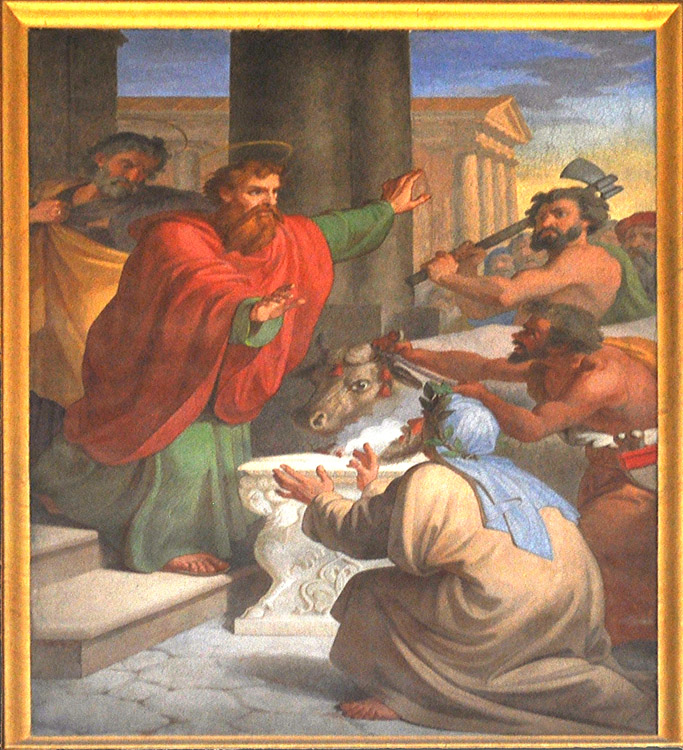
“Paul and Barnabas Taken for Gods” – after Paul got his Second Chance…

*   *   *   *

June 14, 2026 – June 11 was the Feast Day for Saint Barnabas. Though not one of the original 12, he is regarded as one of the first 72 disciples, and at that he was a “most respected man in the early Church after the Apostles themselves.” As one of Christ’s earliest followers he was also responsible for welcoming Paul into the Church. (Despite serious fears and misgivings.)

Aside from the Twelve, few others receive the designation of apostle in the New Testament. Chief among them is the apostle Paul. Among the others is his one-time collaborator Barnabas, whose memorial is celebrated by the Church on June 11.

Barnabas is first mentioned in Acts 4:36: “Joseph, a Levite, born in Cyprus, whom the apostles called Barnabas (son of encouragement), sold a field he owned, brought the money, and turned it over to the apostles.” As to Paul, the website Barnabas the Apostle added that even after his Damascus Road Experience, most Christians in Jerusalem “wanted nothing to do with him. They had known him as a persecutor and an enemy of the Church. But Barnabas was willing to give him a second chance.” (Which is pretty much what Jesus is all about…)

In short, if it hadn’t been for Barnabas willing to give Paul a second chance – Paul, once a zealous persecutor of early Christians – he might never have become that Church’s most important early convert. (If not “the Founder of Christianity,” after Jesus of course.) But then came an ironic twist, after Barnabas gave that new “Apostle Paul” his Second Chance:

Paul and Barnabas went on a missionary journey together, taking Mark with them. Part way, Mark turned back and went home. When Paul and Barnabas were about to set out on another such journey, Barnabas proposed to take Mark along, and Paul was against it, saying that Mark had shown himself undependable. Barnabas wanted to give Mark a second chance [again] and so he and Mark went off on one journey, while Paul took Silas and went on another. Apparently Mark responded well to the trust given him by the “son of encouragement,” since we find that Paul later speaks of him as a valuable assistant (2 Timothy 4:11; see also Colossians 4:10 and Philemon 24).

So we could call Barnabas “the Apostle of Second Chances.” (On that note, June ’24, St. Barnabas and second chances discussed Purgatory as a second chance we may have, compared to the “pass-fail” theory advanced by some. My feeling: “I’ll take all the help I can get.”)

The bottom line: The early Church benefited greatly because Barnabas gave both Paul and Mark a second chance, and if only for that we celebrate his life on June 11. But there’s another factor: The feast day for St. Barnabas always falls just five days after June 6, when we remember the sacrifices made on D-Day in 1944. (A “key turning point in World War II.”)

Which raises a dilemma. Can good Christians take part in an armed conflict, “characterized by widespread violence, destruction, and mortality?” (Like what took place on D-Day, on a vast scale.) St. Augustine for one thought we could, depending on circumstances of course. Which is why he and others developed a system of military ethics “to ensure that a war is morally justifiable through a series of criteria, all of which must be met for a war to be considered just. It has been studied by military leaders, theologians, ethicists and policymakers.”

One short answer? Consider it not unlike the Blessing of a Marriage: “Not to be entered into unadvisedly or lightly, but reverently, deliberately, and in accordance with” – in this case – criteria set out by St. Augustine and others after him. (To insure the violence is indeed “justified.”) That’s something our political leaders would do well to keep in mind before putting our young people – the one hope for our future – “in harm’s way.” But what is your duty if you think your country’s leaders are sending our young people to war “unadvisedly and lightly?”

Some people in power love to cite Hebrews 13:17 as support from the Bible for their saying that you should just take them at their word: “Have confidence in your leaders and submit to their authority, because they keep watch over you as those who must give an account. Do this so that their work will be a joy, not a burden, for that would be of no benefit to you.”

Which may have been true enough when Hebrews was written. (Circa 63 A.D.) Kings ruled, almost always (sometimes queens), and almost always their subjects had no say whatever in how they would be ruled. But these days we have “something new under the sun.” (Qoheleth.)

The opening words of the [United States] Constitution settle who holds supreme authority: “We the People of the United States…do ordain and establish this Constitution.”1 The government did not create itself. The people created it, gave it a defined set of powers, and kept everything else. That framing makes the United States government a delegated agent, not a sovereign in its own right.

Which is a subject I’ll address in greater length in the post covering the July 4th weekend coming up. (And after posts covering the upcoming feast days for the Nativity of St John, the Baptist on June 24, and St Peter and St Paul, Apostles on June 29.)

In the meantime, for more on this saint see Barnabas – Wikipedia, including information on how some early Christians considered him the author of the Hebrews, and how he is now the patron saint of Cyprus, and how he was eventually martyred. (Stoned to death, or bound with a rope around his neck, then dragged to the site where he would be burned to death?) Which can lead to the conclusion that standing up for Jesus, the rule of law and the American way of Life can still be a risky business. (Up to and including the risks of saying out loud that you think your country’s leaders are sending our young people to war “unadvisedly and lightly?”)

*   *   *   *

A question while celebrating Freedom Day ; St. Augustine, and “is it a ‘Just war?’“

*   *   *   *

The upper image is courtesy of St. Barnabas in Art – Christian Iconography, with text: “In Acts 14:8-18 Paul and Barnabas in Lystra heal a crippled man and the Lystrans take them for gods. A priest even brings an ox to sacrifice to them, as shown in this painting. The two have to explain that ‘we are of the same nature as you.'” See also “St. Barnabas: The Forgotten Apostle? – Simply Catholic, which provided some of the text including the “model for ministry” part.

The Book of Common Prayer reference: The “corporate-mystical” prayer is on page 339, the post-communion prayer for Holy Eucharist, Rite I.

Feast days are designated days on the liturgical (church) calendar “set aside to commemorate events, saints, or doctrines that are important in the life of the Church. These can range from Solemnities, which are the highest-ranking feast days like Easter and Christmas, to optional memorials that celebrate lesser-known saints.” Feast Days … the Church’s Calendar. See also Wikipedia’s Calendar of saints. “The calendar of saints is the traditional Christian method of organizing a liturgical year by associating each day with one or more saints and referring to the day as the feast day or feast of said saint. The word ‘feast’ in this context does not mean ‘a large meal, typically a celebratory one,’ but instead ‘an annual religious celebration, a day dedicated to a particular saint.’”

Note also: Feast days falling on a Sunday get transferred to the next Monday. Precedence, Rules of – The Episcopal Church: “Sunday takes precedence over all other feasts and observances of the church year. When a feast of our Lord or other major feast appointed cannot be observed because it occurs on a Sunday, the feast is normally transferred to the first convenient open day in the following week.”

For this post I reviewed 2014’s St. Barnabas, On the DORs for June 6, 2015, D-Day and St. Barnabas – 2021, June ’24, St. Barnabas and second chances, and Pentecost and St. Barnabas – 2025.

“In Harm’s Way.” There is of course that 1965 John Wayne movie (directed by Otto Preminger) but for the original see John Paul Jones – Wikiquote: “I wish to have no connection with any ship that does not sail fast; for I intend to go in harm‘s way.”

For more on the “opening words” see What Is American Sovereignty Under the Constitution?

The lower image is courtesy of Just war theory – Wikipedia: “The purpose of the doctrine is to ensure that a war is morally justifiable through a series of criteria, all of which must be met in order for a war to be considered just.” For more information google “Christianity and just war theory.”

*   *   *   *

On Trinity Sunday and the Visitation – 2026

*   *   *   *

The hand represents the Father, the ichthys the Son, and the dove represents the Holy Spirit…

*   *   *   *

June 4, 2026 – Last Sunday, May 31, would have been a busy day. Both Trinity Sunday – the first Sunday after Pentecost, 56 days after Easter Sunday – and also the Day to remember the Visitation of the Blessed Virgin both fell on that day. But because the Visitation did fall on a Sunday, it got transferred to Monday, June 1. And now for some specifics about “Trinity:”

Trinity Sunday celebrates the Christian doctrine of the Trinity, the three Persons of God: The Father, the Son, and the Holy Spirit… The Sundays following Pentecost, until Advent, are numbered from this day.  In traditional Catholic usage, the First Sunday After Pentecost is on the same day as Trinity Sunday…  [T]he Episcopal Church in the United States of America (ECUSA) now follows the Catholic usage…

(Trinity Sunday – Wikipedia.) Also, this feast day is one of the few in the Christian Calendar to celebrate “a reality and doctrine rather than a person or event.” The idea of the Trinity is both fascinating, controversial and difficult to understand; a mystery. But by mystery “the Church does not mean a riddle,” but rather a reality above human comprehension. (So hard to understand that even a smart guy like Thomas Jefferson couldn’t make sense of it, as noted below.) On the other hand, it’s been said that the mystery of the Trinity “is not a wall to run up against, but an ocean in which to swim.” (All About Trinity Sunday | Prayers, History, Customs.)

As for Jefferson, he referred to the doctrine as a “Three-headed Monster.” (For the full quote see Thomas Jefferson quote.) But it seems to me that while Jefferson was really smart, he fell into the common error of “thinking that he could ever really understand everything there is to know about God.” (He was much like Nicodemus, in taking the Bible “way too literally.”) 

See also What does the Bible teach about the Trinity? – GotQuestions.org:

The most difficult thing about the Christian concept of the Trinity is that there is no way to completely understand it or explain it. God is infinitely greater than we are; therefore, we should not expect to be able to fully understand Him. 

There’s lots more to read in the link, but you get the idea. (Or do you?)

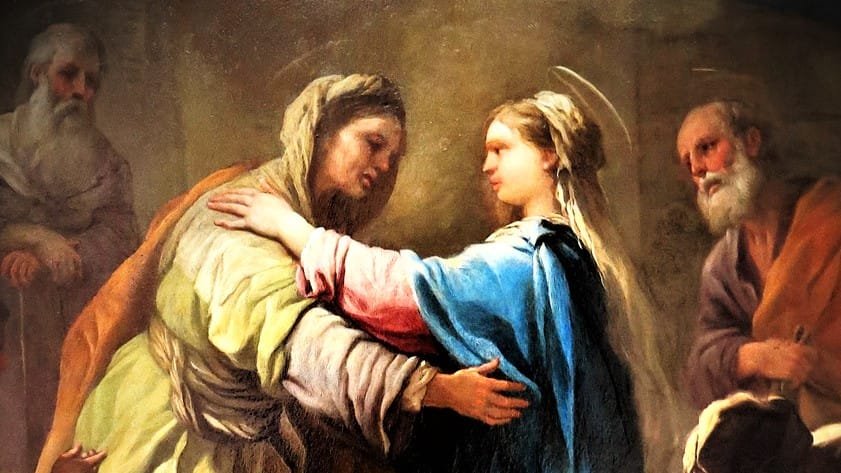
Moving on the Visitation of the Blessed Virgin Mary. (The formal name.) Wikipedia noted:

The Visitation is the visit of Mary with Elizabeth as recorded [in] Luke 1:39–56.  It is also the name of a Christian feast day[,] celebrated on 31 May…  Mary is pregnant with Jesus and Elizabeth is pregnant with John the Baptist.  Mary left Nazareth immediately after the Annunciation and went “into the hill country” [of Judah] to attend to her cousin.

Wikipedia added, “In the Gospel of Luke, the author’s accounts of the Annunciation and Visitation are constructed using eight points of literary parallelism to compare Mary to the Ark of the Covenant.” (Which I didn’t know.) Also, Mary’s Magnificat echoes Old Testament passages including the Song of Hannah, in 1st Samuel 2:1-10. There’s more background in Visitation – 2016, but here’s the main point: On May 31 we celebrate the early meeting of Mary and her cousin Elizabeth. “Their meeting sets the stage for all that will come later, and it is women who recognize it first.” (See also Mary Magdalene, “Apostle to the Apostles.”)

More to the point, when Mary visited Elizabeth, “John the Baptist, still unborn, leaped for joy in his mother’s womb.” Meaning the two women, one seemingly too old, would bear John, “the last prophet of the Old Covenant.” Her cousin Mary, a virgin not ready to have a child, was “destined to bear the One Who was Himself the beginning of the New Covenant.”

*   *   *   *

Representing the transition from the Old to the New Covenant…

*   *   *   *

The upper image was first courtesy of Trinity – Wikipedia. Caption: “An artistic depiction of the Trinity, with the hand representing the Father, the ichthys representing the Son, and the dove representing the Holy Spirit.

The Book of Common Prayer reference: The “corporate-mystical” prayer is on page 339, the post-communion prayer for Holy Eucharist, Rite I.

Feast days are designated days on the liturgical (church) calendar “set aside to commemorate events, saints, or doctrines that are important in the life of the Church. These can range from Solemnities, which are the highest-ranking feast days like Easter and Christmas, to optional memorials that celebrate lesser-known saints.” Feast Days … the Church’s Calendar. See also Wikipedia’s Calendar of saints. “The calendar of saints is the traditional Christian method of organizing a liturgical year by associating each day with one or more saints and referring to the day as the feast day or feast of said saint. The word ‘feast’ in this context does not mean ‘a large meal, typically a celebratory one,’ but instead ‘an annual religious celebration, a day dedicated to a particular saint.’”

Note also: Feast days falling on a Sunday get transferred to the next Monday. Precedence, Rules of – The Episcopal Church: “Sunday takes precedence over all other feasts and observances of the church year. When a feast of our Lord or other major feast appointed cannot be observed because it occurs on a Sunday, the feast is normally transferred to the first convenient open day in the following week.”

For this post I reviewed On Trinity Sunday, 2015, On Trinity Sunday (2016) – and more, and 2018’s The Trinity – Jefferson’s “3-headed monster.” Also, On the Visitation – 2016, Mary’s Visitation – and Pentecost – 2017, and Mary’s Visitation and Jefferson’s Monster – 2023.

The lower image is courtesy of Images, “the visitation of the blessed virgin Mary.”

*   *   *   *