* * * *
* * * *
June 14, 2026 – June 11 was the Feast Day for Saint Barnabas. Though not one of the original 12, he is regarded as one of the first 72 disciples, and at that he was a “most respected man in the early Church after the Apostles themselves.” As one of Christ’s earliest followers he was also responsible for welcoming Paul into the Church. (Despite serious fears and misgivings.)
Aside from the Twelve, few others receive the designation of apostle in the New Testament. Chief among them is the apostle Paul. Among the others is his one-time collaborator Barnabas, whose memorial is celebrated by the Church on June 11.
Barnabas is first mentioned in Acts 4:36: “Joseph, a Levite, born in Cyprus, whom the apostles called Barnabas (son of encouragement), sold a field he owned, brought the money, and turned it over to the apostles.” As to Paul, the website Barnabas the Apostle added that even after his Damascus Road Experience, most Christians in Jerusalem “wanted nothing to do with him. They had known him as a persecutor and an enemy of the Church. But Barnabas was willing to give him a second chance.” (Which is pretty much what Jesus is all about…)
In short, if it hadn’t been for Barnabas willing to give Paul a second chance – Paul, once a zealous persecutor of early Christians – he might never have become that Church’s most important early convert. (If not “the Founder of Christianity,” after Jesus of course.) But then came an ironic twist, after Barnabas gave that new “Apostle Paul” his Second Chance:
Paul and Barnabas went on a missionary journey together, taking Mark with them. Part way, Mark turned back and went home. When Paul and Barnabas were about to set out on another such journey, Barnabas proposed to take Mark along, and Paul was against it, saying that Mark had shown himself undependable. Barnabas wanted to give Mark a second chance [again] and so he and Mark went off on one journey, while Paul took Silas and went on another. Apparently Mark responded well to the trust given him by the “son of encouragement,” since we find that Paul later speaks of him as a valuable assistant (2 Timothy 4:11; see also Colossians 4:10 and Philemon 24).
So we could call Barnabas “the Apostle of Second Chances.” (On that note, June ’24, St. Barnabas and second chances discussed Purgatory as a second chance we may have, compared to the “pass-fail” theory advanced by some. My feeling: “I’ll take all the help I can get.”)
The bottom line: The early Church benefited greatly because Barnabas gave both Paul and Mark a second chance, and if only for that we celebrate his life on June 11. But there’s another factor: The feast day for St. Barnabas always falls just five days after June 6, when we remember the sacrifices made on D-Day in 1944. (A “key turning point in World War II.”)
Which raises a dilemma. Can good Christians take part in an armed conflict, “characterized by widespread violence, destruction, and mortality?” (Like what took place on D-Day, on a vast scale.) St. Augustine for one thought we could, depending on circumstances of course. Which is why he and others developed a system of military ethics “to ensure that a war is morally justifiable through a series of criteria, all of which must be met for a war to be considered just. It has been studied by military leaders, theologians, ethicists and policymakers.”
One short answer? Consider it not unlike the Blessing of a Marriage: “Not to be entered into unadvisedly or lightly, but reverently, deliberately, and in accordance with” – in this case – criteria set out by St. Augustine and others after him. (To insure the violence is indeed “justified.”) That’s something our political leaders would do well to keep in mind before putting our young people – the one hope for our future – “in harm’s way.” But what is your duty if you think your country’s leaders are sending our young people to war “unadvisedly and lightly?”
Some people in power love to cite Hebrews 13:17 as support from the Bible for their saying that you should just take them at their word: “Have confidence in your leaders and submit to their authority, because they keep watch over you as those who must give an account. Do this so that their work will be a joy, not a burden, for that would be of no benefit to you.”
Which may have been true enough when Hebrews was written. (Circa 63 A.D.) Kings ruled, almost always (sometimes queens), and almost always their subjects had no say whatever in how they would be ruled. But these days we have “something new under the sun.” (Qoheleth.)
The opening words of the [United States] Constitution settle who holds supreme authority: “We the People of the United States…do ordain and establish this Constitution.”1 The government did not create itself. The people created it, gave it a defined set of powers, and kept everything else. That framing makes the United States government a delegated agent, not a sovereign in its own right.
Which is a subject I’ll address in greater length in the post covering the July 4th weekend coming up. (And after posts covering the upcoming feast days for the Nativity of St John, the Baptist on June 24, and St Peter and St Paul, Apostles on June 29.)
In the meantime, for more on this saint see Barnabas – Wikipedia, including information on how some early Christians considered him the author of the Hebrews, and how he is now the patron saint of Cyprus, and how he was eventually martyred. (Stoned to death, or bound with a rope around his neck, then dragged to the site where he would be burned to death?) Which can lead to the conclusion that standing up for Jesus, the rule of law and the American way of Life can still be a risky business. (Up to and including the risks of saying out loud that you think your country’s leaders are sending our young people to war “unadvisedly and lightly?”)
* * * *

* * * *
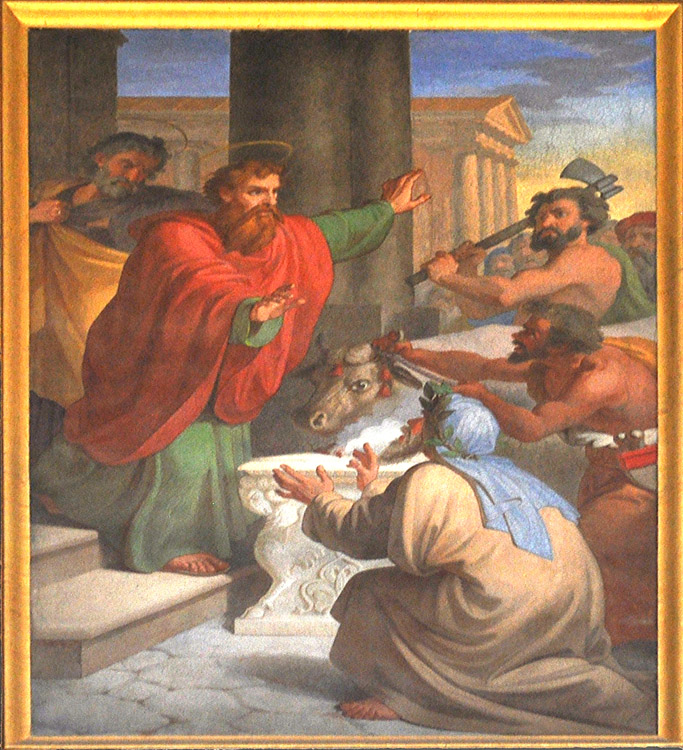
The upper image is courtesy of St. Barnabas in Art – Christian Iconography, with text: “In Acts 14:8-18 Paul and Barnabas in Lystra heal a crippled man and the Lystrans take them for gods. A priest even brings an ox to sacrifice to them, as shown in this painting. The two have to explain that ‘we are of the same nature as you.'” See also “St. Barnabas: The Forgotten Apostle? – Simply Catholic, which provided some of the text including the “model for ministry” part.
The Book of Common Prayer reference: The “corporate-mystical” prayer is on page 339, the post-communion prayer for Holy Eucharist, Rite I.
Feast days are designated days on the liturgical (church) calendar “set aside to commemorate events, saints, or doctrines that are important in the life of the Church. These can range from Solemnities, which are the highest-ranking feast days like Easter and Christmas, to optional memorials that celebrate lesser-known saints.” Feast Days … the Church’s Calendar. See also Wikipedia’s Calendar of saints. “The calendar of saints is the traditional Christian method of organizing a liturgical year by associating each day with one or more saints and referring to the day as the feast day or feast of said saint. The word ‘feast’ in this context does not mean ‘a large meal, typically a celebratory one,’ but instead ‘an annual religious celebration, a day dedicated to a particular saint.’”
Note also: Feast days falling on a Sunday get transferred to the next Monday. Precedence, Rules of – The Episcopal Church: “Sunday takes precedence over all other feasts and observances of the church year. When a feast of our Lord or other major feast appointed cannot be observed because it occurs on a Sunday, the feast is normally transferred to the first convenient open day in the following week.”
For this post I reviewed 2014’s St. Barnabas, On the DORs for June 6, 2015, D-Day and St. Barnabas – 2021, June ’24, St. Barnabas and second chances, and Pentecost and St. Barnabas – 2025.
“In Harm’s Way.” There is of course that 1965 John Wayne movie (directed by Otto Preminger) but for the original see John Paul Jones – Wikiquote: “I wish to have no connection with any ship that does not sail fast; for I intend to go in harm‘s way.”
For more on the “opening words” see What Is American Sovereignty Under the Constitution?
The lower image is courtesy of Just war theory – Wikipedia: “The purpose of the doctrine is to ensure that a war is morally justifiable through a series of criteria, all of which must be met in order for a war to be considered just.” For more information google “Christianity and just war theory.”
* * * *