* * * *

* * * *
June 4, 2026 – Last Sunday, May 31, would have been a busy day. Both Trinity Sunday – the first Sunday after Pentecost, 56 days after Easter Sunday – and also the Day to remember the Visitation of the Blessed Virgin both fell on that day. But because the Visitation did fall on a Sunday, it got transferred to Monday, June 1. And now for some specifics about “Trinity:”
Trinity Sunday celebrates the Christian doctrine of the Trinity, the three Persons of God: The Father, the Son, and the Holy Spirit… The Sundays following Pentecost, until Advent, are numbered from this day. In traditional Catholic usage, the First Sunday After Pentecost is on the same day as Trinity Sunday… [T]he Episcopal Church in the United States of America (ECUSA) now follows the Catholic usage…
(Trinity Sunday – Wikipedia.) Also, this feast day is one of the few in the Christian Calendar to celebrate “a reality and doctrine rather than a person or event.” The idea of the Trinity is both fascinating, controversial and difficult to understand; a mystery. But by mystery “the Church does not mean a riddle,” but rather a reality above human comprehension. (So hard to understand that even a smart guy like Thomas Jefferson couldn’t make sense of it, as noted below.) On the other hand, it’s been said that the mystery of the Trinity “is not a wall to run up against, but an ocean in which to swim.” (All About Trinity Sunday | Prayers, History, Customs.)
As for Jefferson, he referred to the doctrine as a “Three-headed Monster.” (For the full quote see Thomas Jefferson quote.) But it seems to me that while Jefferson was really smart, he fell into the common error of “thinking that he could ever really understand everything there is to know about God.” (He was much like Nicodemus, in taking the Bible “way too literally.”)
See also What does the Bible teach about the Trinity? – GotQuestions.org:
The most difficult thing about the Christian concept of the Trinity is that there is no way to completely understand it or explain it. God is infinitely greater than we are; therefore, we should not expect to be able to fully understand Him.
There’s lots more to read in the link, but you get the idea. (Or do you?)
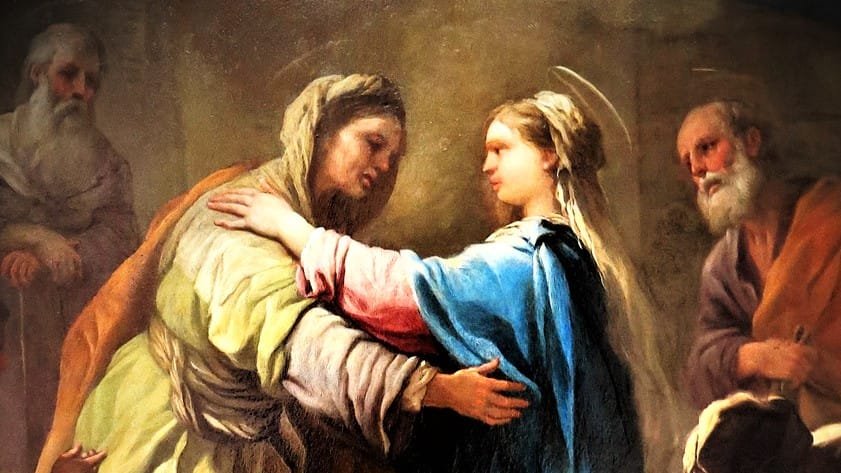
Moving on the Visitation of the Blessed Virgin Mary. (The formal name.) Wikipedia noted:
The Visitation is the visit of Mary with Elizabeth as recorded [in] Luke 1:39–56. It is also the name of a Christian feast day[,] celebrated on 31 May… Mary is pregnant with Jesus and Elizabeth is pregnant with John the Baptist. Mary left Nazareth immediately after the Annunciation and went “into the hill country” [of Judah] to attend to her cousin.
Wikipedia added, “In the Gospel of Luke, the author’s accounts of the Annunciation and Visitation are constructed using eight points of literary parallelism to compare Mary to the Ark of the Covenant.” (Which I didn’t know.) Also, Mary’s Magnificat echoes Old Testament passages including the Song of Hannah, in 1st Samuel 2:1-10. There’s more background in Visitation – 2016, but here’s the main point: On May 31 we celebrate the early meeting of Mary and her cousin Elizabeth. “Their meeting sets the stage for all that will come later, and it is women who recognize it first.” (See also Mary Magdalene, “Apostle to the Apostles.”)
More to the point, when Mary visited Elizabeth, “John the Baptist, still unborn, leaped for joy in his mother’s womb.” Meaning the two women, one seemingly too old, would bear John, “the last prophet of the Old Covenant.” Her cousin Mary, a virgin not ready to have a child, was “destined to bear the One Who was Himself the beginning of the New Covenant.”
* * * *
* * * *
The upper image was first courtesy of Trinity – Wikipedia. Caption: “An artistic depiction of the Trinity, with the hand representing the Father, the ichthys representing the Son, and the dove representing the Holy Spirit.
The Book of Common Prayer reference: The “corporate-mystical” prayer is on page 339, the post-communion prayer for Holy Eucharist, Rite I.
Feast days are designated days on the liturgical (church) calendar “set aside to commemorate events, saints, or doctrines that are important in the life of the Church. These can range from Solemnities, which are the highest-ranking feast days like Easter and Christmas, to optional memorials that celebrate lesser-known saints.” Feast Days … the Church’s Calendar. See also Wikipedia’s Calendar of saints. “The calendar of saints is the traditional Christian method of organizing a liturgical year by associating each day with one or more saints and referring to the day as the feast day or feast of said saint. The word ‘feast’ in this context does not mean ‘a large meal, typically a celebratory one,’ but instead ‘an annual religious celebration, a day dedicated to a particular saint.’”
Note also: Feast days falling on a Sunday get transferred to the next Monday. Precedence, Rules of – The Episcopal Church: “Sunday takes precedence over all other feasts and observances of the church year. When a feast of our Lord or other major feast appointed cannot be observed because it occurs on a Sunday, the feast is normally transferred to the first convenient open day in the following week.”
For this post I reviewed On Trinity Sunday, 2015, On Trinity Sunday (2016) – and more, and 2018’s The Trinity – Jefferson’s “3-headed monster.” Also, On the Visitation – 2016, Mary’s Visitation – and Pentecost – 2017, and Mary’s Visitation and Jefferson’s Monster – 2023.
The lower image is courtesy of Images, “the visitation of the blessed virgin Mary.”
* * * *