* * * *

* * * *
October 14, 2025 – Saturday, October 18 is the feast of St Luke, Evangelist. He wrote the third and last “synoptic” gospel. (See below.) The first one – Mark’s – was written “as early as the mid 50s.” (A.D.) Matthew’s came somewhere between 61 and 70 A.D. But scholars like Isaac Asimov say Luke wrote his Gospel some time later, between 71 and 80 A.D. As to those “synoptics:”
The gospels of Matthew, Mark, and Luke are considered synoptic gospels on the basis of many similarities between them that are not shared by the Gospel of John. “Synoptic” means here that they can be “seen” or “read together…” The synoptic gospels are the source of many popular stories, parables, and sermons, such as Jesus’ humble birth in Bethlehem, the Sermon on the Mount, the Beatitudes, the Last Supper, and the Great Commission… The fourth gospel [John], presents a very different picture of Jesus and his ministry…
(See Gospel – Wikipedia.) Getting back to Asimov, he said Mark was written for “the ordinary Christian of Jewish background” and Matthew for “those learned in Old Testament lore.” But Luke wrote his Gospel for Gentiles sympathetic to Christianity and considering conversion. Then too Luke treated Roman authorities more gently than the first two gospels, and Jesus Himself is portrayed as more sympathetic to Gentiles than in Matthew or Mark.
Luke the Evangelist – Wikipedia added that he is “believed by many scholars to be a Greek physician who lived in the Greek city of Antioch in Ancient Syria.” The article added that going back as far as the early church fathers, Luke is considered to have written“both the Gospel according to Luke and the Acts of the Apostles.” (Originally one work called Luke-Acts.) Also:
Based on his accurate description of towns, cities and islands, as well as correctly naming various official titles, archaeologist Sir William Ramsay wrote that “Luke is a historian of the first rank [and] should be placed along with the very greatest of historians.” Professor of Classics at Auckland University, E.M. Blaiklock, wrote: “For accuracy of detail, and for evocation of atmosphere, Luke stands, in fact, with Thucydides. The Acts of the Apostles is not shoddy product of pious imagining, but a trustworthy record… it was the spadework of archaeology which first revealed the truth.” New Testament scholar Colin Hemer [also attested to] the historical nature and accuracy of Luke’s writings. (Emphasis added.)
Note also Luke 21:5-36, on “Destruction of the Temple and Signs of the End Times,” known as the Little Apocalypse. See The Son of Man and the Little Apocalypse|Catholic World:
[T]he Olivet Discourse, sometimes called a “little apocalypse” … because it contains difficult teachings by Jesus about the destruction of the Jerusalem temple in A.D. 70 and the final day of judgment. Like The Apocalypse of John the Revelator [the Book of Revelation], the little apocalypse is filled with strong imagery and a complex web of allusions drawn from the Old Testament, especially from the prophets.
(See too Wikipedia on the Olivet Discourse; Jesus saying His followers “will suffer tribulation and persecution before the ultimate triumph of the Kingdom of God.”)
Not that there’s any connection to current events or anything…
Some other notes: Luke is commonly thought to be the only non-Jewish writer with a “book” in the New Testament. (It includes numerous letters.) And he wrote more pages in the New Testament than anyone else. While Luke’s Gospel and Acts occupy a total of sixty pages, “all the letters traditionally attributed to Paul (not counting Hebrews) total fifty-six.”
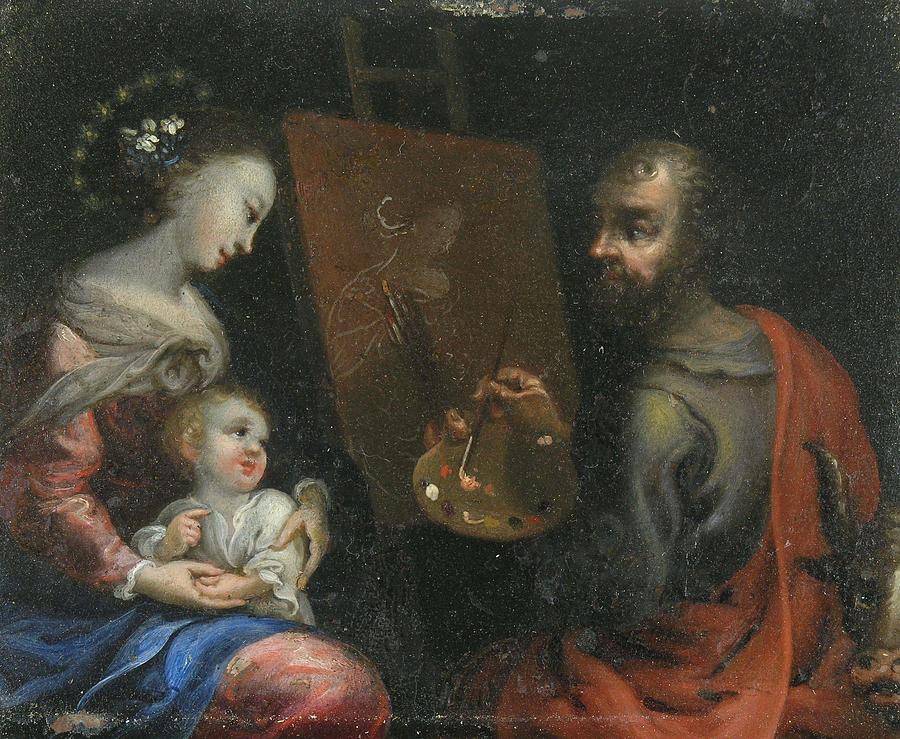
And the rest of the acts of Luke, are they not described in the chronicles of some past posts? (Which is being interpreted: “See the Notes for links thereto.”) Including the idea that Luke was also a painter, and beyond that painted Mary, the mother of Jesus, as shown below.
* * * *
Some final thoughts, thoughts that occurred during a service at Trinity Presbyterian Church in Hendersonville NC last October 5: It struck me that I’m a writer, and that my writing can be described as mostly about my “journeys with Jesus.” Which includes the metaphoric physical journeys I describe in a companion blog. (Long hikes on the Camino de Santiago, etc.). But it also includes the journeys I’ve made through the Bible – 16 full trips and-counting – starting in 1992 via the Daily Office. (The two-year cycle of Bible readings by which you go the whole Bible one time in two years, and the psalms and Gospels three to four times in those two years.)
Another, simple thought for these troubling times: “Moses said love your neighbor, Jesus said love your enemy, and Paul said Christ died for the Ungodly – whoever you think they may be.” In these times of political (and religious) polarization it pays to have a nice, simple sound bite. And this simple mantra may both help you defend yourself – and may even spread the Gospel…
* * * *
* * * *
The upper image is courtesy of St. Luke – Image Results. It goes with a page, “Catholic Prayers.”
The Book of Common Prayer reference: The “corporate-mystical” prayer is on page 339, the post-communion prayer for Holy Eucharist, Rite I.
Feast days are designated days on the liturgical (church) calendar “set aside to commemorate events, saints, or doctrines that are important in the life of the Church. These can range from Solemnities, which are the highest-ranking feast days like Easter and Christmas, to optional memorials that celebrate lesser-known saints.” Feast Days: Celebrating the Church’s Calendar.
Re: “And the rest of the acts of Luke, are they not described in the chronicles of some past posts?” An allusion to 2 Kings 20:20, “And the rest of the acts of Hezekiah … are they not written in the book of the chronicles of the kings of Judah?” See also 2 Kings 8:23, 2 Kings 15:6,26, and 2 Kings 16:19.
Re: “Which is being interpreted.” I.e., for this post I borrowed from 2014’s On St. Luke – physician, historian, artist, On St. Luke – 2015, 2022’s On Luke, James the Just and Halloween, and St. Luke’s day – 2023. (With the image I borrowed for the top of this post-page.) See also the St. Luke article on the The Lectionary – Satucket website.
The Asimov quotes are from Asimov’s Guide to the Bible (Two Volumes in One), Avenel Books (1981), at pages 912-15.
The lower image is courtesy of St. Luke Painting The Virgin – Image Results, with the caption: “‘Saint Luke Painting the Virgin Mary #1’ is a painting by Central European Painter which was uploaded on October 23rd, 2020.”
* * * *