On the “Infinite Frog”

Infinite Frogs

There actually IS a website for “infinite frogs. . .”

*   *   *   *

From the Scribe – 15 July 2014:

I just got back from a two-week vacation to New York City and Montreal, which included a round-trip on Amtrak’s Adirondack Route, “through the wine country of the Hudson Valley.”  (See On the Bible readings for July 13, “written in beautiful Montreal.”)

So anyway, last Sunday afternoon – July 13 – I was driving home on Interstate 81, through western Virginia’s Shenandoah Valley, and talking on the phone* with Mi Dulce, who happened to take her two-week vacation at the same time (albeit in Cleveland Ohio).

This nice lady was saying something about getting some things back from her former life in Cleveland, which included what sounded like her Infinite Frog.    There followed a couple of definite say whats?   But as it turned out, this mi Dulce o’ mine was actually saying that she’d gotten her Infant of Prague back, which then became the seed thought for this blog-post.

The Infant Jesus of Prague . . . is a 16th-century Roman Catholic wax-coated wooden statue of child Jesus holding a globus cruciger, located in the Carmelite Church of Our Lady Victorious in Malá Strana, Prague, Czech Republic.  Pious legends state that the statue once belonged to Saint Teresa of Avila and allegedly holds miraculous powers, especially among expectant mothers.

See Infant Jesus of Prague – Wikipedia, the free encyclopedia.  (As was explained later, this statuette – also known as a “Child of Prague” –  was a gift from a former mother-in-law.)

As Wikipedia noted, thousands of pilgrims pay homage to the Infant of Prague every year, and statuettes of this “Infant Jesus are placed inside many Catholic churches, sometimes with the quotation, ‘The more you honor me, the more I will bless you.'”  Further, devotion to the “Child of Prague and belief in its power to influence the weather is still strong in many parts of Ireland. A wedding gift of a statue of the Child of Prague is particularly auspicious.”   (E.A.)

It further turns out that the basis for this adoration goes back four centuries:

In April 1639, the Swedish army began a siege of the city of Prague.  The frightened citizens hurried to the shrine of the Infant Jesus of Prague as services were held day and night at the Church of Our Lady Victorious in the Little Quarter.  When the [Swedish] army decided instead to pull out, the grateful residents ascribed this to the miraculous Holy Infant.  The tradition of the Infant Jesus procession and the coronation continues to this day.  This ceremony is the closing highlight of the annual Feast of the Infant Jesus in Prague.

All of which brings up the power of prayer (and there was no doubt a passel of prayer going on back in 1639 Prague).  It also brings up the different types of prayer.

As the Book of Common Prayer noted, “the principle kinds of prayer are adoration, praise, thanksgiving, penitence, oblation, intercession, and petition.”

Most people are more familiar with the petition type of prayer, basically translated, “Gimme, gimme, gimme!”   On the other hand, we’ve all had times in our lives when we’ve found ourselves in way over our heads, like those people of Prague in 1639, but that’s a totally different “petition.”  It also brings up the “thrilling drama” noted above, and Psalm 50:15:

Call upon me in the day of trouble; I will deliver you, and you shall honor me.

Which is another way of saying that God loves drama.   So, if you expect to go from victory to victory when you begin your Christian Pilgrimage, you’re in for a big surprise.  (For one thing, drama makes a much better story to bore your grandchildren with.)

But all of this drama in your life can lead to the best, simplest and most appreciated-by-God type of prayer, adoration, “the lifting up of the heart and mind to God, asking nothing but to enjoy God’s presence.”  For more on that see On three suitors (a parable), and this prayer:

O God, if I worship Thee in fear of hell, burn me in hell;   if I worship Thee in hope of Paradise, exclude me from Paradise;   but if I worship Thee for Thine own sake, withhold not Thine everlasting beauty.

In the meantime, enjoy having learned about this Infinite Frog.

*   *   *   *

*   *   *   *

The upper image is courtesy of Infinite Frogs | Are We Full Yet? 

The lower image is courtesy of the article, Infant Jesus of Prague – Wikipedia, and includes the caption: “The elaborate shrine which houses the wax-wooden statue.  Church of Our Lady Victorious, Mala Strana, Prague, Czech Republic.”

The article includes a section on Vestments:

Several costly embroidered vestments have been donated by benefactors.  Among those donated are those from Empress Maria Theresa and Emperor Ferdinand I of Austria, which are preserved to this day.  A notable garment in the collection is an ermine cloak placed on the statue the first Sunday after Easter, which is the anniversary day of the coronation of the statue by the bishop of Prague in 1655.   In 1713 the clothing began to be changed according to the liturgical norms.  Other valuable garments worn by the image are vestments studded with various gemstones, embroidered with gold French bullion wire threading, and silk fabrics as well as handmade lace customised purposely for the statue.

The schedule includes Green for “Ordinary Time;” Purple for “Lent, Candlemas and Advent;” Red or Gold for Christmas and Easter; and Royal Blue for “Immaculate Conception / Feast of Assumption.”

*   *   *   *

As to Amtrak’s Adirondack Route, see Adirondack Trains Travel from New York City to Montreal, and/or Adirondack Route Guide – Amtrak.

*  As to “talking on the phone,” I was using the functional equivalent of Bluetooth.

As to adoration and the other types of prayer, see the Book of Common Prayer at pages 856-57, or The Online Book of Common Prayer, and/or The Catechism.

On the Bible readings for July 13

Esau Selling His Birthright – (to the crafty Jacob, ancestor of Moses)


From the Scribe (7/8/14)


Today’s post was written in beautiful Montreal, as part of my vacation to “Yankee-land and beyond,” but more about that later.   In the meantime:

The Bible readings for next Sunday, July 13, are: Genesis 25:19-34, Psalm 119:105-112, Romans 8:1-11, and Matthew 13:1-9,18-23.

The Genesis reading – 25:19-34 – began with the birth of Jacob and Esau, to Isaac and Rebekah.  It moved to “Esau‘s loss of his birthright to Jacob and the conflict that had spawned between their descendant nations.”  (Jacob was “father of the Israelites,” while Esau was progenitor of the Edomites, from the land of Edom, or Idumea.  “The Edomites may have been connected with  . . . nomadic raiders mentioned in Egyptian sources.”  Edom – Wikipedia, the free encyclopedia.)

The conflict started in the womb and continued to young adulthood, with Isaac liking his first-born Esau more, while Rebekah loved the younger Jacob more.   (Keep in mind, Jacob was an ancestor of Moses, who wrote the book.)

Surprisingly, the writer emphasized Jacob’s trait of being sneaky, again starting in the womb as Jacob grabbed Esau’s heel, “seemingly trying to pull Esau back into the womb so that he could be firstborn.  The grasping of the heel is also a reference to deceptive behavior.”

The deception continued to young adulthood when Esau gave up his birthright in exchange for a bowl of stew, because he was so hungry.  (In the painting above Esau is the hungry one on the right.   The shifty-looking guy on the left is Jacob.)  But as Wikipedia noted:

The birthright has to do with inheritance of goods and position both.  The tale is typically biblical.  Esau acts impulsively.  As he did not value his birthright over a bowl of lentil stew, by his actions, Esau demonstrates that he does not deserve to be the one who continues Abraham’s responsibilities and rewards under God’s covenant, since he does not have the steady, thoughtful qualities which are required.   Jacob shows his wiliness as well as his greater intelligence and forethought. What he does is not quite honorable, though not illegal.  (Emphasis added.)

There are a host of object lessons here, one of which might be that we as Christians are expected to be harmless as dove, but also expected to be “wise as serpents.”  That’s Matthew 10:16, where some translations say to be “cunning as serpents,” “crafty as snakes,” or “shrewd as serpents.”  And since the serpent is a metaphor for the Devil, what Jesus seemed to say in Matthew 10:16 was that we should be “wise as hell” or “wise as the Devil.”

Which by the way is something much harder to do if you only interpret the Bible in a narrow, strict, or “fundamental” way.    (BTW: that’s the theme of this blog.)

 The Psalm 119 reading begins with the beloved Bible-verse, “Thy word is a lantern [or lamp] unto my feet.”  That’s Psalm 119:105 in the King James Version ( the one God uses).  If you Google that phrase, you’ll get some 3,900 results.

[T]he word of God is like a torch … in a dark night.  It shows … the way; it prevents [us] stumbling over obstacles, or failing down precipices, or wandering off into paths which would lead into danger, or would turn him away altogether from the path to life.

(See Barnes’ Notes on the Bible, at Psalm 119:105 Commentaries: Your word is a lamp to my feet …, and Second Peter 1:19, saying we have – from Jesus – “a light shining in a dark place, until the day dawns and the morning star rises in your hearts.”)

The Psalm 119 reading ends at verse 12, “I have applied my heart to fulfill your statutes, for ever and to the end.”  As noted in the “About” pages above, those statutes were fulfilled in Jesus and his three main promises:  1) that He would accept anyone, 2) that He came so His followers could have life in abundance, and 3) that He expected His followers to perform even greater miracles than He did. See ABOUT THIS BLOG.

In Romans 8:1-11, Paul compared the old law and the new grace, available through faith in Jesus.  In Romans 8:6 Paul said, “To set the mind on the flesh is death, but to set the mind on the Spirit is life and peace.”  Compare that with what he said in Second Corinthians 3:6, that the letter of the law kills, while the Spirit of the law gives life.  See also John 4:24 (in the KJV), “God is a Spirit: and they that worship him must worship him in spirit and in truth.”

That’s another way of saying rather than focusing only on the literal sense of the Bible, the better course to try and discern what it means spiritually, in a deeper sense, or what Paul Harvey might have called “the rest of the story.”  (See below.)

And finally, in Matthew 13:1-9, 18-23, Jesus told the Parable of the Sower.  For more on that see Parable of the Sower – Wikipedia, the free encyclopedia.


PaulHarvey.banner.jpg


The top image is courtesy of Jacob and Esau – Wikipedia, the free encyclopedia.  The full caption:  “Hendrick ter Brugghen, Esau Selling His Birthright, c. 1627.”

The bottom image is courtesy of Paul Harvey’s 1978 ‘So God Made a Farmer’ Speech – Garance …. On the matter of being “wise as the devil,” noted above, see also Harvey’s “If I were the Devil,” at If I Were the Devil – (BEST VERSION) by PAUL HARVEY audio ….

Speaking of “the rest of the story,” see also Paul Harvey – Wikipedia, the free encyclopedia, which added of Harvey’s service in World War II:  “He eventually enlisted in the United States Army Air Forces [after Pearl Harbor] but served only from December 1943 to March 1944.”   Some critics claimed he was “given a psychiatric discharge for deliberately injuring himself in the heel. Harvey angrily denied the accusation, but was vague about details: ‘There was a little training accident…a minor cut on the obstacle course…I don’t recall seeing anyone I knew who was a psychiatrist…I cannot tell you the exact wording on my discharge.'”


For Sunday of the July 4th weekend

*   *   *   *

July 6, 2014 – “Happy 4th of July Weekend!” As I’m writing this, I’m riding a train north from New York City to Montreal. That means I had to find my passport, and in the process I found out that passport makes for some interesting reading. Especially on this holiday weekend. Like page 1, where the “Secretary of State of the United States of America” personally requests, of “all whom it may concern,” to permit this named citizen – me – “to pass without delay or hindrance and in case of need to give all lawful aid and protection.” Pretty impressive.

That’s followed by the Preamble to the United States Constitution, which also makes for some pretty impressive reading.  That’s followed by pages of Important Information, then pages where you get your visa(s) stamped. Each two-page set is topped with a pithy quotation, about America and the promise of freedom it entails. For example, pages 8-9 are topped by a saying from George Washington, “Let us raise a standard to which the wise and honest can repair.”

Unfortunately – and as we’ve seen way too often lately – the stupid and dishonest can also “repair to the standard” of freedom that America promises.  But that seems part and parcel of what “freedom” is all about. Or as John Steinbeck said:

…this I believe: that the free, exploring mind of the individual human is the most valuable thing in the world.  And this I would fight for: the freedom of the mind to take any direction it wishes, undirected.  And this I must fight against: any idea, religion, or government which limits or destroys the individual.  This is what I am and what I am about.

See Quote by John Steinbeck. (Of course he always was an ornery cuss.) Then there’s a quote on pages 16-17, attributed to Teddy Roosevelt:  “This is a new nation, based on a mighty continent, of endless possibilities.” Get that?  “Endless possibilities.”

But to get to that land of endless possibilities, our ancestors – the people with gumption and nerve – had to leave behind the old and corrupt ways of where they came from. (Another way of saying “conservative types,” but that’s a subject for later posts.) And finally there’s the last quote on page 28, from the late astronaut Ellison Onizuka:

Every generation has the obligation to free men’s minds for a look at new worlds . . . to look out from a higher plateau than the last generation.

(Ellipses in the passport.) But that’s just another way of saying, “Sing to the Lord a new song.” Also a way of saying you can’t “live up to, fulfill or implement” either promise – either of the American Dream with its “endless possibilities” or Promises of Jesus – if you interpret the Bible or the Constitution in a closed, narrow, or “strict” way.

The point is that our duty as Americans – and especially Christian Americans – is to help and not hinder the endless possibilities of the American Dream or the promise of Jesus that we should live a life of abundance, in His name. (Some things to remember this July 4th weekend.)

*   *   *   *

From the original post: “Onizuka (1946-1986) was an American astronaut ‘from Kealakekua, Hawaii, who successfully flew into space with the Space Shuttle Discovery on STS-51-C. He died in the destruction of the Space Shuttle Challenger, on which he was serving as Mission Specialist for mission STS-51-L. He was the first Asian-American to reach space.'” See Ellison Onizuka – Wikipedia.

*   *   *   *


On the Bible readings for July 4, 2014

*   *   *   *

Happy July 4th!!

July 4, 2014 – As I write this I’m sitting in a McDonald’s on Concord Pike northeast of Wilmington Delaware.  (They have free Wifi.)  That means I’m taking a vacation from God’s Country – down south – on a trip that will include but not be limited to a family reunion.

But back to Independence Day. . .

*   *   *   *

Google “Freedom Day” – instead of the usual Independence Day.  If you do that you’ll probably get a host of sites, including National Religious Freedom Day.  That day is celebrated on January 16, and it’ designed to remember the adoption of Thomas Jefferson’s landmark statute.  That would be the Virginia Statute for Religious Freedom, noted in the photo below.  (Read more about it at Virginia Statute for Religious Freedom – Wikipedia.)

That article – and this post – make compelling reading on this July 4th:

The statute disestablished the Church of England … and guaranteed freedom of religion to people of all religious faiths, including Catholics and Jews [and] was a notable precursor of the Establishment Clause and Free Exercise Clause of the First Amendment to the United States Constitution. The Statute for Religious Freedom is one of only three accomplishments Jefferson instructed be put in his epitaph.

(Emphasis added.) By that statute legislators (“burgesses”) of Virginia “disestablished” the official religion of the state. That state religion was Anglican – Church of England – and most if not all Burgesses back then were members of that official church. In other words the Established Church of Virginia voluntarily gave up its power, including the power to impose taxes for its own support. It did that to guarantee freedom of religion to people of all faiths.  To the members of all other religious faiths – and those who had no faith at all. For starters, the statute said “Almighty God hath created the mind free.”  It also said when any government or majority tries to influence the religious beliefs of others, they only “beget habits of hypocrisy and meanness.”

That sounds like it was written yesterday!

The statute further noted the “impious presumption of legislators and rulers” to establish “their own opinions and modes of thinking as the only true and infallible,” even though they were “but fallible and uninspired men.” The statute said it was wrong for “fallible and uninspired men” to try and establish their own view of religious truth as “the only true and infallible.”

Finally, the statute said noted “Truth is great, and will prevail if left to herself . . . and has nothing to fear from the conflict.” I.e., that religion is best that proves itself in the “free market place of ideas.” See Marketplace of ideas – Wikipedia.  In further words, if your faith is true and sound, you won’t be afraid of a little competition. What that means is that under the Constitution and the ideals of Jefferson’s Statute for Religious Freedom,  our government isn’t a teacher of religion. Instead that government should be an impartial referee, to insure a level playing field.

So if your Faith is true and sound, you don’t want help from the government.  As by having officially-sponsored prayer at public events.) That in turn also means you have the confidence to say in the open marketplace of ideas, “My views of religion can beat yours with one hand tied behind its back – on a level playing field without any outside help.” 

*   *   *   *

So Independence Day is a Feast Day of the American Episcopal Church. That church is a direct descendant of the Church of England that voluntarily “disenfranchised itself” to help gain that precious freedom of religion for people of all faiths (or no faith. And the Bible readings for this day are – according to the Revised Common Lectionary – are:  Deuteronomy 10:17-2, Psalm 145, Hebrews 11:8-16, and Matthew 5:43-48. The Collect for this Feast Day is as follows:

Lord God Almighty, in whose Name the founders of this country won liberty for themselves and for us, and lit the torch of freedom for nations then unborn:  Grant that we and all the people of this land may have grace to maintain our liberties in righteousness and peace; through Jesus Christ our Lord, who lives and reigns with you and the Holy Spirit, one God, for ever and ever.  Amen.

Note that a Collect is a “form of prayer unique to the  Western Church;” in the Scribe’s church, it is said at the beginning of each Sunday service.  It is a form of collective prayer, often followed by a period of silence “collect all their thoughts and prayers and, in essence, give them to the celebrant, who prays on behalf of all.” (Emphasis added.)

Note too that there are a number of definitions of grace, but the one that seems most fitting here seems to be a “disposition to be generous or helpful; goodwill.” See Definition of grace by the Free Online Dictionary. So the prayer above could be tweaked to read that God grants “all the people of this land” the goodwill and disposition to be generous and/or helpful, in order to “maintain [all] our liberties in righteousness and peace .”  (Say what?  See also More honoured in the breach than in the observance.)

Turning to the Bible readings for July 4th, one point to be noted from Deuteronomy 10:17-21 is that God “is not partial and takes no bribe,” He executes justice for orphans and widows, and “loves the strangers, providing them food and clothing.  You shall also love the stranger, for you were strangers in the land of Egypt.” (Emphasis added.   Various translations substitute “sojourner,” “foreigner,” or “immigrant” for the word “stranger” in the King James Version.)

Psalm 145 verse 9 reads:  “The LORD is loving to everyone [maybe even moderates and/or liberals] and his compassion is over all his works.”  Psalm 145 verse 4 says of God, “One generation shall praise your works to another and shall declare your power.”  (Emphases added, and all of which is one reason why we have holidays like July 4th and the commemoration of D-Day.  See On D-Day and confession.)

Hebrews 11:8-16 talks about Abraham having the faith to heed the call of God to “set out for a place . . . not knowing where he was going,” which is pretty much what all of our ancestors did.

And finally, in Matthew 5:43-48 Jesus told His disciples and followers to love everyone, even their most obnoxious neighbors, because God “makes his sun rise on the evil and on the good, and sends rain on the righteous and on the unrighteous.”  Besides, they might be right and you might be wrong, or you might both be partly right, but working together you might both find the truth.   (See also Adversarial system – Wikipedia.)

*   *   *   *

See Virginia Statute for Religious Freedom – Wikipedia, with a caption, “Jefferson’s tombstone. The inscription, as he stipulated, reads Here was buried Thomas Jefferson, author of the Declaration of American Independence, of the Statute of Virginia for Religious Freedom, and father of the University of Virginia.” (Emphasis added.)

As to Collects, see What is a collect? | Trinity Episcopal Church in Cranford, NJ, and What is a Collect? | Reformed Liturgical Institute. As to the adversarial system, see also Adversarial system, to wit: a “system of law that relies on the contest between each advocate representing his or her party’s positions . . . trying to determine the truth of the case.”

*   *   *   *

On Gregorian chant

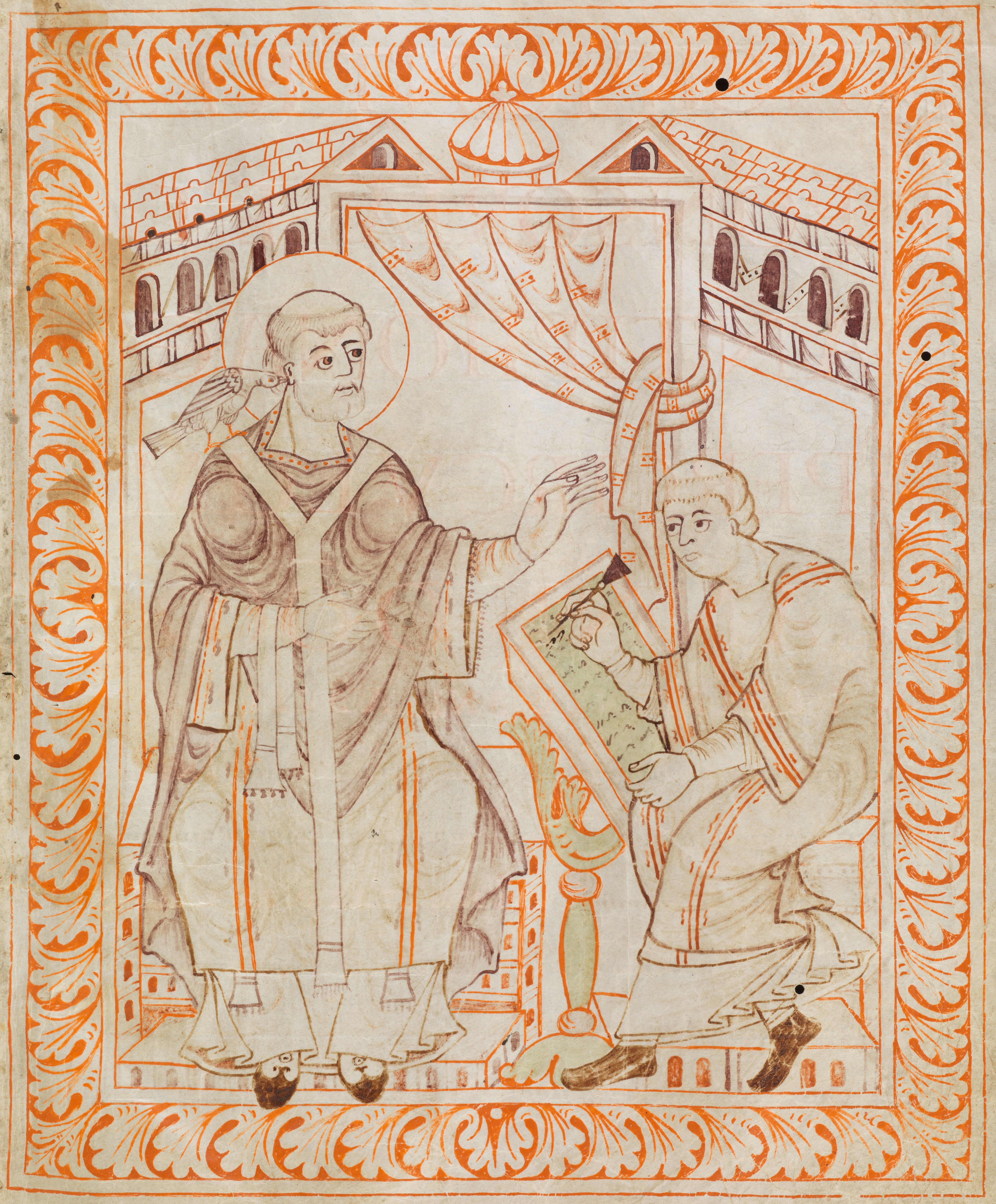
“A dove . . . symbolizes Divine Inspiration” for the Gregorian chant. . .


 From the Scribe (6/29/14)


Once upon a time there was a Great Flood.

Actually there were at least two Great Floods, but this one took place in 1993 – from April to October – and covered “the American Midwest, along the Mississippi and Missouri rivers and their tributaries.”   An estimated 32 to 50 people died.  Some places on the Mississippi River were flooded nearly 200 days and some 100,000 homes were destroyed.  It was among the most costly and devastating floods ever in the United States, with an estimated $15 billion in damages. see Great Flood of 1993 – Wikipedia, the free encyclopedia.

I mention this because my late wife and I took a small part in the relief effort, in the summer of 1994.  Towns like St. Louis were still reeling from the flood and needed all kinds of basic necessities – like plain clean drinking water – that most people normally take for granted.

At the time we had a  van and travel trailer, and had been planning a trip from Florida to Las Vegas anyway.  So as part of the trip we decided to take that van-and-trailer, load them full of supplies, plus a hefty check – all the fruits of a fundraising drive at our local church – and drop them off in St. Louis.   (Which by the way allowed us to deduct part of the trip’s expenses.)

Among other things the long trip west was noteworthy for the number of videos we took along the way.  Most of the videos have this enchanting background music, and that enchanting music was courtesy of the CDs of Gregorian chants that we listened to most of the way.

I mention this because somewhere on the trip from “back then to now,” I lost the habit.  I lost the habit until last Friday afternoon and a particularly bad bout of traffic.   During a long wait at a stop-light I shuffled through my pack of CDs, and came upon one of the “Gregorian” CDs that managed to survive the journey from 1994 to the present day.  It was so soothing, so calming and so relaxing that I wondered why I ever stopped listening to them.

But don’t take my word for it.  Listen for yourself, courtesy of GREGORIAN CHANT – YouTube.

Meanwhile, back at Wikipedia: “Gregorian chant is the central tradition of Western plainchant, a form of monophonic, unaccompanied sacred song of the western Roman Catholic Church,” which developed “mainly in western and central Europe during the 9th and 10th centuries.”  The chants were usually sung by choirs of men and boys in churches, monasteries, other other religious orders.  “Although Gregorian chant is no longer obligatory,” the Catholic Church still considers it “most suitable for worship.”  And lately “plainchant” has enjoyed a “musicological and popular resurgence.”  See Gregorian chant – Wikipedia, the free encyclopedia.

But like most popular phenomena, there’s always the story behind the story.  For one thing, there is some debate whether the chant is really “Gregorian:”

That “Gregorian” chant was named for and credited to Pope Gregory I (r. 590-604) is an accident of politics and spin doctoring.  Tension between the Pope (the Bishop of Rome) and other Bishops regarding the authority of the Pope as “first among equals” was matched by tension between the Pope, as spiritual ruler of Rome, and Rome’s secular rulers. . .    There are any number of lovely stories and legends associated with Gregory[, including] a bird singing chants into his ear as he wrote them down.   (Unfortunately, of course, there was no usable music notation at the time.)   There are [also] stories of his sending out missionaries with instructions to bring back any new music they encountered, saying “Why should the Devil have all the good songs?“

(See Why is chant called Gregorian?)  I had two responses to the quote above, the first being  “Why indeed?”   As in, “Why indeed should the Devil have all the good songs?”

The second response is more along the line of “Be that as it may. . .”  That is, does it really matter if Pope Gregory got undue credit for “creating” such chants, or does it really matter if Admiral Beaufort really “created” the wind scale that carries his name?  (See Defining the Wind: The Beaufort Scale and How a 19th-Century Admiral Turned Science into Poetry.)

“Be that as it may,” we still measure the wind by Beaufort’s scale, and – as I told a dear, dear friend (who happens to be “RC”) – “Gregorian chant is one thing the Catholic Church really got right.”  Or to paraphrase that 1970s TV ad again, “Try it, you’ll like it!”


“Mississippi River out of its banks in Festus, Missouri. . .” 


The upper image is courtesy of Wikipedia.  The full caption:  “A dove representing the Holy Spirit sitting on Pope Gregory I‘s shoulder symbolizes Divine Inspiration.”  Aside from the sources listed in the main text, see also CATHOLIC ENCYCLOPEDIA: Gregorian Chant – New Advent.

As to the “old TV ad from the 1970s, ‘Try it, you’ll like it!‘”   See On “what a drag it is. . .”

The lower image is courtesy of Great Flood of 1993 – Wikipedia, the free encyclopedia, full caption:  “Mississippi River out of its banks in Festus, Missouri.  The spot where this photo was taken” was a mile and a half and 30 feet above the river.  Note too the “waterfront dining” sign, an example of the usual warped-but-plucky American sense of humor in the face of death and disaster. 


On scapegoating

http://fridayfunfact.files.wordpress.com/2011/12/scapegoat.jpg


From the Scribe (6/27/14):


This afternoon I was going through my old posts, transferring them to flash drive in preparing Volume 2 of my collections of Blog-posts.   (Volume 2 will soon be available in e-book or “old-fashioned paperback version.”  See For a paperback or e-book version…)

In doing so I ran across this draft of a review of Daily Office readings for last May 19.  It was on scapegoating, but for some reason I never finished.  So here it is:

*   *   *   *

The Old Testament reading in the Daily Office for Monday, May 19, was Leviticus 16:1-19.  Of particular interest is the original idea of a scapegoat.

In modern usage a scapegoat is an individual, group, or country singled out for unmerited negative treatment or blame.   A whipping boy, “fall guy” or “patsy” is a form of scapegoat…    In ancient Greece a cripple or beggar or criminal (the pharmakos) was cast out of the community, either in response to a natural disaster (such as a plague, famine or an invasion) or in response to a calendrical crisis (such as the end of the year)…   In psychology and sociology, the practice of selecting someone as a scapegoat has led to the concept of scapegoating.

See Scapegoat – Wikipedia.   So the original idea was to make “atonement for sin,” an idea that turns a lot of people off (especially liberals and such).

So again, what’s the big deal about “sin?”

As Isaac Asimov explained, to sin “involves separation from God,” which means in turn an unhealthy separation from both The Force that Created the Universe and the community where you live.   Since the whole idea of most religions or spiritual disciplines is to “become one” with both that Force and that Community, that’s not a good thing.  So “atoning for sin” means getting “back on track on this idea of becoming one with God.”   (See On sin and cybernetics.)

Getting back to the Daily Office OT reading for last May, God – through Moses – directed his brother Aaron to take a bull and two goats, to get the people of Israel back on track to remaining one with “God and neighbor.”  Aaron was then directed as follows:

[T]ake the two goats and set them before the Lord at the entrance of the tent of meeting; 8and Aaron shall cast lots on the two goats, one lot for the Lord and the other lot for Azazel.* 9Aaron shall present the goat on which the lot fell for the Lord, and offer it as a sin-offering; 10but the goat on which the lot fell for Azazel* shall be presented alive before the Lord to make atonement over it, so that it may be sent away into the wilderness to Azazel.

So what the heck is Azazel?

The term is used three times in the Hebrew Bible – what we call the Old Testament – and  has been “traditionally understood either as a scapegoat, or in some traditions of Judaism, Christianity, and Islam, as the name of a fallen angel or demon.”

The medieval scholar Nachmanides (1194–1270) identified the Hebrew text as also referring to a demon. . .   However, he did not see the sending of the goat as honoring Azazel as a deity, but as a symbolic expression of the idea that the people’s sins and their evil consequences were to be sent back to the spirit of desolation and ruin, the source of all impurity. The very fact that the two goats were presented before God, before the one was sacrificed and the other sent into the wilderness, was proof that Azazel was not ranked alongside God, but regarded simply as the personification of wickedness. . .

(See Azazel – Wikipedia.)  And by the way, in keeping with the theory that there is “nothing new under the sun,” Azazel these days has become a “comic book supervillain.”

That is, these days he appears in comic books published by Marvel, and in particular those featuring the X-Men. A mutant with the power of teleportation, he is the father of the X-Man Nightcrawler.”  See Azazel (Marvel Comics) – Wikipedia.

As to the reappearance of Azazel – albeit as a comic figure – see Ecclesiastes 1:9:

What has been will be again,
    what has been done will be done again;
    there is nothing new under the sun.


The upper image is courtesy of “fridayfunfact.files.wordpress.com/2011/12/scapegoat.jpg.”

The full text of the “scapegoat” passages:

11 Aaron shall present the bull as a sin-offering for himself, and shall make atonement for himself and for his house; he shall slaughter the bull as a sin-offering for himself. 12He shall take a censer full of coals of fire from the altar before the Lord, and two handfuls of crushed sweet incense, and he shall bring it inside the curtain 13and put the incense on the fire before the Lord, so that the cloud of the incense may cover the mercy-seat* that is upon the covenant,* or he will die. 14He shall take some of the blood of the bull, and sprinkle it with his finger on the front of the mercy-seat,* and before the mercy-seat* he shall sprinkle the blood with his finger seven times.

15 He shall slaughter the goat of the sin-offering that is for the people and bring its blood inside the curtain, and do with its blood as he did with the blood of the bull, sprinkling it upon the mercy-seat* and before the mercy-seat.* 16Thus he shall make atonement for the sanctuary, because of the uncleannesses of the people of Israel, and because of their transgressions, all their sins;


There is also a physical Mount Azazel, located in the “Judean Desert 14 km southeast of Jerusalem.” See Let us tour Eretz Yisroel: Mount Azazel:  “A road through the desert connects Jerusalem with Mount Azazel or Jabel Muntar. . .     Most likely, this very road was used to march the scapegoat to its death on the high place of Mount Azazel.”

“As Isaac Asimov explained…”  See Asimov’s Guide to the Bible (Two Volumes in One),  Avenel Books (1981), at page 157 (on Leviticus).

On the idea of becoming “one with The Force That Created the Universe” (and even your most obnoxious neighbor), see Some Bible basics from Vince Lombardi and Charlie Chan:

Hear what our Lord Jesus Christ said: “You shall love the Lord your God with all your heart, with all your strength, and with all your mind. This is the first and great commandment, and the second is like unto it: you shall love your neighbor as yourself.  On these two commandments hang all the Law and the Prophets.

As to the modern-day “comic book” version:  “Azazel claims that many years ago an ancient horde of demonic humanoid mutants from biblical times called the Neyaphem were in an epic battle with a group of angelic xenophobic mutants. . .   The Neyaphem’s leader, Azazel, was the only one who was able to breach the dimensional void for brief periods of time due to his teleportation powers. His only hope to return to Earth was by impregnating women because his children are linked to his dimension.”   (Which also sounds patently familiar.)


On “nothing new under the sun,” see also Ecclesiastes – Wikipedia:

Ecclesiastes has had a deep influence on Western literature: American novelist Thomas Wolfe wrote:   “[O]f all I have ever seen or learned, that book seems to me the noblest, the wisest, and the most powerful expression of man’s life upon this earth — and also the highest flower of poetry, eloquence, and truth.  I am not given to dogmatic judgments in the matter of literary creation, but if I had to make one I could say that Ecclesiastes is the greatest single piece of writing I have ever known, and the wisdom expressed in it the most lasting and profound.”


On “expressio unius”

Re: “Latin scholar. . .”


From the Scribe:

There’s a sign at my bank, taped to the window next to the front door.  It has words saying in effect, “When entering, please remove your hat and/or sunglasses,” etc.

So being a former lawyer, I do exactly that.  “When entering,” I remove my hat.  Then, once I get inside I put my hat back on.  I do that because in law school I learned the maxim, expressio unius est exclusio alterius.  That translates to “the expression of one thing is the exclusion of another.”

Among other things, this is called gaming the system, about which more later.

It also brings up the distinction between the letter of the law and the spirit of the law.

The spirit of the bank’s request seems pretty clear:  Remove your hat and/or sunglasses, so in case you turn out to be a bank robber we’ll be able to have clear surveillance photos of your sorry “self” and will be able to send you to jail.   On the other hand, by focusing exclusively on the letter of that bank-request, you can pretty much rob it of its intended effect.

(A BTW:  That’s the whole theory behind this Blog.  And just in case I’m being too subtle, let me spell it out.  Those “fundamental” people who focus exclusively on the “letter” of the Bible – limiting it to a strict “literalism” – pretty much likewise rob it of its intended effect.)

That’s why the Apostle Paul said in Second Corinthians 3:6, that God “has made us competent to be ministers of a new covenant, not of the letter, but of the Spirit.  For the letter kills, but the Spirit produces life.”  (That’s the Holman Christian Standard Bible, emphasis added.)

That’s also arguably why Jesus Himself said, “For God is Spirit, so those who worship him must worship in spirit and in truth.”  (The Living Bible, emphasis added.)  In other words, these passages show that God does not want Good Christians to limit their reading, interpreting and living according to the Bible to a spirit-killing literalism.  (A sentiment that can easily get you a busted nose in these parts, like the “scholar” portrayed above.)

So based on expressio unius, here’s how a sleazy lawyer and/or “literalist” would interpret the bank’s request.  “If they wanted me to keep my hat and/or sunglasses off the whole time I was in the bank, they would have said so clearly and plainly.  Instead they just told me to take off my hat and/or sunglasses ‘when entering.'”  On the other hand, maybe the bank didn’t think it needed to either “waste the space” or spell out something that should be perfectly clear by a reasonable person using good old common sense.

Which brings up Gaming the system.  Such a practice is also known as “gaming the rules, bending the rules, abusing the system, milking the system, playing the system, or working the system,” and can further be defined as using the rules and procedures “to manipulate the system for a desired outcome.”

See also, Wikipedia: Gaming the system, which notes, “Gaming the system means deliberately using Wikipedia policies and guidelines in bad faith to thwart the aims of Wikipedia.”  That could easily be interpolated into, “Gaming the system includes deliberately using those policies and guidelines set out in the Bible, in bad faith, either to thwart the aims of the people and/or entities who took part in writing the Bible.”

Now I’m not saying that there aren’t many good Christians who take the Bible “literally,” but in a whole and entire “good faith.”  I’m simply saying – again – that taking the Bible too literally can both rob it of its intended effect, and give rise to a temptation to manipulate the Bible for a desired outcome, as for example some “charismatic personality who infuses biblical passages and fervor into his pitches as a way to ease and collect money.”

Forewarned is forearmed.  That’s all I’m saying (even though it may get me a busted nose.).


The upper image is “at:  en.wikipedia.org/wiki/Classics,” with the caption:  “Bust of Homer, the ancient Greek epic poet.”  (Latin, Greek, whatever. . .)

See also Expressio unius est exclusio alterius legal definition of ….

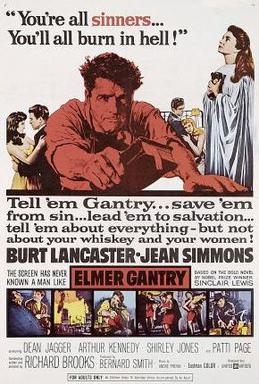
The lower image is courtesy of Wikipedia, Elmer Gantry – Wikipedia, the free encyclopedia, and Elmer Gantry (film) – Wikipedia, the free encyclopedia:

On publication in 1927, Elmer Gantry created a public furor.  The book was banned in Boston and other cities and denounced from pulpits across the USA.  One cleric suggested that Lewis should be imprisoned for five years, and there were also threats of physical violence against the author.  The famous evangelist Billy Sunday called [author Sinclair] Lewis “Satan‘s cohort.”   [But] Elmer Gantry ranked as the number one fiction bestseller of 1927, according to “Publisher’s Weekly.”

See also, The lady doth protest too much, methinks – Wikipedia, referring to a line from Shakespeare’s play Hamlet, which line is “used as a figure of speech . . . to indicate that a person’s overly frequent or vehement attempts to convince others of something have ironically helped to convince others that the opposite is true, by making the person look insincere and defensive.”

And finally, see Forewarned is forearmed – Idioms and phrases, and Praemonitus praemunitus – Wikipedia, for our second Latin lesson for the day.

Abraham and Isaac – Where God CHANGED some “traditional values and attitudes…”

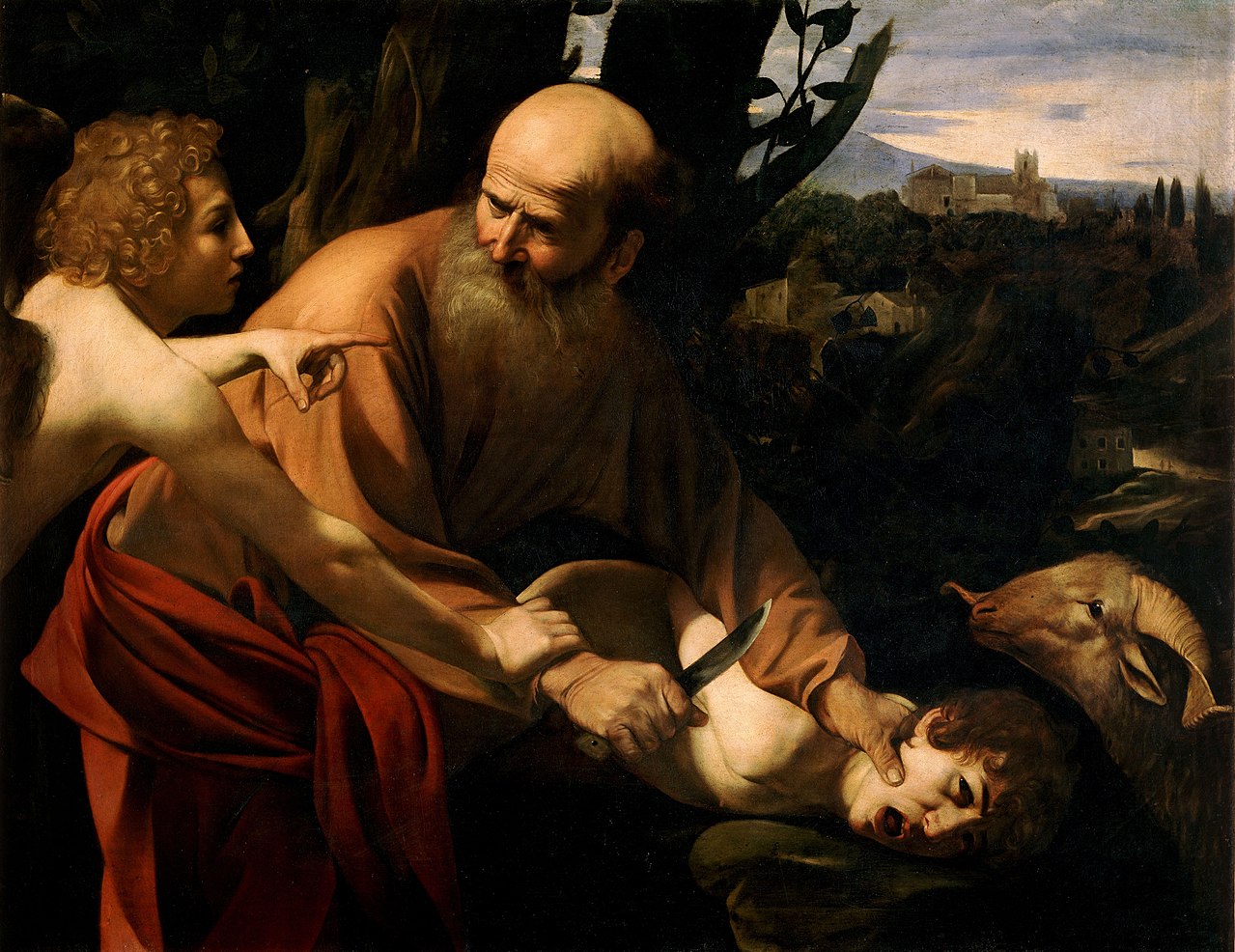
“The ‘Sacrifice of Isaac,’ where God finally said “Stop!  Let’s change some ‘traditional values…'”

*   *   *   *

The readings for June 29, 2014, are Genesis 22:1-14, Psalm 13, Romans 6:12-23, and Matthew 10:40-42.  The Genesis story tells of God apparently asking Abraham to kill his son.
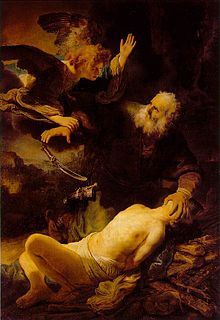
That is, In Genesis 22:1-14, “God tested Abraham,” by appearing to ask him to kill his first-born son Isaac.  That was the son – Isaac – that Abraham and his wife Sarah had been waiting and praying for “lo these many years.”   (As noted in On “Call me Ishmael” – June 22 Part I, “Abraham was 100 years old when Isaac was born, and Sarah was past 90” when Isaac was born.)

The story bothers a lot of people.  That’s because it apparently shows God ordering a father to kill his own son.  And that’s the view you would take if you took the lesson literally.   

But if you look at some other “prevailing wisdom,” you might get a wholly different take.  (See On “originalism,” noting that originalism is the view that interpretation “should be based on what reasonable persons living at the time . . . would have declared the ordinary meaning of the text to be.”)  In that view you would ask:  What would a reasonable man – under the “community standards” at the time – have thought of Abraham killing his son as a “sacrifice?”

Apparently it wouldn’t have bothered that “reasonable man” at all.  That’s because at that time and place, child sacrifice was quite common.  See Binding of Isaac – Wikipedia – illustrated at right – and citing “Hertz:”

“[C]hild sacrifice was actually “rife among the Semitic peoples. . .  [I]n that age, it was astounding that Abraham’s God should have interposed to prevent the sacrifice, not that He should have asked for it.”  Hertz interprets the Akedah as demonstrating to the Jews that human sacrifice is abhorrent.

A note:  Akedah is Hebrew short-hand for the Abraham-Isaac story, and translates “The Binding.”  So to a reasonable Semite at the time – when the story occurred, or when Moses wrote it down, if not both – a father offering his son as a “sacrifice to the gods” was so common that the Akedah proved the noteworthy exception.

So at the time of Abraham, routine child sacrifice was a prevailing “traditional value.”

Which means this story would  be something like today’s “man bites dog” journalism.  That is, a story about “an unusual, infrequent event is more likely to be reported as news than an ordinary, everyday occurrence.”  See Man bites dog (journalism) – Wikipedia.

(Did the Scribe mention that he got a Master’s Degree in Journalism?)

So the Good News is not that God is as cruel as a literal reading of the story would indicate.  (I.e., from from a “plain reading.”)  The point God wanted to make was just the opposite of what a plain or “literal reading” would show.  God wanted to change some of the “prevailing practices” at the time.  On that note, the general definition of conservative is of a “person who is averse to change and holds to traditional values and attitudes.”

But in this case, God felt a prevailing practice needed to be changed.

*   *   *   *

Moving on, in Psalm 13, the writer first asked, “How long, O LORD?  Will you forget me for ever?”  But he ended on a note of hope, “I will sing to the LORD, for he has dealt with me richly; I will praise the Name of the Lord Most High.”  (Maybe because God didn’t require child sacrifice.)

In Romans 6:12-23, Paul wrote about the wages of sin; “For the wages of sin is death, but the free gift of God is eternal life in Christ Jesus our Lord.”  And the post D-Day and confession addressed this whole business of sin, a “business” that seems to turn off a whole lot of non-Christians.  (For example, the search “Christians hung up on sin” led to offerings including Advocatus Atheist: Why are Christians Hung Up on Sin?)  Anyway, here’s what  “D-Day” said:

When we “sin” we simply fall short of our goals; we “miss the target.”  When we “confess,” we simply admit to ourselves how far short of the target we were.   And maybe the purpose of all this is not to make people feel guilty all the time, as some seem to imply.

Note also Paul’s saying, in Romans 6:19, “I am speaking in human terms because of your natural limitations.”  In other words Paul – like Moses and indeed God Himself – is not limited by his (or His) ability to teach, but only by our ability to comprehend.

So Moses couldn’t tell “the truth” about such things as the earth revolving around the sun, because he had to tell the story of Creation “using language and concepts that his relatively-pea-brained contemporary audience could understand.” See On the readings for June 15 – Part I.  So also Paul – like God – had to keep in mind the “natural limitations” of his (His) audience.

And finally, in Matthew 10:40-42, Jesus spoke of the “reward of the righteous.”  That especially concerned the children who used to be so routinely offered as a sacrifice to the “old gods” in the time of Abraham.  As Jesus said, “Whoever gives even a cup of cold water to one of these little ones in the name of a disciple – truly I tell you, none of these will lose their reward.”

Note the difference – and the improvement – over some “traditional values and attitudes.”

*   *   *   *

“Christ with children by Carl Heinrich Bloch.”

*   *   *   *

The upper image is courtesy of Binding of Isaac – Wikipedia.  The full caption reads: “‘The Sacrifice of Isaac’ by Caravaggio, in the Baroque tenebrist manner.”  As to the wording of the caption, see “Or words to that effect” – Wiktionary, and also “Or Words to that Effect” – Adoremus Bulletin, quoting the character Richard Rich in the plan “A Man for All Seasons.”

Re:  Abraham – Wikipedia.  The caption for the image to the left of the lead paragraph is captioned:  “Abraham about to sacrifice Isaac. From a 14th-century missal.”

Note also this post was originally published on June 23, 2014, titled, “On the readings for June 29.”  I upgraded it, changed the title, added some images and otherwise upgraded it on October 16, 2018.

As to reasonable, see Reasonable person – Wikipedia:  “The reasonable person (historically reasonable man) is one of many tools for explaining the law to a jury.”

As to the Hertz reference, “Rabbi Joseph Herman Hertz, CH (September 25, 1872 – January 14, 1946) was a Jewish Hungarian-born rabbi and Bible scholar. He is most notable for holding the position of Chief Rabbi of the United Kingdom from 1913 until his death in 1946, in a period encompassing both world wars and the Holocaust.”

The lower image – and note the contrast between the upper and lower images – is courtesy of The Little Children – Wikipedia.

On “holier than thou”

*   *   *   *

Try this. Type “holier” in your search engine. “Holier than thou” will automatically pop up, and there’s probably some kind of object lesson there.  (“An example from real life that teaches a lesson or explains something.”)

Then too, an Internet “holier than thou” search will lead to the self-righteousness article in Wikipedia. It defines self-righteousness and/or a holier than thou attitude as a “feeling or display” – usually smug – “of moral superiority derived from a sense that one’s beliefs, actions, or affiliations are of greater virtue than those of the average person. Self-righteous individuals are often intolerant of the opinions and behaviors of others.”

Wikipedia also noted that the term is often considered derogatory:

…particularly because self-righteous individuals are often thought to exhibit hypocrisy due to the belief that humans are imperfect and can therefore never be infallible, an idea similar to that of the Freudian defense mechanism of reaction formation. The connection between self-righteousness and hypocrisy predates Freud‘s views, however, as evidenced by the 1899 book Good Mrs. Hypocrite: A Study in Self-Righteousness, by the pseudonymous author “Rita.”

In other words, the attitude has been around for a lot longer than 1899.   In fact it was around when Jesus walked the shores of Lake Galilee, which leads to another interesting note. The Wikipedia article on self-righteousness includes a link to The Mote and the Beam, the parable of Jesus illustrated in the painting above.  (There’s probably some kind of object lesson there too.) If you missed it, here’s Wikipedia on the story:

The Mote and the Beam (also called discourse on judgmentalism) is a proverbial saying of Jesus given in the Sermon on the Mount, in the Gospel of Matthew, chapter 7, verses 1 to 5. The discourse is fairly brief, and begins by telling his disciples not to judge others, arguing that they too would be judged by the same standard.

Specifically, Jesus said, “Why, then, do you look at the speck in your brother’s eye and pay no attention to the log in your own eye?   4 How dare you say to your brother, ‘Please, let me take that speck out of your eye,’ when you have a log in your own eye?  5 You hypocrite! First take the log out of your own eye, and then you will be able to see clearly to take the speck out of your brother’s eye.”  (This was right before Jesus told about “casting pearls before swine.”)

So how do you know if you’re self-righteous???  That’s the problem, you don’t.  If you’re self-righteous or have a “holier than thou” attitude, you won’t realize it.  That’s because – being self-righteous – you simply can’t admit the possibility that you are wrong.  You simply can’t be wrong on your take on the Bible, and more to the point, you simply can’t be wrong in telling people that you’re going to heaven and they aren’t.  (“Bleah!”)

(That’s where the “prevailing quacks” come in. See the Mencken note below.)

Or maybe it’s like what a former mentor, Father Watson, said about the Unforgiveable Sin.  He said if you’re worried that you may have committed the Unforgiveable Sin (or the Eternal Sin), you probably haven’t.  In other words, just by being aware you may have committed the Unforgiveable Sin can assure you that you haven’t.

In the same way, just being aware that you may be self-righteous – or may have a “holier than thou” attitude – is a strong indication that you probably don’t have either problem.

Of course I could be wrong!

http://3.bp.blogspot.com/-XZJhPXe2I7M/TLqFa9FQUfI/AAAAAAAAABk/brh__nKDJik/s1600/ducksign.jpg


The upper image is courtesy of the “Mote and beam” Wikipedia article.   The full caption: “A [circa] 1619 painting by Domenico Fetti entitled The Parable of the Mote and the Beam.”

“Object lesson.”  See Object lesson – Merriam-Webster Online, and also object lesson – Wiktionary.

As to Father Watson’s take, see also What is the “unforgivable sin … Power to Change: “Thus, if you are worried that you have committed blasphemy against the Holy Spirit, you could not possibly have done it.”  (Emphasis in the original.)

As to what God really wants – rather than being self-righteous or “holier than thou” – see the end of On the June 22 readings – Part II: from Micah 6:8 (in the Living Bible); God “has told you what he wants, and this is all it is: to be fair, just, merciful, and to walk humbly with your God.”

The lower image is courtesy of “http://3.bp.blogspot.com/-XZJhPXe2I7M/TLqFa9FQUfI/AAAAAAAAABk/brh__nKDJik/s1600/ducksign.jpg.”   The image refers H. L. Mencken’s quote indicating the job of both journalists and Christians is to “challenge the prevailing quacks,” as noted in his Minority Report:

The only way that democracy can be made bearable is by developing and cherishing a class of men sufficiently honest and disinterested to challenge the prevailing quacks.   No such class has ever appeared in strength in the United States.  Thus, the business of harassing the quacks devolves upon the newspapers.  When they fail in their duty, which is usually, we are at the quacks’ mercy.

Did the Scribe mention that he has a Master’s Degree in journalism??

On sharing the “Keys to the Kingdom”

http://1.bp.blogspot.com/--1vhjKxrU9U/UGeCj3_8C8I/AAAAAAAAIng/uG8Bh0ZvmMY/s1600/jesus-handing-keys-to-apostle-peter.jpg


Roman Catholics like to claim theirs is the one-and-only true church, based on Matthew 16:13-19, where Jesus asked His disciples, “Who do people say that the Son of Man is?”

The guesses included John the Baptist, Elijah, Jeremiah, or one of the other prophets of old.  Then Jesus said, “But who do you say that I am?”

Simon Peter said in reply, “You are the Messiah, the Son of the living God.”  Jesus said to him in reply, “Blessed are you, Simon son of Jonah. . .   I say to you, you are Peter, and upon this rock I will build my church, and the gates of the netherworld shall not prevail against it.  I will give you the keys to the kingdom of heaven. Whatever you bind on earth shall be bound in heaven; and whatever you loose on earth shall be loosed in heaven.” (E.A.)

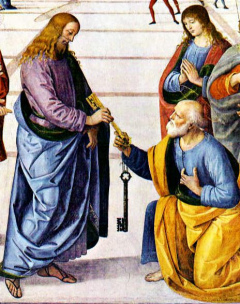
So far so good.  Jesus gave Peter the “keys to the kingdom,” as shown in the painting-detail above.  (Actually a fresco in the Sistine Chapel.)  And so – Jesus told Peter – “Whatever you bind on earth shall be bound in heaven; and whatever you loose on earth shall be loosed in heaven.” (See Power of the Keys – Wikipedia, and CATHOLIC ENCYCLOPEDIA: Power of the Keys – New Advent.)

But note what happened a couple chapters later, in Matthew 18.  That chapter began with the  disciples – all 12 of them – coming to Jesus and asking, “Who is the greatest in the kingdom of heaven?”  That’s when Jesus called a child and “put him in the midst of them” – all 12 of them – and said, “Truly, I say to you, unless you turn and become like children, you will never enter the kingdom of heaven.”  Jesus spoke on sin and “woe to the man by whom the temptation comes!”  He added the metaphor – not to be taken literally – about plucking your eye out if it caused you to sin, because “it is better for you to enter life with one eye than with two eyes to be thrown into the hell of fire.”  Later He added this, speaking to all 12 disciples:

Truly, I say to you, whatever you bind on earth shall be bound in heaven, and whatever you loose on earth shall be loosed in heaven.

Wait.  What?  Weren’t those the same words that Jesus spoke to only Peter, a chapter or two before?  And wasn’t that the same power that Jesus had given only to Peter?

What happened?

One thing that happened came just a few verses later in Matthew 16, beginning at verse 21.  That’s where Jesus started to tell His disciples He had to go to Jerusalem, suffer at the hands of “the elders and chief priests and scribes,” and be killed, and on the third day be raised:

And Peter took him and began to rebuke him, saying, “God forbid, Lord! This shall never happen to you.” 23 But [Jesus] turned and said to Peter, “Get behind me, Satan!  You are a hindrance to me; for you are not on the side of God, but of men.” (E.A.)

(In the words of the King James Bible – the one God uses – the phrase was “Get thee behind me, Satan.”)  As to why Jesus said that, consider Why did Jesus say to Peter, “Get behind me Satan”?   But the fact remains that Jesus did say that, and so – not long after saying that – He took the exclusive power He’d given to Peter and made it the power of all 12 disciples.

As to the effect of that change, see for example A Natural Law Manifesto – Right Reason, which indicated in pertinent part that “the statute passed later is presumed to have superseded the law enacted earlier.”  See also 7 Modification of Contracts – Shefsky & Froelich, which indicated that an “agreement that is complete on its face supersedes all prior agreements on the same
subject matter.”  (Did the Scribe mention that he was a lawyer in his prior life?)

So, in Matthew 16:16 Jesus gave Peter the exclusive power of the “keys to the kingdom.”  Then a few verses later Jesus sternly rebuked Peter for becoming “an unwitting spokesperson for Satan.” (See the “Why did” site above.)  Later still Jesus either effectively modified His “statute” or His “contract” and – using the same language – changed the power of “binding and loosing” by giving it to all 12 disciples instead of just Peter alone.

The effect of all this is to nullify the strong implication – promoted by the whole “St. Peter and the Keys” thing – that only Roman Catholics will get into heaven.  Of course Southern Baptists say pretty much the same thing, on the theory that infant baptism has no practical effect and that in order to get into heaven you have to be baptized as an adult. (See Baptists – Wikipedia.)

But what does the Bible say?  For one thing the Apostle Paul said, in Philippians 2:12, “work out your own salvation with fear and trembling.”  Which is of course perfectly consistent with what he said much earlier, in Romans 10:9, “If you declare that Jesus is Lord, and believe that God brought him back to life, you will be saved.”  (Emphases added.)

Maybe that’s why they call it “Good News. . .”

*   *   *   *

*   *   *   *

As to the keys to the kingdom, see also Delivery of the Keys (Perugino) – Wikipedia, the …, describing a fresco in the Sistine Chapel, in Rome.  The image at the top of this post is a detail of that fresco.

As to “Roman Catholics.”  Here’s the distinction.  “Small-c” catholic means universal or comprehensive; “especially :  broad in sympathies, tastes, or interests <a catholic taste in music>”.  See Catholic – Definition and More from the Free Merriam-Webster.  A more earthy example might be:  “That guy certainly has catholic tastes in women.  He’ll do anybody.”

But see also Cafeteria Catholicism – Wikipedia, which noted in part:

The term cafeteria Catholicism is applied to those who assert their Catholic identity yet dissent from Catholic doctrinal or moral teaching or who are viewed as dissenting by those using the term.  Examples include Catholics who are accused of dissenting from Church teachings on human sexuality (the so-called “pelvic issues”). . .

The site also noted that the term “is most often used by conservative Catholics critical of progressive Catholics.”  On that note see About this Blog, which said “those who read the Bible strictly, narrowly and/or ‘fundamentally'” – or you could read in conservatively – “are not only cheating themselves, they’re also driving other people away from the Faith of the Bible in droves.”

As to good news and gospel:  “The word gospel derives from the Old English gōd-spell [5] (rarely godspel), meaning ‘good news’ or ‘glad tidings.’   The word comes from the Greek euangelion, or ‘good news.’   The gospel was considered the ‘good news’ of the coming Kingdom of Messiah, and of redemption through the life and death of Jesus, the central Christian message.” Gospel – Wikipedia.  The lower image is courtesy of that article, which featured the caption, “The first page of the Gospel of Mark in Armenian, by Sargis Pitsak, 14th century.”