Category Archives: Feast Days

On Hilary – 1″L,” and HE was a bishop…

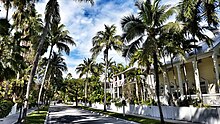
Chelsea, Bill, and Hillary Clinton take an inauguration day walk

The “Hillary” in pink is NOT the one we’re talking about today…


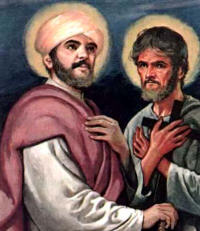
Wednesday, January 13, is the Feast Day for St. Hilary.  And the “Hillary” we’re talking about today is not the one shown in the image above.

But note first that the term “feast” here doesn’t mean a large meal.  (As in a family celebration.) Instead it refers to a religious celebration dedicated to a particular saint.

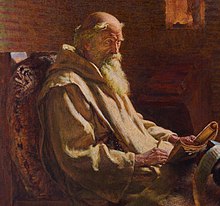
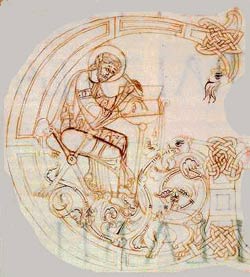
Illuminated manuscript showing Hilary writing his commentary on MatthewIn this case, Saint Hilary was born in Poitiers, a city in France.  (Some 210 miles southwest of Paris.)  We don’t know exactly when he was born.  (Either “at the end of the 3rd or beginning of the 4th century A.D.” Best guess: somewhere around 310 A.D.)

For the Bible readings of the day – and a short biography –  see Hilary, from the “Satucket” Lectionary.  (That page included the image at left, apparently related to Hilary.  For more on the image, right-click “Search Google for image.”)  And speaking of Hilary, we’re not real sure when he died either.  But according to St. Jerome, he died in Poitiers in 367.

(Jerome was a noted priest, confessor, theologian, historian, and Doctor of the Church.)

Hilary’s parents were pagans – “of distinction.”  And he was said to have had a “good pagan education, which included a high level of Greek.”  His name came from the Latin for “happy” or “cheerful.”  And somewhere between 350 and 353, the Christians of Poitiers “so respected Hilary” that they unanimously elected him their bishop.

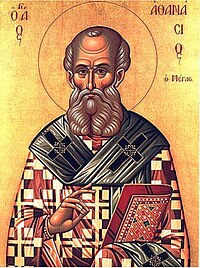
Ikone Athanasius von Alexandria.jpgThe problem was that Hilary served as bishop at the time of a great early-church conflict:  The one pitting Athanasius – shown at right – against Arius.  (For whom Arianism was named.)

Arianism is the nontrinitarian belief that Jesus, as the Son of God, was “created by God the Father.”  In other words, that “God the Father and the Son of God did not always exist together eternally.”

For more information on the conflict, see Arian controversy:

The Arian controversy …  arose between Arius, a priest and theologian, and Bishop Athanasius, a Church Father.  The most important of these controversies concerned the substantial relationship between God the Father and Jesus Christ.  These disagreements divided the Church into two opposing theological factions for over 55 years … until after the Council of Constantinople in 381.  There was no formal resolution or formal schism[.]  The Catholic church eventually formed its own theology on this matter.

In a nutshell, the issue was whether Jesus was of the “same substance” as God – the Athanasian position – or of (merely) a “similar substance.”  (The position held by Arius.)

The argument may sound pretty obtuse to us today.  But back in the mid-300s, it was immensely important.  It had just been some 40 years – since around 313 – that Christianity had been “decriminalized.”  (It changed from being a persecuted religion to one that was “tolerated” by the Roman state.  In documents including the Edict of Milan.)

And contrary to the popular assertion that Roman emperor Constantine the Great made Christianity Rome’s official religion, that didn’t happen in 313.

The image at right shows Constantine’s conversion (As “imagined by Rubens.”)  But despite that conversion, Constantine “continued to support both Christianity and paganism.  In 314, the cross appeared on Constantine’s coins, but so did the figures of Sol Invictus and Mars.” (Mars was the Roman god of war.  See also “to hedge your bets.”)

In fact, Christianity wasn’t made Rome’s official religion until 380 – or 391 – under Theodosius I.

The point is this:  That at the time of the Arian controversy, the stakes were pretty high. (Basically the future of the Western Church was at stake.)  Then too, Roman emperors changed their minds quite often.  That’s what happened to St. Hilary.  For a time the Emperor backed the Arian argument, which led to Hilary getting exiled for four years.

On that note, the Gospel for Hilary’s day – Luke 12:8-12 – included this:

When you are brought before synagogues, rulers and authorities, do not worry about how you will defend yourselves or what you will say, for the Holy Spirit will teach you at that time what you should say.”

Those are the words of Jesus, in Luke 12:11 and 12:12.  And they pretty much summed up what Hilary had to go through, facing up to the Roman emperor Constantius II.

Constantius II ultimately followed a compromise position – between Arius and Athanasius. (“Retrospectively called Semi-Arianism.”)  But in 356 A.D., he found the Arian position persuasive enough to banish Hilary to Phrygia for four long years.  (At the time, Phrygia – in the west central part of what is now Turkey – was something of a backwater of the Roman Empire.)

Put another way, for his strong defense of Athanasius, “Hilary has often been referred to as ‘Athanasius of the West.'”  But in 356, he essentially backed the wrong horse.

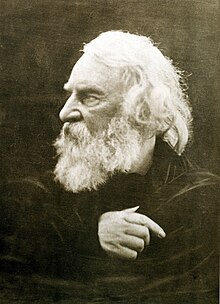
Oliver Wendell Holmes Jr circa 1930-edit.jpgOn the other hand, Hilary put his four years in exile to good use.  He honed his arguments so well that they ultimately acquired the force of (church) law.  In essence he was a “Great Dissenter” over 1,500 years before Supreme Court justice Oliver Wendell Holmes, Jr.  (Holmes’ “dissents were often prescient and acquired so much authority that he became known as ‘The Great Dissenter.'”  He is shown at right.)

Which is another way of saying “Athanasianism” ultimately won the day.

In fact – and as a bit of an aside – you can see the full text of the Athanasian Creed in today’s Book of Common Prayer.  (Under the link, Historical Documents of the Church, and/or beginning on page 864, under the “Council of Chalcedon” entry.  For more on the Creed, see the notes.)

But note also that Athanasius wrote his creed “during his exile in Rome.”  In fact, Athanasius got exiled five times during his bishopric, mostly because succeeding emperors kept changing their minds.  (Between “orthodoxy” and Arianism.)  Which could go to show that some of the great writing in history has come from people “in exile.”  (See e.g. Prison literature – Wikipedia.)

Be that as it may, on January 13 we remember Hilary of Poitiers, the 4th-century philosopher:

[His] studies made him a champion of orthodox Trinitarian theology during one of the most difficult periods of Church history. He protected the Church and its members by brilliantly defending the sacred humanity of Jesus while also defeating aranism which denied Christ’s divinity.  St. Hilary was a gentle and courteous man, devoted to writing some of the greatest theology on the Trinity, and … in being labeled a “disturber of the peace.”  In a very troubled period in the Church, his holiness was lived out in both scholarship and controversy.

Which could show that sometimes God’s work means being “a disturber of the peace.”


Hilaryofpoitiers.jpg

“The ordination of Saint Hilary of Poitiers…”

*   *   *   *

The upper image is courtesy of Hillary Clinton – Wikipedia, the free encyclopedia.  The caption: “The Clinton family takes an Inauguration Day walk down Pennsylvania Avenue to start President Bill Clinton’s second term in office, January 20, 1997.”

The text of this post was gleaned from from sources including Hilary of Poitiers – WikipediaST. HILARY OF POITIERS :: Catholic News Agency (CNA)CATHOLIC ENCYCLOPEDIA: St. Hilary of Poitiers, and What is Arianism? – GotQuestions.org.

Re: Constantine’s conversion, said to happen in 313.  See Constantine … and Christianity – Wikipedia:

[When] Constantine the Great reigned … Christianity began to transition to the dominant religion of the Roman Empire.  Historians remain uncertain about Constantine’s reasons for favoring Christianity, and theologians and historians have argued about which form of Early Christianity he subscribed to…  Some scholars question whether he should be considered a Christian at all … and he did not receive baptism until shortly before his death.

[His] decision to cease the persecution of Christians in the Roman Empire was a turning point for Early Christianity…  In 313, Constantine and Licinius issued the Edict of Milan decriminalizing Christian worship.  The emperor became a great patron of the Church and set a precedent … and the notion of orthodoxy, Christendom, ecumenical councils and the state church of the Roman Empire declared by edict in 380.

As noted above, the edict in 380 – or 391 depending on the source – was promulgated by Theodisius. 

Re: Athanasius and his Creed.  Note that his first exile was to Gaul (to what is now Trier in Germany). His second exile was a type of “protective custody” in Rome, where he wrote his Creed.  Later exiles included his twice “withdrawing” into the desert of Upper Egypt, and lastly an exile of a few months to the outskirts of Alexandria, where he had been serving as bishop.  As to the Creed:

The Latin name of the creed, Quicunque vult, is taken from the opening words, “Whosoever wishes.”  The creed has been used by Christian churches since the sixth century.  It is the first creed in which the equality of the three persons of the Trinity is explicitly stated.

The lower image is courtesy of Hilary of Poitiers – Wikipedia.  The full caption indicated that the image was gleaned from a 14th-century manuscript.  


Epiphany, circumcision, and “3 wise guys”

The Adoration of the Magi, by Bartolomé Esteban Murillo

*   *   *   *

The 12 Days of Christmas officially end on January 6.  But in another sense you could say the extended Christmas holiday season doesn’t end – this year – until January 11.

To the Church of England – and others – that Feast Day is known as Plough Monday.  (As noted in the post of the same name, which also noted the preceding “Plough Sunday.”)  But the key to all these Feast Days is January 6, familiar to most church-goers as the Epiphany.

The Epiphany is the “Christian feast day that celebrates the revelation of God the Son as human in Jesus Christ.”  Yet another name for January 6 is Three Kings’ Day:

The observance [of Epiphany] was a general celebration of the manifestation of the Incarnation of Jesus Christ.  It included the commemoration of his birth; the visit of the Magi [and] all of Jesus’ childhood events, up to and including his baptism in the Jordan by John the Baptist;  and even the miracle at the wedding at Cana in Galilee. [E.A.]

So January 6 is celebrated for a number of reasons, including but not limited to the Epiphany. That’s another way of saying the day also commemorates – inter alia – the circumcision of Jesus, as noted below.  But first some more on the Magi (“Three Kings”).

In its original sense – circa 600 A.D. – Magi meant “followers of Zoroastrianism or Zoroaster.”

But starting about 1200 A.D., the term became more commonly used “in reference to the “μάγοι” [“magoi”] from the east who visit Jesus.”  (As noted in Matthew 2, verses 1-12.  And incidentally, these “Three Wise Men” were mentioned only in Matthew’s Gospel.)

The consensus – that there were three “kings” – seems to have arisen because they brought three gifts:  Gold, frankincense, and myrrh.  And while a literal view of the Three Wise Men seems to indicate that they arrived at the manger-scene shortly after the birth of Jesus, the truth of the matter seems a bit harder to pin down.

For one thing the Bible doesn’t name these three kings.  (Shown at left.)

But later tradition and legend did provide a number of names.  The most common names given the three are:  Melchior, from Persia; Caspar, from India; and Balthazar, from Babylon.  (Which could have presented some logistical difficulties;  for example, in their getting together to start the trip.)  And as to when they actually visited Jesus:

The Bible specifies no interval between the birth and the visit [by the Magi, but] artistic depictions … encourage the popular assumption that the visit took place the same winter as the birth…  [L]ater traditions varied, with the visit [said to occur] up to two winters later.  This maximum interval explained Herod’s command at Matthew 2:16–18 that the Massacre of the Innocents included boys up to two years old. (E.A.)

Thus adding some more confusion to these after-Christmas holidays.

One thing we do know – from the Revised Common Lectionary – is the list of Bible readings for the Epiphany.  It includes Isaiah 60:1-6Psalm 72, Ephesians 3:1-12, and Matthew 2:1-12.

Matthew’s Gospel begins, “In the time of King Herod, after Jesus was born in Bethlehem of Judea, wise men from the East came to Jerusalem, asking, ‘Where is the child who has been born king of the Jews?  For we observed his star at its rising, and have come to pay him homage.'”  

Unfortunately, this news scared the stuffing out of Herod the Great.  (At the time the “Roman client king of Judea.”)  That kingly fright led to another Feast Day – December 28 – remembering the Slaughter of the Holy Innocents.  See also the Wikipedia article, which included the image at right:

Herod ordered the execution of all young male children in the vicinity of Bethlehem, so as to avoid the loss of his throne to a newborn King of the Jews whose birth had been announced to him by the Magi.  In typical Matthean style, it is understood as the fulfillment of an Old Testament prophecy [in] Jeremiah 31:15:  [“Rachel weeping for her children…”]

On a more cheerful note – and also getting back to the Three Kings:

We’re familiar with those three wise men today largely thanks to a Christmas carol,  “We Three Kings of Orient Are.”  (For a live “old-timey” version see the Kings College Choir, Cambridge.)

That carol – a “song of praise or joy, especially for Christmas” – was written in 1857 by John Henry Hopkins, Jr.   (At the time he was an Episcopal deacon serving as the musical director for the General Theological Seminary in New York City.)  But as noted in We Three Kings – Wikipedia, solid facts about the three are hard to pin down:  “Though the event is recounted in the Gospel of Matthew, there are no further details given with regards to their names, the number of Magi that were present or whether they were even royal.”

On that note – and continuing the theme of confusion in these recent “Christmasy” holidays:

We may know January 1st as National Hangover Day.  But in and to the universal church, it’s better known as the Feast of the Holy Name of Jesus.  (See also CATHOLIC ENCYCLOPEDIA: Feast of the Holy Name.)  And for the full “rest of the story,” see Lectionary – Satucket.

“Satucket” has full sets of Bible readings for the Daily Office.  (As noted below, that’s where the “DOR” in Dorscribe” came from.)  And a fuller, more earthy explanation:

On January 1st, we celebrate the Circumcision of Christ.  Since we are more squeamish than our ancestors [ – “easily shocked, offended, or disgusted by unpleasant things” – ], modern calendars often list it as the feast of the Holy Name of Jesus, but the other emphasis is the older.  Every Jewish boy was circumcised (and formally named) on the eighth day of his life, and so, one week after Christmas, we celebrate the occasion when Our Lord first shed His blood for us.  It is a fit close for a week of martyrs, and reminds us that to suffer for Christ is to suffer with Him.  (E.A.)

(See the Holy Name link.)  But one problem leading to confusion is that January 1 is only seven days after December 25.  That problem could be solved by saying Jesus was actually born on Christmas Eve – December 24 – but the confusion wouldn’t end there:

In the Latin Rite Catholic Church it [ – the Feast of the Holy Name – ] is observed as an optional memorial on January 3 by Catholics following the present General Roman Calendar. Franciscans, Carmelites, and Augustinians kept the feast on January 14; Dominicans on January 15[, and] in some localities the date was January 8, in others January 31, in some localities in Great Britain on August 7.*

For one sure answer we can look to Luke 2:21:  “On the eighth day, when it was time to circumcise the child, he was named Jesus, the name the angel had given him before he was conceived.”  That was in accordance with Genesis 17:12:  “For the generations to come every male among you who is eight days old must be circumcised.”

The reason for such a practice was given in Genesis 17:11.  There God told Abraham (nee “Abram”) – and those who would follow him – “You are to undergo circumcision, and it will be the sign of the covenant between me and you.”  And finally, this was consistent with what happened to John the Baptist, in Luke 1:59: “On the eighth day they came to circumcise the child, and they were going to name him after his father Zechariah.”  (But his mother said, “No!  His name is John!“)

And now – in closing – a few words about circumcision.  It’s “the world’s oldest planned surgical procedure,” thought to be “over 15,000 years old, pre-dating recorded history.”  And aside from showing one’s “covenant with God,” some historians suggest it began as a way to mark slaves.  (Perhaps with an instrument like that at right.)

But the consensus seems to be that it served as a “mark of distinction:”

The earliest historical record of circumcision comes from Egypt … dating to about 2400–2300 BCE…  No well-accepted theory explains the significance of circumcision to the Egyptians, but it appears to have been endowed with great honor and importance as a rite of passage into adulthood…  It may have been a mark of distinction for the elite: the Egyptian Book of the Dead describes the sun god Ra as having circumcised himself. (E.A.)

It’s thought that about a third of males worldwide have been circumcised.  (Mostly in the “Muslim world and Israel (where it is near-universal), the United States and parts of Southeast Asia and Africa.”  It’s rare in Europe, Latin America, parts of Southern Africa and most of Asia.)

Also – per Wikipedia – a study in 2014 showed the benefits outweigh the risks “by at least 100 to 1.”  (And that “over their lifetime, half of uncircumcised males will require treatment for a medical condition associated with retention of the foreskin.”)

Which pretty much sums up everything you always wanted to know about circumcision – but were afraid to ask.  Except to say that that Ra guy had to be “One Tough Monkey!

*   *   *   *

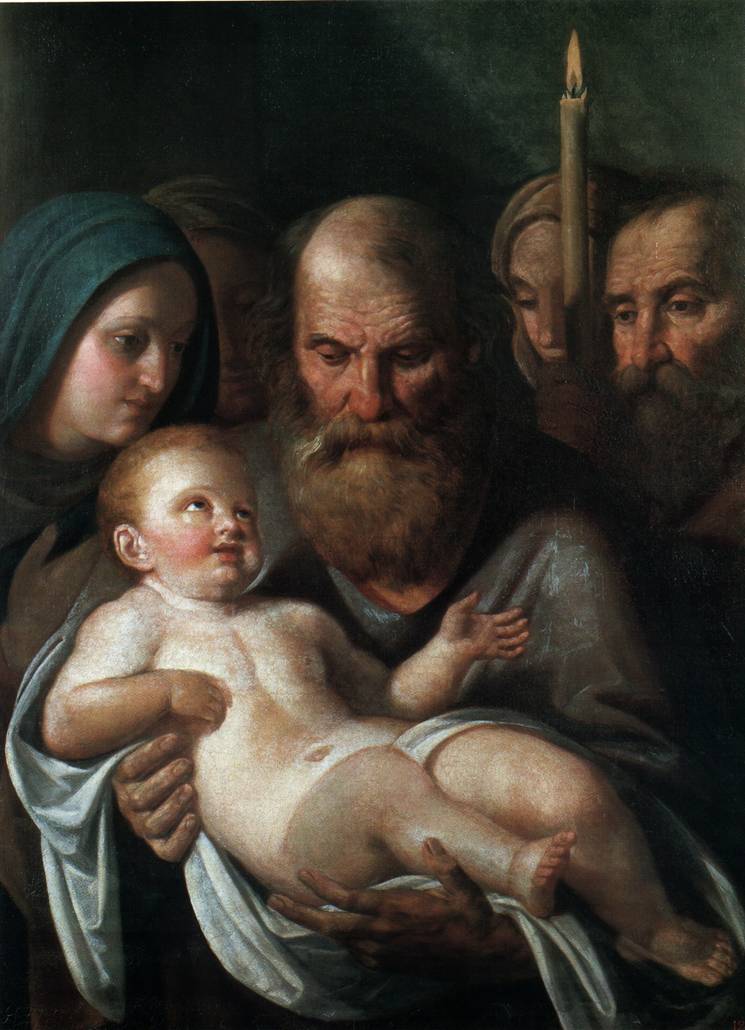
The Circumcision, by Luca Signorelli.jpgThe Circumcision of Jesus by Signorelli

*   *   *   *

The upper image is courtesy of Epiphany (holiday) – Wikipedia, the free encyclopedia.  The full caption: “Adoration of the Magi by Bartolomé Esteban Murillo, 17th century.”

Re: the “Innocents” image.  Courtesy of the Wikipedia article, it’s caption is:  “François-Joseph Navez, The massacre of the innocents, 1824.”  For a different take, see The Triumph of the Innocents, by William Holman Hunt.  That painting showed both the “Holy Family” – Joseph, Mary and Jesus – on their Flight into Egypt, and the martyred “innocents” in ultimate triumph:

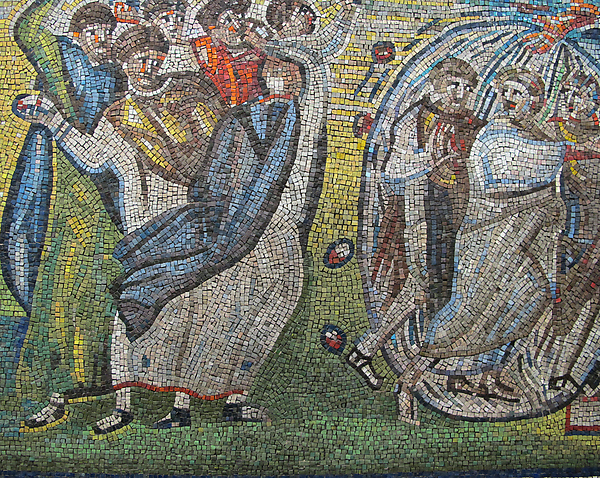
The Holy Family are surrounded by the spirits of the children slain by Herod.  Hunt wanted the bubbles, or “airy globes” which accompany the procession, to convey a sense of the waves of “the streams of eternal life.”

Re: The seminary musical director who wrote “We Three Kings.”  Wikipedia first indicated that “At the time of composing the carol, Hopkins served as the rector of Christ Episcopal Church in Williamsport, Pennsylvania.”   But it later added, “Hopkins studied at the General Theological Seminary in New York City and after graduating and being ordained a deacon in 1850, he became its first music teacher five years later, holding the post until 1857 alongside his ministry in the Episcopal Church.

See also Double dipper … The Free Dictionary.

Re: “Carol.”  According to the Urban Dictionary, the term can also refer to “a hot, irresistable female with a big heart,” and/or a “short, fiery red-headed female.”

Re: the asterisk (“*”) in the indented quote beginning “In the Latin Rite.”  The Wikipedia article featured dates in the “military” format, that is, “14 January,” “7 August,” etc.  I took the liberty of changing the format to the easier-to-read “January 14,” “August 7,” etc.

Re: Circumcision.  As Wikipedia noted, the over 15,000 years old claim was “suggested by anatomist and hyperdiffusionist historian Grafton Elliot Smith.”  The article also noted:

In his 1891 work History of Circumcision, physician Peter Charles Remondino suggested that it began as a less severe form of emasculating a captured enemy:  penectomy or castration would likely have been fatal, while some form of circumcision would permanently mark the defeated yet leave him alive to serve as a slave.

The image of the “instrument like that at right” is courtesy of Wikipedia, with the caption:  “Circumcision knife from the Congo; wood, iron; late 19th/early 20th century.”  

Re: “Everything you wanted to know.”  The phrase is an allusion to the 1969 book Everything You Always Wanted to Know About Sex* (*But Were Afraid to Ask).  Since then the phrase has been used to apply to all “you” wanted to know about topics as diverse as the Carry TradePig LatinFamily Trusts, and Probability Theory.

Re: “One tough monkey.”  See Jerry Seinfeld (Character) – Quotes – IMDb, and also “1991” “Seinfeld Clip” “Mr. Bookman, Library Cop,” where Seinfeld used the term to describe Bookman.  Former American sportscaster Billy Packer – who spent “more than three decades as a color analyst for television coverage of college basketball” – also used the phrase to describe Georgetown Hoyas star guard Allen Iverson.  Packer’s use of the term led to controversy, as having “racist” overtones:

Packer later apologized, insisting he was actually trying to praise Iverson’s relentless play. Neither Iverson nor Georgetown coach John Thompson [ – both of whom are black – ] said they were offended by the remark. Thompson told USA Today he doesn’t “have to explain to anybody about Billy being a racist because he’s not.

Note that Seinfeld was not accused of being racist by applying the phrase to an older white man,”Mr. Bookman.”  On that note see also Howard Cosell – ‘Little Monkey’ Comments, Facts and Video,  Political correctness – Wikipedia, and possibly the definition of squeamish used above.  

The lower image is courtesy of The Circumcision (Signorelli) – Wikipedia, the free encyclopedia.

“Here’s to Plough Monday!”

*   *   *   *

January 6 – last of the 12 Days of Christmas – leads to “Plough Monday…”

*   *   *   *

December 28, 2015 – Christmas Day has come and gone, but that doesn’t mean the Christmas season is over. As noted last year at this time, the 12 Days of Christmas are “both a festive Christmas season” and the title of a “host of songs and spin-offs (including one on a Mustang GT):”

The Twelve Days of Christmas [begin] on Christmas Day (25 December)[, celebrate] the birth of Jesus [and are] also known as Christmastide…   The Feast of the Epiphany is on 6 January [and] celebrates the visit of the Wise Men (Magi) and their bringing of gifts to the child Jesus.  In some traditions, the feast of Epiphany and Twelfth Day overlap.

The post also said that technically this holiday season really started back on Halloween.

The thing is, winters back in the really old days – when life was nasty, brutish and short – were really long and really boring.  So folks back then looked for any good reason to throw a party and get sloshed.  (Which explains why the “party season” started on Halloween.)

In one sense you could say the end of that extended holiday season comes on January 6.  But in another sense you could say the season extends to the Monday following January 6.  That’s the Monday known as Plough Monday.  Which is another way of saying some of the post-Christmas holidays and/or Feast Days can be extremely confusing.

For example, another name for January 6 was Twelfth Night.  That in turn was the name of famous play by William Shakespeare.  The play “expanded on the musical interludes and riotous disorder expected of the occasion,” to wit: the “occasion of the ‘drunken revelry’ of 12th Night.”

And January 6th has yet another name.  It’s perhaps best known as the Epiphany, the Christian feast day celebrating “the revelation of God the Son as a human being in Jesus Christ.”  And yet another name for the Day is The Presentation of Our Lord.

But getting back to Plough Monday:  In England it marked the start of the new Agricultural Year.   (And thus – in a sense – the end of the “old” agricultural year.)  Anyway, the Church of England had a long church service to mark the occasion.  The service included prayers for a bountiful harvest, and both a blessing of the seed to be planted and a “blessing of the plough” – as illustrated at right:

Blessed are you, Lord God of all creation:  for in your abundant care you have given us fertile land, rich soil, the seasons in their courses…  By your blessing, let this plough be a sign of all that you promise to us.  Prosper the work of our hands, and provide abundant crops for your people to share.

In turn, Plough Monday was preceded by Plough Sunday.  Plough Sunday was seen as a way of celebrating farming and the work of farmers, in church.  But since you weren’t supposed to work on Sundays – back in the good old days – the new agricultural year didn’t really start until the next work day:  “work in the fields did not begin until the day after Plough Sunday.”

Put another way:  Since the the date of Epiphany always came on January 6, Plough Sunday came on the Sunday after the Epiphany.  (The Sunday between January 7 and January 13.)  Thus Plough Monday is usually the first Monday after Twelfth Day (Epiphany), 6 January.

The point of all this – January 6, Plough Sunday, Plough Monday, etc. – was to have one more big blast before getting back to work.  (Resuming farm-work after the extended holiday season.)  As such it was one more occasion for general tomfoolery, as shown in the top picture:

In some areas, particularly in northern England and East England, a plough was hauled from house to house in a procession, collecting money.  They were often accompanied by musicians, an old woman or a boy dressed as an old woman, called the “Bessy,” and a man in the role of the “fool.”

In turn it may  help to remember that one big reason for all this general tomfoolery was that – otherwise – life back then was indeed “nasty, brutish and short.”

And finally, people usually celebrated Plough Monday by eating Plough Pudding, as seen at left:  A “boiled suet pudding, containing meat and onions.  It is from Norfolk and is eaten on Plough Monday.”

*   *   *   *

In other news – and in preparation for 2016 – I’ve been tweaking the “pages” above.  (Pages including The basics, The Blog, and The Scribe.)  But I’ve been working especially hard on the INTRODUCTION and CONTENTS.

Part of that work included updating post-links, including the one on how reading the Bible on a regular basis can by like an ongoing “transcendental meditation.”

You try to do what you know you can’t do, yet you try anyway…  It’s as impossible a goal as – say – as trying to love the Lord your God with all your heart, with all your strength, and with all your mind.  This is the first and great commandment, and the second is like unto it: you shall love your neighbor as yourself.

(See Matthew 22:36-40, on the Two Great Commandments.)  But there are rewards from this “impossible meditation” – reading the Bible on a daily basis, with an eye to “being one” with God and your neighbor.  Those rewards include but are not limited to:

1)  Greater personal efficiency in everyday life;  2)  The “comprehension of a different view of reality than the one we ordinarily use;”  3)  A capacity to transcend the painful, negative aspects of life;  4)  The ability to live with a serene “inner peace;”  and 5)  The ability to live  with “a zest, a fervor and gusto in life...”

All of which means that starting – or continuing – the meditation of Bible-reading is a great way to ring in the New Year!  (Not to mention reading this blog for color commentary…) 


Baby New Year 1905 chases old 1904 into the history books…”

*   *   *   *

Re:  The theme of this blog.  It is that taking the Bible literally is a great place to start.  (That is, to start the process of evolving on your earthly pilgrimage.)  But if you really want to be all that you can be, you need to go on and explore the “mystical side of Bible reading.*”

That’s what this blog is about.  Exploring that mystical side of the Bible.

Which is another way of saying the blog is all about “evolving.”  On that note see You Want Pies With That, on the quote by “Nick,” the character in The Big Chill played by William Hurt.  Asked about his “coming home from Vietnam a changed man,” Nick answered, “What are you getting at?  I was e-VOL-ving.”   (As we all should be…)

http://www.toywonders.com/productcart/pc/catalog/aw30.jpgThat’s another way of saying that exploring the mystical side of the Bible can help you “be all that you can be.”  On that note see Slogans of the United States Army – Wikipedia, re: the Army recruiting slogan from 1980 to 2001.  In  turn, the related image at  left is courtesy of: “toywonders.com/productcart/pc/catalog/aw30.jpg.”

*  Re: “mystical.”  As first used, the term mysticism “referred to the Biblical liturgical, spiritual, and contemplative dimensions of early and medieval Christianity.”  See Mysticism – Wikipedia, and the post On originalism.  (“That’s what the Bible was originally about!”)

For an explanation of the Daily Office – where “Dorscribe” came from – see What’s a DOR?

*   *   *   *

Re: Mustang GT.  See also Jeff Foxworthy – Redneck 12 Days Of Christmas lyrics.

Re: “Nasty, brutish and short.”  That’s a quote from the book Leviathan, written by Thomas Hobbes and published in 1651.  Hobbes described the natural state of mankind as a “warre of every man against every man,” a life which was in turn “solitary, poor, nasty, brutish, and short. See Wikipedia, and also Nasty, brutish and short – meaning and origin.

The lower image is courtesy of New Year – Wikipedia, the free encyclopedia.  The full caption:  “Baby New Year 1905 chases old 1904 into the history books in this cartoon by John T. McCutcheon.”  See also ‘Ringing’ Or ‘Bringing In The New Year:’ A History.


On Advent – 2015

 Jeremiah – the Weeping Prophet – “Lamenting the Destruction of Jerusalem…”

*   *   *   *

“It’s that time again.”  Time to start the New (church) Year!

That’s another way of saying:  According to the church, the New Year started on November 29.  (Aka, “Advent Sunday … the first day of the liturgical year.”)

November 29 also begins the Season of Advent:

Advent is “a time of expectant waiting and preparation for the celebration of the Nativity of Jesus at Christmas.”  The theme of Bible readings is to prepare for the Second Coming while “commemorating the First Coming of Christ at Christmas.”

See On the readings for Advent Sunday, from last year.  Note that the Advent Season doesn’t end until the afternoon of December 24.  That’s when the Season of Christmas – also known as Christmastide – begins.  See The 12 Days of Christmas.  But we’re getting ahead of ourselves.

Getting back to the Advent Season, it used to be kept as a period of fasting “as strict as in Lent.”  And just as Mardi Gras kicks off the season of Lent, the penitential season of Advent used to be preceded by the “feast day of St. Martin of Tours.”  (Seen at right.)

The feast of St. Martin used to be  “a time of frolic and heavy eating,” much like Mardi Gras.  But while the Church kept Advent as a season of penitence, it relaxed the rules on fasting before Christmas.

Anyway, to see the full Bible readings for November 29, see First Sunday of Advent.  Note also that November 30 is the Feast Day of St. Andrew, Apostle.  (Who gave his name to the church I attend.)

This year the Bible readings for November 29 were:  Jeremiah 33:14-16Psalm 25:1-91st Thessalonians 3:9-13, and Luke 21:25-36.  The first reading – from Jeremiah – is from the man known as The Weeping Prophet.  (The term “jeremiad” came from him.  That’s a “long, mournful complaint or lamentation,” or a “list of woes.”)  

But for Advent Sunday, Jeremiah had a joyful message:  “The days are surely coming, says the LORD, when I will fulfill the promise I made to the house of Israel…   I will cause a righteous Branch to spring up for David; and he shall execute justice and righteousness in the land.”

That “righteous branch” of course was Jesus.

http://cmsimg.marinecorpstimes.com/apps/pbcsi.dll/bilde?Site=M6&Date=20120913&Category=NEWS&ArtNo=209130325&Ref=AR&MaxW=640&Border=0&Boot-camp-curriculum-up-reviewFor a good commentary on Psalm 25, see Seeking God in the Hard Times(And in a way the church seasons of preparation and penitence – Advent and Lent – can be seen as a kind of Spiritual boot campAs seen at left…)

On that note too, see the reading from 1st Thessalonians, where the Apostle Paul prayed that God might “so strengthen your hearts in holiness that you may be blameless …  at the coming of our Lord Jesus with all his saints.”

And finally, note that last year’s Gospel was Mark 13:24-37.  This year, the Gospel for Advent Sunday retells the same story, but from Luke’s perspective.  In Luke 21:25-36, Jesus foretold of “signs in the sun, the moon, and the stars, and on the earth distress among nations…

He said those signs would precede “the Son of Man coming in a cloud.”  And as an example He told the Parable of the Budding Fig Tree(Not to be confused with the barren fig tree):

“Look at the fig tree and all the trees;  as soon as they sprout leaves you can see for yourselves and know that summer is already near.  So also, when you see these things taking place, you know that the kingdom of God is near…”

As noted in last year’s post on Advent Sunday, in doing so Jesus was quoting the Book of Isaiah – twice – as well as the Book of Daniel.  See also Jesus and messianic prophecy.  The main point Jesus was trying to make?  “Beware, keep alert;  for you do not know when the time will come.”  And also, “What I say to you I say to all:  Keep awake.”

Which is pretty much what the Season of Advent is all about…

*   *   *   *

 The Parable of the barren fig tree, not to be confused with “the Budding Fig Tree…”

*   *   *   *

The upper image is courtesy of Jeremiah – Wikipedia, the free encyclopedia.  The caption:  “Rembrandt van Rijn, Jeremiah Lamenting the Destruction of Jerusalem, c. 1630.”

Re: “church calendar.”  See also Liturgical Calendar – Android Apps on Google Play.

Re: the end of Advent.  See Liturgy: Advent and Christmas Seasons – Felix Just, SJ“Advent technically ends of the afternoon of Dec. 24, since that evening, Christmas Eve, begins the Christmas Season.”

The image of St. Martin of Tours is courtesy of Wikipedia, “St. Martin of Tours.”   The caption:  “San Martín y el mendigo by El Greco.”  Translated, “Saint Martin and the Beggar:”

… a painting by Spanish mannerist painter El Greco, painted c. 1597-1599 [“now showing” at] the National Gallery of Art, Washington, DC.   It depicts a legend in the life of Christian saint Martin of Tours:  the saint cut off half his cloak and gave it to a beggar.

See also St. Martin’s Day – Wikipedia, which said the actual feast day was November 11: 

In the 6th century, local councils required fasting on all days except Saturdays and Sundays from Saint Martin’s Day to Epiphany [January 6], a period of 56 days, but of 40 days fasting, like the fast of Lent.  It was therefore called Quadragesima Sancti Martini (Saint Martin’s Lent).  This period of fasting was later shortened and called “Advent” by the Church.

Re: Jeremiah as “weeping prophet.”  See The Weeping Prophet: Reflections on Jeremiah 31:27-34 – Patheos, and also What should we learn from the life of Jeremiah?

Re:  Jesus quoting Isaiah and Daniel.  See:  1)  Isaiah 13:10, “The stars of heaven and their constellations will not show their light.  The rising sun will be darkened and the moon will not give its light.”  2)   Isaiah 34:4, “All the stars in the sky will be dissolved and the heavens rolled up like a scroll; all the starry host will fall like withered leaves from the vine, like shriveled figs from the fig tree.”  And 3)   Daniel 7:13, “In my vision at night I looked, and there before me was one like a son of man, coming with the clouds of heaven.”

The lower image is courtesy of Wikipedia, The Parable of the barren fig tree.

On Thanksgiving 2015

http://godw1nz.files.wordpress.com/2010/06/a-prosperous-wind1.jpgThe Mayflower leaving English shores” – the voyage that led to the first Thanksgiving… 

*   *   *   *

It’s that time of year again.  Time to re-enact the First Thanksgiving.

Last year I wrote The first ThanksgivingPart I and Part II.  But there is a change.  This year the Bible readings are different.  This year they are:  Joel 2:21-27Psalm 1261st Timothy 2:1-7, and Matthew 6:25-33.  (To see the full readings go to Thanksgiving Day.)

On the other hand, the Collect of the day has stayed the same:

Almighty and gracious Father, we give you thanks for the fruits of the earth in their season and for the labors of those who harvest them.  Make us, we pray, faithful stewards of your great bounty, for the provision of our necessities and the relief of all who are in need…

Note the prayer-parts:  First, thankfulness.  For both the “fruits of the earth” and the work of those who harvest them.  But with that comes a prayer that God make us “faithful stewards.” Which means providing for both our own necessities and for “all in need.”

But enough of the Soapbox.  Suffice it to say that next Thursday – or Wednesday, if your Dulce works Thanksgiving (say at Grady Hospital) – is a time to give thanks.  For every blessing from above.

Now, getting back to those Bible readings.

Joel 2:21-27 notes in part that the “threshing floors shall be full of grain” and “the vats shall overflow with wine and oil.”  Beyond that, God will repay “for the years that the swarming locust has eaten…”

A word of explanation:  The Book of Joel was based on a “literal locust invasion” that happened around 845 B.C. The prophet then lamented over the great locust plague and severe drought, after which he compared the locusts to an army.  An army of God, that is:

The literal swarms of locusts that invaded in successive waves to destroy the crops of Israel spoke of a soon-coming invasion of enemies as well as a future day of judgment.

See also Wikipedia.  But the book ended with Joel saying Israel would later be vindicated.

Psalm 126 begins in a similar vein.  With a note of vindication.)  To wit:  “When the LORD restored the fortunes of Zion, then were we like those who dream.”  Verse 6 reads, “Those who sowed with tears will reap with songs of joy.”   So in a sense that passage foreshadowed the trials and tribulations of the Pilgrims and their first Thanksgiving, as noted below.

Then in 1st Timothy 2:1-7, the Apostle Paul urged that “supplications, prayers, intercessions, and thanksgivings be made for everyone.” (Even those you don’t like.)  And Matthew 6:25-33 included the “lilies of the field” discourse.  (Illustrated at right and explained below.)

Jesus told his followers not to worry about food, because even the lowly birds are provided for by God.  In this verse Jesus presents the example of the lilies, who also do no labor.

On the other hand, the original Pilgrims had lots to worry about before they could celebrate the first Thanksgiving.  For starters – as noted in Part I – they had to survive a rough trip across the North Atlantic.  That rough trip included – but was not limited to – almost losing “lusty young” John Howland, who fell overboard.  (As shown below.)

But finally they set foot back on dry land, on November 11,1620.  Whereupon:

… they fell upon their knees and blessed the God of Heaven who had brought them over the vast and furious ocean, and delivered them from the perils and miseries thereof

But – as noted in Part II – “even then their ordeal was far from over.”  102 people landed in November 1620.  Less than half survived the next year.  (To November 1621.)  Of the handful of adult women – 18 in all – only four survived that first winter in the hoped-for “New World.”

17th century image of a man in armor with musket.  Myles Standish would have worn similar armor, clothing and used similar weapons to those seen here.And – as at Jamestown – there was a whole lot of suffering. (Alleviated in part by the leadership of Myles Standish, who would have been accoutred like the soldier at left):

The major similarity between the first Jamestown settlers and the first Plymouth settlers was great human suffering…  November was too late to plant crops.  Many settlers died of scurvy and malnutrition during that horrible first winter.  Of the 102 original Mayflower passengers, only 44 survived.  Again like in Jamestown, the kindness of the local Native Americans saved them from a frosty death.

(See First Thanksgiving.)  Note that the Jamestown landing came in 1607, 13 years before the Pilgrims.  Then too, those Jamestown settlers had their own Starving Time:  “What became known as the ‘Starving Time‘ in the Virginia Colony occurred during the winter of 1609–10.  Only 60 of 500 English colonists survived.”

The point is this:  As noted in Part II, the men and women who first settled America paid a high price, so that we could enjoy the privilege of stuffing ourselves into a state of stupor.

Which brings us back to the subject of these Pilgrim Fathers.  And pilgrimages in general…

“In the spiritual literature of Christianity, the concept of pilgrim and pilgrimage may refer to the experience of life in the world (considered as a period of exile) or to the inner path of the spiritual aspirant from a state of wretchedness to a state of beatitude.”

And the Pilgrims of 1621 certainly met that test.  (Going from a state of wretchedness to beatitude.)

As also noted in Part II, during the worst part of that first harsh winter of 1620-1621, only six or seven surviving colonists were fit enough to feed and care for the rest.

And they had to let the graves in the new cemetery “overgrow with grass for fear the Indians would discover how weakened the settlement had actually become.”  (And then attack the weakened settlement.)  All of which led to the thought that “freedom isn’t free, and it isn’t cheap either.  Sometimes the price is paid in human lives.”

But again as noted in Part II, the effort can be worth it:

Do the best you can, and – after taking all due and sensible precautions – trust God to help you with the rest.  Some of those bad things [ – that you worried about – ] might not happen, and some bad things might be prevented with foresight and preparation.  Then too, if you’re “on a mission from God,” you might reasonably expect His help.

Or it could be summed up this way:  “If it was easy, anybody could do it!

*   *   *   *

The upper image is courtesy of Mayflower Collection – Mike Haywood’s Artwork – Mayflower HMS, with the caption, “A prosperous wind  The Mayflower leaving English shores.”  The ship in the background is the Speedwell, which had to turn back.  (As explained in “2014.”)  Then too, the home-page of the Haywood site notes that he “has a growing International reputation as a marine and portrait painter.  He has a Doctorate in Oceanography and loves painting rough or lively seas.  Each painting is painstakingly researched to ensure accuracy.”

The soap box image is courtesy of thepoliticalpotteries.com/2015/05/31/tony-walley-on-my-stoke-on-trent-soapbox.  The image was included in a blog-post from THE POLITICAL POTTERIES, “A Political News and Debating Website for Stoke-on-Trent.”  Stoke-on-Trent is a city in Staffordshire, England.  In turn it is “the home of the pottery industry in England … commonly known as the Potteries,” and also now “a center for service industries and distribution centres.”  See Wikipedia.

According to the “Potteries” blog, the six towns of Stoke-on-Trent have a population of 249,000, represented by three Members of Parliament.  The blog in turn seems designed to foster an exchange of thoughts and ideas, presumably for the benefit and guidance of those MPs.

See also Soapbox – Wikipedia.

The “Miles Standish” image is courtesy of mayflowerhistory.com/standish-myles.  The caption:  “17th century image of a man in armor with musket.  Myles Standish would have worn similar armor, clothing and used similar weapons to those seen here.”  See also Myles Standish – Wikipedia.

Re: the ‘Starving Time‘ in Jamestown, during the harsh winter of 1609-1610:

Archaeologists have found evidence that they ate cats, dogs, horses, and rats.  Cannibalism has been confirmed to have occurred in at least one case;  the remains of a teenage girl of about fourteen years of age has been forensically analyzed and shown to have telltale marks consistent with butchering meat…    

Re: the image at right of the paragraph – “And the Pilgrims of 1621” – is courtesy of Pilgrimage – Wikipedia.  The caption:  “Jews at the Wailing Wall in Jerusalem during the Ottoman period, 1860.”

*   *   *   *

The original post had a lower image courtesy of Mayflower Collection – Mike Haywood’s Artwork, about the passenger John Howland. With the caption,  “Yet he held his hold (Rescue of John Howland who fell overboard during the voyage).” Or see John Howland – Biographies – Society of Mayflower Descendants, which noted that he arrived as a servant to John Carver, the first Governor of Plymouth Colony.  He went on to sign the Mayflower Compact. He also went on to serve the colony as selectman, assistant and deputy governor, and surveyor of highways.  He died “over 80″ in 1672.  (No one knew when he was actually born).  But that long and productive life was almost cut short on the voyage over, in 1620:

“In sundry of these storms the winds were so fierce and the seas so high, as they could not bear a knot of sail…   And in one of them … a lusty young man called John Howland, coming upon some occasion above the gratings was … thrown into the sea; but it pleased God that he caught hold of the topsail halyards which hung overboard…   Yet he held his hold [and] got into the ship again[,] his life saved.   And though he was something ill with it, yet he lived many years after and became a profitable member both in church and commonwealth.”

I did an update on Howland this past Thanksgiving, On Thanksgiving 2022 – and “He-e-l-p!!”

*   *   *   *

For more on the upcoming holidays, see also On the 12 Days of Christmas.

Hitler and Mussolini help create Christ the King Sunday…

Hitler and Mussolini in 1940

Adolf Hitler and Benito Mussolini:  Their actions led to the making of Christ the King Sunday…  

*   *   *   *

November 18, 2015 – This post talks about two separate subjects.  One is “the end of Ordinary Time” in the Christian calendar.  The second topic is a group of Jewish freedom fighters.  The Maccabees – a century or two before Jesus was born – were able to free the Jewish people from foreign domination.  Their story is being told “even as we speak,” in the Daily Office Readings. But first a note: I edited this 2015 post on November 13-14, in preparing a post on the time between “Halloween and Thanksgiving, 2022.” I tried to smooth this post out a bit, but there may be some glitches And now, back to Ordinary Time

Next Sunday – November 22[, 2015*] – goes by several names: The final Sunday of Ordinary Time, and Christ the King Sunday.  And the idea of Christ the King Sunday is of recent origin:

Pope Pius XI instituted The Feast of Christ the King in 1925 [after] the rise of non-Christian dictatorships in Europe…  These dictators often attempted to assert authority over the Church [and] the Feast of Christ the King was instituted during a time when respect for Christ and the Church was waning…  [E.A.]

And speaking of 1925, here’s how that year started, according to Wikipedia: On January 3, Benito Mussolini “promised to take charge of restoring order to Italy within forty-eight hours,” leading to the beginning of Mussolini’s dictatorship. Aside from Mussolini there was Adolph Hitler, and a front organization leading to the Russian KGB, and – in the United States  in 1925 – a demonstration of strength by a group called the Ku Klux Klan.

In July 1925, “Adolf Hitler published Volume 1 of his personal manifesto Mein Kampf.”  Also in July, TASS was created, and quickly became a front for “the NKVD (later, the KGB).” In the United States, the Ku Klux Klan held a parade in Washington.  Their five million members made the Klan the “largest fraternal organization in the United States.”

In plain words, Pius XI created the Feast of Christ the King in response to world events swirling around him.  (Including – but hardly limited to – Hitler, Mussolini, and the KKK.) But getting back to more pleasant matters:  Christ the King Sunday ends “Ordinary Time.”  It also bridges that end and the start of Advent.  (Which leads to Christmas.) In plain words, Ordinary Time refers to twoseasons of the Christian liturgical calendar.”

The better known Ordinary Time takes up half the Christian calendar.  See On Pentecost – “Happy Birthday, Church!”  (From which the following was gleaned:) Ordinary time begins with Pentecost Sunday, for Catholics.  In the Anglican liturgy, it’s known as the Season of Pentecost.

[In] 2015 the Season of Pentecost [ends on] November 28 [Thanksgiving Weekend.  T]he day after that – November 29 – marks … a new liturgical year.

(See also Liturgical year – Wikipedia.) For more on the upcoming transition of seasons, see last year’s On the readings for Advent Sunday, and On the 12 Days of Christmas.  The first one noted an alternate “New Year:”

Advent Sunday is the first day of the liturgical year in the Western Christian churches.  It also marks the start of the season of Advent [and leads to Christmas…]

See Advent Sunday – Wikipedia, and also Advent – Wikipedia, which noted that Advent is “a time of expectant waiting and preparation.”  (For Christmas.) But we’re getting ahead of ourselves.  The second topic here:  the Maccabees. Readings from the First Book of the Maccabees have been featured in the Daily Office since Thursday. November 12.

So what the heck is a “Maccabee?”

They were Jewish Freedom Fighters, a century or two before Jesus was born.  They were a family who led a rebellion against the foreigners occupying Judea.  (Before the Romans.) And so for one brief shining moment in time, their homeland was free. Also, and as Isaac Asimov noted, in 142 B.C. their actions led to the Jewish holiday of Hanukkah.

The story  begins about 150 years after Alexander the Great conquered Judea.  But he died and Judea was taken over by Antiochus IV Epiphanes, who tried to force his strange foreign ways on the Jewish people.  The Maccabee family fought back, successfully – from 175 to 134 BC – in a long guerrilla war.  So they were early versions of the “Swamp Fox,” in our Revolutionary War, as seen below.

And as shown in the painting below.  More to the point, Hanukkah celebrates their victories. See Hanukkah – Wikipedia, noting this year the eight-day holiday begins at sunset on Sunday December 6, and ends Monday, December 14.  (Not unlike the 12 days of Christmas.)

All of which is a reminder: Freedom isn’t free.  (Nor is it easy to keep…)

*   *   *   *

The “Swamp Fox” shares a meal with his sworn enemy… 

*   *   *   *

The upper image is courtesy of Hitler and Mussolini meet in Rome | History Today

In 2022, Christ the King Sunday comes on November 20. 

Re:  The Old Testament readings.  The last reading from 1 Maccabees is on Friday, November 20.

Re: the ratio of Klan members.  According to US Population by Year – S&P 500 PE Ratio, in 1925 the population of the United States was just under 116 million.  

Re: Isaac Asimov.  The quote is from Asimov’s Guide to the Bible (Two Volumes in One),  Avenel Books (1981), at pages 748-49.  Asimov (1920-1992) was “an American author and professor of biochemistry at Boston University, best known for his works of science fiction and for his popular science books.  Asimov was one of the most prolific writers of all time, having written or edited more than 500 books and an estimated 90,000 letters and postcards.”  His list of books included those on “astronomy, mathematics, the Bible, William Shakespeare’s writing, and chemistry.”  He was a long-time member of Mensa, “albeit reluctantly;  he described some members of that organization as ‘brain-proud and aggressive about their IQs.’”  See Isaac Asimov – Wikipedia. 

Re: “one brief shining moment.”  See Camelot – Wikipedia:

In American contexts, the word “Camelot” is sometimes used to refer admiringly to the presidency of John F. Kennedy.  The Lerner and Loewe musical was still quite recent at the time and his widow Jackie quoted its lines in a 1963 Life interview…  She said the lines, “Don’t let it be forgot, that once there was a spot, for one brief shining moment, that was known as Camelot” were Kennedy’s favorite…  [E.A.]

Unfortunately, such moments do tend do to be brief.  

To see a painting of the Maccabee family, check Maccabees – Wikipedia.  The article added, “One explanation of the name’s origins is that it derives from the Aramaic “makkaba,” “the hammer,” in recognition of Judah [Maccabee’s] ferocity in battle.

The lower image is courtesy of Francis Marion “Swamp Fox” – Wikipedia.  The full caption:  “General Marion Inviting a British Officer to Share His Meal by John Blake White;  his slave Oscar Marion kneels at the left of the group. ” 

*   *   *   *

And finally, here’s a longer version,” on questions like: 

What the heck is “Ordinary Time?

*   *   *   *

And now, back to Ordinary Time… As noted, this next Sunday – November 22 – goes by several names: Last Sunday after Pentecost, the final Sunday of Ordinary Time, the Sunday before Advent, and – last but not least – Christ the King Sunday.  In turn, the idea of Christ the King Sunday is of recent origin:

Pope Pius XI instituted The Feast of Christ the King in 1925…  [At the time] many Christians (including Catholics) began to doubt Christ’s authority and existence…  Pius XI, and the rest of the Christian world, witnessed the rise of non-Christian dictatorships in Europe, and saw Catholics being taken in by these earthly leaders.  These dictators often attempted to assert authority over the Church…  [T]he Feast of Christ the King was instituted during a time when respect for Christ and the Church was waning…  [E.A.]

See All About Christ the King Sunday, and Feast of Christ the King – Wikipedia. And on December 11, 1925, “Pope Pius XI‘s encyclical Quas primas, on the Feast of Christ the King, is promulgated.”  (For reasons that should now seem obvious.)

The first – and shorter – “Ordinary Time” comes between Christmas and Lent, as shown in the chart…  The better known – and longer – season of Ordinary Time takes over the half the Christian yearly calendar.  (From the end of Easter Season, up to the First Sunday of Advent.) See also On Pentecost – “Happy Birthday, Church!”  (From which the following was gleaned:)

Pentecost Sunday marks the beginning of “Ordinary Time.”  (As it’s called in the Catholic Church, and shown in the chart…)

Such “Ordinary Time” takes up over half the church year.  (Though in the Episcopal Church and other Protestant denominations, it goes by another name.)

In the Anglican liturgy, the Season of Pentecost begins on the Monday after Pentecost Sunday and goes on “through most of the summer and autumn.”  It may include as many as 28 Sundays, “depending on the date of Easter.”  (See also the List of Anglican Church Calendars.)

In other words, this year – 2015 – the Season of Pentecost begins on Monday, May 25, and doesn’t end until Saturday, November 28.   That’s Thanksgiving Weekend, and the day after that – November 29 – marks the First Sunday of Advent, and with it the start of a newliturgical year.

I wrote that back on May 19, which just goes to show one benefit of reading the Bible on a regular basis.  You get into the rhythm of the seasons.  That is, a “regular quantitative change in a variable (notably natural) process.”  And as exemplified in:  “The rhythm of the seasons dominates agriculture as well as wildlife…”  (See also Liturgical year – Wikipedia.)

As an example:  Last Sunday – November 15, 2015 – was the Thirty-third Sunday in Ordinary Time, in the Catholic Church.  Also in the Catholic Church, Sunday the 22d is more formally known as The Solemnity Our Lord Jesus Christ, King of the Universe.

For more on the upcoming transition of seasons, see last year’s On the readings for Advent Sunday, and On the 12 Days of Christmas.  The first one noted an alternate “New Year:”

Advent Sunday is the first day of the liturgical year in the Western Christian churches. It also marks the start of the season of Advent [and] the first violet or blue Advent candle is lit…  [T]he symbolism of the day is that Christ enters the church.   Advent Sunday is the fourth Sunday before Christmas Day. This is equivalent to the Sunday nearest to St. Andrew’s Day, 30 November, and the Sunday following the Feast of Christ the King.

See Advent Sunday – Wikipedia, emphasis added.  See also Advent – Wikipedia, which noted that Advent is “a time of expectant waiting and preparation for the celebration of the Nativity of Jesus at Christmas.”  The theme of Bible readings is to prepare for the Second Coming while “commemorating the First Coming of Christ at Christmas.”

Stattler-Machabeusze.jpg Readings from the First Book of the Maccabees have been featured in the Daily Office since Thursday. November 12.

So what the heck is a “Maccabee?”

They were Jewish Freedom Fighters, a century or two before Jesus was born.  They were a familywho led a rebellion against the foreigners occupying Judea.

(Before the Romans.)  And so for one brief shining moment in time, their homeland was free.

In plain words, the Maccabees were an early group of Jewish Freedom Fighters.  And – for one brief shining moment – between occupation by the Seleucid Empire and the Roman Empire – their homeland was free.  As Isaac Asimov noted, in the year 142 B.C., “for the first time since Nebuchadnezzar’s destruction of Jerusalem 445 years before, the land of Judah was completely free and the foot of no foreign soldier was to be found in Jerusalem.” (748-49)

For another answer, see Why the Maccabees Aren’t in the Bible – My Jewish Learning:

The First and Second Books of Maccabees contain the most detailed accounts of the battles of Judah Maccabee and his brothers for the liberation of Judea from foreign domination.  These books include within them the earliest references to the story of Hanukkah and the re-dedication of the Temple, in addition to the famous story of the mother and her seven sons. And yet, these two books are missing from the Hebrew Bible.

See also Books of the Maccabees – Wikipedia, which noted that the first book is set “about a century and a half after the conquest of Judea by the Greeks under Alexander the Great, after Alexander’s empire has been divided so that Judea was part of the Greek Seleucid Empire.”

And according to Maccabees – Wikipedia, the first book tells of the Greek ruler Antiochus IV Epiphanes trying to force the Jewish people to accept his culture, by suppressing the practice of “basic Jewish law.”  The result was a Jewish revolt against Seleucid rule, from 175 to 134 BC.

…after Antiochus issued his decrees forbidding Jewish religious practice, a rural Jewish priest … Mattathias the Hasmonean, sparked the revolt … by refusing to worship the Greek gods…   After Mattathias’ death about one year later in 166 BCE, his son Judas Maccabee led an army of Jewish dissidents to victory over the Seleucid dynasty in guerrilla warfare… 

And finally, the Jewish festival of Hanukkah celebrates the re-dedication of the Temple following Judah Maccabee’s victory over the Seleucids.  See Hanukkah – Wikipedia, re: the 8-dayholiday celebrating the re-dedication of the Second Temple in Jerusalem, during the “Maccabean Revolt against the Seleucid Empire of the 2nd century BC.”  This year Hanukkah 2015 begins at sunset on Sunday, December 6, and ends on Monday, December 14.”

“All Hallows E’en” – 2015

William-Adolphe Bouguereau (1825-1905) - The Day of the Dead (1859).jpg

November 2  –  All Souls’ Day  –  is the third of “Three Days of Halloween…”

 *   *   *   *

Next Saturday night is Halloween.  (Literally, the evening or e’en before “Hallows Day.”)

That’s not a holiday most people connect with the process of evolving in life through daily Bible reading.  But in fact, Halloween is strongly connected with both your spiritual development and “walking that road to Jesus.”  (See John 6:37.)

Which brings up the fact that the next major set of Feast Days is actually the Halloween Triduum.

“Triduum” is a fancy Latin word for “three days.”  Here it refers to the three days set aside each year for remembering “the dear departed.”  And this particular threesome starts with what used to be called – back in the way olden days – “All Hallows E’en.”

These days it’s been shortened to “Halloween.”

The Scarred, Scared, and Sacred article noted that this is all part of the annual process of the days getting shorter and shorter.  (Fewer and fewer hours of daylight.)  And back in those way olden days, the process seemed “inexorable,” like death and taxes.   We now know that this “movement” is always toward the Winter Solstice – “the darkest day of the year.”  But long ago the largely illiterate hoi polloi didn’t know that.  And so each year they wondered:  “Is this process going to keep going?  Are we going to finally reach a point where there’s no daylight left, and our days will be nothing but complete darkness?”

Jack-o'-Lantern 2003-10-31.jpg

Which naturally brought up the subject of death.  (And with it the possibility of an afterlife, either “down” or “up.”  Then too the thought was that at this time of year there was a mere “thin veil” separating the dead from the living, as illustrated by the jack-o’-lantern at right…)

All of which led to the Triduum centered around All Saints’ Day.

That’s a major feast in the Christian calendar and it comes each year on November 1.  (Though in this case, the term saint is more generic, and largely refers to “anyone who has been saved and … set apart for holy use.”)

Note also that the Old English word for “saint” was halig – which eventually became “hallow.”  (Maybe it was easier to say.)  So the Old English “All Haligs’ Day” became “All Hallows Day.”  In turn the evening before that Feast Day became “All Hallows Evening.”  In time that got shortened to “All Hallows E’en.”  Later still it got shortened to “Hallowe’en,” and then just plain Halloween.

And as always, note that the term “feast” as used here doesn’t refer to a large meal – as in a family celebration – but rather to an religious celebration dedicated to a particular saint.  Or in this case, to all the “saints,” the “dear departed” or the “hallows” in general.

I wrote two posts on the subject last year, On “All Hallows E’en” – Part I and Part II.  (Mostly because it’s such a fascinating subject.)  The “Part I” post noted this:

According to many scholars, All Hallows’ Eve is a Christianized feast initially influenced by Celtic harvest festivals, with possible pagan roots, particularly the Gaelic Samhain…  On All Hallows’ Eve, Christians traditionally believed that the veil between the material world and the afterlife thinned.

Maler der Grabkammer des Sennudem 001.jpgIt noted too that Samhain was an age-old Celtic festival “marking the end of the harvest season and the beginning of winter or the ‘darker half’ of the year.”  (Such festivals go back to the time of ancient Egypt, as shown at left.)

So getting back to basics:  Halloween is just one day of the three-day religious observance known as Hallowmas.  And it’s also known as the Triduum of All Hallows, three feast days which include:  1) All Hallows’ Eve (Hallowe’en),  2) All Saints’ Day (All Hallows’ Day), and  3) All Soul’s Day.

That’s the Halloween triduum, from October 31 to November 2.  That’s also when – according to ancient belief – the veil between the “material world and afterlife” was most permeable.

So what’s the deal with wearing masks and disguises? 

The Celts believed that at the time of Samhain, more so than any other time of the year, the ghosts of the dead were able to mingle with the living, because at Samhain the souls of those who had died during the year traveled into the other world.

But who wants to “mingle” with a bunch of ghosts who died over the past year?

If it was a close friend or relative who recently died, that would be one thing.  But suppose some of those “ghosts” were people who really didn’t like you, or maybe hated you, or otherwise had a score to settle with you?  (Which is a good reason not to go around making people mad…)

So – to protect themselves on the Eve of All Hallows – people would wear masks or put on costumes.  The goal was to disguise their identities.  The idea was also to keep these afterlife “hallows” from recognizing you, in this, the “material world.”

And here’s some more history, borrowed from last year’s Part II:

A long, long time ago, our ancestors celebrated New Year’s Day on November 1.  (That meant New Year’s Eve came on October 31.)  But then about the year 835 AD, the Church made November 1 a feast day for “all saints.”  Again, the idea was to honor those practicing Christians who had died before those who were then living, and especially the “recently departed.”

Back in those long-ago days, people thought evil spirits were most prevalent during the long winter nights.  (And especially those long winter nights that started at the end of October.)  They also believed that the “barriers between our world and the spirit world” were weakest on All Hallows E’en.  Accordingly, it was then that the “spirits were most likely to be seen on earth.”

Put another way, this was believed to be a time of year “when the spirits or fairies (the Aos Sí) could more easily come into our world and were particularly active.”  (The Aos Si were Irish, and “comparable to the fairies or elves.”  They were said to live “underground in fairy mounds, across the western sea, or in an invisible world that coexists with the world of humans.”)

So anyway, our ancestors developed another custom designed to frighten away those spirits.

Briefly, they built bonfires, then feasted and danced around them.

“The fires were thought to bring comfort to the souls in purgatory and people prayed for them as they held burning straw up high.”  The idea came from pagan times, when evil spirits had to be driven away with noise and fire.  (Note also that “bonfire” is short for bone-fire.  See Bonfire – Wikipedia, noting the term “is derived from the fact that bonfires were originally fires in which bones were burned.”)

In yet another old-time custom, travelers carried candles on All Hallows E’en, from 11:00 p.m. until midnight.  The theory here was that if the candles kept burning steadily that was a good omen.  It indicated the candle-holder would be safe during the upcoming “season of darkness.”  On the other hand, if your candle went out , “the omen was bad indeed.”  (The thought was that the candle had been blown out by witches.)

On another note, in England Halloween is also called “Snap Apple Night.”  That’s from a game with apples tied on a  string, related to apple bobbing.  That in turn refers to a “game often played on Halloween,” by filling a tub or a large basin with water and putting apples in.  The apples float on the surface, and players “try to catch one with their teeth.  Use of arms is not allowed, and often are tied behind the back to prevent cheating.”  And incidentally, there’s both a fertility goddess involved, and the ancient Celtic belief that the pentagram was a fertility symbol.  (Thus “bobbing for apples” was somehow involved with fertility…)

So there you have it.  The Halloween Triduum is primarily dedicated to “All Saints:”

…the Solemnity of All Saints is when the Church honors all saints, known and unknown.  This is similar to the American holidays of Veterans Day and Presidents Day, when a group of people are honored on a specific day.  While we have information about many saints, and we honor them on specific days, there are many unknown or unsung saints, who may have been forgotten, or never been honored specifically.  On All Saints Day, we celebrate these holy men and women, and ask for their prayers and intercessions.

See All Saints Day | History, Customs.   In turn, whether you’re working on fertile fields – perhaps as in plowing with a heifer – or remembering the dear departed, or trying to disguise yourself from elves and fairies, or just trying to keep a witch from blowing out your candle…


Have a Happy Halloween!


A graveyard in Sweden, “on the feast of All Hallows…”

*   *   *   *

The upper image is courtesy of All Souls’ Day – Wikipedia, the free encyclopediaThe caption: “All Souls’ Day by William Bouguereau.”  See also Allhallowtide, and All Saints’ Day – Wikipedia.

The image of the jack-o’lantern is courtesy of Halloween – Wikipedia.  The caption:  “A jack-o’-lantern, one of the symbols of Halloween representing the souls of the dead.”

Re:  The expansive definition of “saints.”  See also What is the Bible Definition of a Saint? – Patheos, and especially the text under the heading, You are Saints in the Present:  “If you have repented and trusted in Christ, you are a saint of God today, right now!”

The right-image next to the paragraph – “people would wear masks or put on costumes” – is courtesy of the Wikipedia article, Will-o’-the-wispThe full caption:  “A Japanese rendition of a Russian will-o’-the-wisp.”   Note also that a will-o’-the-wisp is also known as ignis fatuus or “foolish fire.”  It’s an “atmospheric ghost light seen by travelers at night, especially over bogs, swamps or marshes:”

It resembles a flickering lamp and is said to recede if approached, drawing travelers from the safe paths.  The phenomenon is known by a variety of names, including jack-o’-lantern, friar’s lantern, hinkypunk, and hobby lantern in English folk belief, well attested in English folklore and in much of European folklore.

Re: “Plowing.”  See Judges 14:18, where Samson said, “If you had not plowed with my heifer, you would not have solved my riddle.”

The lower image is courtesy of Allhallowtide – Wikipedia, the free encyclopedia.  The full caption:

A cemetery outside a Lutheran church in Röke, Sweden on the feast of All Hallows.  Flowers and lighted candles are placed by relatives on the graves of their deceased loved ones.

On St. Luke – 2015

File:Maarten van Heemskerck - St Luke Painting the Virgin and Child - WGA11299.jpg

Saint Luke painting the Virgin Mary and the Christ Child… 

 *   *   *   *

Today – Monday, October 19 – is the next major Feast Day.

It’s the Feast of St. Luke, who wrote the third-of-four Gospels.  (Luke also wrote the Acts of the Apostles, “the fifth book of the New Testament.”)

Note also  that the term “feast” as used here doesn’t refer to a large meal – as in a family celebration – but rather to an religious celebration dedicated to a particular saint.

I did a post last year, On St. Luke – physician, historian, artist.  (Which included the painting at left, of St. Luke, by El Greco.)

For the Bible readings of the day, see St. Luke, Evangelist.  They are Ecclesiasticus 38:1-4,6-10,12-14 – not to be confused with Ecclesiastes – along with Psalm 147, 2 Timothy 4:5-13, and Luke 4:14-21.

From the early days of the Church, Luke was described as a physician:

Eusebius (AD 260-340), considered to be the Father of Early Church History, described Luke the Physician in these terms:  “Luke, who was by race an Antiochian and a physician by profession, was long a companion of Paul … and in two books left us examples of the medicine for the souls which he had gained from them.”

See Luke the Physician: with “Medicine for the Souls.”  Thus the day’s Bible reading from Ecclesiasticus (also called The Wisdom of Sirach) begins appropriately like this:  “Honor physicians for their services, for the Lord created them.”  In turn, Psalm 147:3 speaks of God as the Ultimate Healer, with a side note that quite often He does His work using human hands.  (By extension, His physicians:  “He heals the brokenhearted and binds up their wounds. “)

As to the reading from the Second Letter to Timothy, Paul was in prison in Rome when he wrote it.  He wrote that “the time of my departure has come” and that he had been deserted by those including Demas, Crescens and Titus.  But note 2 Timothy 4:11, “Only Luke is with me.”

Luke was with St. Paul in his voyage to Rome (Acts 27:1; Acts 28:11, 16), and when he wrote the Epistles to the Colossians and Philemon [see Colossians 4:14], having doubtless composed the Acts of the Apostles during St. Paul’s two years’ imprisonment (Acts 28:30).

(See the Pulpit Commentary.)  Which brings up what Garry Wills had to say about St. Luke.

In his book What the Gospels Meant, Wills noted that Luke wrote the longest Gospel, and that Acts of the Apostles is almost as long.  He added that these two volumes “thus make up a quarter of the New Testament.”  (And that they are longer than all 13 of Paul’s letters.)

head-and-chest side portrait of Dante in red and white coat and cowlHe said Luke is considered the most humane of the Gospel writers.  He quoted Dante – shown at right – as saying that Luke was a “describer of Christ’s kindness.”  He added a quote from Ernest Renan , who referred to Luke’s Gospel “the most beautiful book that ever was.”

And Wills added that Luke showed a “special sensitivity to women.”  A notable example is Luke’s treatment of The Woman with the Menstrual Disorder.  (From Chapter 8, “A Jesus for Outcasts.”)  Here’s what Wills said about the episode, from Luke 8, verses 43-48:

Jesus’ embrace of the despised is made very clear in the case of [this] woman with a perpetual discharge…  Each month when a Jewish woman underwent her period, she had to go to the Temple or the ritual baths to be purified.  So the woman with a perpetual discharge was permanently unpurifiable.  She was not only barred from the Temple but all her dealings with others would make them unclean. (E.A.)

Note that this sense of a woman being permanently unpurifiable was in keeping with Leviticus 15, verses 25-27:  “When a woman has a discharge of blood for many days … she will be unclean as long as she has the discharge…  Anyone who touches [her] will be unclean.”  And this woman had suffered for 12 long years.  And so finally now, “defying the ban on contact with others, she pushes through the crowd around Jesus and touches the tassels on His robe.”

Here she was – “permanently unclean” – and yet she had the audacity to approach Jesus. 

Which is a reminder that sometimes it pays to be a bit pushy with God.  (See also Arguing with God.)  The other point is that Jesus – being Jesus – sensed what happened.  In response the woman, “in a panic,” confessed her effrontery, and said she’d been instantly healed.  But Jesus – being Jesus – said only, “Daughter, your faith has healed you.  Go in peace.”  (See Luke 8:48.)

Then there’s the Parable of the Prodigal Son (illustrated at left).  And as noted below, this lesson in God’s boundless love appears only in Luke:

The richness of the parable comes from the fact that it can be read, as it were, backwards and forwards…  It is an endlessly reversible tale of the Father’s bounty…  Luke [] is at his very best in this parable that opens up endless mirrors of meaning…   I think it would be fair to describe the tale of the Prodigal Son as containing the inmost kernel of Luke’s thinking and theology, according to which we are all outcasts, and Jesus is coming to rescue us all.

(Which brings up the tangential concepts of mashal, if not nimshal.  For more, see the notes.)

But in closing, it should be added that to many scholars, “Luke is a historian of the first rank [and] should be placed along with the very greatest of historians.”  Beyond that:

Only in Luke do we hear the story of the Prodigal Son welcomed back by the overjoyed father. Only in Luke do we hear the story of the forgiven woman disrupting the feast by washing Jesus’ feet with her tears.  Throughout Luke’s gospel, Jesus takes the side of the sinner who wants to return to God’s mercy…   Reading Luke’s gospel gives a good idea of his character as one who loved the poor, who wanted the door to God’s kingdom opened to all, who respected women, and who saw hope in God’s mercy for everyone.

For more see last year’s St. Luke – physician, historian, artist, with the Collect of the Day:   “Almighty God, who inspired your servant Luke the physician to set forth in the Gospel the love and healing power of your Son:  Graciously continue in your Church this love and power to heal…“

 St. Luke, Painting by El Greco. Indianapolis Museum of Art.jpg Saint Luke, by El Greco (circa 1607)…

  *   *   *   *

The upper image is courtesy of File: Maarten van Heemskerck – St Luke Painting the Virgin, and/or “Wikimedia.”  See also Maarten van Heemskerck – Wikipedia, which noted that the artist (1498-1574) was a “Dutch portrait and religious painter, who spent most of his career in Haarlem,” and did the painting above in or about 1532.

Re: The actual “feast of St. Luke.”  Normally it’s October 18, but according to The Lectionary Page, this year the date was transferred to the 19th, because the 18th fell on a Sunday.  (For those interested in the reason for such transfers – or other such minutiae – see What happens when a saint’s feast falls on a Sunday?)   On the other hand, some churches celebrated the feast day anyway, even though it fell on a Sunday.  One example was St. John’s Episcopal Church Savannah GA.  That’s where I went yesterday, during a weekend family visit to Savannah.

Of note:  St. John’s offers traditional worship from the 1928 Book of Common Prayer.  (Complete with all the “thees” and “thous” found in Elizabethan English.  And including those “eths:”  “And the third day he rose again according to the Scriptures:  And ascended into heaven,  And sitteth on the right hand of the Father.)  That’s as opposed to the 1979 revision of the Book of Common Prayer used in most American Episcopal churches.  Again, those interested in such minutiae can find more information at The 1928 U. S. Book of Common Prayer, and/or Book of Common Prayer – Wikipedia, the free encyclopedia.

Re: Paul writing “Second Timothy” while in prison.  See 2 Timothy:  About Paul’s second letter to Timothy.  On the other hand, the Wikipedia article indicated that 2d Timothy was “not written by Paul but by an anonymous follower, after Paul’s death.”

Re: Garry Wills.  Other posts or pages mentioning Wills include The True Test of Faith, On St. Mark’s “Cinderella story,” and On Peter, Paul – and other “relics.”

A side note:  The quotes in What the Gospels Meant are from the 2009 Penguin Books edition, beginning at page 109-11, and – from Chapter 8 – pages 127, 132-33, and 136-40.

The lower image is courtesy of St. Luke of El Greco – Wikipedia, one of several interpretations by the artist.  See for example last year’s On St. Luke, which included a painting shown courtesy of wikimedia.org/wiki/File: El_Greco_-_St_Luke_-_WGA10577.jpg, which included this note:

El Greco portrayed the apostles with a powerfully expressive body language.  This St. Luke is from a cycle for the Toledo Cathedral…  El Greco included St. Luke in several of his [paintings of the Apostles] although Luke was not actually one of the twelve apostles.  Here the artist provided the Western version of a subject he depicted in quite different terms during his period as an icon painter.

*   *   *   *

See also On three suitors, on interpreting such parables, “strictly” or otherwise.  That post noted that quite often, in transposing a parable from oral to written form, it  needed an interpretation added.  The Hebrew word for such interpretation is nimshal, or the plural nimshalim:

The essence of the parabolic method of teaching is that life and the words that tell of life can mean more than one thing.  Each hearer is different and therefore to each hearer a particular secret of the kingdom [of God] can be revealed.  We are supposed to create nimshalim for ourselves.

On Saint Teresa of Avila

“The Ecstasy of Saint Teresa, by Bernini…”

*   *   *   *

The next Feast Day of interest is Thursday, October 15.  That’s the Feast of St. Teresa of Ávila.

St. Teresa was recently dubbed “the Pope Francis of her time,” but there’s more on that later.  There’s also more about her talking to God and saying, “If this is how you treat your friends, no wonder you have so few!”   (Note too that “feast” here doesn’t refer to a large meal – as in a celebration – but rather to an religious celebration dedicated to a particular saint.)

I’ve written about Teresa before.  See On the Bible and mysticism, and On the Christian repertoire.  (See also Teresa of Avila, Nun, which includes the Bible readings for the Day.)

The point being that Teresa was a mystic before that became a bad word:

The terms “mystic” or “mysticism” seem to throw Southern Baptists and other conservative Christians into apoplexy.  (Try it sometime!!!)

That was a bit of sarcasm from The Bible and mysticism, but enough of my ramblings.  (For now anyway.)  Here’s what Wikipedia said about how Teresa got started as a mystic:

Teresa entered a Carmelite Monastery of the Incarnation in Ávila, Spain [in November 1535, but] found herself increasingly in disharmony with [its] spiritual malaise…  The daily invasion of visitors, many of high social and political rank, vitiated the atmosphere with frivolous concerns and vain conversations.  These violations of the solitude absolutely essential to progress in genuine contemplative prayer grieved Teresa…

Frivolous concerns?  Vain conversations?  That sounds just like today!

More to the point, AmericanCatholic.org noted that Teresa “lived in an age of exploration as well as political, social and religious upheaval.  It was the 16th century, a time of turmoil and reform.”  That is, she was born in 1515, a mere two years before Martin Luther – seen at right as a “friar, with tonsure” – nailed his 95 Theses to the door of All Saints’ Church in Wittenberg.  (Thus starting the Protestant Reformation.)

But getting back to the idea of “mystic” freaking out some Christians.  An example:   “The term ‘Christian mystic’ is an oxymoron.  Mysticism is not the experience of a Christian.” That’s from What is Christian mysticism? – GotQuestions.org.  Or this:

Mysticism is when you get into a mystical state and it’s something you cannot understand, you’re out there in “la-la” land, it’s an “oooh” experience and you’re really not thinking.

See Is There A Biblical Mysticism? | thebereancall.org.  (About one “click” down).

On the other hand, see Mysticism – Wikipedia.  That said the term originally “referred to the biblical, the liturgical and the spiritual or contemplative dimensions in early and medieval Christianity.”   And the article Teresa of Ávila – Wikipedia noted in pertinent part that “Teresa’s writings, produced for didactic purposes, stand among the most remarkable in the mystical literature of the Catholic Church.”  (So you’re going to argue with the Catholic Church?)

All of which I noted in On the Bible and mysticism.  In the post On the Christian repertoire, I included the image at the bottom, “The Appearance of the Holy Spirit before Saint Teresa.”  And a note to that post pointed out that an internet search will generally lead the searcher to the definition of mystic as “a person who seeks by contemplation and self-surrender to obtain unity with or absorption into the Deity or the absolute. . .”

In other words, a mystic is a person who seeks to become “one” with both God and his or her neighbor.  Not unlike Francis of Assisi(Who no doubt some contemporaries thought himself was a bit of a weirdo…)  See also The basics.

And speaking of “absorption into oneness:”  That seems to be what Jesus spoke of as He prayed in John 17:20-23.  He was in the Upper Room the evening before the Crucifixion, and asked God to help His followers:

“I ask . . . on behalf of those who will believe in me . . . that they may all be one.  As you, Father, are in me and I am in you, may they also be in us, so that the world may believe that you have sent me.  The glory that you have given me I have given them, so that they may be one, as we are oneI in them and you in me, that they may become completely one. . .”

On that note, focus especially on John 17:21, John 17:22, and John 17:23John 17:21 reads – in pertinent part – “ that all of them [that’s us] may be one, Father, just as you are in me and I am in you.”   John 17:22 reads – ditto – “that they may be one as we are one.”  John 17:23, reads – one last ditto – “I in them and you in me – so that they may be brought to complete unity.”

Then too, that seems to be just what one “Common Prayer” means when it said that all Christians – by and through sharing Holy Communion – are in the process of becoming “very members incorporate in the mystical body of thy Son.”

But we were talking about Teresa of Avila.

Among the Bible readings for her day, the first – Romans 8:22-27 – includes one of my favorite verses.  Romans 8:26 is especially useful when you’re not sure how to pray or what to pray for:  “the Spirit helps us in our weakness;  for we do not know how to pray as we ought, but that very Spirit intercedes with sighs too deep for words.”  (And that “sighs too deep for words” is one of my favorite translations…)

But back to Teresa.  She was born in 1515 and died in 1882, at the then-ripe-old-age of 67.  She was a devout “theologian of contemplative life through mental prayer.”

In 1622 she was canonized by Pope Gregory XV – seen at right – and in 1970 was named a Doctor of the Church by Pope Paul VI.  And in March, 2015 – as noted – St. Teresa of Avila [was] dubbed the Pope Francis of her time.

Witty, warm and personable, she nonetheless pushed the Carmelite order to reform.  St. Teresa taught the faithful not to be caught up with creature comforts, to be true to their vocation and to dedicate hours each day to contemplative Carmelite prayer.

Somewhat surprisingly, she was “of Jewish descent,” and among other things could be rather droll.  (If not apparently disrespectful to God.)  According to one story, she was traveling to visit another convent when her cart overturned and she was thrown into a mud puddle. Embarrassed at having to show up in a dirty habit, Teresa reportedly prayed, “God, if this is how you treat your friends, no wonder you have so few!

But seriously, today she is perhaps best known as a mystic.  However, even when she was alive – a long time ago – some people considered that bad.  As Wikipedia noted, “Around 1556, various friends suggested that her newfound knowledge was diabolical, not divine. ”

So some people have always been offended by the terms ‘mystic” and “mysticism.”

On that note, it can’t be denied that there are a lot of weirdos out there calling themselves “mystics.”  But by the same token, there are a lot of people learning karate for all the wrong reasons.  (How many “hypocritical” karate students want to learn how to beat the tar out of people they don’t like?)  For example, see Deshimaru’s The Zen Way to Martial Arts:

Many people these days come to the martial arts as if to a sport or, worse, as if seeking an effective instrument of aggression and domination.   And, unhappily, there are studios that cater to this clientele.   Violent and exploitative martial arts movies contribute to the corruption…

But does that make “traditional” karate training any less valid?  In the same way, does the existence of some “hypocritical” Christians make the entire faith invalid?  Then too, how many Christians seem to view their faith as an “instrument of aggression and domination?”

That wasn’t Teresa’s way.  As the Collect of her Feast Day recalls:

God, by your Holy Spirit you moved Teresa of Avila to manifest to your Church the way of perfection: Grant us, we pray, to be nourished by her excellent teaching…

*   *   *   *

“The Appearance of the Holy Spirit before Saint Teresa of Ávila…”

*   *   *   *

The upper image is courtesy of Teresa of Ávila – Wikipedia.  The full caption:  “The Ecstasy of Saint Teresa by Bernini, Basilica of Santa Maria della Vittoria, Rome.”

The Pope Francis image is courtesy of Pope Francis – Wikipedia.  The caption:  “Francis among the people at St. Peter’s Square.”

See an image of Francis of Assisi at Mysticism – Wikipedia, with the caption: “Life of Francis of Assisi by José Benlliure y Gil.”

For more on Teresa of Avila, see Selections Of An Interview – St Teresa Of Jesus.  (One of her other names.)   Note that she is not to be confused with Thérèse of Lisieux (1873-1897), best known for her “Little Way” method of what might be called “life meditation.”  See Wikipedia and also St. Therese and Her Little Way – Society of the Little Flower:

St. Therese believed that the people of her time lived in too great fear of Gods judgment… [She] translated “the little way” in terms of a commitment to the tasks and to the people we meet in our everyday lives…  Her life sounds so routine and ordinary, but it was steeped in a loving commitment that knew no breakdown.  It is called a little way precisely by being simple, direct, yet calling for amazing fortitude and commitment.

The “Common Prayer” quote is from page 339 of the Book of Common Prayer.  See the full prayer on The Online Book of Common Prayer, at the end of The Holy Eucharist:  Rite One

Re: “Deshimaru’s The Zen Way to Martial Arts.”  The full title of the Amazon book is The Zen Way to Martial Arts: A Japanese Master Reveals the Secrets of the Samurai.  The quote itself is from the 1991 Arkana Books edition, translated by Nancy Amphoux.

Also on page 3, Deshimaru told of a student who asked, “How many years do I have to practice Zazen?”  (The meditation technique used by Zen masters.)  His answer, “Until the day you die.” (For what that’s worth.)  Taisen Deshimaru (1914-1982) “was a Japanese Sōtō Zen Buddhist,” who founded the Association Zen Internationale.  During World War II:

Deshimaru was exempted from the Imperial Japanese Army because of his near-sightedness.  He went to the island of Banka, Indonesia, to direct a copper-mine.  He found himself on the island of Bangka, where he taught the practice of zazen to the Chinese, Indonesian, and European inhabitants.   He defended inhabitants against the violence of his own people, and was therefore thrown in jail, but released by “the highest military authorities in Japan.”  (E.A.)

Re:  Some Christians using the faith as an “instrument of aggression and domination.”  See also Dark side (Star Wars) – Wikipedia:  “The dark side of the Force is a fictional moral, philosophical, metaphorical and psychic concept in the Star Wars universe created by George Lucas.  The Force is a mystical energy which permeates the Star Wars galaxy;  its dark side represents an aspect of it that is not practiced by the Jedi who view it as evil.”

The lower image is courtesy of Mysticism – Wikipedia. The full caption:  “The Appearance of the Holy Spirit before Saint Teresa of Ávila, Peter Paul Rubens.”

*   *   *   *

On Bill Tyndale – who published a Bible you could actually READ!

William Tyndale – “strangled and burned at the stake” – for making a Bible you could read


And speaking of themes in this blog…

One prevalent theme is that the more you know about the Bible – and how it was written – the more spiritual progress you can make.

William TyndaleThat brings up the fact that last October 6 was the Feast Day for “William Tyndale, Priest.”  More to the point, he also published the first Bible that you as a “vulgar person” could actually read for yourself.  And for that he was strangled and burned at the stake.

The thing is, you can’t really learn more about the Bible – and how it was written – unless you as an individual have one you can actually read.  But for the first 1,500 years of the Christian faith, you didn’t have that option.  (Unless you were a priest, and could read Latin.)

In plain words, back in the “good old days, “the clergy” held a monopoly on the Bible.

To find out what the Bible said, you – who were likely illiterate – had to rely on the local parish priest.  (And/or his superiors, in a far-away country.)   That is, your priest told you what the Bible said, and you had  no choice but to take his word for it.

In other words, you had no choice but to rely on “stale rehashes” from your parish priest, and many of those were illiterate themselves.  To repeat, you had to rely on what other people said the Bible said, rather than being able to read it yourself.  In legal circles they call that hearsay.

One example:  A witness testifies at trial that “Sally told me Tom was in town,” as opposed to being able to testify, “I saw Tom in town.”  The question is:  Which form of evidence is considered more reliable?  To most people – and based on centuries of legal precedent – a witness saying “I heard someone say Tom was in town” is dubious proof at best.

That all changed in 1525, when Tyndale first published the Bible in English.

(What was known then as a “vulgar tongue.”  That is, “the national or vernacular language of a people … used typically to contrast such a language with Latin.”)  

But Tyndale paid dearly for publishing the first Bible not written in Latin.  As shown in the top illustration, the powers that be had him first strangled, then burned at the stake.  And all of that just so you – today- could read the Bible in “good old English…”

Which brings up again the most recent Feast Day, October 6.  (The term “feast” here does not refer to a “large meal” – as in celebration – but rather to an “annual religious celebration dedicated to a particular saint.”)  And the link “Tyndale” shows the Bible-readings and Collect for the day:

Almighty God, you planted in the heart of your servant William Tyndale a consuming passion to bring the Scriptures to people in their native tongue, and endowed him with the gift of powerful and graceful expression and with strength to persevere against all obstacles: Reveal to us your saving Word, as we read and study the Scriptures…

See also William Tyndale, which included a note on Miles Coverdale.  (Basically Coverdale finished the work that Tyndale started, but was unable to finish – due to his being executed.)

Six copies were set up for public reading in Old St Paul’s Church, and throughout the daylight hours the church was crowded with those who had come to hear it.  One man would stand at the lectern and read until his voice gave out, and then he would stand down and another would take his place.  All English translations of the Bible from that time to the present century are essentially revisions of the Tyndale-Coverdale work.

And that of course includes the King James Bible.  (The one God uses…)

Another reason he was executed?  Tyndale taught that salvation was a free gift from God, available to all.  But that cut into the revenue of the Church at the time.  Unlike Tyndale – and Martin Luther – the religous “powers that be” at the time taught that you could earn your way into heaven, through “good works and penance.”  Which of course brought in a lot of money.  (As through the Church selling indulgences.)

That is, the medieval Church sold indulgences as “a way to reduce the amount of punishment one has to undergo for sins.”  But we digress.  (Or perhaps not…)

See, the strange, ironic and/or incongruous thing about all this is that Tyndale’s death was largely the work of Sir Thomas More.  “Saint Thomas” is venerated as a saint (“and martyr“) by the Roman Catholic Church.  (See e.g. the CATHOLIC ENCYCLOPEDIA.)  As Wikipedia noted:

More opposed the Protestant Reformation, in particular the theology of Martin Luther and William Tyndale.  He also wrote Utopia, published in 1516, about the political system of an imaginary ideal island nation.

But then he himself ran afoul of the powers that be, in the person of King Henry VIII.  That episode in his life was popularized by the 1966 film A Man for All Seasons. A Man for All Seasons (1966 movie poster).gif“The title reflects [the] portrayal of More as the ultimate man of conscience and as remaining true to his principles and religion under all circumstances and at all times.”

More opposed the King’s separation from the Catholic Church, refusing to acknowledge him as Supreme Head of the Church of England and refusing to acknowledge Henry’s annulment from Catherine of Aragon.  After refusing to take the Oath of Supremacy, he was convicted of treason and beheaded.

But at least he wasn’t “strangled and burned at the stake.”  See Decapitation – Wikipedia:

Decapitation … was sometimes considered the honorable way to die for an aristocrat…  [I]n England it was considered the privilege of noblemen to be beheaded.  This would be distinguished from a dishonorable death on the gallows or through burning at the stake.  In medieval England, the punishment for high treason was to be hanged, drawn and quartered but in the case of nobles and knights it was often commuted to beheading…

Which leads to the phrase, “Thank God for commutation!

But seriously – that was a bit of sarcasm – that takes us to some recent Daily Office Readings.  For example: the readings for Monday, October 5 included 1st Corinthians 10:14-11:1:

Eat whatever is sold in the meat market without raising any question on the ground of conscience, for ‘the earth and its fullness are the Lord’s.’   If an unbeliever invites you to a meal and you are disposed to go, eat whatever is set before you without raising any question on the ground of conscience.  But if someone says to you, ‘This has been offered in sacrifice’, then do not eat it, out of consideration for the one who informed you, and for the sake of conscience – I mean the other’s conscience.

That loosely translates to “Eat what the heck they put in front of you, and stop whining!

Then there’s Psalm 127, one of the readings for Tuesday, October 6.  Which leads to the fact that some people tend – in my view – to take isolated passages of the Bible way out of context.  One example is people who “handle” snakes, based on .)   (See On snake-handling, Fundamentalism and suicide – Part I.)  Another example is people who take Psalm 127, verses 3-5, “way out of context:”

[T]he “Quiverfull Movement” can be found at sites including Quiverfull – Wikipedia, the free encyclopediaWhat Is Quiverfull? – Patheos, part of “No longer quivering,” an ostensible “gathering place for women escaping and healing from spiritual abuse;”  5 Insane Lessons from My Christian Fundamentalist Childhood ;  and/or QuiverFull .com :: Psalm 127:3-5.

Which means we wouldn’t have the “Quiverfull” movement if it hadn’t been for Bill Tyndale.

Meanwhile, there’s the matter of karma and/or “turnabout is fair play…”


“Sir Thomas More … after his sentence of death.”

The upper image is courtesy of William Tyndale – Wikipedia, the free encyclopedia.  The caption: “William Tyndale, before being strangled and burned at the stake, cries out, ‘Lord, open the King of England’s eyes,’ woodcut from Foxe’s Book of Martyrs (1563).”

The portrait-image of Tyndale is courtesy of the link, William Tyndale.  

Re: Clergy.  See also Benefit of clergy, a principle of English law which originally meant that “clergymen could claim that they were outside the jurisdiction of the secular courts and be tried instead in an ecclesiastical court under canon law.”  In other words a priest charged with murder or rape – for example – could demand to be tried by a “court” of his fellow priests.

Various reforms limited the scope of this legal arrangement to prevent its abuse.  Eventually the benefit of clergy evolved into a legal fiction in which first-time offenders could receive lesser sentences for some crimes (the so-called “clergyable” ones).  The legal mechanism was abolished in 1823 with the passage of the Judgement of Death Act which gave judges the discretion to pass lesser sentences on the first-time offenders.

The “witness – trial” image is courtesy of Famous Trials – UMKC School of Law – Prof. Douglas Linder.  The specific trial image is from the Selected Images link at O. J. Simpson Trial (1995) The caption:  “Simpson tries on ‘the gloves that did not fit.'”

The image of “King James” is courtesy of the James I link included in King James Version – Wikipedia.  The caption:  “Portrait after John de Critz, c. 1606.”

Re: “Quiverfull.”  See also On Pentecost – “Happy Birthday, Church!”:

On the other hand, it could be argued this is another example of some people taking isolated Bible passages out of context, like those who handle snakes based on Mark 16:17-18, or those who have a “quiverfull” of children based on a passage from Psalm 127. 

The lower image is courtesy of Thomas More – Wikipedia.  The full caption:  “William Frederick Yeames, The meeting of Sir Thomas More with his daughter after his sentence of death, 1872.”  See also Karma – Wikipedia, and the idiom: “turnabout is fair play – Wiktionary.”  (An idiom is a phrase or a fixed expression that has a figurative, or sometimes literal, meaning.)  Also:

An idiom’s figurative meaning is different from the literal meaning.  There are thousands of idioms, and they occur frequently in all languages. It is estimated that there are at least twenty-five thousand idiomatic expressions in the English language.

Other sources for this post include: William Tyndale | Christian History, William Tyndale Bible History, and William Tyndale – Christian History Facts – Christianity.