Category Archives: Feast Days

On St. Matthew – 2015

*   *   *   *

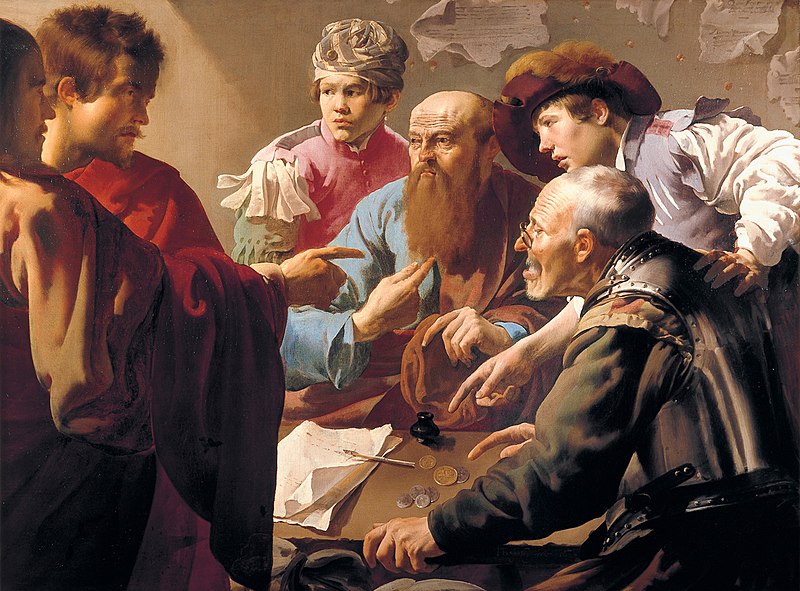
File:Brugghen, Hendrick ter - The Calling of St. Matthew - 1621.jpg

The Calling of St. Matthew,” by Hendrick ter Brugghen…                      (“Who?  Me?”)

*   *   *   *

The next major Feast Day is Monday September 21.  (Here the term “feast” does not refer to a “large meal” – typically a celebration – but rather to an annual religious celebration … dedicated to a particular saint.)  So September 21 is the Feast for “St Matthew, Evangelist.”

See also On St. Matthew, from last year.  On that note the Bible readings are the same as those for last year:  Proverbs 3:1-6Psalm 119:33-40, 2d Timothy 3:14-17, and Matthew 9:9-13.

There’s more on St. Matthew further below, but first it’s time to do some reflecting.  For one thing, many churches have their “Rally Day” this time of year.  Such Rally Days mark the beginning of a new year of Sunday School, not to mention a new liturgical year.   They also mark the end of summer vacation – with its generally low attendance – and a time for welcoming new parish members.

Aside from that, September 20 is National Back to Church Sunday.  (“Strategically designed to help churches reach out and invite everyone to try church again.”)

So this reflection deals with some basics:  What do you get for going to church?  What does it mean to “become a Christian,” or “begin your journey toward Jesus.”  (See John 6:37.)  More basically, some potential converts may ask, “Who is this ‘God,’ and what can ‘He’ do for me?

Yet a third variation:  “How can I get God – who created the universe – to do good things for me?”

Here’s my take:  Getting good stuff from God should be at least as hard as shooting the head off a match from 90 yards away.  “It’s hard as hell…  But now and then I’ll do it just right, and light one.”

Bear with me…

Over the millenia, two basic answers have been formulated on “does God exist?”  The first might be called the “Greek” view, which says there is no God and that we pitiful humans are at the whim of a merciless uncaring fate.  The other might be called the Hebraic view.

That view says that not only does God exist, but – that if you play your cards right – you can get Him to do good things for you, personally and as an individual. (Put another way, there is one God and that if you approach Him in the proper manner, He can make your life ever so much better.)

I explored this question in On the wisdom of Virgil – and an “Angel.”  That in turn was inspired by a series of lectures, Hebrews, Greeks and Romans:  Foundations of Western Civilization, via audiobook by Professor Timothy Shutt.  See also Job the not patient – REDUX.

Job REDUX noted Professor Shutt’s saying that when it comes to understanding the whole idea of God, we humans are “simply not up to the task.”  (We are no more up to the task of fully understanding God than “cats are prepared to study calculus.  It’s just not in our nature.”)

And Wisdom of Virgil noted Shutt’s observation that when it comes to such questions – like “does God exist?” – we humans tend to answer in terms of black or white.  (Or “all or nothing.”)   That is, most people say either that there is a “God who controls all things, or that there must be no God at all.”  In other words, there’s no middle ground.  (In our view.)

But Virgil – good old Virgil, at left reading his Aeneid – came up with just such a “middle view” that seems to make more sense than the black or white view:

There is … an overarching order at work in the world, a final coherence in the way that things work.  But it remains out of human reach, and despite our efforts, we can merely come to know it only in part

The emphasized “only in part” would seem to be just plain common sense.  If there is indeed a Force that Created the Universe, then we pitiful human beings – living a mere 70 or 80 years, if lucky – would (logically speaking) be hard pressed to ever fully understand it.  (Or “Him.”)

But just because we can’t fully understand “Him” doesn’t mean “He” doesn’t exist.  Thus there is – most likely – an “overarching order,” and that overarching order could well be the very God who provides the “final coherence in the way that things work.”

The problem is that we “earthy” humans tend to think in terms of “all or nothing.”  We tend to think that if this “God” doesn’t cater to our every whim – or if “He” does something we don’t like, or just can’t understand – then “He” must not exist at all.  (“I guess I showed Him!“)

But the good news is:  We can still get to know God, even if “only in part.”

Which brings up the Hell’s Angel.

As noted in Virgil and an “Angel,” his name was Magoo (from the ‘Frisco chapter), and:

…on days when he isn’t working, he goes out to the dump and tries to shoot the heads off match sticks.  “It’s hard as hell,” he said.  “But now and then I’ll do it just right, and light one…” But the really strange thing is how many people think that dealing with God – the Force that Created the Universe – is somehow easier than trying to shoot the head off a match stick…

So again, here’s my take on the two key questions.  (Does God exist?  And if He does, how can I get good stuff from Him?)  The answer?  Getting good stuff from God should be at least as hard as shooting the head off a match from 90 yards away.   The good news:  It isn’t always that hard.

One thing you can do is accept the promise of Jesus in John 6:37.  Another thing you can do is read the Bible on a daily basis, to find out how other people have successfully approached this “God” person.   A third thing you can do is realize the process is both interactive and ongoing.  (The more you do it the better you get at it.)

And finally, the fourth – and perhaps the most difficult – thing you can do is simply realize the fundamental principle that just because something bad happens to you – or just because “God doesn’t cater to you every whim” – doesn’t mean He doesn’t exist.

*   *   *   *

Meanwhile, back to St. Matthew.  (See Matthew 9:9.)  I covered his Feast Day last year in On St. Matthew.  (Including the painting at right.)

This year I added some different paintings, including ter Brugghen‘s take on the calling of St. Matthew, at the top of the page.  See The Calling of St Matthew – Web Gallery of Art, which noted that Ter Brugghen spent ten years in Italy and likely studied under the noted Italian artist Caravaggio.  Caravaggio in turn “exerted a great influence on him” and sometimes ter Brugghen “repeated the subjects of Caravaggio, like in the Calling of St. Matthew.”

As to the ter Brugghen painting at the top of the page:

Christ and his follower appear to the left as dark figures in the foreground.  The main accent is on the brightly illuminated group on the right [including the] mercenary soldier pointing to the money on the table…  The light enters in a broad beam … from the left.  However, the quality of the light is original;  it is lighter, richer, and more atmospheric than Caravaggio’s, which seldom has the brightness or softness of real daylight.

Note also the “six gesticulating hands in the center.”  Thus in ter Brugghen‘s  interpretation, Jesus stands at the far left, in shadow and in profile.  St. Matthew – the one being “called” – sits near the center of the painting, pointing to himself with an expression of “Who?  Me?

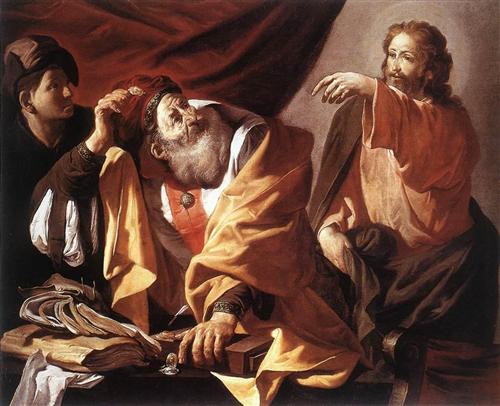
Note also that ter Brugghen did other paintings on St. Matthew’s “calling,” including the one at the bottom of the page.  (Immediately before the “notes” section.)

And finally, consider some of the things Isaac Asimov wrote about St. Matthew.

Asimov noted that Matthew’s name came from the Hebrew meaning “gift of God,” and that it was a common name in New Testament times.  This was due in large part to “the great pride of the Jews in the achievements of priest Mattathias” (seen at left on the head of a Jewish coin at the time).  Mattathias in turn was the “father of Judas Maccabeus and the heroic initiator of the revolt against the Seleucids.”  (167-160 B.C.)
But there were also good reasons why this author – and any other Gospel writer – might try and remain anonymous.  For one thing, such “holy books” were thought to carry a lot more weight – seem more “holy” – if the real authorship was “assigned to some ancient worthy:”

Indeed, there might be considered the very real force of the feeling that a truly holy book was inspired by God and that the worldly author acted only as a mouthpiece and deserved no credit.  (Emphasis added.)

Then there was the “mundane” consideration of personal mayhem.

The time when the Gospels were written “was a hard one for Christians.  Jewish hostility was pronounced and so was Roman hostility.”  Christians at the time had  vivid memories of Nero Persecuting the Christianscirca 64 A.D.  Then there was the great Jewish Revolt.  That revolt ran from 66 to 70 A.D. and turned out to be “one of the greatest catastrophes in Jewish life.”  It ultimately resulted in the Destruction of Jerusalem.  It also turned the Jewish people “from a major population in the Eastern Mediterranean into a scattered and persecuted minority” throughout the world.  (See also Jewish diaspora – Wikipedia.)

The upshot was that the Jews who had revolted against Rome “were resentful, indeed, of Christian failure to join the rebellion.”  Thus as Asimov noted, because of intense hostility from both Jews and Romans, “It might well be that a gospel writer preferred to remain anonymous out of considerations of personal safety.”  The bottom line is that Matthew “witnessed” at a time when it was dangerous for him to do so.  Thus as the Collect for Matthew’s Day says:

We thank you, heavenly Father, for the witness of your apostle and evangelist Matthew … and we pray that, after his example, we may with ready wills and hearts obey the calling of our Lord to follow him…

*   *   *   *

The Calling of St. Matthew - Hendrick TerbrugghenAnother interpretation of Jesus “calling” Matthew…

*   *   *   *

The upper image is courtesy of  Brugghen, Hendrick ter – The Calling of St. Matthew.  As noted, the artist did different paintings on the same subject.  See for example ter Brugghen, Calling of Saint Matthew | MuMa Le Havre, and The Calling of St. Matthew – Hendrick Terbrugghen – WikiArt.org, which provided the lower image immediately above the “notes” section.

Re:  “Rally Day.”  See Rally Day | Article about Rally Day by The Free Dictionary, which noted:  

In liturgical Protestant churches, Rally Day marks the beginning of the church calendar year. It typically occurs at the end of September or the beginning of October.  Although not all Protestant churches observe this day, the customs associated with it include giving Bibles to children, promoting children from one Sunday school grade to the next, welcoming new members into the church, and [presenting] church goals for the coming year.

Re:  National Back to Church Sunday.  See also – from 2012 – Over 10,000 Churches Commit to ‘National Back to Church Sunday,’ from the Christian Post, a “nondenominational, Evangelical Christian newspaper based in Washington, D.C.”  The Post noted that since 2009, “National Back to Church Sunday has inspired churchgoers to invite more than 2.6 million family members, friends, neighbors and co-workers to their churches.”  

Re: “Virgil.”  The illustration, from Wikipedia, includes the caption:  “Virgil Reading the Aeneid to Augustus, Octavia, and Livia by Jean-Baptiste Wicar, Art Institute of Chicago.”

Re: “interactive.”  See On Mary Magdalene, “Apostle to the Apostles:”

[That] just goes to show the importance of the interactive – if not the mystical – part of your walk toward Jesus.  (Pursuant to John 6:37.)  In the end there’s simply no way to prove the existence of either God or Jesus, with enough courtroom evidence o convince the most jaded of skeptics.  In the end it all comes down to faith, and experience.

Re: Isaac Asimov.  The quotes about St. Matthew are from Asimov’s Guide to the Bible (Two Volumes in One),  Avenel Books (1981), at pages 771-72. 

Asimov (1920-1992) was “an American author and professor of biochemistry at Boston University, best known for his works of science fiction and for his popular science books.  Asimov was one of the most prolific writers of all time, having written or edited more than 500 books and an estimated 90,000 letters and postcards.”  His list of books included those on “astronomy, mathematics, theBible, William Shakespeare’s writing, and chemistry.”  He was a long-time member of Mensa, “albeit reluctantly;  he described some members of that organization as ‘brain-proud and aggressive about their IQs.’”  See also Isaac Asimov – Wikipedia.

The coin image of “Mattathias” is courtesy of Mattathias – Wikipedia, with the caption:  “Mattathias from Guillaume Rouillé‘s Promptuarii Iconum Insigniorum.”

Re: the Jewish Revolt of 66-70 A.D.  See also Jewish–Roman wars – Wikipedia

*   *   *   *

And speaking of reviews, here’s a portion of the “Welcome” portion of “Matthew 2014:”

[T]his Bible-blog is different…  It says that not only should we read the Bible with an open mind, but also that it was designed to liberate us, not shackle and shape us into some “pre-formed” spiritual straitjacket…  That runs contrary to a common perception these days, that way too many Christians are way too focused on a “one size fits all” Faith, on pain of which those who don’t think just like they do – or belong to their particular “club” – are going to hell.   For more on that topic and others like it see [The] Blog, which talks about how we can live fuller, richer lives of great spiritual abundance, and do greater miracles than even Jesus did, if only we open our minds

*   *   *   *

Transfiguration – The Greatest Miracle in the World

Transfiguration Raphael.jpg

Transfiguration, by Raphael (1516-20)

The Transfiguration stands as an allegory of the transformative nature” of the faith of the Bible…

*   *   *   *

August 6 is the Feast Day for The Transfiguration, arguably the “greatest miracle in the world.” (Unlike the other miracles of Jesus, this one happened to Him.   All the others involved Jesus doing things for other people.)  The story of the Transfiguration is told in Luke 9:28-36:

About eight days after Jesus had foretold his death and resurrection, Jesus took with him Peter and John and James, and went up on the mountain to pray.  And while he was praying, the appearance of his face changed, and his clothes became dazzling white.  Suddenly they saw two men, Moses and Elijah, talking to him.  They appeared in glory and were speaking of his departure, which he was about to accomplish at Jerusalem…

See also Transfiguration of Christ, which noted this particular miracle is unique among those listed in the “Canonical gospels, in that the miracle happens to Jesus himself.” And St. Thomas Aquinas considered the Transfiguration “the greatest miracle.”  (E.A.)

The problem was that “Peter and his companions were weighed down with sleep.”  But they did manage to stay awake enough to see Moses and Elijah.  In fact, Peter thought that Moses and Elijah were planning on staying awhile.  That’s why he suggested that he make three “booths” – or primitive huts – for Moses, Elijah and Jesus to stay in. (Luke 9:33.)

See also Sukkot – Wikipedia, which described the type of “booth” that Peter was referring to.  (Sukkot is also known as the Feast of Booths.)  The thing is:  When we think of a “booth,” what comes to mind is a “stall, compartment, or light structure for the sale of goods or for display purposes, as at a market, exhibition, or fair.”  (Like the “kissing booth” at left.)  But Peter was thinking of a whole different structure.

During Sukkot, faithful Jews remember The Exodus by living in the kind of huts their ancestors stayed in while Wandering for 40 years in the Wilderness.  That kind of booth is a frail, lean-to-type structure, with two-and-a-half walls and covered with some kind of local plant material.  (Which hopefully won’t “blow away in the wind.”)  The feast is “intended as a reminiscence of the type of fragile dwellings in which … the Israelites dwelt during their 40 years of travel in the desert after the Exodus from slavery in Egypt.”  (See Judaism 101: Sukkot.)

But back to the Gospel.  We pick up after Peter spoke of the booths, “not knowing what he said:”

While he was saying this, a cloud came and overshadowed them; and they were terrified as they entered the cloud.  Then from the cloud came a voice that said, “This is my Son, my Chosen; listen to him!”  When the voice had spoken, Jesus was found alone.  And they kept silent and in those days told no one any of the things they had seen.

Which brings up the painting above.  (Courtesy of Transfiguration (Raphael) – Wikipedia.)

Wikipedia said the painting “exemplifies Raphael’s development as an artist and the culmination of his career.”  And it’s unique for showing both the Transfiguration – in the upper half of the painting – along with another episode from the Gospels in the lower half.

The lower part of the painting illustrates Matthew 17 (verses 14-21), where Jesus had to step in and heal a boy possessed by demons, after the disciples couldn’t do it themselves.  (This comes right after Matthew’s account of the Transfiguration in Matthew 17, verses 1-13.)

The upper part of the painting shows Moses and Elijah “floating.”  On the ground, the three disciple-witnesses,  “from left to right, James, Peter and John, traditionally read as symbols of faith, hope and love; hence the symbolic colors of blue-yellow, green and red for their robes.”

In Christian teachings, the Transfiguration is a pivotal moment, and the setting on the mountain is presented as the point where human nature meets God: the meeting place for the temporal and the eternal, with Jesus himself as the connecting point, acting as the bridge between heaven and earth.

For another view, check out Feast of the Transfiguration of Our Lord.  That site presents a Greek Orthodox analysis, including that – in the story – Moses and Elijah “represent the Law and the Prophets.” (“Moses received the Law from God, and Elijah was a great prophet.”) So it was indeed a dramatic moment in time. Or as Aquinas said, “the greatest miracle.”

Or see What was the meaning and importance of the transfiguration.  The site noted that the three disciples “never forgot what happened that day,” which was probably exactly what Jesus intended.  John, one witness wrote in his gospel, “We have seen His glory, the glory of the one and only.” (John 1:14)  Peter also noted, wrote of it, “We ourselves heard this voice that came from heaven when we were with Him on the sacred mountain.” (2 Peter 1:16-18.)

The disciples, who had only known Him in His human body, now had a greater realization of the deity of Christ…  That gave them the reassurance they needed after hearing the shocking news of His coming death…  But God’s voice from heaven – “Listen to Him!” – clearly showed that the Law and the Prophets [noted above] must give way to Jesus.

And one last note:  See Readings for October 26 for more on this feast and how it fulfilled a centuries-old dream for Moses, who God kept from the Promised Land. (See Why was God so upset with Moses and Why Moses [couldn’t] enter the Promised Land.)  As Readings noted:

Moses finally entered the Promised Land – [at] the Transfiguration – albeit a Millennium after he expected.  In modern terms, Moses died some seven miles due east of the northern end of the Sea of Galilee, inside Jordan, while in the Transfiguration he “met up” with Jesus on Mount Tabor, inside Israel and 11 miles west of the Sea of Galilee.

Which is proof positive that while God may have His own time-table, He always keeps His promises.  (And that patience is definitely a virtue)

*   *   *   *

*   *   *   *

A note on the painting by Raphael:  According to Wikipedia, “The iconography of the picture has been interpreted as a reference to the delivery of the city of Narbonne from the repeated assaults of the Saracens.  Pope Calixtus III proclaimed August 6 a feast day on the occasion of the victory of the Christians in 1456.”

Re:  The Greek Orthodox analysis.  Feast of the Transfiguration of Our Lord added that in addition to representing “the Law and the Prophets,” both Moses and Elijah experienced visions of God.  (“Moses on Mount Sinai and Elijah on Mount Carmel.”)  And the two men “represent the living and the dead (Elijah, the living, because he was taken up into heaven by a chariot of fire, and Moses, the dead, because he did experience death).”  But see the final note above…

The lower image is courtesy of Christian mysticism – Wikipedia, the free encyclopedia, with the caption:  “Transfiguration of Jesus depicting him with Elijah, Moses and 3 apostles by Carracci, 1594.”  The site noted:  “[P]ractices such as the Eucharist, baptism and the Lord’s Prayer all become activities that take on importance for both their ritual and symbolic values.”  Further, “Jesus’ conception, in which the Holy Spirit overshadows Mary, and his Transfiguration, in which he is briefly revealed in his heavenly glory, also become important images for meditation.”

For related posts see On Exodus (Part II) and Transfiguration and On the Bible and mysticism.

On Mary and Martha of Bethany

Christ in the House of Martha and Mary,” by Velázquez (1618)

 *   *   *   *

The next major feast day – after  Mary Magdalene, “Apostle to the Apostles” – is for Mary and Martha of Bethany, celebrated on July 29.   (Not counting July 25.  For that feast day see “On St. James the Greater,” from 2014.  The Bible readings are at St James, Apostle.)

The July 29 Gospel for Mary and Martha of Bethany is Luke 10:38-42:

Now as Jesus and his disciples went on their way, he entered a certain village, where a woman named Martha welcomed him into her home.  She had a sister named Mary, who sat at the Lord’s feet and listened to what he was saying.  But Martha was distracted by her many tasks; so she came to him and asked, “Lord, do you not care that my sister has left me to do all the work by myself?  Tell her then to help me.”  But the Lord answered her, “Martha, Martha, you are worried and distracted by many things; there is need of only one thing.  Mary has chosen the better part, which will not be taken away from her.”

As Wikipedia noted, this episode is usually interpreted as meaning “spiritual values [are] more important than material business, such as preparation of food.”  The article said this mirrored what Jesus said in Luke 4:4 (as part of His Temptation by Satan):  “It is written: ‘Man shall not live on bread alone.'” (Citing Deuteronomy 8:3.)  Not to mention John 6:63, “The Spirit alone gives eternal life.  Human effort accomplishes nothing.”  (Referring to eternal life.)

The Raising of Lazarus after Rembrandt - Vincent van GoghAlso, these two sisters had a brother, Lazarus.  See Martha – Wikipedia.  He’s the man that Jesus raised from the dead.  (As shown at right – by van Gogh – but not to be confused with the “beggar Lazarus.”  See Luke 16:19–31 and parable of the rich man and Lazarus.)

So anyway, here’s what Women in the Bible said of these two-sisters-and-a-brother.  First of all: “None of the three appeared to be married.”  That alone was highly unusual in Jewish society of the time, “where people were usually married before the age of 20.”  Thus the consensus is that all three siblings were “quite young, perhaps still in their teens.”

Another interpretation is that the three were “on the edge of society,” or otherwise worthy of being shunned, or seen as “unclean.”  Yet despite that possibility, “they seem to have been young, comparatively well-off, independent, and intelligent.”  Finally, the article said this:

[In this episode] Jesus was ignoring the traditional role of women, and encouraging Mary to think and learn.  He upheld her right to listen, think about ideas, and to develop her mind. She should not be limited to the tasks that society laid down for her, but be allowed access to ideas, as Jewish men were.

See also The Martha Syndrome and the Mary Solution – Religious tolerance  (as illustrated at left) which added:  “Our unbelief can block God’s miracles in our lives.”  (And that’s a point worth remembering.)  The article cited John 11:40, in the account of John’s Gospel, of the raising of Lazarus:

Jesus said, “Remove the stone.”  Martha, the sister of the deceased, said to Him,  “Lord, by this time there will be a stench, for he has been dead four days.”  Jesus said to her, “Did I not say to you that if you believe, you will see the glory of God?

See also Matthew 17:20 and Mark 9:23, not to mention Exodus 16:7, “you will see the glory of the LORD, because he has heard your grumbling against Him.”  (The emphasized portion adds an interesting “plot twist” to the concept of communicating with God)

But getting back to the topic at hand, see Mary and Martha of Bethany 29 July:

Christian writers have seen Mary as representing Contemplation (prayer and devotion), and Martha as representing Action (good works, helping others)…  Contemplation has fewer results, but one of those results is Faith, without which it is impossible to please God.” (Hebrews 11:6)  Yet, there is a sense in which Action comes first – “If a man love not his brother, whom he hath seen, how shall he love God, whom he hath not seen?” (1 John 4:20)

Which brings up the question:  Which of these examples should we we follow?  Should we follow Mary’s path, and let our earthly concerns tend to themselves?  Or should we follow Martha’s way, a live a life of service to others?  Maybe the best answer is both

See for example, Mary and Martha … who were they?  The site argued that far from being bickering sisters, these two were a team, each complementing the other:

Saint george raphael.jpg

Mary and Martha need not tame dragons [as shown at right] to engage the modern reader … they have much to offer beyond their imagined rivalry.  In Vermeer’s painting [shown below], Jesus points toward Mary, not as a rebuke to Martha but as a gentle reminder that leadership demands both the ability to listen and the ability to act.  Finally, Mary and Martha are not at odds but form two parts of a whole. (E.A.)

Which is another way of saying that the debate over which is the better path – faith or works – has been going for most if not all the 2,000 years since the Church was born.  See for example, Faith and Works – Reconciling the Two Doctrines:

[B]elievers are … declared righteous before God solely by faith…  Works, on the other hand, are the evidence of genuine salvation.  They are the “proof in the pudding,” so to speak. Good works demonstrate the truth of one’s faith.

So on this 29th day of July, 2015, Mary and Martha remind us that we need not “be at odds with each other” over religion.  Instead we need to work on becoming two – or more – “parts of the whole.”  (And – like many other efforts while we’re on this earthly pilgrimage – it may be easier to do it on your own, but it is definitely not as much fun…)


Johannes (Jan) Vermeer - Christ in the House of Martha and Mary - Google Art Project.jpg

Christ in the House of Martha and Mary, (1655)

*   *   *   *

The upper image is courtesy of Jesus at the home of Martha and Mary.  The caption:  “‘Christ in the House of Martha and Mary,’ Diego Velázquez, 1618.”   There’s more input on the painting below.

The “bright yellow” image is courtesy of The Raising of Lazarus after Rembrandt – Vincent van Gogh.

The “tolerance puzzle” image is courtesy of  thesouthern.com/religious-tolerance.

Re: “if you believe.”  See also the Gospel for July 25, 2015:  Mark 6:1-13, on Jesus confronting a lack of faith in His home town:  “He could do no deed of power there, except that he laid his hands on a few sick people and cured them.  And he was amazed at their unbelief.”  (See Mark 6:6.)

Re:  Mary representing contemplation.  The quote included this:

They [Christian writers] see the same symbolism also in Leah and Rachel, the daughters of Laban (Genesis 29 and 35).  Leah was dim of sight, but had many children.  Rachel had few children, but one of them saved the whole family from destruction.  Leah represents Action, which is near-sighted and cannot penetrate very far into the mysteries of God, but produces many worth-while results.

Re: Faith and works.  See also The Controversy Over Faith And Works Continues.

The “St. George and dragon” image is courtesy of Collections of the National Gallery of Art, and/or Saint George and the Dragon (Raphael).

The lower image is courtesy of  Christ in the House of Martha and Mary (Vermeer) – Wikipedia.

*   *   *   *

Here’s that “more input,” from the Velasquez painting link as noted above:

The plight of Martha clearly relates to that of the maid in the foreground.  She has just prepared a large amount of food and, from the redness of her creased puffy cheeks, we can see that she is also upset.  To comfort her (or perhaps even to rebuke her), the elderly woman indicates the scene in the background reminding her that she can not expect to gain fulfillment from work alone.  The maid, who cannot bring herself to look directly at the biblical scene and instead looks out of the painting towards us, meditates on the implications of the story…

This is the most likely interpretation[, but some] have argued over the identities of the characters, suggesting that the maid in the foreground is actually Martha herself and the lady standing in the background is just an incidental character….  On the one hand, we may be looking at a mirror or through a hatch at the biblical scene.  If so, it would imply that the whole painting, foreground and background, is set in Christ’s time and would perhaps lend weight to the argument that the maid in the foreground is Martha.  On the other hand, the biblical scene may just be a painting which is hung in the maid’s kitchen.

Finally, the article noted that when he did this painting, “Velázquez was experimenting with the potential of the bodegones, a form of genre painting set in taverns (the meaning of bodegon) or kitchens … to relate scenes of contemporary Spain to themes and stories from the Bible.”   And that whatever the interpretation, “we can appreciate this as an early example of Velázquez’s interest in layered composition, a form also known as ‘paintings within the painting.'”  See also A Painting Within a Painting: Hidden Messages in Dutch Art.


On Mary Magdalene, “Apostle to the Apostles”

Tizian 009.jpg

A Penitent Magdalene, by Titian (1565)…

*   *   *   *

As noted in Mid-summer Travelog, I just got back from a two-week road trip.  (From Friday June 26 to Sunday July 12).  So now it’s time to get back up to speed.  I’ll do that with a post on the next major feast day.  That would be Wednesday, July 22, the feast day for Mary Magdalene.

As the Collect for her Day says, Jesus “restored Mary Magdalene to health of body and of mind, and called her to be a witness of his resurrection.”  She did that, and set an example for us all.

And she did all that despite a sordid past and a really lousy reputation.

To start off, “Mary” was an extremely common name at the time of Jesus.  This particular Mary was born in Magdala, which is where she got her name:   “Mary from Magdala,” or Magdalene.  Unfortunately it’s not clear where Magdala is, but most Christian scholars assume it’s “the place the Talmud calls Magdala Nunayya.”  (“Magdala of the fishes.”)  And the consensus is also that this is the site noted in Matthew 15:39, on what happened after Jesus fed the 4,000:

And those who ate were four thousand men, besides women and children.  [39] And sending away the crowds, Jesus got into the boat and came to the region of Magadan (below left).

As Wikipedia noted, this particular Mary has long had a bad reputation.  In Western Christianity, she’s known as “repentant prostitute or loose woman.”  But the consensus now is that “these claims are unfounded.”  Consider also what Isaac Asimov said.

He first noted that Magdala is usually considered a town on the western shore of the Sea of Galilee, and may have been a suburb of Tiberias.”  He also noted this Mary “has been considered, in tradition, to have been a prostitute and to have repented as a result of her meeting with Jesus.  (Thus the “devils” in Mark 16:9 and Luke 8:2 “might then be considered devils of lust.”)

Asimov also noted some confusion that arose from the placement of the story of Mary’s “devils” coming right after the story of the woman washing the feet of Jesus with her tears and drying them with her hair.  See also Wikipedia, noting there’s long been a mix-up between Mary from Magdala and the “unnamed sinner who anoints Jesus’ feet in Luke 7:36-50:”

Mary Magdalene, the anointing sinner of Luke, and Mary of Bethany, who in John 11:1-2 also anoints Jesus’ feet, were long regarded as the same person.  Though Mary Magdalene is named in each of the four gospels … none of the clear references to her indicate that she was a prostitute or notable for a sinful way of life, nor link her with Mary of Bethany.

Asimov put it this way:  The sinner in Luke 7:36-50 “was, indeed, a prostitute in all likelihood,” but there was no direct link in the Bible between this woman and Mary Magdalene.  He added that to be “possessed by devils” – as Mary was said to be – would be considered today as “mental illness, rather than anything else.”  Thus to Asimov, Mary Magdalene would be more accurately considered “a cured madwoman rather than a reformed prostitute.”

Which may be a problem for her account of Jesus’ resurrection, as will be seen…

Yet – notwithstanding any confusion about her “sordid past” – it’s clear that Mary Magdalene showed more courage and faith than the original 11 disciples.  That’s one reason St. Augustine referred to her as the “Apostle to the Apostles.”  See also Mary of Magdala | FutureChurch:

Mary of Magdala is perhaps the most maligned and misunderstood figure in early Christianity…  Since the fourth century, she has been portrayed as a prostitute and public sinner…   Paintings, some little more than pious pornography, reinforce the mistaken belief that sexuality, especially female sexuality, is shameful, sinful, and worthy of repentance.  Yet the actual biblical account of Mary of Magdala paints a far different portrait than that of the bare-breasted reformed harlot of Renaissance art.

The one indisputable fact seems to be that Mary Magdalene was both the first person to see the empty tomb of Jesus, and one of the first – if not the first – to see the risen Jesus.  (Which may have accounted for jealous males trying to  sully her reputation.)

As noted in John 20:1, “Early on the first day of the week, while it was still dark, Mary Magdalene went to the tomb and saw that the stone had been removed from the entrance.” 

So she went to tell Peter and the disciple “whom Jesus loved.”  They both got there, looked inside and saw the burial clothes lying there.  (And no body.)  Then they “went back to where they were staying.”  But Mary – ever faithful Mary, who ended up with the lousy reputation – stayed there, as noted in the Gospel for her feast day, John 20:11-18.  She saw two angels, who asked why she was crying, then turned to see another man she thought was a caretaker:

Supposing him to be the gardener [as seen in the bottom painting by Rembrandt], she said to him, “Sir, if you have carried him away, tell me where you have laid him, and I will take him away.”  Jesus said to her, “Mary!”  She turned and said to him in Hebrew, “Rabbouni!” (which means Teacher).  Jesus said to her, “Do not hold on to me, because I have not yet ascended to the Father.  But go to my brothers and say to them, `I am ascending to my Father and your Father, to my God and your God.’”  Mary Magdalene went and announced to the disciples, “I have seen the Lord;”  and she told them that he had said these things to her.

Which is why this Mary – from Magdala – is rightly known as the “Apostle to the Apostles.”

Or as it was put in Who Was Mary Magdalene, the “history of western civilization is epitomized in the cult of Mary Magdalene.  For many centuries the most obsessively revered of saints, this woman became the embodiment of Christian devotion, which was defined as repentance.”

So why doesn’t this Mary get much better “press” than she does?  For one thing:

…since Mary Magdalene, as a repentant sinner, is always shown in paintings with her eyes red and swollen with weeping, the word “maudlin” (the British pronunciation of “magdalen”) has come to mean tearfully or weakly emotional.

(See also maudlin – Word of the Day | Dictionary.com.)   In other words, this Mary became a bit of a cliche.  Then there’s fact – noted by Asimov – that Mary was not only the first one to see the risen Jesus, but that she was arguably the only person to have seen the risen Jesus:

[It] all might conceivably have rested entirely upon the word of one witness, Mary Magdalene…  Yet Mary Magdalene had been possessed by “seven devils.”  She had been a madwoman or, in any case, seriously disturbed, and her behavior might have remained erratic enough to give her the reputation of being “touched.”  Even if she had shown marked improvement under Jesus’ influence, the shock of the arrest, trial and crucifixion might well have unhinged her once more and made her an easy target for hallucination…  The people generally would have shrugged off anything she had to say as the ravings of a madwoman.

As Asimov concluded:  “The existence of Mary Magdalene may explain a puzzle concerning the resurrection – why it was believed, and yet not believed.”  Or as the last phrase might be expanded:  “why it was believed by some, and yet not believed by others.”

Which just goes to show the importance of the interactive – if not the mystical – part of your walk toward Jesus.  (Pursuant to John 6:37.)  In the end there’s simply no way to prove the existence of either God or Jesus, with enough courtroom evidence o convince the most jaded of skeptics.  In the end it all comes down to faith, and experience.

Apart from scripture, experience is the strongest proof of Christianity…   Although traditional proof is complex, experience is simple:  “One thing I know; I was blind, but now I see.”

To those who’ve interacted with God in their John 6:37 walk toward Jesus – as for example through the discipline of Daily Office Reading,it just doesn’t matter what kind of sordid past Mary from Magala may have had.  They’ve experienced the risen Jesus themselves…

*   *   *   *

Rembrandt Harmensz. van Rijn: The Risen Christ Appearing to Mary Magdalen

The Risen Christ Appearing to Mary Magdalen, by Rembrandt  (1638)…

*   *   *   *

The Penitent Magdalene is a 1565 oil painting by Titian of saint Mary Magdalene, now in the Hermitage Museum in Saint Petersburg.  Unlike his 1533 version of the same subject, Titian has covered Mary’s nudity and introduced a vase, an open book and a skull as a memento mori.  Its coloring is more mature than the earlier work, using colors harmoni[z]ing with character.  In the background the sky is bathed in the rays of the setting sun, with a dark rock contrasting with the brightly lit figure of Mary.

That is, Titian did a “racier” version in 1533.  See Penitent Magdalene (Titian, 1533) – Wikipedia.

For more on this Mary see also MARY MAGDALENE, Bible Woman: first witness to Resurrection, and What Did Mary Magdalene look like?

Re: Isaac Asimov.  The quotes about Mary Magdalene are from Asimov’s Guide to the Bible (Two Volumes in One),  Avenel Books (1981), at pages 899-902. 

Asimov (1920-1992) was “an American author and professor of biochemistry at Boston University, best known for his works of science fiction and for his popular science books.  Asimov was one of the most prolific writers of all time, having written or edited more than 500 books and an estimated 90,000 letters and postcards.”  His list of books included those on “astronomy, mathematics, the Bible, William Shakespeare’s writing, and chemistry.”  He was a long-time member of Mensa, “albeit reluctantly;  he described some members of that organization as ‘brain-proud and aggressive about their IQs.’”  See Isaac Asimov – Wikipedia.

Re: Magdala Nunayya:  See History & Culture Archives – Tour Magdala, which noted that the term means “Magdala of the fishes,” as opposed to Magdala Gadar The former is the “better known Magdala,” located near Tiberias “on the shores of the Sea of Galilee.”  The latter, Magdala Gadar, is “in the east on the River Yarmouk,” the largest tributary of the Jordan River. 

Re: courtroom evidence:  “The main concept behind correct evidence handling is that the item recovered is the same as that produced in the court room.”

Re: faith and experience.  See Wesleyan Quadrilateral – Wikipedia, referring to “a methodology for theological reflection that is credited to John Wesley, leader of the Methodist movement in the late 18th Century…  This method based its teaching on four sources as the basis of theological and doctrinal development, scripture, tradition, reason, and experience.”  Also, a complete quote:

Apart from scripture, experience is the strongest proof of Christianity…   Wesley insisted that we cannot have reasonable assurance of something unless we have experienced it personally.  John Wesley was assured of both justification and sanctification because he had experienced them in his own life.  What Christianity promised (considered as a doctrine) was accomplished in his soul.  Furthermore, Christianity (considered as an inward principle) is the completion of all those promises.  Although traditional proof is complex, experience is simple: “One thing I know; I was blind, but now I see.”  Although tradition establishes the evidence a long way off, experience makes it present to all persons.  As for the proof of justification and sanctification Wesley states that Christianity is an experience of holiness and happiness, the image of God impressed on a created spirit, a fountain of peace and love springing up into everlasting life.

As noted elsewhere in this blog, Jesus promises – in the most important part of John 6:37 – “I will never turn away anyone who comes to me.

The lower image is courtesy of File: Rembrandt – The Risen Christ Appearing to Mary Magdalen.  See also On Easter Season – AND BEYOND.

On Peter, Paul – and other “relics”

*   *   *   *

“Saints Peter and Paul,” by El Greco

*   *   *   *

June 29 is the Feast of Saints Peter and Paul.  It honors “the martyrdom in Rome of the apostles Saint Peter and Saint Paul” (seen above).  It’s an ancient celebration, and the date is “the anniversary either of their death or of the translation of their relics.”

There’s more on translating relics below, but first:  On January 18 we celebrate the Confession of Peter: “Thou art the Christ, Son of the Living God.”  A week later on January 25 we celebrate the Conversion of St. Paul.  Then comes June 29, when we celebrate both men:

On 29 June we commemorate the martyrdoms of both apostles.  The date is the anniversary of a day around 258, under the Valerian Persecution, when what were believed to be the remains of the two apostles were both moved temporarily to prevent them from falling into the hands of the persecutors.

See St. Peter & St. Paul.  (A link from the Daily Office Lectionary, Satucket.com.)

So on June 29 we commemorate the fact that both men were martyred at about the same time, in Rome, and that the bodily remains of both men were “removed” at about the same time, to keep those bodily remains – “relics” – from being desecrated by unbelievers.

The Peter & Paul article noted that the Bible doesn’t mention the deaths of Peter or Paul, “or indeed any of the Apostles except for James the son of Zebedee.”  (See Acts 12:2.)  But early tradition said they were martyred at Rome at the command of an Emperor, and buried there:

As a Roman citizen, Paul would probably have been beheaded with a sword.  It is said of Peter that he was crucified head downward [as shown below left.  And thus as St. Augustine wrote,]  “even though they suffered on different days, they were as one.  Peter went first, and Paul followed.  And so we celebrate this day made holy for us by the apostles’ blood…”

The Crucifixion of St. Peter, by CaravaggioWhich brings us back to the “translation of relics.”  (Here, “the remains of the two apostles … moved temporarily.”)  The term relics came to include the body parts of people considered especially holy.  The translation of those relics – again – meant moving those body parts from where they were originally buried.  (To a new place, and usually for a “holy purpose.”)  See also Why do we venerate relics: “Relics include the physical remains of a saint (or of a person who is considered holy but not yet officially canonized) as well as other objects which have been ‘sanctified’ by being touched,” by the saint in question.

Thus translating relics is the practice of moving “holy objects from one locality to another (usually a higher status location)…   Translations could be accompanied by many acts, including all-night vigils and processions.”  As Wikipedia also noted, in the really-early church the body parts of saints like Peter and Paul remained undisturbed, where they were originally buried.

Then came the persecutions under Roman emperors…

But it wasn’t until the 8th century – the 700s – that such relics really began to be spread “all over Europe.”  (The image at right shows “St. Corbinian’s relics being moved to Freising from Merano.”)  One big reason was that after the year 787, all new Christian churches “had to possess a relic before they could be properly consecrated.”  See Wikipedia:

New churches, situated in areas newly converted to Christianity, needed relics and this encouraged the translation of relics to far-off places.  Relics became collectible items, and owning them became a symbol of prestige…

So as the Christian Church spread as an institution, more and more such “relics” had to be found.  (Or more precisely, “unearthed.”)  Unfortunately the need for such relics led to abuse.

The situation got so bad that Protestant church leaders came to totally reject this and other “Romish” practices.  That skepticism vis-a-vis such relics continues “even to this day:”

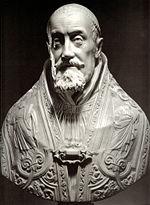
Pope Gregory I [shown below] forbade the selling of relics and the disruption of tombs in the catacombs.  Unfortunately, the popes or other religious authorities were powerless in trying to control the translation of relics or prevent forgeries [and] the abuses and the negative reaction surrounding relics has led many people to this day to be skeptical about relics.

Gregory I - Antiphonary of Hartker of Sankt Gallen.jpg

(See Why venerate relics?)    But we digress!   

We were talking about June 29 as “the Feast of Saints Peter and Paul.”  That article includes a link to and discussion of the Incident at Antioch, involving these two Founding Fathers of the Church.  That dispute also continues “even to this day.”

The dispute ostensibly involved circumcision, as a prerequisite for admission to the new Christian church.  But more precisely, the dispute involved whether all new non-Jewish converts – “Gentile Christians” – had to follow all the laws, rules and regulations of the Jewish faith in order to be a real Christian. (Or put another way, “legalism” versus “grace.”)  And as was noted in the article, Incident at Antioch:

[T]he issue of Biblical law in Christianity remains disputed to this day.  The Catholic Encyclopedia states:  “St. Paul’s account of the incident leaves no doubt that St. Peter saw the justice of the rebuke…”   In contrast, L. Michael White‘s From Jesus to Christianity states:  “The blowup with Peter was a total failure of political bravado, and Paul soon left Antioch as persona non grata, never again to return.”

Wikipedia added,  “The final outcome of the incident remains uncertain resulting in several Christian views of the Old Covenant to this day.”

Put simply:  There’s an ongoing debate on how much of the Old Testament Christians have to follow.  Some think only parts of the Old Testament apply to them.  Others believe that none of the Old Testament rules apply to them.  Then there are “dual-covenant theologians,” who think Old Testament rules are binding only on Jewish people.  And then there are those who believe “all are still applicable to believers in Jesus and the New Covenant.”

Be that as it may, the other dispute at issue here is whether Peter and Paul remained at odds with each other.  Tradition has it that “Peter and Paul taught together in Rome and founded Christianity in that city…  ‘They taught together in like manner in Italy, and suffered martyrdom at the same time.'”  Or as another blogger said, the Incident at Antioch was a case of Peter and Paul resolv[ing] a problem, although some critics act “as if Peter were cowardly before the onslaught of Judaisers and Paul was arrogant in tackling a senior Apostle!”

Then there’s the view of Garry Wills, who referred to the incident as “the Blowup at Antioch.”

Wills noted first that Paul wrote his version of events some 30 years before Luke described the Council at Jerusalem, in Acts 15.  (And thus was presumably more reliable than Luke’s version).  He then noted that Paul’s account of the Jerusalem Council – in Galatians 2 – “could not be more different.  There, Paul is neither summoned by Jerusalem nor sent by Antioch.  He goes there as a result of a vision urging him to go.” (81-82)

Then came Galatians 2 , verses 11-15, where “Paul Rebukes Peter at Antioch:”

When Cephas [Peter] came to Antioch, I opposed him to his face, because he stood self-condemned;  for until certain people came from James, he used to eat with the Gentiles.  But after they came, he drew back and kept himself separate for fear of the circumcision faction.  And the other Jews joined him in this hypocrisy…

As noted below, Paul basically got mad at Peter for being two-faced about the Lord’s Supper.  To Paul, the effect was to “dismember the mystical body of Christ.”

And there’s another aspect of the dispute:  Whether you are “saved” by following a set of rules and regulations, or by faith in Jesus alone.  See The Controversy Over Faith And Works Continues.  While some Christians indicate that you are “saved” by following a set of rules, Paul clearly came down on the side of faith.  See Galatians 2:16:  “know that a person is not justified by the works of the law, but by faith in Jesus Christ.”

But getting back to Garry Wills… He wrote that Paul was furious with Peter because “the Lord’s Meal was the symbol of unity for all the Brothers, Jew or Gentile.”  He added that many later Church Fathers were shocked at the idea that Peter and Paul would “squabble” like that, “unable to accept the fact that great men could differ.”

But for Paul the debate was serious:  Peter’s “backpedaling on Jewish observance” was a denial that the “risen Christ in Antioch in all those baptized into His mystical body.” (Emphasis added.)  To Paul, it was the equivalent of “dismembering the body of Christ.”

Wills went on to say that Paul wrote at great length on the matter in his Letter to the Galatians.  He did so because the members of that later church were “acting as if the matter of food laws were not settled.”  (Emphasis in original.)  More to the point here, Wills said “Paul’s last reported dealings with Peter” were not at Antioch, but rather with a “handshake of peace:”

Peter continued to be an emissary in the Diaspora and ended with Paul in Rome, where they died together as victims of Nero’s mad reaction to the fire that destroyed the city.  The treatment of them as ultimately partners … would thus be justified.  The two great leaders ended up on the same side. (E.A.)

The point being this:  Some Christians seem to think they have to be all “nicey-nicey,” all the &%#$ time, with each other and with non-Christians.  But the Feast of Peter and Paul goes to show it’s okay to have differences of opinion, or even “squabble” from time to time.

(For that matter, it’s okay to argue with God too…)

*   *   *   *

http://www.canvasreplicas.com/images/Two%20Scholars%20Disputing%20Peter%20and%20Paul%20Rembrandt%20van%20Rijn.jpg

“Scholars Disputing (Peter and Paul)” – but they still worked together… 

*   *   *   *

The upper image is courtesy of Saints Peter and Paul by GRECO, El – Web Gallery of Art:

The two saints[,] the most influential leaders of the early Church[, are shown here] engaged in an animated discussion.  The older, white-haired Peter … inclines his head thoughtfully to one side as he looks towards the text being expounded.  In his left hand he holds his attribute, the key to the kingdom of Heaven.  His right hand is cupped as if weighing up an idea.  Paul presses his left hand down firmly on the open volume on the table, his right hand raised in a gesture of explanation as he looks directly at the viewer.

The article noted El Greco painted the two together several times “with remarkable consistency.”  Peter always has white hair and a beard, while “Paul is always shown slightly balding, with dark hair and beard, wearing a red mantle…”  See also Feast of Peter and Paul – Wikipedia, with caption:  “Saint Peter and Saint Paul. Oil on canvas by El Greco. circa 16th-century. Hermitage Museum, Russia.”

Re: the definition of “saint.”  As one website said, “the ‘saints’ are the body of Christ, Christians, the church.  All Christians are considered saints.  All Christian are saints – and at the same time are called to be saints.”  (Citing 1st Corinthians 1:2.)  See What are Christian saints according to the Bible?

The “Corbinian” image is courtesy of Translation (relic) – Wikipedia, with caption:  “St. Corbinian’s relics being moved to Freising from Merano.  From a panel in the crypt of Freising Cathedral.”

The article Why do we venerate relics added that they are “divided into two classes.  First class or real relics include the physical body parts, clothing and instruments connected with a martyr’s imprisonment, torture and execution.  Second class or representative relics are those which the faithful have touched to the physical body parts or grave of the saint.”

Re: relics becoming “collectibles.”  See Wikipedia, which added:  “According to one legend concerning Saint Paternian, the inhabitants of Fano [a city in northeastern Italy] competed with those of Cervia for possession of his relics.  Cervia [some 60 miles up the coast] would be left with a finger, while Fano would possess the rest of the saint’s relics [aka body parts].

The Pope Gregory image is courtesy of Pope Gregory I – Wikipedia, the free encyclopediaNote that he was the pope who originated Gregorian chant, “the central tradition of Western plainchant, a form of monophonic, unaccompanied sacred song of the western Roman Catholic Church.  Gregorian chant developed mainly in western and central Europe during the 9th and 10th centuries…”

As to the skepticism surrounding the value of such relics (“then and now”), see Wikipedia:

With various barbarian invasions, the conquests of the Crusades, the lack of means for verifying all relics and less than reputable individuals who in their greed preyed on the ignorant and the superstitious, abuses did occur.  St. Augustine denounced impostors who dressed as monks selling spurious relics of saints…   [T]he abuses and the negative reaction surrounding relics has led many people to this day to be skeptical about relics.

Re:  the emporer at the time of the death of Peter and Paul.  There is some debate whether it was Nero or Valerian (emperor) See Wikipedia, the free encyclopedia.

The full quote from Galatians 2 , verses 11-15, where “Paul Rebukes Peter at Antioch:”

When Cephas [Peter] came to Antioch, I opposed him to his face, because he stood self-condemned;  for until certain people came from James, he used to eat with the Gentiles.  But after they came, he drew back and kept himself separate for fear of the circumcision faction.  And the other Jews joined him in this hypocrisy … so that even Barnabas was led astray by their hypocrisy.  But when I saw that they were not acting consistently with the truth of the gospel, I said to Cephas before them all, “If you, though a Jew, live like a Gentile and not like a Jew, how can you compel the Gentiles to live like Jews?”

The Garry Wills quotes are from his book, What Paul MeantSpecifically, from the 2007 Penguin Books edition, at pages 79-88, in Chapter 4, “Paul and Peter.”

Re: Faith and works.  See also Sola fide – WikipediaOr just Google “faith works controversy.”

Re: early church fathers “shocked at the idea that Peter and Paul would ‘squabble.'”  Wills noted that according to St. Jerome , the whole incident at Antioch was a “kind of didactic charade,” a way of “dramatizing the truth that external rites are unimportant.”

The Garry Wills image is courtesy of Garry Wills – Department of History – Northwestern University.

The lower image is courtesy of www.canvasreplicas.com/Rembrandt.htm.  See also Two Scholars Disputing by REMBRANDT Harmenszoon van Rijn.

*   *   *   *

On the Nativity of John the Baptist – 2015

Bucking tradition, the prophet Zechariah writes, “My son’s name is John…”

*   *   *   *

June 24 is the Feast Day for the Nativity of St. John the Baptist.

One valuable lesson from his Bible readings is that sometimes you have to bite the bullet

The feast day celebrates the birth of John the Baptist, “a prophet who foretold the coming of the Messiah in the person of Jesus, whom he later baptised.” The Bible readings are Isaiah 40:1-11, Psalm 85, Acts 13:14b-26, and Luke 1:57-80. Luke tells how Elizabeth – cousin of Mary (mother of Jesus) – came to be a mother, and how her husband got  struck dumb.

The time came for Elizabeth to give birth, and she bore a son.  Her neighbors and relatives heard that the Lord had shown his great mercy to her, and they rejoiced…  [T]hey were going to name him Zechariah after his father.  But his mother said, “No; he is to be called John.”  They said to her, “None of your relatives has this name.”  Then they began motioning to his father to find out what name he wanted to give him.  He asked for a writing tablet and wrote, “His name is John…”

The story of Zechariah getting struck dumb started at Luke 1, verses 5-7.  He was a member of the “priestly order of Abijah,” and he and Elizabeth were righteous before God but also old and childless.   Then God sent an angel to tell Zechariah he was about to become a father.  He got struck dumb because he doubted the angel.  (That’s where biting the bullet came in.  Zechariah should have accepted on faith what was, to him, counterintuitive.)

http://www.nationalgallery.org.uk/upload/img/gaudenzio-ferrari-annunciation-angel-gabriel-NG3068.1-fm.jpgThat is, nine months earlier – as Zechariah was doing his priestly duties in the inner sanctuary – the angel Gabriel (at left) appeared and told him Elizabeth would bear a son.  But he doubted:  “How will I know that this is so?  For I am an old man, and my wife is getting on in years.  And that was why he was struck dumb.  As Gabriel told him, “Since you didn’t believe what I said, you will be silent and unable to speak until the child is born.” Luke 1:20.

That came right after Zechariah wrote out, “His name is John.”  See Luke 1:64, saying that right after Zechariah wrote his son’s name, “Immediately his mouth was opened and his tongue freed, and he began to speak, praising God.”  Then – right after that – came the Benedictus (Song of Zechariah), “the song of thanksgiving uttered by Zechariah on the occasion of the birth of his son, John the Baptist” (and – no doubt – his being able to speak again):

The second part … is an address by Zechariah to [his son John], who was to take so important a part in the scheme of the Redemption; for he was to be a prophet, and to preach the remission of sins before the coming or the Dawn from on high.  The prophecy that he was to “go before the face of the Lord to prepare his ways…”  [See Luke 1:76,] an allusion to the well-known words of Isaiah 40:3 which John himself afterwards applied to his own mission (John 1:23), and which all three Synoptic Gospels adopt (Matt 3:3; Mark 1:2; Luke 3:4).

The reading ends with Luke 1:80; the child John “grew and became strong in spirit; and he lived in the wilderness until he appeared publicly to Israel.

Note that Isaiah 40:3 is included in the Old Testament reading for the day, Isaiah 40:1-11.  Isaiah 40:3 says (in one translation):  “A voice cries out in the desert:  ‘Clear a way for the LORD.  Make a straight highway in the wilderness for our God.'”  Thus John the Baptist became that voice crying in the wilderness, as noted in Matthew 3:3This is he who was spoken of through the prophet Isaiah: “A voice of one calling in the wilderness, ‘Prepare the way for the Lord, make straight paths for him.’

Which is another way of saying that  John the Baptist served as a precursor, forerunner or advance man for Jesus. (As in, “News Flash:  Jesus is on the way!“) Or as it says in the Collect: “your servant John the Baptist … sent to prepare the way of your Son our Savior.”

The Collect adds that we too should follow John’s example, and so to “constantly speak the truth, boldly rebuke vice, and patiently suffer for the truth’s sake.”  (See Nativity of St. John.)

For more on how John “grew and became strong in spirit,” see John the Baptist – Wikipedia:

John’s knowledge of Jesus varies…  In the Gospel of Mark, John preaches of a coming leader, but shows no signs of recognizing that Jesus is this leader.  In Matthew, however, John immediately recognizes Jesus and John questions his own worthiness to baptize Jesus.  In both Matthew and Luke, John later dispatches disciples to question Jesus about his status, asking “Are you he who is to come, or shall we look for another?”  In Luke, John is a familial relative of Jesus whose birth was foretold by Gabriel.  In the Gospel of John, John the Baptist himself sees the spirit descend like a dove and he explicitly preaches that Jesus is the Son of God.

See also Who Was John the Baptist? : Christian Courier, which noted that his name derived from “a Hebrew term signifying ‘Jehovah is gracious.'”  The article also noted that “John, therefore, was a key figure in the preparation of the Messiah’s work.”

Unfortunately, that “advance work for Jesus” included a gruesome death by beheading, as told in Mark 6:14–29:  “the king sent a soldier of the guard with orders to bring John’s head.  He went and beheaded him in the prison, brought his head on a platter, and gave it to [Salome]…   When his disciples heard about it, they came and took his body, and laid it in a tomb.”

So this June 24th we celebrate the birth of John the Baptist, who in his lifetime performed an invaluable service as forerunner and advance man for Jesus.  His life and especially his gruesome death serves as a reminder that, as one “Christian mystic” said: 

It is to vigor rather than comfort that you are called.”

*   *   *   *

http://www.nationalgallery.org.uk/upload/img/caravaggio-salome-receives-head-saint-john-baptist-NG6389-fm.jpg

“Salome receives the Head of John the Baptist…”

*   *   *   *

The upper image is courtesy of the link – Benedictus (Song of Zechariah) – in the Wikipedia article, Nativity of St. John the Baptist.  The caption:  “Detail of Zechariah writing down the name of his son (Domenico Ghirlandaio, 15th century, Tornabuoni Chapel, Italy).”

The “Gabriel” image is courtesy of www.nationalgallery.org.uk/paintings/gaudenzio-ferrari-the-annunciation:  “The Angel Gabriel announces to the Virgin Mary that she will bear the son of God (Luke 1: 26-8).  His words, ‘Hail Mary full of Grace, the Lord be with you,’ appear in abbreviated form in Latin on the scroll.”   Thus Gabriel appeared to both Elizabeth and Mary.

The “Salome” image is courtesy of www.nationalgallery.org.uk/paintings/caravaggio:  “The subject is from the New Testament [Mark 6, verses 14-29].  Salome had danced so well for King Herod that he swore he would grant her any request.  Her mother, Herodias, who sought revenge on John the Baptist, persuaded Salome to ask for his head.  The old woman behind Salome may be Herodias.”

The “vigor-comfort” quote is from Practical Mysticism, with advice for the “new Christian:”

Hearing now and again the mysterious piping of the Shepherd, you realize your own perpetual forward movement . . . and so are able to handle life with a surer hand.  Do not suppose from this that your new career is to be perpetually supported by agreeable spiritual contacts, or occupy itself in the mild contemplation of the great world through which you move.  True, it is said of the Shepherd that he carries the lambs in his bosom; but the sheep are expected to walk, and to put up with the bunts and blunders of the flock.  It is to vigor rather than comfort that you are called.  (E.A.)

Evelyn Underhill, Ariel Press (1914), at page 177.  See also Evelyn Underhill – Wikipedia.

*   *   *   *

On St. Barnabus’ Day, 2015


Barnabas curing the sick by Paolo Veronese, Musée des Beaux-Arts de Rouen.

Thursday June 11, 2015, is the Feast Day for Saint Barnabas.

For a more-complete rundown, see last year’s post, On St. Barnabas.

But first, there’s a reader comment to address.  It had to do with The DORs for June 6, 2015.  As edited for content, the comment was:  “A really good post … BUT … Why 2 separate & unrelated subjects??   Giving joyfully & D-day … but good content.”

Here’s the answer:  The trick I tried to pull off was blending two disparate subjects.  Such dichotomies are common in both Western thought and Western literature especially.  See How can we define and explain “dichotomy” in literature:  “dichotomy is a useful literary device which creates drama, causes conflict and adds depth to characters and situations.”  See also Dichotomy – Wikipedia, the free encyclopedia:

Perceived Dichotomies are common in Western thought.  C. P. Snow believes that Western society has become an argument culture (The Two Cultures).  In The Argument Culture (1998), Deborah Tannen suggests that the dialogue of Western culture is characterized by a warlike atmosphere in which the winning side has truth (like a trophy).  Such a dialogue virtually ignores the middle alternatives.  (Emphasis added.)

In the case of June 6, 2015, the theme was supposed to be:  “We kicked Nazi butt in World War II because of American ingenuity.  Because we’re inherently creative and because we constantly ‘ask questions.'”  This was as opposed to certain Bible-thumpers of today who – in the realm of Bible reading – are “trying to create a culture that rewards conformism and stifles creativity.”  That was the dichotomy:  Applying a principle from World War II to Bible Study.

Again, the point was supposed to be that the question-asking, probing method of Bible study is far better for both the individual reader and for American society as a whole.  It’s far better than just saying, “Oh, I’ll take everything that slick-haired televangelist says at face value!

Of course I confess – I do not deny, but confess –  that I may have been a bit too subtle.

So anyway, back to Barnabus.  According to AmericanCatholic.org, Barnabus came “as close as anyone outside the Twelve to being a full-fledged apostle.  He was closely associated with St. Paul (he introduced Paul to Peter and the other apostles) and served as a kind of mediator between the former persecutor and the still suspicious Jewish Christians.” 

See also Barnabas – Wikipedia, and ST. BARNABAS, APOSTLE : Catholic News Agency:

The apostle and missionary was among Christ’s earliest followers and was responsible for welcoming St. Paul into the Church.  Though not one of the 12 apostles . . . he is traditionally regarded as one of the 72 disciples of Christ and [the] most respected man in the first century Church after the Apostles themselves.

Note that the Bible first mentions Barnabas in Acts 4:36:  “Joseph, a Levite, born in Cyprus, whom the apostles called Barnabas (son of encouragement), sold a field he owned, brought the money, and turned it over to the apostles.”  And Barnabas the Apostle – Justus added that even after Paul’s Damascus Road experience, most Christians in Jerusalem “wanted nothing to do with him.  They had known him as a persecutor and an enemy of the Church.  But Barnabas was willing to give him a second chance.”  (Which is pretty much what Jesus is all about.)

To sum up, if it hadn’t been for Barnabas and his willingness to give Paul a second chance – a second chance for the formerly zealous persecutor of the early Church – he might never have become Christianity’s most important early convert, if not the “Founder of Christianity.”

See also On St. Barnabas, from last year.  That post noted that not only did Barnabus give Paul a second chance, he did the same thing with Mark.  Mark in turn “responded well to the trust given him by the ‘son of encouragement,’ since we find that Paul later speaks of him as a valuable assistant (2 Tim 4:11; see also Col 4:10 and Phil 24).”


“So we might just call Barnabas ‘the Apostle of Second Chances.’”


 If it wasn’t for Barnabus, Paul’s Damascus Road experience might have gone for naught


The upper image was borrowed from last year’s post, On St. Barnabas.  In turn it’s courtesy of Barnabas – Wikipedia, the free encyclopedia.

The lower image is courtesy of Conversion of Paul the Apostle – Wikipedia.  The caption:  “The Conversion of Saint Paul, a 1600 painting by the Italian artist Caravaggio.”  See also What happened on the road to Damascus?  That site noted:  “The events that happened on the road to Damascus relate not only to the apostle Paul, whose dramatic conversion occurred there, but they also provide a clear picture of the conversion of all people.”  (E.A.)

Re: Televangelists.  See also Why are there so many televangelist scandals? – GotQuestions, Televangelists – Huffington Post (a list of articles on the subject), and Televangelist – RationalWiki.

Re: “argument culture.”  The full title of Deborah Tannen‘s book is The Argument Culture: Stopping America’s War of Words.  Tannen wrote an earlier book, You Just Don’t Understand: Women and Men in Conversation (1990).  According to Amazon, in that earlier book “Tannen showed why talking to someone of the opposite sex can be like talking to someone from another world.”

On Trinity Sunday, 2015

The Trinity, as envisioned by “Bartolomé Esteban Murillo (d. 1682)…”


Last year Trinity Sunday – always the Sunday after Pentecost – came on June 15.  This year it’s celebrated on May 31st.  See Trinity Sunday – Wikipedia, the free encyclopedia:

Trinity Sunday celebrates the Christian doctrine of the Trinity, the three Persons of God:  the Father, the Son, and the Holy Spirit…   The Sundays following Pentecost, until Advent, are numbered from this day.  In traditional Catholic usage, the First Sunday After Pentecost is on the same day as Trinity Sunday…   [T]he Episcopal Church in the United States of America (ECUSA) now follows the Catholic usage…

The link First Sunday after Pentecost will take you to the “RCL” Bible readings for that day:  Isaiah 6:1-8, Psalm 29 or Canticle 2 or 13, Romans 8:12-17, and John 3:1-17.

The first reading – from the Book of Isaiah – is by the prophet who lived in the “8th-century B.C. Kingdom of Judah.”  The book told how God would make Jerusalem the center of His world rule through a Messiah, an “agent who brings about Yahweh’s kingship.”  In general, Isaiah spoke out for the poor and oppressed and “against corrupt princes and judges.”  And Isaiah 44:6 contained the “first clear statement of monotheism,” a model that became “the defining characteristic of post-Exilic Judaism,” as well as of Christianity and Islam.  (See Wikipedia.)

As for the Trinity Sunday reading, Isaiah 6:1-8 told of the prophet – seen at right iconocally – being first “cleansed and commissioned” to be a prophet, in the year “King Uzziah died.”  (Asimov put that at 740 B.C.)  At first he protested that he wasn’t worthy:  “I am a man of unclean lips, and I live among a people of unclean lips.”  But he got cleansed through the act of a seraph, holding a hot coal with a pair of tongs:

The seraph touched my mouth with it and said:  “Now that this has touched your lips, your guilt has departed and your sin is blotted out.”  Then I heard the voice of the Lord saying, “Whom shall I send, and who will go for us?”  And I said, “Here am I; send me!”

Which brings up a note about the whole idea behind Trinity Sunday, to wit:  the Trinity itself.  (That is, both the doctrine of the Trinity and the idea that Isaiah could have his lips “touched” with a hot coal without screaming like a banshee are difficult to comprehend.)

As to the Trinity, see for example All About Trinity Sunday | Prayers, History, Customs:

Trinity Sunday … is one of the few celebrations of the Christian Year that commemorates a reality and doctrine rather than a person or event…   The Trinity is one of the most fascinating – and controversial – Christian dogmas.  The Trinity is a mystery.  By mystery the Church does not mean a riddle, but rather the Trinity is a reality above our human comprehension that we may begin to grasp, but ultimately must know through worship, symbol, and faith.  It has been said that [this] mystery is not a wall to run up against, but an ocean in which to swim.

(Emphasis added.)  And as noted in June 15 [2014] – Part I, the Trinity is so extremely difficult to understand that even a smart guy like Thomas Jefferson couldn’t do it.

To prove my point:  On April 29, 1962, President Kennedy gave a White House dinner to honor Nobel Prize winners “of the Western Hemisphere.”  Attendees included Pearl S. Buck and Robert Frost, as well as a number of lesser-known Nobel laureates listed in the Notes.  (Buck won the 1938 Nobel Prize in Literature.  Frost won four Pulitzer Prizes for Poetry.  In 1960 he was awarded the Congressional Gold Medal for his “poetical works,” and in 1961 he was named Poet laureate of Vermont.)   Kennedy’s conclusion was:

I think this is the most extraordinary collection of talent, of human knowledge, that has ever been gathered at the White House – with the possible exception of when Thomas Jefferson dined alone.”  (E.A.)

The point is this:  If a smart guy like Thomas Jefferson couldn’t comprehend the Christian Trinity, what hope do we “mere mortals” have?  Or as I noted in the post, Readings for June 15 [2014] – Part I, don’t worry:

Neither did Thomas Jefferson, so you’re in good company…  Jefferson questioned key parts of Christianity including Mary’s virgin birth, Jesus’ resurrection and Jesus’ teachings of being the messiah long before his death in 1826.  “As early as 1788, we have a letter where he said he didn’t understand the trinity, and if he didn’t understand the trinity, how could he possibly agree to it?”

The thing is, even though Jefferson was a very smart guy, he fell into a “common error of thinking that he could ever really understand everything there is to know about God.”

But as noted above, “the Trinity is a reality above our human comprehension.”  It’s a reality that we may only begin to grasp.  The same seems to be true of much of the Bible, and especially the “mystical” parts.   (That may be why some choose “literalism.”  It’s ever so much easier…)

Fortunately the New Testament and Gospel readings are a tad easier to understand.

In Romans 8:12-17, Paul wrote that “all who are led by the Spirit of God are children of God,” and thus that we have “received a spirit of adoption.  When we cry, ‘Abba! Father! it is that very Spirit bearing witness with our spirit that we are children of God.”  As the International Bible Commentary put it:  “The Spirit is not one who maintains the frightening, servile conditions of the old era, but gives the confidence that God is a personal Father.” (1331)

And in the Gospel  –  John 3:1-17  –  Jesus had a talk with a “Pharisee named Nicodemus, a leader of the Jews” who was also a follower, but secretly.  And again, even a smart guy like Nicodemus didn’t understand the concept of being “born again.”  His problem?  He took Jesus’ words too literally:  “Nicodemus said to Him, ‘How can anyone be born after having grown old?  Can one enter a second time into the mother’s womb and be born?'”

Jesus answered him, “Are you a teacher of Israel, and yet you do not understand these things?
…  If I have told you about earthly things and you do not believe, how can you believe if I tell you about heavenly things?

Which goes to show that reading the Bible too literally can only take you so far in your spiritual journey.  As Jesus Himself noted, the Bible includes many realities that are simply above our human comprehension:  “How can you believe if I tell you about heavenly things?

See also the end of John’s Gospel, John 21:25, which said there were many other things Jesus did, “which if they were written in detail, I suppose that even the world itself would not contain the books that would be written.”   There’ll be more about this in the next post…

 Painting of Jefferson wearing fur collar by Rembrandt Peale, 1800

As smart a guy as Thomas Jefferson couldn’t comprehend the Trinity


One final note:  The Trinity Sunday Gospel included John 3:16, “one of the most widely quoted verses from the Christian Bible.”  It has been called “the most famous Bible verse,” and also “the ‘Gospel in a nutshell,’ because it is considered a summary of the central theme of traditional Christianity.”  See John 3:16 – Wikipedia, the free encyclopedia.  See also the 3:16 Game – Wikipedia, and “John 3:16” signs that people hold up at football games?   (The “3:16” game was the “AFC Division Wild Card game on Sunday, January 8, 2012, between the Denver Broncos and Pittsburgh Steelers,” noted for “its statistical correlations to John 3:16, the quintessential Bible verse of Christianity.”)

For myself, I prefer to focus on the promise that Jesus made in John 6:37, to wit:  That He would never turn away anyone who came to Him.  See “What’s in it for me?”  That post noted that John 3:16 was “a nice general sentiment,” but doesn’t answer the question, “what’s in it for me?”

Moving on to the credits and references:

The upper image is courtesy of Trinity – WikipediaThe full caption:  “God the Father (top), the Holy Spirit (represented by a dove), and child Jesus, painting by Bartolomé Esteban Murillo (d. 1682).” 

The Isaiah image is courtesy of Isaiah – Wikipedia.  The caption:  “Russian icon of the Prophet Isaiah, 18th century (iconostasis of Transfiguration Church, Kizhi monastery, Karelia, Russia).”

The lower image is courtesy of Thomas Jefferson – Wikipedia, the free encyclopedia.  The caption:  “Thomas Jefferson, Official White House Portrait, by Rembrandt Peale, 1805.”  That article also provided the Jefferson postage stamp image:  “1st Jefferson stamp, 1856 issue.”

Re:  Kennedy on Jefferson.  See also Remarks at a Dinner Honoring Nobel Prize Winners, “…when Thomas Jefferson dined alone.” | The Pavellas Perspective,” and Dinner in Honor of Nobel Laureates.  The latter noted that aside from Ms. Buck and Mr. Frost, other attending Nobel Prize winners included: Chairman of the Department of Biochemistry at Cornell University Medical College, Dr. Vincent du Vigneaud;  physicist from the Institute for Advanced Study, Dr. Chen Ning Yang;  biochemist from the University of California, Berkeley, Dr. Melvin Calvin;  and chemist from the University of California, Berkeley, Dr. William F. Giauque.”

Re:  Thomas Jefferson on the Trinity.   See for example Controversial Thomas Jefferson book pulled over complaints.  See also Jefferson Bible – Wikipedia, the free encyclopedia, which said Jefferson’s book titled The Life and Morals of Jesus of Nazareth began with an account of Jesus’s birth “without references to angels (at that time), genealogy, or prophecy.   Miracles, references to the Trinity and the divinity of Jesus, and Jesus’ resurrection are also absent from his collection.”

One other final note:  I wrote about last year’s Trinity Sunday in The readings for June 15 – Part II.

On Pentecost – “Happy Birthday, Church!”

An artist’s depiction of Pentecost – the “birthday of the Church…”

*   *   *   *

Pentecost Sunday is coming up on May 24th.  The word “Pentecost” comes from the Greek for “the 50th day,” and it’s always celebrated 50 days after Easter Sunday.  (That’s “seven weeks plus one day.”)  And it’s been around a long, long time.  See Pentecost – Wikipedia:

Pentecost is the Greek name for the Feast of Weeks, a prominent feast in the calendar of ancient Israel celebrating the giving of the Law on Sinai.  This feast is still celebrated in Judaism as Shavuot.  Later, in the Christian liturgical year, it became a feast commemorating the descent of the Holy Spirit upon the Apostles and other followers of Jesus Christ (120 in all), as described in the Acts of the Apostles [verses 1-13 et seq.].

Another name for Pentecost is Tongue Sunday.  For one thing there were the “tongues of fire” that appeared that day, as shown in the El Greco painting below. (See also Acts 2:3.)

The Theotokos & the Twelve Apostles — Fifty Days after the Resurrection of Christ, awaiting the descent of the Holy SpiritFor another thing there was the “speaking in tongues” – also known as glossolalia, as shown at left – that was such a feature of the original Pentecost.  See Acts 2:4, “All of them were filled with the Holy Spirit and began to speak in other tongues as the Spirit enabled them.

That made some onlookers skeptical, even at the time.  As noted in Acts 2:12 and 13, some people who saw the event were amazed, but “others sneered and said, ‘They are filled with new wine!'” 

But as Isaac Asimov noted, the Apostles weren’t just “babbling.”

Instead they spoke in concrete, known languages.  As a result, people from a host of different nations could understand them.  As Asimov put it, “in their ecstasy, they uttered phrases in both languages”  –  i.e., the “marketplace” Koine Greek prominent at the time, or the disciples’ native Aramaic  –   so that “those who listened to them from the various nations … would have understood something.”  (See Readings for Pentecost (6/8/14).)  See also Acts 2, verse 8-11:

“How is it that we hear, each of us, in our own native language?   Parthians, Medes, Elamites, and residents of Mesopotamia, Judea and Cappadocia, Pontus and Asia, Phrygia and Pamphylia, Egypt and the parts of Libya belonging to Cyrene, and visitors from Rome, both Jews and proselytes, Cretans and Arabs – in our own languages we hear them speaking about God’s deeds of power.”

(See also 1st Corinthians 14:19, on the potential abuse of that “gift,” where the Apostle Paul said that while he was glad he could speak in tongues, in church “I would rather speak five intelligible words to instruct others than ten thousand words in a tongue.”)

For another view of this “first Pentecost,” see What is Pentecost?  (Patheos):

Before the events of the first Pentecost … a few weeks after Jesus’ death and resurrection, there were followers of Jesus, but no movement that could be meaningfully called “the church.”  Thus, from an historical point of view, Pentecost is the day on which the church was started.  This is also true from a spiritual perspective, since the Spirit brings the church into existence and enlivens it.  Thus Pentecost is the church’s birthday.

Another thing that Pentecost does is mark the beginning of “Ordinary Time,” as it’s called in the Catholic Church, and shown in the chart at left.

Such “Ordinary Time” takes up over half the church year, though in the Episcopal Church and other “Protestant” denominations, it goes by another name.  That is, in the Anglican liturgy, the Season of Pentecost begins on the Monday after Pentecost Sunday and goes on “through most of the summer and autumn.”  It may include as many as 28 Sundays, “depending on the date of Easter.”  (See also the List of Anglican Church Calendars.)

In other words, this year – 2015 – the Season of Pentecost begins on Monday, May 25, and doesn’t end until Saturday, November 28.   That’s Thanksgiving Weekend, and the day after that – November 29 – marks the First Sunday of Advent, and with it the start of a new liturgical year.

Also, the readings for each Sunday – from June 7 to November 22  – are designated as a given “Sunday after Pentecost,” with a given “Proper” number.  For example, the Bible readings for Sunday August 16 – right about the middle of the Season of Pentecost – are designated as those for the Twelfth Sunday after Pentecost – Proper 15.

But the key point to remember is that it wasn’t only people who were already Christians who saw the Pentecost in Acts as a miracle;  “so did the onlookers … for many were converted to the belief in Jesus as Messiah.”   (Asimov, 1002-1003)  Or as was noted in Acts 2:41, “the same day there were added unto them about three thousand souls.”

To sum up, the Pentecost described in Acts “was a momentous, watershed event.”  For the first time in history, God had empowered “all different sorts of people for ministry.  Whereas in the era of the Old Testament, the Spirit was poured out almost exclusively on prophets, priests, and kings,” on this Day of Pentecost the Holy Spirit had been given to “‘all people.’  All would be empowered to minister regardless of their gender, age, or social position.”  (See What is Pentecost? Why Does It Matter? – Patheos, noted above and emphasis added.)

*   *   *   *

El Greco. Pentecost.

The upper image is courtesy of Pentecost – Wikipedia, with the caption: A Western depiction of the Pentecost, painted by Jean II Restout, 1732.” 

The version at left is courtesy of El Greco. Pentecost – Olga’s GallerySee also El Greco | Hear what the Spirit is saying, with the following notes by Hovak Najarian, on “The Pentecost, Oil on Canvas,” circa1600:

“Its height above floor level would place the seminarians at the lower part of the painting and they would see the subject matter increase in complexity as their gaze moved upward toward Mary, the apostles, and the plumes of fire.  A dove at the top of the painting represents the Holy Spirit; its wings are spread and the light that surrounds it is radiating downward over the gathering. 

“The two men in the foreground at the bottom of a short flight of stairs have lifted their arms and are leaning back slightly in order to look at the dove.  Mary (dressed in red and blue) is seated at the center of the painting with apostles gathered around her; two other women are included in the painting.   

“The woman at Mary’s left shoulder is thought to be Mary Magdalene and the fourth person from the left side may be Martha…  El Greco also included himself in this painting.  His face is second from the right; he is the man with a white beard who seems to be in deep thought and is not looking up toward the dove.

“Although the term, ‘Expressionism,’ did not come into use until the twentieth century, it is an apt term for El Greco’s late paintings.  Expressionism is the result of an artist’s effort to project emotional intensity and inner feelings into a work.  The figures in The Pentecost are not posing for a formal group portrait.  They are an animated informal mix of people who in body language and facial expression are reacting individually, and yet they are part of the collective experience. They are responding with awe and excited emotional involvement as they take part in this miraculous event.”

On the subject of “Propers” in the liturgical year, and especially in the season of Pentecost.  A “proper” definition of the term Proper is far beyond the scope of the themes explored in this blog.  However, those interested in further information on this rather ethereal concept are directed to web articles including but not limited to The Revised Common Lectionary, Proper Ordinary Time | Liturgy, and/or Lectionary #, Proper #, or Sunday after Pentecost?

For more on the issue of speaking in tongues, see On the readings for Pentecost (6/8/14), which noted in part that such “speaking” refers to the “fluid vocalizing of speech-like syllables that lack any readily comprehended meaning, in some cases as part of religious practice. Some consider it as a part of a sacred language. It is a common practice amongst Pentecostal and Charismatic Christianity:”

On the other hand, it could be argued this is another example of some people taking isolated Bible passages out of context, like those who handle snakes based on Mark 16:17-18, or those who have a “quiverfull” of children based on a passage from Psalm 127.  (See Snake handling – Wikipedia, and QuiverFull .com :: Psalm 127:3-5.)

On Ascension Day 2015

 “Jesus’ ascension to heaven,” by John Singleton Copley

 *   *   *   *

“Liturgically speaking,” it was a year ago that I posted On Ascension Day.   More precisely:

Ascension Day is always celebrated on a Thursday, 40 days after Easter.  (In 2014 it falls on May 29).  This major Feast Day – ranking with Easter and Pentecost – commemorates “the bodily Ascension of Jesus into heaven.”

But this year, that 40th day after Easter falls on Thursday, May 14.  (15 days earlier than last year.)  The upshot is that since it hasn’t quite been a year, this isn’t technically an anniversary post.   But “Ascension Daywas one of my first-ever posts, so to me it’s worth commemorating.

But why “40 days after Easter?”  That’s because according to tradition, after Jesus was crucified and rose again, He stuck around on earth for 40 days, before He ascended to Heaven to “sit on the right hand of God.” See Mark 16:19, Resurrection appearances of Jesus – Wikipedia, and Why did Jesus stay around for 40 days after He came back from the grave?

The former noted that these appearances of Jesus “are reported to have occurred after his death, burial and resurrection, but prior to his Ascension.”  The latter noted:

During those 40 days [between Easter and the Ascension], He appeared to various groups … proving beyond doubt to them that he had been raised from the dead by the power of God.  Over two decades later, the Apostle Paul wrote that “he appeared to more than five hundred of the brothers at the same time, most of whom are still living” (1st Cor. 15:6).

But getting back to The Ascension itself:  In the 2014 Ascension Day post, I discussed the whole idea of this “bodily ascension of Jesus into heaven.”  I noted that some people – skeptics – might have a problem with that, or with the “underlying idea that there is indeed ‘life after life,’ for each and every one of us.”  To such skeptics I cited the First law of thermodynamics, that “energy can be transformed from one form to another, but cannot be created or destroyed.”  Put another way, energy is neither created nor destroyed, but simply changes form:

So if the human soul is a form of energy – an idea that seems self-evident – then it too can neither be created nor destroyed, but simply changes form. (E.A.)

The 2014 Ascension Day also cited On arguing with God, for the idea that the name Israel literally translates, “He who struggles with God.”  But in a metaphoric sense, Israel can mean anyone who “struggles with the idea of God.”  (Or with the idea of an afterlife.)

In turn I cited the post on Ascension Day in Jesus in Hell.  That post talked about how 1st Peter 3:19–20 and 1st Peter 4:6 led to the Catholic doctrine of the harrowing of hell:

This is the Old English and Middle English term for the triumphant descent of Christ into hell (or Hades) between the time of His Crucifixion and His Resurrection, when, according to Christian belief, He brought salvation to the souls held captive there since the beginning of the world…   Writers of Old English prose homilies and lives of saints continually employ the subject, but it is in medieval English literature that it is most fully found, both in prose and verse, and particularly in the drama. (E.A.)

See also CATHOLIC ENCYCLOPEDIA: Harrowing of Hell – New Advent.  That in turn led to the idea that “Jesus did really die and through his death for us conquered death and the devil ‘who has the power of death.'”  (Citing Hebrews 2:14, that “through death he might destroy the one who has the power of death, that is, the devil.”)

Or as I put it:  In his First Epistle, Peter was one of the first to advance the “whole concept of ‘life after life.‘”  (See also Raymond Moody – Wikipedia.)    I then added this:

One constant has remained:  “The above views share the traditional Christian belief in the immortality of the soul…”   [See also] Psalm 68:20[, which reads in one version] “God is the Lord, by whom we escape death.”  So all in all, “death” – like New Jersey – would seem to be a pretty good place to [be] from.  In the meantime it’s reassuring to think that Jesus would [literally] “go to hell” on our behalf…

So first Jesus got crucified, for us.  Then He “descended into Hell,” for us.  Then He reappeared on earth and stuck around 40 days, just to make sure His message got through.  Then He ascended to Heaven, to “sit at the right hand of God.”  One possible point being that we too should enjoy our time here on earth, just like He did at the Supper at Emmaus:

The upper image was courtesy of the Wikipedia article, Ascension of Jesus, with the full caption: “Jesus’ ascension to heaven depicted by John Singleton Copley, 1775.”   

The lower image is courtesy of Resurrection appearances of Jesus – Wikipedia, with the caption, “Supper at Emmaus,” in which Caravaggio “depicted the moment the disciples recognize Jesus.”  As Wikipedia noted, “The Road to Emmaus appearance refers to one of the early resurrection appearances of Jesus after his crucifixion and the discovery of the empty tomb.

Re: commemorating.  My 2014 post – On Ascension Day  – was the 25th of 151 I’ve done so far.  (As noted, on or about May 29, 2014.)  My very first post was The Bible – Lectionary Musings and Color Commentary, and was published on April 24, 2014.  That post included information on:

Quasimodo Sunday … not through any connection with Victor Hugo’s character in The Hunchback of Notre Dame.   Instead, the name comes from a Latin translation of the beginning of First Peter 2:2, a traditional “introit” used in churches on this day.    First Peter 2:2 begins – in English and depending on the translation – “As newborn babes, desire the rational milk without guile…”  In Latin the verse reads:  “Quasi modo geniti infantes

I also cited the 2014 post on Ascension Day in On the readings for June 1, which included a painting by Eugène Delacroix, Lion Devouring a Rabbit.  That post cited Peter’s warning in 1st Peter 5:8, and added that “you don’t want to end up like the rabbit in the Delacroix painting.” (E.A.)

The original post included an image, in black and white, of a woodcut, courtesy of Harrowing of Hell – Wikipedia, with the full caption:  “Christ’s Descent into Limbo, woodcut by Albrecht Dürer, c. 1510.”  See also the Jesus in Hell post, which included: Other references of possible interest include: Paradise – Wikipedia, Zohar – Wikipedia, and/or Heaven – Wikipedia.