Category Archives: Feast Days

On Trinity Sunday (2016) – and more!

Painting of Jefferson wearing fur collar by Rembrandt Peale, 1800

Even a smart guy like Jefferson couldn’t figure out The Trinity – celebrated next Sunday… 

*   *   *   *

Next May 22 is Trinity Sunday.  That’s a rare feast day in the liturgical year that celebrates “a doctrine instead of an event.”  See also What is the Trinity:

The word “trinity” is a term used to denote the Christian doctrine that God exists as a unity of three distinct persons:  Father, Son, and Holy Spirit.  Each of the persons is distinct from the other yet identical in essence.  In other words, each is fully divine in nature, but each is not the totality of the other persons of the Trinity.

Sound confusing?  It is, but before we get into it any deeper, a note about a recent Daily Office Reading.  I.e., the New Testament DOR for Monday, May 16, 2016:  1st John 3:18-4:6.

That reading included 1st John 3:22.  This passage is right after the one saying we can have confidence – or “boldness” – when dealing with God. (Assuming “our hearts don’t condemn us.”)  Then comes 1st John 3:22, which added this:  “And we will receive from [God] whatever we ask because we obey him and do the things that please him.”

And that’s a passage that can be misleading.  That is, some people seem to think that once they become a Christian, God becomes a sort of “magic genie,” who will cater to their every whim.  (As illustrated – sarcastically – in “O Lord won’t you buy me a Mercedes Benz,” by Janis Joplin, above left.)

But – as a reasonable person might expect – the spiritual life isn’t that simple.

For starters, Matthew Henry’s Commentary noted Christians can indeed “ask what they would” of God.  But there’s this proviso:  “They would receive it, if good for them.”  And as all kids can say of their parents, what they want is usually way different than “what’s good for them.”

Then there’s the fact that quite often God has a different timetable than us.  See Readings for October 26, which noted that Moses finally did reach the Promised Land. However, it took over a thousand years after he died.  (In the Transfiguration of Jesus):

Moses’ faith had its ultimate reward and vindication centuries later.  In God’s economy, promises and fulfillment are not measured by our calendars.  Centuries run their course.  Yet some day in the future, the full meaning of our acts and life of faith will become evident.  That was true for Moses, and it will be true for us.

You can see another disclaimer – on the tendency to over-simplify 1st John 3:22 – at “Job the not patient” – REDUX.  That post discussed the ever-perplexing theme of “God’s justice in the face of human suffering – or simply, ‘Why do the righteous suffer?’”

Which is another way of saying that many times we don’t get what we ask for, from God.  (As opposed to getting what we need, or “what’s good for us.”)

Or see Wisdom of Virgil – and an “Angel,” which noted that getting good things from God should be as hard as shooting the head off a matchstick from 100 yards away.  (But usually isn’t.)

(And “Virgil” also noted one professor’s view:  That we mere human beings are no more prepared to fully comprehend God than “cats are prepared to study calculus.”)

But getting back to Trinity Sunday.  The point of all this is that – if you don’t fully understand the whole concept of The Trinity – don’t feel too bad.  Or alone, for that matter…

A leather-bound Bible

The thing is, as smart a guy as Thomas Jefferson couldn’t figure it out either.  (In fact, Jefferson wrote his own version of the Bible – shown at left – “by cutting and pasting with a razor and glue numerous sections from the New Testament as extractions of the doctrine of Jesus.”)

Or as it was put in The Solemnity of Trinity Sunday in the Catholic Church: “We can never fully understand the mystery of the Trinity.”  It is however “the most fundamental of Christian beliefs,” that God is “three Persons in one Nature.  The three Persons of God – Father, Son, and Holy Spirit – are all equally God, and They cannot be divided.”

Which is indeed food for thought.

You can see all the Sunday Bible readings at 1st Sunday after Pentecost (Trinity Sunday).  And Romans 5:3-4 continues the theme of what we want vswhat’s good for us:

[S]uffering produces endurance, and endurance produces character, and character produces hope, and hope does not disappoint us, because God’s love has been poured into our hearts through the Holy Spirit that has been given to us.

Character Building(For a more “worldly” view on building character, see Calvin and Hobbes, with the image at right.)

But getting back to the readings at Trinity Sunday, they also include John 16:12-13.  There Jesus said, “There is so much more I want to tell you, but you can’t bear it now.  However, when the Spirit of truth comes, He will guide you into all truth.”

Two points.  The first has to do with the part where Jesus said, “you can’t bear it now.”

Paul brought up that very issue in 1st Corinthians 3:2.  There he told the Christians in Corinth, “I had to feed you with milk” – metaphorically speaking – “not with solid food, because you weren’t ready for anything stronger.  And you still aren’t ready…”  Which is another way of saying that the people both Jesus and Paul were talking to were still boot-camp Christians.

(As noted below, these days they’re the Biblical literalists who never go “beyond the fundamentals.”)

And that’s just another way of saying – as Paul did – that the Bible is fully of “mysteries.”  For a list of some “mysteries” Paul listed, see the notes below, or St. Mark’s “Cinderella story.”

But because of all those “mysteries” in the Bible, it takes awhile to understand.  (A lifetime “and more,” in fact.)  And that’s just another way of saying, sometimes we just “can’t handle the truth!”

We need help.  And that brings up the second point, which has to do with the Spirit of truth, also called the Holy Spirit.  That’s the “third divine person of The Trinity,” and probably the least understood of the Three.

Put simply, assume God is the Ultimate Judge and Jesus is the Ultimate Public Defender.  In turn, the Holy Spirit is the “Ultimate Counselor.”  See John 14:26, interpreted in the Complete Jewish Bible.  There Jesus said, “the Counselor, the Ruach HaKodesh, whom the Father will send in my name, will teach you everything;  that is, he will remind you of everything I have said to you.”

Note that as originally written, the term can be translated “the Comforter,” the “Spirit of Promise,” the “Spirit of Revelation,” or the “Spirit of Wisdom.”

But we’re getting close to the end here.  So in closing, for more information, see last year’s On Trinity Sunday, 2015.  That post included an image similar to the one below.   And it included some notes about parts of the Bible that are hard to understand:

That is, both the doctrine of the Trinity and the idea that Isaiah could have his lips “touched” with a hot coal without screaming like a banshee are difficult to comprehend.

The “banshee” part referred to Isaiah 6:6-7.  That was part of the Old Testament reading for Trinity Sunday 2015.  The full reading was about Isaiah being commissioned by God, during which “one of the seraphim flew to me with a live coal in his hand, which he had taken with tongs from the altar.  With it he touched my mouth…”  

Which led to my comment about screaming like a banshee.

One point from last year’s post:  That Thomas Jefferson – like many of us – fell into a common error:  Thinking “he could ever really understand everything there is to know about God.”  But like many parts of the Bible, the Trinity – like Isaiah 6:6-7 – are simply beyond our ability to comprehend, fully.  “It’s a reality that we may only begin to grasp.”  Which seems to be why   so many Christians choose literalism.  “It’s ever so much easier.

However – if you don’t want to remain “a Bible buck private all your life” – enjoy your spiritual journey, with all its challenges.  Beginning with next Sunday’s celebration of the Trinity.

*   *   *   *

The “Holy Trinity,” by Luca Rossetti da Orta (1738-39)

*   *   *   *

The upper image is courtesy of Thomas Jefferson – Wikipedia.  The caption:  “Thomas Jefferson, Official White House Portrait, by Rembrandt Peale, 1805.”  That article also included the “Jefferson Bible” image in the text, to the left of the paragraph beginning, “And if you don’t understand all that, don’t feel bad.”

See also Trinity Sunday in the U.S., and On the readings for July 26.

Re: the Jefferson Bible. It is formally known as The Life and Morals of Jesus of Nazareth.

The complete Daily Office Bible readings for Monday, May 16, 2016, are:  Psalms 1, 2, 3, 4 and 7; along with Proverbs 3:11-20; 1st John 3:18-4:6; and Matthew. 11:1-6.

Re: Romans 5:3-4. Note that the link is to the NIV translation. The block-quote is from “Satucket.”   

The full list of Paul’s “mysteries,” noted in St. Mark’s “Cinderella story:”

For example, see 1st Corinthians 2:7, where Paul spoke of “the word of God in a mystery, even the hidden wisdom.”  He spoke of the “knowledge in the mystery of Christ” in Ephesians 3:4, and of the “fellowship of the mystery” in Ephesians 3:9.  In Ephesians 5:32 he wrote, “This is a great [or “profound”] mystery: but I speak concerning Christ and the church.”  Paul told Christians to “make known the mystery of the gospel” in Ephesians 6:19, and to hold “the mystery of the faith” – or the “deep truths” – in a “pure conscience” in 1st Timothy 3:9.  He said that “great is the mystery of godliness” in 1st Timothy 3:16, and in 1 Corinthians 4:1, Paul said that Christians were to be faithful “stewards of the mysteries of God.”

Re: God as Ultimate Judge, Jesus as Ultimate Public Defender, and the Holy Spirit as the Ultimate Counselor.  See also The GIST (Part II).

The lower image is courtesy of Trinity Sunday – Wikipedia.  The caption:  “Holy Trinity, fresco by Luca Rossetti da Orta, 1738-9 (St. Gaudenzio Church at Ivrea, Torino).”

Ascension Day and Pentecost – 2016

 Before Jesus could Ascend into Heaven, He had to Descend into Hell…

*   *   *   *

First a note.  Last Thursday – May 5 – was the Feast of the Ascension:

The Feast … commemorates the bodily Ascension of Jesus into heaven.  It is one of the ecumenical feasts (i.e., universally celebrated) … ranking with the feasts of the Passion, of Easter, and Pentecost.  Ascension Day is traditionally celebrated on a Thursday, the fortieth day of Easter

Obereschach Pfarrkirche Fresko Fugel Christi Himmelfahrt crop.jpgNote that the 40-day calculation is from Acts 1:3.  That passage – in the GWT – said, “After his death Jesus showed the apostles a lot of convincing evidence that he was alive.  For 40 days he appeared to them and talked with them about the kingdom of God.”

Then – 50 days after Easter – comes Pentecost.  (The name is from the Greek meaning “50th day.”)  So Pentecost is celebrated 50 days after Easter Sunday, “counting inclusively (including both the first and last days).”  In other words, seven weeks and a day later.

Which means this year Pentecost is next Sunday, May 15.

Pentecost is also called the “Birthday of the Church,” for reasons discussed in last year’s On Pentecost – “Happy Birthday, Church!”

But first things first.  You can see the full Bible readings for last Thursday’s feast day – May 5 – at Ascension Day.  Those Bible readings include two accounts of the Ascension, including Luke 24:51 and Acts 1:9.  (With both books written by the same Luke the Evangelist.)

I covered the subject two years ago, and again in Ascension Day 2015, which noted this:

So first Jesus got crucified, for us.  Then He “descended into Hell,” for us.  Then He reappeared on earth and stuck around 40 days, just to make sure His message got through.  Then He ascended to Heaven, to “sit at the right hand of God.”

Which brings up the top-image caption, that before Jesus could “Ascend into Heaven, He had to Descend into Hell.”  Which could be another way of saying “Into Each Life Some Rain Must Fall.”

Henry Wadsworth Longfellow, photographed by Julia Margaret Cameron in 1868.jpgThat was the name of a 1944 song performed by The Ink Spots, and “featuring Bill Kenny, and Ella Fitzgerald.”  But in turn the name of the song came from Henry Wadsworth Longfellow‘s poem “The Rainy Day.”  (He is shown at right.)

And that could be another way of saying that – just like Jesus had to “descend into Hell” – we too face something similar.  Before we can hope to reach our own “Promised Land,” we’ll have to spend a lot of time Wandering in the Wilderness.

More to the point, Paul the Apostle touched on the subject in Ephesians 4:1-16.  (Which just happened to be the New Testament DOR for today, May 11.)  That is In Ephesians 4:9, Paul said of Jesus:  “What does ‘he ascended’ mean except that he also descended to the lower, earthly regions?”

Which sounds a bit like circular reasoning, but bear with me.  (And Paul.)  

For one thing, that seems to apply to all of us.  We all pretty much all have to descend before we can ascend.   Note also that the NIV has this passage set in parentheses, which are “used in writing to mark off an interjected explanatory or qualifying remark.”  (See also John 3:13, “No one has ascended into heaven except the One who descended from heaven – the Son of Man.”)

Which could also be interpreted like this:  For Jesus, descending into Hell – from here on Earth – might not have been all that different from descending “down to Earth,” from Heaven.  

(Not to mention having to go through the whole process of being born – and worse – being a teenager who did “know everything.”  See Jesus as a teenager – REDUX, including the image below left.)

James Dean in Rebel Without a Cause.jpgFor a more erudite explanation of what Paul may have meant, see Ephesians 4:9 Commentaries.  The initial commentary noted that Ephesians 4:9 was part of a “parenthesis, designed to bring out the pervading idea” of the Divine Humanity of Christ as “‘filling all in all’ and ‘gathering all things’ into Himself.”

A later commentary on Ephesians 4:9 said that in “descending into Hell,” Jesus had actually gone down, way down:

To the lowest state of humiliation.  This seems to be the fair meaning of the words.  Heaven stands opposed to earth.  One is above; the other is beneath.  From the one Christ descended to the other; and he came not only to the earth, but he stooped to the most humble condition of humanity here…

And all of which seems to have been necessary for Jesus to become – in a sense – your own personal Ultimate Court-appointed Defense Attorney.  (See The GIST, Parts I and II.)

See also 2014’s On Ascension Day, which noted the problem some people might have with the whole idea of the “bodily ascension of Jesus into heaven.”  (And indeed with the whole idea of life after death.  That post cited the First law of thermodynamics as “proof positive.”)

All of which leads – metaphorically or otherwise – to the Good News.  In this case, of next Sunday’s celebration of Pentecost as the “birthday of the Church.”

In The readings for Pentecost (6/8/14), I noted that the day is sometimes called “‘Tongue Sunday.”  That’s both because of the ‘tongues of fire'” routinely shown in paintings of the event, “and because of the phenomenon of ‘speaking in tongues.'”  (See Glossolalia.) 

The post noted that some witnesses thought those “tongue-speakers” were just babbling drunkenly.  On the other hand, there were enough people who understood what the “babblers” were saying to be convinced of Peter’s response.  That is, beginning at Acts 2:15 Peter responded to the charges of the witnesses who mocked the disciples as drunken babblers.  “These people are not drunk, as you suppose.  It’s only nine in the morning!”

pentecost copyAnd as a result of Peter’s response, “Those who believed what Peter said were baptized and added to the church that day – about 3,000 in all.”  See Acts 2:41.  And that’s why Pentecost is called the Birthday of the Church.  See also On Pentecost – “Happy Birthday, Church!”

That post included the full-length version of El Greco‘s interpretation of the event.  (Part of which is seen at right.)  It also included a note that Pentecost marks the beginning of “Ordinary Time.”

That is, in the liturgical calendar the season of “Ordinary Time” – as it’s known by Catholics – can take up over half the year.  In the Anglican liturgy this time is the Season of Pentecost.  That season begins on the Monday after Pentecost,  and goes on “through most of the summer and autumn.”  It may include up to 28 Sundays, “depending on the date of Easter.”

This year the Last Sunday after Pentecost doesn’t come until next November 20.  The Sunday after that is the First Sunday of Advent, the season that leads up to Christmas.

But we’re getting ahead of ourselves.  As noted in “Happy Birthday, Church:”

To sum up, the Pentecost described in Acts “was a momentous, watershed event.”  For the first time in history, God had empowered “all different sorts of people for ministry.  Whereas in the era of the Old Testament, the Spirit was poured out almost exclusively on prophets, priests, and kings,” on this Day of Pentecost the Holy Spirit had been given to “‘all people.’”

Which is a pretty good reason for all the celebrating – and barbecue – this Sunday…


An artist’s depiction of Pentecost – the “birthday of the Church…”

*   *   *   *

The upper image, in black and white, is a woodcut, courtesy of Harrowing of Hell – Wikipedia, the free encyclopedia, with the full caption:  “Christ’s Descent into Limbo, woodcut by Albrecht Dürer, c. 1510.”  See also the Jesus in Hell post, which included: Other references of possible interest include: Paradise – Wikipedia, Zohar – Wikipedia, and/or Heaven – Wikipedia, the free encyclopedia.

The complete Daily Office Readings for Wednesday, May 11, include: Psalms 101, 109:1-4 (5-19) 20-30, and 119:121-144, together with Isaiah 4:2-6; Ephesians 4:1-16, and Matthew 8:28-34.

Re: “parentheses.”  See also Bracket – Wikipedia, referring to the punctuation marks used “to set apart or interject other text.”  The article noted that chevrons “(< >) were the earliest type of bracket to appear in written English.  Desiderius Erasmus coined the term lunula to refer to the rounded parentheses (), recalling the shape of the crescent moon.

The full title of the “wandering in the wilderness” link is What We Can Learn from Wandering in the Wilderness.  Rabbi Geoffrey A. Mitelman noted three valuable lessons we can learn, including: 

The truth is, we spend much more time wandering in the wilderness than living in the Promised Land.  In fact, that may be why the Torah was given in middle of the wilderness – to remind us that while the Promised Land is wonderful, we learn our greatest lessons on the journey along the way.

Re: “erudite.”  That term has come to mean “having or showing great knowledge or learning.”  But see Erudition – Wikipedia, which noted that – as originally used – a scholar was said to be “erudite” when his instruction “effaced all rudeness … that is to say smoothed away all raw, untrained incivility. Common usage has blurred the distinction from ‘learned’ but the two terms are quite different.” 

The “tongues of fire” image is courtesy of El Greco. Pentecost – Olga’s GallerySee also El Greco … the Spirit is saying.  The post “Happy Birthday, Church” includes explanatory notes about the painting.

Re: Pentecost and barbecue.  That seems to be a tradition, especially in Anglican/Episcopal churches. See Pentecost Praise and Barbecue – anglican-cb.org, and also Pentecost BBQ & Potluck | Christ the Good Shepherd.  Or just Google “barbecue pentecost.”

The lower image is courtesy of Pentecost – Wikipedia, with the caption: A Western depiction of the Pentecost, painted by Jean II Restout, 1732.” 

Philip and James – Saints and Apostles

Rubens apostel philippus.jpg

Philip the Apostle – the saint we know is being celebrated on Monday, May 2… 

*   *   *   *

The next major Feast Day is Monday, May 2.  That’s the feast of St. Philip and St. James, Apostles.  It’s normally celebrated on May 1, but this year May 1 falls on a Sunday, so it got transferred.

The days’ readings are: Isaiah 30:18-21, Psalm 119:33-402 Corinthians 4:1-6, and John 14:6-14.  That’s according to lectionarypage.net, which has a three-year cycle of Bible readings for Sunday services.

But see also St. Philip & St. James, from Satucket.  It has a two-year cycle of Daily Bible Readings. (You get through the Bible in two years.)  And that site shows some debate on “St. James:”

The New Testament mentions at least two persons named James, probably at least three, and perhaps as many as eight.  This is as good a place as any to sort them out.

The bottom line:  We seem to be none to sure which St. James is being celebrated on May 2.  But for a complete list of all eight possible candidates – for the post of the “James” being celebrated on May 1 (or 2, along with Philip) –  see St. Philip & St. James.

At the top of that list-of-eight is James the Greater.  (Seen at left.)

He’s also called James the son of Zebedee, and I wrote about him in St. James the Greater.  On the other hand, the americancatholic.org piece on Philip and James said the James here was the Son of Alphaeus:

We know nothing of this man except his name, and … that Jesus chose him to be one of the 12 pillars of the New Israel…  He is not the James of Acts, son of Clopas, “brother” of Jesus and later bishop of Jerusalem and the traditional author of the Letter of James.  James, son of Alphaeus, is also known as James the Lesser to avoid confusing him with James the son of Zebedee, also an apostle and known as James the Greater.

Be all that as it may…  The James the Greater post said he has a Feast Day all his own, on July 25. It also noted that – according to tradition – he was the first apostle to be martyred.  (Some time around 44 A.D.)  And that according to tradition, he’s the patron saint of pilgrims:

In the spiritual literature of Christianity, the concept of pilgrim and pilgrimage may refer to the experience of life in the world (considered as a period of exile) or to the inner path of the spiritual aspirant from a state of wretchedness to a state of beatitude.

On that note, the post cited a book by James Roose-Evans, Passages of the Soul: Ritual Today.

The book noted that a sense of ritual “should pervade a healthy society.”  (Apparently ours is none too healthy that way.)  The book added that a big problem these days is that we’ve “abandoned many rituals that used to help us deal with big change and major trauma.”

In turn the book called a pilgrimage a “ritual” – a ceremonial act – “on the move.”

The book also noted that a good pilgrimage can be “one of the most chastening, but also one of the most liberating” of human experiences.  Which led to the following observation, a la Dirty Harry:  “So, punk, do you feel like getting chastened and liberated?”

(For more on a chastening-liberating pilgrimage I took – back in November 2014 – see Returning from a pilgrimage – and the coming holidays.)

But getting back to St. Philip…  (We know a lot more about him.)  The post Total love – and “the Living Vine” talked about the Sunday Bible readings for May 3, 2015.  The first reading – Acts of the Apostles (8:26-40) – told about Philip and the Ethiopian eunuch:

Philip the Evangelist was told by an angel to go to the road from Jerusalem to Gaza, and there he met the Ethiopian eunuch…  The eunuch was sitting in his chariot reading the Book of Isaiah, and had come to Isaiah 53:7-8.  Philip asked the Ethiopian, “Do you understand what you are reading?”  He said[,] “How can I understand unless I have a teacher to teach me?”  …Philip told him the Gospel of Jesus, and the Ethiopian asked to be baptized.  They went down into some water and Philip baptized him.

The post also noted that as a eunuch the Ethiopian was beyond the pale – if not untouchable – from a legalistic standpoint.  That was because of Deuteronomy 23:1.   The King James Version – the Bible that God uses – puts the matter rather delicately:  “He that is wounded in the stones, or hath his privy member cut off, shall not enter into the congregation of the LORD.

Yet Philip, guided by God’s Spirit, does not hesitate to share the good news of God’s love and salvation with this less than whole Ethiopian and to baptize him into the faith, to welcome him into the life of the Christian church.  This new faith is for all, God’s love is for every human being no matter what disability or disease or affliction has come our way.

(See “Wesley Uniting Church.”)  In other words, the point of Acts 8:26-40 – and Philip and the Ethiopian eunuch – is that God’s Love is Universal.  (See also Jonah and the bra-burners.)

So here’s to “Philip and James – Saints and Apostles,” and their Feast Day.

*   *   *   *

The upper image is courtesy of Philip the Apostle – Wikipedia.  The caption:  “St. Philip, by Peter Paul Rubens, from his Twelve Apostles series (c. 1611), at the Museo del Prado, Madrid.”  That article added:  “In the Roman Catholic Church, the feast day of Philip, along with that of James the Just, was traditionally observed on 1 May, the anniversary of the dedication of the church dedicated to them in Rome (now called the Church of the Twelve Apostles).”  A note:  “James the Just” is third on the Satucket list, just below James the Greater and James the Lesser.

The image of St. Philip and St. James together is courtesy of catholicculture.org/culture/liturgicalyear. That site indicated that the Feast Day – May 1 or 2 – honors “James the Less:”

St. James the Less, a brother of the Apostle Jude, was of Cana of Galilee.  He is the author of one of the Catholic Epistles in the New Testament.  He was favored by an appearance of the Risen Christ (I Cor. 15:7).  After the dispersion of the Apostles he was made Bishop of Jerusalem.  He was visited by St. Paul (Gal. 1:19).  He spoke after Peter at the meeting of the Apostles (Acts 15:13).

Another note:  The “Daily” Bible readings for St. Philip & St. James include:  Psalm 119:137-160 (morning); Psalm 139 (evening); Job 23:1-12; John 1:43-51 and/or John 12:20-26.

Re: Isaiah 53:7-8:  He was oppressed and afflicted, yet he did not open his mouth;  he was led like a lamb to the slaughter, and as a sheep before its shearers is silent, so he did not open his mouth…  For he was cut off from the land of the living;  for the transgression of my people he was punished.”  The passage is said to refer to the sufferings of Christ.  See John Gill’s Exposition of the Bible.

Re:  “Beyond the pale.”  See also The Pale – Wikipedia.

Re:  “Untouchable.”  See also Dalit – Wikipedia.

Re:  Jonah and the bra-burners, which said the Book “ain’t about no stinkin’ whale:”

Clearly, the Book of Jonah … is the product of that school of Jewish thought which was universalist and which opposed the nationalist view…  It is the universality of God and the attribute of divine mercy that are the lessons of Jonah.  Those who think of the book as nothing more than the story of a man and a whale miss the whole point. (E.A.)

There used to be a lower image, and it was courtesy of the Wikipedia article, The Baptism of the Eunuch.  

An Annunciation-Good Friday anomaly

Johann Schröder‘s interpretation of the Annunciation, which this year falls on Good Friday…  

*   *   *   *

Here’s an anomaly, having to do with this year’s Good Friday.  (An anomaly is “odd, peculiar, or strange condition, situation, quality, etc.”  Either that or an “incongruity.”)

This year, Good Friday falls on March 25.  But by tradition, March 25 is also the day when we celebrate the Annunciation.  So this year – on the same day we remember Jesus being hung on a cross – we would normally also celebrate “the announcement by the angel Gabriel to the Virgin Mary that she would conceive and become the mother of Jesus.”  However:

The Annunciation would normally fall on Friday, March 25, 2016. That day, however, is Good Friday, and Annunciation is never celebrated during Holy Week.  It is transferred, therefore, to Monday, April 4, 2016, the first open day after Easter Sunday.

See catholicism.about.com, as to the question, When Is Annunciation 2016?

And speaking of the Annunciation, last year I posted The Annunciation “gets the ball rolling.” I noted the metaphor of how the original early Church Fathers got that March 25 date by “figuring it backwards:”

It all started with the birth of Jesus.  The early Church Fathers decided first that the celebration would be on December 25. (For reasons explained further below.)  Then they figured backwards, nine months.  Since they said Jesus was born on December 25, He had to have been “conceived” on the previous March 25.  That’s where the Annunciation comes in.

I also noted how December 25 got picked as Jesus’ birthday.  It had to do with the winter solstice, “the shortest day and the longest night of the year.”  Back in the olden days, our primitive ancestors started worrying; “there was never any certainty that the sinking Sun would ever return…   So about mid-December those old-time people kept worrying that the days would keep getting shorter and  shorter, until there was nothing but eternal night.”

Which makes that the perfect complement to Good Friday, on which the liturgical color is black.

That is, beginning at the end of the evening Maundy Thursday service – in the Western church – the altar is stripped.  Also, “the clergy no longer wear the purple or red that is customary throughout Great Lent, but instead don black vestments.”

But as we know, there is a happy ending.

For more on particular-church practices on Good Friday, see Wikipedia.  But the general theme is revisiting “the events of the day through public reading of specific Psalms and the Gospels, and singing hymns about Christ’s death.”  Other practices include fasting and acts of reparation.

Also, “the Stations of the Cross are often prayed either in the church or outside, and a prayer service may be held from midday to 3.00 pm, known as the Three Hours’ Agony.”

But during all those Good Friday hours of fasting, penance and remembering, don’t forget the real “reason for the season.”

That would be exemplified by the El Greco painting at right.

That painting “shows Jesus – the Risen Messiah – ‘in a blaze of glory … holding the white banner of victory over death.’”  (See also On Easter Season – AND BEYOND.)

Note also that the Annunciation is celebrated about the time of the vernal equinox(Vernal is from the Latin word for “spring.”)

Which brings up the matter of the Incarnation.  See Wikipedia:

The Incarnation … is the belief that [Jesus], “became flesh” by being conceived in the womb of Mary…   [The idea is that the Son of God] took on a human body and nature and becameboth man and God.  In the Bible its clearest teaching is in John 1:14: “And the Word became flesh, and dwelt among us…”  The Incarnation is commemorated and celebrated each year at Christmas, and also reference can be made to the Feast of the Annunciation;  “different aspects of the mystery of the Incarnation” are celebrated at Christmas and the Annunciation.

(See also Liturgical year – Wikipedia.)  In other words, before Jesus could perform His greatest miracle, he had to pay the price of going through Good Friday.

And that could be another way of saying that both the Good Friday Experience and the Joyful Easter Experience that followed were all part of the rich tapestry of life.   On the part of Jesus, that is.  (And through Him, something we can experience as well…)

Which in turn is another way of saying “When one door closes, another one opens.”

That’s a famous saying, and it’s variously attributed to Alexander Graham Bell, or to Helen Keller, or to “the 21st chapter of Spanish novelist Miguel de Cervantes’s classic, “Don Quixote.” (And incidentally, here’s the rest of the quote:  “…but often we look so long at the closed door that we do not see the one which has been opened for us.”)

So here’s the real reason for the season:  To remember the door that Jesus “opened for us.”

*   *   *   *


Mihály Munkácsy‘s depiction of “behold the man” with Jesus and Pontius Pilate

*   *   *   *

The upper image is courtesy of Annunciation – Wikipedia.  The caption:  “The Annunciation – Johann Christian Schröder.”  As to Good Friday on the same date at the Annunciation:

Because the sacrifice of Jesus through his crucifixion is commemorated on this day, the Divine Liturgy (the sacrifice of bread and wine) is never celebrated on Great Friday, except when this day coincides with the Great Feast of the Annunciation, which falls on the fixed date of 25 March (for those churches which follow the traditional Julian Calendar

Re: “rich tapestry.” See also quotes and quotations on the tapestry of life, and/or America A Rich Tapestry Of Life « NaegeleBlog.

The lower image is courtesy of the Ecce Homo link in Annunciation – Wikipedia.   

On Holy Week – 2016

*   *   *   *

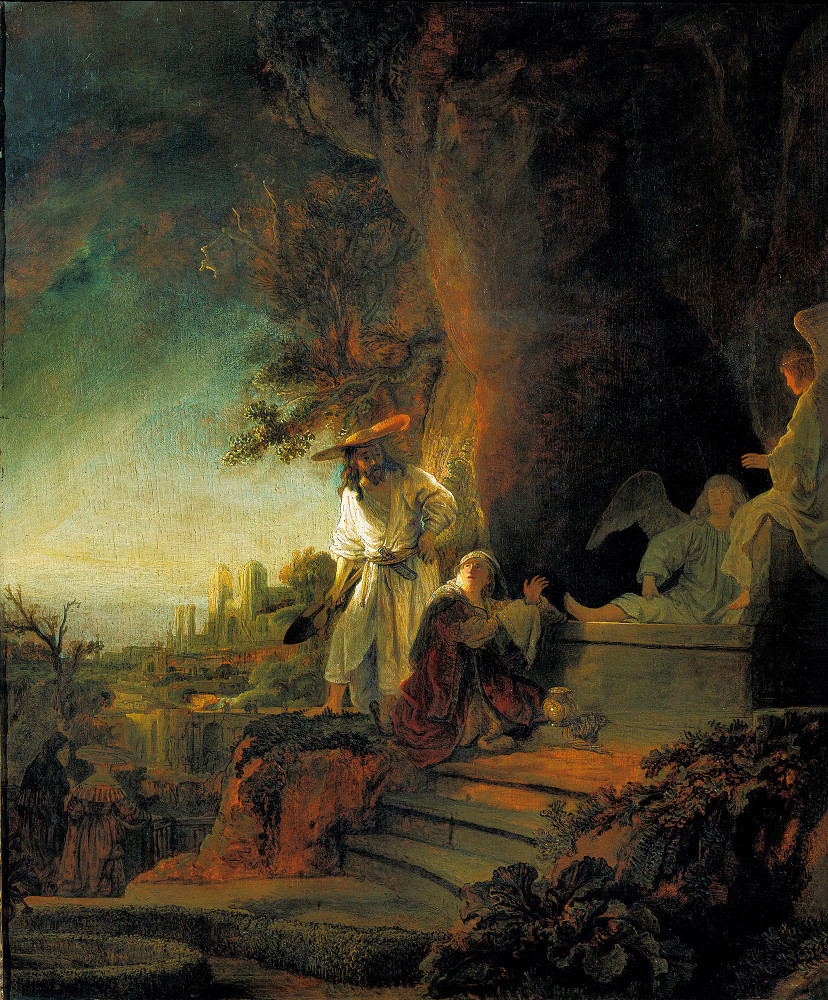
Rembrandt Harmensz. van Rijn: The Risen Christ Appearing to Mary Magdalen

“The Risen Christ Appearing to Mary Magdalen” – which comes at the end of Holy Week

*   *   *   *

Today is the start of Holy Week.  (Also known as the last week of Lent.)  And just as an aside, last year – 2015 – Easter Sunday came later, on April 4.  (As noted in On Holy Week – and hot buns.)

The “hot buns” part of that equation noted that “’hot cross buns are traditionally toasted and eaten on Good Friday,’ in the Anglican countries of the British Commonwealth:”

hot cross bun is a “spiced sweet bun made with currants or raisins and marked with a cross on the top.”  The eating of this hot cross bun was designed to mark the end of Lent, with all its disciplines and “giving ups.”  I.e., during Lent, only “plain buns made without dairy products” could be eaten.  That prohibition ended at noon on Good Friday.

Homemade Hot Cross Buns.jpgThe post also noted a number of superstitions from English folklore, about such “hot buns.”  For example: Sharing a hot cross bun with friend “is supposed to ensure friendship throughout the coming year.”  Also, if taken on a sea voyage, “hot cross buns are said to protect against shipwreck.”

But enough about those “hot buns.”  (We are still in Lent, after all…)  

More to the point, Holy Week includes – but is not limited to, spiritually speaking – the following Feast Days:  Palm Sunday,  Holy Wednesday (also known as Spy Wednesday), Maundy Thursday (Holy Thursday), Good Friday (Holy Friday), and Holy Saturday.”  But here’s a key note:

Holy Week doesn’t “end” with Easter Sunday.  By definition, Easter Sunday “is the beginning of another liturgical [season, 50 days long]…”  That in turn could be a metaphor or object lesson for a whole new beginning, as in a “whole new way of life.”  Which is another way of saying [that] Easter Sunday is the defining moment of the liturgical year…

See On Easter Season – AND BEYOND.  That post noted that Easter Sunday – the end of Holy Week – is also known as Resurrection Sunday.  For obvious reasons.  It also included “a word about Rembrandt‘s interpretation of Easter morning, shown above:”

Mary Magdalen had just found Jesus’ grave empty, and asks a bystander what has happened. In her confusion she thinks the man is a gardener.  Only when he replies with “Mary!” does she realize who she’s talking to.  To illustrate Mary’s confusion, Jesus is often depicted as a gardener in this scene.

Then there’s the matter of Easter Sunday as celebrated today, “with the ‘Easter Bunny, colorfully decorated Easter eggs, and Easter egg hunts.’”  (For a more liturgical view see What is Easter Sunday?)   Which leads to the question:  “So how did the Easter Bunny get mixed up in all this?”

The Easter Bunny (also called the Easter Rabbit or Easter Hare) is a symbol of Easter, depicted as a rabbit bringing Easter eggs.  Originating among German Lutherans, the “Easter Hare” originally played the role of a judge, evaluating whether children were good or disobedient…   In legend, the creature carries colored eggs in his basket, candy, and sometimes also toys to the homes of children, and as such shows similarities to Santa Claus or the Christkind, as they both bring gifts to children on the night before their respective holidays.

That’s from the Easter Bunny link, connected with the “bunny” postcard image at the bottom of the main text.  There’s also a note that the Easter Bunny custom was first written of – in America – at about the year 1682.  (See also social control, connected to similar practices before Christmas.)

Last year’s post – On Easter Season – AND BEYOND – also included a link to Ēostre – Wikipedia.

The Venerable Bede translates John 1902.jpgThat noted the “Germanic divinity” who originally served as “namesake of the festival of Easter.”  And it noted that the “Ēostre” celebration was mentioned by the Venerable Bede – at left – in his “8th-century work The Reckoning of Time.”

But in closing, here’s a more incongruous note.

I was sitting in church this morning, listening to the priest read from Luke 22:14-23:56.  (Part of the full Palm Sunday readings, which can be seen at Sunday of the Passion: Palm Sunday.)  And for some reason, on this particular morning I was struck by Luke 22:37.  That passage came right after Jesus said that Peter would deny Him three times before the cock crowed.  Jesus went on to say – in our translation – “I tell you, this scripture must be fulfilled in me, `And he was counted among the lawless‘; and indeed what is written about me is being fulfilled.

Biblehub.com has a number of different translations for the word “lawless:”  Words like “transgressors,” or “rebels,” or “evil doers,” “criminals,” or even “outlaws.”  And the notes thereto point to the “fifty third chapter of Isaiah, where this passage stands.”  That 53d chapter is in turn “a manifest prophecy of the Messiah.”  Specifically, see Isaiah 53:12:

Therefore I will give him a portion among the great, and he will divide the spoils with the strong, because he poured out his life unto death, and was numbered with the transgressors.  For he bore the sin of many, and made intercession for the transgressors.

Another note pointed out that Jesus was “crucified between two thieves; and more than this.”

The more than this involved what might be known in the lawyer trade as a legal fiction.  (That is, ” a fact assumed or created by courts which is then used in order to apply a legal rule.”)  The legal rule in question demanded a blood sacrifice, under the Old Law, to cover the sins of the people.  But to solve that problem for all time, Jesus substituted HIs own “blood” for ours:

[B]eing in the legal place, and stead of his people, and having their sins laid upon him, and imputed to him, he was made and accounted, by imputation, not only a sinner, but sin itself; and as such, was considered in the eye of the law, and by the justice of God…   (E.A.)

Which is something to remember next Sunday, while enjoying those Chocolate Bunnies.

*   *   *   *

“An Easter postcard depicting the Easter Bunny...”

*   *   *   *

The upper image is courtesy of The Risen Christ Appearing to Mary Magdalen – Art and the Bible.

The lower image is courtesy of Easter – Wikipedia.


St. Joseph and the “Passover Plot”

*   *   *   *

Here’s a spoiler alert:  Saint Joseph – earthly “father” of Jesus – has nothing to do with The Passover Plot.  It’s just that this post is about both St. Joe and the book by Hugh Schonfield(The thesis of that 1965 Schonfield book: The Crucifixion was a “conscious attempt by Jesus to fulfill the Messianic expectations rampant in his time,” but His plan “went unexpectedly wrong.”)

Resurrection (24).jpgThen too, a discussion of The Passover Plot seems especially appropriate because Easter Sunday – March 27 – is now less than two weeks away.

But first, about St. Joseph.  Last year at this time I posted On St. Paddy and St. Joe.  There I noted the unusual situation in March – of most years – where a minor feast day is celebrated more than a major feast day.

That is – in a liturgical sense – the “earthly father[figure] of Jesus” outranks – by far – Saint Patrick, patron saint of Ireland.

(As noted in St. Joe, when it comes to the list of important Bible figures with feast days, St. Joseph “comes in third only to Christ the King and Mary.”)

St Patrick's DayNevertheless,  St. Patrick’s Day – March 17 – is celebrated far more widely than St. Joseph’s Day.  (March 19.)  On the other hand, this year’s Lectionary Page does list St. Joseph’s Feast Day, but it doesn’t list St. Patrick’s Day.

That’s because this year Easter comes way earlier than usual.

In other words, for this year – on what would normally be St. Patrick’s Day – the Lectionary Page has March 17 officially listed as Thursday in the Fifth Week of Lent.  But of course that won’t change the fact that “St. Paddy’s Day” will be the more widely celebrated…

For more on St. Paddy and St. Joe, see last year’s post.  It included a section on How the Irish Saved Civilizationand on how the Irish went from widespread ridicule to acceptance:

Facing nativist detractors who characterized them as drunken, violent, criminalized, and diseased [ – as illustrated at right – ] Irish-Americans were looking for ways to display their civic pride and the strength of their identity…  [They] celebrated their Catholicism and patron saint … but they also stressed their patriotic belief in their new home.  In essence, St. Patrick’s Day was a public declaration of a hybrid identity [with] a strict adherence to the values and liberties that the U.S. offered them.

And that seems to be an object lesson we could re-learn today…

But back to The Passover Plot.  As noted, the thesis of Hugh Schonfield‘s 1965 book was that the Crucifixion was part of a “conscious attempt by Jesus to fulfill the Messianic expectations [but] that the plan went unexpectedly wrong.”  On a related note, here’s something I didn’t know before:  The book was made into a movie in 1976.  That is, it was made into a:

Dramatization of the controversial best-seller that posits an alternate version of the birth of Christianity.  In this version, Jesus planned for His crucifixion by taking a drug that would simulate death.  After His unconscious body was placed in the tomb, a religious sect known as the Zealots would secretly steal Christ’s body from the tomb, then spread the rumor that He had risen, thus fulfilling Biblical prophecy.

The one thing I do remember is that the book was so fascinating it made me miss a plane to Key West.

This was in the days before cell phones.  (In the late 1980s or very early 1990s.)  My late wife was working as a traveling sales-lady, for a company that did church directories.  So when she got posted down to Key West, I planned to fly down for the weekend.  (From Tampa Airport.)

I brought along a copy of Passover Plot.  I got checked in and seated in the waiting area, then started reading.  When I looked up from the book – finally – I saw that my “flight had flown.”

I ended up getting to Key West on a later flight.  I also ended up disagreeing with many or most of Schonfield‘s conclusions.  But I found his methodical research enlightening.  (In much the same way that I found Last Temptation of Christ enlightening.  There too, I didn’t agree with all the premises of the movie, but I did feel it showed the conditions in which Jesus lived, far more accurately than the typical Hollywood “blonde, blue-eyed Jesus.”)

Then too, I’ve always felt that personal faith is not a matter of scientific proof.  (Like those “boot camp Christians” who look so assiduously for proof of Noah’s Ark in Turkey, on or near Mount Ararat.)    To me, faith is more a matter of that ongoing interactive walk to Jesus.

(See also GIST of the matter, and Why I’d Still Believe In God Even if the Bible was a Fairytale.)

But we were discussing Passover Plot.  I’ve included some excerpts in the notes, but first a couple reviews.  For one, Goodreads also called the book fascinating, as well as “lucidly written and carefully documented.”  At the same time it acknowledged “probably no other figure in modern Jewish historical research” was more controversial than Schonfield, who wrote the book.

Tim Chaffey said the book “created quite a stir.”  He also questioned the author’s claims of objectivity:  “it is easily demonstrated that his bias and philosophy overrule any attempt at objectivity.”  And Stefan Zenker got to the crux of the matter:

[T]he discussion of Jesus’ faith and objectives was not what made the book controversial.  The part that created an uproar was Schonfield’s claim that Jesus painstakingly built his own legend without actually performing any miracles.  In particular, the greatest miracle of all: resurrection after death, had been carefully staged.

But Zenker also acknowledged that this “unusual book … read[s] like a thriller.”

And finally, there’s a review with a title that sounds a bit like a country-western song:  “Pass Over ‘The Passover Plot’.'”  But this review by the Christian Courier does provide one very valid reason for reading the book:  “The Passover Plot  illustrates every argument that tries to naturally explain the empty tomb.”  (Emphasis in the original.)

And if that is true, then the Courier’s take on the matter almost makes The Passover Plot a bit of  “required reading.”  After all, Jesus Himself said in Matthew 10:16, “Behold, I send you forth as sheep in the midst of wolves:  be therefore wise as serpents, and harmless as doves.”

Other translations of Matthew 10:16 tell us to be “cunning as serpents,” or “crafty as snakes,” or “shrewd as serpents.”  And since the serpent is a metaphor for the Devil, what Jesus seemed to say in Matthew 10:16 was that we should be “wise as hell” or “wise as the Devil.”

In plain words, Jesus was saying, “Know your enemy.”  (A shrewd bit of wisdom officially attributed to Sun Tzu.)  So for whatever reason, it might be “wise” to read The Passover Plot.

Unless of course you never made it beyond Bible boot-camp. . .

 *   *   *   *

*   *   *   *

See Saint Joseph – Wikipedia, which also noted that the “Pauline epistles make no reference to Jesus’ father; nor does the Gospel of Mark.”    The caption for the painting:  “Saint Joseph with the Infant Jesus, Guido Reni (c. 1635).”

The plot summary of the movie version of Passover Plot was written by Mike Konczewski.

The lower image is courtesy of The Passover Plot – Wikipedia:  “First edition (publ. Hutchinson).”

*   *   *   *

The following excerpts are from the 1967 “Bantam Books” paperback version of The Passover Plot.  

1)  At pages 17-19, Schonfield described circumstances “making the Messianic Hope the powerful influence it became in the first century B.C.,” one of which was a “change of attitude towards the Bible.”  The Hebrew Bible had three divisions, the Law, the Prophets, and the Writings:

The Law, as consisting of the five books of Moses, had binding force by the fifth century B.C., or not much later.  The Prophets did not acquire their force until about the third century B.C….  The effects of the recognition of the Law and the Prophets … as a corpus of sacred Scriptures were far-reaching.  It opened the way for a new development, the treatment of these books as the Oracles of God.  They became subject to all kinds of interpretation to draw out of them hidden meaning hidden meanings and prognostications.

This and other factors – including occupation by foreign armies – led to an increase in both religious devotion and “messianic thinking and prediction.”  As a result, from “160 B.C. we are in a new age, an age of extraordinary fervour and religiousity…  The whole condition of the Jewish people was psychologically abnormal.”  At page 23 he added, “A whole nation was in the grip of delirium.”

2)  And speaking of Palm Sunday – coming up next week – at pages 114-15, Schonfield wrote of “the brilliant move on the part of Jesus” to enter Jerusalem openly, and with great fanfare.  “There had been no attempt  to sneak into the city unobserved.”  That brilliant move also kept the members of Sanhedrin from “molesting” Jesus.  And speaking of being “wise as a serpent:

He had finally allowed Himself to be acknowledged as the Messiah; but the clever way in which He had done this secured Him for the present complete freedom from molestation.  They had to recognise that they were up against a man of courage, cunning and ingenuity.

And finally,  3)  At pages 179-80, Schonfield noted the love and compassion of Jesus, but “united with commitment …  the emphasis is on deeds as the proof of faith and love.”  He then indicated – in an offhanded way – that we too could fulfill John 14:12 by performing as great or greater miracles than Jesus.   (Okay, that last was a bit of artistic license on my part.)  He concluded Part I with this:

The Iron Chancellor Bismarck, with reluctant admiration, once said of Disraeli, another famous schemer, “The old Jew, there is the man!”  Seen in the Messianic light of the Passover Plot we can with more wholehearted approbation say of jesus, “The young Jew, there was the Man!”

All of which leads to a key observation.  It was apparently only from the fifth century B.C. on that the Hebrew Bible achieved “binding force.”  It was also at that “original” time that the Scripture “became subject to all kinds of interpretation to draw out of them hidden meaning hidden meanings and prognostications.”  In other words, it appears that as originally intended, there were no “boot-camp Hebrews.”  Then too, it can be said that in his book Schonfield greatly admired Jesus, even if he didn’t recognize Jesus as “the Messiah.”  But as noted above, while I disagreed with much of what Schonfield wrote, I found his research enlightening.  That is, giving “spiritual or intellectual insight.”

On Ash Wednesday and Lent – 2016

*   *   *   *

Last year, Ash Wednesday came on February 18.   This year, 2016, it’s celebrated on February 10. Which brings up a post I did last year at this time:  On Ash Wednesday and Lent.  That post was on and about the “whole topic of Ash Wednesday and the Season of Lent:”

According to the canonical gospels of Matthew, Mark and Luke, Jesus Christ spent 40 days fasting in the desert, where he endured temptation by Satan.  Lent originated as a mirroring of this, fasting 40 days as preparation for Easter.

See also Lent 101 – The Upper Room.  So the “40 days of Lent” are supposed to commemorate the 40 days that Jesus spent “wandering in the wilderness.”  On a related note, that act by Jesus mirrored the 40 years that the Hebrews – led by Moses – also spent “wandering around.”

But before that 40 days of Lenten “wandering in the wilderness,” there’s one last celebration, one last “blowout.”  (The whole Christian – or liturgical – calendar year is pretty much filled with such alternating seasons of celebration and penance…)

For example,  Lent is a season devoted to “prayer, penance, repentance of sins, almsgiving, atonement and self-denial.  But that season of self-denial is preceded by “Fat Tuesday.”  That’s the day before Ash Wednesday, which means this year Fat Tuesday is February 9. The French term for Fat Tuesday is Mardi Gras, and Mardi Gras is now a generic term for “Let’s Party!!

As Wikipedia put it, “Popular practices on Mardi Gras include wearing masks and costumes, overturning social conventions, dancing, sports competitions, parades, debauchery, etc.”

See also A Brief History of Mardi Gras – Photo Essays – TIME, which noted that “Mardi Gras isn’t all nudity and drunken debauchery (though, yes, there is definitely nudity and drunken debauchery).”  (Emphasis in original.)

But – as the article noted – the origin of Fat Tuesday was far more spiritual:

In earlier times, people used Lent as a time of fasting and repentance.  Since they didn’t want to be tempted by sweets, meat and other distractions in the house, they cleaned out their cabinets.  They used up all the sugar and yeast in sweet breads before the Lent season started, and fixed meals with all the meat available.  It was a great feast!  Through the years Mardi Gras has evolved (in some places) into a pretty wild party with little to do with preparing for the Lenten season of repentance and simplicity.

Lent 101, emphasis added.  And incidentally, there are actually 46 days between Ash Wednesday and Easter Sunday.  That’s because Sundays don’t count in the calculation.

That’s important because it means you can still enjoy whatever it is you’ve given up for Lent.  (A fact overlooked by the producers of 40 Days and 40 Nights.  That “2002 romantic comedy film” showed the main character in a “period of abstinence from any sexual contact for the duration of Lent.”  But as noted, he could have “taken Sundays off.”)

But getting back to the subject at hand…   You can see the full set of Bible readings for the day at Ash Wednesday.  The highlight – once again – is the Gospel Matthew 6:1-6,16-21.  That’s where Jesus warned of “practicing your piety before others in order to be seen by them.”

On that subject, fasting (and abstinence are the usual components of a Lenten discipline. But as Jesus noted, “Do not look dismal, like the hypocrites, for they disfigure their faces so as to show others that they are fasting.”  Instead, He said to basically put on a happy face.  That way, “your fasting may be seen not by others, but by your Father who is in secret.

As for almsgiving, Jesus said, “Do not sound a trumpet before you, as the hypocrites do … so that they may be praised by others.”  Instead, “When you give alms, do not let your left hand know what your right hand is doing, so that your alms may be done in secret.

Incidentally, that’s where the expression the left hand doesn’t know what the right hand is doing came from. And finally Jesus said this about praying in public:

Whenever you pray, do not be like the hypocrites; for they love to stand and pray in the synagogues and at the street corners, so that they may be seen by others.  Truly I tell you, they have received their reward.  But whenever you pray, go into your room and shut the door and pray to your Father who is in secret;  and your Father who sees in secret will reward you.

Are we getting the picture here? 

The one theme Jesus kept returning to –  over and over again – was hypocrisy.  That includes – but is not limited to – “the false assumption of an appearance of virtue or religion.”

I wrote about this whole controversy in On praying in public.  I concluded that post with a variation of the classic Henny Youngman one-liner,  “Take school prayer…  Please!

But we digress…

If you’re interested in more history on Ash Wednesday see The History and Meaning of Ash Wednesday.  That site noted the “pouring of ashes on one’s body” – as an “outer manifestation of inner repentance” – is an ancient practice.

The earliest mention of that practice seems to have come at the end of the Book of Job, “older than any other book of the Bible.”  In Job 42:6 – and after he is rebuked by God – Job says, “I despise myself and repent in dust and ashes.”  (Not to mention “dressing in sackcloth, a very rough material.”  On a related note, see also On Job, the not-so-patient.)

And finally see The ‘Splainer: Ash Wednesday and dirty Christian foreheads, about “washing:”

No one is required to keep the ashes on his or her face after the ritual.  But some Christians choose to, perhaps as a reminder to themselves that they are mortal and fallible, while others may choose to leave them on as a witness to their faith in the hope others will ask about them and open a door to sharing their faith.

Here’s wishing you a happy and spiritually-fulfilling Lent!

*   *   *   *

*   *   *   *

The initial indented quote about Lent is from Wikipedia

The original post had an image courtesy of A Brief History of Mardi Gras … TIME.  That article includes the caption:

OK, Mardi Gras’ reputation as an alcohol-fueled, nudity-filled bacchanal is not completely unearned.  In 1973, a ban was established on Krewe parades in the increasingly rowdy and narrow streets of the French Quarter.  In subsequent years, tourists and other drunken fools descended on the Quarter (especially the particularly saucy Bourbon Street) en masse, and the tradition of showing skin for beads began.  Native New Orleanians despise the reputation, and rarely venture into the Quarter during Carnival season.

Emphasis added, which means “there’s probably some kind of object lesson there…”

For another take on praying in public, see school prayer.

The lower image is courtesy of Lent – Wikipedia.  The caption:  

Lent celebrants carrying out a street procession during Holy Week [in Granada, Nicaragua.] The violet color is often associated with penance and detachment.  Similar Christian penitential practice is seen in other Catholic countries, sometimes associated with mortification of the flesh.

The article added that Lent’s “institutional purpose is heightened in the annual commemoration of Holy Week, marking the death, burial and resurrection of Jesus … which ultimately culminates in the joyful celebration on Easter Sunday of the Resurrection of Jesus Christ.”

The Presentation of the Lord – 2016

Yegorov-Simeon the Righteous.jpg

Simeon and Anna Recognize the Lord in Jesus” – at the Presentation of Our Lord

*   *   *   *

Tuesday, February 2, was the Feast for the Presentation of Jesus at the Temple:

Counting forward from December 25 as Day One, we find that Day Forty is February 2.  A Jewish woman is in semi-seclusion for 40 days after giving birth to a son, and accordingly it is on February 2 that we celebrate the coming of Mary and Joseph with the infant Jesus to the Temple at Jerusalem…

The Presentation of Christ in the TempleSee The Presentation, from the Satucket web site.  (The one with all the DORs.)  See also On The Presentation of Our Lord, a post I did last year at this time.  And as noted last year, this Feast celebrates the episode in Jesus’ life described in Luke 2:22-40.

Luke said that “Mary and Joseph took the Infant Jesus to the Temple in Jerusalem … to complete Mary’s ritual purification after childbirth.”  They did so “in obedience to the Torah (Leviticus 12, Exodus 13:12–15.”

Luke explicitly says that Joseph and Mary take the option provided for poor people (those who could not afford a lamb) (Leviticus 12:8), sacrificing “a pair of turtledoves, or two young pigeons.”  Leviticus 12:1–4 indicates that this event should take place forty days after birth for a male child, hence the Presentation is celebrated forty days after Christmas.

That’s where “Simeon and Anna” come in.  Briefly, they recognize the Lord in Jesus.

That is, Simeon had previously been “visited by the Holy Spirit” – as imagined in the image below right – “and told that he would not die until he had seen the Lord’s Christ.”  So – according to Luke 2:27 – Simeon “came in the Spirit into the temple,” on what happened to be the exact day that Jesus’ parents brought Him in.  (For “ritual purification.”)

(See also 2d Peter 1:21 for an example of prophets being moved in the spirit: “no prophecy ever originated through a human decision.  Instead, men spoke from God as they were carried along by the Holy Spirit.”)

So anyway, on seeing the baby Jesus, Simeon “uttered the prayer that would become known as the Nunc Dimittis,” Luke 2:29-32 (NIV):

“Sovereign Lord, as you have promised, you may now dismiss your servant in peace.  For my eyes have seen your salvation, which you have prepared in the sight of all nations:  a light for revelation to the Gentiles, and the glory of your people Israel.”

Simeon then prophesied to Mary, as told in Luke 2:34-35.  And finally there was the “elderly prophetess Anna,” who was also in the Temple at the time.

She too offered prayers and praise to God – for Jesus – and spoke to everyone there of His importance to the redemption of His People.  (In Luke 2:36-38.)

KosmicFrenchmenPurpleFaceMardiGras2009.JPGIn last year’s post on the Presentation, I wrote a lot about Mardi Gras.

Put simply, Mardi Gras is one final blowout (celebration) on the last day before by Lent.  (A “solemn religious observance” involving some 40 days of “prayer, penance,repentance of sins, almsgiving, atonement and self-denial.”)  And both of those Feast Days are right around the corner.

Shrove Tuesday in 2016 comes a week after the Presentation, on February 9.  The next day, February 10, is Ash Wednesday, which marks the beginning of Lent.  And Lent serves as a reminder of the last time that Jesus would be “Presented to the People.”

The painting below shows us that last time Jesus would be presented.  This time it was by Pontius Pilate, “presenting the mocked and scourged Jesus to the people.”

*   *   *   *

Ecce homo by Antonio Ciseri (1).jpg

*   *   *   *

The upper image is courtesy of the “Simeon” link in the Wikipedia article on the Presentation.  That caption:  “Simeon the Godreceiver by Alexei Egorov. 1830–40s.”  The caption I used for the upper image is actually the one from Simeon and Anna Recognize the Lord in Jesus.  That’s another interpretation of the event, by Rembrandt (van Rijn).  (Who is far better known that Egorov.)  You can see Rembrandt’s interpretation at “Wikigallery,” or at “Rembrandtonline.”

And I’m assuming “Anna” is one of the women in Egorov’s background.

*   *   *   *

The Nunc Dimittis is also known as the Canticle Of Simeon, “which prophesied the redemption of the world by Jesus.”  See Prayers – Catholic Online for another good image of the event. 

The lower image is courtesy of Pontius Pilate – Wikipedia.  The caption:  “Ecce Homo (‘Behold the Man’), Antonio Ciseri‘s depiction of Pilate presenting a scourged Jesus to the people of Jerusalem.”

See also Rembrandt van Rijn: Christ Presented to the People – for a drypoint image – and Jesus Christ Presented to the People by Rembrandt, which provided the “mocked and scourged Jesus” text.

Thomas Aquinas – “mystic” and angelic

St. Thomas Aquinas, being “girded by angels with a mystical belt of purity…” 

*   *   *   *

January 28 is the feast day of perhaps the greatest intellect of the Catholic Church, St. Thomas Aquinas, known as the Angelic Doctor due to his purity of mind and body.  He gave up a life of nobility and wealth to be a poor Dominican friar, at the time a new religious order, much to the consternation of his family.

See January 28 … Thomas Aquinas.  See also Thomas Aquinas – Wikipedia, which noted that this St. Thomas is considered the Catholic Church’s greatest theologian and philosopher, and was “honored as a Doctor of the Church.”

But first note the word “doctor” used here comes from the Latin docere.  That means “to instruct, teach, or point out.”

Thus Doctor of the Church – like St. Isidore of Seville, at left – “is a title given by a variety of Christian Churches, to those they recognize as “having been of particular importance, particularly regarding their contribution to theology or doctrine.”

(And incidentally, I’d argue that any good “doctor of the church” would recognize that he – or she – can learn as much from the person being taught, as he – or she – knows already.  See also Seneca the Younger …)

So anyway, for more on what made this St. Thomas so special, see St. Thomas Aquinas.  (From the Satucket website.)  For starters, he was born in 1225 and died – a mere 49 years old – in 1274.

That means he lived right at the end of the Dark Ages.  (A time of “cultural and economic deterioration” in Western Europe, “following the decline of the Roman Empire.”)

During the Dark Ages, one of the institutions that kept things together was “Holy Mother Church.”  (In Latin, “Sancta Mater Ecclesia.”)  But one problem was that – largely due to widespread illiteracy – the Bible became the only book that was widely studied.  (And then only as interpreted by local parish priests, and many of them couldn’t read.)

Thomas Aquinas changed things up.  He “modernized” things.

Ironically, he did that by reading golden oldies, books written by people like Aristotle.  (Shown at “right right,” but who was at the time of Aquinas ” largely forgotten in Western Europe.”)

There was no such thing as printing – not until Gutenberg, in and around 1450 – and there were precious few books other than the Bible to “read.”  (Or more likely, have read to you.)

But then by Aquinas’s time – after a “dark” millennium or more – such books started reappearing.  (They’d been preserved “partly from Eastern European sources and partly from Moslem Arab sources in Africa and Spain.”)  And like all good golden oldies, such re-discovered books got “liked:”

These works offered a new and exciting way of looking at the world.  Many enthusiastic students of Aristotle adopted him quite frankly as as an alternative to Christianity.  The response of many Christians was to denounce Aristotle as an enemy of the Christian Faith.

Stoning of Moses, Joshua and CalebPut another way, there were two initial reactions.  Some people rejected the Bible and adopted the philosophy of Aristotle “whole cloth.”  Others reacted vehemently and felt that reading such books bordered on heresy.  (See On Moses getting stoned, on a similar phenomenon, illustrated at left.)

Gradually a third approach emerged:  Those “who tried to hold both Christian and Aristotelian views side by side with no attempt to reconcile the two.”  And finally came Aquinas, who developed what has been called his “fourth approach:”

Aquinas had a fourth approach.  While remaining a Christian, he immersed himself in the ideas of Aristotle, and then undertook to explain Christian ideas and beliefs in language that would make sense to disciples of Aristotle.  At the time, this seemed like a very dangerous and radical idea, and Aquinas spent much of his life living on the edge of ecclesiastical approval.  His success can be measured by the prevalence today of the notion that of course all Christian scholars in the Middle Ages were followers of Aristotle.

Another source said Aquinas “lived at a critical juncture of western culture when the arrival of the Aristotelian corpus in Latin translation reopened the question of the relation between faith and reason.”  Which is another way of asking:  “Can you be ‘smart’ and still believe in the Bible?

(See also On broadminded, spelled “s-i-n”,” about the old – 1952 – Louvin Brothers song.)

Which is another way of saying that – even to this day – some believe you can’t do both.  That you can’t have “true faith” and at the same time use your powers of reason.  In other words, such people reject any modus vivendi.  They say you have to choose between faith and reason.

And pardon me for saying so, but such people are idiots.**  (Or at least greatly misled.)

Which is another way of saying such views are antithetical to this blog.  But I’m not alone.  St. Thomas Aquinas – for one – is “on the same page” as me.  (And the image at right is titled, “Triumph of St. Thomas Aquinas.”)

That is, beginning with Thomas Aquinas, people started reading books in addition to the Bible.  And from that developed – in due course – things like the Wesleyan Quadrilateral.  (Referring to the use of Scripture, Tradition, and Reason as a “methodology for theological reflection.”)

All of which brings us – as if “preordained before the beginning of time” – to one of the Daily Office Readings for Monday, January 25, 2016.  (To wit: the Feast Day for the Conversion of St. Paul.)  That reading is Ecclesiasticus – not to be confused with Ecclesiastes – 39:1-10;

He seeks out the wisdom of all the ancients…   [H]e preserves the sayings of the famous and penetrates the subtleties of parables;  he seeks out the hidden meanings of proverbs and is at home with the obscurities of parables.

Which is another of saying that when it comes to God – or for that matter the Bible:

There’s no such thing as a know-it-all


*   *   *   *

“Four Great Doctors,” including Saint Augustine and Saint Jerome… 

*   *   *   *

The upper image is courtesy of Thomas Aquinas – Wikipedia.  The caption:  “Diego Velázquez, Aquinas is girded by angels with a mystical belt of purity after his proof of chastity.”  

Re: “Doctors” – as teachers – learning from their students:

One of the best ways to understand something is to try to explain it to others.  If you want to test your own understanding of this new way of thinking, try springing it on some of your friends.  Undoubtedly, you will discover something all teachers know – that the person giving instruction often learns more than the person receiving it…

See How to Develop Your Thinking Ability, by Kenneth S. Keyes, Jr., originally published in 1950.  The quote is found on page 34 of the McGraw-Hill paperback edition, published in 1963.

See also Know-it-all – Wikipedia, referring to a person “who obnoxiously purports an expansive comprehension of a topic and/or situation when in reality, his/her comprehension is inaccurate or limited.”  Based in part on Mr. Keyes’ point of view – with which I agree – I’d argue that – when it comes to “God” – there’s no such thing as a “know it all.”  (Notwithstanding the massive evidence to the contrary in too many religious circles.)

And finally, see Learning by teaching – Wikipedia:  “Seneca the Younger told … Lucilius that we are learning if we teach[:] docendo discimus (lat.: ‘by teaching we are learning’).”

*   *   *   *

Here’s the full quote from the St. Thomas Aquinas link at Satucket, on his “fourth approach,” etc:

In the thirteenth century, when Thomas Aquinas lived, the works of Aristotle, largely forgotten in Western Europe, began to be available again, partly from Eastern European sources and partly from Moslem Arab sources in Africa and Spain.  These works offered a new and exciting way of looking at the world.  Many enthusiastic students of Aristotle adopted him quite frankly as as an alternative to Christianity.  The response of many Christians was to denounce Aristotle as an enemy of the Christian Faith.  A third approach was that of those who tried to hold both Christian and Aristotelian views side by side with no attempt to reconcile the two.  Aquinas had a fourth approach.  While remaining a Christian…

I added the emphasized “dangerous and radical idea,” in the quoted section in the main text.  The all in “all Christian scholars in the Middle Ages” was emphasized in the original.

The image of Aristotle is courtesy of the Wikipedia article on Aristotle.  A partial caption reads: “Plato (left) and Aristotle (right), a detail of The School of Athens, a fresco by Raphael.”

Re: Thomas living “at a critical juncture of western culture.”  See Saint Thomas Aquinas (Stanford Encyclopedia of Philosophy).  That article also used the term modus vivendi in a way that seemed incongruous at best, at least to me.

**  Re: “such people are idiots.”  That statement is an example of hyperbole, “the use of exaggeration as a rhetorical device or figure of speech.”  Obviously – as a good Christian – I could never really believe such a thing.  I merely believe that such Biblical literalists are greatly misquided.  On the other hand, it seems that most people won’t listen to anything but overblown hyperbole these days…

Re: Antithetical.  See also Anathema, referring to “something dedicated to evil and thus accursed.” 

The side panel of Aquinas is courtesy of Thomas Aquinas – Wikipedia. The full caption:  “Triumph of St Thomas Aquinas, ‘Doctor Angelicus,’ with saints and angels, Andrea di Bonaiuto, 1366.  Basilica of Santa Maria Novella, fresco.”

Re: “Preordained before the beginning of time.”  See also Ephesians 1:4, “For he [God] chose us in him before the creation of the world to be holy and blameless in his sight…” 

On that note, the link phrased as “preordained before the beginning of time” – near the end of the main text – will take you to the article, Incentives, Predestination and Free Will, by “Glaeser, Edward L.,” and “Glendon, Spencer.”  That excerpt distinguished some points of theology between Catholicism on the one hand and some brands of Protestantism:

One of the largest theological gaps between the denominations is that Calvinism accepts the dogma of predestination while Catholicism argues for a dogma of free will…  Under predestination, a spiritual elite is preordained before the beginning of time and will receive eternal life.  Under free will, it is only through a lifetime of good actions that individuals are accepted into Heaven. (E.A.)

Re: The difference between Ecclesiasticus and Ecclesiastes.  The former – also known as Wisdom of Sirach – is “accepted as part of the Christian biblical canons by CatholicsEastern Orthodox, and most of Oriental Orthodox.  The Anglican Church [does] not accept Sirach as protocanonical, and say[s] it should be read only ‘for example of life and instruction of manners; but yet doth not apply them to establish any doctrine.'”  Ecclesiastes on the other hand is far more widely known.  It’s “one of 24 books of the Tanakh or Hebrew Bible” – classified as Ketuvim (or ‘Writings’) – and is “among the canonical Wisdom Books in the Old Testament of most denominations of Christianity.”

See also On Ecclesiasticus – NOT “Ecclesiastes,” which noted in part that the latter was popularized by the 1965 hit song “Turn! Turn! Turn!”  See also The Byrds … YouTube.   

The lower image is courtesy of the Doctor of the Church, at Thomas Aquinas – Wikipedia.  The full caption:  “The Four Great Doctors of the Western Church were often depicted in art, here by Pier Francesco Sacchi, c. 1516.  From the left: Saint Augustine,Pope Gregory I, Saint Jerome, and Saint Ambrose, with their attributes.”

Peter confesses, Paul converts

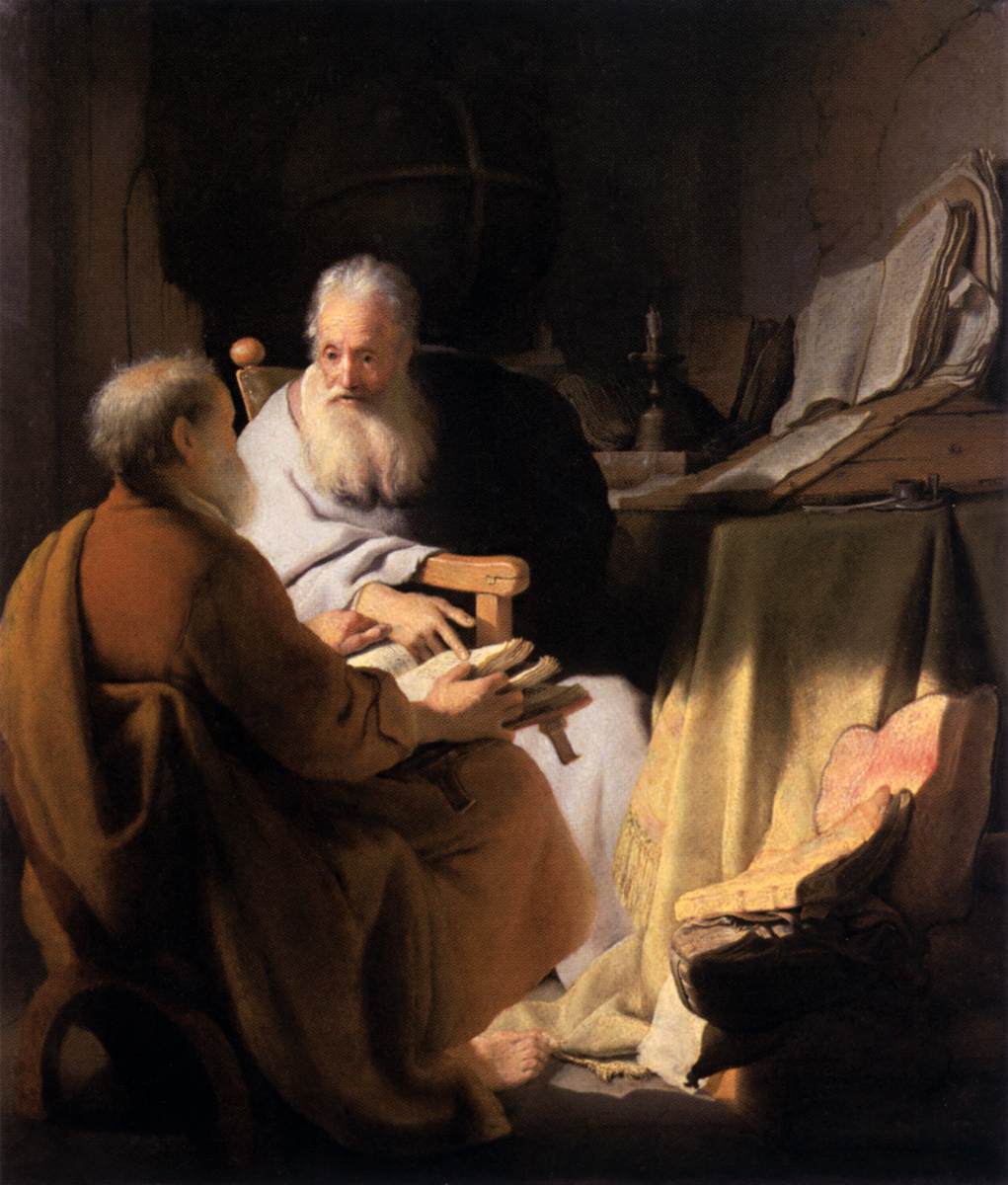
“Saints Peter and Paul,” by El Greco

*   *   *   *

January 20, 2016 – Here’s a parable.  Or at least a quasi-parable.

Two marathon runners were enrolled in a race.  By all accounts they were perfectly equal, in speed and endurance. But there was one minor difference:  One runner wanted to do it all on his own.  He didn’t want help from anyone.  But the other runner could imagine.  So as the race wore on and each runner got more and more tired, the second runner “imagined.”

He imagined wearing a harness, attached to a long rope.  And he further imagined that long, strong rope pulled him along, pulled him forward.  And as he imagined that long, strong rope, he could feel himself pulled along, a process that seemed to give him extra strength.

So here’s the question. Which runner has a better chance of winning the marathon?

“Just sayin’…”

But getting back to the topic at hand, see Peter, Paul – and other “relics:”

On January 18 we celebrate the Confession of Peter:  “Thou art the Christ, Son of the Living God.”  A week later on January 25 we celebrate the Conversion of St. Paul.  Then comes June 29, when we celebrate both men…

That post – from last June 25 – noted that the June 29 Feast Day remembers both Peter and Paul, together.  We remember that both men were martyred at about the same time.  (In Rome, around 65 A.D.)  We also remember on June 29 that their body parts – relics – were removed (translated) at about the same time, to keep them from being desecrated.

(That’s where the “relics” came in, in the post title.  In turn, the image at right – from that June 25 post – shows “St. Corbinian’s relics being moved…”)

But on the other side of the liturgical year – here, in the dead of winter – we remember both men separately, on January 18 and 25.  Or more precisely, we remember how these two “Pillars of the Church” took two completely different paths to the same destination.

On 18 January we remember how the Apostle Peter was led by God’s grace to acknowledge Jesus as the Christ (Matthew 16:13-20), and we join with Peter, and with all Christians everywhere, in hailing Jesus as our Lord, God, and Savior.

(See Confession of St. Peter, from the Satucket website.)  Put another way, the January 18 Feast Day commemorates Peter being the first apostle “to confess Jesus as Messiah.”

On the other hand, the January 25 Feast Day commemorates how “Saul (or Paul) of Tarsus, formerly an enemy and persecutor of the early Christian Church, was led by God’s grace to become one of its chief spokesmen.”  (See Conversion of St. Paul, emphasis added.)

In other words, Peter came to his position of authority from “inside the church.”  Paul on the other hand was pretty much dragged kicking and screaming into his position of authority.

Turning to the Confession of Peter, that refers to “an episode in the New Testament:”

[The] Apostle Peter proclaims Jesus to be Christ – the Messiah.  The proclamation is described in the three Synoptic Gospels: Matthew 16:13-20, Mark 8:27–30 and Luke 9:18–20.  The proclamation of Jesus as Christ is fundamental to Christology … and Jesus’ acceptance of the title is a definitive statement for it in the New Testament narrative.

On the other hand, the Conversion of St. Paul commemorates “an event in the life of Paul the Apostle that led him to cease persecuting early Christians and to become a follower of Jesus.”

Wikipedia noted that before that event, Paul – known as Saul – was a zealous “Pharisee who ‘intensely persecuted‘” what might then have been called the Jesus Movement.  (An allusion to an arguably-similar movement in the late 1960s and early 1970s):

…beginning on the West Coast of the United States … and spreading primarily throughout North America and Europe, before subsiding by the early 1980s.  [The Jesus movement] was the major Christian element within the hippie counterculture…  Members of the movement were called Jesus people, or Jesus freaks.

Getting back to Paul:  He wrote about his former life – as a devout and zealous enemy of the budding Christian church – in Galatians 1:13-14.  There he wrote about his being “extremely zealous for the traditions of my fathers.”  Accordingly, he intensely “persecuted the church of God” – that is, the newly-formed Christian Church –  “and tried to destroy it.”  

But then he had his Damascus Road Experience (illustrated above right).  In that episode he was literally struck blind, for three days.  So like I said before, Paul was “pretty much dragged kicking and screaming into his position of authority.”

Paul also wrote about his former life – as a persecutor of the church – and in particular his part in the stoning of Stephen, in Acts 7:57-8:3.  (“Saul was ravaging the church, and entering house after house, he dragged off men and women and committed them to prison.”)

In plain words, Paul’s Damascus experience “changed him from a Christ-hating persecutor of Christians to the foremost spokesman for the faith.”  But before that could happen, the people most afraid of him – in Jerusalem especially – had to be convinced that his change of heart was genuine.  In turn, that change of heart by those early Christians started with Barnabas:

To sum up, if it hadn’t been for Barnabas and his willingness to give Paul a second chance – a second chance for the formerly zealous persecutor of the early Church – he might never have become Christianity’s most important early convert, if not the “Founder of Christianity.”

See St. Barnabus’ Day, 2015, and also On St. Barnabas – from 2014.  Both posts noted:

[E]ven after Paul’s Damascus Road experience, most Christians in Jerusalem “wanted nothing to do with him.  They had known him as a persecutor and an enemy of the Church.  But Barnabas was willing to give him a second chance.”

I concluded the second Barnabas post by saying:

“So we might just call Barnabas ‘the Apostle of Second Chances.’”

Which seems – after all – to be pretty much what “the Jesus movement” is all about.

*   *   *   *

The original post had an upper image courtesy of Saints Peter and Paul by GRECO – Web Gallery and showed:

The two saints … the most influential leaders of the early Church … engaged in an animated discussion.  The older, white-haired Peter … inclines his head thoughtfully to one side as he looks towards the text being expounded.  In his left hand he holds his attribute, the key to the kingdom of Heaven.  His right hand is cupped as if weighing up an idea.  Paul presses his left hand down firmly on the open volume on the table, his right hand raised in a gesture of explanation as he looks directly at the viewer.

The article said El Greco painted the two together several times “with remarkable consistency.”  Peter always has white hair and a beard, while “Paul is always shown slightly balding, with dark hair and beard, wearing a red mantle…”  See also Feast of Peter and Paul – Wikipedia, with caption:  “Saint Peter and Saint Paul. Oil on canvas by El Greco. circa 16th-century. Hermitage Museum,Russia.”

*   *   *   *

A “marathon” image was courtesy of Marathon – Wikipedia.  The caption:  “A competitor collapses just prior to the finish line of the 2006 Melbourne Marathon.”

The point of the parable:  That if the second runner couldn’t “imagine” the existence of that Helping Rope, he had no hope of “finding” that Source of Help…

The death-dates of Peter and Paul.  The best answer seems to come from Answers.com:

Tradition has it that Peter was crucified upside down in Rome, Italy.  The actual date is unknown but is probably around the late 50s to late 60s AD.  The Annuario Pontificio gives the year of Peter’s death as … A.D. 67.  Early church tradition says Peter probably died at the time of the Great Fire of Rome of the year 64.  His co-worker Paul was also executed a little later, but as Paul was a Roman citizen … he was granted a swift death by beheading by sword … as opposed to crucifixion which was reserved for foreigners.

Re:  “Pillars of the church.”  A Google-search will lead to widely disparate answers as to who or what such “pillars” are.  (Some sites refer to people, but most refer to Biblical principles.)  But see especially The Three Pillars of the First Century Christian Church, citing Galatians 2:9.  In the New Living Translation, Paul wrote of a meeting in Jerusalem:  

James, Peter, and John, who were known as pillars of the church, recognized the gift God had given me, and they accepted Barnabas and me as their co-workers.  They encouraged us to keep preaching to the Gentiles, while they continued their work with the Jews.

This was some 14 to 17 years or more after his Damascus Road Experience.

*   *   *   *

A “Conversion of St. Paul” image was courtesy of vocations-syracuse.org/who-prayed-for-pauls-conversion. The title of the painting, “The Conversion of St. Paul, 1767 by Nicolas-Bernard Lepicie.” See also Nicolas-Bernard Lepicie | Conversion of St. Paul.  (For a print.)

A quote about Paul changing from “Christ-hating persecutor of Christians” can be found at the post, Doubting Thomas’ “passage to India.”  That post discussed Doubting Thomases in general, and specifically “the ‘mother of all‘ such skeptics,” the Apostle Thomas himself.   The post also discussed the differences between “skeptical” and “cynical.” 

A lower image was courtesy of www.canvasreplicas.com/Rembrandt.htm.  See also Two Scholars Disputing by REMBRANDT Harmenszoon van Rijn.

*   *   *   *

An original caption: “Two Scholars Disputing” – Peter and Paul – but working together…