Monthly Archives: November 2024

On Judgment (Good or Bad) – and Thanksgiving 2024

*   *   *   *

*   *   *   *

November 30, 2024 – This year Thanksgiving came a mere 23 days after a much-anticipated – and in some quarters much dreaded – set of Election Day results.

But we knew going in that no matter who got elected, the next four years would be as polarizing as the last four years have been. (Depending on whose ox is being gored.) Which brings up the topic of making judgments, as your future expressed opinions may pertain to those results. (And maybe defending “truth, justice and the American Way,” as you define those terms.)

On the one hand Jesus said in Matthew 7:1, “Judge not, that ye be not judged.” (In the King James Bible, the one God uses.) On the other hand, Ezekiel 3:16-27 warns that if we see someone doing something wrong and don’t warn them, we’ll both be punished. (The one who sins and the one who failed to warn him.) But if we warn that erring person and they ignore the warning, that person will be punished but we won’t. (“They will die for their sin; but you will have saved yourself.”) But doesn’t that type of Bible duty require some type of judgment?

Fortunately we have the internet to turn to for answers, like the article Two Types of Judgments – DBT Center of the South Bay: “We all make judgments, so why is it sometimes bad to be stating judgments?” It turns out that there are two types of judgments; “judgments that are discriminating, and judgments that are evaluative.” I would have thought the “discriminating” type would be bad, but it’s actually the good one: “Judgments that are discriminating (i.e. I prefer X over Y) reflect personal preferences and subjective opinions. They are considered judgments that are effective in terms of not projecting one’s perception as a complete conclusion.”

When judgments are evaluative (i.e. This is horrible) it is stating something as a whole and objectively. It is taking the facts of a situation and adding personal preferences, values, and opinions to make it an objective truth. This type of judgment is ineffective because others may view the same situation differently, whether it is marginally different or completely different.

By using “discriminating” judgments – and opinions – you leave room for other people’s interpretations and perceptions. In other words, “don’t project your own perceptions as a complete conclusion.” In more blunt terms, when expressing your opinions don’t think you’re perfect like Jesus. (The only person in history who can say His opinions are infallible.)

And that’s what Jesus meant when He said, “Judge not, that ye be not judged.” But just to be on the safe side you might want to add, “That’s my stupid opinion anyway. What’s yours?” That way you might avoid being “weighed in the balances and found wanting,” as shown in the painting below. But this post is also supposed to be about Thanksgiving, so here are some snippets.

For one thing, the idea behind the holiday goes back long before Plymouth Rock and the Pilgrims. For Native Americans, “gathering to give thanks was already a familiar custom, taking place not just annually, but 13 times throughout the lunar, calendar year – a cycle known as the Thirteen Moons. As one Wampanoag said, “Thanksgivings are a big part of our culture. Giving thanks is how we pray.” (The Wampanoags were the tribe who helped the Pilgrims survive their first winter in 1620-21. Of the 102 who landed in November 1620, less than half survived. Of the 18 adult women, only four survived. “And you think today’s politics are bad?”)

Anyway, as it turns out there’s a very good reason why special days of thanksgiving have been around a long time. “As more researchers dig into the science of gratitude, they’ve found the feeling likely played a key role in helping our ancestors band together and survive.”

So, “Who knew there was a science of gratitude?” But there is, and it has a definite healing effect: Whether thanking others, ourselves, Mother Nature or the Lord, “gratitude in any form can enlighten the mind and make us feel happier.” Which explains why our annual Thanksgiving in all its forms has been around so long: “That legacy continues today, as being in the mood for gratitude shapes who we are as a species and how we connect with the people around us.” And we could use a lot of positive shaping and connecting over the next four years…

*   *   *   *

Be thankful! (Don’t end up “weighed in … and found ‘negatively judgmental…'”)

*   *   *   *

The upper image is courtesy of Judgment Image – Image Results, and came with the page The Proper Use of Biblical Judgment – pastorfulmer.com, including another take on Matthew 7:1:

This is a verse from the Bible that is often thrown about with great liberty! Rather than being used as it is presented by the Lord in this text, it seems to be used more as a shield against any form of questioning or examination… When people try to deflect by using the text of Matthew 7:1, realize that it’s probably because they just don’t want to be held accountable for something. 

Re: DBT, “Dialectical Behavior Therapy (DBT) is an evidence-based therapy that uses dialectical strategies and mindfulness to help change behaviors that prevent people from leading a life worth living.”

The Book of Common Prayer reference: The “corporate-mystical” prayer is on page 339, the post-communion prayer for Holy Eucharist, Rite I.

“Feast days” are designated days on the liturgical (church) calendar “set aside to commemorate events, saints, or doctrines that are important in the life of the Church. These can range from Solemnities, which are the highest-ranking feast days like Easter and Christmas, to optional memorials that celebrate lesser-known saints.” Feast Days: Celebrating the Church’s Calendar.

For more on the Ezekiel quote, see Ezekiel 3:16-27 — Commissioned as the Lord’s Watchman.

The “snippets” came from the post, Thanksgiving 2023 – and an “epileptic Rabbit Trail.” For another snippet see On Thanksgiving 2022 – and an Unknown American Icon (on John Howland – a Pilgrim who almost drowned on the Mayflower‘s voyage over from England – and later “peopled America with his progeny.” He died at the ripe old age of 80 and populated America with 2 million descendants.”) Or see other Thanksgiving posts, from 2015 to 2019, and others.

The lower image is courtesy of Mene Mene Tekel Upharsin Image – Image Results. See also Belshazzar’s feast – Wikipedia.

*   *   *   *

Also, an interesting read from November 26, 2024, How these older voters who backed Harris are engaging in “quiet resistance.”
On “Santa Monica” – and the Unforgivable Sin…

*   *   *   *

*   *   *   *

The last post talked about Halloween, and how this year it came five days before Election Day. And how on the day after that election half of America would feel treated, while the other half would feel “tricked;” unhappy, despondent. And how before that election God was no doubt inundated with prayers from both sides, along with lots of begging and pleading.

And speaking of all those prayers, I have a feeling the “treated” half stopped praying and started partying, while the tricked half will move on to doing lots of praying in the coming months. (And years, with the Christians among us keeping in mind the hard parts, like that “love your enemy” thing and how Christ died for the Ungodly, whoever you think they may be.)

But what if you fear that some on the winning half are flirting with the Unforgivable Sin? Do you care, or do you let them “get what they deserve?” One answer comes from Ezekiel 3:16-27, which basically tells you to warn such people about the danger, and how if they ignore your warning you’re okay. However, if you don’t warn them you’ll both be punished. (“Yeesh!”) But what if you won’t have a chance to give such a warning in person? Can you do it indirectly (and thus save your own soul at least)? Saint Monica seemed to think so…

I’ll get to her in a minute, but first here’s more about that most serious of sins. I first read about it when I was young, in Matthew 12:31-32, and it scared the crap out of me:

I say to you, every sin and blasphemy will be forgiven men, but the blasphemy against the Spirit will not be forgiven men. Anyone who speaks a word against the Son of Man, it will be forgiven him; but whoever speaks against the Holy Spirit, it will not be forgiven him, either in this age or in the age to come.

But what the heck does that mean? Years ago Father Watson down in Florida explained it this way. (After I got a bit older.) “If you’re worried about whether you’ve committed the Unforgivable Sin, you probably haven’t.” Then there’s The Unforgivable Sin … Billy Graham: “Only one sin that can’t be forgiven is … the sin of rejecting Him and refusing His offer of forgiveness and new life in Jesus Christ. This alone is the unforgivable sin.” Or this:

The unforgivable sin is interpreted by Christian theologians in various ways, although they generally agree that one who has committed the sin is no longer able to repent, and so one who is fearful that one has committed it has not done so.

(Eternal sin – Wikipedia.) And finally, Are you afraid of the Unforgivable Sin? Don’t be. “If this is your fear, be encouraged. You have not committed the unforgivable sin.

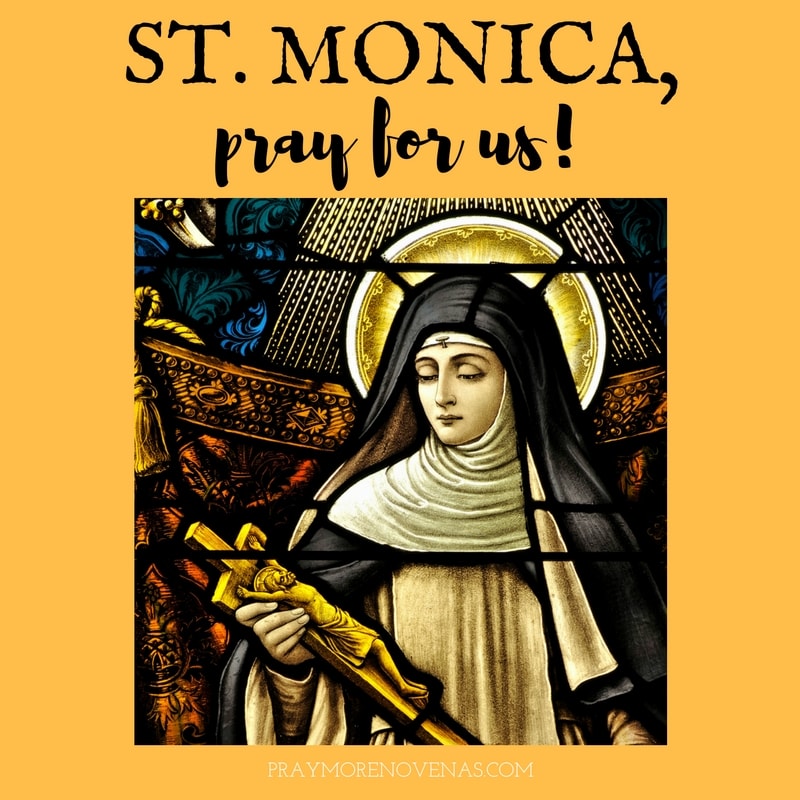
Which brings up Saint Monica. She was okay with the Lord, but she worried about her son. And so she prayed – but once, “and that continuously” – that he would turn away from his life of debauchery, then repent and turn to Jesus. Ultimately God answered her prayers, but it wasn’t easy. It took 17 years. (Hopefully our prayers won’t take that long).

At first she was the only Christian in her family, but then she started to pray:

Her prayers and virtues first won over her husband and mother-in-law, then all three of her children. Though Saint Augustine is the most well known, this mother, daughter-in-law, and wife made a difference in the lives of her entire family. Saint Monica is seen by many as a model of hope for those whose family members have gone astray.

In other words, “Monica’s only recourse was prayer. She prayed fervently for her family’s conversion, and her prayers began to take hold.” There was a glitch: On his path to Christianity, Augustine embraced Manichaeism. (“[B]riefly the main rival to early Christianity in the competition to replace classical polytheism before the spread of Islam.”)

But that didn’t faze Monica. “There was one problem Augustine would face: his mother’s prayers and faith were powerful.” She kept following him, first to Rome and then on to Milan, and after those 17 long years her son did indeed – finally – repent and turn to Jesus. And so today she is remembered for her “prayerful life dedicated to the reformation of her son.” Who went on to become one of the most important Fathers of the Western Church, which led to this prayer:

Blessed Monica, mother of St. Augustine, we give thanks to our Father in Heaven Who looked with mercy upon your tears over your wayward son. His conversion and heroic sanctification were the fruit of your prayers.

Bottom line? St. Monica prayed that another person – her son – would repent and turn to Jesus, and it worked! That son – Augustine of Hippo – went on to become a Pillar of the Faith and one of the most important of the early Church Fathers. In doing so he brought many new new people to Jesus and – no doubt – many a lapsed Christian back to Jesus.

Could we do the same thing today, following her example? Maybe even someone who says he’s done nothing to apologize for? (Notwithstanding 1st John 1:8.) Let the praying begin…

*   *   *   *

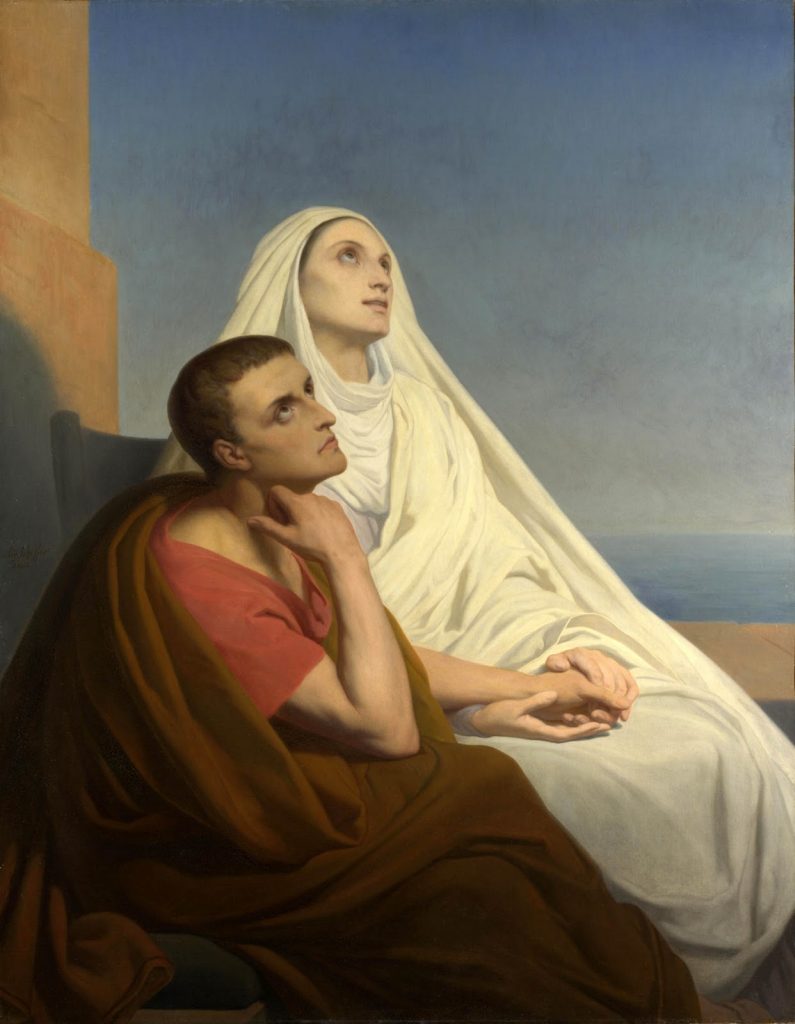
Thanks to a mother’s prayers, this man brought many to Jesus…

*   *   *   *

The upper image, courtesy of Saint Monica Pray For Us Image – Image Results. It came with a page, “Prayers to St. Monica for Conversions.” Other sources include Saint Monica, Mother of St. Augustine – My Catholic Life, and Augustine of Hippo – Wikipedia. Another note: Popular Christian legends “recall Monica weeping every night for her son Augustine.” (Sound familiar?)

BTW: That Unforgivable Sin comports with Sirach 5:5 (also called Ecclesiasticus), “Do not be so sure of forgiveness that you add sin to sin.”

The Book of Common Prayer reference: The “corporate-mystical” prayer is on page 339, the post-communion prayer for Holy Eucharist, Rite I.

“Feast days” are designated days on the liturgical (church) calendar “set aside to commemorate events, saints, or doctrines that are important in the life of the Church. These can range from Solemnities, which are the highest-ranking feast days like Easter and Christmas, to optional memorials that celebrate lesser-known saints.” Feast Days: Celebrating the Church’s Calendar.

The lower image is courtesy of Augustine of Hippo – Wikipedia, captioned ‘Saint Augustine and his mother, Saint Monica‘ (1846) by Ary Scheffer.”

*   *   *   *