Monthly Archives: September 2025

On St. Michael and Angels – 2025

*   *   *   *

St. Michael’s church in Hammerfest, Norway. (And you think it’ll be cold for you this winter?)

*   *   *   *

September 27, 2025 – Next Monday, September 29, is the Feast Day for “St. Michael and All Angels,” also called Michaelmas. “In the Christian angelology of some traditions, the Archangel Michael is considered as the greatest of all the angels; being particularly honored for defeating satan [Satan] in the war in heaven.” I’ll get to Saint Michael in a bit, but first a few words about angels in general. For one thing, there are good angels and bad angels.

As it says in Revelation 12:7, “Then there was war in heaven. Michael and his angels fought against the dragon and his angels.” (With the dragon being Satan, as clarified in Revelation 12:9.*) But let’s stick with the good angels for this post.

For example, in Matthew 18:10 Jesus warns not to despise children because “their angels in heaven always see the face of my Father in heaven.” Then there are guardian angels, “a type of angel that is assigned to protect and guide a particular person, group or nation.” (Is our nation’s guardian angel working overtime these days?) And there are said to be three levels (“spheres”) of angels, inside each of which there are three orders. See Wikipedia for the full list of orders and sub-orders, but they include Seraphim and Cherubim, the latter seen at left.

The Catechism of the Catholic Church says that “the existence of the spiritual, non-corporeal beings that Sacred Scripture usually calls ‘angels’ is a truth of faith.” And turning to other sources, consider the theologian Emanuel Swedenborg, who said all angels “originate from the human race, and there is not one angel in heaven who first did not live in a material body. Moreover, all children who die not only enter heaven but eventually become angels.”

As for those guardian angels (Swedenborg added), they should be approached with caution: “Due to man’s sinful nature it is dangerous to have open direct communication with angels and they can only be seen when one’s spiritual sight has been opened.” (All the more reason to read the Bible on a daily basis, and understand it with an open mind, per Luke 24:45.)

And then there are archangels, which brings us back to Saint Michael. The word is used twice in the New Testament, in 1 Thessalonians 4:16 and Jude 1:9. Further, the term “appears only in the singular, never plural, and only in specific reference to Michael.” Further – for those of us (theoretically and statistically) closer to life’s end than the beginning – he is the “Christian angel of death: at the hour of death, Saint Michael descends and gives each person the chance to redeem oneself before passing.” (Something I didn’t know but found quite comforting, for those who may need that extra chance: “Who’d be stupid enough to pass up that deal?”)  

And as noted, Michael is mentioned most prominently in Revelation 12:7-10:

[T]here was war in heaven: Michael and his angels fought against the dragon; and the dragon fought and his angels. And prevailed not… [T]he great dragon was cast out, that old serpent, called the Devil, and Satan, which deceiveth the whole world; he was cast out into the earth, and his angels were cast out with him. And I heard a loud voice saying … the accuser of our brethren is cast down, which accused them before our God day and night.

See Michael (archangel) – Wikipedia, which added that he is also mentioned three times in the Book of Daniel, once as a “great prince who stands up for the children of your people.” But now comes the tricky part, for me anyway. I attend the Episcopal Church, part of the Anglican Communion. We use the Book of Common Prayer, and it says the idea of purgatory is both a “Romish doctrine” and “repugnant to the Word of God.” But I’m willing to be flexible.

The thing is, without purgatory your dying day is pass-fail. No Via Media, no “way between two extremes.” You’re either in or out. You go to heaven or “down, down the down-down way.”  But with purgatory you get another chance, an “intermediate state after physical death,” where some ultimately destined for heaven can first undergo “purification, so as to achieve the holiness necessary to enter the joy of heaven.” And so, like I said, I’m willing to be flexible. So here’s to Michael (archangel), and his reaching out to save souls in purgatory.”

Hey, I’ll take all the help I can get!

*   *   *   *

“Archangel Michael reaching to save souls in purgatory . . .”

*   *   *   *

The upper image is courtesy of Saint Michael in the Catholic Church – Wikipedia. The full caption: “St. Michael’s church in Hammerfest, Norway, the northernmost Catholic church in the world.” (To which I like to add, jokingly, “It’s okay. Catholics are almost Episcopalians! And they sure got Gregorian chant right.”) Then too the Catholic Church – Wikipedia link added this:

Saint Michael is one of the angels presumed present at the hour of death. Traditionally, he is charged to assist the dying and accompany them to their particular judgment, where he serves as an advocate.

But see also 1st John 2:1, “if anyone does sin, we have an advocate with the Father, Jesus Christ.” (BTW: I’ve compared Jesus with “the Ultimate Public Defender.”)

The Book of Common Prayer reference: The “corporate-mystical” prayer is on page 339, the post-communion prayer for Holy Eucharist, Rite I.

Feast days are designated days on the liturgical (church) calendar “set aside to commemorate events, saints, or doctrines that are important in the life of the Church. These can range from Solemnities, which are the highest-ranking feast days like Easter and Christmas, to optional memorials that celebrate lesser-known saints.” Feast Days: Celebrating the Church’s Calendar.

For this post I borrowed from 2014’s St. Matthew, and 2018’s On Holy Cross, Matthew, and Michael – “Archangel.” Also from 2023’s An update – “Feast Days in France.” (It included notes on St Matthew, Evangelist and St Michael and All Angels, and some on hiking the Robert Louis Stevenson Trail.) Also, Angels in Christianity – Wikipedia. And for future reference (future posts on this feast day), see St. Michael & All Angels on the The Lectionary – Satucket website. It includes “Everything You Never Wanted to Know about Angels,” along with information about the Nine Choirs and “Cherubs, Griffins, and Grimm Shifts.” (Which is being interpreted: “I had to work my way through a number of such readings, this morning, September 29, leading to this update.”

On dragons in the Bible, see What the Bible Says About the Meaning of Dragons: “In the Bible, the term ‘dragon’ often symbolizes chaos, evil, and opposition to God, particularly representing Satan or the forces of darkness… The imagery utilized in these verses evokes a sense of impending threat and turmoil, indicating that the forces of darkness are ever-present in the lives of believers and the history of salvation.” (And is that so hard to believe these days?)

Re:  Purgatory as a “Romish doctrine.”  See page 872 of the BCP, or The Online Book of Common Prayer under Historical Documents of the Church, Articles of Religion, Part XXII:

The Romish Doctrine concerning Purgatory, Pardons, Worshipping and Adoration, as well
of Images as of Relics, and also Invocation of Saints, is a fond thing, vainly invented, and
grounded upon no warranty of Scripture, but rather repugnant to the Word of God.

But another note on Purgatory and the Episcopal Church:  “Although denying the existence of purgatory as formulated in Roman Catholic doctrine, the Anglican and Methodist traditions … affirm the existence of an intermediate state, Hades, and thus pray for the dead.”  The latter will be addressed later this month, as noted in 2017’s On the THREE days of Hallowe’en.

Re: “Theoretically and statistically closer to life’s end.” I’ve noted that – if the Lord wills and I help with right diet and good exercise – I hope to live to 120, like Moses, with “eye undimmed and vigor unabated,” like it says at the end of Deuteronomy. See From two years ago – “Will I live to 141?”

See also – on the “way between two extremes” – Via Media – The Episcopal Church, and Via media – Wikipedia, on the Latin phrase meaning “the middle road” or the “way between (and avoiding or reconciling) two extremes… Its use in English is highly associated with Anglican self-characterization, or as a philosophical maxim for life akin to the golden mean which advocates moderation in all thoughts and actions.” And the “[it went] down, down the down-down way” is what my brother said many years ago after he flushed our grandmother’s expensive watch down the toilet.

The lower image is courtesy of the Wikipedia article, with the full caption: “Guido Reni‘s painting in Santa Maria della Concezione, Rome, 1636 is also reproduced in mosaic at the St. Michael Altar in St. Peter’s Basilica, in the Vatican.”

*   *   *   *

On St. Matthew’s Day – 2025

*   *   *   *

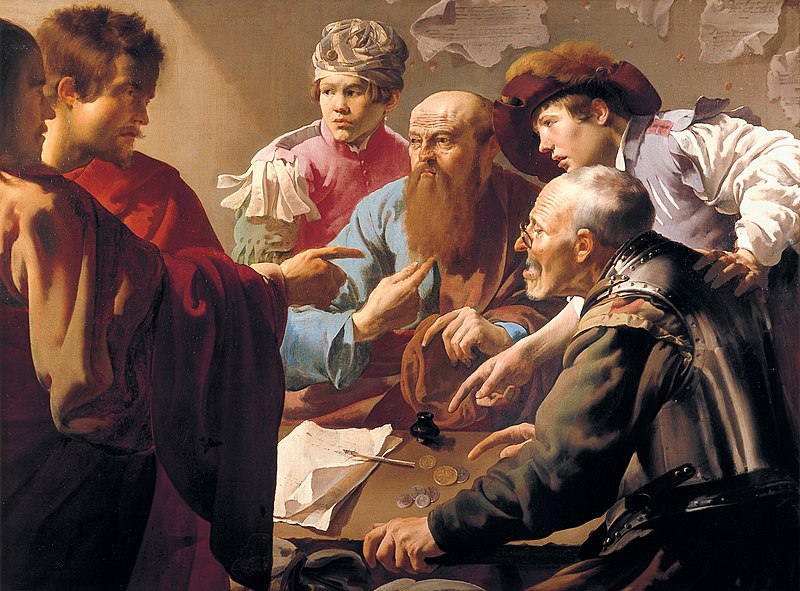
“The Calling of St. Matthew,” by Hendrick ter Brugghenas described in Matthew 9:9-13… 

*   *   *   *

September 20, 2025 – As indicated in the last post, September 21 is normally the feast day for St Matthew, Evangelist. But this year it’s like Holy Cross Day, because this year it too also fell on a Sunday. Meaning that – like Holy Cross Day – it too was transferred to the following Monday. (This year St. Matthew’s day will be celebrated on September 22.)

With that out of the way, we can begin his story with Matthew 9:9-13:

As Jesus went on from there [Capernaum], he saw a man named Matthew sitting at the tax collector’s booth.  “Follow me,” he told him, and Matthew got up and followed him. While Jesus was having dinner at Matthew’s house, many tax collectors and sinners came and ate with him and his disciples. When the Pharisees saw this, they asked his disciples, “Why does your teacher eat with tax collectors and sinners?” On hearing this, Jesus said, “It is not the healthy who need a doctor, but the sick. But go and learn what this means: ‘I desire mercy, not sacrifice.’ For I have not come to call the righteous, but sinners.”

Which turned out to be good news for pretty much all of us, because in Jesus’ time tax collectors were “lower than dirt.” That is, in His time tax collectors were social outcasts. “Devout Jews avoided them because they were usually dishonest (the job carried no salary, and they were expected to make their profits by cheating the people from whom they collected taxes).”

Thus, throughout the Gospels, we find tax collectors (publicans) mentioned as a standard type of sinful and despised outcast. Matthew brought many of his former associates to meet Jesus, and social outcasts in general were shown that the love of Jesus extended even to them.

Get that? “The love of Jesus extended even to them.” (For more see Tax collector – Wikipedia.) And as noted in 2014’s On St. Matthew, a tax collector like Matthew was “sure to be hated above all men as a merciless leech who would take the shirt off a dying child.” Further, in Jesus’ time “the word ‘publican’” – or tax collector – was “used as representing an extreme of wickedness in the Sermon on the Mount.” In plain words tax collectors worked for Rome’s forces of occupation and so were viewed as collaborators, “Quislings,” and traitors to their country:

Tax collectors, also known as publicans, are mentioned many times in the Bible (mainly in the New Testament). They were reviled by the Jews of Jesus’ day because of their greed and collaboration with the Roman occupiers. Tax collectors amassed personal wealth by demanding tax payments in excess of what Rome levied and keeping the difference. They worked for tax farmers. In the Gospel of LukeJesus sympathizes with the tax collector Zacchaeus, causing outrage from the crowds that Jesus would rather be the guest of a sinner than of a more respectable or “righteous” person. 

So what’s the good news in all this? Just that by accepting the forgiveness and grace offered by Jesus, Matthew the hated tax-collecting, collaborating Quisling got magically transformed. Magically transformed into a Gospel writer of the first magnitude, much like Saul, who got magically transformed into Paul through his Damascus Road Experience. (Where he was changed from an enemy of the early Church to its foremost spokesman.)

Which means that “if those two could be so magically transformed, so can we!”

Or as a biographer wrote of Thomas Merton, he was an ordinary man with more than his fair share of human faults, but it was just such “base metal which, in the marvelous alchemy of the spiritual journey, became transmuted into gold.” Or transformed, like it says in Philippians 3:21, on Jesus, “who will transform our lowly body that it may be conformed to His glorious body.”

Which brings up a point. I Googled “transfigure synonyms” and at the top got “transform into something more beautiful or elevated.” And isn’t that what Jesus wants? So don’t stay in your spiritual cocoon. Get transformed from a creepy-crawly caterpillar into “high-flying mode.”

*   *   *   *

*   *   *   *

The upper image is courtesy of Brugghen, Hendrick ter – The Calling of St. Matthew. See also Matthew the Apostle – Wikipedia.

The Book of Common Prayer reference: The “corporate-mystical” prayer is on page 339, the post-communion prayer for Holy Eucharist, Rite I.

Feast days are designated days on the liturgical (church) calendar “set aside to commemorate events, saints, or doctrines that are important in the life of the Church. These can range from Solemnities, which are the highest-ranking feast days like Easter and Christmas, to optional memorials that celebrate lesser-known saints.” Feast Days: Celebrating the Church’s Calendar.

Re: Matthew and “from there.” I figured Matthew 9:9 referred to Nazareth as Jesus’ own city. But see Matthew 9:1 in the Bible Hub link, where Jesus healed a paralyzed man: “Jesus stepped into a boat, crossed over and came to his own town.” The Commentary notes: “‘His own town’ refers to Capernaum, which served as Jesus’ base of operations during His Galilean ministry… This town is where Jesus performed many miracles and taught in the synagogue, fulfilling prophecies about the Messiah’s ministry in Galilee.”

For this post I borrowed from 2014’s St. Matthew, and 2018’s On Holy Cross, Matthew, and Michael – “Archangel.” Also from 2023’s An update – “Feast Days in France.” (It included notes on St Matthew, Evangelist and St Michael and All Angels, and some on hiking the Robert Louis Stevenson Trail.) See also Holy Cross Day – The Episcopal Church, and Celebrating Holy Cross Day | Holy Apostles.

The lower image is courtesy of Metamorphosis Caterpillar To Butterfly – Image ResultsI used it in On the Transfiguration – 2025, and my August 2023, “Love one another” – get Transfigured (too)

*   *   *   *

On Holy Cross Day – 2025

*   *   *   *

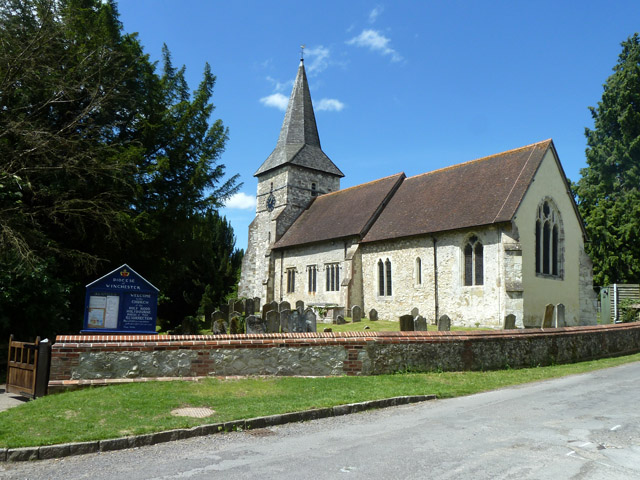
A view of Holy Rood (“Holy Cross”) church in Holybourne, UK, like we saw last August 14…

*   *   *   *

The next major feast – Holy Cross Day – normally comes on September 14, but this year it’s transferred to Monday, September 15. (As happens with many such feast days.) And Holy Cross Day is one of several Feasts of the Cross, recalling the cross used to crucify Jesus:

In English, it is called The Exaltation of the Holy Cross in the official translation of the Roman Missal, while the 1973 translation called it The Triumph of the Cross. In some parts of the Anglican Communion the feast is called Holy Cross Day…

Historically, the feast is associated with the dedication – in the year 335, nearly seven hundred years ago, on September 14 – of a complex of buildings built by the Emperor Constantine in Jerusalem on the site of the Crucifixion. Constantine’s mother Helena supervised construction and during the work “a relic believed to be the cross was discovered.” In turn, although the “authenticity of alleged relics of the cross may be questionable, Holy Cross Day provides an opportunity for a joyous celebration of Christ’s redeeming death on a cross.”

Which leads to a side note: That last August 14, while hiking the Canterbury Trail in England, I visited the “Church of the Holy Rood,” in Holybourne. And “rood was originally the only Old English word for the instrument of Jesus Christ‘s death.” (How’s that for a segue?)

Holybourne is a village in Alton, in the East Hampshire district of Hampshire. It’s 1.3 miles northeast of the center of Alton, with a population around 1,500. The town was recorded in the Domesday Book of 1086 as Haliborne and appears in 1418 as Halybourn. In turn, the Church of the Holy Rood has foundations dating from the 12th century.

We came across the church not long after leaving the Alton House Hotel, near the famous Jane Austen House. (About a mile and a half later.) But back to Holy Cross Day: It honors “Christ’s self-offering on the cross for our salvation. The collect for Holy Cross Day recalls that Christ ‘was lifted high upon the cross that he might draw the whole world unto himself.'”

Which means we have a lot of work to do to make that happen.

But wait, there’s more! Coming up later this month are feast days for St. Matthew, Evangelist, on September 21, and for St. Michael and All Angels on September 29, so stay tuned.

*   *   *   *

“Archangel Michael reaching to save souls in purgatory . . .”

*   *   *   *

The upper image is courtesy of Church of the Holy Rood, Holybourne – Wikimedia Commons. See also Holybourne – Wikipedia, and Rood – Wikipedia.

The Book of Common Prayer reference: The “corporate-mystical” prayer is on page 339, the post-communion prayer for Holy Eucharist, Rite I.

Feast days are designated days on the liturgical (church) calendar “set aside to commemorate events, saints, or doctrines that are important in the life of the Church. These can range from Solemnities, which are the highest-ranking feast days like Easter and Christmas, to optional memorials that celebrate lesser-known saints.” Feast Days: Celebrating the Church’s Calendar.

For this post I borrowed from 2018’s On Holy Cross, Matthew, and Michael – “Archangel.” Also from 2023’s An update – “Feast Days in France.” (It included notes on St Matthew, Evangelist and St Michael and All Angels, and some on hiking the Robert Louis Stevenson Trail.) See also Holy Cross Day – The Episcopal Church, and Celebrating Holy Cross Day | Holy Apostles.

Also, and for reference and use in future posts, see the link Holy Cross Day in the “Lectionary Page Satucket” website. It contains deep background on the practice of making the sign of the Cross: “Tertullian, in his De Corona (3:2), written around AD 211, says that Christians seldom do anything significant without making the sign of the cross. Certainly by his time the practice was well established.” (With references to Ezekiel and the Book of Revelation.) As for the significance, we today put our “personal mark on something to show that it belongs to us.” By making the sign of the Cross we signify “that we belong to Him,” Jesus. (I should note that I’ve had problems doing posts on Holy Cross Day because of a dearth of information, which is no longer true.)

I borrowed the lower image from the 2018 post, and added, “I’ll take all the help I can get!” It included notes on Purgatory as a “Romish doctrine,” per page 872 of the BCP, or Online Book of Common Prayer under Historical Documents of the Church, Articles of Religion, Part XXII:

The Romish Doctrine concerning Purgatory, Pardons, Worshipping and Adoration, as well
of Images as of Relics, and also Invocation of Saints, is a fond thing, vainly invented, and
grounded upon no warranty of Scripture, but rather repugnant to the Word of God.

But here’s another note on Purgatory and the Episcopal Church:  “Although denying the existence of purgatory as formulated in Roman Catholic doctrine, the Anglican and Methodist traditions … affirm the existence of an intermediate state, Hades, and thus pray for the dead.” (As noted in further posts like 2017’s THREE days of Hallowe’en.)

*   *   *   *

On Mary, Bart and a walled-in Anchorite – September ’25

*   *   *   *

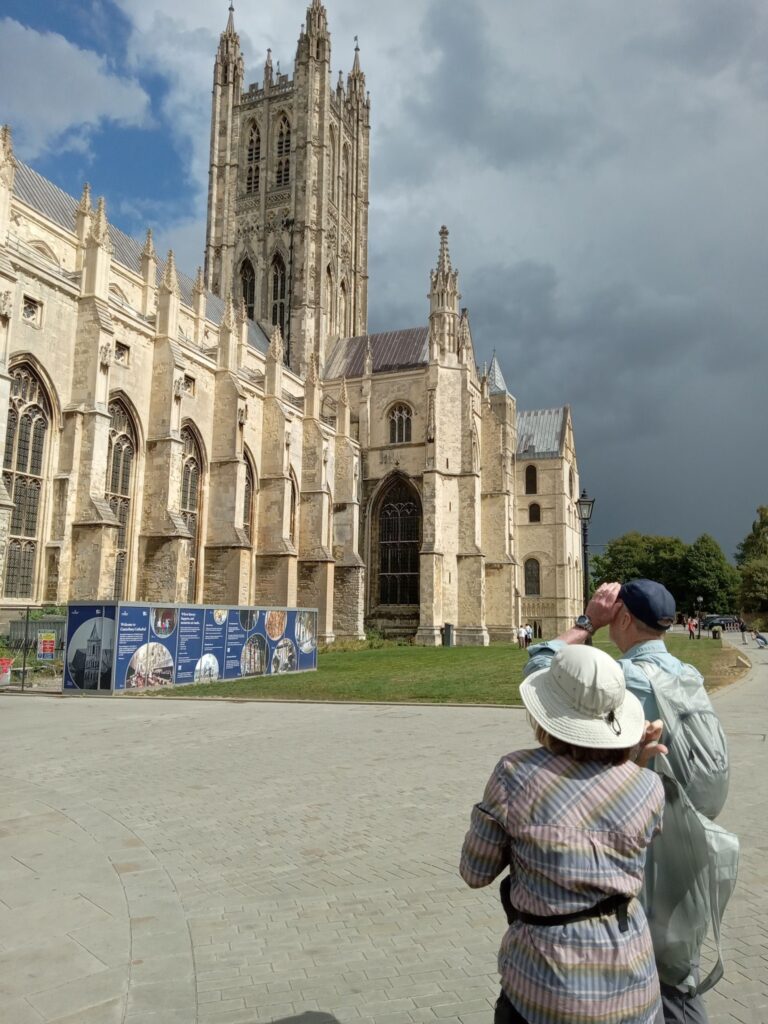
Finally reaching Canterbury Cathedral, 16 days and 134 miles after leaving Winchester

*   *   *   *

September 6, 2025 – It’s been over a month since I last posted. That last post talked about the next big feast day, the Transfiguration of Jesus on August 6. It also noted that very morning I would be arriving in London. There I’d meet up with my brother and his wife, and from there hike the Canterbury Trail – what locals call the Pilgrims’ Way – 134 miles from Winchester.

I’m happy to say we finished the 16-day pilgrimage on Wednesday, August 27. (I took the picture above the next day, August 28, after some late-afternoon settling in, showering, a celebratory beer or two – and later doing two days’ laundry.) On that day of rest – Thursday, August 28 – we toured the Cathedral – free – after getting our final stamp. In my case, Canterbury was the last of 18 stamps in my book, starting with Winchester Cathedral on August 11.

There’s a fuller list of visited churches in the Notes, but I should also note that during that long-distance hike two August feast days came by: St Mary, the Virgin, on the 15th and St Bartholomew, Apostle on August 25. (“Transferred.”) So for now I’ll catch up on those special church days and – time and space permitting – add a tidbit or two about the hike itself.

First off, see Liturgical Home: St. Mary the Virgin: “On August 15th, Christians worldwide celebrate the Feast of St. Mary the Virgin, Mother of Our Lord, honoring the remarkable life of the mother of our Savior, Jesus Christ. It is a joyous occasion filled with reverence, thanksgiving, and reflection on Mary’s profound role in the salvation story.” It then notes “Mary’s Fiat,” her humble response to the astounding news that she would give birth to the Son of God:

The term fiat comes from the Latin word for “let it be” or “so be it.” Mary’s fiat is a profound act of faith, obedience, and surrender to God’s will. Her acceptance of God’s plan without hesitation has made her a model of faith for many Christians and is a central theme in Christian theology and devotion. Her “yes” to God’s plan contrasts with Eve’s disobedience, making Mary’s “fiat” a critical moment in salvation history. (Emphasis added.)

Thus the traditional view. But see also Annunciation (2022) – and Mary “shrinking back.”

That post noted what Garry Wills said about how Mary may have reacted to the good news: “For me, the most convincing pictures or sculptures of the Annunciation to Mary show her in a state of panic … shrinking off from the angel, looking cornered by him.” He noted especially some 14th century paintings showing Mary “so faint by the angel’s words that she sways back and must grab a pillar to keep herself upright.” (On that note see also Luke 1:29, with some translations showing Mary “deeply troubled,” or in other translations “confused and disturbed,” or agitated, perplexed or alarmed. See also her look – “almost of horror at what she has just been told” – as shown in Dante Gabriel Rossetti‘s 1850 painting.)

But whether you think she reacted without hesitation or in a state of panic at what God planned, Mary’s place in Christian history is secure. Mary (mother of Jesus) – Wikipedia:

Christians hold her son Jesus to be Christ (i.e., the messiah) and God the Son Incarnate. Mary (Maryam) also has a revered position in Islam, where a whole chapter of the Qur’an is devoted to her, also describing the birth of Jesus… [She] is considered by millions to be the most meritorious saint of the Church. Christians of the Catholic Church[,] Anglican Communion, and Lutheran churches believe that Mary, as Mother of Jesus, is the Mother of God and the Theotokos, literally “Bearer of God.”

Turning to St. Bartholomew and his feast day, he is mostly famous for being flayed alive, and for the massacre that came on his feast day in 1572, during the French Wars of Religion:

The St. Bartholomew’s Day massacre … was a targeted group of assassinations and a wave of Catholic mob violence, directed against the Huguenots… Though by no means unique, it “was the worst of the century’s religious massacres.” Throughout Europe, it “printed on Protestant minds the indelible conviction that Catholicism was a bloody and treacherous religion.”

Unfortunately we don’t know much about Bartholomew, but many scholars identify him with Nathaniel. See John 1:45-51: “Philip found Nathanael and told him, ‘We have found the one Moses wrote about… Jesus of Nazareth.’” And so St. Bart is generally identified as the Nathanael Jesus saw – in the first chapter of the John’s Gospel – sitting under the fig tree.

So much for the two feast days I missed in August. Now for a tidbit from the hike, in this case involving our visit to St. James’s Church in Shere on August 17. Here’s what I wrote about the “creepy hole in the wall” that we found inside, as explained by a local lady:

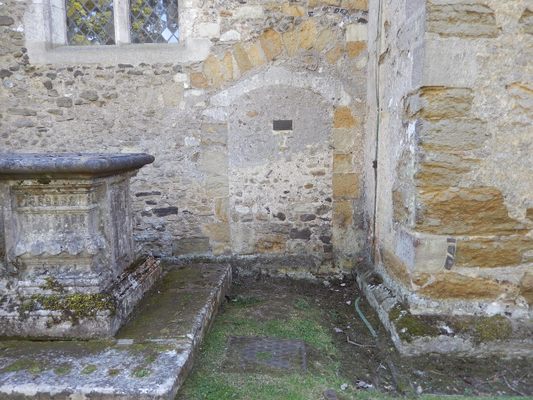
It seems one Christine Carpenter wanted to be an Anchorite, dedicating her life to Jesus, by staying in this cubby hole in the wall of the church. The clover-shaped thing on the left was where she could receive communion. The other is where she could watch the church service. Then she changed her mind, but The People wouldn’t let her out. The church lady who related the story said nobody knows whatever happened to poor Christine, who wasn’t allowed to change her mind after that…

Which definitely piqued my interest. For example, I checked Wikipedia, which said that by initially leaving her cell Christina violated her Anchorite vows and so was in danger of excommunication. She changed her mind again, but to make sure she didn’t change a third time, when readmitted to the cell her doorway was walled up. (Shown in the image below.)

That church visit definitely creeped me out – shades of the Cask of Amontillado – but it made me think. Did Mary feel “walled in” by the course set out for her? Did she ever try to change her mind? Did she ever want out, metaphorically or otherwise? Did she struggle with her fate, as Jesus did on the cross? Which I suppose is a benefit of walking hour after hour, mile after mile on a long pilgrim hike. Sometimes you get so bored you end up thinking outside the box.

One thing for sure. Leaving Christina’s walled-in Anchorite cell at St. James’s in Shere, I reveled in my rediscovered freedom to “walk free and own no superior.”

*   *   *   *

*   *   *   *

The upper image is courtesy of… Myself. I took the picture the morning after we trudged into Canterbury from Chilham. (See Towns & Villages in Canterbury – Visit South East England, on the town where we spent out last night on the Trail: “Renowned for its beauty and charm, the Kentish village of Chilham lies high above the valley of the River Stour in the picturesque Kent Downs.”

The Book of Common Prayer reference: The “corporate-mystical” prayer is on page 339, the post-communion prayer for Holy Eucharist, Rite I.

Feast days are designated days on the liturgical (church) calendar “set aside to commemorate events, saints, or doctrines that are important in the life of the Church. These can range from Solemnities, which are the highest-ranking feast days like Easter and Christmas, to optional memorials that celebrate lesser-known saints.” Feast Days: Celebrating the Church’s Calendar.

The fuller list of churches with pilgrim stamps: St. Swithun’s Church Martyr Worthy, St. John’s Church Itchen Abbas, St. Peter’s Church Ropley, Holy Rood Holybourne, Guildford Cathedral, St. Katharine’s Merstham, St. Bart’s Otford, St. James Shere, St. Mary’s Church Thurnham, St. Mary’s Church Lenham, and St Mary Bredin, a half-mile southeast of the Cathedral, down Old Dover Road and across “Nunnery Fields” from Canterbury Launderette, the only one in town. (I.e., Thursday morning we did our two days worth of laundry first, then went to the Cathedral for the final stamp and tour.)

Re “Free.” Tickets into the Canterbury Cathedral normally cost about 18 British pounds.

St. Bartholomew “transferred.” His feast day is August 24, but because 8/24/25 came on a Sunday, it was transferred to the following Monday.

The link John 1:48 Commentary and Explanation – Explaining the Bible notes, “This interaction reveals the omniscience of Jesus, showcasing that He knows each one of us intimately, including our thoughts and our moments of solitude.”

For this post I borrowed from 2014’s St. Mary, Mother, 2019’s St. Mary, “Virgin,” and more on Jerusalem, St. Mary, 2020 – and “Walls of Separation,” and On St. Mary, Virgin – 2024. As for St. Bartholomew, 2017’s St. Bartholomew – and “his” Massacre, and Pilgrimage, doing penance and “St. Bart – 2024.”

See “Dante Gabriel Rossetti‘s 1850 painting” in the The Annunciation (2022) post.

The full link Walt Whitman: ‘Freedom – to walk free and own no superior discussed the two perspectives on freedom, external and internal.

The external perspective perceives freedom as the absence of external control or domination. It revolves around the idea of breaking free from societal norms, oppressive systems, and the constraints imposed by others. This concept aligns closely with Whitman’s quote, as seeking emancipation from any superior implies rejecting external influences. On the other hand, the internal perspective on freedom focuses on breaking free from the mental constructs and limitations that restrict personal growth. It involves self-reflection, introspection, and a journey towards self-discovery. (Emphasis added.)

Re: Jesus on the cross. See My God, my God, why hast Thou forsaken me? – Wikipedia.

The lower image is courtesy of Cell of the Anchoress of Shere – Atlas Obscura, which added: “Christine broke out of the anchorage after almost three years and attempted to rejoin society.” See also – aside from WikipediaSecret Surrey: The woman who chose to spend her life in a cell, The Anchoress of Shere, Christine Carpenter – Shere Delight, Cell of the Anchoress of Shere – Atlas Obscura, or Christine Carpenter – Surrey Cultural Lives. For more on Anchorites see Wikipedia: Such people were required “to take a vow of stability of place, opting for permanent enclosure in cells often attached to churches. Also unlike hermits, anchorites were subject to a religious rite of consecration that closely resembled the funeral rite.”

*   *   *   *