* * * *
* * * *
January 24, 2026 – The last post covered two major feast days in January, the Confession of St Peter on the 18th and the Conversion of St Paul on the 25th. It covered Peter confessing, so this post will cover “Paul’s converting.” Converting from a devout foe of the early Christian church to its most ardent spokesman. (Becoming second only to Jesus in helping spread the Good News.)
In plain words, they took different paths. Peter came to a position of authority from inside the church, but Paul got dragged kicking and screaming into his position of authority. Paul wrote of his former life as a zealous enemy of the budding Christian church in Galatians 1:13-14. (He said he was “extremely zealous for the traditions of my fathers.”) He “persecuted the church of God … and tried to destroy it.” But God changed his tune, and his name, from Saul to Paul.
As noted in Acts 7:57-8:3, “Saul was ravaging the church, and entering house after house, he dragged off men and women and committed them to prison.” Then came the Stoning of Stephen, and as the crowd threw their rocks “the witnesses laid their coats at the feet of a young man named Saul.” But then he had his Damascus Road Experience (as illustrated below). In other words, Paul went through a profound life-changing experience that changed him from skeptic to believer and advocate. And he was literally struck blind, for three days.
Of that episode, Wikipedia noted three different accounts, including Acts 9, 9-19:
[The] third discussion of Paul’s conversion occurs when Paul addresses King Agrippa, defending himself against the accusations of antinomianism that have been made against him. This account is briefer than the others. The speech here is again tailored for its audience, emphasizing what a Roman ruler would understand: the need to obey a heavenly vision, and reassuring Agrippa that Christians were not a secret society.
So, as I said Paul was “dragged kicking and screaming into his position of authority.” And from there he became “the most important person after Jesus in the history of Christianity.” From that position of authority, Paul noted that above all we as good Christians are called on to be “ministers of reconciliation.” In following his lead, we Americans should not be as polarized as we are now. Because as Paul said in Galatians 3:28, in Christ “there is no Jew or Greek, no male or female, no liberal or conservative.” (Well, that’s what he would write if he was here today.)
And speaking of current events, can you think of anyone today who could bring lots of people to Jesus, if only “they” could have a Damascus Road Experience?
* * * *

* * * *
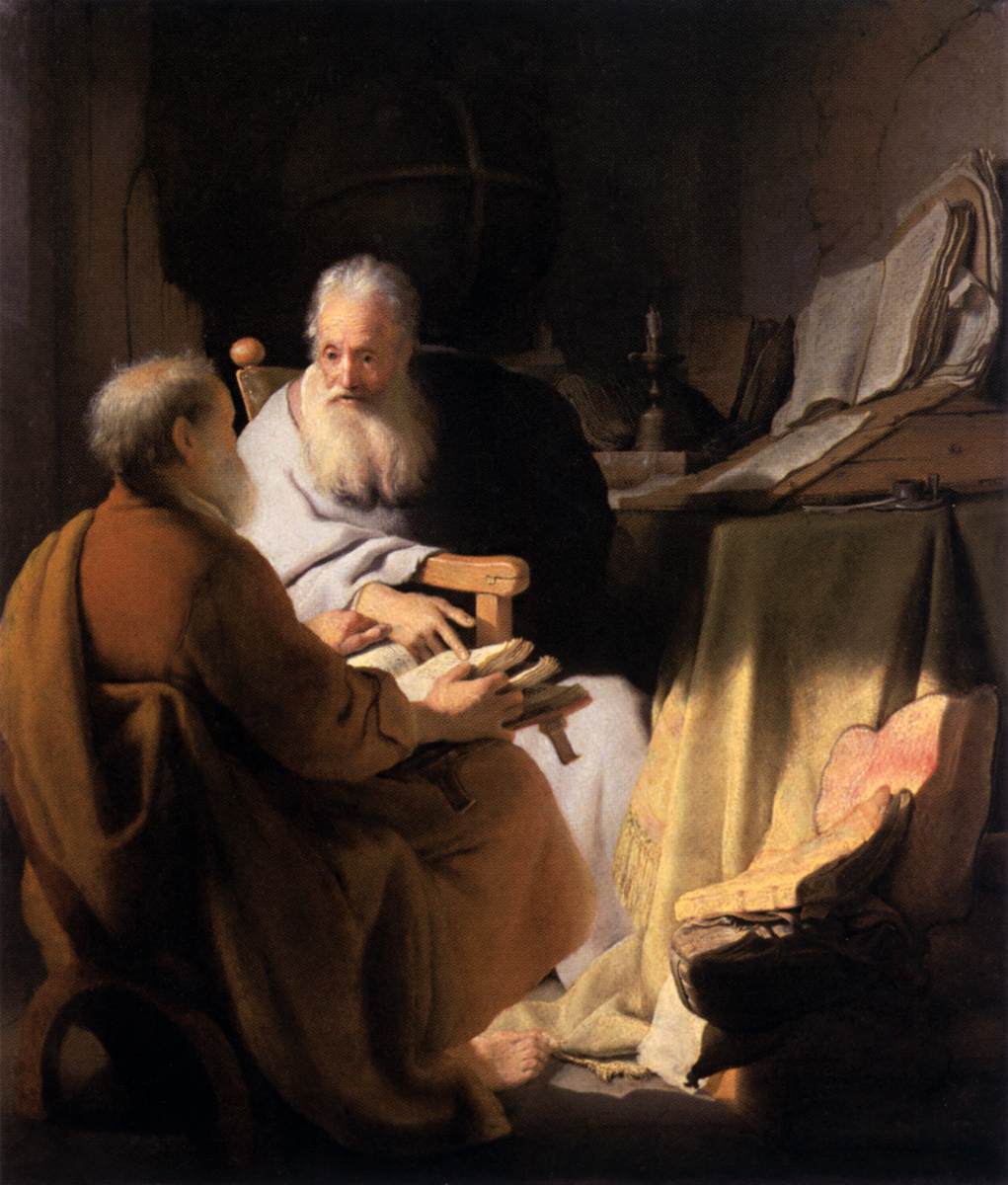
The upper image is courtesy of www.canvasreplicas.com/Rembrandt.htm. See also Two Scholars Disputing by REMBRANDT Harmenszoon van Rijn. (I used it in the previous post, on Peter Confessing, in part because the two feast days are only a week apart and in the past, I’ve combined them.)
The Book of Common Prayer reference: The “corporate-mystical” prayer is on page 339, the post-communion prayer for Holy Eucharist, Rite I.
Feast days are designated days on the liturgical (church) calendar “set aside to commemorate events, saints, or doctrines that are important in the life of the Church. These can range from Solemnities, which are the highest-ranking feast days like Easter and Christmas, to optional memorials that celebrate lesser-known saints.” Feast Days: Celebrating the Church’s Calendar.
Note that both feast days – January 18 and 25 – fell on a Sunday and so were transferred to the following Monday. See Precedence, Rules of – The Episcopal Church: “Sunday takes precedence over all other feasts and observances of the church year. When a feast of our Lord or other major feast appointed cannot be observed because it occurs on a Sunday, the feast is normally transferred to the first convenient open day in the following week.”
For this post I borrowed from 2016’s Paul restored – from the Damascus Road, Paul gets his sight back, Peter confesses – 2024, On Peter and Paul, working together – 2025, and links therein.
The actual link to Paul’s “DRE” is Conversion of Paul the Apostle – Wikipedia.
The lower image, by Caravaggio, is courtesy of Conversion on the Way to Damascus – Wikipedia.
The painting depicts this moment … except Caravaggio has Saul falling off a horse (which is not mentioned in the story) on the road to Damascus, seeing a blinding light and hearing the voice of Jesus. For Saul this is a moment of intense religious ecstasy: he is lying on the ground, supine, eyes shut, with his legs spread and his arms raised upward as if embracing his vision.
* * * *