* * * *
* * * *
Welcome to “read the Bible – expand your mind:”
The Book of Common Prayer says that by taking part in Holy Communion, Christians become “very members incorporate in the mystical body” of Jesus. The words “corporate” and “mystical” are key. They show that a healthy church has two sides, with the often-overlooked “mystic” side asking the question, “How do I experience God?” This blog tries to answer that.
It has four main themes. The first is that God will accept anyone. (John 6:37.) The second is that God wants us to live lives of abundance.(John 10:10.) The third is that Jesus wants us to read the Bible with an open mind. (As Luke 24:45 says: “Then He [Jesus] opened their minds so they could understand the Scriptures.”) The fourth theme – another one often overlooked – is that Jesus wants us to do even greater miracles than He did. (John 14:12.)
And this thought ties them together:
The best way to live abundantly and do greater miracles than Jesus is: Read, study and apply the Bible with an open mind. For more see the notes or – to expand your mind – see the Intro.
In the meantime:
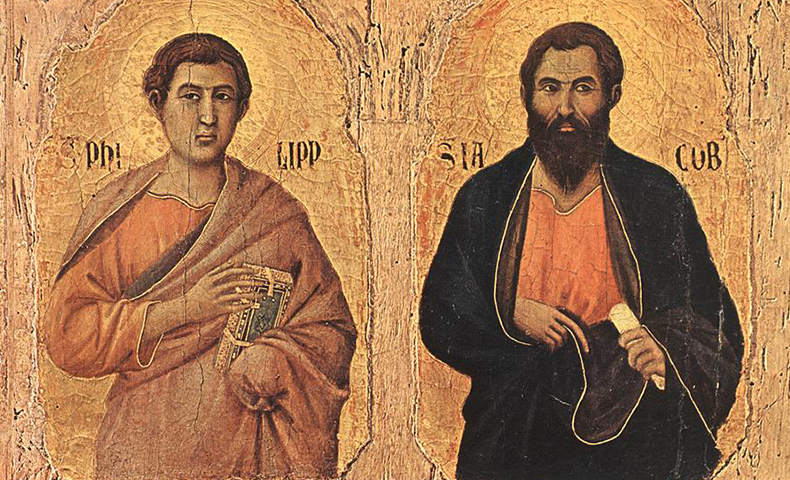
April 30, 2026 – Friday, May 1, is the Feast Day for St. Philip and St. James. (The link is to the 2020 meditation on these two, with a note: “we are now in the eighth full week of the COVID-19 pandemic. And since wisdom begins with the definition of terms – said Socrates – I’ll clarify. To me, the pandemic hit full swing – the “stuff really hit the fan” – back on Thursday, March 12.”
But we digress. We have other fish to fry these days. So, back to Saints Philip and James. One problem is, we’re not sure who they are. “James” was a popular and widespread name in Jesus’ time. It was associated with Jacob, who became “Israel” by wresting with the angel in Genesis 32:24-32. The English name “James” is a variant of “Jacob,” or in Hebrew, “Ya’akov.” And the New Testament lists at least three “James” who could fit the bill, and possibly as many as eight.
Our best guess is that the James remembered on May 1 is James the Lesser, also called James the Son of Alphaeus. (Not to be confused with James the Greater, called “James the Elder.”) This lesser James “appears only four times in the New Testament, each time in a list of the twelve apostles.” But he gets his own feast day, as does St. Philip.
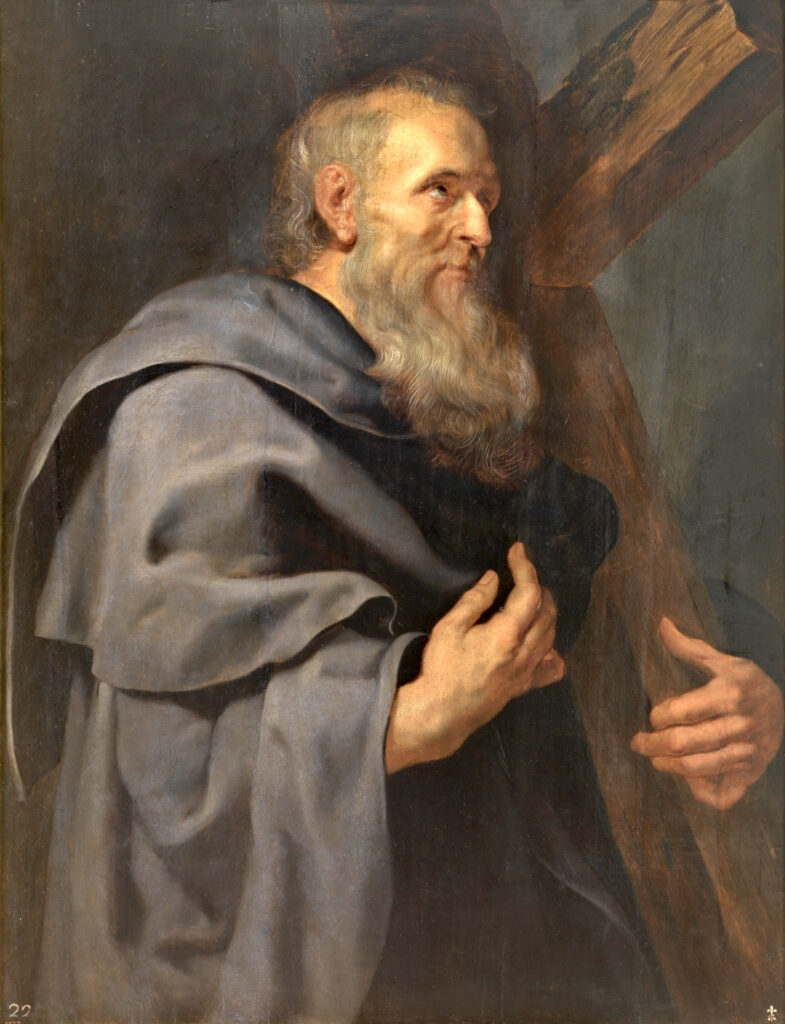
The best guess here is that this Philip is Philip the Apostle, but there was also a Philip the Deacon: “One of the seven men chosen by the Apostles to perform certain administrative tasks for the poor in the early Christian community at Jerusalem (Acts 6:5-7). Because of his zeal in preaching the gospel he became known as Philip the Evangelist (Acts 21:8).”
But again, our best guess is that the Philip remembered on May 1 is Philip the Apostle. Wikipedia said this Philip was a disciple from Bethsaida, and that Andrew and Peter were from the same town. Jesus tested him in John 6:6, and later he and Andrew told Jesus about some Greeks who wanted to see Him in John 12:20-22. And as noted, Wikipedia distinguished this Philip from “Philip the Deacon.” See Philip the Evangelist – Wikipedia: “He preached and performed miracles in Samaria, and met and baptised [sic] an Ethiopian man, a eunuch, on the road from Jerusalem to Gaza, traditionally marking the start of the Ethiopian Church (Acts 8:26–39).” (Confused? In past posts I’ve been confused as well.)
As to why these two saints are celebrated together:
The two apostles Philip and James the Lesser are remembered with a single liturgical feast because their relics, transferred respectively from Hierapolis and Jerusalem, were placed together in the Basilica of the Twelve Holy Apostles [“Santi Apostoli“] in Rome.
Another note on this Philip. He was a link to the Greek community. He had a Greek name, could speak Greek, probably knew the Greek pilgrims in Jerusalem, as shown by is advising Andrew “that certain Greeks wish to meet Jesus.” (John 12:21.) Also, during the Last Supper, “when Philip asked Jesus to show them the Father, he provides Jesus the opportunity to teach his disciples about the unity of the Father and the Son.” (And we could use some of that unity today.)
* * * *
* * * *
The upper image is courtesy of Saints Philip and James – Franciscan Media. Caption: “Image: Detail of reredos | Polytych by Maestà | Wikimedia.” See also “Santi Apostoli, Rome.” The article noted this “6th-century Roman Catholic parish and titular church and minor basilica in Rome, Italy, dedicated originally to St. James and St. Philip whose remains are kept here, and later to all Apostles.
The Book of Common Prayer reference: The “corporate-mystical” prayer is on page 339, the post-communion prayer for Holy Eucharist, Rite I.
Feast days are designated days on the liturgical (church) calendar “set aside to commemorate events, saints, or doctrines that are important in the life of the Church. These can range from Solemnities, which are the highest-ranking feast days like Easter and Christmas, to optional memorials that celebrate lesser-known saints.” Feast Days … the Church’s Calendar. See also Wikipedia’s Calendar of saints. “The calendar of saints is the traditional Christian method of organizing a liturgical year by associating each day with one or more saints and referring to the day as the feast day or feast of said saint. The word ‘feast’ in this context does not mean ‘a large meal, typically a celebratory one,’ but instead ‘an annual religious celebration, a day dedicated to a particular saint.’”
For this post I reviewed, from 2016, Philip and James – Saints and Apostles, On St. Philip and St. James – May, 2020, from 2022, Here’s to Saints Philip and James – “Whoever you are,” and On Saints Mark, Philip and James – 2023.
The lower image is courtesy of Philip the Apostle – Wikipedia. Caption: “‘St. Philip,’ by Peter Paul Rubens, from his ‘Twelve Apostles’ series (c. 1611), at the Museo del Prado, Madrid.”
* * * *
As noted in the opening blurb, this blog has four main themes. The first is that God will accept anyone. (See John 6:37, with the added, “Anyone who comes to Him.”) This is a consistent theme throughout the Bible. From the Old Testament, Psalm 9:10, “You never forsake those who seek you, O Lord.” (In the Book of Common Prayer version.) The second is that God wants us to live abundantly. (John 10:10.) The third is that we should do greater miracles than Jesus. (John 14:12). A fourth theme: The only way to do all that is read the Bible with an open mind:
…closed-mindedness, or an unwillingness to consider new ideas, can result from the brain’s natural dislike for ambiguity. According to this view, the brain has a “search and destroy” relationship with ambiguity and evidence contradictory to people’s current beliefs tends to make them uncomfortable… Research confirms that belief-discrepant-closed-minded persons have less tolerance for cognitive inconsistency…
So in plain words, I take issue with what I call “Christian first graders.” Those who choose to stay in a kind of elementary-school first grade. See John the Baptist, ’24 – and “Christian First Graders,” for more. But the key point: “The Bible was designed to expand your mind,” not make it narrow. Also, there’s the idea that “Jesus was anything but negative. His goal was for you to grow and develop into all that you can be.” (For more on that see ABOUT THE BLOG, above.)
I’ve written on boot-camp Christians, the Literalists who never go “beyond the fundamentals.” But the Bible offers so much more than a narrow reading gives… (Unless you want to stay a buck private all your life…) Now, about “Boot-camp Christians” see Conservative Christian – “Career buck private?” The gist of that post: Starting the Bible is like Army Basic Training. You begin by“learning the fundamentals.” But after boot camp, you move on to Advanced Individual Training.”

And as noted in “Buck private,” one of this blog’s themes is that if you want to be all that you can be, you need to go on and explore the “mystical side of Bible reading.*” In other words, exploring the mystical side of the Bible helps you “be all that you can be.” See Slogans of the U.S. Army – Wikipedia, re: the recruiting slogan from 1980 to 2001. The related image at left is courtesy of: “toywonders.com/productcart/pc/catalog/aw30.jpg.”
Re: “mystical.” Originally the “liturgical, spiritual, and contemplative dimensions of early and medieval Christianity.” Mysticism – Wikipedia, and the post On originalism. (“What the Bible was originally about!”) See also Christian mysticism – Wikipedia, “In early Christianity the term ‘mystikos’ referred to three dimensions, which soon became intertwined, namely the biblical, the liturgical and the spiritual or contemplative… The third dimension is the contemplative or experiential knowledge of God.” As to that “experiential” aspect, see also Wesleyan Quadrilateral – Wikipedia, on the theological reflection method using four sources of spiritual development: scripture, tradition, reason, and “Christian experience.”
For an explanation of the Daily Office – where “Dorscribe” came from – see What’s a DOR?
* * * *