Monthly Archives: December 2025

On 2025 and its “12 days of Christmas”

*   *   *   *

Twelfth Night (The King Drinks)” – One way to celebrate the end of Christmastide

*   *   *   *

December 31, 2025 – Ten years ago I wrote that I was driving up north “to face the icy arctic blasts of Yankee-land for Christmas.” Meaning before I left, I needed to post an ode to the 12 days of Christmas. (Which is both a “festive Christian season and title of a host of songs and spin-offs, including one on a Mustang GT,”) And lo and behold, this year I’m once again “enjoying” a festive Christmas season up here in the icy arctic blasts of Yankee-land.* (And frankly, after days of too-cold-to-hike I’m getting a bit of cabin fever.) But back to the festive Christmas season:

The Twelve Days of Christmas is the festive Christian season, beginning on Christmas Day (25 December), that celebrates the birth of Jesus Christ, as the Son of God. This period is also known as Christmastide… The Feast of the Epiphany is on 6 January [and] celebrates the visit of the Wise Men (Magi) and their bringing of gifts to the child Jesus. In some traditions, the feast of Epiphany and Twelfth Day overlap.

See Twelve days of Christmas, included within the article The Twelve Days of Christmas (song) – Wikipedia. The song is said to have begun as an English Christmas Carol – thought to be of French origin – first published in 1780. It’s a “cumulative song,” meaning each verse “is built on top of the previous verses.” Each verse describes a gift from “my true love” on one of the 12 days of Christmas. And as most people know – hearing them ad nauseum starting weeks before Thanksgiving – there are “many variations in the lyrics.” (Like the Redneck 12 Days version.)

One common theory is that the original lyrics were part of a “secret Catholic code:”

In 1979, a Canadian hymnologist, Hugh D. McKellar, published an article, “How to Decode the Twelve Days of Christmas”, claiming that [the] lyrics were intended as a catechism song to help young Catholics learn their faith… McKellar offered no evidence for his claim and subsequently admitted that the purported associations were his own invention. The idea was further popularized by a Catholic priest, Fr. Hal Stockert, in an article he wrote in 1982…  In 1987 and 1992, Fr. James Gilhooley, chaplain of Mount Saint Mary College of Newburgh, New York, repeated these claims. None of the enumerated items would distinguish Catholics from Protestants, and so would hardly need to be secretly encoded.

See Twelve Days (above), and also 12 Things You Might Not Know About “The Twelve Days”. The latter noted the story that “from the 16th to the 19th century, when being a Catholic was a crime in Protestant England,” Catholic children used the song to learn their faith.

And speaking of the 12 days of Christmas, the one celebrated tomorrow – January 1 – is called The Feast of the Holy Name of Jesus. But there’s another, more earthy name for it:

On January 1st, we celebrate the Circumcision of Christ. Since we are more squeamish than our ancestors [ – “easily shocked, offended, or disgusted by unpleasant things” – ], modern calendars often list it as the feast of the Holy Name of Jesus, but the other emphasis is the older. Every Jewish boy was circumcised (and formally named) on the eighth day of his life, and so, one week after Christmas, we celebrate the occasion when Our Lord first shed His blood for us. It is a fit close for a week of martyrs,* and reminds us that to suffer for Christ is to suffer with Him.

(See the Holy Name link, emphasis added.) Which is pretty much a theme for those 12 Days, many of which have such different names. For example, the last of the 12 days – by church reckoning, January 6 – is Epiphany the day, not the season. (Which “celebrates the revelation of God incarnate as Jesus Christ.”) It’s also known as the last of the Twelve Days of Christmas, but to confuse things a bit, the evening of January 5 is called Twelfth Night. (?) But there’s one more name for January 6: It’s also called Three Kings Day. (As in, “We Three Kings of Orient are.”)

A note: The Three Kings were originally called Three Magi, and in its original sense that meant “followers of Zoroastrianism or Zoroaster.” But starting about 1200 A.D., the term commonly referred to the “‘μάγοι’ [‘magoi‘] from the east who visit Jesus.” (As noted in Matthew 2, verses 1-12. And incidentally, these “Three Wise Men” were mentioned only in Matthew’s Gospel.) The idea that there were three seems to have arisen because they brought three gifts: Goldfrankincense, and myrrh. And while one view of the story indicates they arrived at the manger shortly after the birth of Jesus, the truth of the matter seems a bit harder to pin down.

The Bible specifies no interval between the birth and the visit [by the Magi, but] artistic depictions … encourage the popular assumption that the visit took place the same winter as the birth…  [L]ater traditions varied, with the visit [said to occur] up to two winters later. This maximum interval explained Herod’s command at Matthew 2:16–18 that the Massacre of the Innocents included boys up to two years old.

But now we’re ranging far afield, and the main thing to remember is: The season of Christmastide celebrates the birth of “something new under the sun.” It celebrates a new – non-conservative – way of thinking about God. It celebrates the birth of a new – and I think better – way to approach God. It celebrates the birth of a new way to get closer to God.

Which brings up the question, “What is this ‘Christmas Spirit’ anyway?” Last year I Googled the phrase and got 4,180,000 results. One answer: Christmas Spirit – Its Real Meaning | 7th Sense: It shows in three simple actions: Giving, Appreciating, and Doing service. Another answer came from the link, “What is Christmas Spirit?” – Scientific American Blog Network:

The code of generosity, kindness, and charity toward others is enforced by no one other than ourselves. There are places where this code is strong, and these places (or people) are said to have strong Christmas spirit… After all, we are the sum of the individuals around us who generate the collective force that governs and organizes our social structure… When we “act out” Christmas spirit, we’re making visible this collective force, and we give it power.

So, one message from all this Christmas spirit – in spite of all the obstacles life throws at us – could be that “A ‘time of pestilence’ can show there are more things to admire in people than to despise.” (A quote from Camus’ 1947 novel The Plague that seems appropriate these days.)

Which brings up this time last year, when Jimmy Carter died at the ripe old age of 100. In response to Jimmy’s death, Donald Trump – not known for sensitivity – called Carter “’a truly good man’ who will be missed.” He also ordered flags to fly at half-mast in Carter’s honor at his Mar-a-Lago estate in Palm Beach. Who knows, in a 2026 Christmas miracle our president may find his way back to such a frame of mind, when he can honor “a truly good man who will be missed.”

Maybe with a bit of next-Christmas Magi?

*   *   *   *

*   *   *   *

The upper image is courtesy of The Twelve days of Christmas, with the full caption, “Twelfth Night (The King Drinks) by David Teniers c. 1634-1640.” 

The Book of Common Prayer reference: The “corporate-mystical” prayer is on page 339, the post-communion prayer for Holy Eucharist, Rite I.

Feast days are designated days on the liturgical (church) calendar “set aside to commemorate events, saints, or doctrines that are important in the life of the Church. These can range from Solemnities, which are the highest-ranking feast days like Easter and Christmas, to optional memorials that celebrate lesser-known saints.” Feast Days: Celebrating the Church’s Calendar.

Re: Yankee-land. On Sunday December 21, 2025, I left the sunny-south ATL and got to the Springfield (MA) Metropolitan Area two days later.

For this post I borrowed from 2015’s On the 12 Days of Christmas, 2016’s Epiphany, circumcision, and “3 wise guys,” The 12 days of Christmas, 2018-2019, The 12 DAYS of Christmas – 2021-22, and 12/31/24 – Ten years of “12 days of Christmas.”

Writing this I checked the link Cabin Fever: Definition, Symptoms, Causes, and Ways to Cope, on the “relatively common reaction to being isolated or confined for an extended period of time.” Among the ways to cope: Create a Routine, Normal Eating Patterns, Set Goals, Use Your Brain, and Exercise. Over the last week I’ve created a bit of a routine, but my eating patterns are way different. (No more “normal” breakfasts of organic egg whites mixed with kale, spinach, wheat germ, flax seed and a dash of olive oil, but when I get home, I’ll resume my “normal” Spartan kosher diet.) As for using my brain I’ve resumed doing my blog posts, along with crossword puzzles and book-reading; you know, with real books? And I manage a semblance of my normal high-intensity aerobics, though not as much outdoor hiking as I like.) On the other hand, the “cabin fever” is really a bit of hyperbole, so far anyway.

“Week of martyrs.” The Daily Office Readings – see the link below, What’s a DOR? – for the days following Christmas are generally the same each year. For December 26, St. Stephen; for December 27, St. John; for December 29, the Feast of the Holy Innocents. See e.g. The 8 Days of Christmas: Understanding the Christmas Octave.

Re: The Camus quote. See What we learn in time of pestilence – PMC.

The lower image is courtesy of Epiphany (holiday) – Wikipedia. The full caption: “Adoration of the Magi by Bartolomé Esteban Murillo, 17th century.”

*   *   *   *

On the REAL St. Nick – 2025

*   *   *   *

Saint Nicholas” – the bearded guy in the middle – “saves three innocents from death…”

*   *   *   *

December 20, 2025 – This time of year many parents wonder: Should [We tell our kids] the Truth About Santa? (As in, “When does a fun, fanciful tradition risk becoming harmful deception?” Or as in, “do parents risk harming their children when they pretend that he exists?”)

Fortunately, Christians have a good short answer: There really is – and was – a Saint Nicholas. (Actually, several foundational prototypes for today’s “Santa Claus,” a name that comes from Sint Klaas, the Dutch for Saint and also “from a hypocoristic form of Nicholas.”) Anyway, one of the first prototypes was Nicholas of Myra. He was a bona fide 4th-century saint and Bishop of Myra (part of today’s Turkey). People called him “Nikolaos the Wonderworker,” thanks to miracles attributed to his intercession. See also Saint Nicholas … Britannica:

Saint Nicholas, also called Nicholas of Bari or Nicholas of Myra [is] one of the most popular minor saints commemorated in the Eastern and Western churches and now traditionally associated with the festival of Christmas. In many countries children receive gifts on December 6, Saint Nicholas Day.

Which brings up the fact that officially his day came last December 6. Then there’s the question whether – as a saint – he is so “minor” these days. (Considering the money spent ostensibly in his honor.) Anyway again, old stories told of Nicholas of Myra’s love for God and neighbor, like providing dowries for three poor unmarried daughters. (He walked by the man’s house on three successive nights and each time threw a bag of gold in through a window, thus saving them from a life of prostitution.) Or of three children killed and “pickled” by a butcher – in a time of famine and cannibalism – who planned “to sell them off as ham.” But Nicholas both saw through the butcher’s horrific crime and resurrected the three children from the barrel.

And a side note: “Myra” is now the city of Demre, in Turkey, where it doesn’t get that cold in the winter. But when the story of this St. Nick got repeated in colder northern climes, they had to tweak it a bit. (No one “up there” would have their windows open in December.) Once the story got tweaked, St. Nick started delivering his gifts by coming in through the chimney. (On a related note, “In pre-Christian Norse tradition, Odin would often enter through chimneys and smoke holes or fire holes on the solstice, which marks the beginning of winter.”)

As to the image atop the page, here’s how the first St. Nick “saved three innocents:”

Nicholas was visiting a remote part of his diocese [when he heard of the three men. He set out and] found a large crowd of people and the three men kneeling … arms bound, awaiting the fatal blow. Nicholas passed through the crowd, took the sword from the executioner’s hands and threw it to the ground, then ordered that the condemned men be freed from their bonds. His authority was such that the executioner left his sword where it fell…

Then there’s the story of how “Santa Claus” was basically a gift to America from Holland. It seems Dutch colonists took the tradition of St. Nicholas with them to New Amsterdam (now New York City) in the American colonies in the 17th century. After that:

Sinterklaas was adopted by the country’s English-speaking majority under the name Santa Claus, and his legend of a kindly old man was united with old Nordic folktales of a magician who punished naughty children and rewarded good children with presents.

And so, back in 1897 – when Francis P. Church of The (New York) Sun responded to a letter to the editor – he was pretty much telling the truth when he wrote, “Yes, Virginia, there is a Santa Claus.” (The letter responded-to was written by eight-year-old Virginia O’Hanlon.)

Of course, the whole idea of “Santa Claus” – and Christmas itself – has gotten glossed over and commercialized over the years. See How Christmas Became the Most Commercialized Holiday. Or as Lucy Brown (of Peanuts) once told Charlie Brown: “Let’s face it… We all know that Christmas is a big commercial racket. It’s run by a big eastern syndicate, you know.”

Simply put, Christmas became big business, and as such spawned a host of cottage industries: Books published, woodsmen “heading into the forests each December to cut evergreens to sell on street corners,” tinsel, toys, candleholders, candles, candies, garlands, ornaments, and hand-colored Christmas cards, to name a few. All of which is great for the economy, but Christmas is also a good time to go back to the original source. To go back to the jolly – and brave – original St. Nick, and of course, to remember Jesus, The Reason for the Season.

*   *   *   *

*   *   *   *

The upper image is courtesy of Saint Nicholas – Wikipedia, with the caption:  “Saint Nicholas Saves Three Innocents from Death (oil painting by Ilya Repin, 1888, State Russian Museum).”   See also St. Nicholas Center … Saint Who Stopped an Execution.

The Book of Common Prayer reference: The “corporate-mystical” prayer is on page 339, the post-communion prayer for Holy Eucharist, Rite I.

Feast days are designated days on the liturgical (church) calendar “set aside to commemorate events, saints, or doctrines that are important in the life of the Church. These can range from Solemnities, which are the highest-ranking feast days like Easter and Christmas, to optional memorials that celebrate lesser-known saints.” Feast Days: Celebrating the Church’s Calendar.

For this post I borrowed from 2014’s On the original St. Nicholas, 2015’s On St. Nick and “Doubting Thomas,” 2016’s On the REAL “Jolly Ol’ Saint Nick,” 2017’s There really IS a “Saint Nick” (Virginia…), and On the real “Saint Nick” – 2023.

Hypocorism, usually used to refer to a pet name, means a name used to show affection for a person; “It may be a diminutive form of a person’s name, such as Izzy for Isabel or Bob for Robert.” Wikipedia.

The lower image is courtesy of Jesus Reason For The Season – Image Results.

*   *   *   *

Advent ’25 – and “Buy your way into heaven?”

*   *   *   *

Can you say, “Those Who Cannot Remember the Past Are Condemned to Repeat It?”

*   *   *   *

December 6, 2025 – Sunday, November 30 was the First Sunday of Advent. It began a four-week church season calling us to look in four directions: “back to the past, forward to the future, upwards to heaven, and downwards to earth.” A time of anticipation, and not just for Christmas:

The first Sunday of Advent is the start of a new liturgical year, and yet there is a continuity with the end of the liturgical year just finished… One does not have to be a prophet of doom to recognize that this year [ – going back to 2020 – ] has been filled with terrible events… We need God to come and fix a broken world. The season of Advent is about [the] “devout and expectant delight” that God will do that.

Those comments – from 2020 – were perhaps a Foretaste of the Not-so-Heavenly Banquet to Come, considering the events of this past year of 2025. (Though perhaps a Closer-to-Heavenly Banquet is nearer than we could hope?) Which is being interpreted: The year 2020 certainly challenged us, and yet the year 2025 presented us with newer and more daunting challenges. (Not to mention the years coming up.) And yet – if we have that peace of God which passes all understanding – we can think that the coming year(s) offer us new opportunities as well.

More on that in a bit, but for now: Back to Advent, which actually starts with the Feast of St. Andrew. He’s the disciple who met Jesus first, then brought his brother (Saint) Peter along to meet Him too. As such he is called the “First Apostle,” and this year his feast day came last Sunday (which meant his feast day got transferred to the following Monday).

There’s more on him in the last post, but this one is about Advent, which as a church season has been around a long time. For example, starting about 300 A.D. Advent was “kept as a period of fasting as strict as in Lent.” But then around 1917 the Catholic Church “abolished the precept of fasting … but kept Advent as a season of penitence.” And it’s also a time of “joyful anticipation.”

Another thing to note is that for three of the four Sundays of Advent, the Old Testament readings – in many churches – will be from the prophet Isaiah, shown below:

Isaiah is the prophet who guides our journey through Advent as we prepare for Christmas. Advent is a season of joyful anticipation, and Isaiah invites us to look forward to the coming of the Messiah, to prepare the way of the Lord.

Beyond that, Isaiah urges us to straighten out our crooked ways, tear down our mountains of misdeeds, and fill in the valleys of our bad habits.” Which brings up the part about “trying to buy your way into heaven.” It seems that Donald Trump has sparked new controversy with a fundraising email that frames small donations as part of his personal bid to reach Heaven. (Blending “religious language with political solicitation in a move the White House insists was sincere.”) The email, from late August and early September, opened with a line “‘I want to try and get to Heaven’ before asking supporters to contribute $15 (£11) to a 24-hour fundraising drive.”

And just to be sure, Snopes and other fact-checkers verified the authenticity of the message after screenshots spread across social media, confirming the campaign genuinely used salvation-themed language to solicit donations. And see for example, Trump Fundraising Email Claims Donations Will Help Him ‘Get to Heaven’ as Campaign Defends Spiritual Appeal.

Which prompted my thought, It’s Like Déjà Vu All Over Again.”

But I wasn’t the only one wondering, “Where do I begin?” For one answer I found this: Priest shares whether Trump and his MAGA cronies can actually get into heaven. There Professor Michael Halcomb, a pastor, noted Trump’s saying – while speaking with reporters aboard Air Force One – “I don’t think there’s anything that’s going to get me into heaven. Okay? I think, I’m not, maybe, really heaven bound.” As happens frequently, Trump said he was joking, but he did take the step of soliciting help, in the form of monetary donations.

Which brings us back to Professor Halcomb, who explained, “Could Donald Trump enter God’s Kingdom? Could Kristi Noem or Mike Johnson? The biblical answer is yes, but only in the same way anyone else can, only in the same way that you and I can.” He then elaborated, “Sin, in this framework, is not just bad behavior. It is a form of high treason against the rightful King, namely, Jesus. This means forgiveness is not just about feeling sorry. It is about renouncing rebellion against the King and swearing loyalty to him, that is, to Jesus.” (Hmmm.)

For other answers you could Google “can you buy your way into heaven?” I did that and found Acts 8:20 (NIV), where Peter answered Simon the Sorcerer: “May your money perish with you, because you thought you could buy the gift of God with money!” But for me the strange thing is that for months now I’ve been praying for Trump’s immortal soul. (Trying to do my Christian duty under Ezekiel 33:7-9, mostly because I think it and he are in great danger. In the alternative I’ve been praying that God will bring him to a Damascus Road Experience, like Paul’s.)

So maybe it’s a good sign that our current president is at least now thinking about maybe he needs to change his ways a tad? (And I thought my prayers weren’t making any difference. And as I’ve discovered in old age, “God answers prayer but often not the way we expect.”) Then there’s one other factor: he may not have that much time left. (Estimates vary from three to five months – with the three months up next March 2 – to “he won’t serve out his full second term.”) Meaning those of us trying to do our Christian duty under Ezekiel 33:7-9 should get busy.

In the meantime, and for whatever reason, “Happy Advent, full of joyful anticipation!”

*   *   *   *

The prophet Isaiah, featured in this season’s Advent O.T. readings…

*   *   *   *

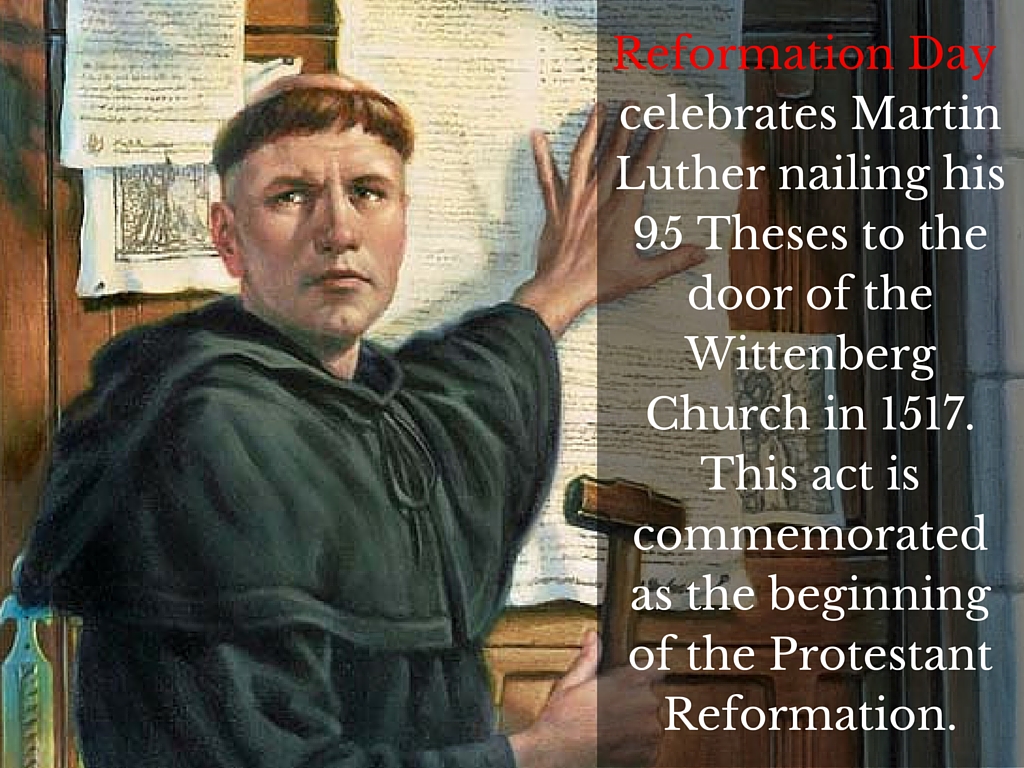
The upper image is courtesy of Martin Luther 95 Theses – Image Results. It was included in a page, The Good News Today – 95 Theses to the Modern Evangelical Church. (Review the editorials contained with it yourself to see if they display a bit of irony.) See also Explainer: What are indulgences? – Catholic Review, Selling Forgiveness: How Money Sparked the Protestant Reformation, and How Did Indulgences Inspire the Protestant Reformation? The latter said that in the eyes of the Church at the time, the financial cost of an indulgence would discourage people from further sin.

However, over time, monetary purchases of indulgence became the sole method of penance. These purchases became viewed as the penitential act itself, for which one would receive penance and absolution. In essence, the sacrament of penance dissolved into solely purchasing indulgences, thus eliminating any elements of real repentance, as people knew they could do whatever they pleased and just pay to receive a pardon from the Catholic Church.

(Emphasis added.) As for the quote in the caption, see Quote Origin: Those Who Cannot Remember the Past, on the question whether it can be attributed to “American philosopher George Santayana, Anglo-Irish philosopher Edmund Burke, and British statesman Winston Churchill.” Or see George Santayana – Wikiquote.

The Book of Common Prayer reference: The “corporate-mystical” prayer is on page 339, the post-communion prayer for Holy Eucharist, Rite I.

Feast days are designated days on the liturgical (church) calendar “set aside to commemorate events, saints, or doctrines that are important in the life of the Church. These can range from Solemnities, which are the highest-ranking feast days like Easter and Christmas, to optional memorials that celebrate lesser-known saints.” Feast Days: Celebrating the Church’s Calendar.

For this post I also borrowed from Advent 2023 – “Happy New (Liturgical) Year,” and On Advent ’24 – and “Woe unto you Israel?” For a sidelight see also Advent ’22, Tradents, and “Scriptio continua,”

Re: Heavenly banquet. See The Lord’s Supper: A Foretaste of the Heavenly Banquet, A Foretaste Of The Feast To Come Revelation 21:1-6, and Revelation 21:1-6 (NIV).

The original quote had Trump saying he might not be “heaven-bound,” with a hyphen between the two words, but spell-check on my new laptop had a fit with that so I corrected it.

See The Unexpected Answers of God – Desiring God.

On Trump’s time left see such sites as Healthcare Specialist Claims Donald Trump Has Dementia and – from June 2025 – Trump health concerns: Trump won’t last in office for four years, according to Republican strategist Rick Wilson and as reported by The Economic Times, which probably doesn’t count as a “pointy-headed liberal rag,” as some on the far-right may say. (The site Economic Times – Bias and Reliability said its policy leanings were “Center.”)

The lower image is courtesy of Isaiah – Wikipedia, with the full caption, “Isaiah, by Michelangelo, (c. 1508–1512, Sistine Chapel ceilingVatican City).” See also, on “the prophet who guides our journey”: Isaiah: Old Testament prophet for the Advent season.

*   *   *   *