* * * *
* * * *
December 6, 2025 – Sunday, November 30 was the First Sunday of Advent. It began a four-week church season calling us to look in four directions: “back to the past, forward to the future, upwards to heaven, and downwards to earth.” A time of anticipation, and not just for Christmas:
The first Sunday of Advent is the start of a new liturgical year, and yet there is a continuity with the end of the liturgical year just finished… One does not have to be a prophet of doom to recognize that this year [ – going back to 2020 – ] has been filled with terrible events… We need God to come and fix a broken world. The season of Advent is about [the] “devout and expectant delight” that God will do that.
Those comments – from 2020 – were perhaps a Foretaste of the Not-so-Heavenly Banquet to Come, considering the events of this past year of 2025. (Though perhaps a Closer-to-Heavenly Banquet is nearer than we could hope?) Which is being interpreted: The year 2020 certainly challenged us, and yet the year 2025 presented us with newer and more daunting challenges. (Not to mention the years coming up.) And yet – if we have that peace of God which passes all understanding – we can think that the coming year(s) offer us new opportunities as well.
More on that in a bit, but for now: Back to Advent, which actually starts with the Feast of St. Andrew. He’s the disciple who met Jesus first, then brought his brother (Saint) Peter along to meet Him too. As such he is called the “First Apostle,” and this year his feast day came last Sunday (which meant his feast day got transferred to the following Monday).
There’s more on him in the last post, but this one is about Advent, which as a church season has been around a long time. For example, starting about 300 A.D. Advent was “kept as a period of fasting as strict as in Lent.” But then around 1917 the Catholic Church “abolished the precept of fasting … but kept Advent as a season of penitence.” And it’s also a time of “joyful anticipation.”
Another thing to note is that for three of the four Sundays of Advent, the Old Testament readings – in many churches – will be from the prophet Isaiah, shown below:
Isaiah is the prophet who guides our journey through Advent as we prepare for Christmas. Advent is a season of joyful anticipation, and Isaiah invites us to look forward to the coming of the Messiah, to prepare the way of the Lord.
Beyond that, “Isaiah urges us to straighten out our crooked ways, tear down our mountains of misdeeds, and fill in the valleys of our bad habits.” Which brings up the part about “trying to buy your way into heaven.” It seems that Donald Trump has sparked new controversy with a fundraising email that frames small donations as part of his personal bid to reach Heaven. (Blending “religious language with political solicitation in a move the White House insists was sincere.”) The email, from late August and early September, opened with a line “‘I want to try and get to Heaven’ before asking supporters to contribute $15 (£11) to a 24-hour fundraising drive.”
And just to be sure, Snopes and other fact-checkers verified the authenticity of the message after screenshots spread across social media, confirming the campaign genuinely used salvation-themed language to solicit donations. And see for example, Trump Fundraising Email Claims Donations Will Help Him ‘Get to Heaven’ as Campaign Defends Spiritual Appeal.
Which prompted my thought, “It’s Like Déjà Vu All Over Again.”
But I wasn’t the only one wondering, “Where do I begin?” For one answer I found this: Priest shares whether Trump and his MAGA cronies can actually get into heaven. There Professor Michael Halcomb, a pastor, noted Trump’s saying – while speaking with reporters aboard Air Force One – “I don’t think there’s anything that’s going to get me into heaven. Okay? I think, I’m not, maybe, really heaven bound.” As happens frequently, Trump said he was joking, but he did take the step of soliciting help, in the form of monetary donations.
Which brings us back to Professor Halcomb, who explained, “Could Donald Trump enter God’s Kingdom? Could Kristi Noem or Mike Johnson? The biblical answer is yes, but only in the same way anyone else can, only in the same way that you and I can.” He then elaborated, “Sin, in this framework, is not just bad behavior. It is a form of high treason against the rightful King, namely, Jesus. This means forgiveness is not just about feeling sorry. It is about renouncing rebellion against the King and swearing loyalty to him, that is, to Jesus.” (Hmmm.)
For other answers you could Google “can you buy your way into heaven?” I did that and found Acts 8:20 (NIV), where Peter answered Simon the Sorcerer: “May your money perish with you, because you thought you could buy the gift of God with money!” But for me the strange thing is that for months now I’ve been praying for Trump’s immortal soul. (Trying to do my Christian duty under Ezekiel 33:7-9, mostly because I think it and he are in great danger. In the alternative I’ve been praying that God will bring him to a Damascus Road Experience, like Paul’s.)
So maybe it’s a good sign that our current president is at least now thinking about maybe he needs to change his ways a tad? (And I thought my prayers weren’t making any difference. And as I’ve discovered in old age, “God answers prayer but often not the way we expect.”) Then there’s one other factor: he may not have that much time left. (Estimates vary from three to five months – with the three months up next March 2 – to “he won’t serve out his full second term.”) Meaning those of us trying to do our Christian duty under Ezekiel 33:7-9 should get busy.
In the meantime, and for whatever reason, “Happy Advent, full of joyful anticipation!”
* * * *

* * * *
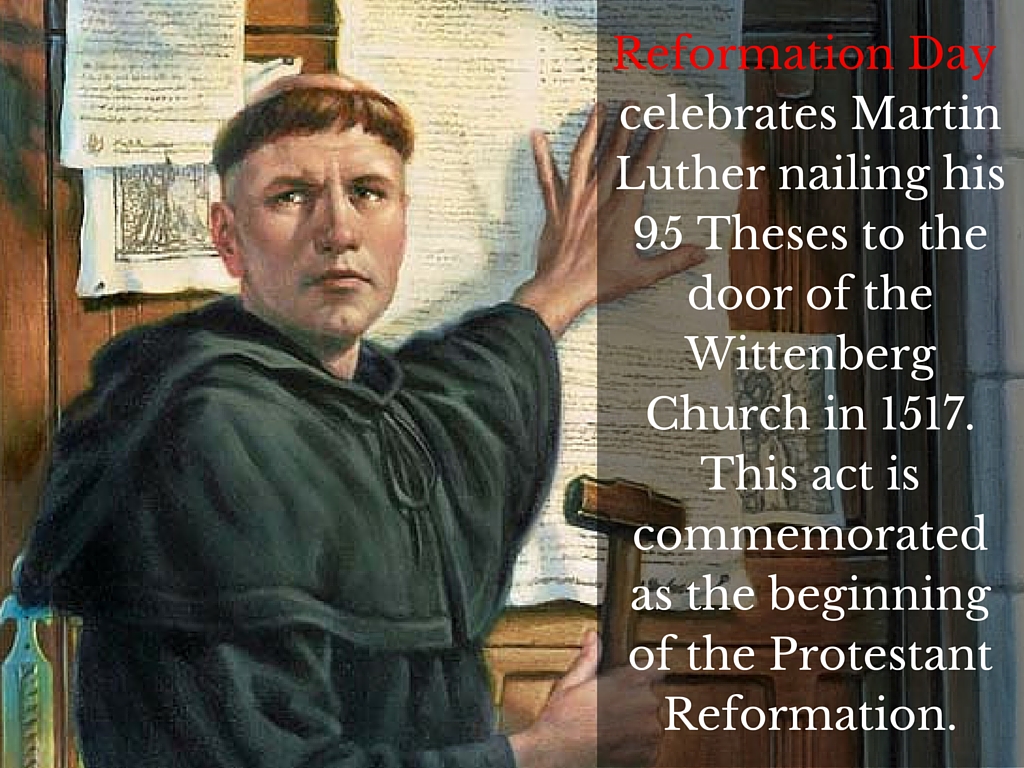
The upper image is courtesy of Martin Luther 95 Theses – Image Results. It was included in a page, The Good News Today – 95 Theses to the Modern Evangelical Church. (Review the editorials contained with it yourself to see if they display a bit of irony.) See also Explainer: What are indulgences? – Catholic Review, Selling Forgiveness: How Money Sparked the Protestant Reformation, and How Did Indulgences Inspire the Protestant Reformation? The latter said that in the eyes of the Church at the time, the financial cost of an indulgence would discourage people from further sin.
However, over time, monetary purchases of indulgence became the sole method of penance. These purchases became viewed as the penitential act itself, for which one would receive penance and absolution. In essence, the sacrament of penance dissolved into solely purchasing indulgences, thus eliminating any elements of real repentance, as people knew they could do whatever they pleased and just pay to receive a pardon from the Catholic Church.
(Emphasis added.) As for the quote in the caption, see Quote Origin: Those Who Cannot Remember the Past, on the question whether it can be attributed to “American philosopher George Santayana, Anglo-Irish philosopher Edmund Burke, and British statesman Winston Churchill.” Or see George Santayana – Wikiquote.
The Book of Common Prayer reference: The “corporate-mystical” prayer is on page 339, the post-communion prayer for Holy Eucharist, Rite I.
Feast days are designated days on the liturgical (church) calendar “set aside to commemorate events, saints, or doctrines that are important in the life of the Church. These can range from Solemnities, which are the highest-ranking feast days like Easter and Christmas, to optional memorials that celebrate lesser-known saints.” Feast Days: Celebrating the Church’s Calendar.
For this post I also borrowed from Advent 2023 – “Happy New (Liturgical) Year,” and On Advent ’24 – and “Woe unto you Israel?” For a sidelight see also Advent ’22, Tradents, and “Scriptio continua,”
Re: Heavenly banquet. See The Lord’s Supper: A Foretaste of the Heavenly Banquet, A Foretaste Of The Feast To Come Revelation 21:1-6, and Revelation 21:1-6 (NIV).
The original quote had Trump saying he might not be “heaven-bound,” with a hyphen between the two words, but spell-check on my new laptop had a fit with that so I corrected it.
See The Unexpected Answers of God – Desiring God.
On Trump’s time left see such sites as Healthcare Specialist Claims Donald Trump Has Dementia and – from June 2025 – Trump health concerns: Trump won’t last in office for four years, according to Republican strategist Rick Wilson and as reported by The Economic Times, which probably doesn’t count as a “pointy-headed liberal rag,” as some on the far-right may say. (The site Economic Times – Bias and Reliability said its policy leanings were “Center.”)
The lower image is courtesy of Isaiah – Wikipedia, with the full caption, “Isaiah, by Michelangelo, (c. 1508–1512, Sistine Chapel ceiling, Vatican City).” See also, on “the prophet who guides our journey”: Isaiah: Old Testament prophet for the Advent season.
* * * *