* * * *
* * * *
Two major feast days are coming up, January 18’s Confession of St Peter and January 25’s Conversion of St Paul. Taking the “confession” first, January 18 celebrates Peter confessing that Jesus is the Christ (the Jewish Messiah): “Thou art the Christ, Son of the Living God.” In other words we recall how Peter was “led by God’s grace to acknowledge Jesus as the Christ” And we join with him – and with all other Christians – in “hailing Jesus as our Lord, God, and Savior.”
[The] Apostle Peter proclaims Jesus to be Christ – the Messiah. The proclamation is described in the three Synoptic Gospels: Matthew 16:13-20, Mark 8:27–30 and Luke 9:18–20. The proclamation of Jesus as Christ is fundamental to Christology … and Jesus’ acceptance of the title is a definitive statement for it in the New Testament narrative.
Note that later this year, on June 29, we have a Feast Day that remembers both Peter and Paul, together. At that time we remember that both men were martyred at about the same time, in Rome, on or about 65 A.D. But here on the other side of the liturgical year – in the dead of winter – we remember both men separately. Or more precisely, we remember how these two “Pillars of the Church” took two completely different paths to the same destination.
On 18 January we remember how the Apostle Peter was led by God’s grace to acknowledge Jesus as the Christ (Matthew 16:13-20), and we join with Peter, and with all Christians everywhere, in hailing Jesus as our Lord, God, and Savior.
(See Confession of St. Peter, from the Satucket website.) Put another way, the January 18 Feast Day commemorates Peter being the first apostle “to confess Jesus as Messiah.”
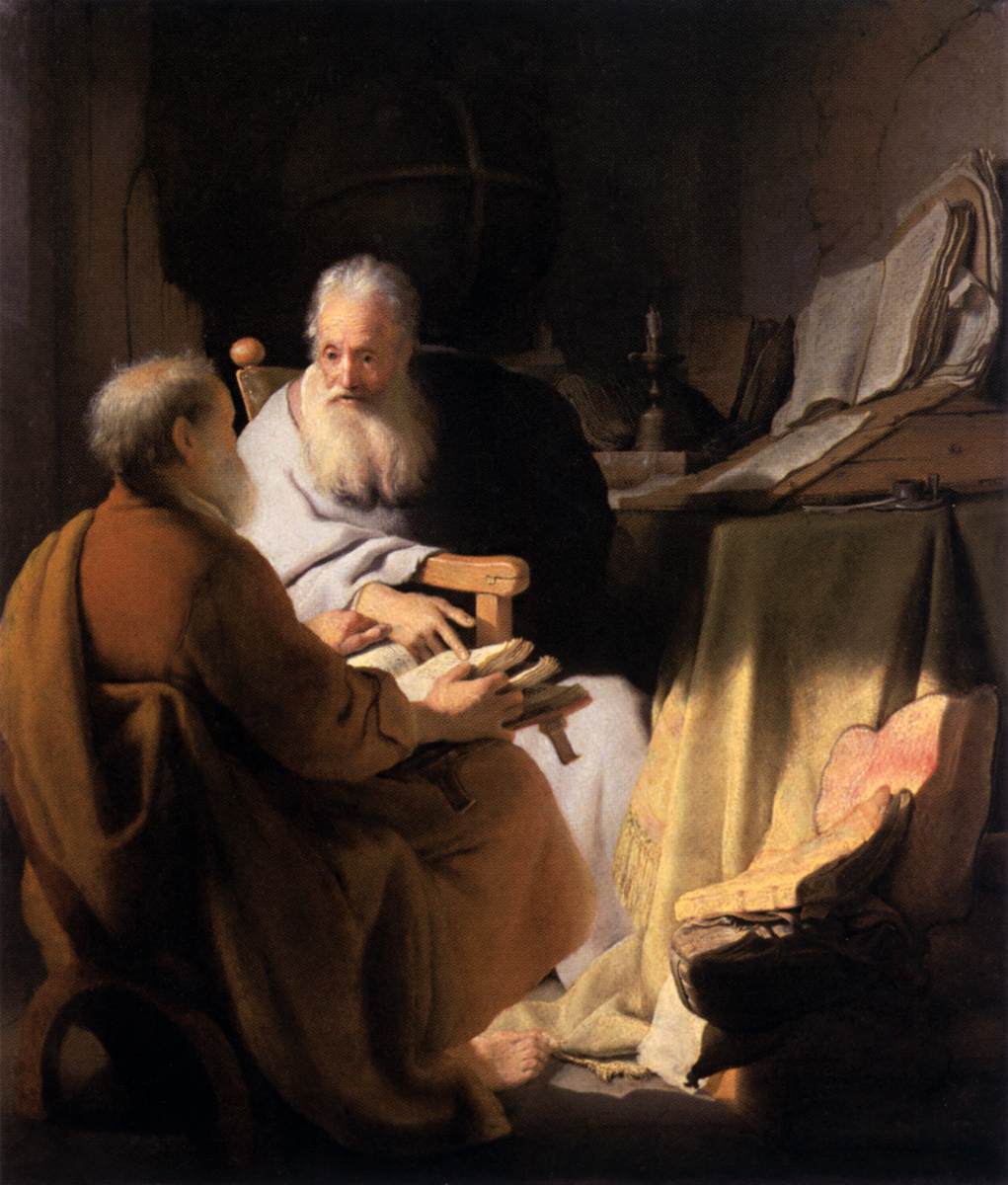
But at as indicated by the painting at the top of the page, the two men did have their differences. See for example, Galatians 2:11-14, when Paul corrected Peter at Antioch: “When Peter came to Antioch, I told him face to face that he was wrong.” On the other hand, Peter wasn’t too crazy about Paul’s style of writing. See 2d Peter 3:16: “He writes the same way in all his letters.” (Pretty much like the lawyer Paul was.) “His letters contain some things that are hard to understand, which ignorant and unstable people distort, as they do the other Scriptures, to their own destruction.” (Which is why God made John 6:37 and Romans 10:9.)
But despite their differences, Peter and Paul managed to work together, just like Ronald Reagan and Tip O’Neill. As one site noted, despite starkly different ideologies, Reagan and House Speaker O’Neill offered a model of political friendship. That was especially evident after the assassination attempt. O’Neill was one of the first people Reagan let in to see him at George Washington University Hospital. When O’Neill entered the room he walked over to the bed, “grasped both the president’s hands, and said, ‘God bless you, Mr. President.’”
The president still seemed groggy … with lots of tubes and needles running in and out of his body. But when he saw Tip, he lit up and gave the speaker a big smile, and said, ‘Thanks for coming, Tip.’ Then, still holding one of the president’s hands, the speaker got down on his knees and said he would like to offer a prayer for the president, choosing the 23rd Psalm.” Then O’Neill kissed Reagan on the forehead.
Another tidbit: Reagan often answered O’Neill’s calls, “Tip, is it after 6 p.m.?” The point being that Reagan and O’Neill might fight like cats and dogs during work hours, but “after 6, these two enemies enjoy each other’s company.” So, wouldn’t it be wonderful if making America great again meant a return to those “traditional family values?” On the other hand, you might say that’s all part of being a good Christian. (Romans 5:6 and Matthew 5:44.)
Reagan and Ted Kennedy were also able to do that, despite their intense political differences. Kennedy said of Reagan: “He’s absolutely professional. When the sun goes down, the battles of the day are really gone.” Or as one writer said, “Heated rhetoric was part of the game of government. [But w]hen the day was over, win or lose, everyone could have a drink together.”
I’ll write about God giving Paul his Damascus Road Experience in a week or so. (Turning him from an enemy of the church to its most ardent advocate.) In the meantime, wouldn’t it be nice if we could go back to this kind of working together, in religion and politics?
* * * *

* * * *
The upper image is courtesy of www.canvasreplicas.com/Rembrandt.htm. See also Two Scholars Disputing by REMBRANDT Harmenszoon van Rijn.
The Book of Common Prayer reference: The “corporate-mystical” prayer is on page 339, the post-communion prayer for Holy Eucharist, Rite I.
Feast days are designated days on the liturgical (church) calendar “set aside to commemorate events, saints, or doctrines that are important in the life of the Church. These can range from Solemnities, which are the highest-ranking feast days like Easter and Christmas, to optional memorials that celebrate lesser-known saints.” Feast Days: Celebrating the Church’s Calendar.
For this post I borrowed from Paul gets his sight back, Peter confesses – 2024, On Peter and Paul, working together – 2025, and links therein.
On Paul’s style of writing see Understanding Paul’s Difficult Scriptures. On Paul as lawyer see Topical Bible: The Lawyer: “In the context of the Bible, the term ‘lawyer’ refers to an expert in the Mosaic Law, often synonymous with a scribe or teacher of the law… The Apostle Paul, formerly known as Saul of Tarsus, was a Pharisee and well-versed in the law. His background as a lawyer-like figure provided him with a deep understanding of Jewish law.”
Romans 10:9 says, “if you confess with your mouth that Jesus is Lord and believe in your heart that God raised him from the dead, you will be saved.” Period, no ifs, ands or buts. To me that’s pretty much sums up the whole point of the Bible.
The quote about Kennedy and “heated rhetoric” is courtesy of Battle for Justice: How the [Robert] Bork Nomination Shook America, by Ethan Bronner, Anchor Book edition (1989), at pages 103-104.
The lower image is courtesy of the Ronald Reagan and Tip O’Neill link in the main text of the January 2025 post noted above.
* * * *