Monthly Archives: November 2025

St. Andrew – and the start of Advent 2025

*   *   *   *

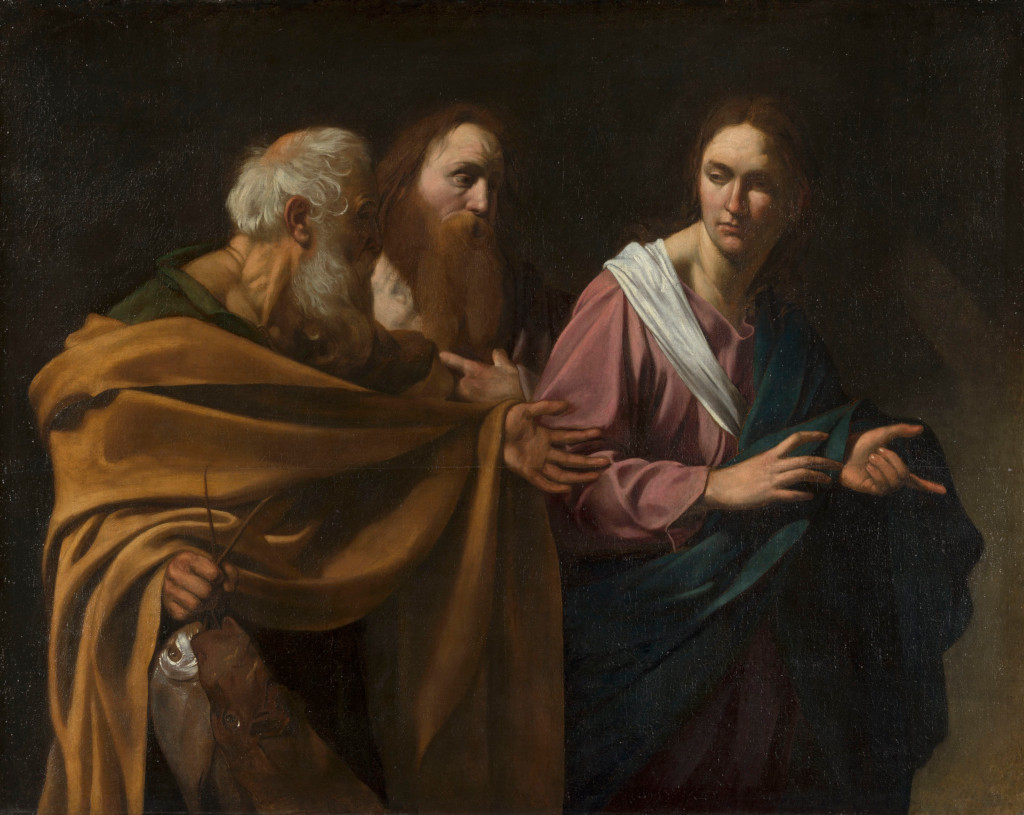
Caravaggio: The calling of Sts Peter and Andrew
The Calling of Saints Peter and Andrew” – the two brothers – by Caravaggio

*   *   *   *

Welcome to “read the Bible – expand your mind:”

The Book of Common Prayer says that by taking part in Holy Communion, Christians become “very members incorporate in the mystical body” of Jesus. The words “corporate” and “mystical” are key. They show that a healthy church has two sides, with the often-overlooked “mystic” side asking the question, “How do I experience God?” This blog tries to answer that.

It has four main themes. The first is that God will accept anyone. (John 6:37.) The second is that God wants us to live lives of abundance.(John 10:10.) The third is that Jesus wants us to read the Bible with an open mind. (As Luke 24:45 says: “Then He [Jesus] opened their minds so they could understand the Scriptures.”) The fourth theme – another one often overlooked – is that Jesus wants us to do even greater miracles than He did. (John 14:12.) 

And this thought ties them together:

The best way to live abundantly and do greater miracles than Jesus is: Read, study and apply the Bible with an open mind. For more see the notes or – to expand your mind – see the Intro.

In the meantime:

November 27, 2025 – This year Thanksgiving fell on Thursday, November 27th. Three days later comes the First Sunday of Advent and the feast of St Andrew. (Both on November 30, but officially “Andy’s Day” got transferred to Monday, December 1st, as detailed in the Notes.)

The First Sunday of Advent and St. Andrew’s Day also fell on the same Sunday back in November 2014. My post back then said Andrew was one of Jesus’ closest disciples, but few know much about him. So: He was St. Peter’s brother and is regularly mentioned after him, which suggests he was the younger brother. And like Peter and his partners James and John, Andrew was a fisherman on the Sea of Galilee. (One note: The name Andrew is Greek, which may reflect a “mixed Jewish-Gentile environment” in Galilee in the time of Jesus.)

He was one of four disciples closest to Jesus but seems to have been the least close of the four. That’s ironic because Andrew found Jesus before Peter. (He was an early disciple of John the Baptist who saw Jesus at the beginning of John’s Gospel: “From the Fourth Gospel we know [that] Andrew had previously been a disciple of John the Baptist: and this shows us that he was a man who was searching, who shared in Israel’s hope, who wanted to know better the word of the Lord, the presence of the Lord.”) And because he was first to find Jesus he is called the Protoclete or ‘First Called’ apostle.” On that note see John 1:35-42:

The next day John [the Baptist] was … with two of his disciples, when he saw Jesus walking by. “There is the Lamb of God!” he said. The two disciples heard him say this and went with Jesus. Jesus turned, saw them following him, and asked, “What are you looking for?” They answered, “Where do you live, Rabbi?” (This word means “Teacher.”) “Come and see,” he answered. (It was then about four o’clock in the afternoon.) So they went with him and saw where he lived, and spent the rest of that day with him. One of them was Andrew, Simon Peter’s brother. At once he found his brother Simon and told him, “We have found the Messiah.” (This word means “Christ.”) Then he took Simon to Jesus. 

So, you might say Andrew was sine qua non; “Without which there is none.” Then there’s his death: Early tradition told of his death at Patras, in Greece, where he too was crucified.   

At that supreme moment, however, like his brother Peter, he asked to be nailed to a cross different from the Cross of Jesus. In his case it was a diagonal or X-shaped cross, which has thus come to be known as “St Andrew’s cross.”

That x-shaped cross – called a Saltire – is a “heraldic symbol in the form of a diagonal cross, like the shape of the letter X in Roman typeSaint Andrew is said to have been martyred on such a cross.” See Saltire – Wikipedia, which added the Saltire is featured in national flags of Scotland and other countries. (Andrew is also the patron of Scotland, and of fishermen.)

The notes have more detail on him, but now a word or two about Advent. (I’ll write more about it in the coming weeks, in part because the next feast day doesn’t come until December 22 and St Thomas, Apostle; officially it’s the 21st but it too got transferred to the following Monday.)

For starters, Advent Sunday (the First Sunday of Advent) is the first day of the liturgical year in Western Christian churches. It marks the start of the season of Advent. The symbolism of the day is that Christ enters the church. Advent Sunday is also the fourth Sunday before Christmas Day, and the Sunday nearest St. Andrew’s Day, 30 November. (And the Sunday following the Feast of Christ the King.) Another thing to remember is that for those four Sundays of Advent, the Old Testament readings will be from the prophet Isaiah:

Isaiah is the prophet who guides our journey through Advent as we prepare for Christmas. Advent is a season of joyful anticipation, and Isaiah invites us to look forward to the coming of the Messiah, to prepare the way of the Lord.

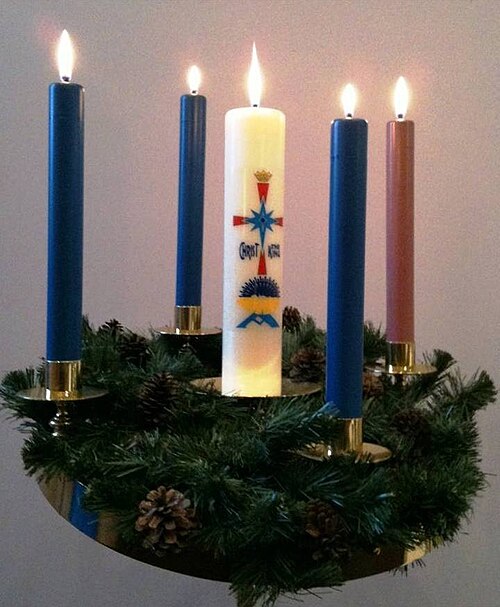
The theme of the season is getting ready for the Second Coming of Jesus and the Last Judgement, as reflected in the Sunday readings. The season’s liturgical color is violet (since the 13th century or so). Yet another tradition is the Advent Wreath, with three blue candles, one rose candle and a central “Christ Candle.” The candles are said to symbolize the stages of salvation before the Second Coming of Jesus, exemplified by 1) the forgiveness of Adam and Eve, 2) the faith of Abraham, 3) the joy of David and his lineage (leading to Jesus), and 4) the teaching of the prophets who announce a reign of justice and peace. (Let’s hope…)

So here’s wishing you a happy Advent – after you finish all those Thanksgiving leftovers…

*   *   *   *
*   *   *   *

The upper image is courtesy of Caravaggio: The calling of Sts Peter and Andrew – Art, which added:

A beardless Jesus gestures Peter (who was still called Simon at the time) and his brother Andrew to follow him: “Come ye after me, and I will make you to become fishers of men.” According to the gospel Peter and Andrew were out fishing on the lake when they were called. Caravaggio gives his own interpretation. Because of his prominence, the man on the left is thought to be Peter. It is only since 2006 that this painting is attributed to Caravaggio…

On the painting see also The Calling of Saints Peter and Andrew – Wikipedia.

The Book of Common Prayer reference: The “corporate-mystical” prayer is on page 339, the post-communion prayer for Holy Eucharist, Rite I.

Feast days are designated days on the liturgical (church) calendar “set aside to commemorate events, saints, or doctrines that are important in the life of the Church. These can range from Solemnities, which are the highest-ranking feast days like Easter and Christmas, to optional memorials that celebrate lesser-known saints.” Feast Days: Celebrating the Church’s Calendar.

On St. Andrew’s Day transferred to the following Monday, see Precedence, Rules of – The Episcopal Church: “Sunday takes precedence over all other feasts and observances of the church year. When a feast of our Lord or other major feast appointed cannot be observed because it occurs on a Sunday, the feast is normally transferred to the first convenient open day in the following week.”

For this post I borrowed from 2014’s St. Andrew, the “First Apostle,” 2016’s On Andrew – “First Apostle” – and Advent, On Advent 2022 – and St. Andrew, and On Advent 2023 – “Happy New (Liturgical) Year!”

The lower image is courtesy of Wikipedia on Advent. The full caption: “An Advent wreath with three blue candles and one rose candle surrounding the central Christ Candle.” The symbolism in full:

The candles symbolize, in one interpretation, the great stages of salvation before the coming of the Messiah; the first is the symbol of the forgiveness granted to Adam and Eve, the second is the symbol of the faith of Abraham and of the patriarchs who believe in the gift of the Promised Land, the third is the symbol of the joy of David whose lineage does not stop and also testifies to his covenant with God, and the fourth and last candle is the symbol of the teaching of the prophets who announce a reign of justice and peace. Alternatively, they symbolize the four stages of human history; creation, the Incarnation, the redemption of sins, and the Last Judgment.

*   *   *   *

As noted in the opening blurb, this blog has four main themes. The first is that God will accept anyone. (See John 6:37, with the added, “Anyone who comes to Him.”) This is a consistent theme throughout the Bible. From the Old Testament, Psalm 9:10, “You never forsake those who seek you, O Lord.” (In the Book of Common Prayer version.) The second is that God wants us to live abundantly.  (John 10:10.) The third is that we should do greater miracles than Jesus. (John 14:12). A fourth theme: The only way to do all that is read the Bible with an open mind:

…closed-mindedness, or an unwillingness to consider new ideas, can result from the brain’s natural dislike for ambiguity. According to this view, the brain has a “search and destroy” relationship with ambiguity and evidence contradictory to people’s current beliefs tends to make them uncomfortable… Research confirms that belief-discrepant-closed-minded persons have less tolerance for cognitive inconsistency

So in plain words, I take issue with what I call “Christian first graders.” Those who choose to stay in a kind of elementary-school first grade. See John the Baptist, ’24 – and “Christian First Graders,” for more. But the key point: “The Bible was designed to expand your mind,” not make it narrow. Also, there’s the idea that “Jesus was anything but negative. His goal was for you to grow and develop into all that you can be.” (For more on that see ABOUT THE BLOG, above.)

I’ve written on boot-camp Christians, the Literalists who never go “beyond the fundamentals.” But the Bible offers so much more than a narrow reading gives… (Unless you want to stay a buck private all your life…) Now, about “Boot-camp Christians” see Conservative Christian – “Career buck private?” The gist of that post: Starting the Bible is like Army Basic Training. You begin by“learning the fundamentals.” But after boot camp, you move on to Advanced Individual Training.” 

http://www.toywonders.com/productcart/pc/catalog/aw30.jpg

And as noted in “Buck private,” one of this blog’s themes is that if you want to be all that you can be, you need to go on and explore the “mystical side of Bible reading.*” In other words, exploring the mystical side of the Bible helps you “be all that you can be.” See Slogans of the U.S. Army – Wikipedia, re: the recruiting slogan from 1980 to 2001. The related image at left is courtesy of: “toywonders.com/productcart/pc/catalog/aw30.jpg.”

Re: “mystical.” Originally the “liturgical, spiritual, and contemplative dimensions of early and medieval Christianity.” Mysticism – Wikipedia, and the post On originalism.  (“What the Bible was originally about!”) See also Christian mysticism – Wikipedia, “In early Christianity the term ‘mystikos’ referred to three dimensions, which soon became intertwined, namely the biblical, the liturgical and the spiritual or contemplative… The third dimension is the contemplative or experiential knowledge of God.” As to that “experiential” aspect, see also Wesleyan Quadrilateral – Wikipedia, on the theological reflection method using four sources of spiritual development: scripturetradition, reason, and “Christian experience.”

For an explanation of the Daily Office – where “Dorscribe” came from – see What’s a DOR?

*   *   *   *

On Thanksgiving Day, 2025

*   *   *   *

Let’s hope that – in the name of Jesus – we can have such a Thanksgiving someday soon

*   *   *   *

November 16, 2025 – Thanksgiving is the next major feast day. (There’s a large gap between that holiday and the Halloween Triduum.) And as noted in past posts, the idea behind the holy-day feast goes back long before 1621, Plymouth Rock and the Pilgrims.

For Native Americans, “gathering to give thanks was already a familiar custom, taking place not just annually, but 13 times throughout the lunar, calendar year – a cycle known as the Thirteen Moons.” As one Wampanoag said, “Thanksgivings are a big part of our culture. Giving thanks is how we pray.” (The Wampanoag helped Pilgrims survive their first winter in 1620-21.)

And something else to remember: Of the 102 Mayflower Pilgrims who landed in December 1620, less than half survived the following winter that led to November 1621. And of the 18 adult women only four survived those 11 months. (“And you think today is bad?”) Anyway, it turns out there’s a good reason special days of thanksgiving have been around a long time. Research has shown that giving thanks can reduce pain, reduce depression and improve immunity and sleep. “As more researchers dig into the science of gratitude, they’ve found the feeling likely played a key role in helping our ancestors band together and survive.”

Gratitude is a powerful human emotion… [T]his simple practice can lead to profound positive changes in mood, resilience, and overall well-being… Gratitude can boost emotional resilience by focusing on positive things in life instead of toxic emotions like envy, jealousy, resentment, and anxiety.

In 1620 the Pilgrims just wanted to make it through another harsh New England winter.

But why did they leave the Old World to “The New” where less than half survived? For one thing the Pilgrims spent years in Holland trying to escape persecution from the Established Church in England. Yet while Holland had tolerance and security, there were troubling signs. Those signs included a threat of invasion by Spain (which then owned Holland as a colony) and also:

The Netherlands was … a land whose culture and language were strange and difficult for the English congregation to understand or learn. They found the Dutch morals much too libertine. Their children were becoming more and more Dutch as the years passed by. The congregation came to believe that they faced eventual extinction if they remained there. (Emphasis added.)

But after leaving England – finally – they faced a treacherous voyage across the North Atlantic, during which one member, John Howland, got swept overboard. So when the Mayflower finally landed at “Plymouth Rock” – at long last – William Bradford memorialized the event:

“Being thus arrived in a good harbor, and brought safe to land, they fell upon their knees and blessed the God of Heaven who had brought them over the vast and furious ocean, and delivered them from the perils and miseries thereof, again to set their feet on the firm and stable earth.” (Emphasis added.)

That was from Bradford’s classic book Of Plymouth Plantation, to which Wikipedia added that the “passengers who had endured miserable conditions for about sixty-five days were led by William Brewster in Psalm 100 as a prayer of thanksgiving.” And by the way, John Howland did more than survive after being swept overboard into that “vast and furious ocean.” He lived on to age 80 and ended up populat[ing] America with two million descendants

John and Elizabeth Howland founded one of the three largest Mayflower families and their descendants have been “associated largely with both the ‘Boston Brahmins‘ and Harvard’s ‘intellectual aristocracy’ of the nineteenth and twentieth centuries.” American actors Humphrey Bogart (1899-1957), Anthony Perkins (1932-1992), and Alec Baldwin (b. 1958) are counted among Howland’s descendants.

But we digress. Meanwhile, back to the Pilgrims. After landing at the tip of Cape Cod, then trying to find a good place to spend the winter, their ordeal was far from over. Most notably there was the risk of starvation: “The Pilgrims had no way of knowing that the ground would be frozen by the middle of November, making it impossible to do any planting.” The frozen ground and starving conditions led to disease, and as Wikipedia noted, “During the worst of the sickness, only six or seven of the group were able and willing to feed and care for the rest.” 

Also, the surviving colonists had to let the graves in the new cemetery “overgrow with grass for fear the Indians would discover how weakened the settlement had actually become.” On the other hand there was Squanto, a Patuxet Native American. He taught the Pilgrims how to catch eel and grow corn, and served as an interpreter. (He’d learned English during travels in England.)  “Additionally the Wampanoag leader Massasoit had donated food stores to the fledgling colony during the first winter when supplies brought from England were insufficient.”

So somehow the fledgling band of colonists survived, and celebrated their first Thanks-giving:

The first Thanksgiving feast lasted three days, providing enough food for 53 Pilgrims and 90 Native Americans.  The feast consisted of fish (cod, eels, and bass) and shellfish (clams, lobster, and mussels), wild fowl (ducks, geese, swans, and turkey), venison, berries and fruit, vegetables (peas, pumpkin, beetroot and possibly, wild or cultivated onion), harvest grains (barley and wheat), and the Three Sisters: beans, dried Indian maize or corn, and squash.

So get ready for your Thanksgiving dinner of eel, mussels and beetroot. And if you feel like giving thanks to the Lord but don’t know how to say it, see the full Lectionary readings at Thanksgiving Day for some ideas. Like “Almighty and gracious Father, we give you thanks for the fruits of the earth in their season and for the labors of those who harvest them.” Or “Rejoice in the Lord always; again I will say, Rejoice. Let your gentleness be known to everyone.”

Happy Thanksgiving!

*   *   *   *

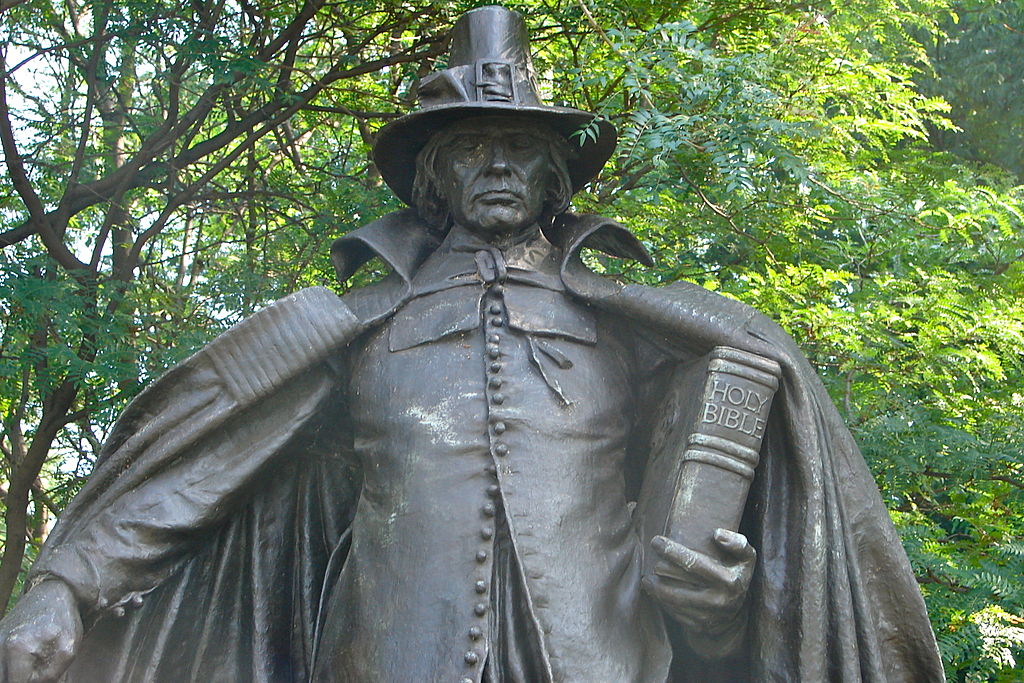
“Pilgrims never wore” such a hat – it’s part of the American Myth

*   *   *   *

The upper image is courtesy of Uncle Sam’s Thanksgiving Dinner By Thomas Nast – Image Results. See also Thanksgiving (United States) – Wikipedia.

The Book of Common Prayer reference: The “corporate-mystical” prayer is on page 339, the post-communion prayer for Holy Eucharist, Rite I.

Feast days are designated days on the liturgical (church) calendar “set aside to commemorate events, saints, or doctrines that are important in the life of the Church. These can range from Solemnities, which are the highest-ranking feast days like Easter and Christmas, to optional memorials that celebrate lesser-known saints.” Feast Days: Celebrating the Church’s Calendar.

For this post I borrowed from 2014’s On the first Thanksgiving – Part I, and On the first Thanksgiving – Part II, On Thanksgiving 2015, and On Thanksgiving – 2016. Also, more recently, On Thanksgiving 2022 – and an Unknown American Icon (which detailed John Howland’s full story), Between Halloween and Thanksgiving – 2023, Thanksgiving 2023 – and an “epileptic Rabbit Trail,” and On Judgment (Good or Bad) – and Thanksgiving 2024.

The Mayflower originally landed at the tip of Cape Cod, then tried to sail south to Virginia, but contrary winds forced them to turn back. For more see Plymouth Rock | Geology, Legend, History, & Facts | Britannica: “The rock, now much reduced from its original size thanks to damage from being moved and to the depredations of souvenir seekers, rests on the coast of Plymouth Bay… The Pilgrims – who made their first North American landfall on Cape Cod, not at Plymouth – did not mention any rocks in the earliest accounts of Plymouth colony. Plymouth Rock’s historic significance was not generally recognized until 1741, when Thomas Faunce spoke up to stop construction of a wharf that would have covered it. Faunce, then 94 years old, was the son of a settler who had arrived in Plymouth only three years after the Pilgrims.” 

The lower image is courtesy of The Puritan By Augustus St. Gaudens, – Image Results. The Wikipedia article on Thanksgiving included this caption about the statue: “The ‘buckle hat’ atop the sculpture’s head, now associated with the Pilgrims in pop culture, was fictional; Pilgrims never wore such an item, nor has any such hat ever existed as a serious piece of apparel.” See also – on the “American Myth” cite – The 40 Most Enduring Myths in American History — Best Life. Number 16 said, “Pretty much everything you know about Thanksgiving isn’t true… The real story involves plagues, and Pilgrims showing up because they thought the Native Americans were sick or dead, so it’d be easy to steal their food.” (Not so Kumbaya.)

*   *   *   *

On 2025’s “Halloween Triduum…”

*   *   *   *

“A graveyard outside a Lutheran church in Röke, Sweden on the feast of All Hallows…”

*   *   *   *

November 1, 2025 – We call it “Halloween,” but few know the October 31 Eve is just one of three days called the Halloween “Triduum.” (Meaning three days.) It’s also called Allhallowtide:

The word Allhallowtide was first used in 1471, and is derived from three words: the Old English word hallow, meaning ‘holy’, the word tide, meaning ‘time’ or ‘season’ [see Eastertide or Christmastide] and all (from Old English eall) meaning “every.” The latter part of the word Hallowmas is derived from the word Mass. The words hallow and saint are synonyms.

And speaking of Old English, its word for “saint” was halig, which as an adjective meant holy or sacred. It eventually became “hallow” – as easier to say? – which led to the main triduum event, All Hallows’ Day, November 1. (What we now call “All Saints’ Day.”) And since the night before a big day is often called its evening or “eve” – think Christmas Eve – the full old-timey name for the night before November 1 was All Hallows’ Evening. (Or “Eve.”) In time that got shortened to All Hallows’ E’en, then to Hallows’ E’en – dropping the “all” – and finally just “Halloween.”

So much for etymology, but what about all those weird things people do on All Hallows’ E’en? And what’s it all about anyway? Is it just an excuse for wearing crazy costumes, getting lots of candy or watching really creepy movies, as so many seem to think?

Actually, Wikipedia said the three days are times “to remember the dead, including martyrs, saints, and all faithful departed Christians.” The main day of the three is November 1, now called All Saints Day, but previously called Hallowmas. It was established sometime between 731 and 741 – over 1,300 years ago – “perhaps by Pope Gregory III.”

Put another way, November 1 honors “all the saints and martyrs, both known and unknown.” In other words, special people in the Church. (A saint is defined as one “having an exceptional degree of holiness,” while a martyr is someone “killed because of their testimony of Jesus.”) On the other hand, November 2 – All Souls’ Day – was designed to honor “all faithful Christians … unknown in the wider fellowship of the church, especially family members and friends.’” In other words, the rest of us poor schmucks. (That is, those who have gone on before.) Also, consider this:

Given that many Christian cemeteries are interdenominational in nature, All Souls Day observances often have an ecumenical dimension, with believers from various Christian denominations praying together and cooperating to adorn graves.

Another note: Ecumenism means that Christians even from far different denominations “should work together to develop closer relationships among their churches and promote Christian unity.” Which would be a nice change of pace for this year’s November 2.

But again, what about all those strange “Eve of All Hallow’s” customs? It seems they started with the old-time idea that evil spirits were strongest during the long nights of winter. And that on the night of October 31 the “barriers between our world and the spirit world” were at their most permeable; the barrier between this world and the next was at is lowest point. Which brings up the masks and costumes that are a big part of Halloween. In the old days people wore masks or costumes to disguise their identities. The idea was to keep the ghosts or spirits – coming from the netherworld – “from recognizing live people in this ‘material world.’”

The same is true of bonfires; literally bonefires, fires where bones were burned. One idea? Evil spirits could be driven away with fire and noise. Also, old-timers thought the fires brought comfort to “souls in purgatory and people prayed for them as they held burning straw up high.”

Then there are those pumpkins. Some other old-time people set out carved pumpkins on their windowsills to keep “harmful spirits” out of their home. But yet another tradition said  jack-o’-lanterns “represented Christian souls in purgatory.” And while today jack-o’-lanterns are made from pumpkins, they were originally carved from large turnips.

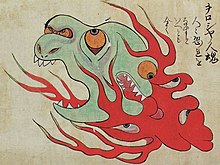
In turn, both the jack-o’-lantern and Will-o’-the-wisp – see a Japanese interpretation at right – are tied in with the strange ghostly light known as ignis fatuus(From the Medieval Latin for “foolish fire.”) That refers to the “atmospheric ghost light seen by travelers at night, especially over bogs, swamps or marshes. It resembles a flickering lamp and is said to recede if approached:”

Tradition had it that this ghostly light – seen by travelers at night and “especially over bogs, swamps or marshes – resembled a flickering lamp. The flickering lamp then receded if you approached it, and so it “drew travelers from their safe paths,” to their doom…

And about traveling on All Hallows E’en. (Holding a candle.) If you hiked from 11:00 p.m. until midnight, your had to be careful. If your candle kept burning, that was a good omen. (The traveler would be safe in the upcoming “season of darkness.”) But if the candle went out, “the omen was bad indeed.” (The thought was that the candle had been blown out by witches…)

But once again, the Halloween Triduum officially ends on November 2, All Souls’ Day. The idea iss to remember the souls of the dear departed, illustrated by the painting below. Good Christians remember deceased relatives on the day, and – in many churches – the following Sunday includes a memorial service for those who died in the past year. Which should make for the Good News of Halloween. Accordingly, here’s wishing you:

A Happy “All Hallow’s Triduum!”

*   *   *   *

Three Days of Halloween” end November 2, with All Souls’ Day …

*   *   *   *

The upper image is courtesy of Allhallowtide – Wikipedia, with the caption:  “A graveyard outside a Lutheran church in Röke, Sweden on the feast of All Hallows. Flowers and lighted candles are placed by relatives on the graves of their deceased loved ones.”

The Book of Common Prayer reference: The “corporate-mystical” prayer is on page 339, the post-communion prayer for Holy Eucharist, Rite I.

Feast days are designated days on the liturgical (church) calendar “set aside to commemorate events, saints, or doctrines that are important in the life of the Church. These can range from Solemnities, which are the highest-ranking feast days like Easter and Christmas, to optional memorials that celebrate lesser-known saints.” Feast Days: Celebrating the Church’s Calendar.

For this post I borrowed from 2018’s The THREE days of Hallowe’en, The Halloween Triduum – 2019, On the Hallowe’en “Triduum” – 2021, and On Halloween 2023 – and a Sheol “rabbit trail.”

The lower image is courtesy of All Souls’ Day – Wikipedia.  The caption: “All Souls’ Day by William Bouguereau.” See also Allhallowtide, and All Saints’ Day – Wikipedia.

*   *   *   *