* * * *

* * * *
November 1, 2025 – We call it “Halloween,” but few know the October 31 Eve is just one of three days called the Halloween “Triduum.” (Meaning three days.) It’s also called Allhallowtide:
The word Allhallowtide was first used in 1471, and is derived from three words: the Old English word hallow, meaning ‘holy’, the word tide, meaning ‘time’ or ‘season’ [see Eastertide or Christmastide] and all (from Old English eall) meaning “every.” The latter part of the word Hallowmas is derived from the word Mass. The words hallow and saint are synonyms.
And speaking of Old English, its word for “saint” was halig, which as an adjective meant holy or sacred. It eventually became “hallow” – as easier to say? – which led to the main triduum event, All Hallows’ Day, November 1. (What we now call “All Saints’ Day.”) And since the night before a big day is often called its evening or “eve” – think Christmas Eve – the full old-timey name for the night before November 1 was All Hallows’ Evening. (Or “Eve.”) In time that got shortened to All Hallows’ E’en, then to Hallows’ E’en – dropping the “all” – and finally just “Halloween.”
So much for etymology, but what about all those weird things people do on All Hallows’ E’en? And what’s it all about anyway? Is it just an excuse for wearing crazy costumes, getting lots of candy or watching really creepy movies, as so many seem to think?
Actually, Wikipedia said the three days are times “to remember the dead, including martyrs, saints, and all faithful departed Christians.” The main day of the three is November 1, now called All Saints Day, but previously called Hallowmas. It was established sometime between 731 and 741 – over 1,300 years ago – “perhaps by Pope Gregory III.”
Put another way, November 1 honors “all the saints and martyrs, both known and unknown.” In other words, special people in the Church. (A saint is defined as one “having an exceptional degree of holiness,” while a martyr is someone “killed because of their testimony of Jesus.”) On the other hand, November 2 – All Souls’ Day – was designed to honor “all faithful Christians … unknown in the wider fellowship of the church, especially family members and friends.’” In other words, the rest of us poor schmucks. (That is, those who have gone on before.) Also, consider this:
Given that many Christian cemeteries are interdenominational in nature, All Souls Day observances often have an ecumenical dimension, with believers from various Christian denominations praying together and cooperating to adorn graves.
Another note: Ecumenism means that Christians even from far different denominations “should work together to develop closer relationships among their churches and promote Christian unity.” Which would be a nice change of pace for this year’s November 2.
But again, what about all those strange “Eve of All Hallow’s” customs? It seems they started with the old-time idea that evil spirits were strongest during the long nights of winter. And that on the night of October 31 the “barriers between our world and the spirit world” were at their most permeable; the barrier between this world and the next was at is lowest point. Which brings up the masks and costumes that are a big part of Halloween. In the old days people wore masks or costumes to disguise their identities. The idea was to keep the ghosts or spirits – coming from the netherworld – “from recognizing live people in this ‘material world.’”
The same is true of bonfires; literally bonefires, fires where bones were burned. One idea? Evil spirits could be driven away with fire and noise. Also, old-timers thought the fires brought comfort to “souls in purgatory and people prayed for them as they held burning straw up high.”
Then there are those pumpkins. Some other old-time people set out carved pumpkins on their windowsills to keep “harmful spirits” out of their home. But yet another tradition said jack-o’-lanterns “represented Christian souls in purgatory.” And while today jack-o’-lanterns are made from pumpkins, they were originally carved from large turnips.
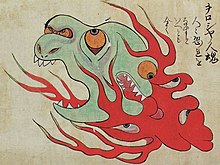
In turn, both the jack-o’-lantern and Will-o’-the-wisp – see a Japanese interpretation at right – are tied in with the strange ghostly light known as ignis fatuus. (From the Medieval Latin for “foolish fire.”) That refers to the “atmospheric ghost light seen by travelers at night, especially over bogs, swamps or marshes. It resembles a flickering lamp and is said to recede if approached:”
Tradition had it that this ghostly light – seen by travelers at night and “especially over bogs, swamps or marshes – resembled a flickering lamp. The flickering lamp then receded if you approached it, and so it “drew travelers from their safe paths,” to their doom…
And about traveling on All Hallows E’en. (Holding a candle.) If you hiked from 11:00 p.m. until midnight, your had to be careful. If your candle kept burning, that was a good omen. (The traveler would be safe in the upcoming “season of darkness.”) But if the candle went out, “the omen was bad indeed.” (The thought was that the candle had been blown out by witches…)
But once again, the Halloween Triduum officially ends on November 2, All Souls’ Day. The idea iss to remember the souls of the dear departed, illustrated by the painting below. Good Christians remember deceased relatives on the day, and – in many churches – the following Sunday includes a memorial service for those who died in the past year. Which should make for the Good News of Halloween. Accordingly, here’s wishing you:
A Happy “All Hallow’s Triduum!”
* * * *

* * * *
The upper image is courtesy of Allhallowtide – Wikipedia, with the caption: “A graveyard outside a Lutheran church in Röke, Sweden on the feast of All Hallows. Flowers and lighted candles are placed by relatives on the graves of their deceased loved ones.”
The Book of Common Prayer reference: The “corporate-mystical” prayer is on page 339, the post-communion prayer for Holy Eucharist, Rite I.
Feast days are designated days on the liturgical (church) calendar “set aside to commemorate events, saints, or doctrines that are important in the life of the Church. These can range from Solemnities, which are the highest-ranking feast days like Easter and Christmas, to optional memorials that celebrate lesser-known saints.” Feast Days: Celebrating the Church’s Calendar.
* * * *