* * * *
* * * *
Welcome to “read the Bible – expand your mind:”
The Book of Common Prayer says that by taking part in Holy Communion, Christians become “very members incorporate in the mystical body” of Jesus. The words “corporate” and “mystical” are key. They show that a healthy church has two sides, with the often-overlooked “mystic” side asking the question, “How do I experience God?” This blog tries to answer that.
It has four main themes. The first is that God will accept anyone. (John 6:37.) The second is that God wants us to live lives of abundance.(John 10:10.) The third is that Jesus wants us to read the Bible with an open mind. (As Luke 24:45 says: “Then He [Jesus] opened their minds so they could understand the Scriptures.”) The fourth theme – another one often overlooked – is that Jesus wants us to do even greater miracles than He did. (John 14:12.)
And this thought ties them together:
The best way to live abundantly and do greater miracles than Jesus is: Read, study and apply the Bible with an open mind. For more see the notes or – to expand your mind – see the Intro.
In the meantime:
March 19, 2026 – From today’s Daily Office: “You who seek God, your heart shall live.”
A pretty good thing to remember in this time of Lent, preparing for a joyous Easter Sunday on April 5. (To go along with John 6:37 and Romans 10:9.) I read that just this morning, part of the Daily Office readings. Specifically, Psalm 69:32. (“You could look it up!”)
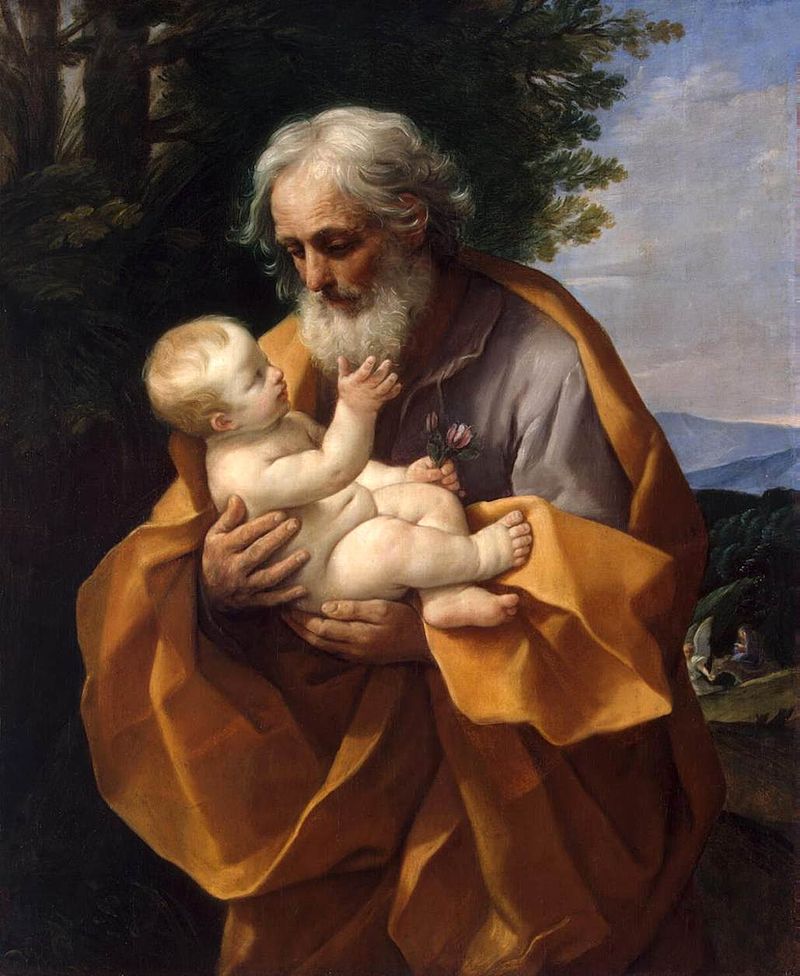
But seriously, on Thursday, March 19, we celebrate the Feast of St Joseph, “earthly” father-figure of Jesus. Two days before that, on Tuesday, March 17, we celebrated another saint, St. Patrick, and it seems like a whole lot more people know and celebrate his day, maybe because of the Green Beer? (The “minor” festival is the far better-known of the two.) I wrote about these two saints in 2015’s St. Paddy and St. Joe, and 2016’s St. Joseph and the “Passover Plot.”
A note: The Passover Plot is a 1965 book by Hugh Schonfield saying the Crucifixion was a “conscious attempt by Jesus to fulfill the Messianic expectations rampant in his time,” but the plan went unexpectedly wrong. (Jesus really died.) And the book was made into a movie in 1976:
Dramatization of the controversial best-seller that posits an alternate version of the birth of Christianity. In this version, Jesus planned for His crucifixion by taking a drug that would simulate death. After His unconscious body was placed in the tomb, a religious sect known as the Zealots would secretly steal Christ’s body from the tomb, then spread the rumor that He had risen, thus fulfilling Biblical prophecy.
Needless to say, the book created quite a stir. One site said it was “lucidly written and carefully documented, but As For Me and My House, I’ve always felt that personal faith is not a matter of scientific proof. Faith is more a matter of the ongoing interactive walk to Jesus. Then there’s the Wesleyan Quadrilateral, that apart from scripture, “experience is the most substantial proof of Christianity.” And my 74 years of experience has convinced me of the truth of Romans 10:9.
But getting back to Joseph: “Whatever happened to him?” For possible answers check out Question of Faith: What happened to St. Joseph – Catholic Telegraph, or – for a lot of Bible passages – What ever happened to Joseph, Jesus’ stepfather? One thing we do know: Joseph is the patron saint of workers – specifically, carpenters – along with fathers in general and “the dying.” (Those at or approaching death.) See also St. Joseph – Saints & Angels – Catholic Online, which added that assuming he died before Jesus’ public life, he died with Jesus and Mary close to him, “the way we all would like to leave this earth.” And this:
Christian tradition places Joseph as Jesus‘ foster father [but] represents Mary as a widow during the adult ministry of her son. Joseph is not mentioned [at] the Wedding at Cana at the beginning of Jesus’ mission, nor at the Passion at the end. If he had been present at the Crucifixion, he would under Jewish custom have been expected to take charge of Jesus’ body, but this role is instead performed by Joseph of Arimathea. Nor would Jesus have entrusted his mother to the care of John the Apostle if her husband was alive.
Now a bit about St. Patrick. We don’t know when he was born, but he is said to have died on March 17, now celebrated as his Feast Day. (And in Irish his name would be Padraig.) And about the celebration, see How America Invented St. Patrick’s Day | TIME: “Immigration and nativism transformed a quiet religious celebration into a day of raucous parades and shamrock shakes.” And that transformation began in America. In Ireland – up to about 1904 – March 17 was a “quiet day with no parades or public events.” But in America the holiday became a means for all Americans to become Irish for the day. “It’s the closest thing in America to National Immigrant Day, a tribute not only to the Irish, but to the idea that Americans are all part “other.” (Emphasis added.) Or as Jesus said “that we all may be one.”
In honor of those noble sentiments, I believe I’ll go out tonight and hoist a pint.
* * * *

* * * *
The upper image is courtesy of Saint Joseph – Wikipedia, which also noted that the “Pauline epistles make no reference to Jesus’ father; nor does the Gospel of Mark.” The caption for the painting: “Saint Joseph with the Infant Jesus, Guido Reni (c. 1635).”
The Book of Common Prayer reference: The “corporate-mystical” prayer is on page 339, the post-communion prayer for Holy Eucharist, Rite I.
The Daily Office readings for today included “AM Psalm 69:1-23(24-30)31-38; PM Psalm 73; Exod. 1:6-22; 1 Cor. 12:12-26;” and Mark 8:27-9:1. Also the readings for St. Joseph: “AM: Psalm 132; Isaiah 63:7-16; Matthew 1:18-25[;] PM: Psalm 34; 2 Chronicles 6:12-17; Ephesians 3:14-21.” A note: I read that in the Book of Common Prayer psaltery. There it’s the second line of Psalm 69:34.
Feast days are designated days on the liturgical (church) calendar “set aside to commemorate events, saints, or doctrines that are important in the life of the Church. These can range from Solemnities, which are the highest-ranking feast days like Easter and Christmas, to optional memorials that celebrate lesser-known saints.” Feast Days: Celebrating the Church’s Calendar.
The lower image is courtesy of Green Beer St Patrick’s Day – Image Results. One page explained that Green Beer is an American invention, not Irish. “Thomas Curtin was an American physician and the man credited with the invention of green beer. He made green beer for a St. Patrick’s Day party at the Schenerer Club of Morrisania located in the Bronx in 1914 and the rest is history.”
Here’s the scoop – the Irish, in their homeland, don’t typically go for green beer. They have a rich tradition of stouts, ales, and lagers that don’t need a hue change. In my years behind the bar, I’ve had my fair share of Irish patrons shaking their heads at the sight of the neon green concoctions… For those who want to keep it authentic, there’s a treasure trove of traditional Irish beers to explore. Guinness, Murphy’s Stout, and Smithwick’s Red Ale are staples on St Patrick’s Day. These brews carry the spirit of the Emerald Isle, and let me tell you, serving a perfectly poured Guinness on St Paddy’s Day feels like winning a pot of gold.
And a note on the name “Paddy” as an alternate to “Patty,” for Patrick. Some sources say it’s a slur, other say it’s a cause for pride. See Negative terms used to describe Irish everywhere – IrishCentral, ” More common in Britain, where ‘Paddy’ was used as a derogatory catch-all name to describe anyone male and Irish.” Or this, Origin of the Name Paddy (Complete History) – Lets Learn Slang: ” The origins of Paddy can be traced back to Ireland, where it holds a special place in the hearts of the Irish people. This name not only acts as a shorthand for the popular Irish name Patrick, but it also carries a sense of identity and pride.” Urban Dictionary: paddy wagon, about the “police vehicle used to transport prisoners.” Finally, paddy wagon — Wordorigins.org: “A paddywagon is a police van used to transport criminals. The name is commonly thought to come from an association with the Irish, because in the nineteenth and early twentieth centuries a disproportionately large number of Irish were police in North American cities.”
* * * *
As noted in the opening blurb, this blog has four main themes. The first is that God will accept anyone. (See John 6:37, with the added, “Anyone who comes to Him.”) This is a consistent theme throughout the Bible. From the Old Testament, Psalm 9:10, “You never forsake those who seek you, O Lord.” (In the Book of Common Prayer version.) The second is that God wants us to live abundantly. (John 10:10.) The third is that we should do greater miracles than Jesus. (John 14:12). A fourth theme: The only way to do all that is read the Bible with an open mind:
…closed-mindedness, or an unwillingness to consider new ideas, can result from the brain’s natural dislike for ambiguity. According to this view, the brain has a “search and destroy” relationship with ambiguity and evidence contradictory to people’s current beliefs tends to make them uncomfortable… Research confirms that belief-discrepant-closed-minded persons have less tolerance for cognitive inconsistency…
So in plain words, I take issue with what I call “Christian first graders.” Those who choose to stay in a kind of elementary-school first grade. See John the Baptist, ’24 – and “Christian First Graders,” for more. But the key point: “The Bible was designed to expand your mind,” not make it narrow. Also, there’s the idea that “Jesus was anything but negative. His goal was for you to grow and develop into all that you can be.” (For more on that see ABOUT THE BLOG, above.)
I’ve written on boot-camp Christians, the Literalists who never go “beyond the fundamentals.” But the Bible offers so much more than a narrow reading gives… (Unless you want to stay a buck private all your life…) Now, about “Boot-camp Christians” see Conservative Christian – “Career buck private?” The gist of that post: Starting the Bible is like Army Basic Training. You begin by“learning the fundamentals.” But after boot camp, you move on to Advanced Individual Training.”

And as noted in “Buck private,” one of this blog’s themes is that if you want to be all that you can be, you need to go on and explore the “mystical side of Bible reading.*” In other words, exploring the mystical side of the Bible helps you “be all that you can be.” See Slogans of the U.S. Army – Wikipedia, re: the recruiting slogan from 1980 to 2001. The related image at left is courtesy of: “toywonders.com/productcart/pc/catalog/aw30.jpg.”
Re: “mystical.” Originally the “liturgical, spiritual, and contemplative dimensions of early and medieval Christianity.” Mysticism – Wikipedia, and the post On originalism. (“What the Bible was originally about!”) See also Christian mysticism – Wikipedia, “In early Christianity the term ‘mystikos’ referred to three dimensions, which soon became intertwined, namely the biblical, the liturgical and the spiritual or contemplative… The third dimension is the contemplative or experiential knowledge of God.” As to that “experiential” aspect, see also Wesleyan Quadrilateral – Wikipedia, on the theological reflection method using four sources of spiritual development: scripture, tradition, reason, and “Christian experience.”
For an explanation of the Daily Office – where “Dorscribe” came from – see What’s a DOR?
* * * *