* * * *

* * * *
November 16, 2025 – Thanksgiving is the next major feast day. (There’s a large gap between that holiday and the Halloween Triduum.) And as noted in past posts, the idea behind the holy-day feast goes back long before 1621, Plymouth Rock and the Pilgrims.
For Native Americans, “gathering to give thanks was already a familiar custom, taking place not just annually, but 13 times throughout the lunar, calendar year – a cycle known as the Thirteen Moons.” As one Wampanoag said, “Thanksgivings are a big part of our culture. Giving thanks is how we pray.” (The Wampanoag helped Pilgrims survive their first winter in 1620-21.)
And something else to remember: Of the 102 Mayflower Pilgrims who landed in December 1620, less than half survived the following winter that led to November 1621. And of the 18 adult women only four survived those 11 months. (“And you think today is bad?”) Anyway, it turns out there’s a good reason special days of thanksgiving have been around a long time. Research has shown that giving thanks can reduce pain, reduce depression and improve immunity and sleep. “As more researchers dig into the science of gratitude, they’ve found the feeling likely played a key role in helping our ancestors band together and survive.”
Gratitude is a powerful human emotion… [T]his simple practice can lead to profound positive changes in mood, resilience, and overall well-being… Gratitude can boost emotional resilience by focusing on positive things in life instead of toxic emotions like envy, jealousy, resentment, and anxiety.
In 1620 the Pilgrims just wanted to make it through another harsh New England winter.
But why did they leave the Old World to “The New” where less than half survived? For one thing the Pilgrims spent years in Holland trying to escape persecution from the Established Church in England. Yet while Holland had tolerance and security, there were troubling signs. Those signs included a threat of invasion by Spain (which then owned Holland as a colony) and also:
The Netherlands was … a land whose culture and language were strange and difficult for the English congregation to understand or learn. They found the Dutch morals much too libertine. Their children were becoming more and more Dutch as the years passed by. The congregation came to believe that they faced eventual extinction if they remained there. (Emphasis added.)
But after leaving England – finally – they faced a treacherous voyage across the North Atlantic, during which one member, John Howland, got swept overboard. So when the Mayflower finally landed at “Plymouth Rock” – at long last – William Bradford memorialized the event:
“Being thus arrived in a good harbor, and brought safe to land, they fell upon their knees and blessed the God of Heaven who had brought them over the vast and furious ocean, and delivered them from the perils and miseries thereof, again to set their feet on the firm and stable earth.” (Emphasis added.)
That was from Bradford’s classic book Of Plymouth Plantation, to which Wikipedia added that the “passengers who had endured miserable conditions for about sixty-five days were led by William Brewster in Psalm 100 as a prayer of thanksgiving.” And by the way, John Howland did more than survive after being swept overboard into that “vast and furious ocean.” He lived on to age 80 and ended up populat[ing] America with two million descendants.
John and Elizabeth Howland founded one of the three largest Mayflower families and their descendants have been “associated largely with both the ‘Boston Brahmins‘ and Harvard’s ‘intellectual aristocracy’ of the nineteenth and twentieth centuries.” American actors Humphrey Bogart (1899-1957), Anthony Perkins (1932-1992), and Alec Baldwin (b. 1958) are counted among Howland’s descendants.
But we digress. Meanwhile, back to the Pilgrims. After landing at the tip of Cape Cod, then trying to find a good place to spend the winter, their ordeal was far from over. Most notably there was the risk of starvation: “The Pilgrims had no way of knowing that the ground would be frozen by the middle of November, making it impossible to do any planting.” The frozen ground and starving conditions led to disease, and as Wikipedia noted, “During the worst of the sickness, only six or seven of the group were able and willing to feed and care for the rest.”
Also, the surviving colonists had to let the graves in the new cemetery “overgrow with grass for fear the Indians would discover how weakened the settlement had actually become.” On the other hand there was Squanto, a Patuxet Native American. He taught the Pilgrims how to catch eel and grow corn, and served as an interpreter. (He’d learned English during travels in England.) “Additionally the Wampanoag leader Massasoit had donated food stores to the fledgling colony during the first winter when supplies brought from England were insufficient.”
So somehow the fledgling band of colonists survived, and celebrated their first Thanks-giving:
The first Thanksgiving feast lasted three days, providing enough food for 53 Pilgrims and 90 Native Americans. The feast consisted of fish (cod, eels, and bass) and shellfish (clams, lobster, and mussels), wild fowl (ducks, geese, swans, and turkey), venison, berries and fruit, vegetables (peas, pumpkin, beetroot and possibly, wild or cultivated onion), harvest grains (barley and wheat), and the Three Sisters: beans, dried Indian maize or corn, and squash.
So get ready for your Thanksgiving dinner of eel, mussels and beetroot. And if you feel like giving thanks to the Lord but don’t know how to say it, see the full Lectionary readings at Thanksgiving Day for some ideas. Like “Almighty and gracious Father, we give you thanks for the fruits of the earth in their season and for the labors of those who harvest them.” Or “Rejoice in the Lord always; again I will say, Rejoice. Let your gentleness be known to everyone.”
Happy Thanksgiving!
* * * *
* * * *
The upper image is courtesy of Uncle Sam’s Thanksgiving Dinner By Thomas Nast – Image Results. See also Thanksgiving (United States) – Wikipedia.
The Book of Common Prayer reference: The “corporate-mystical” prayer is on page 339, the post-communion prayer for Holy Eucharist, Rite I.
Feast days are designated days on the liturgical (church) calendar “set aside to commemorate events, saints, or doctrines that are important in the life of the Church. These can range from Solemnities, which are the highest-ranking feast days like Easter and Christmas, to optional memorials that celebrate lesser-known saints.” Feast Days: Celebrating the Church’s Calendar.
For this post I borrowed from 2014’s On the first Thanksgiving – Part I, and On the first Thanksgiving – Part II, On Thanksgiving 2015, and On Thanksgiving – 2016. Also, more recently, On Thanksgiving 2022 – and an Unknown American Icon (which detailed John Howland’s full story), Between Halloween and Thanksgiving – 2023, Thanksgiving 2023 – and an “epileptic Rabbit Trail,” and On Judgment (Good or Bad) – and Thanksgiving 2024.
The Mayflower originally landed at the tip of Cape Cod, then tried to sail south to Virginia, but contrary winds forced them to turn back. For more see Plymouth Rock | Geology, Legend, History, & Facts | Britannica: “The rock, now much reduced from its original size thanks to damage from being moved and to the depredations of souvenir seekers, rests on the coast of Plymouth Bay… The Pilgrims – who made their first North American landfall on Cape Cod, not at Plymouth – did not mention any rocks in the earliest accounts of Plymouth colony. Plymouth Rock’s historic significance was not generally recognized until 1741, when Thomas Faunce spoke up to stop construction of a wharf that would have covered it. Faunce, then 94 years old, was the son of a settler who had arrived in Plymouth only three years after the Pilgrims.”
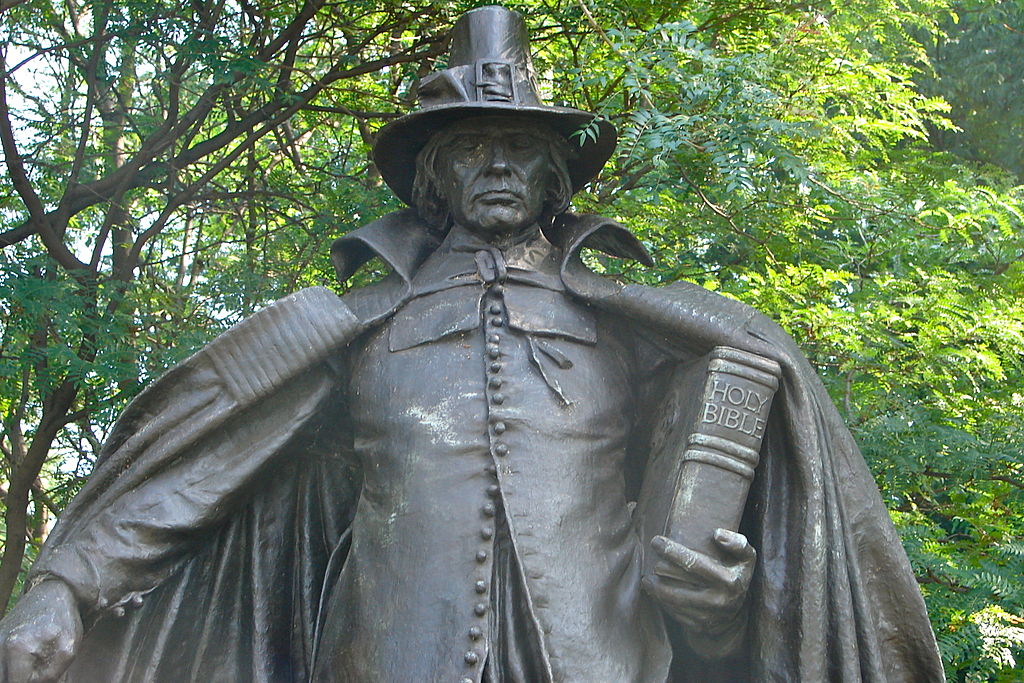
The lower image is courtesy of The Puritan By Augustus St. Gaudens, – Image Results. The Wikipedia article on Thanksgiving included this caption about the statue: “The ‘buckle hat’ atop the sculpture’s head, now associated with the Pilgrims in pop culture, was fictional; Pilgrims never wore such an item, nor has any such hat ever existed as a serious piece of apparel.” See also – on the “American Myth” cite – The 40 Most Enduring Myths in American History — Best Life. Number 16 said, “Pretty much everything you know about Thanksgiving isn’t true… The real story involves plagues, and Pilgrims showing up because they thought the Native Americans were sick or dead, so it’d be easy to steal their food.” (Not so Kumbaya.)
* * * *