* * * *
* * * *
September 20, 2025 – As indicated in the last post, September 21 is normally the feast day for St Matthew, Evangelist. But this year it’s like Holy Cross Day, because this year it too also fell on a Sunday. Meaning that – like Holy Cross Day – it too was transferred to the following Monday. (This year St. Matthew’s day will be celebrated on September 22.)
With that out of the way, we can begin his story with Matthew 9:9-13:
As Jesus went on from there [Capernaum], he saw a man named Matthew sitting at the tax collector’s booth. “Follow me,” he told him, and Matthew got up and followed him. While Jesus was having dinner at Matthew’s house, many tax collectors and sinners came and ate with him and his disciples. When the Pharisees saw this, they asked his disciples, “Why does your teacher eat with tax collectors and sinners?” On hearing this, Jesus said, “It is not the healthy who need a doctor, but the sick. But go and learn what this means: ‘I desire mercy, not sacrifice.’ For I have not come to call the righteous, but sinners.”
Which turned out to be good news for pretty much all of us, because in Jesus’ time tax collectors were “lower than dirt.” That is, in His time tax collectors were social outcasts. “Devout Jews avoided them because they were usually dishonest (the job carried no salary, and they were expected to make their profits by cheating the people from whom they collected taxes).”
Thus, throughout the Gospels, we find tax collectors (publicans) mentioned as a standard type of sinful and despised outcast. Matthew brought many of his former associates to meet Jesus, and social outcasts in general were shown that the love of Jesus extended even to them.
Get that? “The love of Jesus extended even to them.” (For more see Tax collector – Wikipedia.) And as noted in 2014’s On St. Matthew, a tax collector like Matthew was “sure to be hated above all men as a merciless leech who would take the shirt off a dying child.” Further, in Jesus’ time “the word ‘publican’” – or tax collector – was “used as representing an extreme of wickedness in the Sermon on the Mount.” In plain words tax collectors worked for Rome’s forces of occupation and so were viewed as collaborators, “Quislings,” and traitors to their country:
Tax collectors, also known as publicans, are mentioned many times in the Bible (mainly in the New Testament). They were reviled by the Jews of Jesus’ day because of their greed and collaboration with the Roman occupiers. Tax collectors amassed personal wealth by demanding tax payments in excess of what Rome levied and keeping the difference. They worked for tax farmers. In the Gospel of Luke, Jesus sympathizes with the tax collector Zacchaeus, causing outrage from the crowds that Jesus would rather be the guest of a sinner than of a more respectable or “righteous” person.
So what’s the good news in all this? Just that by accepting the forgiveness and grace offered by Jesus, Matthew the hated tax-collecting, collaborating Quisling got magically transformed. Magically transformed into a Gospel writer of the first magnitude, much like Saul, who got magically transformed into Paul through his Damascus Road Experience. (Where he was changed from an enemy of the early Church to its foremost spokesman.)
Which means that “if those two could be so magically transformed, so can we!”
Or as a biographer wrote of Thomas Merton, he was an ordinary man with more than his fair share of human faults, but it was just such “base metal which, in the marvelous alchemy of the spiritual journey, became transmuted into gold.” Or transformed, like it says in Philippians 3:21, on Jesus, “who will transform our lowly body that it may be conformed to His glorious body.”
Which brings up a point. I Googled “transfigure synonyms” and at the top got “transform into something more beautiful or elevated.” And isn’t that what Jesus wants? So don’t stay in your spiritual cocoon. Get transformed from a creepy-crawly caterpillar into “high-flying mode.”
* * * *

* * * *
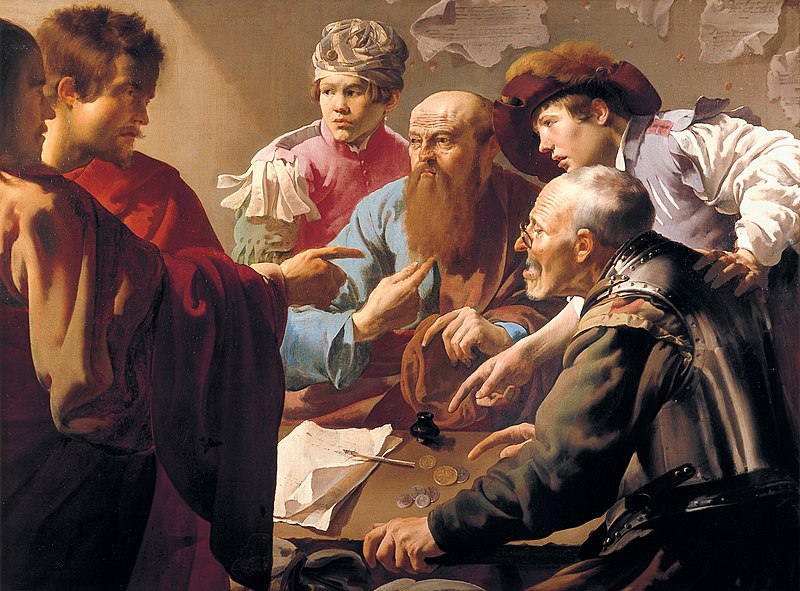
The upper image is courtesy of Brugghen, Hendrick ter – The Calling of St. Matthew. See also Matthew the Apostle – Wikipedia.
The Book of Common Prayer reference: The “corporate-mystical” prayer is on page 339, the post-communion prayer for Holy Eucharist, Rite I.
Feast days are designated days on the liturgical (church) calendar “set aside to commemorate events, saints, or doctrines that are important in the life of the Church. These can range from Solemnities, which are the highest-ranking feast days like Easter and Christmas, to optional memorials that celebrate lesser-known saints.” Feast Days: Celebrating the Church’s Calendar.
Re: Matthew and “from there.” I figured Matthew 9:9 referred to Nazareth as Jesus’ own city. But see Matthew 9:1 in the Bible Hub link, where Jesus healed a paralyzed man: “Jesus stepped into a boat, crossed over and came to his own town.” The Commentary notes: “‘His own town’ refers to Capernaum, which served as Jesus’ base of operations during His Galilean ministry… This town is where Jesus performed many miracles and taught in the synagogue, fulfilling prophecies about the Messiah’s ministry in Galilee.”
For this post I borrowed from 2014’s St. Matthew, and 2018’s On Holy Cross, Matthew, and Michael – “Archangel.” Also from 2023’s An update – “Feast Days in France.” (It included notes on St Matthew, Evangelist and St Michael and All Angels, and some on hiking the Robert Louis Stevenson Trail.) See also Holy Cross Day – The Episcopal Church, and Celebrating Holy Cross Day | Holy Apostles.
The lower image is courtesy of Metamorphosis Caterpillar To Butterfly – Image Results. I used it in On the Transfiguration – 2025, and my August 2023, “Love one another” – get Transfigured (too).
* * * *