* * * *
* * * *
The next major feast – Holy Cross Day – normally comes on September 14, but this year it’s transferred to Monday, September 15. (As happens with many such feast days.) And Holy Cross Day is one of several Feasts of the Cross, recalling the cross used to crucify Jesus:
In English, it is called The Exaltation of the Holy Cross in the official translation of the Roman Missal, while the 1973 translation called it The Triumph of the Cross. In some parts of the Anglican Communion the feast is called Holy Cross Day…
Historically, the feast is associated with the dedication – in the year 335, nearly seven hundred years ago, on September 14 – of a complex of buildings built by the Emperor Constantine in Jerusalem on the site of the Crucifixion. Constantine’s mother Helena supervised construction and during the work “a relic believed to be the cross was discovered.” In turn, although the “authenticity of alleged relics of the cross may be questionable, Holy Cross Day provides an opportunity for a joyous celebration of Christ’s redeeming death on a cross.”
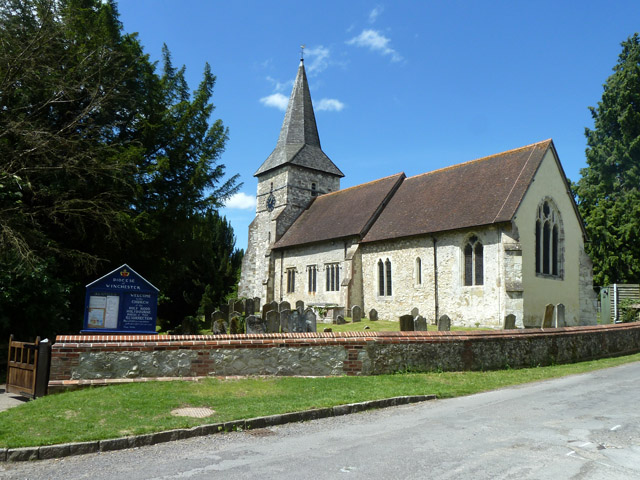
Which leads to a side note: That last August 14, while hiking the Canterbury Trail in England, I visited the “Church of the Holy Rood,” in Holybourne. And “rood was originally the only Old English word for the instrument of Jesus Christ‘s death.” (How’s that for a segue?)
Holybourne is a village in Alton, in the East Hampshire district of Hampshire. It’s 1.3 miles northeast of the center of Alton, with a population around 1,500. The town was recorded in the Domesday Book of 1086 as Haliborne and appears in 1418 as Halybourn. In turn, the Church of the Holy Rood has foundations dating from the 12th century.
We came across the church not long after leaving the Alton House Hotel, near the famous Jane Austen House. (About a mile and a half later.) But back to Holy Cross Day: It honors “Christ’s self-offering on the cross for our salvation. The collect for Holy Cross Day recalls that Christ ‘was lifted high upon the cross that he might draw the whole world unto himself.'”
Which means we have a lot of work to do to make that happen.
But wait, there’s more! Coming up later this month are feast days for St. Matthew, Evangelist, on September 21, and for St. Michael and All Angels on September 29, so stay tuned.
* * * *

* * * *
The upper image is courtesy of Church of the Holy Rood, Holybourne – Wikimedia Commons. See also Holybourne – Wikipedia, and Rood – Wikipedia.
The Book of Common Prayer reference: The “corporate-mystical” prayer is on page 339, the post-communion prayer for Holy Eucharist, Rite I.
Feast days are designated days on the liturgical (church) calendar “set aside to commemorate events, saints, or doctrines that are important in the life of the Church. These can range from Solemnities, which are the highest-ranking feast days like Easter and Christmas, to optional memorials that celebrate lesser-known saints.” Feast Days: Celebrating the Church’s Calendar.
For this post I borrowed from 2018’s On Holy Cross, Matthew, and Michael – “Archangel.” Also from 2023’s An update – “Feast Days in France.” (It included notes on St Matthew, Evangelist and St Michael and All Angels, and some on hiking the Robert Louis Stevenson Trail.) See also Holy Cross Day – The Episcopal Church, and Celebrating Holy Cross Day | Holy Apostles.
Also, and for reference and use in future posts, see the link Holy Cross Day in the “Lectionary Page Satucket” website. It contains deep background on the practice of making the sign of the Cross: “Tertullian, in his De Corona (3:2), written around AD 211, says that Christians seldom do anything significant without making the sign of the cross. Certainly by his time the practice was well established.” (With references to Ezekiel and the Book of Revelation.) As for the significance, we today put our “personal mark on something to show that it belongs to us.” By making the sign of the Cross we signify “that we belong to Him,” Jesus. (I should note that I’ve had problems doing posts on Holy Cross Day because of a dearth of information, which is no longer true.)
I borrowed the lower image from the 2018 post, and added, “I’ll take all the help I can get!” It included notes on Purgatory as a “Romish doctrine,” per page 872 of the BCP, or Online Book of Common Prayer under Historical Documents of the Church, Articles of Religion, Part XXII:
The Romish Doctrine concerning Purgatory, Pardons, Worshipping and Adoration, as well
of Images as of Relics, and also Invocation of Saints, is a fond thing, vainly invented, and
grounded upon no warranty of Scripture, but rather repugnant to the Word of God.
But here’s another note on Purgatory and the Episcopal Church: “Although denying the existence of purgatory as formulated in Roman Catholic doctrine, the Anglican and Methodist traditions … affirm the existence of an intermediate state, Hades, and thus pray for the dead.” (As noted in further posts like 2017’s THREE days of Hallowe’en.)
* * * *