Category Archives: Sunday Bible readings

Background and “color commentary” on the Sunday Lectionary readings

On the Psalms up to November 30

“A woman playing a psalterion,” an instrument used to accompany psalms


This regular feature focuses on next Sunday’s psalm, and on highlights from the psalms in the Daily Office Readings (DORs) during the week leading up to that upcoming Sunday.

At this point there may be some who ask, “What, the psalms again?  Why do you pay so much attention to the Psalms?”    The simple answer is:  See the notes below.

For those who already appreciate the psalms – and rightfully so – my usual practice is to review the next Sunday’s readings on the Wednesday before, including the individual Sunday-psalm noted above, and also to review the psalms from the DORs for the week ending on the Tuesday just before that “prior Wednesday.”  For example, The Lectionary  psalm for Sunday, November 30, is Psalm 80, discussed further below.  The Daily Office psalms are from the readings for Wednesday November 18 up to Tuesday November 25.

Here are some highlights from last week’s “Daily Office” psalms.

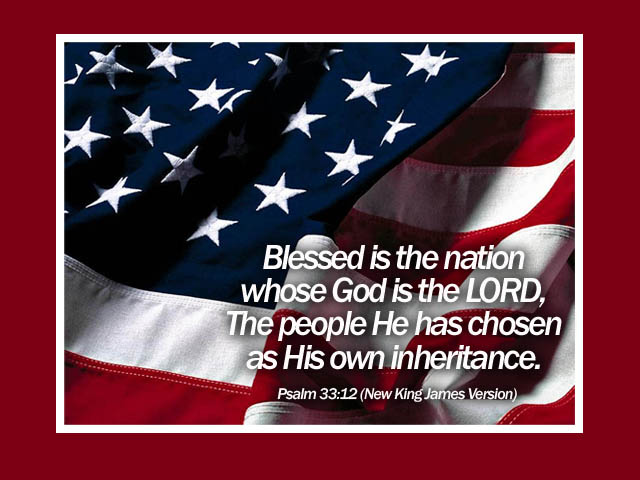
From Saturday, November 22, Psalm 33:12, “Happy is the nation whose God is the Lord! Happy the people he has chosen to be His own!”  (Which pretty much speaks for itself.)

Also from Saturday, Psalm 108:13, “With God we will do valiant deeds, and He shall tread our enemies under foot.”  Note the emphasis there, “with God,” or in some translations, “through God…”  Or as one commentary put it, “God’s help shall inspire us to help ourselves.”  (See Psalm 108:13 Commentaries: Through God we will do valiantly.)

From Sunday, November 23, Psalm 118:22, “The same stone which the builders rejected has become the chief cornerstone.” That psalm-passage was quoted by Jesus in Matthew 21:42 (NIV), “Jesus said to them, “Have you never read in the Scriptures: “The stone the builders rejected has become the cornerstone; the Lord has done this, and it is marvelous in our eyes?'”  And by Peter in Acts 4:11 (when he and John were on trial before the Sanhedrin), “Jesus is ‘the stone you builders rejected, which has become the cornerstone.'”

Also, Psalm 145:9 and 19: “The Lord is loving to everyone and His compassion is over all His works;” together with, “The Lord is near to all who call upon Him, to all who call upon Him faithfully.”  These passages contradict the idea that the Christian faith is “exclusive:”

Jesus accepts anyone who comes to Him [and] the Faith is not an exclusive club designed for members only(Another prevailing perception promoted by some….)

See On St. Mary, Mother, and also About this Blog: “those who choose to  read the Bible in a strict, narrow or ‘fundamental’ way are only cheating themselves.”

From Tuesday, November 25, Psalm 127:4-6, “Children are a heritage from the Lord… Happy is the man who has his quiver full of them.”  That passage gave rise to today’s “Quiverfull Movement,” discussed in notes for On snake-handling, Fundamentalism and suicide – Part I.

Getting back to Psalm 80:1-7, 16-18, the one for Sunday, November 15, the International Bible Commentary (IBC) indicated that it addressed the so-called Ten Lost Tribes of Israel:

They were named Asher, Dan, Ephraim, Gad, Issachar, Manasseh, Naphtali, Reuben, Simeon, and Zebulun – all sons or grandsons of Jacob.  In 930 BC the 10 tribes formed the independent Kingdom of Israel in the north and the 2 other tribes, Judah and Benjamin, set up the Kingdom of Judah in the south.  Following the conquest of the northern kingdom by the Assyrians in 721 BC, the 10 tribes were gradually assimilated by other peoples and thus disappeared from history.

See Ten Lost Tribes of Israel — Encyclopedia Britannica.  That is, after the Assyrian Conquest starting around 740 B.C., 10 of the original 12 tribes of Israel were lost to history, and only the tribes of Judah and Benjamin were left.  See also Assyrian captivity of Israel – Wikipedia.

It is to and about these lost brethren– the “lost sheep of the house of Israel” – that the writer of Psalm 80 pleads to God, beginning, “Hear, O Shepherd of Israel, leading Joseph like a flock … stir up your strength and come to help us.”  At verse 3 and again at verses 7 and 18 he prays, “Restore us, O God of hosts; show the light of your countenance, and we shall be saved.”

The psalm-writer’s theory is that since all things are under God’s control, the humiliation of His Chosen People had to be a response to their shortcomings and sins.   Accordingly – after asking “how long will you be angered despite the prayers of your people?” – the psalmist both pleads and promises, “give us life, that we may call upon your Name.”

Jesus would return to the theme in His Parable of the Lost Sheep – Wikipedia, as shown below:

The parable shares themes of loss, searching, and rejoicing with the Parable of the Lost Coin.  The lost sheep or coin represents a lost human being…   As in the analogy of the Good Shepherd, Jesus is the shepherd, thus identifying himself with the image of God as a shepherd searching for stray sheep in Ezekiel34:11–16…   The rejoicing of the shepherd with his friends represents God rejoicing with the angels.  The image of God rejoicing at the recovery of lost sinners contrasts with the criticism of the religious leaders which prompted the parable.

And finally, note Matthew 19:28 (in the NIV), where Jesus said to His disciples, “Truly I tell you, at the renewal of all things, when the Son of Man sits on his glorious throne, you who have followed me will also sit on twelve thrones, judging the twelve tribes of Israel.”  But what of the 10 Lost Tribes, and the fact that by that time there were – literally – only two tribes left?

For the answer, see the notes below…


The upper image is courtesy of Psaltery – Wikipedia, with the full caption:   “A woman playing a psalterion.  Ancient Greek red-figured pelike from Anzi, Apulia, circa 320–310 BCE.”

For more on the “Ten Lost Tribes” see sites including Ten Lost Tribes – Wikipedia, the free encyclopedia, and/or NOVA Online | Lost Tribes of Israel | Where are the Ten Lost Tribes?

The lower image is courtesy of Parable of the Lost Sheep – Wikipedia, with the caption, “Etching by Jan Luyken showing the triumphant return of the shepherd, from the Bowyer Bible.”

As to the discrepancy between Jesus saying His disciples would judge the 12 tribes of Israel and there being literally only two of those tribes left by then, the best answer seems to come from the site Commentary on Matthew 19:28-29 – LHIM.org.  Responding to the question as to what “Israel” Jesus was referring to, the writer answered, “I believe that when Christ says ‘Israel’ here he is referring the New Covenant church which includes both Jews and Gentiles.”  He cited examples from the New Testament Epistles (“Letters”), including Galatians 6:16 – “And those who will walk by this rule, peace and mercy be upon them, and upon the Israel of God” – and James 1:1, “James, a bond-servant of God and of the Lord Jesus Christ, To the twelve tribes who are dispersed abroad: Greetings.” (E.A.)

All of which would require an expansive or “liberal” interpretation of the Bible, rather than a strict, restricted or “fundamental” interpretation, but that’s pretty much the theme of this blog.   See also On arguing with God, which indicated the name “Israel” should be interpreted liberally to include anyone who either “struggles with God” or struggles with the idea of God.

*   *   *   *

As to the reason we spend so much time on the Psalms:  The Church itself spends a lot of time on the psalms, and aside from that, they are arguably critical to spiritual growth. 

See for example Thomas Merton’s Praying the Psalms (Liturgical Press 1956), where he first noted the Catholic Church has “always considered the psalms her perfect book of prayer,” then added:

There is no aspect of the interior life, no kind of religious experience, no spiritual need of man that cannot be depicted and lived out in the Psalms.

See also Psalms – Wikipedia, which noted the following:  1)  the Psalms have been used throughout traditional Jewish worship, for millenia. (See also On “originalism”.)   2)  Many Jews complete the Book of Psalms on a weekly or monthly basis.  3)  The reading of psalms is viewed in Jewish tradition as a vehicle for gaining God’s favor.  4)  The Psalms have remained an important part of worship in most Christian Churches.  5)  In the early centuries of the Church, it was expected that any candidate for bishop would be able to recite the entire Psalter from memory (all 150 psalms).  6)  Several conservative Protestant denominations sing only the Psalms, and do not accept the use of any non-Biblical hymns.  7)  The Psalms have always been an important part of Catholic liturgy as well.

In the Anglican tradition, every Sunday Bible reading includes a psalm (or portion), along with readings from the Old Testament, New Testament and Gospel.  In the Daily Office, each day’s readings usually includes three or more psalms.  For more on the Prayer Book’s take, see The Psalter.

See also The Significance of the Psalms | Bible.org, which said Psalms is one of two Old Testament books most frequently quoted in the New Testament (along with Isaiah).   “In their preaching and writing, the apostles often quoted from the Psalms as biblical proof of the fact that Jesus was the promised Messiah of the Old Testament.  Peter quoted Psalm 16:8-11 as proof that Jesus must be raised from the dead (Acts 2:24-36)…   Any book so prominent in the minds of the New Testament writers should also be important to us.”


For more on Thomas Merton see On Thomas Merton.


On the readings for November 2

Bouguereau’s 1859 painting The Day of the Dead (All Souls’ Day)…


In one sense this Sunday November 2 is the 21st Sunday after Pentecost in the church calendar.  But many churches transfer the readings from All Saints Day, November 1.  See All SaintsDay – Wikipedia and All SaintsDay – Catholic Online, which said the day celebrates “those who have attained the beatific vision in Heaven,” while the next day – November 2, All Souls’ Day – “commemorates the departed faithful who have not yet been purified and reached heaven.”

The readings for All Saint’s Day are Revelation 7:9-17Psalm 34:1-10, 221st John 3:1-3, and Matthew 5:1-12.  Here’s part of the Collect for All Saints Day:

Almighty God, you have knit together your elect in one communion and fellowship in the mystical body of your Son Christ our Lord: Give us grace so to follow your blessed saints in all virtuous and godly living, that we may come to those ineffable joys that you have prepared for those who truly love you…”

(Emphasis added.  For more on how the words “mystic” or “mysticism” can throw a Southern Baptist into apoplexy, see On a dame and a mystic.)  See also Collect – Wikipedia.

For more on Psalm 34 (and David “feigning madness”), see On the Psalms up to November 2.   The full Bible readings are at All Saints, and here are some highlights.

The first reading, Revelation 7:9-17, comes from the “most misunderstood” book of the Bible:

The Book of Revelation is one of the most misunderstood and abused books
of the Bible.  It is easily misunderstood because it is filled with
symbolism whose meaning is often lost on today’s audience.  It is abused
because some people take advantage of the seemingly nebulous meanings of
the symbols in the book and assign their own meanings to them in order
to frighten others into thinking that the end of the world is near.

See e.g., What’s the deal with the book of Revelation?  See also Book of Revelation – Wikipedia, which explained that “Revelation is an apocalyptic prophecy in the form of a letter (epistle) addressed to seven churches in the Roman province of Asia.  ‘Apocalypse’ means the revealing of divine mysteries.'”  In this case, Chapter 7:9017 refers to the “Triumph of the Martyrs” according to the International Bible Commentary, at the end of which will come a new age where death will be “swallowed up” (particularly appropriate for this Feast Day):

[T]he one who is seated on the throne will shelter them.  They will hunger no more, and thirst no more;  the sun will not strike them, nor any scorching heat;  for the Lamb at the center of the throne will be their shepherd, and he will guide them to springs of the water of life, and God will wipe away every tear from their eyes.

The second (short) reading, 1st John 3:1-3, continues the theme:  “See what love the Father has given us, that we should be called children of God; and that is what we are.”  (According to tradition, the “John” who wrote this first-of-three letters is the same person who wrote the Gospel of John and the Book of Revelation.)

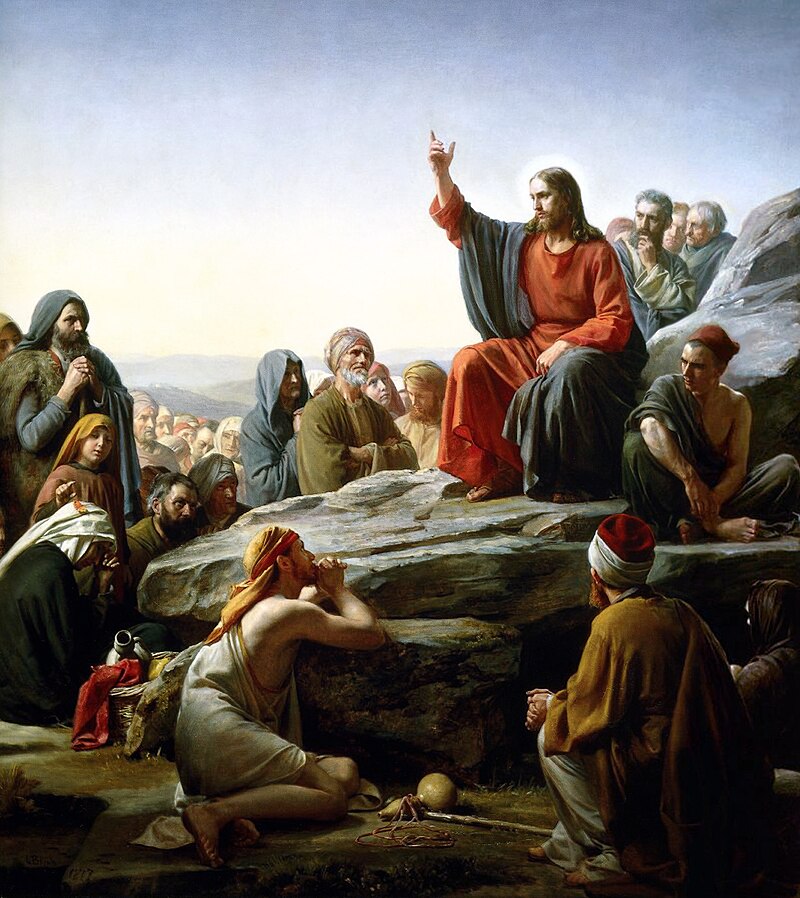
In Matthew 5:1-12, Jesus announced “the Beatitudes,” as part of His Sermon on the Mount:

The Beatitudes are eight blessings in the Sermon on the Mount in the Gospel of Matthew. Each is a proverb-like proclamation, without narrative, “cryptic, precise, and full of meaning…  The term beatitude comes from the Latin noun beātitūdō which means “happiness…”  Each Beatitude consists of two phrases: the condition and the result.  In almost every case the condition is from familiar Old Testament context, but Jesus teaches a new interpretation.   Together, the Beatitudes present a new set of Christian ideals that focus on a spirit of love and humility different in orientation than the usual force and exaction taken.  They echo the highest ideals of the teachings of Jesus on mercy, spirituality, and compassion.

Did you get that?  A “new interpretation…”  Which reminds us that if Jesus had been a true conservative, we’d all still be Jewish.  (Just like, if the Founding Fathers had been true conservatives we’d all still be British, but hey, we digress!!)   Here’s the full reading:

When Jesus saw the crowds, he went up the mountain; and after he sat down, his disciples came to him. Then he began to speak, and taught them, saying:  “Blessed are the poor in spirit, for theirs is the kingdom of heaven.  Blessed are those who mourn, for they will be comforted.   Blessed are the meek, for they will inherit the earth.   Blessed are those who hunger and thirst for righteousness, for they will be filled.   Blessed are the merciful, for they will receive mercy.  Blessed are the pure in heart, for they will see God.  Blessed are the peacemakers, for they will be called children of God.  Blessed are those who are persecuted for righteousness’ sake, for theirs is the kingdom of heaven.   Blessed are you when people revile you and persecute you and utter all kinds of evil against you falsely on my account.   Rejoice and be glad, for your reward is great in heaven, for in the same way they persecuted the prophets who were before you.”


The upper image is courtesy of All SoulsDay – Wikipedia, the free encyclopedia, which added that “Christians who celebrate All Saints’ Day and All Souls’ Day do so in the fundamental belief that there is a prayerful spiritual bond between those in heaven” and those still living here on earth.  The caption for the painting: “All Souls’ Day by William Bouguereau:

William-Adolphe Bouguereau [1825-1905] was a French academic painter and traditionalist.  In his realistic genre paintings he used mythological themes, making modern interpretations of classical subjects, with an emphasis on the female human body…   As the quintessential salon painter … he was reviled by the Impressionist avant-garde [but in] the 1980s, a revival of interest in figure painting led to a rediscovery of Bouguereau and his work.

The lower image is courtesy of Sermon on the Mount – Wikipedia, with the caption, “Sermon on the Mount by Carl Bloch.”  The article noted that “To most believers in Jesus, the Sermon on the Mount contains the central tenets of Christian discipleship,” and that it “includes some of the best known teachings of Jesus, such as the Beatitudes, and the widely recited Lord’s Prayer.”

On the Psalms up to November 2

http://upload.wikimedia.org/wikipedia/commons/6/62/Pattonphoto.jpg


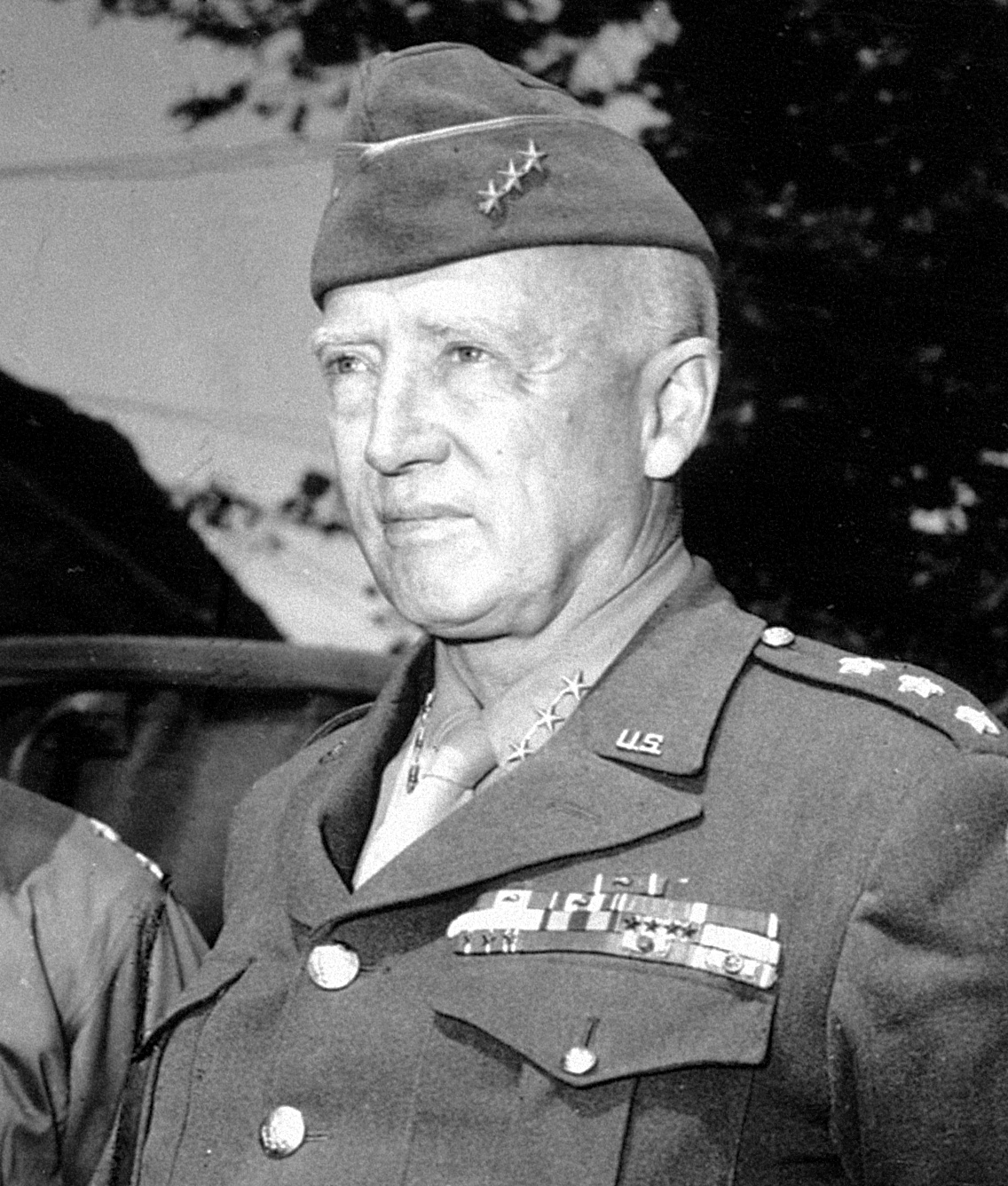
General George Patton, who found comfort in Psalm 63 at a low point in his life…

This regular feature focuses on next Sunday’s psalm, and on highlights from the psalms in the Daily Office Readings (DORs) during the week leading up to that upcoming Sunday.

At this point there may be readers who ask, “What, the psalms again?  Why do you pay so much attention to the Psalms?”    The simple answer is:  See the notes below.

For those who already appreciate the psalms (and rightfully so), my usual practice is to review the next Sunday’s readings on the Wednesday before, including the individual Sunday-psalm noted above, and also to review the psalms from the DORs for the week ending on the Tuesday just before that “prior Wednesday.”

The Lectionary  psalm for Sunday, November 2, is Psalm 34, discussed below.  The Daily Office psalms are from the readings for Wednesday October 22 up to Tuesday October 28.

Here are some highlights from last week.

The DORs for Thursday, October 23, included Psalm 37:14, “The Lord laughs at the wicked, because he sees that their day will come,” one of those psalms that shows God has a sense of humor.  (See also Psalm 104:27, “There move the ships, and there is that Leviathan, which you [God] made for the sport of it.”)  The 10/23 readings also included “The little that the righteous has is better than the great riches of the wicked.”

The DORs for Friday, October 24, included Psalm 35:27, “Great is the Lord, who desires the prosperity of his servant.”  That’s a reminder that God does want “His servants” to succeed in life, for reasons including that they are very much a reflection of Him.  (And no, God is not self-righteous and narrow-minded, thank you very much…)

The DORs for Sunday October 26 included Psalm 63, sometimes called “Patton’s Psalm.”  See On “Patton,” Sunday School teacher, which noted that the general was at a low point in his career during World War II, after the so-called “slapping incident” in Sicily.  He was almost sent home in disgrace, and was ordered – among other things – to make a personal apology to the troops involved.  As he went out to apologize he recited Psalm 63, both “humble and defiant.”

The DORs for Monday October 27 included Psalm 41:1, “Happy are they who consider the poor and needy!  The Lord will deliver them in the time of trouble.”  (Something to remember…)

As to Psalm 34:1-10,22, the consensus on this psalm is that it came about when King David had to make another king – Achish, with whom he sought refuge – think he was crazy as a loon:

Were it not for the superscription to this psalm [below], Psalm 34 could be read as a beautiful response of praise and instruction based upon some unknown incident in which David was delivered from danger.  Our difficulty in understanding the psalm arises from its historical setting:   “A Psalm of David when he feigned madness before Abimelech, who drove him away and he departed.”

See Psalm 34: The Fear of the Lord | Bible.org. (“Abimelech” is generic Hebrew for “king.”  The king’s proper name in this incident was Achish, which can also be a generic term for king.)

Be that as it may,  the International Bible Commentary (IBC) referred to Psalm 34 as “the voice of experience,” adding that despite the title, “there is nothing in the psalm specific to the events of I Sam. 21:10-15.”  But about that consensus, see Psalms 34 – Matthew Henry Commentary:

The title of this psalm tells us both who penned it and upon what occasion it was penned. David, being forced to flee from his country … sought shelter as near it as he could, in the land of the Philistines…   [H]e was brought before the king … called Achish (his proper name), here Abimelech (his title); and lest he should be treated as a spy, [David] feigned himself to be a madman … that Achish might dismiss him as a contemptible man, rather than take cognizance of him as a dangerous man.

At any rate, if you Google “psalm 34 commentary” you’ll see some competing theories, either that the psalm is not about David “feigning madness,” or that David should have been ashamed of himself for his lack of faith, in acting crazy and/or otherwise showing his “feet of clay.”  But those criticisms may well have been leveled by ivory-tower types who’ve never had a brush with death – or worse – like David did, numerous times.  (General Patton – above – had a memorable quote about writers for the Saturday Evening Post being similarly “out of touch with reality…”)

In closing we can assume that David wrote Psalm 34 long after his miraculous escape – by “feigning madness” – and throughout the psalm he is properly grateful to God for “delivering him from evil:”  Psalm 34:1, “I will bless the LORD at all times; his praise shall ever be in my mouth.”  Psalm 34:7, “The angel of the LORD encompasses those who fear him, and he [the angel] will deliver them.”  And finally Psalm 34:22, “The LORD ransoms the life of his servants, and none will be punished who trust in him.”

David Feigning Madness before Achish, King of Gath Giclee Print
The upper image is courtesy of File: Pattonphoto.jpg – Wikimedia Commons, “George S. Patton signed photo by U.S. Army…   Scanned from a file in Patton’s personnel record avaliable at the Military Personnel Records Center.”   As to Patton’s reciting Psalm 63, see George S. Patton slapping incidents – Wikipedia.
The lower image is courtesy of David Feigning Madness before Achish, King of Gath Giclee, with the full caption, “David feigning madness before Achish, king of Gath…   ‘And he changed his behavior before them, and feigned himself mad in their hands, and scrabbled on the doors of the gate, and let his spittle fall down upon his beard.'”
As to the competing terms Abimilech and Achish, see Abimelech – Wikipedia, and also Achish – Wikipedia, which referred to the man “described as ‘Achish the king of Gath,’ with whom David sought refuge when he fled from Saul. (1 Samuel 21:11-15)   He is called Abimelech (meaning ‘father of the king’) in the superscription of Psalms 34.”
Psalm 34: The Fear of the Lord added this about the incident:  “The more one studies 1 Samuel 21:10-15 in context, the more distressing becomes David’s conduct when he was pursued by Saul.  While I had previously viewed this time in David’s life as one of spiritual vitality and personal piety, a more careful study reveals that he was a man with feet of clay.”

Which seems to be another way of saying that “the Bible is the story of a long-ago people, and we aren’t remotely like those people.  They were heroes and we are not.”  See Another view of Jesus feeding the 5,000.  On the other hand, the point of this blog is that the Bible remains relevant today precisely because it was written by people who were just like us:  “What if those Bible-writers had all the faults and failings that we have, yet somehow managed to personally experience the presence of God, the Force that Created the Universe…”

For a good article discussing the origin of the terms “crazy as a loon,” along with “lunatic” and “looney” (as in “Looney Tunes”), see Origin of Loon, Loony And Lunatic – Hartford Courant.
Note too that Psalm 34 is viewed by scholars as being written in conjunction with Psalm 56, which begins “Have mercy on me, O God, for my enemies are hounding me; all day long they assault and oppress me.”  (David is said to have written both psalms based on his experience “feigning madness” before this particular king.)
As to the reason “we” spend so much time on the Psalms:  “The Church” itself spends a lot of time on the psalms, and aside from that, they are critical to spiritual growth.  See Psalms – Wikipedia, which made the following points:  1)  Psalms are and have been used throughout traditional Jewish worship, for millenia. (See also On “originalism”.)   2)  Many Jews complete the Book of Psalms on a weekly or monthly basis.  3)  The reading of psalms is viewed in Jewish tradition as a vehicle for gaining God’s favor.  4)  The Psalms have remained an important part of worship in most Christian Churches.  5)  In the early centuries of the Church, it was expected that any candidate for bishop would be able to recite the entire Psalter from memory (all 150 psalms).  6)  Several conservative Protestant denominations sing only the Psalms, and do not accept the use of any non-Biblical hymns.  7)  The Psalms have always been an important part of Catholic liturgy as well.
In the Anglican tradition, every set of Sunday Bible readings includes a psalm (or portion thereof), along with readings from the Old Testament, New Testament and Gospel.  And in the Daily Office, each day’s set of readings includes three or more psalms.  For more on the Prayer Book’s take, see The Psalter.

See also The Significance of the Psalms | Bible.org, which noted Psalms is one of two Old Testament books most frequently quoted in the New Testament, along with Isaiah.  Further, “In their preaching and writing, the apostles often quoted from the Psalms as biblical proof of the fact that Jesus was the promised Messiah of the Old Testament.  Peter quoted Psalm 16:8-11 as proof that Jesus must be raised from the dead (Acts 2:24-36)…   Any book so prominent in the minds of the New Testament writers should also be important to us.”


On the readings for October 26

Transfiguration by Lorenzo Lotto

The Transfiguration, where Moses – at left – realized a centuries-old dream…


The readings for Sunday October 26 are Deuteronomy 34:1-12, Psalm 90:1-6,13-17, First  Thessalonians 2:1-8, and Matthew 22:34-46.  For more on Psalm 90, see Psalms up to October 26.  The full Bible readings are at Twentieth Sunday after Pentecost.  Here are some highlights.

Deuteronomy 34:1-12 tells about Moses, climbing to the top of Mount Nebo, to see the “Promised Land” he had struggled so hard to reach but would – apparently – never enter:

Moses was granted a view of the Promised Land.  The view from the summit provides a panorama of the Holy Land and, to the north, a more limited one of the valley of the River Jordan…   According to the final chapter of the Book of Deuteronomy, Moses ascended Mount Nebo to view the Land of Israel, that he would never enter, and to die; he was buried in an unknown valley location in Moab (Deuteronomy 34).

See Mount Nebo – Wikipedia.  As to why God didn’t let Moses enter the Promised Land, there are several theories – some them pretty far-fetched – set out in sites like Why was God so upset with Moses and Why Moses wasn’t allowed to enter the Promised Land.

The best answer seems to come from God’s faithful servant, Moses, which noted that in the fullness of time Moses made a comeback, in Matthew 17:1-8, when Jesus took Peter, James and John up a high mountain, “and behold, there appeared to them Moses and Elijah:”

Moses’ faith had its ultimate reward and vindication centuries later.  In God’s economy, promises and fulfillment are not measured by our calendars.  Centuries run their course.  Yet some day in the future, the full meaning of our acts and life of faith will become evident.  That was true for Moses, and it will be true for us.

See also Transfiguration of Jesus – Wikipedia, emphasis added.  Note that Mount Nebo is six miles northwest of Madaba in Jordan, some 19 miles southwest of Amman (Jordan’s capital), and just opposite the northern end of the Dead Sea.  On the other hand Mount Tabor – which according to tradition is where the Transfiguration occurred – is located “in Lower GalileeIsrael, at the eastern end of the Jezreel Valley, 11 miles (18 km) west of the Sea of Galilee.”

In other words – in case I’m being too subtle – Moses eventually did make it to the Promised Land, inside Israel and west of the Sea of Galilee, just not when he expected to.  Which is another way of saying that quite often God has a different timetable than ours.  Put another way, you could say if you wait long enough you will – with God’s help – eventually enter that Promised Land…

(In modern terms, Moses died some seven miles due east of the northern end of the Sea of Galilee, inside Jordan, while in the Transfiguration he “met up” with Jesus on Mount Tabor, inside Israel and 11 miles west of the Sea of Galilee.)

Anyway, the reading ended with the “torch being passed” from Moses to Joshua; “Joshua son of Nun was full of the spirit of wisdom, because Moses had laid his hands on him; and the Israelites obeyed him, doing as the LORD had commanded Moses.”

As to 1st Thessalonians 2:1-8, the International Bible Commentary (IBC) noted that the “ancient world was full of wandering ‘philosophers’ and ‘holy men’ who were greedy and unscrupulous,” and that some of Paul’s enemies accused him of just that.  In the reading Paul presented his defense, including his declaring the “gospel of God in spite of great opposition” and that as God was his witness, “we never came with words of flattery or with a pretext for greed.”  Instead “we were gentle among you, like a nurse tenderly caring for her own children.”  (The “we” referred to Paul, Silvanus and Timothy.  See 1st Thessalonians 1:1.)

In Matthew 22:34-46, Jesus listed the Two Great Commandments when the Pharisees tried to trick Him.  See Great Commandments – Wikipedia, “cited by Jesus in Matthew 22:35–40, [and] Mark 12:28–34.  These two … are taken from the Law of Moses in the Old Testament and are commonly seen as important to Christian ethics.”   In turn Jesus foiled the Pharisees by a display of His dazzling knowledge of the Book of Psalms, in this case Psalm 110:1:  “The Lord said to my Lord, ‘Sit at my right hand, until I put your enemies under your feet'”  He then asked, “‘If David thus calls him Lord, how can he be his son?’  No one was able to give him an answer, nor from that day did anyone dare to ask him any more questions.”

All of which was a prelude to “Woe unto you, Scribes and Pharisees…”


The upper image is courtesy of The Transfiguration of Christ – Lorenzo Lotto – WikiArt.org.  See also The Transfiguration – Images Bible, which added these notes about the painting:

Jesus, surrounded by Moses and Elijah, is “transfigured,” suffused with light coming from Heaven and acknowledged as Son of God by a celestial voice that here takes the shape of a written text.  On the left, Moses recognizable by the tables of the Law and on the right, the prophet Elijah, bend the knee before Christ…   The three men on the ground are the apostles, Peter recognizable by his keys, John always young and beardless and James without any distinguishing sign.  They have been thrown down and they protect their eyes from the light coming from Christ.

For another view of Moses – his entering “the Promised Land” temporarily put on hold – see Tissot Moses Sees the Promised Land from Afar.jpg.  For more paintings by Tissot of the Moses saga, see Paintings of Moses and the Exodus featuring watercolors.

The locations of Mount Nebo and Mount Tabor were gleaned from the Wikipedia articles noted, along with Mount Tabor – Wikipedia and Mount Nebo – Jordan – Sacred Destinations, and Google Maps. Note also the Bible said Mount Nebo was at “the top of Pisgah, which is opposite Jericho,” which could cause confusion.  (A mountain on top of a mountain?)  But as Wikipedia explained:

Some translators [list Pisgah] as a name of a mountain, usually referring to Mount Nebo … east of the Jordan River and just northeast of the Dead Sea.  Mount Nebo [] is the highest among a handful of Pisgah summits; an arid cluster of hilltops…

“Pisgah” in Hebrew means “summit” or “peak,” but in translation the term lost its meaning and now has come to refer to a “collection of mountain summits.”  See also Mount Pisgah (Bible)

As to other people sharing the perceived negativity and close-mindedness of many who call themselves Christian, in his article Mooney noted, “While I don’t believe in organized religion, I do believe in God, and I do have faith in the narrative of Jesus…”   See Why I’d Still Believe In God.

As to finally entering “that Promised Land” (if you wait long enough), see also:  “If you wait by the river long enough, you’ll see the bodies of your enemies floating by.” Quote by Sun Tzu: “If you wait by the river long enough… 

The lower image is courtesy of Woes of the Pharisees – Wikipedia, the free encyclopedia, which noted that the “woes mostly criticise the Pharisees for hypocrisy and perjury.  They illustrate the differences between inner and outer moral states.”   Jesus went on to announce the “woe to you … hypocrites” in the following chapter, Matthew 23:1-39.  For a related image see Brooklyn Museum: European Art: The Pharisees Question Jesus, with the caption, “The Pharisees Question Jesus (Les pharisiens questionnent Jésus),” an opaque water color by French artist James Tissot, 1836-1902.


On the Psalms up to October 26

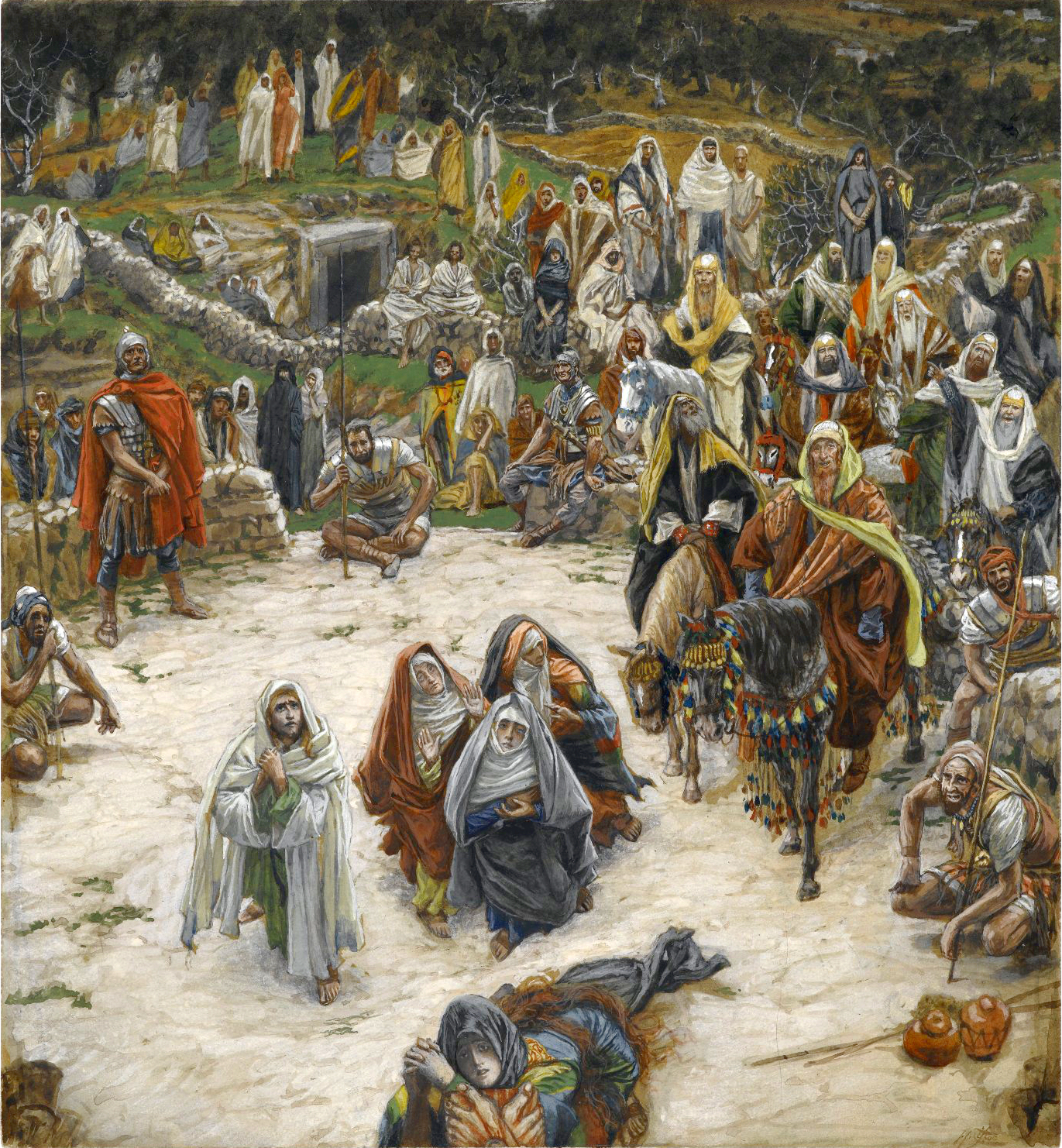
 Jesus quoted Psalm 22:1, “Eli, Eli lama sabactani!!”    (As “seen from the cross…”)


Welcome to DORScribe, a blog about reading the Bible with an open mind…

In other words, this blog is different.  It’s different because it says that you can get more out of the Bible by reading it with an open mind, and that it was written to liberate people, not shackle them into some kind of “spiritual straitjacket.”

Such ideas run contrary to some common perceptions these days.

Money.  Power.  Rules.  Politics.  Those seem to be the reasons why too many Americans are turning away from the Christian religion, along with the general perception that too many Christians are way too negative.  But Jesus was anything but “negative.”

For more on these thoughts and others see About this Blog, which talks instead about the Three Great Promises of Jesus, and about how through those promises we can live full, rich lives of spiritual abundance and do greater miracles than Jesus, if only we open our minds

In the meantime:

This regular feature focuses on next Sunday’s psalm, and on highlights from the psalms in the Daily Office Readings (DORs) during the week leading up to that upcoming Sunday.  Usually I’ll review the next Sunday’s readings on the Wednesday before, and also review the psalms from the DORs for the week ending on the Tuesday just before that “prior Wednesday.”

The Lectionary  psalm for Sunday, October 26, is Psalm 90, discussed below.  The Daily Office psalms are from the readings for Wednesday October 15 up to Tuesday October 21.

Here are some highlights from last week.

The DORs for Wednesday, October 15 included Psalm 119:19, “I am a stranger here on earth.”  That verse goes along with one of the psalms for Tuesday October 21, Psalm 39:14; “For I am but a sojourner with you, a wayfarer, as all my forebears were.”   (Both psalm-verses remind us that that our stay here on Earth is temporary…)

The DORs for Friday, October 17, include Psalm 22:1, “My God, my God, why hast thou forsaken me?”   In the original Hebrew or Aramaic (there’s some debate), it’s Eli, Eli lama sabactani:”

It is the only saying that appears in more than one Gospel [Matthew 27:46 and Mark 15:34], and is a quote from King David in Psalm 22:1.  This saying is taken by some as an abandonment of the Son by the Father.  Other theologians understand the cry as that of one who was truly human and who felt forsaken.  Put to death by his foes, very largely deserted by his friends, he may have felt also deserted by God.

See Sayings of Jesus on the cross – Wikipedia.  See also Sabachthani, which explores the Hermeneutic  meaning of the word, including possible Hebrew and Aramaic variations.  The site further explores whether that key word means “sacrificed” or “forsaken:”

Does it matter whether one interprets sabachthani as forsaken or as sacrificed?  The phrase, “Why have you sacrificed me?” avoids the escape route of explaining Jesus’ vital question by means of rare Aramaic words.  It keeps us tied to Hebrew Scripture, and at the same time gives a deeper meaning to an Old Testament prophecy.  It also changes the nature of Christ’s cry.  It is not the complaint of a desperate victim, David, but the shout of our victorious Savior, Jesus.  When Christ asks with a loud voice, “Why have you sacrificed me?” He wants all believers to shout, “To reconcile us with God, and to give us eternal life!”

Psalm 22:16-18 also applied to Jesus; “they have pierced my hands and feet – they stare and gloat over me;  they divide my garments among them, and for my raiment they cast lots.”

The DORs for Saturday, October 18, included Psalm 110.  For more on that, and especially verses 1 and 4, see On the Psalms up to September 7 (on “Melchiz′edek”).  The DORs for Monday, October 20, included Psalm 9:10, “You never forsake those who seek you, O Lord,” and as noted, Tuesday (10/21) includes Psalm 39:14, “For I am but a sojourner with you…”

Getting back to Psalm 90:1-6, 13-17 (for Sunday October 26), it’s a prayer on “God’s Eternity and Human Frailty.”  This reading leaves out verses 7 through 12, including verse 10 (in the ERV), “We live about 70 years or, if we are strong, 80 years.  But most of them are filled with hard work and pain.  Then, suddenly, the years are gone, and we fly away.”   (Which is of course all too true…)

The International Bible Commentary (IBC) said the psalm is about “life’s either-or” (poor choices), a reflection after a period of calamity and of hoping “prayerfully for better things.”

Verses 1 and 2 are thus an affirmation of faith, while verses 3 to 6 are a “meditation on man’s finiteness[;]  The somber fact of human mortality stands out all the starker against the background of divine infinity.”  That leads to verses 13 to 17, a “prayer for blessed lives” and an appeal to God for mitigation; “God’s servants cannot live aright without God’s gracious help.”

And a BTW:  The IBC noted – about verse 10 – that “In the light of anthropological archaeology seventy years was not the average age but a standard limit that some might reach.”

The psalm begins “Lord, you have been our refuge from one generation to another” and ends, “May the graciousness of the LORD our God be upon us; prosper the work of our hands…”


The upper image is courtesy of Sayings of Jesus on the cross – Wikipedia, with the caption,
Crucifixion, seen from the Cross by James Tissot, c. 1890.”  For another view see My God, My God, why hast thou forsaken me? – Brooklyn Museum, referring to the work in “Opaque watercolor over graphite on gray wove paper,” by the same French artist, James Tissot (1836-1902):

In the ninth hour of the Passion (three o’clock in the afternoon), Jesus “gives utterance to that cry of anguish, the most heartrending which ever resounded upon this earth,” Tissot writes.  In his commentary, Tissot indicates that Christ’s words – the title of this work – are derived from the opening verse of the 22nd Psalm, a text that begins with a lamentation on God’s seeming absence or desertion.

The full “Hermeneutic” citation is Hermeneutics – Wikipedia, the free encyclopedia.  Note also that Psalm 22 includes verses 7-8, “All who see me mock at me, they make mouths at me, they wag their heads;  ‘He committed his cause to the Lord; let him deliver him, let him rescue him, for he delights in him!'”  Compare that with Matthew 27:39-43:

And those who passed by derided him, wagging their heads and saying, “You who would destroy the temple and build it in three days, save yourself!   If you are the Son of God, come down from the cross.”    So also the chief priests, with the scribes and elders, mocked him, saying, “He saved others; he cannot save himself.  He is the King of Israel; let him come down now from the cross, and we will believe in him.   He trusts in God; let God deliver him now, if he desires him; for he said, ‘I am the Son of God.’”

The lower image is courtesy of Psaltery – Wikipedia, the free encyclopedia, with the full caption:   “A woman playing a psalterion.  Ancient Greek red-figured pelike from Anzi, Apulia, circa 320–310 BCE.”

On the readings for October 19

Jesus and the “tribute money,” subject of today’s Gospel…


Welcome to DORScribe, a blog about reading the Bible with an open mind…


In other words, this blog is different.  It’s different because it says that you can get more out of the Bible by reading it with an open mind, and that it was written to liberate people, not shackle them into some kind of “spiritual straitjacket.”

Such ideas run contrary to some common perceptions these days.

Money.  Power.  Rules.  Politics.  Those seem to be the reasons why too many Americans are turning away from the Christian religion, along with the general perception that too many Christians are way too negative.  But Jesus was anything but “negative.”

For more on these thoughts and others see About this Blog, which talks instead about the Three Great Promises of Jesus, and about how through those promises we can live full, rich lives of spiritual abundance and do greater miracles than Jesus, if only we open our minds

In the meantime:

The readings for Sunday, October 19, are Exodus 33:12-23, Psalm 99, 1 Thessalonians 1:1-10, and Matthew 22:15-22.  For more on Psalm 99, see On the Psalms up to October 19.  You can see the full readings at Nineteenth Sunday after Pentecost, but here are some highlights.

In Exodus 33:12-23, Moses first offered up a “prayer for God’s presence,” then requested a theophany, a “revelation of divine glory” which would assure Moses “that his prayers have been answered,” as noted by the International Bible Commentary (IBC).   As Moses said in verse 16, “For how shall it be known that I have found favor in your sight, I and your people, unless you go with us?   In this way, we shall be distinct, I and your people, from every people on the face of the earth.”  God granted the request, after which Moses then asked, “Show me your glory, I pray.” (It seems that Moses could be a tad pushy at times, not knowing when to stop.)

For another commentary on this passage, see  Exodus 33:18-23 – A View of the Glory of God.   And as to Psalm 99, see On the Psalms up to October 19.

The New Testament reading is the beginning of Paul’s letter to the church he established at Thessalonika (in Greece), 1 Thessalonians 1:1-10.  Of this it has been written:

The words that you have just heard read in our epistle lesson for today are probably the first words that were ever written that became parts of the New Testament.  Bible scholars tell us that Paul wrote this letter to the Christians at Thessalonica about twenty years after the death and resurrection of Christ and about twenty years before the Gospel According to Mark was written to collect and preserve the early church’s memories of the life of Jesus.  This passage can tell us a lot about the Bible as a whole. 

See What Can We Believe about the Bible?  See also First Epistle to the Thessalonians – Wikipedia, which noted:   “The first letter to the Thessalonians was probably the first of Paul’s letters, [about] the end of AD 52, making it the first written book in the New Testament.”  This first passage from the letter consists of a “salutation and thanksgiving,” in which Paul notes in part that the faith of the Thessalonian church has become well known; “in every place your faith in God has become known … and how you turned to God from idols, to serve a living and true God, and to wait for his Son from heaven;” that is, Jesus.

In Matthew 22:15-22, the Pharisees tried to trap Jesus by asking whether it was “lawful” to pay taxes – tribute money – to the Roman forces occupying the Hebrew homeland.  His answer, in the best known translation, was “Render unto Caesar the things that are Caesar’s, and unto God the things that are God’s.”  As Wikipedia noted:

This phrase has become a widely quoted summary of the relationship between Christianity and secular authority.  The original message, coming in response to a question of whether it was lawful for Jews to pay taxes to Caesar, gives rise to multiple possible interpretations about the circumstances under which it is desirable for the Christian to submit to earthly authority.

See Render unto Caesar, emphasis added.  Which raises a good question:  How can you strictly, literally or “fundamentally” construe multiple possible interpretations?

(See also On “originalism”, which explored the idea that one of our important national documents could be “evolving, changing over time,” and capable of adapting to new circumstances, as opposed to being rigid, inflexible and/or incapable of adapting.)


Is this a duck or a rabbit?  See below…


The upper image is courtesy of Render unto Caesar – Wikipedia, the free encyclopedia, with the full caption, “The Tribute Money by Titian depicts Jesus being shown the tribute penny.”

Also as to Paul’s letter to the church at Thessalonika:  “The first thing we discover is that when Paul wrote these words, he had no idea he was writing part of the Bible.  He was writing a personal letter to some friends who were part of a church Paul and his friends Timothy and Silvanus had helped to bring into being during their missionary work.”  What Can We Believe about the Bible?    Located in the northeastern part of the Greek peninsula, this city is the second-largest in Greece and capital of the region of Macedonia; “An important metropolis by the Roman period, Thessaloniki was the second largest and wealthiest city of the Byzantine Empire.” See Thessaloniki – Wikipedia.

The lower image is courtesy of  Ambiguous image – Wikipedia.  See also Define Ambiguous at Dictionary.com, which defined the term as being “open to or having several possible meanings or interpretations.”   See also On three suitors (a parable), discussing problems with the “parabolic” method of teaching, as used by Jesus; that is, teaching through the use of parables:

The essence of the parabolic method of teaching is that life and the words that tell of life can mean more than one thing.  Each hearer is different and therefore to each hearer a particular secret of the kingdom [of God] can be revealed.  We are supposed to create nimshalim for ourselves.

The post noted that in transposing a parable from oral to written form, “it  needed an interpretation added to it.   (In Hebrew the word for such interpretation is nimshal, or the plural, nimshalim.)”


On the Psalms up to October 19

“A woman playing a psalterion,” an instrument used to accompany psalms


Welcome to DORScribe, a blog about reading the Bible with an open mind…

In other words, this blog is different.  It’s different because it says that you can get more out of the Bible by reading it with an open mind, and that it was written to liberate people, not shackle them into some kind of “spiritual straitjacket.”

Such ideas run contrary to some common perceptions these days.

Money.  Power.  Rules.  Politics.  Those seem to be the reasons why too many Americans are turning away from the Christian religion, along with the general perception that too many Christians are way too negative.  But Jesus was anything but “negative.”

For more on these thoughts and others see About this Blog, which talks instead about the Three Great Promises of Jesus, and about how through those promises we can live full, rich lives of spiritual abundance and do greater miracles than Jesus, if only we open our minds

In the meantime:

This feature focuses on next Sunday’s psalm, and on highlights from the psalms in the Daily Office Readings (DORs) in the week leading up to that upcoming Sunday.  The general plan is to review next Sunday’s readings on the Wednesday before, and to review the psalms from the DORs for the week ending on the Tuesday just before that “prior Wednesday.”

The Lectionary  psalm for Sunday, October 19, is Psalm 99.  The highlighted DOR psalms are from the readings for Wednesday October 8 up to Tuesday October 14.

Psalm 99 will be discussed below, but here are some highlights from last week.

The DORs for Friday, October 10, included Psalm 143:10, “Teach me to do what pleases you, for you are my God.”  (Always a good idea.)  And the DORs for Saturday, October 11, include the well-known Psalm 137:5, in the King James Version (the one God uses):

If I forget thee, O Jerusalem, let my right hand forget her cunning.

For recent examples of the psalm see If I Forget TheeO Jerusalem! | Ken Blackwell – Huffington Post.  Note too it was the title of a William Faulkner novel, If I Forget TheeJerusalem – Wikipedia, which noted the novel “was originally published under the title The Wild Palms, which is the title of one of the two interwoven stories.  This title was chosen by the publishers … over the objections of Faulkner’s choice of a title.” 

For those of us needing to be “taken down a notch,” there’s Psalm 144:3, also one of the DORs for October 11:  “O Lord, what are we that you should care for us?  Mere mortals that you should think of us?”  Verse 9 of Psalm 144 says, “O God, I will sing to you a new song,” not the same old rehash of songs somebody else has done.  (Okay, that was a loose translation, but see also the posts under “sing lord new song” in the Search Engine above.)   Psalm 144:16 reads, “Happy are the people of whom this is so!  Happy are the people whose God is the Lord!”

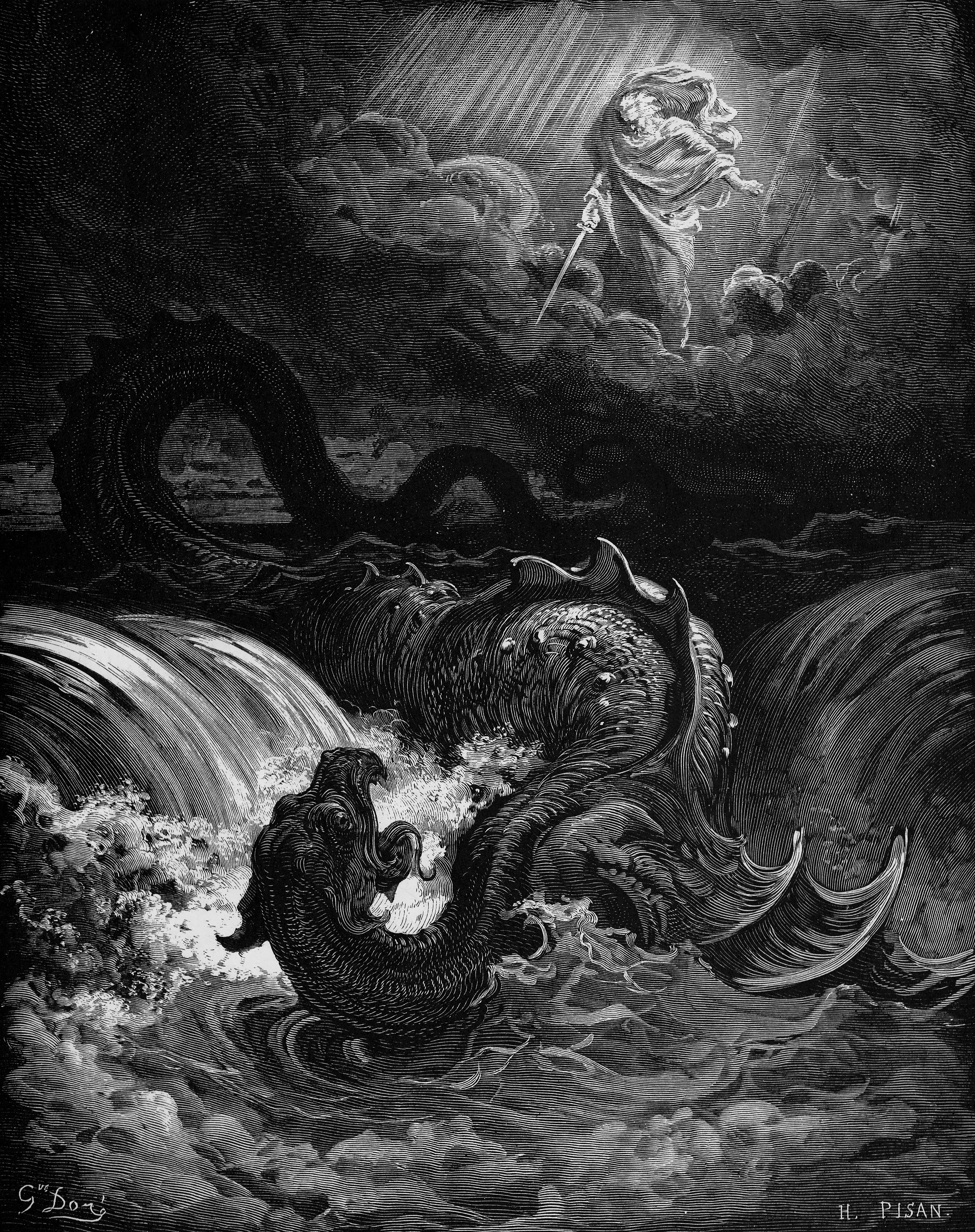
The DORs for Saturday the 11th also included Psalm 104:27, “There move the ships, and there is that Leviathan, which you made for the sport of it.”  Not only does this show that God has a sense of humor (type in “God sense of humor” in the Search Engine above), it also refers to “a sea monster referenced in the Tanakh, or the Old Testament,” and specifically in the Book of Job (as shown below).  See On Job, the not-so-patient and also Leviathan – Wikipedia:

The word has become synonymous with any large sea monster or creature.  In literature (e.g., Herman Melville‘s Moby-Dick) it refers to great whales, and in Modern Hebrew, it simply means “whale.”  It is described extensively in Job 41 and mentioned in Psalm 104:26 [104:27 in the Revised Standard Version] and Isaiah 27:1. 

On the note of God having a sense of humor, see Psalm 2:4, from the DORs for Monday, October 13, “He whose throne is in heaven is laughing; the Lord has them in derision.”

Then there’s Psalm 2:7, in the KJV, “I will declare the decree: the LORD hath said unto me, Thou art my Son; this day have I begotten thee.”  One website said this:

Another psalm utilized often in the New Testament is Psalm 2, particularly verses 7–8:  “The Lord said to me, ‘You are my Son; today I have begotten you.  Ask of me, and I will make the nations your heritage…’”  The apostles even interpret their persecution in light of the “raging of the nations” against Christ, the appointed King, as described in Psalm 2:1–2 (Acts 4:25–28), and Christ Himself, when He commands the apostles to disciple … in the Great Commission (Matt. 28:18–20) … claiming the post-resurrection promise of God to the King He has installed in Zion: “Ask of me and I will make the nations your heritage” (Ps. 2:8).  The author of Hebrews utilizes Psalm 2:7 to develop the glory of Christ as the exalted High Priest (Heb. 5:5)…

See Jesus and the Psalms – Ligonier Ministries.  In other words, and as has been stated repeatedly in this format, “It pays to know the psalms!”

And finally, of Psalm 99 – the one for next Sunday the 19th – it has been written, “There are three psalms which begin with the words, ‘The Lord (JEHOVAH) reigneth.’ (Psalms 93, 97, 99.) This [Psalm 99] is the third and last of these Psalms; and it is remarkable that in this Psalm the words He is holy are repeated three times (Psalm 99:3, 5, 9).”  See Treasury of David—Psalm 99 – The Spurgeon Archive, and also Psalm 99 Commentary by James Limburg:

As to genre, this is an enthronement psalm.  There are two types of psalms associated with kingship in ancient Israel.  The royal psalms are associated with events in the life of Israel’s king, such as a royal wedding (Psalm 45) or the installation of a new king (Psalms 2, 72, 101, 110)…   There are seven psalms that speak of the Lord being acclaimed king at some sort of festival.  These are called the enthronement psalms and include Psalms 47, 93, 95-99.

Note too that Psalm 99 begins and ends with a note of proper awe and respect:  “The LORD is King; let the people tremble; * He is enthroned upon the cherubim; let the earth shake.”  And verse 9,  “Proclaim the greatness of the LORD our God and worship him upon his holy hill; * for the LORD our God is the Holy One.”


The upper image is courtesy of Psaltery – Wikipedia, with the full caption:   “A woman playing a psalterion.  Ancient Greek red-figured pelike from Anzi, Apulia, circa 320–310 BCE.”

The lower image is courtesy of Leviathan – Wikipedia, the free encyclopedia, with the caption, “‘Destruction of Leviathan,’ 1865 engraving by Gustave Doré.”

On the readings for October 12

http://cinemacommentary.files.wordpress.com/2013/03/world4ufree1.jpg

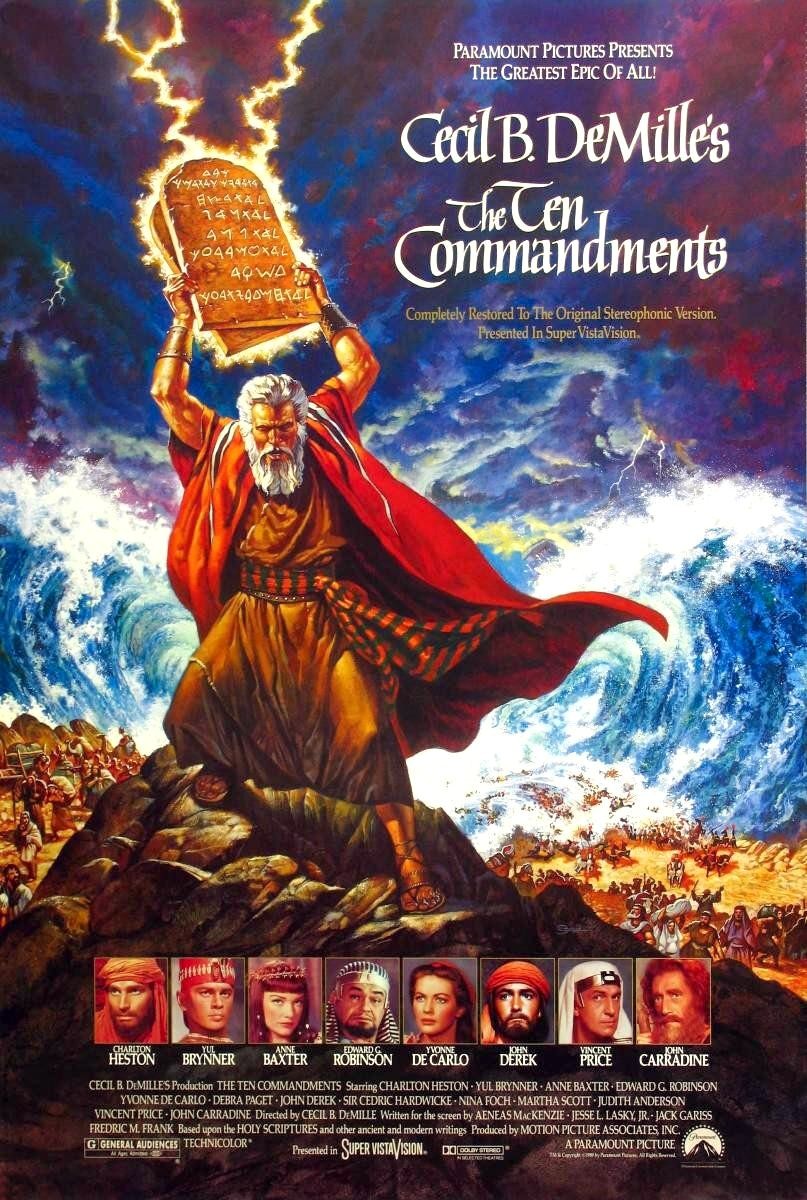
Moses doesn’t like this.   Moses doesn’t like this one bit…


The readings for Sunday October 12 are Exodus 32:1-14, Psalm 106 (portions), Philippians 4:1-9, and Matthew 22:1-14.  For Psalm 106, see On the Psalms up to October 12.  The full readings are at Eighteenth Sunday after Pentecost Proper 23, but here are some highlights.

Exodus 32:1-14 tells  what happened with the people of Israel as Moses was on Mount Sinai – for 40 days and nights – getting the original 10 Commandments.  In brief, they really messed up:

The Israelites feared that [Moses] would not return and demanded that Aaron make them … a “molten calf…”  Aaron built an altar before the calf and proclaimed the next day to be a feast to the LORD.  So they rose up early the next day … and the people sat down to eat and to drink, and rose up to play…   God told Moses what the Israelites were up to back in camp [and said He would ] destroy them and start a new people from Moses.  Moses argued and pleaded* … and God “repented of the evil which He said He would do unto His people.”

See Golden calf – Wikipedia.  (Incidentally, in the follow-up – Exodus 32:15-20 – “Moses went down from the mountain, but upon seeing the calf, he became angry and threw down the two Tablets of Stone,” as shown in the illustration above.  He then “burnt the golden calf in a fire, ground it to powder, scattered it on water, and forced the Israelites to drink it.”)

In Philippians 4:1-9, Paul followed up on last week’s reading (3:4-14), with an “appeal to rejoice in the Lord.”  He called on his followers to “stand firm in the Lord,” to let their gentleness “be known to everyone,” and to “not worry about anything.”  As the International Bible Commentary noted, this referred to “not being careless but free from the strain which turns so easily to distrust.”  Rather, the proper response is to let your requests be made known to God:

And God’s peace, which is far beyond human understanding, will keep your hearts and minds safe in union with Christ Jesus.  

In Matthew 22:1-14, Jesus told the Parable of the Great Banquet – Wikipedia, not to be confused with the Parable of the Wedding Feast – Wikipedia, which is only in Luke’s Gospel.  As Wikipedia noted, the “Banquet” parable appears in both Matthew 22:1-14 and Luke 14:15-24.  On the other hand, Luke’s rendition of the “Feast” parable – at Luke 14:7-14 – is designed to teach at least one different lesson, as told in Luke 14:11:  “For every one who exalts himself will be humbled, and he who humbles himself will be exalted.”

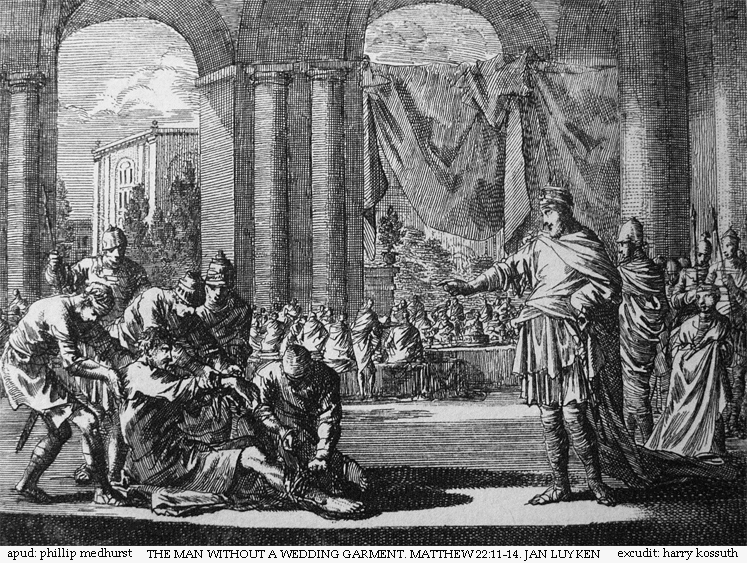
Getting back to today’s parable in Matthew, Jesus told of a king “who gave a wedding banquet for his son,” but the invited guests not only gave lame excuses, they also seized the king’s messengers, “mistreated them, and killed them.”  The king first got his revenge, noting that “those invited were not worthy.”  He then told his messengers go out in the streets and gather “all whom they found, both good and bad; so the wedding hall was filled with guests,” but one guest showed up in his street clothes.   As Wikipedia noted (in “Banquet,” above):

The targets of the parable are the already religious who have no time for God; they are represented by the people who accepted an invitation, but when the food is ready, claim they are too busy to turn up…   In Matthew, the parable immediately follows the parable of the Wicked Husbandmen, to which it is linked.  This connection helps to explain the treatment of the man without wedding clothes. (E.A.)

As generally interpreted, the “wedding invitation” symbolized Jesus extending the “Good News” first to His own people, but when they refused His invitation, that invitation was “extended to anyone and everyone, total strangers, both good and bad…   The gospel message, Jesus taught, would be made available to everyone,” to the Hebrews and to the Gentiles.  See What is the meaning of the Parable of the Wedding Feast?, which added:

[I]t is not because the invited guests could not come … but that they would not come…   The matter of the wedding garment is [also] instructive.  It would be a gross insult to the king to refuse to wear the garment provided to the guests. The man who was caught wearing his old clothing learned what an offense it was as he was removed…   This was Jesus’ way of teaching the inadequacy of self-righteousness.

Which is another way of saying that not only “if it was easy anybody could do it,” but that if your spiritual pilgrimage is too easy, you’re probably not doing it right, because:

It is to vigour rather than comfort that you are called.


The upper image is courtesy of cinemacommentary.com/category/biblical-epics/.   See also On Moses and “illeism”, which showed another version of the image, and is where the caption came from.

Re:  “Moses argued and pleaded…”  See also On arguing with God.

The lower image is courtesy of Parable of the Great Banquet – Wikipedia, with the caption, “Jan Luyken: the man without a wedding garment, Bowyer Bible.”

Re: “It is to vigour…”  See A quick summary, above.

On the Psalms up to October 12

“A woman playing a psalterion,” an instrument used to accompany psalms

This feature focuses on next Sunday’s psalm, and on highlights from the psalms in the Daily Office Readings (DORs) in the week leading up to that upcoming Sunday.  The general plan is to review next Sunday’s readings on the Wednesday before, and to review the psalms from the DORs for the week ending on the Tuesday just before that “prior Wednesday.”

The Lectionary Page  psalm for Sunday, October 12, is Psalm 106:1-6, 19-23.  The highlighted DOR psalms are from the readings for Wednesday October 1 up to Tuesday October 7.

Psalm 106:1-6, 19-23 will be discussed below, but here are some highlights from last week.

The DORs for Thursday, October 2 included Psalm 105 – a psalm I covered in On the readings for August 31- Part II.  That post in turn covered the so-called Curse of Ham – Wikipedia:

[I]n later centuries, the narrative was interpreted by some Jews, Christians and Muslims as a curse of, and an explanation for, black skin, as well as slavery.

But – as I also noted – a strict interpretation of the plain meaning of the Bible would mean “all those years it should have been Egyptians working in those cotton fields.”

The Daily Office Readings for Tuesday, October 7, included Psalm 127:4-6

Children are a heritage from the Lord,
    offspring a reward from him.
Like arrows in the hands of a warrior
    are children born in one’s youth.
Blessed is the man
    whose quiver is full of them.

This passage from Psalm 127 gave rise to Quiverfull, a movement among some conservative Protestant couples, promoting child-bearing and seeing “children as a blessing from God.”  Its followers eschew “all forms of birth control, including natural family planning and sterilization,” and are sometimes known simply as “QF Christians.”  See Quiverfull – Wikipedia.   That movement in turn came under the heading “of taking the Bible too literally, not to mention ‘out of context,'” in the prior post On snake-handling, Fundamentalism and suicide – Part I, which added this:

Further information on the “Quiverfull Movement” can be found at sites including Quiverfull – Wikipedia[;] What Is Quiverfull? [;] 5 Insane Lessons from My Christian Fundamentalist Childhood ;  and/or QuiverFull .com :: Psalm 127:3-5.

The DORs for Saturday, October 4 included Psalm 33:12, as shown in the image below. As to Psalm 106:1-6, 19-23, the one for this upcoming Sunday, here’s what one website said:

This Psalm begins and ends with Hallelujah – “Praise ye the Lord.”  The space between these two descriptions of praise is filled up with the mournful details of Israel’s sin, and the extraordinary patience of God…    It is, in fact, a national confession, and includes an acknowledgment of the transgressions of Israel in Egypt, in the wilderness, and in Canaan, with devout petitions for forgiveness.   

See Psalm 106Commentary – The Treasury of David.  But as always, there is a key point to remember, in this case from verse 1:  “Give thanks to the LORD, for he is good, for his mercy endures for ever.”   Or as noted in the “Commentary” above:

While we are studying this holy Psalm, let us all along see ourselves in the Lord’s ancient people, and bemoan our own provocations of the Most High, at the same time admiring his infinite patience, and adoring him because of it.


The upper image is courtesy of Psaltery – Wikipedia, the free encyclopedia, with the full caption:   “A woman playing a psalterion.  Ancient Greek red-figured pelike from Anzi, Apulia, circa 320–310 BCE.”

The lower image is courtesy of, and/or may be seen at, www.thefellowshipsite.org/psalm-3312.html.

There’s not a whole lot more you can add to that…


On the readings for October 5 – Part II

One take on the “Parable of the Wicked Husbandmen,” as told by Jesus in the Gospel…


Welcome to DORScribe, a blog about reading the Bible with an open mind.


In other words, this blog is different.

It says you can learn more by reading the Bible with an open mind, and also that the Bible was written to liberate, not shackle you it into some kind of “spiritual straitjacket.”

Such ideas run contrary to some common perceptions: 1) that too many Christians are close-minded; 2) that too many are negative; or 3) that too many think The Faith is about following their rules on pain of your “going to hell”.   (See my way or the highway – Wiktionary.)

For more on such thoughts see About this Blog, which talks instead about the Three Great Promises of Jesus, to all people, and about how through those promises we can live full, rich lives of spiritual abundance and do greater miracles than Jesus, if only we open our minds


In the meantime:

As noted in On the readings for October 5 – Part I, next Sunday’s readings are from Exodus 20, Psalm 19, Philippians 3:4b-14, and Matthew 21:33-46.   “Part I” covered the Old Testament reading, and here are some highlights from the New Testament and Gospel.  (The full readings are at Seventeenth Sunday after Pentecost Proper 22. )

The New Testament reading is Philippians 3:4b-14, where Paul first gave his credentials; “a Hebrew born of Hebrews; as to the law, a Pharisee; as to zeal, a persecutor of the church; as to righteousness under the law, blameless.”  But he added that he gave all that up “because of the surpassing value of knowing Christ Jesus my Lord…  I press on toward the goal for the prize of the heavenly call of God in Christ.”  (See also Epistle to the Philippians – Wikipedia.)

Here’s a take on this week’s New Testament reading from Atlanta Bishop Robert Wright, using the metaphor of football teams specializing in either offense or defense:

Many sports have two components: offense and defense.  Defense means you do everything you can to prevent your opponent from scoring…  Offense is different. On offense you use your wits, experience, athleticism and skill to score…    In response to the advance of modern culture some in the church have locked into a defensive mode…  But the Bible says God is always on offense…   God dispatches truth-telling men and women; that’s offense…    God defeated death with love on the Cross…   With this insight into God’s character, [it’s] no surprise Paul said, “I press on toward the goal for the prize….”   Philippians 3:14

See Episcopal Diocese of Atlanta, Georgia (GA), under “For Faith,” for October 3, 2014.

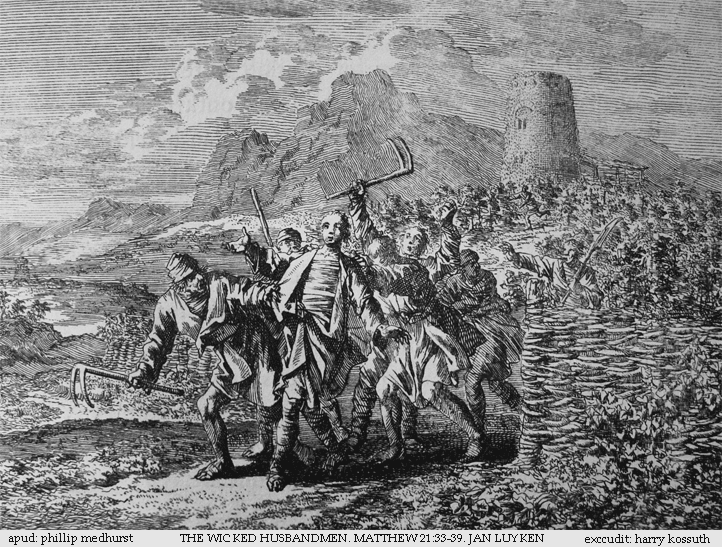
In the Gospel reading, Matthew 21:33-46, Jesus told another parable, the Parable of the Wicked Husbandmen – Wikipedia.   This parable was about the chief priests and Pharisees, given in Jerusalem “in the Temple during the final week before the death of Jesus.”

Wikipedia noted the “description of the vineyard is from Isaiah 5” (see the notes below), while Isaac Asimov said the passage demonstrated Jesus’ quick wit and/or His Talmudic reasoning.  Asimov added that it became increasingly clear to the “powers that be” that Jesus was a threat; “Galilean backwoodsman or not, He had a quick wit and a fund of ready quotations.   Yet He had to be stopped…”  (Asimov, 865-67)   Then Wikipedia added another interesting tidbit:

There also seems to be a direct historical reference by Jesus to Sennacherib, king of Assyria, some 700 years previous.  Sennacherib conquered Babylon at the time that Hezekiah was king of Judah, and set up several rulers over the city, all of whom were overthrown.  Finally, he sent his son and heir apparent Assur-nadin-sumi to rule, but after a short time, he was also killed.  Finally, Sennacherib himself went to Babylon and destroyed the city stone by stone, and placed a curse on it that it should not be rebuilt for seventy years.

At any rate, the passage ends like this:  “When the chief priests and the Pharisees heard his parables, they realized that he was speaking about them.  They wanted to arrest him, but they feared the crowds, because they regarded him as a prophet.”

In other words, Jesus’ time here on earth was running out…


The upper image is courtesy of Parable of the Wicked Husbandmen – Wikipedia, with the caption, “The Wicked Husbandmen from the Bowyer Bible, 19th century.”

The lower image is courtesy of Book of Isaiah – Wikipedia, which included this visual interpretation of Isaiah, by Michelangelo, circa 1508-12), at the Vatican; “Vatican CitySistine Chapel ceiling.”

As to Isaiah Chapter 5, the New International Version (NIV), labels it “The Song of the Vineyard,” while the Expanded Bible (EXB) uses the phrase, “Israel, the Lord’s Vineyard.”   The English Standard Version calls it “The Vineyard of the Lord destroyed.”  Here’s the Living Bible (TLB) translation of Isaiah 5:1-2:  

Now I will sing a song about his vineyard to the one I love.  My Beloved has a vineyard on a very fertile hill.  He plowed it and took out all the rocks and planted his vineyard with the choicest vines.  He built a watchtower and cut a winepress in the rocks.  Then he waited for the harvest, but the grapes that grew were wild and sour and not at all the sweet ones he expected.

So whether Jesus was referring to Isaiah 5 or King Sennacherib in His parable today, He certainly knew His Scripture, or His history, or both.  See also George Santayana – Wikiquote, “Those who cannot remember the past are condemned to repeat it.”


For more on the “Talmudic reasoning” demonstrated by Jesus in the Gospel, see articles including see Talmudic Humor and the Establishment of Legal Principles, and/or Talmudic Reasoning: From Casuistics to Conceptualization ….

The Isaac Asimov quotes are from  Asimov’s Guide to the Bible (Two Volumes in One),  Avenel Books (1981), at pages 865-67.