Category Archives: Daily Office readings

Background and color commentary on highlighted readings from the Daily Office Lectionary

On praying in public

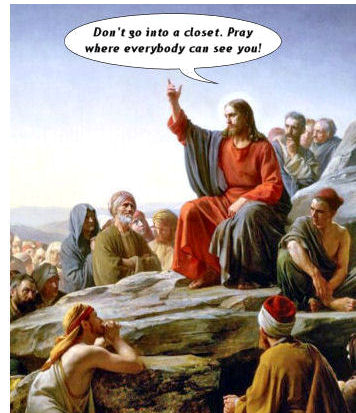
http://www.themonastery.org/blog/wp-content/uploads/2012/02/Jesus-Prayer.png

An illustration of the rhetorical device of irony


The caption above is ironic because Jesus said exactly the opposite – literally – in Matthew 6:6.  In the King James Version – the Bible that God uses – Jesus said in Matthew 6:6, “And when thou prayest, enter into thy closet…”

Matthew 6:6 is part of the Daily Office Reading (DOR) for Monday, May 19.  The full reading was Matthew 6:1-6, and 16-18, which began with Jesus saying, “Beware of practicing your piety before others in order to be seen by them.”  Instead, “when you give alms, do not let your left hand know what your right hand is doing.”

That passage gave rise to the  common English expression, “the left hand doesn’t know what the right hand is doing.”   And while the phrase is now “generally a term of derision for an organization where different members are pursuing opposing or contradictory goals,” in the passage in Matthew, Jesus arguably presented such “lack of coordination as an ideal.”

(So much for “strictly” interpreting the Bible.)

Jesus began on the matter of praying in public one verse earlier, in Matthew 6:5:

“…whenever you pray, do not be like the hypocrites; for they love to stand and pray in the synagogues and at the street corners, so that they may be seen by others.  Truly I tell you, they have received their reward.  6But whenever you pray, go into your room and shut the door and pray to your Father who is in secret…”

That brings up the recent Supreme Court decision, Town of Greece v. Galloway.  It prompted a blog-post by Frank Kirkpatrick of the Huffington Post, The Hollowness of Public Prayer.  Kirkpatrick noted an alternative to trying to distinguish merely-ceremonial prayer from prayers with substance, as the Supreme Court seemed to do.  “Far better to prohibit any and all prayers, substantive and ceremonial, from public gatherings. Let the faithful pray before they come to the meetings or afterwards or perhaps silently during them.”

Then there’s school prayer.  One website said, “Perhaps no aspect of the church-state controversy arouses more emotion and discussion than the subject of prayer in the public schools.”  See School Prayer: News – Secular Web, and School prayer – Wikipedia, the free encyclopedia.   But see also Prayer in School Affects all of Society | Creation Today:  “Since prayer was eliminated from public schools, the quality of education has shown a steady statistical decline.  Is there a link between the two?

(As to, “is there a link?” see Post hoc ergo propter hoc – Wikipedia, the free encyclopedia.  Under that reasoning, it could be said since the Roman Empire collapsed shortly after Emperor Constantine converted to Christianity, that was the cause of the collapse, but we digress…)

To review: on the one hand some say that praying should be done in private, while others say that public prayer – especially prayer in schools – would both set a necessary standard for students, and prevent the declining morality that’s been so evident in the years since 1962.

But what does the Bible say?

We know that from the DOR Gospel for Monday, May 19, 2014, to wit, Matthew 6:6:  “whenever you pray, go into your room [or closet] and shut the door…”

So what’s the “plain meaning” of this passage?

Christians who interpret the Bible “conservatively” – strictly or literally – should say that in a passage like this, the plain meaning of what Jesus said is perfectly clear.  As one website said, “The Bible must be interpreted literally which is the way language is normally and naturally understood.”  Or there is the Golden Rule of Interpretation:  “When the plain sense of Scripture makes common sense, seek no other sense; Therefore, take every word at its primary, ordinary, usual, literal meaning…”  See Do You Interpret the Bible Literally? – Middletown Bible church.  (Or you could just type “Bible plain meaning” in your search engine.)

That should be the end of the story, if you consistently apply the strict and conservative “plain meaning” of the words of Jesus in Matthew 6:6.  (See also, for example,  “The Bible says it, I believe it, that settles it, God said it, I believe it, that settles it : Dictionary of …, or – in a YouTube version – Homosexuality & The Bible 1: God Said It, I Believe It, That Settles It

But that great philosopher Henny Youngman might have summed it up best by saying:


Take school prayer…  Please!


Henny Youngman.jpg

The upper image is courtesy of http://d8rew5imyp13e.cloudfront.net/blog/wp-content/uploads/2012/02/Jesus-Prayer.png.   As to “alms,” see the Wikipedia article and/or alms definition of alms by the Free Online Dictionary, …

On “the left hand doesn’t know what the right hand is doing.”   See the Wikipedia article, Matthew 6:3 – Wikipedia, the free encyclopedia.


On “take school prayer…”    This refers to a classic Henny Youngman joke.  Youngman (1906-1998) was known for his one-liners, and his best-known was ‘Take my wife… please.’”   Henny Youngman – Wikipedia, the free encyclopedia.

An FYI:  The joke relied on the principle of dislocation, as used in comedy, but also in magic and the martial arts in general. See, Shinogi – Budotheory.ca, which mentioned three types of dislocation: positional, temporal, and functional.  And a magician of course is also known as an illusionist.  See the Wikipedia article, Magic (illusion) – Wikipedia, the free encyclopedia, and also Alex Davies – Dislocation.  Finally, see The Internet Classics Archive | The Art of War by Sun Tzu, which noted the saying of Sun Tzu (q.v.), the ancient Chinese philosopher who said, “The fundamental principle of the Art of War is deception,” or in other words, dislocating your opponent.

So anyway, in the classic one-liner – told literally “a century ago” – the audience was led to expect Youngman to say “for example” when he began; as in, “Take my wife… for example.”  But instead of saying “for example,” Youngman dislocated his audience by saying, “Take my wife…  Please!


On Moses and “illeism”

File:Bob Dole, PCCWW photo portrait.JPG

“Bob Dole doesn’t like that…*”


The Old Testament reading in the Daily Office for Saturday, May 17, is Exodus 40:18-38, where seven times Moses used the phrase:  “as the Lord had commanded Moses.”  That brings up illeism, the practice of referring to yourself in the third person.

Chapter 40 ends the Book of Exodus, the story of Moses, about Moses, and by Moses, and about his leading the Children of Israel out of Egyptian slavery and into freedom.

The next book, Leviticus, begins (in the King James Version; the one God uses), “And the Lord called unto Moses, and spake unto him out of the tabernacle of the congregation…”  As noted, tradition says that Moses wrote this book himself.

In the reading for Saturday, May 17, Moses built a “portable dwelling place” for God.

He set up the tabernacle, spread a tent over it and put a tent-covering over that, “as the Lord had commanded Moses.”    He took the Ark of the Covenant – as in “Raiders of the Lost Ark” – and put it in the tent, “and screened the ark of the covenant; as the Lord had commanded Moses.”  He put a table in the tent and “set the bread in order on it before the Lord; as the Lord had commanded Moses.”   Then he set up lampstand,  “as the Lord had commanded Moses.”   He put an altar in and “fragrant incense on it; as the Lord had commanded Moses.”  He set a screen in front and presented “the burnt-offering and the grain-offering as the Lord had commanded Moses.”   He set up a basin with water, so Moses, his brother Aaron and/or Aaron’s sons could wash before approaching the altar, “as the Lord had commanded Moses.”

This then was the portable dwelling place for God (as “modeled” below), as He went with the Hebrews in their 40 years of wandering, before they entered their Promised Land.

File:Stiftshuette Modell Timnapark.jpg

That brings up illeism, “referring to oneself in the third person instead of first person,” used as a stylistic device in literature, while in real life it can reflect “different stylistic intentions…”

Julius Caesar used the device in his Commentaries about the Gallic Wars, while Xenophon of Athens – from whom the term xenophobia derives – used it in Anabasis, “‘one of the great adventures in human history,’ as Will Durant expressed the common assessment.”

Both Caesar’s Commentaries and Anabasis were, as Wikipedia put it, “ostensibly non-fictional accounts of wars led by their authors,” who used the device “to impart an air of objective impartiality to the account, which included justifications of the author’s actions.  In this way personal bias is presented, albeit dishonestly, as objectivity.”

Another note: Tradition says Moses wrote the first five books of the Bible, also known as the Pentateuch or the Torah: Genesis, Exodus, Leviticus, Numbers, and Deuteronomy.  In those books Moses told the story of the Hebrew people, from the beginning of time up to the time Moses was about to die and the Hebrews were about to enter their Promised Land.

Which brings up a question.  In modern terms:  What did Moses know, and when did he know it?  When did Moses find out he was “on a mission from God?”  At the Burning Bush?  Before then, when he killed the Egyptian overseer?  More important, when did he start taking notes for this massive work, five of the most influential books in the history of the world?

So the better question might be:  When did Moses write, and when did he write it?

One answer is to ignore the question.  “The Bible says it, I believe it, that settles it.”  (Another way of saying, “For heaven’s sake, don’t make me think?“)  That approach seems to say super-heroes wrote the Bible and we shouldn’t even think we can become anything like them.

There is another approach.  At some point in his life, Moses had an experience that led him to believe he’d been spoken to by The Force That Created The Universe.  That experience changed the life of Moses and altered the course of history in a way seldom repeated.  And so you might think maybe – just maybe – the Bible was written by people very much like us, and the only difference is they – like Moses – had a “mystic experience with the Divine,” and we haven’t, yet.

Isn’t that what going to church should be about?  Isn’t that especially true because – as Jesus said in John 14:2 – He expects us to perform greater miracles than He did, and by extension, greater miracles than Moses?   (Of course that would mean a lot of work.) 

To be continued…


File:DeMilleTenCommandmentsDVDcover.jpg

Moses doesn’t like this. Moses doesn’t like this one bit…


*  The Bob Dole image is courtesy of Wikipedia.   As for his habit of speaking of himself in the third person, see Urban Dictionary: Bob Dole, which defined him as:  “A guy who ran for president against Bill Clinton.  Known for speaking of himself in the third person…   [Example:] ‘Bob Dole doesn’t like this.  Bob Dole doesn’t like this one bit.'”

On the original tabernacle, see: Tabernacle – Wikipedia, the free encyclopedia.

Xenophobia is excessive and irrational fear of anything foreign. This fear is most often of foreign people, places or objects. People who are xenophobic may display fear or even anger toward others who are foreign. See What Is Xenophobia? – Psychology – About.com.
What did Moses know, and when did he know it?”   An allusion to the Watergate hearings. 
See Howard Baker – Wikipedia, the free encyclopediaIn 1973-74, Baker was a ranking minority member of “the Senate committee, chaired by Senator Sam Ervin, that investigated the Watergate scandal.  Baker is famous for having asked aloud, “What did the President know and when did he know it?”, a question given him by his counsel and former campaign manager, future U.S. Senator Fred Thompson.”   Another site noted that the question “became a Washington mantra.”    For a 36-second clip, see Howard Baker asks Dean what did the president know and when did

On Jethro inventing the supreme court

https://itsallsatire247.files.wordpress.com/2010/06/jethro.jpg

Not Jethro Bodine. . .

http://upload.wikimedia.org/wikipedia/commons/e/ed/Jethro-Tull-cropped.jpg

. . . nor even Jethro Tull . . .

came up with the basic idea behind today’s Supreme Court.  That would have been “the original Jethro,” the one mentioned in the Old Testament part of the Daily Office reading (DOR) for Monday, May 5, 2014, to wit:File:Jan van Bronchorst - Jethro advising Moses - Google Art Project.jpg

The Jethro mentioned in the Old Testament DOR for May 5[, 2014]  was the father-in-law of Moses, who first advised Moses on the idea of delegating authority.

But first a bit of background.

Previous DORs told of Moses hightailing it out of Egypt after: 1) learning that he was not a prince of Egypt, as he’d been led to believe all his life, 2) learning that he was actually a member of Hebrew people, who were then serving as slaves in Egypt, and 3) after killing an Egyptian overlord who was beating a Hebrew slave.

He ended up in Midian, somewhere in the deserts of the Sinai and/or Arabian peninsula, where he met Jethro, a priest of Midian in his own right, and married Jethro’s daughter Zipporah.

But by and by (“in the fullness of time”), Moses went back to Egypt after his ten-year exile and eventually – after persuasions including the Ten Plagues – got the Pharoah of Egypt to “let my people go.”  (All of which was covered in the Daily Office readings leading up to the one for May 5.)   We are now in Exodus 18, with the Children of Israel still wandering in wilderness before getting to The Promised Land, and after the incidents of God providing water-from-the-rock at Massah and/or Meribah, and providing manna and quail to eat.

In the reading for Sunday, May 4, Moses – upon his return to the land of Midian – “told his father-in-law all that the Lord had done to Pharaoh and to the Egyptians for Israel’s sake, all the hardship that had beset them on the way, and how the Lord had delivered them.”  In other words, Jethro welcomed his son-in-law back to Midian with open arms.

Then, in the reading for Monday, May 5 (Exodus 18: 13-27), Jethro watched as Moses tried to settle all the disputes that were coming up as the Children of Israel were still wandering around in the desert wilderness (with tempers no doubt getting extremely short).   And Jethro could see that Moses was wearing himself out in the process.

In today’s terms Moses was suffering burnout:  “someone who has become very physically and emotionally tired after doing a difficult job for a long time.”  So Jethro told Moses:

“What you are doing is not good.  18You will surely wear yourself out, both you and these people with you.  For the task is too heavy for you; you cannot do it alone.”

He advised Moses to appoint officers – in effect, lower-court judges – to settle the easier cases after teaching them the basic tenets of the law that was even then evolving in the wilderness, either as conditions dictated or as Moses had the law revealed to him by God (or perhaps a combination of both).   The passage continues:  “Let them sit as judges for the people at all times; let them bring every important case to you, but decide every minor case themselves.  So it will be easier for you, and they will bear the burden with you. . .

“So Moses listened to his father-in-law and . . . chose able men from all Israel and appointed them as heads over the people, as officers over thousands, hundreds, fifties, and tens.  And they judged the people at all times; hard cases they brought to Moses, but any minor case they decided themselves.”

And that, Dear Reader, is the basic idea behind the Supreme Court of the United States.  And that’s as set out in Article III, section 1 of the Constitution:  “The judicial power of the United States, shall be vested in one Supreme Court, and in such inferior courts as the Congress may from time to time ordain and establish.”

http://www.mediabistro.com/tvnewser/files/2012/01/supreme_court_building.jpgIn other words, that’s the basic idea behind the Supreme Court.  That it will deal with “hard cases,” leaving minor cases for lower courts.
On the other hand, see such recent books as Playing It Safe: How the Supreme Court Sidesteps Hard Cases and Stunts the Development of Law, by Lisa Kloppenberg.

The title alludes to the old legal adage that hard cases make bad law.

That phrase in turn is frequently attributed to Justice Oliver Wendell Holmes, Jr.  However, according to Wikipedia it was earlier used by a judge in the 1842 English case, Winterbottom v. Wright.  Wikipedia also cited legal scholar Glanville Williams, “What is certain is that cases in which the moral indignation of the judge is aroused frequently make bad law.”

On the other hand, Moses didn’t have a legislature to help him, nor did he have power separated into three different branches of “government;” legislative, executive and judicial, and that of the three the judicial – arguably deciding hard cases – was to be “the least dangerous branch.”  See e.g., What is the Proper Role of the Courts (by The Heritage Foundation).

All of which raises the question: Is the Bible “frozen in time,” or is it a living breathing document whose story continues “even to this day?”  In other words:  Is the Bible “grand and eternal” because it provides us with an anchor in a sea of shifting values?  Or is the Bible great because of its flexibility and ambiguity, which to some people attests to its ability to “grow and progress” along with society’s evolving sense of justice?

Put another way, does the Bible provide a set of “rock-ribbed rules” which must be followed every single day, on pain of suffering hellfire-and-damnation?  (As illustrated below.)  Or instead does the Bible provide a series of general principles that provide guidance from the past, and which should be adapted to the challenges of the present. . .

That’s a subject for future posts.

Notes and references:

The Jethro Bodine image is courtesy of itsallsatire247.files.wordpress.com/2010/06/jethro.jpg.

The “Jethro Tull” image is courtesy of Wikipedia, as is the image of “Jethro advising Moses,” a 1659 painting by Jan van Bronchorst.

The “burnout” definition was provided by www.merriam-webster.com/dictionary/burnout.

The original post had a lower image is courtesy of Fire and brimstone – Wikipedia. The caption:  “A 19th-century illustration of Sodom being destroyed by fire and brimstone, while Lot and his family escape.”

On “tables of content”

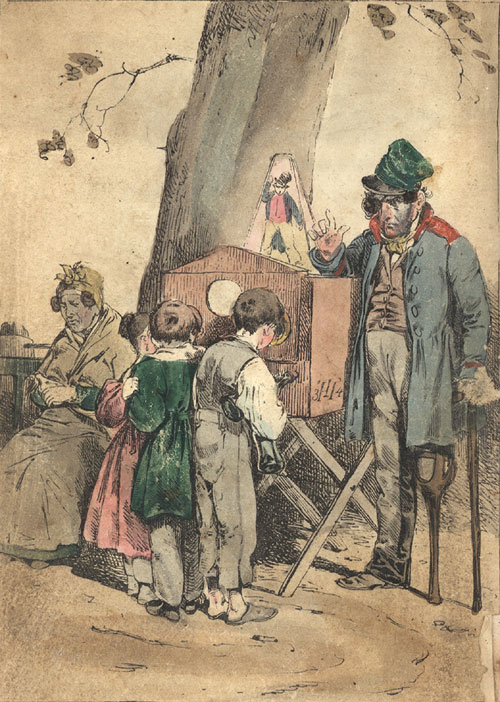
“A boy looks into a peep show…”


Here’s a bit of information you may not have known, about tables of content:

Pliny the Elder credits Quintus Valerius Soranus [ – who died in 82 B.C. and who is shown at lower left – ] as the first author to provide a table of contents to help readers navigate a lengthy work.  Pliny’s own table of contents for his encyclopedic Historia naturalis (“Natural History”) may be viewed online in Latin and in English (following dedication).

On the other hand, such a list of contents could be seen as a kind of “peep show,” as illustrated in the top image.  (That is, it offers you a glimpse of “what’s inside…”)  In other words, such a table -applied to this blog – can let you know what to expect to see.

In another sense this page – and the blog itself – is all about color commentary.  That is, one object of this blog is to provide color commentary on the Bible.  (With an eye to going “beyond the fundamentals…”)  And generally that means commentary on the readings for the upcoming Sunday.

(According to the Revised Common Lectionary.)

It also spends time on the psalms. (Which are almost as key to spiritual growth as the Gospels. For more on that see On the Psalms.)  Another aside:  If you’d like a book collection of these blog-posts – in either an e-book or old-fashioned paperback – check out the post, For a book.

For starters, you can get a a flavor of the blog by checking the category Not your daddy’s Bible.

Or see the post from October 2014, “Gone Girl” and Lazy Cusses – Part II, with Sting – at right – commenting on “religion and religious people:”

I don’t have a problem with God.  I have a problem with religion.  I’ve chosen to live my life without the certainties of religious faith.

I commented:  “If your religion makes you ‘certain, ’you’re missing the point!”  See also On “holier than thou”  and On three suitors (a parable).  (The latter cited a lady Muslim mystic, Rabia Basri).

For another vie, see “Holier than thou,” quoting H. L. Mencken, on “quacks:”

The only way that democracy can be made bearable is by developing and cherishing a class of men sufficiently honest and disinterested to challenge the prevailing quacks.

Which is pretty much what this blog is about.  That’s why I say, “There are way too many so-called Christians who use the Bible and their faith as an excuse to close their minds.  That’s why the sub-title to this blog is ‘Reading the Bible to expand your mind.’”

Or see On “expressio unius,” which said those fundamental readers who focus exclusively on the “letter of the law” pretty much rob the Bible of its intended effect.

Citing 2d Corinthians 3:6 and John 4:24, that post-column said such passages show “God doesnot want Good Christians to limit their reading, interpreting and living according to the Bible to a spirit-killing literalism

Stoning of Moses, Joshua and CalebOr see On Moses getting stoned, on why Moses may have had to “dumb things down” when writing the Torah

The blog also reviews the Daily Office Readings from time to time.  See Daily Office readings.  And by the way, the Daily Office Readings is where the “DOR” in “Dorscribe” comes from.  (For more on the Daily Office Readings, see DOR?)

There’s also a category, Reviews.  Like the two-part “Gone Girl” movie review and Media Frenzy:

Shortly after Joe [Namath] signed with the Jets (for a record salary), a wise-guy New York reporter asked what he had majored in, down south at the University of Alabama; “Basket-weaving?”   Joe answered, “No man, I majored in journalism.  It was easier.”

In case I’m being too subtle, the point is that there’s a lot of wisdom in the Bible about not judging too quickly, and not getting caught up in today’s “media frenzies.”

Which is another way of saying there are more than enough quacks to challenge these days…

https://greatmindsonrace.files.wordpress.com/2011/10/henry-louis-mencken.jpg

H. L. Mencken, the original “quack-challenger…”


The upper image is courtesy of Peep show – Wikipedia, the free encyclopedia.  The caption:  “A boy looks into a peep show device (illustration byTheodor Hosemann, 1835).”  The article noted that while the term now generally applies to pornographic showings, “historically a peep show was a form of entertainment provided by wandering showmen.”

For a more traditional table of contents, consider the one at left.  (Christmas Carols, New and Old, published in 1867, and courtesy of hymnsandcarolsofchristmas.com.)  The book was published by the Reverend Henry Ramsden Bramley (1833-1917) and Sir John Stainer (1840-1901).   For more on the pair see Henry Ramsden Bramley – Wikipedia, and John Stainer – Wikipedia.  The updated version of the first eight hymns/carols are included below (after the rest of the notes).

Re:  The RCL.  “A lectionary is a collection of readings or selections from the Scriptures, arranged and intended for proclamation during the worship of the people of God…”  For more see About the Revised Common Lectionary (RCL) – Consultation on Common Texts, and Revised Common Lectionary – Wikipedia.

Re: “muling it over.”  The actual expression would be “mulling it over,” meaning tothinkabout, ponder or worry about something.  (In the alternative, to “think about (a fact, proposal, orrequest) deeply and at length: [as in:]  “she began to mull over the various possibilities.”  The variation-on-a-theme came from John Steinbeck’s Travels with Charley.  

The quote is from the 1980 Penguin Books edition, at page 11.  Steinbeck wrote of packing“Rocinante” for a trip around America, and his capacity for self-delusion.  He packed ample – and heavy – writing supplies, including reams of paper, a typewriter, and “enough writing material to write ten volumes.”  This despite 30 years experience:  “I cannot write hot on an event.  It has to ferment.  I must do what a friend calls ‘mule it over’ for a time before it goes down.”

An additional FYI:  “TWC” was based on Travels with a Donkey in the Cévennes (1879), by Robert Louis Stevenson (Wikipedia), of which more in posts including Donkey travel – and sluts.

Re: quote from Sting.  See 10 Questions for Sting – TIME.

The lower image is courtesy of greatmindsonrace.wordpress.com/2011/10/09/h-l-mencken, which spoke of Mencken’ssometimes cynical and acerbic writings attack[ing] the holy ideals of his age, including religion, business, government and the press.”   He knew he couldn’t change society; his goal was “to make life ‘measurably more bearable for the civilized minority in America.’”

The “quacks” quote is from Mencken’s 1956 book Minority Report.  See also Minority Report Quotes by H.L. Mencken – Goodreads.

*   *   *   *

Note that as originally published, this post was about the Bible readings for May 4, 2014.  The complete text of that post follows, but without the illustrations:

The RCL Bible readings for Sunday, May 4, are:

 Acts 2:14a,36-41,

Psalm 116:1-3, 10-17,

 1 Peter 1:17-23,

and,

Luke 24:13-35

The first reading, Acts 2:14a, 36-41, has been identified as the Apostle Peter’s Pentecostal Sermon.

Acts – also known as Acts of the Apostles – is the first book of the New Testament after the Gospels, and is generally attributed to the same Luke who wrote the third Gospel.  Notice that the reading for May 4 has the same beginning as the one for April 27: “Peter, standing with the eleven, raised his voice and addressed the multitude…”

Both readings take place right after “the day of Pentecost,” when the “gift of the Holy Spirit” was given to the newly-formed community of believers, many of whom “spoke in tongues.”   But note: they didn’t speak in the gibberish “tongues” often found in some of today’s churches.  The “speakers” spoke in a distinct, identifiable language so visitors from other countries got bewildered, “because each one heard them speaking in the native language of each.”  (Remember, the “speakers” were ignorant, backwater rubes from the boondocks of Galilee.)

But we’re getting ahead of ourselves. . .   The readings in the Easter Season – the season from Easter Day to Pentecost Sunday – are all from after the Day of Pentecost itself.    On June 8, 2014 (Pentecost Sunday), one of the non-Gospel readings will be from the beginning of Acts, Chapter 2 (which we may call editorial license).

Anyway, many of Peter’s listeners were “cut to the heart” and asked what to do.  Peter said repent and be baptized, so they too could get the gift of the Holy Spirit.  (A kind of “spiritual boot camp” drill instructor, but one able to balance tough love with humor and compassion…)

The reading ends, “So those who welcomed his message were baptized, and that day about three thousand persons were added.”

The International Bible Commentary (IBC) calls Psalm 116 a psalm of “thinking and thanking…  This beautiful psalm of thanksgiving owes its charm to the psalmist’s [personal] experience of God’s grace and its spiritual impact upon him.”

Which brings up the distinction between trying to prove the “truth” of the Bible by proving the actual physical existence of Noah’s Ark – for example – as opposed to proving its truth by showing what the Bible experience has done for you personally.

Take – for example – the man with the “legion” of demons, told in Mark 5:1-19 (that formed the basis for the 1973 film The Exorcist).   The story ends: “And he went away and began to proclaim . . . how much Jesus had done for him; and all men marveled.”

Note also page 339 of the Book of Common Prayer:  “we are very members incorporate in the mystical body of thy Son. . .”   That indicates the two sides of any Christian church:  the corporate, business, “bean-counting” side, as opposed to the side encompassing the Church’s true mission: fostering the mystical, personal experience in each and every church-goer, no matter how long that may take, but we digress. . .

Getting back to the readings, 1 Peter 1:17-23  begins like this: “If you invoke as Father the one who judges all people impartially according to their deeds, live in reverent fear during the time of your exile.”  The point being that a true Christian believes this life on earth is just a starting point, a jumping-off point for a better life ahead.

(See also Psalm 119: 19, “I am a stranger here on earth.”)

Sometimes – like New Jersey – Earth is a good place to be from.

The Gospel-reading will be discussed in the following post.