* * * *
* * * *
July 24, 2025 – Friday, July 25, is the feast day for James, son of Zebedee. He was one of the 12 Apostles, and tradition says he was the first to be martyred. (Around 44 A.D.) He was son of Zebedee and Salome, and brother of John the Apostle. He is James the Greater or James the Great to distinguish him from James, son of Alphaeus. (There were as many as eight “James” in the New Testament.) I’ve noted in past posts that this “July 25” James is also the Patron Saint of Pilgrims, which takes us back to my 2016 post St. James, Steinbeck, and sluts:
I’ve gone on a few pilgrimages in my time, and am fixing to go on another one… And in the Sluts post, I noted that in the spiritual literature of Christianity, the concept of pilgrim and pilgrimage may refer to “the inner path of the spiritual aspirant from a state of wretchedness to a state of beatitude…”
So what makes this timely? Just that this coming August I will do yet another pilgrimage. This one in England, hiking the Pilgrims’ Way, also known as the Canterbury Trail. (From Winchester to the cathedral in Canterbury. 16 days, with 14 hiking and two days off to relax a bit.) In doing so I’ll be relying on James as my patron saint. (Hey, I’ll take all the help I can get.)
Perhaps the best known pilgrim path is Camino de Santiago, which translates “Way of St. James.” It’s actually a network of such paths, mostly in Spain, and the Spanish word for James is “Iago.” (Thus, “Sant Iago.”) The two most popular Caminos are the Camino Francés, or French Way, and the Camino Portugués, or Portuguese Way. (And I’ve done both). They all lead to the “shrine of the apostle James in the cathedral of Santiago de Compostela in Galicia in northwestern Spain, where tradition holds that the remains of the apostle are buried.”
But this August my goal is the shrine of Thomas Becket – a.k.a. St. Thomas of Canterbury – at the same-named cathedral in Kent. So what’s the big deal about pilgrimage? One definition is “a journey to a holy place, which can lead to a personal transformation, after which the pilgrim returns to their daily life.” Then there’s what Pope (Emeritus) Benedict XVI said:
To go on pilgrimage is not simply to visit a place to admire its treasures of nature, art or history. To go on pilgrimage really means to step out of ourselves in order to encounter God… Above all, Christians go on pilgrimage to Compostela [for example], which, associated with the memory of Saint James, has welcomed pilgrims from throughout the world who desire to strengthen their spirit with the Apostle’s witness of faith and love.
But back to James himself: He was one of the first disciples to join Jesus – see Matthew 4:21-22 and Mark 1:19-20 – and one of only three who Jesus chose to witness His Transfiguration. Tradition says he went to Spain to spread the Gospel there. (He’s also patron saint of Spain and Portugal.) Specifically, that tradition tells of an event on January 2, 40 A.D.:
[T]he Virgin Mary appeared to James on the bank of the Ebro River at Caesaraugusta, while he was preaching the Gospel in Iberia. She appeared upon a pillar, Nuestra Señora del Pilar, and that pillar is conserved and venerated within the present Basilica of Our Lady of the Pillar, in Zaragoza, Spain. Following that apparition,* St. James returned to Judea, where he was beheaded by King Herod Agrippa I in the year 44.
Still more tradition: Legend holds that after his beheading by Herod, his remains were carried by boat from Jerusalem to northern Spain, where he was buried. (In what is now Santiago de Compostela, under the cathedral named for him.) And over the years Santiago has been the goal for hordes of pilgrims – hiking, biking or on horseback – who “follow its routes as a form of spiritual path or retreat for their spiritual growth.” Which is why – this time each year – I refer to St. James as the Patron Saint of Pilgrims. Which brings us back to Canterbury, and Becket.
In 1162 Henry II, King of England appointed Becket – his friend and sometime drinking companion – as Archbishop of Canterbury. (Mostly because Henry thought the new archbishop would be more amenable to his interests.) Becket served as archbishop from 1162 until his death in 1170, and that death was precipitated by Henry’s disappointment. (Briefly, after Henry appointed him, Becket actually started to take his new job seriously.)
It took six years of long drawn-out drama – from 1164 to 1170 – but eventually Henry got so mad that he uttered the question so often attributed to him: “‘Will no one rid me of this turbulent priest?’ This inspired four knights to set off from the king’s court in Normandy to Canterbury, where on 29 December 1170, they murdered Becket.” But soon after his death, Henry regretted his words and in 1174 did a public act of penance at the site. That and later miracles said to occur there “transformed Canterbury Cathedral into one of the most important pilgrimage destinations in Europe.” And that’s where I’m heading in August.
Aside from all that, Becket was canonized by Pope Alexander III and so he is venerated as saint and martyr by the Catholic Church and the Anglican Communion. The latter includes the Episcopal Church – of which I am a member – and the Archbishop of Canterbury is the head of that worldwide Communion. So again, “that’s where I’m heading in August.”
I may not meet the Archbishop, but I will be able to see the Shrine of Thomas Becket. (Again; “we” visited it back in May.) Either way, as Psalm 84:4 says of God – in the BCP version – “Happy are the people whose strength is in you! Whose hearts are set on the pilgrim’s way.”
* * * *

* * * *
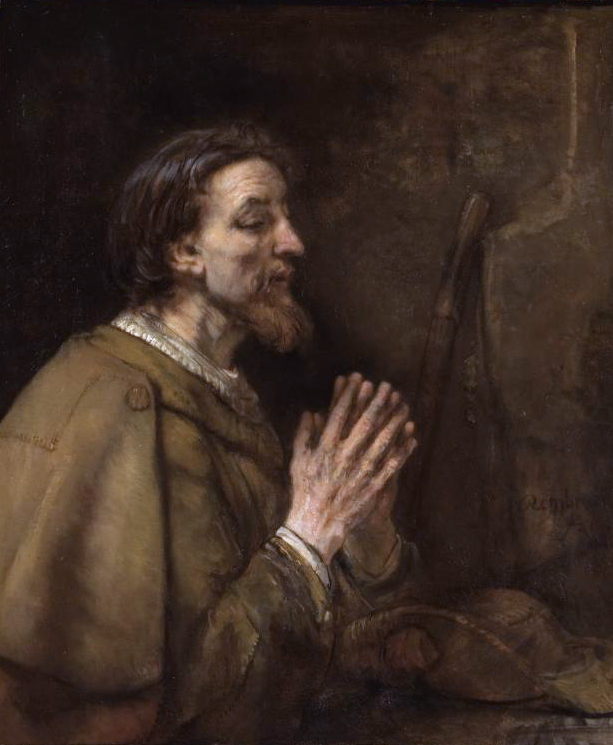
The upper image is courtesy of James, son of Zebedee – Wikipedia, with the full caption, “Saint James the Elder by Rembrandt[.] He is depicted clothed as a pilgrim; note the scallop shell on his shoulder and his staff and pilgrim’s hat beside him.”
The Book of Common Prayer reference: The “corporate-mystical” prayer is on page 339, the post-communion prayer for Holy Eucharist, Rite I.
Feast days are designated days on the liturgical (church) calendar “set aside to commemorate events, saints, or doctrines that are important in the life of the Church. These can range from Solemnities, which are the highest-ranking feast days like Easter and Christmas, to optional memorials that celebrate lesser-known saints.” Feast Days: Celebrating the Church’s Calendar.
For this post I borrowed from – or just reread – the following posts. 2014’s On returning from a pilgrimage – and the coming holidays, on an eight-day canoe trip 12 miles out in the Gulf of Mexico, camping on the occasional salt marsh and islands including Half-moon Island, Cat Island and the Ship Islands. (Primitive camping, as in “dig a hole and squat.”) Also from 2017’s On a pilgrimage in Spain, a prequel to my first official Camino hike: “In less than 24 hours I’ll be winging my way from Atlanta to Madrid… From there I’ll take a train to Pamplona, from whence my brother and I will hike 450 miles in 30 days. (On the Camino de Santiago.) Also, from August of 2019, St. James – and “my next great pilgrimage,” which cited the 2016 post, St. James, Steinbeck, and sluts. (And by the way, Robert Louis Stevenson used the now-offensive word in his 1878 book Travels with a Donkey in the Cévennes, but it had a different meaning back then.)
I also borrowed from – or just reread – from October 2019, On Saints James, Luke – and the lovelies of Portugal, which noted a hike on the Portuguese Camino, and also that there were between six and eight “James” in the New Testament. The post Saints Luke, and James of Jerusalem – 2021 noted a 17 day and 177 mile hike, from Saint-Jean in France, “over the daunting Pyrenees”to Burgos in Spain. And On James, “the Pilgrim’s Saint” – 2024.
“Compostela” in the Pope Benedict quote refers to Santiago de Compostela, the city with the cathedral said to hold the remains of St. James the Greater. In pilgrim terms, a “compostela” is the certificate “awarded to pilgrims for the past 1000 years. It is written in Latin and attests to the fact that you have successfully completed a religious pilgrimage… Do bear in mind that it is written in Latin, a bit like lawyers’ language.” The Compostela Translated into English – Camino de Santiago.
Re: James‘ vision. The quote “St. James returned to Judea“ seems to overlook the three-to-four years that he actually spent in Spain. But there is another legend, of “Our lady of the boat:”
According to tradition, after Jesus’ crucifixion, St. James traveled to the Iberian Peninsula to spread Christianity. His efforts were met with limited success, and he became discouraged… One night, while he was praying on the coast near Muxía, the Virgin Mary appeared to him… She arrived in a stone boat, accompanied by angels, to encourage him to continue his missionary work. The boat’s sail, mast, and hull were said to have turned into three large stones, which are still present near the sanctuary today… This miraculous event bolstered St. James’ resolve, and he continued his mission, eventually becoming the patron saint of Spain.
From Muxía and Our Lady of the Boat – ethanrayd.blogspot.com. BTW: That’s a place I visited during my 2024 hike in Spain, on the Camino Finisterre and Camino Ingles: Route, Map & Stages | English Way – Pilgrim. But strangely enough I didn’t do any posts on that pilgrimage; a lapse I will have to rectify when I get back home this September.
On Thomas Becket, see also Becket controversy – Wikipedia. As to Henry regretting his words, see Thomas Becket: the murder that shook the Middle Ages: “Henry II, in a public act of penance for his involvement in the murder, visited the tomb in 1174, granting royal approval to Becket’s cult. Becket’s death and subsequent miracles transformed Canterbury Cathedral into one of the most important pilgrimage destinations in Europe.”
Re: The pilgrim’s way psalm. In the BCP psaltery it is Psalm 84:4. In the Bible Hub version it is Psalm 84:5, with the New Living Translation saying, “What joy for those whose strength comes from the LORD, who have set their minds on a pilgrimage to Jerusalem.” With Commentary adding:
The concept of pilgrimage in this context refers to the journey to the temple in Jerusalem, a central aspect of Jewish worship and religious life. Pilgrimages were times of spiritual renewal and reflection… The heart being set on pilgrimage indicates a deep, inner desire to seek God and His presence, reflecting a commitment to spiritual growth and devotion. This journey can also be seen as a metaphor for the Christian life, which is often described as a journey or walk of faith (Hebrews 11:13-16). The pilgrimage motif connects to the broader biblical narrative of God’s people as sojourners and exiles, looking forward to a heavenly homeland..
The lower image is courtesy of Canterbury Cathedral Shrine Of Thomas Becket – Image Results.
* * * *