* * * *
* * * *
July 19, 2025 – Next Tuesday, July 22, is the Feast Day for Mary Magdalene. Which means that for the first time in a really long time I’m doing a Feast-Day post before that day rolls around. (I won’t explain it “ex post facto.”) Turning to this Mary – the name was quite common in Jesus’ time – she was said to be a prominent follower of Jesus and to have been healed by Him. She is also said to have supported His ministry financially, and was there at the Crucifixion and Burial. But while she played a key role among his female disciples, for the most part “there is limited information about her life.” And much of that was limited information was bad.
As the Collect for her day says, Jesus “restored Mary Magdalene to health of body and of mind, and called her to be a witness of his resurrection.” She did that, and set an example for us all.
And she did all that despite what some said was a sordid past and a really lousy reputation.
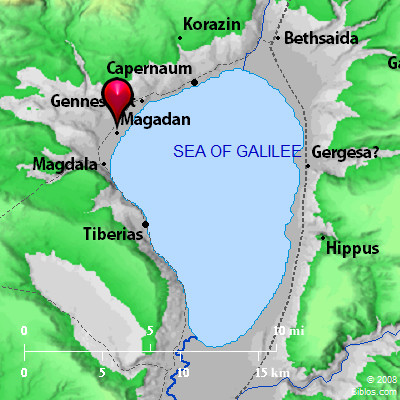
For starters, “Mary” was as noted an extremely common name at the time. This particular Mary was said to have been born in Magdala, which is where she got her name: “Mary from Magdala,” or Magdalene. Unfortunately it’s not clear where Magdala is, but most scholars assume it’s “the place the Talmud calls Magdala Nunayya.” (“Magdala of the fishes.”) And the consensus is also that this is the site noted in Matthew 15:39, on what happened after Jesus fed the 4,000:
And those who ate were four thousand men, besides women and children. And sending away the crowds, Jesus got into the boat and came to the region of Magadan. [Below left.]
As Wikipedia noted, this particular Mary has long had a bad reputation. In Western Christianity, she’s known as “repentant prostitute or loose woman.” But the consensus now is that such claims are unfounded. Consider what Isaac Asimov said.
He first noted that Magdala is usually considered a town on the western shore of the Sea of Galilee, and may have been a suburb of Tiberias. He also noted this Mary “has been considered, in tradition, to have been a prostitute and to have repented as a result of her meeting with Jesus.” (Thus the “devils” in Mark 16:9 and Luke 8:2 “might then be considered devils of lust.”)
Asimov also noted some confusion that arose from the placement of the story of Mary’s “devils” coming right after the story of the woman washing the feet of Jesus with her tears and drying them with her hair. Wikipedia also noted there’s long been a mix-up between Mary from Magdala and the “unnamed sinner who anoints Jesus’ feet in Luke 7:36-50:”
Mary Magdalene, the anointing sinner of Luke, and Mary of Bethany, who in John 11:1-2 also anoints Jesus’ feet, were long regarded as the same person. Though Mary Magdalene is named in each of the four gospels … none of the clear references to her indicate that she was a prostitute or notable for a sinful way of life, nor link her with Mary of Bethany.
Asimov put it this way: The sinner in Luke 7:36-50 “was, indeed, a prostitute in all likelihood,” but there was no direct link in the Bible between this woman and Mary Magdalene. He added that to be “possessed by devils” – as this Mary was said to be – would be considered today as “mental illness, rather than anything else.” Thus to Asimov, Mary Magdalene would be more accurately considered “a cured madwoman rather than a reformed prostitute.”
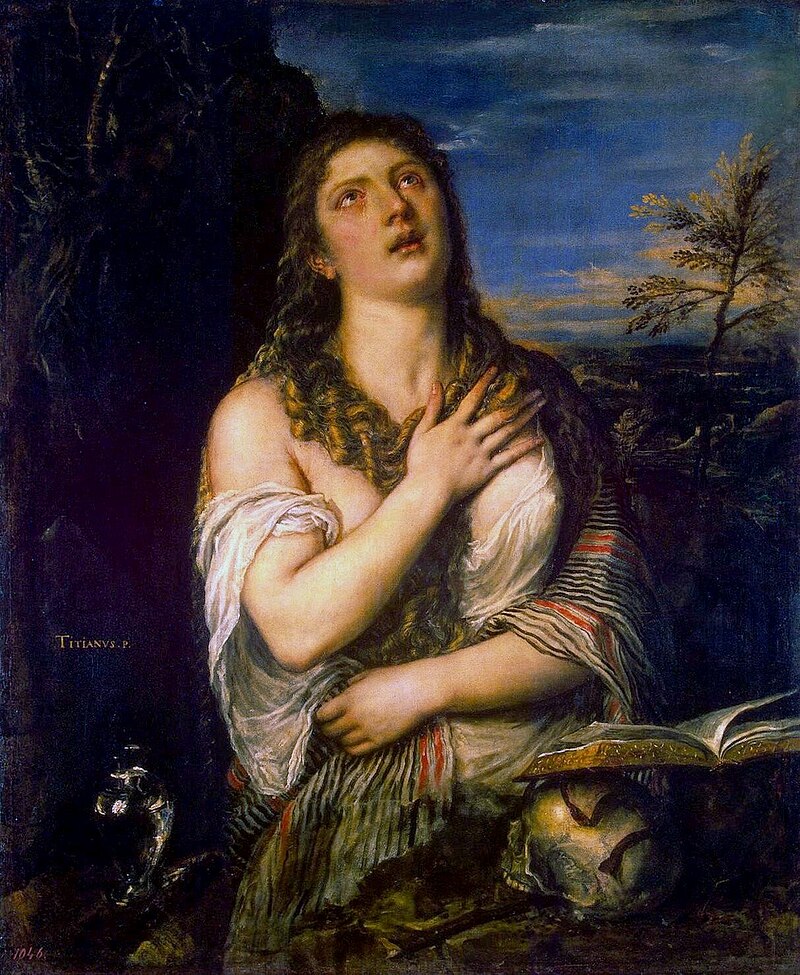
But wait, there’s more! She also gave us – inadvertently – the negative term “maudlin,” meaning effusively sad, full of self-pity or “extremely sentimental.” (“Maudlin” is an alteration of the name Magdalene, referring to this Mary as “frequently depicted as a tearful penitent,” as shown in the painting above.) But she overcame all that bad press by her own series of transforming pilgrimages. Unfortunately, much of that change-of-opinion happened long after she died.
That posthumous journey – in its way – led “to a personal transformation,” a transforming of how we see Mary today. For example, Mary of Magdala | FutureChurch noted that for centuries she was “perhaps the most maligned and misunderstood figure in early Christianity:”
Since the fourth century, she has been portrayed as a prostitute and public sinner… Paintings, some little more than pious pornography, reinforce the mistaken belief that sexuality, especially female sexuality, is shameful, sinful, and worthy of repentance. Yet the actual biblical account of Mary of Magdala paints a far different portrait than that of the bare-breasted reformed harlot of Renaissance art.
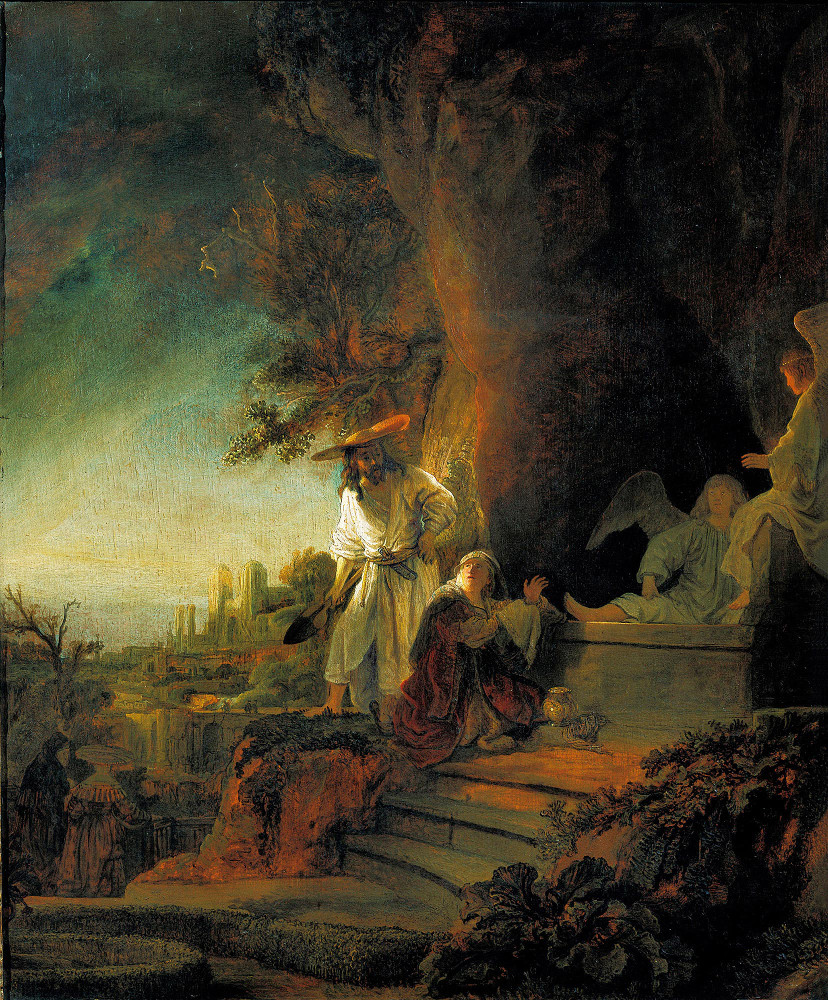
But if you think about it – and read the Gospels – this Mary showed tons more courage than the male disciples when push came to shove. While those 11 men cowered in their room, hiding lest the Romans punish them as well, Mary alone went to the empty tomb. John 20:1: “Early on the first day of the week, while it was still dark, Mary Magdalene went to the tomb and saw that the stone had been removed from the entrance.” Thus one indisputable fact about Mary is that she was both the first person to visit the empty tomb and the first person to see the risen Jesus. (John 20:11-16.) That’s why St. Augustine called her the “Apostle to the Apostles.”
Then too that may account for all the stories of her “sordid past.” Did jealous men – then and later – try to cover up their own cowardice or their own bias, by sullying her reputation? So one lesson from all this? Keep on “pilgriming.” Good results can keep coming even after you die!
But the important thing to remember is that this Mary personally experienced the Risen Jesus, and so was the first among the millions who’ve had that experience. As the Wesleyan Quadrilateral says, aside from Bible itself, a personal experience of the Risen Jesus “is the strongest proof of Christianity.” And Mary of Magdala was the first of all that followed.
* * * *
* * * *
The upper image is courtesy of wikipedia.org/wiki/Penitent_Magdalene_(Titian,_1565):
The Penitent Magdalene is a 1565 oil painting by Titian of saint Mary Magdalene, now in the Hermitage Museum in Saint Petersburg. Unlike his 1533 version of the same subject, Titian has covered Mary’s nudity and introduced a vase, an open book and a skull as a memento mori. Its coloring is more mature than the earlier work, using colors harmoni[z]ing with character. In the background the sky is bathed in the rays of the setting sun, with a dark rock contrasting with the brightly lit figure of Mary.
That is, Titian did a “racier” version in 1533. See Penitent Magdalene (Titian, 1533) – Wikipedia. Also, for more on this Mary see also MARY MAGDALENE, Bible Woman: first witness to Resurrection, and What Did Mary Magdalene look like?
The Book of Common Prayer reference: The “corporate-mystical” prayer is on page 339, the post-communion prayer for Holy Eucharist, Rite I.
Feast days are designated days on the liturgical (church) calendar “set aside to commemorate events, saints, or doctrines that are important in the life of the Church. These can range from Solemnities, which are the highest-ranking feast days like Easter and Christmas, to optional memorials that celebrate lesser-known saints.” Feast Days: Celebrating the Church’s Calendar.
In a pure legal sense, “ex post facto” refers to a law that “retroactively changes the legal consequences or status of actions that were committed, or relationships that existed, before the enactment of the law. In criminal law, it may criminalize actions that were legal when committed.” (Wikipedia.) But the original Latin translates “(from) a thing done afterward.” Legal Information Institute.
For this post I borrowed from 2014’s On Mary Magdalene, “Apostle to the Apostles,” 2023’s St. James (2023), Pilgrimage, and “Maudlin’s Journey.” See also Mary Magdalene – Wikipedia.
Re: Isaac Asimov. The quotes on Mary are from Asimov’s Guide to the Bible (Two Volumes in One), Avenel Books (1981), at pages 899-902. Asimov (1920-1992) was “an American author and professor of biochemistry at Boston University, best known for his works of science fiction and for his popular science books. Asimov was one of the most prolific writers of all time, having written or edited more than 500 books and an estimated 90,000 letters and postcards.” His list of books included those on “astronomy, mathematics, the Bible, William Shakespeare’s writing, and chemistry.” He was a long-time member of Mensa, “albeit reluctantly; he described some members of that organization as ‘brain-proud and aggressive about their IQs.’” See Isaac Asimov – Wikipedia.
Re: Experiencing the Risen Jesus. See Wesleyan Quadrilateral – Wikipedia, referring to “a methodology for theological reflection that is credited to John Wesley, leader of the Methodist movement in the late 18th Century… This method based its teaching on four sources as the basis of theological and doctrinal development, scripture, tradition, reason, and experience.” Also, a complete quote:
Apart from scripture, experience is the strongest proof of Christianity… Wesley insisted that we cannot have reasonable assurance of something unless we have experienced it personally. [He] was assured of both justification and sanctification because he had experienced them in his own life. What Christianity promised … was accomplished in his soul. Furthermore, Christianity (considered as an inward principle) is the completion of all those promises. Although traditional proof is complex, experience is simple: “One thing I know; I was blind, but now I see.” Although tradition establishes the evidence a long way off, experience makes it present to all persons. As for the proof of justification and sanctification Wesley states that Christianity is an experience of holiness and happiness, the image of God impressed on a created spirit, a fountain of peace and love springing up into everlasting life.
The lower image is courtesy of File: Rembrandt – The Risen Christ Appearing to Mary Magdalen. See also On Easter Season – AND BEYOND.
* * * *