Category Archives: Feast Days

Psalm 22 and the “Passion of Jesus”

*   *   *   *

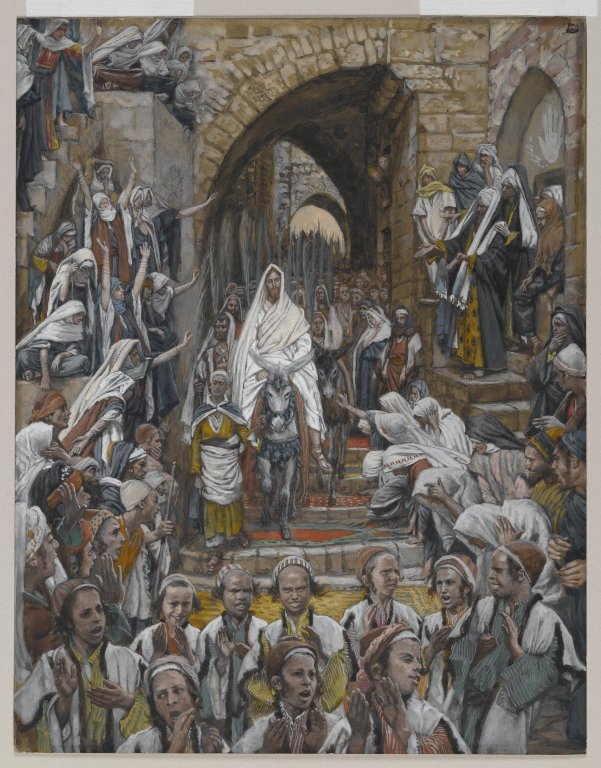
Holy Week started with “Jesus riding on a donkey in his triumphal entry into Jerusalem …”

*   *   *   *

Holy Week is upon us, as the last week of Lent.  (Which started back on Ash Wednesday.)  And it’s the week that leads up to Easter Sunday. And Holy Week begins with Palm Sunday and includes “Holy Wednesday (also known as Spy Wednesday), Maundy Thursday (also known as Holy Thursday), Good Friday (Holy Friday), and Holy Saturday.”

Which sets up the reference to Psalm 22.  It was a Daily Office Reading for Friday, April 7, and Psalm 22 is inextricably intertwined with the “Passion of Jesus.”  (A reference to the “2004 American biblical epic drama film directed by Mel Gibson,” alluded to in the post title.)

Scholars believe Psalm 22 was written some 600 years before Jesus was born.  (In the “pre-exilic period … before the Babylonian destruction of Jerusalem in 587.)  The first words of the Psalm – in the Latin Vulgate translation of the Bible – are “Deus, Deus meus.”  In English we know the verse better as “My God, my God, why have you forsaken me?”

We know that verse well because that’s what Jesus quoted on the cross, as told in Matthew 27:46:  “About the ninth hour, Jesus cried out in a loud voice, ‘Eli, Eli, lema sabachthani?’ which means, ‘My God, My God, why have you forsaken Me?'”  (See also Mark 15:34.)  

What most people don’t realize is that Psalm 22:1 goes on:  “Why are you so far from saving me, so far from my cries of anguish?”  (And that’s a thought many have had from time to time…)

Then there is Psalm 22, verse 16, which reads in part, “they pierce my hands and my feet.”

Which is pretty much what they did to Jesus at the Crucifixion.

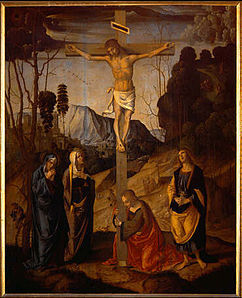
In that historical method of capital punishment – as shown at right – “the victim is tied or nailed to a large wooden beam and left to hang for several days until eventual death from exhaustion and asphyxiation.”

(But see also 10 Misconceptions About Jesus: [He] was pierced through His hands.  The article noted among other things that there was a “translation difficulty” involving the original Greek word usually translated as hand:  “The word xeiros, which we translate to ‘hand’ has a wider semantic range.”  Then there is the fact that – anatomically speaking – the “bones and tendons of the hand simply do not have the strength to hold the weight of the body without the nail ripping through.  The easiest and strongest place to hammer a nail is through the wrist, between the ulna and radius bones.”

And finally comes Psalm 22:18.  In the NIV it reads:  “They divide my clothes among them and cast lots for my garment.”  That verse from Psalm 22 was mirrored in Matthew 27:35:  “When they had crucified Him, they divided up His garments by casting lots.”

So, in order, Matthew 27 tells first of Judas Iscariot hanging himself for betraying Jesus.  Then comes “Jesus Before Pilate,” followed by “The Soldiers Mock Jesus” and “The Crucifixion of Jesus.”  Finally there is “The Death of Jesus,” with its three references to Psalm 22.  

The first reference came with the Crucifixion (Matthew 27:32-44), when Roman soldiers nailed Jesus to the cross.  That fulfilled the prophecy in Psalm 22:16, “they pierce my hands and my feet.”  (Or feet and wrists, depending on the translation of the Greek wordxeiros.”)  Then came Matthew 27:35, “When they had crucified him, they divided up his clothes by casting lots.” All of which is pretty depressing, at first blush.  But here’s a spoiler alert: There is a happy ending, and we get to find out all about it next Sunday…

*   *   *   *

The upper image is courtesy of Palm Sunday (Wikipedia).  The full caption:  “Jesus riding on a donkey in his triumphal entry into Jerusalem depicted by James Tissot.”  I used the image in 2015’s On Holy Week – and hot buns.  See also On Holy Week – 2016.

The full readings for Friday April 7 were “AM Psalm 95 & 22;  PM Psalm 141, 143:1-11(12), Jer. 29:1,4-13; Rom. 11:13-24; John 11:1-27 or 12:1-10.”

For further information on Psalm 22:16 see They have pierced my hands and my feet – Wikipedia.

The “crucifixion” image is courtesy of the Wikipedia article.  The caption:  “‘Crucifixion of Jesus’ by Marco Palmezzano (Uffizi, Florence), painting c. 1490.”

The original post had a lower image courtesy of Passion of the Christ – Wikipedia. I originally captioned it, “Another hint: Good Friday leads to the happy ending..”  

*   *   *   *


On Moses and Paul “dumbing it down…”

In writing his Letter to the Romans, the Apostle Paul – like Moses – “had to really dumb it down…”

*   *   *   *

I should note first that Friday March 25 was the Feast of the “Annunciation.”  That celebrates the day – nine months before Christmas – that the Virgin Mary “would conceive and become the mother of Jesus.”  (See last year’s Annunciation “gets the ball rolling,” and also An Annunciation-Good Friday anamoly, which noted that in 2016 the Annunciation was celebrated on Good Friday; thus the anomaly, an “odd, peculiar, orstrange condition, situation, quality, etc.”)

*   *   *   *

Philippe de Champaigne - Moses with the Ten Commandments - WGA04717.jpgI ended the last post by observing that when he wrote the first five books of the Bible, Moses – at right – had to really dumb it down.

In plain words, when he wrote the Torah Moses was forced by circumstances “to use language and concepts that his ‘relatively-pea-brained contemporary audience’ could understand.’”

Moses was addressing an audience of the largely “unwashed” … illiterate men and women who had been trained since birth to be “mindless, docile slaves…”  Suppose Moses had mentioned dinosaurs in his writings.  Or how “we” revolve around that “big bright thing in the sky.”  The result would have been similar to what nearly happened [in] Exodus 17:4, “Moses cried out to the LORD, ‘What should I do with these people?  They are ready to stone me!’”

(See My “pain in the back.”)  Which is one good reason why Moses wouldn’t have mentioned dinosaurs, or said things like “the earth we live on actually revolves around that ‘big bright thing in the sky.'”  If he had told his contemporary audience such things he would have gotten stoned, burned at the stake or worse.  (See On Moses getting stoned.)

Which is another way of saying that all the people who wrote the Bible had to keep in mind the human limitations of their audience.  They were trying to put incomprehensible things into plain and simple language that even the most obtuse dolt could understand.  Or to paraphrase Sir Kenneth Clark, the people who wrote the Bible had to have the intellectual power to make God comprehensible.

Which is no mean trick.

And which brings up one main theme of this blog:  That reading the Bible means operating on at least two different planes.  The first is the literal plane, the literal story of Jesus – which is so simple that even a child can understand it.  But understanding the second plane requires more thought, more persistence, more work – and having more of an open mind.

Which is another way of saying that no one can ever know all there is to know about the Bible.

There will always be more to learn…

Which is pretty much the point the Apostle Paul – seen at right – was trying to make in Romans 6:19.  (From one of the Daily Office Readings for Saturday, March 25.)  In the New International Version the passage reads:  “I am using an example from everyday life because of your human limitations.”  In the International Standard Version:  “I am speaking in simple terms because of the frailty of your human nature.”

But either way you translate the passage, the point is that Paul – like Moses – “had to really dumb it down.”  But that was also pretty much the point of Isaiah 55:8-9:

“For my thoughts are not your thoughts, neither are your ways my ways,”
declares the Lord.  “As the heavens are higher than the earth, so are my ways higher than your ways and my thoughts than your thoughts.

Then too, Paul made pretty much the same point in Galatians 4:21-5:1, one of today’s New Testament Daily Office Readings.  Specifically, in Galatians 4:24 he used an allegory.  (The image at left shows a “Christian allegorical map of The Journey of Life.”)

Paul used this allegory – in Galatians 4:21-5:1 – to illustrate the difference between salvation through faith in Jesus and – reasonably interpreted – trying to achieve salvation through following the “letter of the law:”

Now this is an allegory:  these women are two covenants.  One woman, in fact, is Hagar, from Mount Sinai, bearing children for slavery…  But the other woman [“Sarai,” or Sarah, the wife of Abraham] corresponds to the Jerusalem above;  she is free, and she is our mother.

See also the GOD’S WORD® Translation of Galatians 4:24, which has Paul saying, “I’m going to use these historical events as an illustration.  The women illustrate two arrangements.”

Which – you could say – is what the Bible does on a regular basis:  Use “historical events as an illustration.”  And then of course there’s the end of John’s Gospel, John 21:25:  “Now there are also many other things that Jesus did.  Were every one of them to be written, I suppose that the world itself could not contain the books that would be written.”

Or as it says in the Matthew Henry Commentary for John 21:25:

Only a small part of the actions of Jesus had been written…  Enough is recorded to direct our faith, and regulate our practice…  We may, however, look forward to the joy we shall receive in heaven, from a more complete knowledge of all Jesus did and said, as well as of the conduct of his providence and grace in his dealings with each of us.

Which seems to be a fact that many Biblical literalists seem to overlook.  You begin your process of Bible-reading and study by “learning the fundamentals.”  But then – after your spiritual boot camp – you’ll want to move on to more Advanced Individual Training, as noted below.  That way – using an open-minded approach – you can get a head start on gaining a “more complete knowledge” of all that Jesus did and said, as well as a knowledge of the whole Bible itself.

And which brings up one final point for today:

“It was never ‘contrary to Scripture’ that the earth revolved around the sun.  It was only contrary to a narrow-minded, pigheaded, too-literal reading of the Scripture…”

*   *   *   *

Galileo facing the Inquisition, for saying the earth revolved around the sun…

*   *   *   *

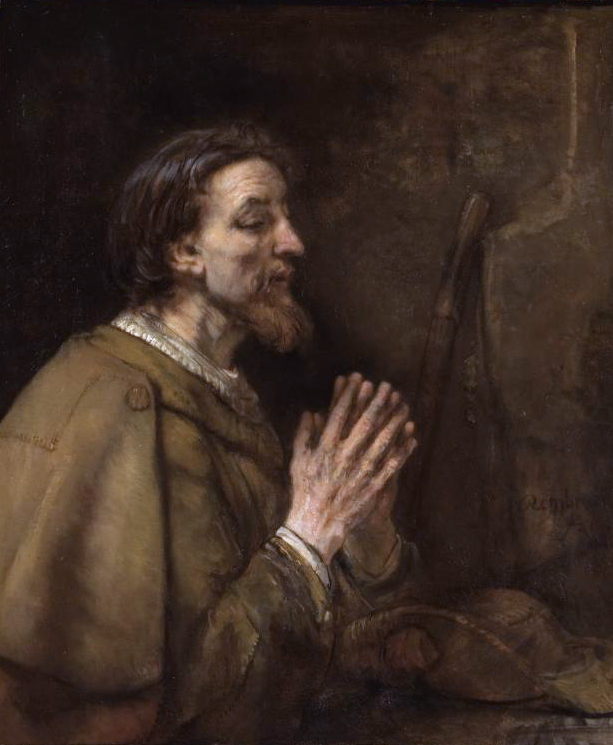
The upper image is courtesy of the Wikipedia article on the Apostle Paul.  The caption:  “‘Paul Writing His Epistles,’ painting attributed to Valentin de Boulogne, 17th century.”

The full Daily Office Bible readings for Saturday, March 25, include:  “AM Psalm 87, 90; PM Psalm 136Jeremiah 13:1-11; Rom. 6:12-23; John 8:47-59.”  See also The Annunciation:  “AM: Psalm 85, 87; Isaiah 52:7-12; Hebrews 2:5-10  PM: Psalm 110:1-5(6-7), 132;Wisdom 9:1-12John 1:9-14.”  See also The Lectionary – Satucket Software Home Page.

The Kenneth Clark paraphrase is from the hardcover book version of Clark’s Civilisation (TV series). On pages 84-85 of the book, Clark compared the poet Dante with the painter Giotto.  Then on page 85, Clark noted the differences between the two men, beginning with the fact that “their imaginations moved on very different planes.”  But in the film version – and only in the film or TV version – Clark said Dante had  “that heroic contempt for baseness that was to come again in Michelangelo.   Above all, that vision of a heavenly order and the intellectual power to make it comprehensible.”  Which is the phrase that drew my attention…  See also Wikipedia, for more on the TV series.

The “allegory” image is courtesy of Wikipedia’s Allegorical interpretation of the Bible, referring to the:

…interpretive method (exegesis) which assumes that the Bible has various levels of meaning and tends to focus on the spiritual sense (which includes the allegorical sense, the moral (or tropological) sense, and the anagogical sense) as opposed to the literal sense.  It is sometimes referred to as the Quadriga, a reference to the Roman chariot drawn by four horses.

The full caption for the map image reads:  “Christian allegorical map of The Journey of Life, or an Accurate Map of the Roads, Counties, Towns &c. in the Ways to Happiness & Misery, 1775.”

Re:  “Sarai,” or Sarah, the wife of Abraham.  Wikipedia noted that she was “the wife and also the half–sister of Abraham and the mother of Isaac…  According to Genesis 17:15, God ‘changed her name to Sarah as part of a covenant after Hagar bore Abraham his first son, Ishmael.'”

The lower image – Cristiano Banti‘s 1857 painting Galileo facing the Roman Inquisition” – is from a prior post (The latest from a “None“) and is courtesy of the article, Heresy – Wikipedia:

Galileo Galilei was brought before the Inquisition for heresy, but abjured his views and was sentenced to house arrest, under which he spent the rest of his life. Galileo was found “vehemently suspect of heresy,” namely of having held the opinions that the Sun lies motionless at the centre of the universe, that the Earth is not at its centre and moves, and that one may hold and defend an opinion as probable after it has been declared contrary to Holy Scripture.  He was required to “abjure, curse and detest” those opinions. (E.A.)

Note that Galileo almost got burned at the stake – for saying the earth revolved around the sun – almost 3,000 after Moses was trying to lead his people to “the Promised Land…”

The “Overlooked Apostle,” Ruth and Mardi Gras

The French term for Fat Tuesday is Mardi Gras – which is now a generic term for “Let’s Party!!

*   *   *   *

In case you missed it, last Friday, February 24, was the Feast Day for St. Matthias.  (The “Overlooked Apostle” of which more anon.)   Then too, the end of the Book of Ruth came last Saturday, February 25, in the Daily Office Bible Readings.  And finally, Lent begins next Wednesday – March 1 – and that season of penance and fasting is preceded by Mardi Gras.

I wrote about St. Matthias in St. Matthias – and “Father Roberts.”

Briefly, Matthias was the apostle who took the place of Judas Iscariot.  (After Judas killed himself.)  Then too, Matthias is not to be confused with either St. Matthew – who wrote the first Gospel – or with Mattathias, who rebelled against the Roman Empire just before Jesus was born.  (And who in turn was the father of Judas Maccabeus, “the greatest guerrilla in Jewish history.”)

You can see more about this “substitute 12th Apostle” at St. Matthias, or in the post about him and “Father Roberts,” noted above.  But unfortunately we know so little about him that he is often referred to either as  “Unremarkable Matthias” or the “Overlooked Apostle.”

Turning to the Book of Ruth:  It’s about ”Ruth the Moabitess, the great-grandmother of David.”

 Also briefly, she – a foreigner – chose to accept the God of Israel as her God, and the Children of Israel as her people.  And this was despite the disasters that happened to her mother-in-law Naomi, as shown at left.  Naomi’s other daughter-in-law, Orpah, decided to leave Naomi, as also shown at left.  (And a BTW:  Oprah Winfrey was originally named “Orpah,” but people got confused.*)

But it was the words that Ruth used – in refusing to leave Naomi – that made her famous:

And Ruth said, “Intreat me not to leave thee, or to return from following after thee:  for whither thou goest, I will go;  and where thou lodgest, I will lodge:  thy people shall be my people,  and thy God my God:  Where thou diest, will I die, and there will I be buried:  the LORD do so to me, and more also, if ought but death part thee and me.”

And that of course was the highly-poetic King James Version.  (Which is of course “the Bible that God uses.”  And for more, see also Ruth (biblical figure) – Wikipedia.)

Finally, there’s the upcoming season of Lent to talk about.  I addressed the season last year in On Ash Wednesday and Lent – 2016.  That post noted that Lent is a season devoted to “prayer, penance, repentance of sins, almsgiving, atonement and self-denial.”  But it also noted that that season of self-denial is preceded by “Fat Tuesday.”  That’s the day before Ash Wednesday, which means that this year Fat Tuesday is February 28.

The French term for Fat Tuesday is Mardi Gras, and Mardi Gras is now a generic term for “Let’s Party!!”  Or as As Wikipedia put it, “Popular practices on Mardi Gras include wearing masks and costumes, overturning social conventions, dancing, sports competitions, parades, debauchery, etc.”  That “debauchery, etc.” has come to include “showing skin for beads” as part of an “alcohol-fueled, nudity-filled bacchanal.”  But because this party-time comes right before the beginning of Lent, there’s an object lesson here.  That lesson?  That “to every thing there is a season…  A time to weep, and a time to laugh;  a time to mourn, and a time to dance…*”

Have a happy and spiritually-fulfilling Season of Lent…

*   *   *   *

The black-and-white image of St. Matthias is courtesy of St. Matthias, in the Satucket website listing the Daily Office readings.

Re:  St Matthias, Apostle.  The full set of Bible readings for his feast day are:  Acts 1:15-26Psalm 15Philippians 3:13-21 and John 15:1,6-16.  The Satucket website had this to add:

The man chosen [to replace Judas] was Matthias…  Apart from the information given in the first chapter of Acts, nothing is known of him…  [And a]bout most of the other apostles (those belonging to the original twelve and later ones like Matthias) we know little after Pentecost on an individual basis.

The caption for the image of Naomi, Ruth and Orpah:  “Naomi entreating Ruth and Orpah to return to the land of Moab by William Blake, 1795.”

“Note” also that an asterisk in the main text indicates a statement supported by a reference detailed further in this “notes” section.  Thus as to people getting confused about “Orpah” Winfrey, see Oprah Winfrey – Wikipedia:  “Winfrey was named ‘Orpah‘ on her birth certificate after the biblical figure in the Book of Ruth, but people mispronounced it regularly and ‘Oprah’ stuck.”  Also, the caption for the photo at left:  “Winfrey on the first national broadcast of The Oprah Winfrey Show in 1986.”

Re:  “To every thing there is a season.”  See Turn! Turn! Turn! – Wikipedia, referring to the song written by Pete Seeger in the late 1950s, which “became an international hit in late 1965 when it was covered by the American folk rock band The Byrds.”  In turn the lyrics were taken “almost verbatim from the book of Ecclesiastes, as found in the King James Version (1611) of the Bible,” at Ecclesiastes 3:1-8.  

Re: Mardi Gras. See A Brief History … Photo Essays – TIME, which noted that “Mardi Gras isn’t all nudity and drunken debauchery (though, yes, there is definitely nudity and drunken debauchery).  [Emphasis in original.]  The blurb below the lower image added:

Mardi Gras’ reputation as an alcohol-fueled, nudity-filled bacchanal is not completely unearned.  In 1973 … the tradition of showing skin for beads began.  Native New Orleanians despise the reputation, and rarely venture into the Quarter during Carnival season.

*   *   *   *

On the Bible’s “erotic love poem…”

*   *   *   *

Antique Valentine 1909 01.jpgToday is Valentine’s Day, which makes this a perfect time to explore the Bible’s “erotic love poem.”  And besides, Lent is coming up.  (It starts on March 1, with Ash Wednesday.*)  And that means 40 days of “penance, repentance of sins, almsgiving, atonement, and self-denial.”

So now is the perfect time to live it up a little…

Anyway, Valentine’s Day started off as a purely “Christian liturgical feast day honoring one or more early saints named Valentinus.”  And several “martyrdom stories” circulated about various Valentines connected to February 14, the most popular being Saint Valentine of Rome.  He was imprisoned for – among other things – “ministering to Christians,” and according to one account, he healed the daughter of his jailer.  Then – shortly before his execution – he “wrote a letter [to the daughter] signed ‘Your Valentine’ as a farewell:”

The day first became associated with romantic love within the circle of Geoffrey Chaucer in the 14th century, when the tradition of courtly love flourished.  In 18th-century England, it evolved into an occasion in which lovers expressed their love for each other…

Which brings us to the Bible’s own love poem, the Song of Songs.  (Aka, “Song of Solomon.”)

Isaac Asimov wrote of the “Song of Songs” in his Guide to the Bible: Two Volumes in One.  He used five pages to cover the book,* first noting that this was the “third of the canonical books to be attributed to Solomon.”  (Shown at left, he was the son of Israel’s King David who became widely known for his wisdom, as well as for his habit of acquiring “foreign wives,” as shown below.)  Asimov added:

The Song of Solomon is a love poem, frankly erotic, apparently composed to celebrate a wedding.  This, too, is appropriate, for Solomon had numerous wives and was, presumably, an experienced lover.

(See for example, 1st Kings 11:3:  “He had seven hundred wives of royal birth and three hundred concubines, and his wives led him astray,” which sounds about right…)

And here are some highlights.  For starters, the poem features a back-and-forth exchange between a man and woman.  (Together with “Others,” acting as a kind of chorus.)

It starts off with the woman saying, “Let him kiss me with the kisses of his mouth!” (1:2, and in verse 3, she adds that “virgins love you.”)  In verse 1:13 the woman says, “My beloved is to me a sachet of myrrh that lies between my breasts.”  Moving on, in 4:5 the man tells the woman: “Your two breasts are like two fawns, twins of a gazelle, that graze among the lilies.”

In Chapter 7, verses 1-3, the man adds these observations:

Your rounded thighs are like jewels, the work of a master hand.  Your navel is a rounded bowl that never lacks mixed wine.  Your belly is a heap of wheat, encircled with lilies. Your two breasts are like two fawns, twins of a gazelle.

Which raises an interesting question:  Why don’t Biblical Fundamentalists interpret the Song of Songs literally?  That is, why don’t they adhere to the “exact letter or the literal sense” of this book?  It also brings up the matter of selective interpretation.

On that note Asimov added, “Because of the erotic nature of the book, it has been customary to find allegorical values in it that would make it more than a description of bodily passion.”  Thus:

Jews would have it speak of the love between Yahveh and Israel;  Catholics of the love between Christ and the Church;  Protestants of the love between God and man’s soul.  However, if we simply accept the words as they stand, the book is a human love poem and a very beautiful one.

Which is fine, but why not be consistent?  Or in the alternative, why reject a spiritual, or even – (gasp!) – a liberal interpretation of the Bible, in favor of only a literal interpretation?

Which brings up the whole point of this blog.  The point is that if you limit your Bible-study to a purely literal interpretation, you’re robbing yourself of at least half it’s value.  (And driving potential converts away in droves.)  But if you move on from a purely literal interpretation, to an open-minded spiritual interpretation, your Bible-study can take you to exotic adventures and explorations that you couldn’t have dreamed of before.

Or as St. Paul said, God made us “servants of a new covenant not based on the letter [of the law] but on the Spirit, for the letter kills, but the Spirit gives life.”  (2d Corinthians 3:6.)

Put another way, if Jesus had been a Biblical conservative and/or literalist, we’d all still be Jewish.  And besides, by taking that “open” approach you won’t have to find a non-erotic literal-but-pure meaning of “your rounded thighs are like jewels, the work of a master hand…”

*   *   *   *

“Solomon sinned by acquiring many foreign wives…”

(Which made him well-versed in the “Art of Love?“)

*   *   *   *

The upper image is courtesy of Valentine’s Day – Wikipedia.  The caption:  “An English Victorian era Valentine card located in the Museum of London.”

“Note” also that an asterisk in the main text indicates a statement supported by a reference detailed further in this “notes” section.  Thus as to Asimov using “five pages to cover” the Song of Songs:  The reference is to the 1981 Avenel Books edition of his Guide to the Bible, at pages 518-23.

Re:  Canonical “Solomon” Bible books.  He is said to have written Proverbs, “a collection of fables and wisdom of life;”  Ecclesiastes, a book of contemplation and self-reflection, and Song of Songs.  The black-and-white image to the left of the paragraph about him is captioned:  “An engraving, ‘Judgment of Solomon,’ by Gustave Doré (19th century).”

The “Weird Tales” image is courtesy of the Wikipedia article on Isaac Asimov.  The caption:  “The novelette ‘Legal Rites,’ a collaboration with Frederik Pohl, was the only Asimov story to appear in Weird Tales.”  The article noted that in addition to his interest in science and history, Asimov was “also a noted mystery author and a frequent contributor to Ellery Queen’s Mystery Magazine.  He began by writing science fiction mysteries … but soon moved on to writing ‘pure’ mysteries.”

The lower image is courtesy of Solomon – Wikipedia.  The caption:  “Solomon sinned by acquiring many foreign wives.  Solomon’s descent into idolatry, Willem de Poorter, Rijksmuseum.”

On the FIRST “Presentation of the Lord”

*   *   *   *

Ecce homo by Antonio Ciseri (1).jpg

This could be called the “Second Presentation” – Good Friday, as Jesus is about to be crucified

*   *   *   *

Thursday,  February 2, is the Feast of the Presentation of Jesus at the Temple.  This presentation – of Jesus as a baby – was done in accordance with a thousand-year-old custom started by Moses.  See Exodus 13:2, where God told Moses, “Consecrate to me every firstborn male.”  And by that tradition, the consecrating came 40 days after the day of birth:

Counting forward from December 25 as Day One [for Jesus], we find that Day Forty is February 2.  A Jewish woman is in semi-seclusion for 40 days after giving birth to a son, and accordingly it is on February 2 that we celebrate the coming of Mary and Joseph with the infant Jesus to the Temple at Jerusalem.

Yegorov-Simeon the Righteous.jpgSee Presentation of the Lord – 2016.  (Including the image at left.)  And just to be clear, that brings up the old-timey, “once-prevalent custom of churching new mothers forty days after the birth of a child.”

That quaint custom came to be called “the churching of Women,” starting – as far as we can tell – back in the Middle Ages.  It was still offered by the Catholic Church until the 1960s, but then discontinued.  (The Anglican Church still offers the service, but it seems rarely used.)  

Among other things, that quaint practice took place in “the good old days when giving birth was a time of real and great danger for all mothers.  Accordingly, the usual prayer of Thanksgiving went something like this:  “ALMIGHTY God, we give thee humble thanks for that thou hast vouchsafed to deliver this woman thy servant from the great pain and peril of child-birth.”

Beyond that, this once-prevalent ritual drew “on the imagery and symbolism” of the original Presentation of the Lord, celebrated on February 2.  But for Mary, there was the problem of Virgin birth.  (She hadn’t been “sullied” in the normal manner of procreation.)  

The answer?  According to church practice, even though Mary had “borne Christ without incurring impurity” – that is, the usual “impurity” involved in conception – “she went to the Temple in Jerusalem to fulfill the requirements of the Law of Moses.”  In other words, in order to avoid even the appearance of impropriety, Mary went through the ritual that became known as The Churching of Women, even though she didn’t have to.

And of course, to set a good example.

But we digress…

You can see the Bible readings for the day at Presentation of Jesus.  They include Malachi 3:1 – seen at right – where God said, “I will send my messenger, who will prepare the way before me.  Then suddenly the Lord you are seeking will come to his temple.”  And of course Luke 2:22-23:

When the time came for the purification rites required by the Law of Moses, Joseph and Mary took him to Jerusalem to present him to the Lord 23 (as it is written in the Law of the Lord, “Every firstborn male is to be consecrated to the Lord…”  (E.A.)

And that ritual – “required by the law of Moses” –  in turn went back to the time of Moses, as detailed in Exodus 13 and as already noted.

For more on the February 2 Feast Day, check out Presentation of the Lord – 2016.  But the ritual described in this post brings up what might be called “the Second Presentation of the Lord.”

That Second Presentation came when Jesus was “presented to the people of Jerusalem.”  But this time it came at the hands of Pontius Pilate, on what turned out to be the day before He was crucified.  This Second Time Around came when Jesus was “presented,” but not in the religious Temple in Jerusalem.  Rather, it came in the praetorium of the secular power.  (See Pilate’s court, which noted two possible sites for this trial;  either the Antonia Fortress or Herod’s Palace.)

The point being that from the time He was first “presented” at just over a month old, Jesus’ life was one long journey to the Second Presentation. (On the eve of His making the ritual sacrifice that would literally change history, if not “split history in two.”) In the same way, this February 2 marks the beginning of our own spiritual journey: Through Epiphany, then Mardi Gras, followed by Lent, then on into Easter Week.

And all of which reminds us that life is not all fun and games.  Put another way, “Into Each Life Some Rain Must Fall.”  (BTW:  That 1944 song by The Ink Spots was based on a quotation from Henry Wadsworth Longfellow‘s poem, The Rainy Day.)  Which is another way of saying that while we know those “rainy days” are coming – that our lives will be interrupted by pain and suffering – we also know that we have “already won the Game of Life.*”

That is, we as practicing Christians know how our lives are going to turn out.  We already know we’re going to have a happy ending.  It’s just those “in between” details that worry us.

On that note, yesterday I ran across a Bible passage apropos to current events.  The Daily Office Readings for February 1 included Isaiah 54:15:  “If anyone stirs up strife, it is not from me…”

“Just sayin’…”

*   *   *   *

*   *   *   *

The upper image is courtesy of Pontius Pilate – Wikipedia.  The caption:  “Ecce Homo (‘Behold the Man’), Antonio Ciseri‘s depiction of Pilate presenting a scourged Jesus to the people of Jerusalem.”

“Note” also that an asterisk in the main text indicates a statement supported by a reference detailed further in this “notes” section.  Thus as to knowing “that we have already won the Game of Life,” see Two Marys and a James – Saints, which indicated that the spiritual life is like water-skiing:

As yours truly once wrote, starting your spiritual pilgrimage by reading the Bible on a regular basis “is a bit like water-skiing,” or more precisely, “a bit like grabbing the handle of the rope” attached to a metaphoric “Big Motorboat in the Sky…  Once you grab on, your main job is simply to hang on for dear life…”

*   *   *   *

Re:  The full Daily Office Readings for Wednesday, February 1, 2017:  “AM Psalm 72; PM Psalm 119:73-96Isaiah 54:1-10(11-17); Galatians 4:21-31; and Mark 8:11-26.”  They also included the readings for the Eve of the Presentation:  “PM: Psalm 113, 122; 1 Samuel 1:20-28a; Romans 8:14-21.”

Re:  Rainy Day, by Longfellow.  One line reads:  “My life is cold, and dark, and dreary.”  Another:  “Into each life some rain must fall, Some days must be dark and dreary.”  But there’s also this line of hope: “Be still, sad heart! and cease repining;  Behind the clouds is the sun still shining.”

Re:  “Just sayin.'”  I first used that phrase for this blog in The True Test of Faith, in February 2015.

The lower image is courtesy of Chaos Defines Trump’s First Week in Office – NBC News.  See also Analysis: Trump’s start creates chaos, and Chaos, anger as Trump order halts some Muslim immigrants.  BTW:  The search term “trump chaos” got me 1,430,000 results.  The search term “trump strife” got me 565,000 results.

“Wouldn’t it be nice if WE could be ‘restored?'”

“Two Scholars Disputing” – Peter and Paul – but they ended up working for the common good… 

*   *   *   *

January 27, 2017 – In the middle of summer – June 29 to be exact – there’s a Feast Day that celebrates both Saint Peter and Saint Paul, together. But on the other end of the church year – here, in the dead of winter,* as seen at left – good Christians remember both of these saints separately, on January 18 and January 25:

On January 18 we celebrate the Confession of Peter:  “Thou art the Christ, Son of the Living God.”  A week later on January 25 we celebrate the Conversion of St. Paul.  Then comes June 29, when we celebrate both men…

See Peter, Paul – and other “relics.”  See also the post from last January 20 (2016), Peter confesses, Paul converts.  The latter noted that both saints were martyred – killed by the Roman authorities – at about the same time and place.  (In Rome, around 65 A.D.)

That post also noted that these twoPillars of the Church took completely different paths to the same destination.  (And often had “spirited” disputes. See Galatians 2:11-14, and 2d Peter 3:16.)

On the one hand, Peter was one of the original 12 disciples, and the first “to confess Jesus as Messiah.”  (See the matching accounts in the three Synoptic Gospels, illustrated at right: Matthew 16:13-20, Mark 8:27–30 and Luke 9:18–20.)

On the other hand, Saul of Tarsus – later “Paul” – started out as the most ardent enemy and persecutor of the early Christian Church.  (See for example Acts 8:3:  “Saul was going everywhere to destroy the church.  He went from house to house, dragging out both men and women to throw them into prison.”)

In other words, Peter came to his position of authority from “inside the church.”  Paul on the other hand was pretty much dragged kicking and screaming into his position of authority.

In plain words, Paul’s Damascus Road experience “changed him from a Christ-hating persecutor of Christians to the foremost spokesman for the faith.”  Put another way, Paul was led by God’s grace, from being the most hated and feared enemy of the church to becoming “one of its chief spokesmen.”  (See Conversion of St. Paul, emphasis added.)  In further words, these two former enemies were brought together – by God – to work together for the common good:

In philosophy, economics, and political science, the common good (also commonwealth or common weal) is a term of art, referring to either what is shared and beneficial for all or most members of a given community, or alternatively, what is achieved by citizenship, collective action, and active participation in the realm of politics and public service.

Which leads to this question:  What would happen if two or more American conservative and liberal politicians today could likewise come together and work for the common good?

Which brings up the topic of being “restored.”  In one sense it means bringing “back to health, good spirits, etc.”   Or “to bring back to a former, more desirable condition.”  So say what you want about the bad old days, they never seemed to be this bad.

For one thing, there once was a time when the most ardent politicians felt free to “sup with their enemies.”  Like Ronald Reagan and Ted Kennedy – at right – were able to do, despite their vastly different political views.  For example, Kennedy said of Reagan:  “He’s absolutely professional.  When the sun goes down, the battles of the day are really gone.” Or as one writer said of Kennedy, having learned to “operate within the politics of symbolism:”

Heated rhetoric was part of the game of government.  When the day was over, win or lose, everyone could have a drink together.*

And that’s the kind of political “Restoration” I’d gladly welcome.  Then too, it turns out that both Peter and Paul got “restored,” again, each in his own way.  See Doubting Thomas – and Peter Restored, which noted that Peter got “restored to grace” after basically turning on Jesus, by denying Him three times.  And as to Paul being both transformed and restored:

As a result of that transformation, the Apostle Paul got transmogrified. I.e., changed from being the early Church’s deadliest enemy to being second only to Jesus in the history of that early Christian Church.

See Paul restored – from the Damascus Road.  Which leads to this question:

Wouldn’t it be nice if we too – here in America – could also be “restored?” To a time when people of all types and backgrounds worked together for the “common good?”

Which is of course the main job of a good Christian.  See 2d Corinthians 5:18, that God “reconciled us to Himself through Christ, and gave us the ministry of reconciliation.”

*   *   *   *

“Ananias Restoring the Sight of St. Paul” – after his Damascus road experience

 *   *   *   *

The upper image is courtesy of www.canvasreplicas.com/Rembrandt.htm.  See also Two Scholars Disputing by REMBRANDT Harmenszoon van Rijn.

“Note” also that an asterisk in the main text indicates a statement supported by a reference detailed further in this “notes” section.  Thus, as to the winter” image, it is courtesy of Wikipedia.  The caption:  “A snow-covered park in Pittsburgh, Pennsylvania, during winter.”

Re:  The common good.  See the Wikipedia article, which added this:

[T]he common good became a central concept in the modern tradition of Catholic social teaching, beginning with [a] papal encyclical by Pope Leo XIII, issued in 1891.  This addressed the crisis of the conditions of industrial workers in Europe and argued for a position different from both laissez-faire capitalism and socialism…  Pope Leo guarantees the right to private property while insisting on the role of the state to require a living wage.

Re:  Heated rhetoric as “part of the game.”  (Of politics.)  See On Reagan, Kennedy – and “Dick the Butcher,” in  my companion blog.  The Reagan-Kennedy photo is courtesy of boston.com/bigpicture … ted_kennedy.  The caption:  “Senator Edward Kennedy talks with President Ronald Reagan, left, on June 24, 1985, as they look over an American Eagle that graced President John F. Kennedy’s desk during a fund raising event for the John F. Kennedy Memorial Library at McLean, Virginia.  (AP Photo/Charles Tasnadi).”  The quotes – of Kennedy and Reagan, and about Kennedy and “heated rhetoric” – are courtesy of Battle for Justice: How the [Robert] Bork Nomination Shook America, by Ethan Bronner, Anchor Book edition (1989), at pages 103-104. 

(And incidentally, “Dick the Butcher” was the character in William Shakespeare‘s play, “Henry The Sixth, Part 2,” who famously said, “The first thing we do, let’s kill all the lawyers.”)

The lower image is courtesy of Conversion of Paul the Apostle – Wikipedia, the free encyclopedia.  The full caption:  “‘Ananias Restoring the Sight of St. Paul’ (c.1631) by Pietro da Cortona.”  See also Ananias of Damascus – Wikipedia, which noted his name means “favored of the LORD.”  The actual restoration of Saul-Paul’s sight was described in Acts 9:17-19 NIV:

Placing his hands on Saul, he said, “Brother Saul, the Lord – Jesus, who appeared to you on the road as you were coming here – has sent me so that you may see again and be filled with the Holy Spirit.”  Immediately, something like scales fell from Saul’s eyes, and he could see again.  He got up and was baptized, and after taking some food, he regained his strength.

To Epiphany – “and BEYOND!”

Buzz Lightyear To Infinity And Beyond by eposselt

*   *   *   *

Each year, January 6 is the traditional day to celebrate the Feast of the Epiphany.  (In this sense, an “annual religious celebration…”)   See also the Satucket (or “Daily Office) piece, on Epiphany:

“Epiphany” is a word of Greek origin, related to such English words as “theophany,” “phenotype,” and “phenomenon.”  It means an appearance, a displaying, a showing forth, a making clear or public or obvious.  On this day, Christians have traditionally celebrated the making known of Jesus Christ to the world.

In other words, January 6 is celebrated as the day the world got “first introduced to Jesus,” in large part by the visit from the “Three Wise Men from the East.”  That is, this Feast Day includes – but is not limited to – a celebration of “the visit of the Magi to the Christ child,” as shown in the painting above left.  (The “We Three Kings of Orient are,” from the Christmas carol.)

But January 6 also marks the start of the Season of Epiphany.  That church season runs from January 6 to – and through – the Last Sunday after the Epiphany.  This year, 2017, that date is February 26.  The following Tuesday, February 28, we celebrate Mardi Gras.  The day after that – March 1 – is Ash Wednesday, which marks the beginning of the 2017 Season of Lent.

Which brings up Buzz Lightyear.  (His catch-phrase – “to infinity, and beyond” – is popular among people including astronauts, philosophers and mathematical theorists…)  The point being that practicing Christians also work to go “to infinity – and beyond!”  Or in the words of the Book of Common Prayer, to “live with confidence in newness and fullness of life,” and to await “the completion of God’s purpose for the world.”

And that’s a promise especially meaningful after that 2016 Year from Hell. But wait!  There’s more!  Practicing Christians can also look forward to infinity – “without any bound” – as a new existence, with “the joy of fully knowing and loving God and each other.”

And – it could be argued – it all starts with Epiphany.

That is, the 2017 church year officially started with the first Sunday of Advent, last November 27.  That was followed by Christmas and the Season of – or after – Epiphany.  That in turn will be followed by Lent – preceded by Mardi Gras – and then Easter.  (It’s a full, 40-day season as well and not just a single day.)

Then comes Ordinary Time – the Season after Pentecost – which takes up over half the church year.  (As shown at left.)

However, you could argue – again – that it all started with the first Epiphany.  (The first “making known of Jesus Christ to the world.”)  That is, Jesus was born in relative obscurity, and it wasn’t until the Three “Wise Men from the East” visited that He started to become better known.

That was the point of last January’s post Epiphany, circumcision, and “3 wise guys.”  It also noted that other names for January 6 include the last day of Christmas and Three Kings Day.

The word originally used for Three Kings was Magi, which gave rise to the current word “magic.”

And  in its original sense – 600 years before Jesus was born – the word Magi referred to “followers of Zoroastrianism or Zoroaster.”  In turn it wasn’t until well after Jesus died that a number of traditions arose about the three Wise Men.  That included their names, places of origin, and how soon after “Christmas” they actually visited the Holy family.

The most common names given the three are: Melchior, from Persia; Caspar, from India; and Balthazar, from Babylon.  (Which could present some logistical difficulties;  for example, in their getting together to start the trip.)  And as to when they actually visited Jesus:

The Bible specifies no interval between the birth and the visit [by the Magi, but] artistic depictions … encourage the popular assumption that the visit took place the same winter as the birth…  [L]ater traditions varied, with the visit [said to occur] up to two winters later.  This maximum interval explained Herod’s command at Matthew 2:16–18 that the Massacre of the Innocents included boys up to two years old. (E.A.)

All of which adds up to some confusion about these post-Christmas holidays…

You’ve probably heard of the 12 Days of Christmas, which end on January 6.  But the evening of the 6th is also known as 12th Night, and was yet another occasion for “drunken revelry.”  (From back in the days when life – especially life in winter – was “nasty, brutish and short.”)  Yet another celebration – and a time for “drunken revelry” – came on Plough Monday, which is officially the Monday following January 6.   In turn, back in Merry Olde England, Plough Monday marked the start of the new Agricultural Year.  In other words, a new year of work.  

So the point of Plough Monday – the Monday after January 6 – was to have one more big blast before getting back to work.  (That is, resuming farm-work after the extended holiday season.  And for more on this seeming rigamarole, see Epiphany, circumcision, and “3 wise guys.”)

So in a way, Plough Monday is like our celebrating Mardi Gras – also called Fat Tuesday – on the day before the first day of Lent.  Or:  “one last feast before the Lenten fast.”

Are we seeing a pattern here?

In a sense it’s like the pattern of growth and debriefing – the asking of  “really aggravating questions” – that should follow such a period of personal growth.

On that note, see DORs for June 6, 2015, which took issue with “sin” as sometimes held out:

[T]he concepts of sin, repentance and confession should be viewed as “tools to help us get closer to the target.”  In other words, they help us grow and develop, and are not to be used as a means of social control…  Note also that the “Biblical Greek term for sin [amartia], means ‘missing the mark,’” and implies that “one’s aim is out and that one has not reached the goal, one’s fullest potential.”

And that – after all – is what the true Christian should be working for, during these upcoming, alternating seasons of celebration and reflection:  To reach his or her full potential.

So the Epiphany reminds us that – in order to do His job – Jesus had to be revealed to the world as “God incarnate.”  That revelation – that “revealing” – involved a substantial risk to Jesus in His earthly incarnation as God “embodied in the flesh.”  In fact, that big risk led to His ultimate – and untimely – death on the Cross.  That in turn should lead us to the conclusion that our job is not to withdraw from world into the safety of being a “carbon copy Christian.”

Instead our job is to grow into our fullest potential, and that means taking risks.  One such risk – for example – involves reading the Bible “with an open mind,” rather than retreating into a safe “fundamental” view.  For more on that see Conservative Christian – “Career buck private?”

In the meantime, celebrate the “Adoration of the Magi,” and the season of growth to follow…

*   *   *   *

The “Adoration of the Magi,” by El Greco

*   *   *   *

The upper image is courtesy of Buzz Lightyear To Infinity And Beyond by eposselt on DeviantArteposselt.deviantart.com.  See also Buzz Lightyear – Wikipedia, which noted:

Buzz’s classic line “To infinity… and beyond!” has seen usage not only on T-shirts, but among philosophers and mathematical theorists as well.…  The 2008 quadruple platinum song “Single Ladies” by Beyoncé includes the lyric “…and delivers me to a destiny, to infinity and beyond,” a reference which was pointed out by alt-country singer Jeff Tweedy of the band Wilco during a 2010 solo performance in Chicago.  Also in 2008, astronauts took an action figure of Buzz Lightyear into space on the Space Shuttle “Discovery” as part of an educational experience for students while stressing the catchphrase…

Re:  The Book of Common Prayer references.  See The Catechism, at pages 861-862

Re:  “Year from hell.”  The website 2016 has been year from hell for many – but not for comics, noted another name:  “Annus horribilis.”  Wikipedia noted that the opposite term – annus mirabilis, meaning “wonderful year” – has a long history of usage, but “annus horribilis” was apparently first used in 1891.  At that time it was used to “describe 1870, the year in which the Roman Catholic church defined the dogma of papal infallibility.”  As to its application to 2016, Googling the phrase “2016 year from hell” got me some 173,000,000 – 173 million – results.

Re:  “Magi,” giving rise to the current word “magic.”  See Asimov’s Guide to the Bible (Two Volumes in One),  Avenel Books (1981), at page 788.  See Asimov’s full “Curriculum vitae” in last October’s On St. Ignatius – and “Persecution Porn.”

The lower image is courtesy of Epiphany (holiday) – Wikipedia.  The full caption:  “‘Adoration of the Magi‘ by El Greco, 1568, Museo Soumaya, Mexico City.”

*   *   *   *

On the REAL “Jolly Ol’ Saint Nick”

*   *   *   *

Tuesday, December 6, 2016 is the Feast Day for Nicholas of Myra.* (But only in the Daily Office Lectionary, not the Revised Common Lectionary used for Sundays.*) And he – Nicholas of Myra – eventually became the guy we now know as Santa Claus.  (Or “Jolly Ol’ St. Nick.”)

Of course there are those who refuse to believe in him.  That is, there are some people out there who think that Santa Clause is a myth:

A myth is a sacred narrative because it holds religious or spiritual significance for those who tell it.  Myths also … express a culture’s systems of thought and values as the myth of gremlins invented by aircraft technicians during World War II to avoid apportioning blame.

See Myth – Wikipedia, which included the image at left, of such “gremlins” at work.  And just as a point of order:  These “gremlins” – especially during World War II – did not work for the enemy:

[E]nemy aircraft had similar and equally inexplicable mechanical problems.  As such, gremlins were portrayed as being equal opportunity tricksters, taking no sides in the conflict, and acting out their mischief from their own self-interest.

But the point is: There is a solid basis in historical fact for believing in both “jolly old St. Nick” and in the spirit of Christmas. For starters, Nicholas of Myra was a real man who lived from 270 to 343 A.D.  Around the year 300 he was elected Bishop of Myra.  As a bishop his “legendary habit of secret gift-giving gave rise to the traditional model of Santa Claus through Sinterklaas:”

The best-known story involves a man with three unmarried daughters, and not enough money to provide them with suitable dowries.  This meant that they could not marry, and were likely to end up as prostitutes.  Nicholas walked by the man’s house on three successive nights, and each time threw a bag of gold in through a window…  Thus, the daughters were saved from a life of shame, and all got married and lived happily ever after.

And here’s another side note:  “Myra” is now the city of Demre, in Turkey, where it doesn’t get that cold in the winter.  But then the story of this “St. Nicholas” started getting repeated in colder, northern climates. (Where no one would keep their windows open in December.)

That’s when the story got tweaked, and St. Nick started delivering his gifts via the chimney.  (For more on that see The History of Santa Claus and Chimneys.  For one thing:  “In pre-Christian Norse tradition, Odin would often enter through chimneys and smoke holes or fire holes on the solstice, which marks the beginning of winter.”)

For more on the real St. Nick, see On the original St. Nicholas, or On St. Nick and “Doubting Thomas.” The first one noted how the story of St. Nicholas was basically a gift to America from the country of Holland:

Dutch colonists took this tradition [of St. Nicholas] with them to New Amsterdam (now New York City) in the American colonies in the 17th century.  Sinterklaas was adopted by the country’s English-speaking majority under the name Santa Claus, and his legend of a kindly old man was united with old Nordic folktales of a magician who punished naughty children and rewarded good children with presents.

The second post noted how the original – the real St. Nicholas – saved three innocent men from death, as shown in the painting below.  It seems he was visiting a remote part of his diocese when he heard about three men, condemned to death back in Myra.  The “the ruler of the city, Eustathius, had condemned three innocent men to death.”

When he arrived back in Myra he went immediately to the site of the execution, took the sword from the executioner’s hand, and ordered that the innocent men be set free:

His authority was such that the executioner left his sword where it fell.  Later Eustathius confessed his sin and sought the saint’s forgiveness.  Nicholas absolved him, but only after the ruler had undergone a period of repentance.

So there you have it.  The real “Ol’ Saint Nick” was not only jolly, he was personally brave.

Virginia O'Hanlon (ca. 1895).jpgAnd so, back in 1897 – when Francis P. Church of The (New York) Sun responded to a letter to the editor – he was pretty much telling the truth when he wrote, “Yes, Virginia, there is a Santa Claus.” (The letter he responded to was written by eight-year-old Virginia O’Hanlon, seen at left.)

Of course the whole idea of “Santa Claus” – and indeed Christmas itself – has gotten glossed over and commercialized over the years.  See How Christmas Became the Most Commercialized Holiday.  It started off with a quote from Lucy Brown – of Peanuts fame – when she told Charlie Brown:  “Let’s face it…  We all know that Christmas is a big commercial racket.  It’s run by a big eastern syndicate, you know.”

Simply put, Christmas became big business.  And as such it spawned a host of new cottage industries:  Books published, woodsmen “heading into the forests each December to cut evergreens to sell on street corners,” tinsel, toys, candle-holders, candles, candies, garlands, ornaments, and hand-colored Christmas cards, to name a few.

All of which is wonderful for the economy, but each Christmas it’s also a good idea to go back to the original source.  To go back to the jolly – and brave – original St. Nick.  (Seen below, in action.)  And of course to remember Jesus, The Reason for the Season.

*   *   *   *

Yes, Virginia, there is a Santa Claus,” and this is him, saving three men from death…

*   *   *   *

The original post cited an article saying,”The protective personality of St. Nicholas and desire of helping children in difficult situations have been transformed into a sympathetic old Santa Claus … appearing on Christmas Eve to make everybody happy.”

The Santa/chimney image is courtesy of Zat You Santa Claus? – Free Christmaslinks2love.com.  Also, re: St. Nick:  See also Saint Nicholas – Wikipedia and/or Nicholas of Myra – Livius

The lower image is courtesy of Saint Nicholas – Wikipedia, with the caption:  “Saint Nicholas Saves Three Innocents from Death (oil painting by Ilya Repin, 1888, State Russian Museum).”   See also St. Nicholas Center … Saint Who Stopped an Execution.

*   *   *   *

On Andrew – “First Apostle” – and Advent

To see St. Andrew’s “x-shaped cross” (or saltire*) check out St Andrew Saltire – Image Results

*   *   *   *

Last Sunday – November 27, 2016 – was the First Sunday of Advent.  And this is the theme for that Season of Advent.  That is, that season of the church-year that ends on Christmas Eve:

Advent is “a time of expectant waiting and preparation for the celebration of the Nativity of Jesus at Christmas.”  The theme of Bible readings is to prepare for the Second Coming while “commemorating the First Coming of Christ at Christmas.”

And as even Scrooge recognized, “Christmas is a very busy time for us.”  (The “spirit of Scrooge” is illustrated at right…)

But this time of year – in the church calendar – can also be very confusing.  That’s because both the Season of Advent and the church-year itself actually begin with St. Andrew, the “First Apostle.*”  His Feast Day is celebrated on November 30, today.

And according to the National Catholic Register, “St. Andrew was one of Jesus’ closest disciples, but many people know little about him.”  Which is another way of saying that he was pretty important, but that he often gets overlooked:

Andrew was “one of the four disciples closest to Jesus, but he seems to have been the least close of the four…   That’s ironic because Andrew was one of the first followers[.  In fact,] because he followed Jesus before St. Peter and the others – he is called the Protoklete or ‘First Called’ apostle.”

For more on this day see On St. Andrew, the “First Apostle.”  But getting back to the Season of Advent, see An early Advent medley, or On Advent – 2015.  (From last year.)

Or for that matter see On the readings for Advent Sunday, from 2014:

Advent Sunday is the first day of the liturgical year in the Western Christian churches.  It also marks the start of the season of Advent…  [T]he symbolism of the day is that Christ enters the church.   Advent Sunday is the fourth Sunday before Christmas Day. This is equivalent to the Sunday nearest to St. Andrew’s Day, 30 November, and the Sunday following the Feast of Christ the King.

See Advent Sunday – Wikipedia.  The article added that for a time – starting about 300 A.D. – Advent was “kept as a period of fasting as strict as in Lent.”  But around 1917 the Catholic Church “abolished the precept of fasting …  but kept Advent as a season of penitence.”

I’ll be writing more about Advent in the coming weeks, but one thing to remember is that for those four Sundays, the Old Testament readings will be from the prophet Isaiah, shown below:

Isaiah is the prophet who guides our journey through Advent as we prepare for Christmas. Advent is a season of joyful anticipation, and Isaiah invites us to look forward to the coming of the Messiah, to prepare the way of the Lord.

*   *   *   *

The prophet Isaiah, featured in this season’s Advent O.T. readings…

*   *   *   *

Notes:

I originally had an upper image “courtesy of ncregister.com/blog/st.-andrew-apostle-11-things-to-know and share, which included the full text of St. Andrew’s words before he died, showing ‘a very profound Christian spirituality.  [He] does not view the Cross as an instrument of torture but rather as the incomparable means for perfect configuration to the Redeemer, to the grain of wheat that fell into the earth.   Here we have a very important lesson to learn: Our own crosses acquire value if we consider them and accept them as a part of the Cross of Christ…'”  See also Andrew the Apostle – Wikipedia, and as noted, St Andrew Saltire – Image Results.

“Note” also that an asterisk in the main text indicates a statement with a reference detailed further in this, the “notes” section.  Thus, as to the “saltire” see St Andrew … 5 facts you might have known:

Legend has it that he [Andrew] asked to be tied to an X-shaped cross because he did not feel worthy of dying on the same shape of cross as Jesus.  The shape has been represented by the white cross on the Scottish flag, the Saltire, since at least 1385.

As to the Feast of St. Andrew beginning the new church year, see Anticipating Christmas, Beginning with Saint Andrew.  Or see St. Andrew, from the Satucket website:

Just as Andrew was the first of the Apostles, so his feast is taken in the West to be the beginning of the Church Year…  The First Sunday of Advent is defined to be the Sunday on or nearest his feast (although it could equivalently be defined as the fourth Sunday before Christmas Day).

That site includes the Daily Office readings for the day:  “AM: Psalm 34; Isaiah 49:1-6; 1 Corinthians 4:1-16,” and “PM: Psalm 96, 100; Isaiah 55:1-5; John 1:35-42.”  Or see St Andrew, Apostle.

Re:  “Isaiah [as] the prophet who guides our journey.”  See Isaiah: Old Testament prophet for the Advent season, which added:  “Isaiah urges us to straighten out our crooked ways, tear down our mountains of misdeeds, and fill in the valleys of our bad habits.”

The lower image is courtesy of Isaiah – Wikipedia, with the full caption, “Isaiah, by Michelangelo, (c. 1508–1512, Sistine Chapel ceiling, Vatican City).”

On Thanksgiving – 2016

Thanksgiving Day in 1863 – as celebrated in the middle of that other American Civil War

*   *   *   *

It’s hard to believe, but Thanksgiving is less than a week away.

Which means it’s about time to give thanks “for the fruits of the earth in their season and for the labors of those who harvest them.”  And that’s especially true after the bitter election* we’ve just been through.  (And survived, thank you very much.)  

Which brings up that other American Civil War.  The thing is, Thanksgiving wasn’t celebrated on the same date – “throughout the United States*” – until 1863.  (In the middle of the war.)

Abraham Lincoln set that uniform date for Thanksgiving – making it the last Thursday in November – by presidential proclamation.  He did it to “foster a sense of American unity:” 

In the midst of a civil war of unequalled magnitude and severity … peace has been preserved with all [other] nations, order has been maintained, the laws have been respected and obeyed, and harmony has prevailed everywhere except in the theatre of military conflict… Population has steadily increased, notwithstanding the waste [in] the siege and the battle-field;  and the country, rejoicing in the consciousness of augmented strength and vigor, is permitted to expect continuance of years, with large increase of freedom.

See Thanksgiving (U.S.) – Wikipedia.  And speaking of Thanksgiving in the middle of a war – cultural or otherwise – the photo at left shows “Servicemen eating a Thanksgiving dinner after the end of World War I (1918).”

(And here’s hoping that image is somehow prescient…) 

I’ve written about Thanksgiving before in Thanksgiving 2015, The first Thanksgiving (Part I and Part II), and On the 12 Days of Christmas.

The post Thanksgiving 2015 offered this reality check about the First Thanksgiving:

102 [Pilgrims] landed in November 1620 [at Plymouth Rock].  Less than half survived the next year.  (To November 1621.)  Of the handful of adult women – 18 in all – only four survived that first winter in the hoped-for “New World…”  The point is this[:  T]he men and women who first settled America paid a high price, so that we could enjoy the privilege of stuffing ourselves into a state of stupor.

http://godw1nz.files.wordpress.com/2010/06/a-prosperous-wind1.jpgMeanwhile, The first Thanksgiving – Part I – from November 2104 – included the image at right, of the “Mayflower leaving English shores.”  It also included a footnote that Americans are fed up with the political status quo and are looking for a “New Political Center:”

…intermixing liberal instincts and conservative values;  “tolerant traditionalists” who believe in “conventional social morality that ensure family stability,” while being “tolerant within reason” of those who challenge such traditional morality, “and as pragmatically supportive of government intervention in spheres such as education, child care, health care as long as budgets are balanced.”

We’ll see how that plays out over the next four years…

The first Thanksgiving – Part II included a lengthy quotation from William Bradford (Plymouth Colony governor) about the difficulties inherent in  “all great and honorable actions.”  (Like trying to maintain a true democracy after the kind of heated-rhetoric election we just went through.)  Which could be summed up this way:  “If it was easy, anybody could do it!”

And finally, The 12 Days of Christmas indicated that Thanksgiving Day marks the beginning of a long holiday season that doesn’t officially end until January 6, 2017 (with Plough Monday):

Christmas celebrations are closely linked to the observance of the December solstice… Although winter was regarded as the season of dormancy, darkness and cold, the coming of lighter days after the winter solstice brought on a more festive mood.  To many people, this return of the light was a reason to celebrate that nature’s cycle was continuing.

And speaking of “dormancy, darkness and cold,” see also Dark Ages – Wikipedia, referring to the “period of intellectual darkness” between the “light of Rome,” up to the rebirth or “Renaissance in the 14th century.”  (Not that there’s any connection to current events or anything…)  

Which serves as a reminder that whatever “Dark Age” you may be going through,

“This too shall pass…

*   *   *   *

A 1640 painting – “ 12th Night” (The King Drinks) – ending the 12 Days of Christmas

*   *   *   *

Notes:

 The upper image is courtesy of Thanksgiving (U.S. – Wikipedia.  The caption:  “Sketch by Alfred Waud of Thanksgiving in camp (of General Louis Blenker) during the U.S. Civil War in 1861.”  That’s also where the “Hymn of Thanksgiving” image came from.  That caption:  “‘A Hymn of Thanksgiving’ sheet music cover – November 26, 1899.”

Re:  Thanksgiving Day:  The full Bible readings for that day are:  Deuteronomy 26:1-11Psalm 100Philippians 4:4-9; and John 6:25-35.

“Note” also that an asterisk in the main text indicates a statement supported by a reference detailed further in this, the “notes” section.  Thus, as to “bitter elections,” see also This bitter battle won’t end on election day – BBC News, for a point of view from “across the pond.”  For an ironic twist, see After a bitter election, a new America: Our first female president and the most diverse coalition in history, written on the morning of the election.  (Before the results were in.)  A prediction:  That “first female president” will come true, but not just yet.  I’m thinking Elizabeth Warren – “Hillary without the baggage” – in 2020, or Hillary herself.  (With or without the “I told ya so” dance.  See Donald Trump and the Hell’s Angel, in my companion blog.)

Re:   “Throughout the United States” and the “sense of American unity.”  Referring to a sense of American unity “between the Northern and Southern states.”  See Thanksgiving – Wikipedia, which noted that because of the “ongoing Civil War and the Confederate States of America‘s refusal to recognize Lincoln’s authority, a nationwide Thanksgiving date was not realized until Reconstruction was completed in the 1870s.”  (Which is another way of saying, “good things take time.” 

Re:  “This too shall pass.”  See That’s NOT in the Bible! “This too shall pass.”  That source indicates that the phrase may originally have come from – or passed through – King Solomon.  He supposedly had a ring reminding him that all his earthly glory – as king – would eventually go away; “the inscription inside the ring became the Hebrew phrase ‘Gam zeh ya’avor,’ ‘this too shall pass.’”  See also Patton (film) Clip “All Glory is Fleeting…” – YouTube.

The lower image is courtesy of The Twelve days of Christmas, with caption, “Twelfth Night (The King Drinks) by David Teniers c. 1634-1640.”