* * * *

* * * *
Welcome to “read the Bible – expand your mind:”
The Book of Common Prayer says that by taking part in Holy Communion, Christians become “very members incorporate in the mystical body” of Jesus. The words “corporate” and “mystical” are key. They show that a healthy church has two sides, with the often-overlooked “mystic” side asking the question, “How do I experience God?” This blog tries to answer that.
It has four main themes. The first is that God will accept anyone. (John 6:37.) The second is that God wants us to live lives of abundance.(John 10:10.) The third is that Jesus wants us to read the Bible with an open mind. (As Luke 24:45 says: “Then He [Jesus] opened their minds so they could understand the Scriptures.”) The fourth theme – another one often overlooked – is that Jesus wants us to do even greater miracles than He did. (John 14:12.)
And this thought ties them together:
The best way to live abundantly and do greater miracles than Jesus is: Read, study and apply the Bible with an open mind. For more see the notes or – to expand your mind – see the Intro.
In the meantime:
May 26, 2026 – Last year, Pentecost Sunday came in June, three days before the feast for St. Barnabas – “Apostle of Second Chances” – on the 11th. This year it came on May 24, eight days before we celebrate the Visitation of the Blessed Virgin Mary. (It’s normally seven days, but the 2026 “Visitation” comes on a Sunday, and so will be transferred to the following Monday.)
And speaking of delay, I couldn’t do this post sooner because I just got back from two weeks in Ireland last Thursday, May 21, and am still trying to get back up to speed. But back to Pentecost, from the Greek word for “50th day.” It always comes 50 days after Easter Sunday. (Or seven weeks and a day.) And it’s been around a long, long time. See Pentecost – Wikipedia:
Pentecost is the Greek name for the Feast of Weeks, a prominent feast in the calendar of ancient Israel celebrating the giving of the Law on Sinai. This feast is still celebrated in Judaism as Shavuot. Later, in the Christian liturgical year, it became a feast commemorating the descent of the Holy Spirit upon the Apostles and other followers of Jesus Christ … as described in the Acts of the Apostles [verses 1-13 et seq.].
In other words, it’s been around for well over 2,000 years.
Other notes: It commemorates the day the Holy Spirit descended on the Apostles and other followers of Jesus, who were in Jerusalem to celebrate the Jewish Feast of Weeks. For a full account of the event see Acts of the Apostles 2. Or for a summary see Acts of the Apostles 2. (Bible Hub: “Verses 37–41 – Three Thousand Receive the Word,” and “Verses 42–47 – A Spirit-Filled Community Forms.” All of which is why this day is called the Birthday of the Church. (As I’ve cited, “from an historical point of view, Pentecost is the day on which the church was started.”)
Before the events of the first Pentecost … a few weeks after Jesus’ death and resurrection, there were followers of Jesus, but no movement that could be meaningfully called “the church.” Thus, from an historical point of view, Pentecost is the day on which the church was started. This is also true from a spiritual perspective, since the Spirit brings the church into existence and enlivens it. Thus Pentecost is the church’s birthday.
(See Patheos.) But another name for the day is Tongue Sunday. For one thing there were the “tongues of fire” that appeared, as shown in the El Greco painting above. (Acts 2:3.) For another thing there was “speaking in tongues” – glossolalia – that became a big part of the first Pentecost Sunday. Acts 2:4: “All of them were filled with the Holy Spirit and began to speak in other tongues as the Spirit enabled them.” That made some onlookers skeptical, even at the time.
As noted in Acts 2:12 and 13, some who saw the event were amazed, but “others sneered and said, ‘They are filled with new wine!’” But the Apostles weren’t babbling. (The “sound of people talking simultaneously,” or talking “rapidly and continuously in a foolish, excited, or incomprehensible way,” or uttering meaningless or foolish words or sounds.) Instead, they spoke in concrete known languages, and not just the prevailing Koine Greek and disciples’ own Aramaic. People from many different nations could understand them. Acts 2, verse 8-11:
“How is it that we hear, each of us, in our own native language? Parthians, Medes, Elamites, and residents of Mesopotamia, Judea and Cappadocia, Pontus and Asia, Phrygia and Pamphylia, Egypt and the parts of Libya belonging to Cyrene, and visitors from Rome, both Jews and proselytes, Cretans and Arabs – in our own languages we hear them speaking about God’s deeds of power.”
(But see also 1st Corinthians 14:19, on the potential abuse of that gift. The Apostle Paul said while he was glad he could speak in tongues, in church “I would rather speak five intelligible words to instruct others than ten thousand words in a tongue.”)
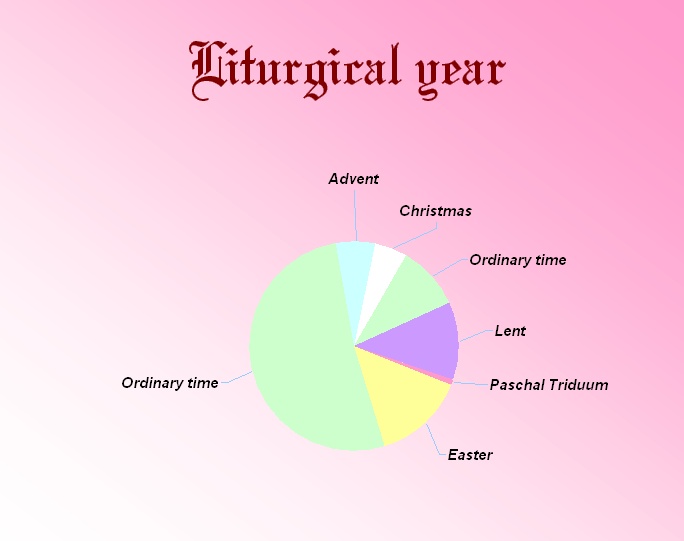
Another thing Pentecost Sunday does is mark the beginning of “Ordinary Time,” as it’s called in the Catholic Church, and shown in the chart below. That Ordinary Time takes up over half the church year, though in the Episcopal Church and other Protestant denominations, it goes by another name. That is, in the Anglican liturgy it’s called the Season after Pentecost and it begins on the Monday after Pentecost Sunday and goes on “through most of the summer and autumn.” So, this year the Season after Pentecost – or Ordinary Time – runs from Monday, May 25, through Sunday, November 29, the First Sunday of Advent.
So, looking ahead to a long Pentecost Season, here’s wishing a Happy Birthday, Church!
* * * *
* * * *
The upper image was first courtesy of Pentecost Sunday Images – Image Results. But see also El Greco – Pentecost, 1610 at Prado Museum Madrid Spain. The caption – gleaned from past posts – is from Wikipedia, in turn gleaned from the following: “The Christian High Holy Day of Pentecost is celebrated on the 50th day (the seventh Sunday) from Easter Sunday. It commemorates the descent of the Holy Spirit upon the Apostles and other followers of Jesus Christ while they were in Jerusalem celebrating the Feast of Weeks, as described in the Acts of the Apostles (Acts 2:1–31).”
The Book of Common Prayer reference: The “corporate-mystical” prayer is on page 339, the post-communion prayer for Holy Eucharist, Rite I.
Feast days are designated days on the liturgical (church) calendar “set aside to commemorate events, saints, or doctrines that are important in the life of the Church. These can range from Solemnities, which are the highest-ranking feast days like Easter and Christmas, to optional memorials that celebrate lesser-known saints.” Feast Days … the Church’s Calendar. See also Wikipedia’s Calendar of saints. “The calendar of saints is the traditional Christian method of organizing a liturgical year by associating each day with one or more saints and referring to the day as the feast day or feast of said saint. The word ‘feast’ in this context does not mean ‘a large meal, typically a celebratory one,’ but instead ‘an annual religious celebration, a day dedicated to a particular saint.’”
Note also: Feast days falling on a Sunday get transferred to the next Monday. Precedence, Rules of – The Episcopal Church: “Sunday takes precedence over all other feasts and observances of the church year. When a feast of our Lord or other major feast appointed cannot be observed because it occurs on a Sunday, the feast is normally transferred to the first convenient open day in the following week.”
For this post I reviewed 2015’s On Pentecost – “Happy Birthday, Church,” Pentecost 2020 – “Learn what is pleasing to the Lord,” On Pink Floyd – and Pentecost Sunday, 2021, On Pentecost Sunday – 2024, and On Pentecost and St. Barnabas – 2025.
The lower image is courtesy of Liturgical year – Wikipedia. See also Ordinary Time – Wikipedia.
* * * *
As noted in the opening blurb, this blog has four main themes. The first is that God will accept anyone. (See John 6:37, with the added, “Anyone who comes to Him.”) This is a consistent theme throughout the Bible. From the Old Testament, Psalm 9:10, “You never forsake those who seek you, O Lord.” (In the Book of Common Prayer version.) The second is that God wants us to live abundantly. (John 10:10.) The third is that we should do greater miracles than Jesus. (John 14:12). A fourth theme: The only way to do all that is read the Bible with an open mind:
…closed-mindedness, or an unwillingness to consider new ideas, can result from the brain’s natural dislike for ambiguity. According to this view, the brain has a “search and destroy” relationship with ambiguity and evidence contradictory to people’s current beliefs tends to make them uncomfortable… Research confirms that belief-discrepant-closed-minded persons have less tolerance for cognitive inconsistency…
See also Splitting (psychology) – Wikipedia, on the phenomenon also called black-and-white thinking, “the failure in a person’s thinking to bring together the dichotomy of both positive and negative qualities of the self and others into a cohesive, realistic whole. It is a common defense mechanism. The individual tends to think in extremes (i.e., an individual’s actions and motivations are all good or all bad with no middle ground).
So in plain words, I take issue with what I call “Christian first graders.” Those who choose to stay in a kind of elementary-school first grade. See John the Baptist, ’24 – and “Christian First Graders,” for more. But the key point: “The Bible was designed to expand your mind,” not make it narrow. Also, there’s the idea that “Jesus was anything but negative. His goal was for you to grow and develop into all that you can be.” (For more on that see ABOUT THE BLOG, above.)
I’ve written on boot-camp Christians, the Literalists who never go “beyond the fundamentals.” But the Bible offers so much more than a narrow reading gives… (Unless you want to stay a buck private all your life…) Now, about “Boot-camp Christians” see Conservative Christian – “Career buck private?” The gist of that post: Starting the Bible is like Army Basic Training. You begin by“learning the fundamentals.” But after boot camp, you move on to Advanced Individual Training.”

And as noted in “Buck private,” one of this blog’s themes is that if you want to be all that you can be, you need to go on and explore the “mystical side of Bible reading.*” In other words, exploring the mystical side of the Bible helps you “be all that you can be.” See Slogans of the U.S. Army – Wikipedia, re: the recruiting slogan from 1980 to 2001. The related image at left is courtesy of: “toywonders.com/productcart/pc/catalog/aw30.jpg.”
Re: “mystical.” Originally the “liturgical, spiritual, and contemplative dimensions of early and medieval Christianity.” Mysticism – Wikipedia, and the post On originalism. (“What the Bible was originally about!”) See also Christian mysticism – Wikipedia, “In early Christianity the term ‘mystikos’ referred to three dimensions, which soon became intertwined, namely the biblical, the liturgical and the spiritual or contemplative… The third dimension is the contemplative or experiential knowledge of God.” As to that “experiential” aspect, see also Wesleyan Quadrilateral – Wikipedia, on the theological reflection method using four sources of spiritual development: scripture, tradition, reason, and “Christian experience.”
For an explanation of the Daily Office – where “Dorscribe” came from – see What’s a DOR?
* * * *