Category Archives: Daily Office readings

Background and color commentary on highlighted readings from the Daily Office Lectionary

On the psalms up to September 28

“A woman playing a psalterion,” an instrument used to accompany psalms


This feature focuses on the psalm for the upcoming Sunday and on highlights from the psalms in the Daily Office (DORs) in the week leading up to that upcoming Sunday.  The general idea is to review the next Sunday’s readings on the prior Wednesday, and review the psalms from the Daily Office Readings for the week ending on the Tuesday just before that “prior Wednesday.”

For example, The Lectionary Page  psalm for Sunday, September 28 is Psalm 78:1-4, 12-16.  In turn, the DOR psalms highlighted in this post will be from the readings for Wednesday, September 18 (“more or less”), up to the readings for Tuesday, September 23.

Psalm 78 will be discussed below, but first here are some highlights from last week’s DORs.

Going back to Thursday, September 18, the DORs for that day included Psalm 71:18:

And now that I am old and gray-headed, O God, do not forsake me, *
till I make known your strength to this generation
and your power to all who are to come.

Which pretty much sums up how this blog got started.  (Incidentally, some translations label this psalm “The Prayer of an Elderly Person,” but I wouldn’t go that far…)

Which is being interpreted:  If the person who wrote Psalm 78 – or any other psalm – were alive today, he’d probably “get the word out” through a blog like this.

The DORs for Friday, September 19, included Psalm 69, verses 10 and 23.   Psalm 69:10 reads, “Zeal for your house has eaten me up…”  That passage was quoted by the Gospel writer in John 2:17, in the King James Version (the one God uses), “And his disciples remembered that it was written, ‘The zeal of thine house hath eaten me up.'”  This was right after the Wedding at Cana, when Jesus went into the Temple in Jerusalem, and proceeded to clean out the place with a whip of cords, driving out money-changers, publicans and the like.  (See also Romans 15:3.)

Psalm 69:23 reads, “They gave me gall to eat, and when I was thirsty, they gave me vinegar to drink,” which foreshadowed Jesus on the cross.  See Matthew 27:34 There they offered Jesus wine to drink, mixed …, and also Sour Wine and Gall: Was it a Merciful Gesture or Mockery? – …, which noted in part, “Offering sour wine combined with gall … may have been a medicinal and merciful gesture to dull the intense pain; but St. Luke in his Holy Gospel implies that the drink offered to our Lord Jesus at His crucifixion was part of the torture.”

The DORs for Sunday, September 21 included Psalm 96:1, “Sing to the Lord a new song,” about which much has been written herein.  For examples, type “sing Lord new song” in the search box above right and you’ll get links like On “what a drag it is. . .” (alluding to the Rolling Stones song, Mother’s Little Helper).   That post noted in part, “now that I’m ‘old and full of years’ – I [was] 62 – I can clearly see that ‘getting o-o-o-o-o-o-o-o-ld’ beats the heck out of the alternative.”   (Which could also qualify as the “prayer of an elderly person.”)

And finally, the DORs for Tuesday, September 23, included Psalm 78:2, “I will open my mouth in a parable; I will declare the mysteries of ancient times.”  On that note, Jesus specialized in the parabolic method of teaching – of teaching through the use of parables – a method discussed in On three suitors (a parable).  That included a discussion of the problems inherent in trying to “strictly” or “conservatively” interpret a parable, as some try to do.

Turning to the psalm for Sunday, September 28, Psalm 78:1-4, 12-16, the first part – including Psalm 78:2, noted above – begins with a note of praise, and of our duty to future generations:

We will recount to generations to come
the praiseworthy deeds and the power of the LORD, *
and the wonderful works he has done.

Which means of course that it is in God’s best interest to have His followers succeed in life, but oh does God love His drama, as noted in Psalm 50:15, “Call upon me in the day of trouble; I will deliver you, and you shall honor me.”  (The “honor” seems to be the flip side of the “trouble.”)

The International Bible Commentary (IBC) said that Psalm 78 was about “the lessons of history,” and despite how short this Sunday’s reading is, “78” is one of those psalms that is so long that it got divided in two.  It has 72 verses, and verses 12 through 16 are about “Grace abounding,” according to the IBC.  Specifically, these five verses recite “the plagues in Egypt, the crossing of the Red Sea, guidance through the wilderness by cloud and fire, and the provision of water at Rephidim (Exod. 17:6) and Kadesh (Num. 2010 f.).”

Which leads to the valuable lesson:  There’s a big difference between “arguing with God” – see On arguing with God – and “deliberately challenging God,” or defying Him, or being too skeptical about His ability to “deliver us from evil,” as detailed in Psalm 78.


The upper image is courtesy of Psaltery – Wikipedia, the free encyclopedia, with the full caption:   “A woman playing a psalterion.  Ancient Greek red-figured pelike from Anzi, Apulia, circa 320–310 BCE.”

The lower image is courtesy of Psalms – Wikipedia, the free encyclopedia, with the full caption:  “David Playing the Harp by Jan de Bray, 1670.”

As to David playing the harp, see David – Wikipedia, the free encyclopedia, which noted the account of First Samuel, Chapter 16, which told of Saul, the first-ever king of Israel, being tormented by an evil spirit.  In turn it was suggested that “he send for David, a young warrior famed for bravery and his lyre playing.  Saul did so, and made David one of his armor-bearers. From then on, whenever ‘the spirit from God came on Saul, David would take up his lyre and play.  Then relief would come to Saul; he would feel better, and the evil spirit would leave him,’” as illustrated above.


My way or the highway – Wiktionary defined the term as “suggesting an ultimatum which indicates the listener(s) will either conform to the desires of the speaker or else be excluded.”

As to “get the word out,” see Get the word out – Idiom Definition – UsingEnglish.com, “If you get the word out, you inform or let people or the public know about something.”

As to deliver us from evil:  The Lord’s Prayer “concludes with ‘deliver us from evil‘ in Matthew, and with ‘lead us not into temptation’ in Luke.”  See Lord’s Prayer – Wikipedia, the free encyclopedia.

*   *   *   *

As to  Book of Psalms generally, it is “commonly referred to simply as Psalms or ‘the Psalms’ … the first book of the Ketuvim (‘Writings’), the third section of the Hebrew Bible. The English title is from the Greek [word] meaning ‘instrumental music’ and, by extension, ‘the words accompanying the music.’   There are 150 psalms in the Jewish and Western Christian tradition.” Psalms – Wikipedia, the free encyclopedia…   The book is “divided into five sections, each closing with a doxology (i.e., a benediction) … probably introduced by the final editors to imitate the five-fold division of the Torah.”

Wikipedia added that the  “version of the Psalter in the American Book of Common Prayer prior to the 1979 edition is a sixteenth-century Coverdale Psalter.  The Psalter in the American Book of Common Prayer of 1979 is a new translation, with some attempt to keep the rhythms of the Coverdale Psalter.”

For another take on the psalms in general, type “Thomas Merton” in the Search Box above right.


On the psalms up to September 14

“A woman playing a psalterion,” an instrument used to accompany psalms


Welcome to DORScribe, a blog on reading the Bible with an open mind.


In other words, this Bible-blog is different.

It says not only that the Bible should be read with an open mind, but also that it was designed to liberate the human spirit, not shackle it.   That runs contrary to a prevailing perception these days, that way too many Christians are way too negative, close-minded, or both.   For more on that, see About this Blog, which also talks about how we can live fuller, richer lives of great spiritual abundance, and do greater miracles than even Jesus did, if only we open our minds


  In the meantime:

This is the second installment of a new feature.  The focus here is both on the psalm for the Sunday coming up, and also on highlights from the psalms in the Daily Office Readings (DORs) leading up to that upcoming Sunday.  The plan here is to review upcoming Sunday-readings on the prior Wednesday, and to review the psalms from the Daily Office Readings for the week ending on the Tuesday just before that “prior Wednesday.”

For example, The Lectionary Page  psalm for Sunday, September 14 is Psalm 114.   In turn, the DOR psalms highlighted in this post will be from the readings for Wednesday, September 3, up to the readings for Tuesday, September 9.  As an example, the DORs for Sunday, September 7 included Psalm 63, sometimes referred to as Patton’s psalm, that is, the psalm – both “humble and defiant” – that General Patton turned to for comfort when he was on the verge of being sent home in disgrace during World War II.   (See On “Patton,” Sunday School teacher.)

The International Bible Commentary (IBC) said of Psalm 114 that it was the second of the so-called “Hallel psalms;”  psalms, hymns and/or songs “sung regularly at all the great Israelite festivals.”  See Hallel – Wikipedia, the free encyclopedia, which noted:

Hallel consists of six Psalms (113–118), which are recited as a unit, on joyous occasions…   Hallel (Hebrew: הלל‎, “Praise”) is a Jewish prayer – a verbatim recitation from Psalms 113-118, which is used for praise and thanksgiving that is recited by observant Jews on Jewish holidays.

See also Hallel – Jewish Virtual Library, which added, “These psalms are essentially expressions of thanksgiving and joy for divine redemption.”

Note also that the English word “Hallelujah” derives from the Hebrew word “Hallel,” with the word added for God – “Yah” (or “Jah”).  See Hallelujah – Wikipedia, the free encyclopedia, defining the term as an exhortation to praise God, deriving from “two Hebrew words, generally rendered as ‘Praise (ye)’ + ‘the LORD,’ [with] the second word is given as ‘Yah.'”  See also Yahweh – Wikipedia, the free encyclopedia, describing “the national god of the Iron Age kingdoms of Israel and Judah,” but we digress…     (Or do we?)

Indeed, Psalm 114 begins like this:  “Hallelujah!   When Israel came out of Egypt, the house of Jacob from a people of strange speech, Judah became God’s sanctuary and Israel his dominion.”  Then too, the IBC describes the psalm as “Exodus set to music:”

Israel hought of herself as essentially a liberated, redeemed people.  They recalled with gratitude the time when the burden of foreign oppression rolled away and they became free – not free in the anarchical sense, but free to enter God’s service.  By the Exodus they became a holy people who worshipped Yahweh as their God and a vassal people who owned Him as their King.

On the other hand, the IBC noted that in Psalm 114, the writer handled this “sacred theme unusually, with a whimsical sense of humor.”  (A reference I need to keep in mind for possible future defense of the “delightfully quirky” vision I’m pursuing in this blog…)

Among other events, the psalm celebrates the crossing of the Red Sea, but with a sense that You Are There;  “By faith the years roll away and the worshippers feel themselves at the very scene as if it had all just happened.”  (Which is also pretty much what this blog tries to do.)

*   *   *   *

Turning to the psalms from the Daily Office readings; the DORs for Thursday, September 4 included Psalm 37:14, “The Lord laughs at the wicked, because he sees that their day will come.” Also 37:17, “The little that the righteous has is better than the great riches of the wicked.”

The Daily Office readings for Friday, September 5 included Psalm 31:5, “Into your hands I commend my spirit, for you have redeemed me, O Lord, O God of truth.”  (See also Acts 7:59.)

The Daily Office readings for Saturday, September 6, included Acts 13:26-43, where the Apostle Paul quoted extensively from the Book of Psalms.  He was in the synagogue in Antioch during his first missionary journey, arguing that Jesus was the long-awaited Messiah:

“Barnabas and I are here to bring you this Good News … that God brought Jesus back to life again.  This is what the second Psalm is talking about when it says concerning Jesus, ‘Today I have honored you as my Son…’   In another Psalm [16:10] he explained more fully, saying, ‘God will not let his Holy One decay.’ 36 This was not a reference to David, for after David had served his generation according to the will of God, he died and was buried, and his body decayed. 37 No, it was a reference to another – someone God brought back to life, whose body was not touched at all by the ravages of death.”

The Daily Office readings for Sunday, September 7, included “Patton’s psalm,” discussed above, and Psalm 98:1, one of many exhortations to “Sing to the Lord a new song,” that is, a song unique to your personal pilgrimage.   (And not to devote your life to “singing” a mere rehash of what other people have done in the past, as some seem to imply).

And finally, the DORs for Monday, September 8, included a reminder from Psalm 41:1, “Happy are they who consider the poor and needy; the Lord will deliver them in the time of trouble.”

– The Scribe


The upper image is courtesy of Psaltery – Wikipedia, the free encyclopedia, with the full caption:   “A woman playing a psalterion.  Ancient Greek red-figured pelike from Anzi, Apulia, circa 320–310 BCE.”

The lower image is courtesy of Psalms – Wikipedia, the free encyclopedia, with the full caption:  “David Playing the Harp by Jan de Bray, 1670.”

As to David playing the harp, see David – Wikipedia, the free encyclopedia, which noted the account of First Samuel, Chapter 16, which told of Saul, the first-ever king of Israel, being tormented by an evil spirit.  In turn it was suggested that “he send for David, a young warrior famed for bravery and his lyre playing.  Saul did so, and made David one of his armor-bearers. From then on, whenever ‘the spirit from God came on Saul, David would take up his lyre and play.  Then relief would come to Saul; he would feel better, and the evil spirit would leave him,’” as illustrated above.


Another note:  You Are There was an “American historical educational television and radio series broadcast over the CBS Radio and CBS Television networks.”  The series began on radio on July 7, 1947, then made the transition to television on February 1, 1953, after a three-year hiatus and/or “retooling.”  The final TV broadcast came on October 13, 1957.  The series “blended history with modern technology, taking an entire network newsroom on a figurative time warp each week reporting the great events of the past.” See You Are There (series) – Wikipedia, the free encyclopedia.

As to Paul’s “missionary journeys,” see e.g. Chronology of Apostle Paul’s Journeys and Epistles.

*   *   *   *

As to  Book of Psalms generally, it is “commonly referred to simply as Psalms or ‘the Psalms’ … the first book of the Ketuvim (‘Writings’), the third section of the Hebrew Bible. The English title is from the Greek [word] meaning ‘instrumental music’ and, by extension, ‘the words accompanying the music.’   There are 150 psalms in the Jewish and Western Christian tradition.” Psalms – Wikipedia, the free encyclopedia…   The book is “divided into five sections, each closing with a doxology (i.e., a benediction) … probably introduced by the final editors to imitate the five-fold division of the Torah.”

Wikipedia added that the  “version of the Psalter in the American Book of Common Prayer prior to the 1979 edition is a sixteenth-century Coverdale Psalter.  The Psalter in the American Book of Common Prayer of 1979 is a new translation, with some attempt to keep the rhythms of the Coverdale Psalter.”

For another take on the psalms in general, type “Thomas Merton” in the Search Box above right.


On the Psalms up to September 7

“A woman playing a psalterion,” an instrument used to accompany psalms


This is a new feature, focusing not only on the psalm for a given, upcoming Sunday, but also on some highlights from the psalms in the Daily Office Readings (DORs) leading up to that “any given Sunday.”  Since I’ll be trying to publish the review of an upcoming Sunday’s readings on the prior Wednesday, the DOR psalms will be taken from the readings for the week ending on the Tuesday before that “prior Wednesday.”

For example, the Psalm for Sunday, September 7 is Psalm 149.   In turn, the DOR psalms highlighted in this post will be from the readings for Wednesday, August 26, and going on to the readings for Tuesday, September 2.  As an example, the DORs for Monday, September 1 included Psalm 9:10, “you never forsake those who seek you, O LORD,” which goes along with and supports what Jesus said in John 6:37:  “I will never turn away anyone who comes to me.”

Turning back to Psalm 149, the International Bible Commentary used the sub-head “firstfruits of victory,” and noted that the psalm was “evidently inspired by a national victory.  As the people praise God for it, they look forward to the future, final triumph of His purposes.”

But first note that the psalm begins, “Hallelujah!  Sing to the LORD a new song…”   On that note see the post On the DORs for July 20, which asked the musical question:

How can we do greater works than Jesus if we interpret the Bible in a cramped, narrow, strict and/or limiting manner?   For that matter, why does the Bible so often tell us to “sing to the Lord a new song?”   (For example, Isaiah 42:10 and Psalms 96:1, 98:1, and 144:9.)

Or for more, in the “Search” box above right you could just type in “sing Lord new song.”

Getting back to Psalm 149, the IBC noted that it was God who had “made a rabble of slaves into a cohesive nation,” and further that “Yesterday’s victory, celebrated in today’s praise, was a steppingstone to the promised triumph of the end time.”

Which is something to keep in mind these days when all the world seems to be roiling against us as a nation.  Thus the mandate of verse 3:  “Let them praise his Name in the dance;  let them sing praise to him with timbrel and harp,” as David did in the painting below.

Getting back to the psalms in the last week’s Daily Office Readings, Saturday’s readings included Psalm 110, verses 1 and 6:  “The Lord said to my Lord, ‘Sit at my right hand, until I make your enemies your footstool,” and also, “The Lord has sworn and he will not recant; ‘You are a priest forever after the order of Melchizedek.”

Jesus quoted Psalm 110:1 in Mark 12:35-36, saying “‘How can the scribes say that the Christ is the son of David?  David himself, in the Holy Spirit, declared, ‘The Lord said to my Lord, Sit at my right hand, until I put your enemies under your feet.’   David himself calls him Lord.  So how is he his son?’ And the great throng heard him gladly.”

And Paul quoted Psalm 110:4 in Hebrews, Chapter 7, speaking of Jesus:

The matter becomes even plainer; a different priest has appeared, who is like Melchizedek. 16 He was made a priest, not by human rules and regulations, but through the power of a life which has no end.   17 For the scripture says, “You will be a priest forever, in the priestly order of Melchizedek.”

And note that Psalm 149:1, one of the DORs for Sunday, August 31, keeps up the theme of singing to the Lord a new song, while Psalm 39:14, one of the DORs for Tuesday, September 2, serves as a reminder that – bottom line – we all came here from somewhere else:

“For I am but a wayfarer with you, a wayfarer, as all my forebears were.”

– The Scribe


The upper image is courtesy of Psaltery – Wikipedia, the free encyclopedia, with the full caption:   “A woman playing a psalterion.  Ancient Greek red-figured pelike from Anzi, Apulia, circa 320–310 BCE.”

The lower image is courtesy of Psalms – Wikipedia, the free encyclopedia, with the full caption:  “David Playing the Harp by Jan de Bray, 1670.”

As to David playing the harp, see David – Wikipedia, the free encyclopedia, which noted the account of First Samuel, Chapter 16, which told of Saul, the first-ever king of Israel, being tormented by an evil spirit.  In turn it was suggested that “he send for David, a young warrior famed for bravery and his lyre playing.  Saul did so, and made David one of his armor-bearers. From then on, whenever ‘the spirit from God came on Saul, David would take up his lyre and play.  Then relief would come to Saul; he would feel better, and the evil spirit would leave him,'” as illustrated above.

As to  Book of Psalms generally, it is “commonly referred to simply as Psalms or ‘the Psalms’ … the first book of the Ketuvim (‘Writings’), the third section of the Hebrew Bible. The English title is from the Greek [word] meaning ‘instrumental music’ and, by extension, ‘the words accompanying the music.’   There are 150 psalms in the Jewish and Western Christian tradition.” Psalms – Wikipedia, the free encyclopedia…   The book is “divided into five sections, each closing with a doxology (i.e., a benediction) … probably introduced by the final editors to imitate the five-fold division of the Torah.”

Wikipedia added that the  “version of the Psalter in the American Book of Common Prayer prior to the 1979 edition is a sixteenth-century Coverdale Psalter.  The Psalter in the American Book of Common Prayer of 1979 is a new translation, with some attempt to keep the rhythms of the Coverdale Psalter.”


On Job, the not-so-patient

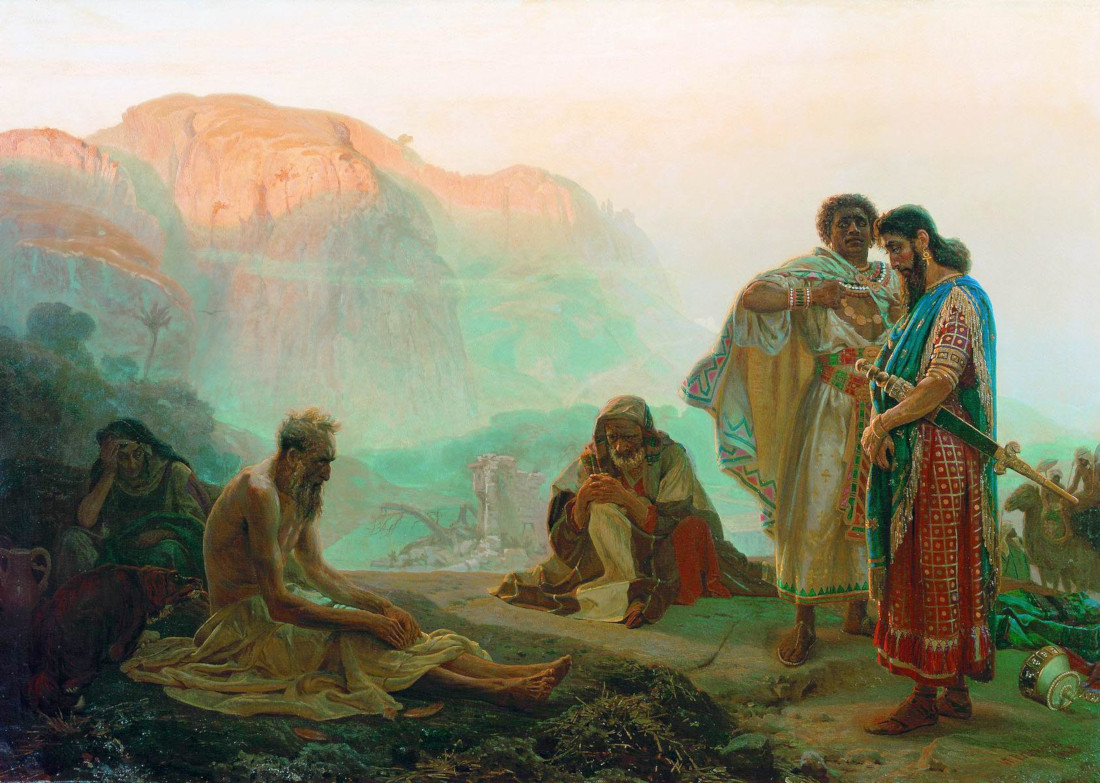
Ilya Repin: Job and his Friends

Job and his friends, by Ilya Repin (1869). . .


The Old Testament Daily Office Readings – the DORs – started with the Book of Job on Thursday, August 21, and those readings continue until Thursday, September 18.    (It’s a really long book, mostly filled with whining and complaining, by Job and his friends as seen above.)

But first a word about the patience of Job.   Wiktionary says that phrase indicates a person who has a great amount of patience, and refers to this book of the Bible, “where Job demonstrated faith and patience with God while suffering many severe trials.”  See patience of Job – Wiktionary, which added the expression seems to have started in James 5:11:

As you know, we count as blessed those who have persevered.  You have heard of Job’s perseverance and have seen what the Lord finally brought about.  The Lord is full of compassion and mercy.

(New International Version.)    But according to Isaac Asimov, Job really wasn’t all that patient.

Asimov first indicated that when the book was first written, Job was known as the hero of a well-known legend, about a wealthy sheik who lived east of Canaan, on the border of a desert.  This legendary Job was a “good man of superhuman patience” who suffered great misfortune without ever losing his faith in God.   Asimov also noted the appearance of Satan – indicating a “Persian influence” – and added that in the story Satan had (and has) the important role of testing human beings, to see if their faith in God was “staunch, or merely superficial.”

Be that as it may, Asimov indicated the “meat of the book” came in the series of question-and-answer speeches involving ethical and theological questions, many outside the realm of Bible study (including some interesting “astronomical references”).  He then noted:

In these speeches, Job is anything but patient and uncomplaining, and seriously questions the justice of God.  Nevertheless, this has not, for some reason, altered the common conception of Job as a patient, uncomplaining man. (E.A.)

Then too, Job is a good example of a Bible book that should be both approached with great caution and not be taken too literally.  For example, consider the following excerpts from Job 3:1-26, from the Daily Office Reading for Saturday, August 23:

Job opened his mouth and cursed the day of his birth…   “Why did I not perish at birth, and die as I came from the womb..?   For now I would be lying down in peace; I would be asleep and at rest…   Or why was I not hidden away in the ground like a stillborn child, like an infant who never saw the light of day?   There the wicked cease from turmoil, and there the weary are at rest.   Captives also enjoy their ease; they no longer hear the slave driver’s shout.   The small and the great are there, and the slaves are freed from their owners…   Why is light given to those in misery, and life to the bitter of soul, to those who long for death that does not come, who search for it more than for hidden treasure, who are filled with gladness and rejoice when they reach the grave?”

To say the least, such sentiments could definitely be “taken out of context.”

First Job cursed the day he was born and asked God why he didn’t die at birth, “as I came from the womb” or like a stillborn child.  He added that had he died, “I would be lying down in peace,” in a better place where “the wicked cease from turmoil” and the weary are at rest.  He then asked God why He gives life to those who long for death and who are “filled with gladness and rejoice when they reach the grave?”

For just that reason, guys like John R. W. Stott took issue with literalists who say the Bible should viewed as “inerrant per se.”  Instead – he said – the Bible should be viewed as inerrant “in all that it affirms.”  As applied to this case, Stott would say that the “plain meaning” of the text of Job should not be seen as affirming suicide, as would appear at first glance.

But since we’re running out of space and time, Stott’s views will be explored in a future post.


989766
The upper image is courtesy of Job and His Friends – Ilya Repin – WikiArt.org.  See also Ilya Repin – Wikipedia, the free encyclopedia, on “the most renowned Russian artist of the 19th century, when his position in the world of art was comparable to that of Leo Tolstoy in literature. . .    His method was the reverse of impressionism.  He produced works slowly and carefully.  They were the result of close and detailed study.  With some of his paintings, he made one hundred or more preliminary sketches.  He was never satisfied with his works, and often painted multiple versions, years apart.”

As to Isaac Asimov on Job, see Asimov’s Guide to the Bible (Two Volumes in One),  Avenel Books (1981), beginning on page 474, up to the “not-so-patient” quote on page 480.  The “interesting astronomical references” include “Arcturas, Orion, and Pleiades.” (Job 9:9)

For other references on the role of Satan – as Accuser or Slanderer – in the “great scheme of things,” see On “St. Michael and All Angels” and/or On the readings for May 25.

James is the book of the Bible right after the Letter to the Hebrews and right before First Peter, “traditionally attributed to James the Just.”   See Epistle of James – Wikipedia, the free encyclopedia.

The full Daily Office Readings can be seen at The Lectionary – Satucket.com.

The lower image is courtesy of Understanding the Bible by John R.W. Stott — Reviews, ….  See also John Stott – Wikipedia, the free encyclopedia, which added that Stott was an Anglican cleric whom Time magazine ranked among the 100 most influential people in the world.  To view some of Stott’s 126 available books, see Amazon.com: John R. W. Stott: Books, Biography, Blog, ….

Then too, “requiring every word of the Bible to be inerrant” brings to mind what Jesus said in Matthew 23:4, as He chastised the scribes and Pharisees.  The Easy-to-Read translation says in pertinent part that such people “make strict rules that are hard for people to obey.  They try to force others to obey all their rules.  But they themselves will not try to follow any of those rules.”


On the “Gospel of Marx”

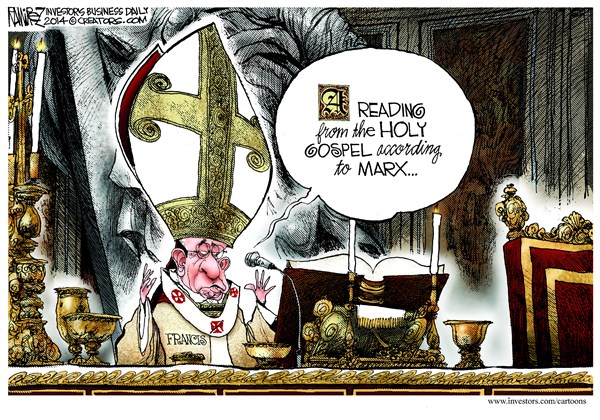
148751 600 Gospel According to Marx cartoons


Conservative Michael Ramirez did the May 18 cartoon above, which led to responses like this:

Ramirez’s May 18 cartoon of Pope Francis and the so-called gospel of Marx is evidence that [he] is ignorant of the difference between Christ’s love of the poor and Marxist communism’s philosophy, which espouses not only atheism but oppression of all, poor and wealthy. Another very important point is that Christ invites us, does not force us – as communism would do – to share our goods with the poor and treat them with love and respect.  (E.A.)

See Drawing wrong conclusion – Spokesman Mobile – May 27, 2014.  (See also Another view of Jesus feeding the 5,000, on getting “normally-greedy people to share what they had.”)

But sometimes the best response comes right from the Bible; in this case, as found in the Daily Office Readings (DORs) for last Saturday, August 9, at The Lectionary – Satucket.com.

The New Testament reading was Acts of the Apostles, 4:32-5:11.  The New Century Translation included the headings “The Believers Share” and “Ananias and Sapphira Die:”

The group of believers were united in their hearts and spirit.  All those in the group acted as though their private property belonged to everyone in the group.  In fact, they shared everything. . .    And God blessed all the believers very much.  There were no needy people among them.  From time to time those who owned fields or houses sold them, brought the money, and gave it to the apostles.  Then the money was given to anyone who needed it. (E.A.)

This happened right after Pentecost, when the number of Believers in the new Church jumped from about 120 to over 3,000.  (See Pentecost – Wikipedia, the free encyclopedia.)

So anyway, the 8/9 reading went on about Joseph, “a Levite from Cyprus,” who sold his property and gave the money to the Apostles.  In contrast, Chapter 5 had Ananias and his wife Sapphira trying to snooker the Apostles (and by extension God  –  which by the way is never a good idea).  

Ananias sold some property and gave some money to the Apostles, but held some back with his wife’s approval.  (They may have been conservatives “but I’m just guessin’ you understand.”)  Somehow Peter figured it out and asked Ananias, “How is it that you have contrived this deed in your heart?  You have not lied to men but to God.”  At that point Ananias literally dropped dead.

They had just carried his body out when his wife Sapphira came in, and Peter confronted her:

Peter said to her, “How is it that you have agreed together to tempt the Spirit of the Lord? Hark, the feet of those that have buried your husband are at the door, and they will carry you out.”   Immediately she fell down at his feet and died.  When the young men came in they found her dead, and they carried her out and buried her beside her husband.  And great fear came upon the whole church, and upon all who heard of these things.

All of which supports my theory that it’s never a good idea to snooker God, and – come to think of it – maybe it’s not such a great idea to call the Pope a Marxist either.

On a related note the Gospel had Jesus cleansing the Temple with a whip of cords, as illustrated in On “chutzpah”.   Which leads me to wonder if it was all Jewish People or just the conservatives who were so dead set against Jesus.  (See also On Jesus: Liberal or Fundamentalist?)   So just for laughs let’s substitute “conservatives” for “Jews” in this portion of the August 9 Gospel:

And he [Jesus] told those who sold the pigeons, “Take these things away; you shall not make my Father’s house a house of trade. . .”   The Conservatives then said to him, “What sign have you to show us for doing this?”   Jesus answered them, “Destroy this temple, and in three days I will raise it up.”  The Conservatives then said, “It has taken forty-six years to build this temple, and will you raise it up in three days?”  But he spoke of the temple of his body. . .

(Hmmm.  We may be on to something.)  And by the way, the point of  Liberal or Fundamentalist was that Jesus was neither conservative nor liberal, but “right there ‘in the middle of the road.’”


Which leads to the point of this post:  It seems some Conservatives are still opposing the message of Jesus.


The upper image is courtesy of Gospel According to Marx by Political Cartoonist Michael …   For more on this cartoonist see Michael Ramirez – Wikipedia, the free encyclopedia.

The lower image – just to show how fair and balanced this blog is – is included in the web article Drawing wrong conclusion – Spokesman Mobile – May 27, 2014, which had a number of interesting comments on the Conservative/Christian dichotomy.  See also On Thomas Merton, which asked the musical question, “If Jesus was ‘orthodox’ why aren’t we all still Jewish?”

For purposes of clarity, as defined here a conservative is simply a person with a predetermined set of “one size fits all” answers for all life’s questions.   A liberal is different only in having a different set of predetermined “one size fits all” answers.  But what such people up doing – metaphorically – is keep pounding square pegs into round holes, but we digress. . .

Another point of this blog is that in contrast to having such a predetermined set of answers, the better approach is:   “Mind like parachute; work best when open.”  See Some Bible basics from Vince Lombardi and Charlie ChanIn turn, as defined herein someone with an open mind can’t be either a true conservative or true liberal, but rather an conservative-leaning moderate (for example).


The reader may also be interested in Was Jesus a Jewish Liberal or a Liberal Jew? – Patheos.

On the DORs for July 20

*   *   *   *

First a note: This blog’s focus is the real Good News* – the positive parts of the Bible – and especially the Three Great Promises of Jesus. As noted elsewhere, the “DOR” in the blog-name stands for Daily Office Reading. The Daily Office is a set of Bible readings in a two-year cycle, so every two years you will have gone through the Bible at least one time. (I’m on my 16th trip through since 1992.) Which brings up the Daily Office readings for Sunday, July 20, 2014.

Those readings included Psalm 63:1-8(9-11), 98; and the evening Psalm 103. The others are Joshua 6:15-27; Acts 22:30-23:11; Mark 2:1-12. As for Psalm 63, I talked about it in a prior post, On “Patton,” Sunday School teacher. It noted the movie about him starring George C. Scott:

Patton was at a low point in his career during World War II, after the “slapping incident” in Sicily.  He was almost sent home in disgrace, but he found comfort in Psalm 63. . .  The film showed Patton praying, then going out to apologize to the troops. As he went, he recited Psalm 63, “humble and defiant.”  As abbreviated . . . the psalm went like this: “O God, Thou art my God, early will I seek Thee. My soul thirsteth for Thee…  But those that seek my soul, to destroy it, shall go into the lower parts of the earth. They shall fall by the sword, they shall be a portion for foxes…   Everyone that sweareth by Him shall glory. But the mouth of them that speak lies shall be stopped.”

Also on the note of irony, the post pointed out that aside from believing in reincarnation, Patton read the Bible on a daily basis.   For example, during a tour of his private quarters an Army chaplain noted a Bible on a desk.  Later “the chaplain asked if Patton actually had time to read that Bible.  Patton said, ‘I sure do.  Every Goddamn day.’”

And finally, Psalm 98:1 was also covered by prior post including On the Gospel for May 18, and About this Blog.  The former post asked the musical question:

How can we do greater works than Jesus if we interpret the Bible in a cramped, narrow, strict and/or limiting manner?   For that matter, why does the Bible so often tell us to “sing to the Lord a new song?”   (For example, Isaiah 42:10 and Psalms 96:1, 98:1, and 144:9.)

Isaiah 42:10 says, “Sing to the Lord a new song, his praise from the end of the earth!”  Psalm 96 and 98 say pretty much the same thing, while Psalm 144:9 adds, “I will sing you a new song, O God, with a ten-stringed harp.”  (The Revised Standard and Living Bible versions, emphasis added.)  As to Psalm 144:9, if taken literally it seems to be a direct command that you can only sing a new song to God using a ten-stringed harp.  (Which would seem to be an absurd result, contrary to the intent of the person who drafted the directive.)

On the other hand, if interpreted metaphorically Psalm 144:9 could indicate that while God wants you to sing a new song to Him now, your best “song” will result from your unique experiences, as shaped and arranged according to lessons learned from other people who have sung songs that were new then, back when the Bible was originally written.   (Hmmmm.)

Okay, this is going to take a whole lot more thought. . .

http://foliovision.com/images/2012/10/Rodin-the-Thinker.jpg

*   *   *   *

As always, you can see the full readings at The Lectionary – Satucket.com.

As to “guilt trips,” see The Psychology and Management of Guilt Trips | Psychology Today: “Guilt trips are a form of verbal or nonverbal communication in which a guilt inducer tries to induce guilty feelings in a target in an effort to control their behavior.”  .

The “Thinker” image is courtesy of foliovision.com/images/2012/10/Rodin-the-Thinker.jpg. “The Thinker (French: Le Penseur) is a bronze sculpture by Auguste Rodin . . . a nude male figure of over life-size sitting on a rock with his chin resting on one hand as though deep in thought, and is often used as an image to represent philosophy.  There are about 28 full size castings. . .   Originally named The Poet (French: Le Poète), the Thinker was initially a figure in a large commission, begun in 1880, for a doorway surround called The Gates of Hell.” See The Thinker – Wikipedia.

*   *   *   * 

Abraham and Isaac – Where God CHANGED some “traditional values and attitudes…”

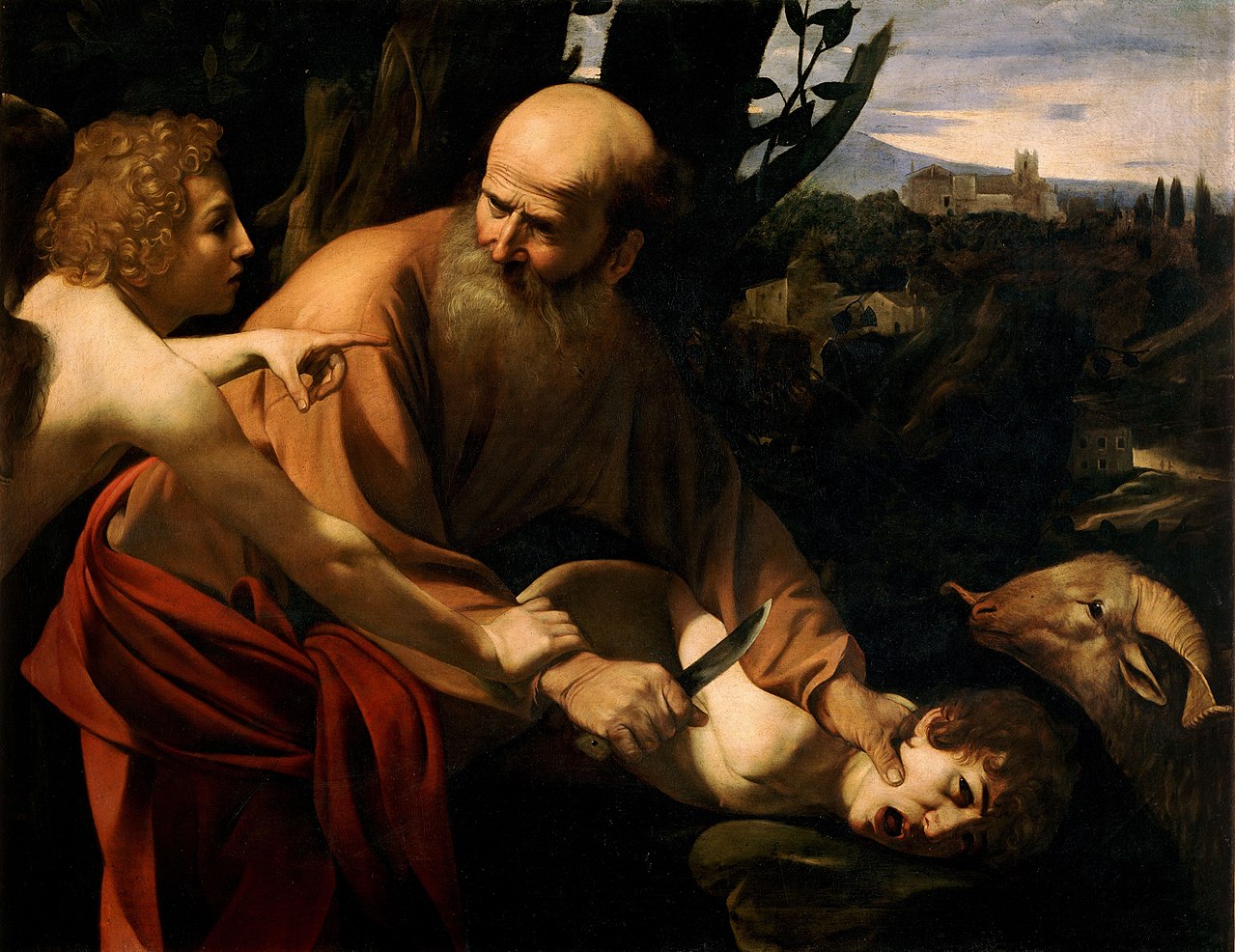
“The ‘Sacrifice of Isaac,’ where God finally said “Stop!  Let’s change some ‘traditional values…'”

*   *   *   *

The readings for June 29, 2014, are Genesis 22:1-14, Psalm 13, Romans 6:12-23, and Matthew 10:40-42.  The Genesis story tells of God apparently asking Abraham to kill his son.
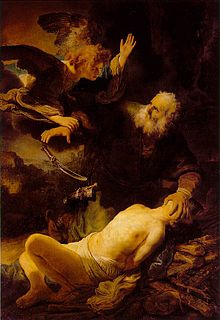
That is, In Genesis 22:1-14, “God tested Abraham,” by appearing to ask him to kill his first-born son Isaac.  That was the son – Isaac – that Abraham and his wife Sarah had been waiting and praying for “lo these many years.”   (As noted in On “Call me Ishmael” – June 22 Part I, “Abraham was 100 years old when Isaac was born, and Sarah was past 90” when Isaac was born.)

The story bothers a lot of people.  That’s because it apparently shows God ordering a father to kill his own son.  And that’s the view you would take if you took the lesson literally.   

But if you look at some other “prevailing wisdom,” you might get a wholly different take.  (See On “originalism,” noting that originalism is the view that interpretation “should be based on what reasonable persons living at the time . . . would have declared the ordinary meaning of the text to be.”)  In that view you would ask:  What would a reasonable man – under the “community standards” at the time – have thought of Abraham killing his son as a “sacrifice?”

Apparently it wouldn’t have bothered that “reasonable man” at all.  That’s because at that time and place, child sacrifice was quite common.  See Binding of Isaac – Wikipedia – illustrated at right – and citing “Hertz:”

[C]hild sacrifice was actually “rife among the Semitic peoples. . .  [I]n that age, it was astounding that Abraham’s God should have interposed to prevent the sacrifice, not that He should have asked for it.”  Hertz interprets the Akedah as demonstrating to the Jews that human sacrifice is abhorrent.

A note:  Akedah is Hebrew short-hand for the Abraham-Isaac story, and translates “The Binding.”  So to a reasonable Semite at the time – when the story occurred, or when Moses wrote it down, if not both – a father offering his son as a “sacrifice to the gods” was so common that the Akedah proved the noteworthy exception.

So at the time of Abraham, routine child sacrifice was a prevailing “traditional value.”

Which means this story would  be something like today’s “man bites dog” journalism.  That is, a story about “an unusual, infrequent event is more likely to be reported as news than an ordinary, everyday occurrence.”  See Man bites dog (journalism) – Wikipedia.

(Did the Scribe mention that he got a Master’s Degree in Journalism?)

So the Good News is not that God is as cruel as a literal reading of the story would indicate.  (I.e., from from a “plain reading.”)  The point God wanted to make was just the opposite of what a plain or “literal reading” would show.  God wanted to change some of the “prevailing practices” at the time.  On that note, the general definition of conservative is of a “person who is averse to change and holds to traditional values and attitudes.”

But in this case, God felt a prevailing practice needed to be changed.

*   *   *   *

Moving on, in Psalm 13, the writer first asked, “How long, O LORD?  Will you forget me for ever?”  But he ended on a note of hope, “I will sing to the LORD, for he has dealt with me richly; I will praise the Name of the Lord Most High.”  (Maybe because God didn’t require child sacrifice.)

In Romans 6:12-23, Paul wrote about the wages of sin; “For the wages of sin is death, but the free gift of God is eternal life in Christ Jesus our Lord.”  And the post D-Day and confession addressed this whole business of sin, a “business” that seems to turn off a whole lot of non-Christians.  (For example, the search “Christians hung up on sin” led to offerings including Advocatus Atheist: Why are Christians Hung Up on Sin?)  Anyway, here’s what  “D-Day” said:

When we “sin” we simply fall short of our goals; we “miss the target.”  When we “confess,” we simply admit to ourselves how far short of the target we were.   And maybe the purpose of all this is not to make people feel guilty all the time, as some seem to imply.

Note also Paul’s saying, in Romans 6:19, “I am speaking in human terms because of your natural limitations.”  In other words Paul – like Moses and indeed God Himself – is not limited by his (or His) ability to teach, but only by our ability to comprehend.

So Moses couldn’t tell “the truth” about such things as the earth revolving around the sun, because he had to tell the story of Creation “using language and concepts that his relatively-pea-brained contemporary audience could understand.” See On the readings for June 15 – Part I.  So also Paul – like God – had to keep in mind the “natural limitations” of his (His) audience.

And finally, in Matthew 10:40-42, Jesus spoke of the “reward of the righteous.”  That especially concerned the children who used to be so routinely offered as a sacrifice to the “old gods” in the time of Abraham.  As Jesus said, “Whoever gives even a cup of cold water to one of these little ones in the name of a disciple – truly I tell you, none of these will lose their reward.”

Note the difference – and the improvement – over some “traditional values and attitudes.”

*   *   *   *

“Christ with children by Carl Heinrich Bloch.”

*   *   *   *

The upper image is courtesy of Binding of Isaac – Wikipedia.  The full caption reads: “‘The Sacrifice of Isaac’ by Caravaggio, in the Baroque tenebrist manner.”  As to the wording of the caption, see “Or words to that effect” – Wiktionary, and also “Or Words to that Effect” – Adoremus Bulletin, quoting the character Richard Rich in the plan “A Man for All Seasons.”

Re:  Abraham – Wikipedia.  The caption for the image to the left of the lead paragraph is captioned:  “Abraham about to sacrifice Isaac. From a 14th-century missal.”

Note also this post was originally published on June 23, 2014, titled, “On the readings for June 29.”  I upgraded it, changed the title, added some images and otherwise upgraded it on October 16, 2018.

As to reasonable, see Reasonable person – Wikipedia:  “The reasonable person (historically reasonable man) is one of many tools for explaining the law to a jury.”

As to the Hertz reference, “Rabbi Joseph Herman Hertz, CH (September 25, 1872 – January 14, 1946) was a Jewish Hungarian-born rabbi and Bible scholar. He is most notable for holding the position of Chief Rabbi of the United Kingdom from 1913 until his death in 1946, in a period encompassing both world wars and the Holocaust.”

The lower image – and note the contrast between the upper and lower images – is courtesy of The Little Children – Wikipedia.

On praying in public

http://www.themonastery.org/blog/wp-content/uploads/2012/02/Jesus-Prayer.png

An illustration of the rhetorical device of irony


The caption above is ironic because Jesus said exactly the opposite – literally – in Matthew 6:6.  In the King James Version – the Bible that God uses – Jesus said in Matthew 6:6, “And when thou prayest, enter into thy closet…”

Matthew 6:6 is part of the Daily Office Reading (DOR) for Monday, May 19.  The full reading was Matthew 6:1-6, and 16-18, which began with Jesus saying, “Beware of practicing your piety before others in order to be seen by them.”  Instead, “when you give alms, do not let your left hand know what your right hand is doing.”

That passage gave rise to the  common English expression, “the left hand doesn’t know what the right hand is doing.”   And while the phrase is now “generally a term of derision for an organization where different members are pursuing opposing or contradictory goals,” in the passage in Matthew, Jesus arguably presented such “lack of coordination as an ideal.”

(So much for “strictly” interpreting the Bible.)

Jesus began on the matter of praying in public one verse earlier, in Matthew 6:5:

“…whenever you pray, do not be like the hypocrites; for they love to stand and pray in the synagogues and at the street corners, so that they may be seen by others.  Truly I tell you, they have received their reward.  6But whenever you pray, go into your room and shut the door and pray to your Father who is in secret…”

That brings up the recent Supreme Court decision, Town of Greece v. Galloway.  It prompted a blog-post by Frank Kirkpatrick of the Huffington Post, The Hollowness of Public Prayer.  Kirkpatrick noted an alternative to trying to distinguish merely-ceremonial prayer from prayers with substance, as the Supreme Court seemed to do.  “Far better to prohibit any and all prayers, substantive and ceremonial, from public gatherings. Let the faithful pray before they come to the meetings or afterwards or perhaps silently during them.”

Then there’s school prayer.  One website said, “Perhaps no aspect of the church-state controversy arouses more emotion and discussion than the subject of prayer in the public schools.”  See School Prayer: News – Secular Web, and School prayer – Wikipedia, the free encyclopedia.   But see also Prayer in School Affects all of Society | Creation Today:  “Since prayer was eliminated from public schools, the quality of education has shown a steady statistical decline.  Is there a link between the two?

(As to, “is there a link?” see Post hoc ergo propter hoc – Wikipedia, the free encyclopedia.  Under that reasoning, it could be said since the Roman Empire collapsed shortly after Emperor Constantine converted to Christianity, that was the cause of the collapse, but we digress…)

To review: on the one hand some say that praying should be done in private, while others say that public prayer – especially prayer in schools – would both set a necessary standard for students, and prevent the declining morality that’s been so evident in the years since 1962.

But what does the Bible say?

We know that from the DOR Gospel for Monday, May 19, 2014, to wit, Matthew 6:6:  “whenever you pray, go into your room [or closet] and shut the door…”

So what’s the “plain meaning” of this passage?

Christians who interpret the Bible “conservatively” – strictly or literally – should say that in a passage like this, the plain meaning of what Jesus said is perfectly clear.  As one website said, “The Bible must be interpreted literally which is the way language is normally and naturally understood.”  Or there is the Golden Rule of Interpretation:  “When the plain sense of Scripture makes common sense, seek no other sense; Therefore, take every word at its primary, ordinary, usual, literal meaning…”  See Do You Interpret the Bible Literally? – Middletown Bible church.  (Or you could just type “Bible plain meaning” in your search engine.)

That should be the end of the story, if you consistently apply the strict and conservative “plain meaning” of the words of Jesus in Matthew 6:6.  (See also, for example,  “The Bible says it, I believe it, that settles it, God said it, I believe it, that settles it : Dictionary of …, or – in a YouTube version – Homosexuality & The Bible 1: God Said It, I Believe It, That Settles It

But that great philosopher Henny Youngman might have summed it up best by saying:


Take school prayer…  Please!


Henny Youngman.jpg

The upper image is courtesy of http://d8rew5imyp13e.cloudfront.net/blog/wp-content/uploads/2012/02/Jesus-Prayer.png.   As to “alms,” see the Wikipedia article and/or alms definition of alms by the Free Online Dictionary, …

On “the left hand doesn’t know what the right hand is doing.”   See the Wikipedia article, Matthew 6:3 – Wikipedia, the free encyclopedia.


On “take school prayer…”    This refers to a classic Henny Youngman joke.  Youngman (1906-1998) was known for his one-liners, and his best-known was ‘Take my wife… please.’”   Henny Youngman – Wikipedia, the free encyclopedia.

An FYI:  The joke relied on the principle of dislocation, as used in comedy, but also in magic and the martial arts in general. See, Shinogi – Budotheory.ca, which mentioned three types of dislocation: positional, temporal, and functional.  And a magician of course is also known as an illusionist.  See the Wikipedia article, Magic (illusion) – Wikipedia, the free encyclopedia, and also Alex Davies – Dislocation.  Finally, see The Internet Classics Archive | The Art of War by Sun Tzu, which noted the saying of Sun Tzu (q.v.), the ancient Chinese philosopher who said, “The fundamental principle of the Art of War is deception,” or in other words, dislocating your opponent.

So anyway, in the classic one-liner – told literally “a century ago” – the audience was led to expect Youngman to say “for example” when he began; as in, “Take my wife… for example.”  But instead of saying “for example,” Youngman dislocated his audience by saying, “Take my wife…  Please!


On Moses and “illeism”

File:Bob Dole, PCCWW photo portrait.JPG

“Bob Dole doesn’t like that…*”


The Old Testament reading in the Daily Office for Saturday, May 17, is Exodus 40:18-38, where seven times Moses used the phrase:  “as the Lord had commanded Moses.”  That brings up illeism, the practice of referring to yourself in the third person.

Chapter 40 ends the Book of Exodus, the story of Moses, about Moses, and by Moses, and about his leading the Children of Israel out of Egyptian slavery and into freedom.

The next book, Leviticus, begins (in the King James Version; the one God uses), “And the Lord called unto Moses, and spake unto him out of the tabernacle of the congregation…”  As noted, tradition says that Moses wrote this book himself.

In the reading for Saturday, May 17, Moses built a “portable dwelling place” for God.

He set up the tabernacle, spread a tent over it and put a tent-covering over that, “as the Lord had commanded Moses.”    He took the Ark of the Covenant – as in “Raiders of the Lost Ark” – and put it in the tent, “and screened the ark of the covenant; as the Lord had commanded Moses.”  He put a table in the tent and “set the bread in order on it before the Lord; as the Lord had commanded Moses.”   Then he set up lampstand,  “as the Lord had commanded Moses.”   He put an altar in and “fragrant incense on it; as the Lord had commanded Moses.”  He set a screen in front and presented “the burnt-offering and the grain-offering as the Lord had commanded Moses.”   He set up a basin with water, so Moses, his brother Aaron and/or Aaron’s sons could wash before approaching the altar, “as the Lord had commanded Moses.”

This then was the portable dwelling place for God (as “modeled” below), as He went with the Hebrews in their 40 years of wandering, before they entered their Promised Land.

File:Stiftshuette Modell Timnapark.jpg

That brings up illeism, “referring to oneself in the third person instead of first person,” used as a stylistic device in literature, while in real life it can reflect “different stylistic intentions…”

Julius Caesar used the device in his Commentaries about the Gallic Wars, while Xenophon of Athens – from whom the term xenophobia derives – used it in Anabasis, “‘one of the great adventures in human history,’ as Will Durant expressed the common assessment.”

Both Caesar’s Commentaries and Anabasis were, as Wikipedia put it, “ostensibly non-fictional accounts of wars led by their authors,” who used the device “to impart an air of objective impartiality to the account, which included justifications of the author’s actions.  In this way personal bias is presented, albeit dishonestly, as objectivity.”

Another note: Tradition says Moses wrote the first five books of the Bible, also known as the Pentateuch or the Torah: Genesis, Exodus, Leviticus, Numbers, and Deuteronomy.  In those books Moses told the story of the Hebrew people, from the beginning of time up to the time Moses was about to die and the Hebrews were about to enter their Promised Land.

Which brings up a question.  In modern terms:  What did Moses know, and when did he know it?  When did Moses find out he was “on a mission from God?”  At the Burning Bush?  Before then, when he killed the Egyptian overseer?  More important, when did he start taking notes for this massive work, five of the most influential books in the history of the world?

So the better question might be:  When did Moses write, and when did he write it?

One answer is to ignore the question.  “The Bible says it, I believe it, that settles it.”  (Another way of saying, “For heaven’s sake, don’t make me think?“)  That approach seems to say super-heroes wrote the Bible and we shouldn’t even think we can become anything like them.

There is another approach.  At some point in his life, Moses had an experience that led him to believe he’d been spoken to by The Force That Created The Universe.  That experience changed the life of Moses and altered the course of history in a way seldom repeated.  And so you might think maybe – just maybe – the Bible was written by people very much like us, and the only difference is they – like Moses – had a “mystic experience with the Divine,” and we haven’t, yet.

Isn’t that what going to church should be about?  Isn’t that especially true because – as Jesus said in John 14:2 – He expects us to perform greater miracles than He did, and by extension, greater miracles than Moses?   (Of course that would mean a lot of work.) 

To be continued…


File:DeMilleTenCommandmentsDVDcover.jpg

Moses doesn’t like this. Moses doesn’t like this one bit…


*  The Bob Dole image is courtesy of Wikipedia.   As for his habit of speaking of himself in the third person, see Urban Dictionary: Bob Dole, which defined him as:  “A guy who ran for president against Bill Clinton.  Known for speaking of himself in the third person…   [Example:] ‘Bob Dole doesn’t like this.  Bob Dole doesn’t like this one bit.'”

On the original tabernacle, see: Tabernacle – Wikipedia, the free encyclopedia.

Xenophobia is excessive and irrational fear of anything foreign. This fear is most often of foreign people, places or objects. People who are xenophobic may display fear or even anger toward others who are foreign. See What Is Xenophobia? – Psychology – About.com.
What did Moses know, and when did he know it?”   An allusion to the Watergate hearings. 
See Howard Baker – Wikipedia, the free encyclopediaIn 1973-74, Baker was a ranking minority member of “the Senate committee, chaired by Senator Sam Ervin, that investigated the Watergate scandal.  Baker is famous for having asked aloud, “What did the President know and when did he know it?”, a question given him by his counsel and former campaign manager, future U.S. Senator Fred Thompson.”   Another site noted that the question “became a Washington mantra.”    For a 36-second clip, see Howard Baker asks Dean what did the president know and when did

On Jethro inventing the supreme court

https://itsallsatire247.files.wordpress.com/2010/06/jethro.jpg


Not Jethro Bodine. . .


http://upload.wikimedia.org/wikipedia/commons/e/ed/Jethro-Tull-cropped.jpg


. . . nor even Jethro Tull . . .


came up with the basic idea behind today’s Supreme Court.  That would have been “the original Jethro,” the one mentioned in the Old Testament part of the Daily Office reading (DOR) for Monday, May 5, 2014, to wit:

File:Jan van Bronchorst - Jethro advising Moses - Google Art Project.jpg


The Jethro mentioned in the Old Testament DOR for May 5[, 2014]  was the father-in-law of Moses.  He is shown in the painting at left, advising Moses on the idea of delegating authority.

But first a bit of background.

Previous DORs told of Moses hightailing it out of Egypt after: 1) learning that he was not a prince of Egypt, as he’d been led to believe all his life, 2) learning that he was actually a member of Hebrew people, who were then serving as slaves in Egypt, and 3) after killing an Egyptian overlord who was beating a Hebrew slave.

He ended up in Midian, somewhere in the deserts of the Sinai and/or Arabian peninsula, where he met Jethro, a priest of Midian in his own right, and married Jethro’s daughter Zipporah.

But by and by (“in the fullness of time”), Moses went back to Egypt after his ten-year exile and eventually – after persuasions including the Ten Plagues – got the Pharoah of Egypt to “let my people go.”  (All of which was covered in the Daily Office readings leading up to the one for May 5.)   We are now in Exodus 18, with the Children of Israel still wandering in wilderness before getting to The Promised Land, and after the incidents of God providing water-from-the-rock at Massah and/or Meribah, and providing manna and quail to eat.

In the reading for Sunday, May 4, Moses – upon his return to the land of Midian – “told his father-in-law all that the Lord had done to Pharaoh and to the Egyptians for Israel’s sake, all the hardship that had beset them on the way, and how the Lord had delivered them.”  In other words, Jethro welcomed his son-in-law back to Midian with open arms.

Then, in the reading for Monday, May 5 (Exodus 18: 13-27), Jethro watched as Moses tried to settle all the disputes that were coming up as the Children of Israel were still wandering around in the desert wilderness (with tempers no doubt getting extremely short).   And Jethro could see that Moses was wearing himself out in the process.

In today’s terms Moses was suffering burnout:  “someone who has become very physically and emotionally tired after doing a difficult job for a long time.”  So Jethro told Moses:

“What you are doing is not good.  18You will surely wear yourself out, both you and these people with you.  For the task is too heavy for you; you cannot do it alone.”

He advised Moses to appoint officers – in effect, lower-court judges – to settle the easier cases after teaching them the basic tenets of the law that was even then evolving in the wilderness, either as conditions dictated or as Moses had the law revealed to him by God (or perhaps a combination of both).   The passage continues:  “Let them sit as judges for the people at all times; let them bring every important case to you, but decide every minor case themselves.  So it will be easier for you, and they will bear the burden with you. . .

“So Moses listened to his father-in-law and . . . chose able men from all Israel and appointed them as heads over the people, as officers over thousands, hundreds, fifties, and tens.  And they judged the people at all times; hard cases they brought to Moses, but any minor case they decided themselves.”

And that, Dear Reader, is the basic idea behind the Supreme Court of the United States.  And that’s as set out in Article III, section 1 of the Constitution:  “The judicial power of the United States, shall be vested in one Supreme Court, and in such inferior courts as the Congress may from time to time ordain and establish.”

http://www.mediabistro.com/tvnewser/files/2012/01/supreme_court_building.jpg

In other words, that’s the basic idea behind the Supreme Court.  That it will deal with “hard cases,” leaving minor cases for lower courts.

On the other hand, see such recent books as Playing It Safe: How the Supreme Court Sidesteps Hard Cases and Stunts the Development of Law, by Lisa Kloppenberg.

The title alludes to the old legal adage that hard cases make bad law.

That phrase in turn is frequently attributed to Justice Oliver Wendell Holmes, Jr.  However, according to Wikipedia it was earlier used by a judge in the 1842 English case, Winterbottom v. Wright.  Wikipedia also cited legal scholar Glanville Williams, “What is certain is that cases in which the moral indignation of the judge is aroused frequently make bad law.”

On the other hand, Moses didn’t have a legislature to help him, nor did he have power separated into three different branches of “government;” legislative, executive and judicial, and that of the three the judicial – arguably deciding hard cases – was to be “the least dangerous branch.”  See e.g., What is the Proper Role of the Courts (by The Heritage Foundation).

All of which raises the question: Is the Bible “frozen in time,” or is it a living breathing document whose story continues “even to this day?”  In other words:  Is the Bible “grand and eternal” because it provides us with an anchor in a sea of shifting values?  Or is the Bible great because of its flexibility and ambiguity, which to some people attests to its ability to “grow and progress” along with society’s evolving sense of justice?

Put another way, does the Bible provide a set of “rock-ribbed rules” which must be followed every single day, on pain of suffering hellfire-and-damnation?  (As illustrated below.)  Or instead does the Bible provide a series of general principles that provide guidance from the past, and which should be adapted to the challenges of the present. . .

That’s a subject for future posts.


Notes and references:

The Jethro Bodine image is courtesy of itsallsatire247.files.wordpress.com/2010/06/jethro.jpg.

The “Jethro Tull” image is courtesy of Wikipedia, as is the image of “Jethro advising Moses,” a 1659 painting by Jan van Bronchorst.

The Supreme Court image is courtesy of www.mediabistro.com/tvnewser/files … supreme_court_building.jpg.

The “burnout” definition was provided by www.merriam-webster.com/dictionary/burnout.

The lower image is courtesy of Fire and brimstone – Wikipedia.  The caption:  “A 19th-century illustration of Sodom being destroyed by fire and brimstone, while Lot and his family escape.”