Category Archives: Feast Days

On Mary Magdalene, “Apostle to the Apostles”

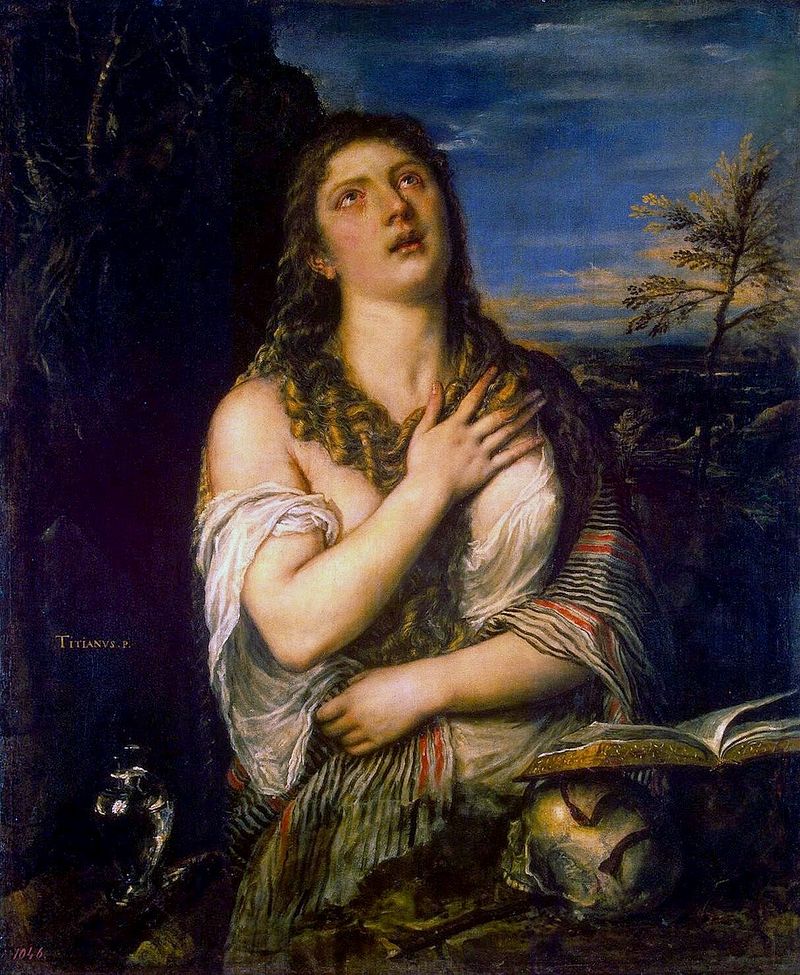
Tizian 009.jpg

A Penitent Magdalene, by Titian (1565)…

*   *   *   *

As noted in Mid-summer Travelog, I just got back from a two-week road trip.  (From Friday June 26 to Sunday July 12).  So now it’s time to get back up to speed.  I’ll do that with a post on the next major feast day.  That would be Wednesday, July 22, the feast day for Mary Magdalene.

As the Collect for her Day says, Jesus “restored Mary Magdalene to health of body and of mind, and called her to be a witness of his resurrection.”  She did that, and set an example for us all.

And she did all that despite a sordid past and a really lousy reputation.

To start off, “Mary” was an extremely common name at the time of Jesus.  This particular Mary was born in Magdala, which is where she got her name:   “Mary from Magdala,” or Magdalene.  Unfortunately it’s not clear where Magdala is, but most Christian scholars assume it’s “the place the Talmud calls Magdala Nunayya.”  (“Magdala of the fishes.”)  And the consensus is also that this is the site noted in Matthew 15:39, on what happened after Jesus fed the 4,000:

And those who ate were four thousand men, besides women and children.  [39] And sending away the crowds, Jesus got into the boat and came to the region of Magadan (below left).

As Wikipedia noted, this particular Mary has long had a bad reputation.  In Western Christianity, she’s known as “repentant prostitute or loose woman.”  But the consensus now is that “these claims are unfounded.”  Consider also what Isaac Asimov said.

He first noted that Magdala is usually considered a town on the western shore of the Sea of Galilee, and may have been a suburb of Tiberias.”  He also noted this Mary “has been considered, in tradition, to have been a prostitute and to have repented as a result of her meeting with Jesus.  (Thus the “devils” in Mark 16:9 and Luke 8:2 “might then be considered devils of lust.”)

Asimov also noted some confusion that arose from the placement of the story of Mary’s “devils” coming right after the story of the woman washing the feet of Jesus with her tears and drying them with her hair.  See also Wikipedia, noting there’s long been a mix-up between Mary from Magdala and the “unnamed sinner who anoints Jesus’ feet in Luke 7:36-50:”

Mary Magdalene, the anointing sinner of Luke, and Mary of Bethany, who in John 11:1-2 also anoints Jesus’ feet, were long regarded as the same person.  Though Mary Magdalene is named in each of the four gospels … none of the clear references to her indicate that she was a prostitute or notable for a sinful way of life, nor link her with Mary of Bethany.

Asimov put it this way:  The sinner in Luke 7:36-50 “was, indeed, a prostitute in all likelihood,” but there was no direct link in the Bible between this woman and Mary Magdalene.  He added that to be “possessed by devils” – as Mary was said to be – would be considered today as “mental illness, rather than anything else.”  Thus to Asimov, Mary Magdalene would be more accurately considered “a cured madwoman rather than a reformed prostitute.”

Which may be a problem for her account of Jesus’ resurrection, as will be seen…

Yet – notwithstanding any confusion about her “sordid past” – it’s clear that Mary Magdalene showed more courage and faith than the original 11 disciples.  That’s one reason St. Augustine referred to her as the “Apostle to the Apostles.”  See also Mary of Magdala | FutureChurch:

Mary of Magdala is perhaps the most maligned and misunderstood figure in early Christianity…  Since the fourth century, she has been portrayed as a prostitute and public sinner…   Paintings, some little more than pious pornography, reinforce the mistaken belief that sexuality, especially female sexuality, is shameful, sinful, and worthy of repentance.  Yet the actual biblical account of Mary of Magdala paints a far different portrait than that of the bare-breasted reformed harlot of Renaissance art.

The one indisputable fact seems to be that Mary Magdalene was both the first person to see the empty tomb of Jesus, and one of the first – if not the first – to see the risen Jesus.  (Which may have accounted for jealous males trying to  sully her reputation.)

As noted in John 20:1, “Early on the first day of the week, while it was still dark, Mary Magdalene went to the tomb and saw that the stone had been removed from the entrance.” 

So she went to tell Peter and the disciple “whom Jesus loved.”  They both got there, looked inside and saw the burial clothes lying there.  (And no body.)  Then they “went back to where they were staying.”  But Mary – ever faithful Mary, who ended up with the lousy reputation – stayed there, as noted in the Gospel for her feast day, John 20:11-18.  She saw two angels, who asked why she was crying, then turned to see another man she thought was a caretaker:

Supposing him to be the gardener [as seen in the bottom painting by Rembrandt], she said to him, “Sir, if you have carried him away, tell me where you have laid him, and I will take him away.”  Jesus said to her, “Mary!”  She turned and said to him in Hebrew, “Rabbouni!” (which means Teacher).  Jesus said to her, “Do not hold on to me, because I have not yet ascended to the Father.  But go to my brothers and say to them, `I am ascending to my Father and your Father, to my God and your God.’”  Mary Magdalene went and announced to the disciples, “I have seen the Lord;”  and she told them that he had said these things to her.

Which is why this Mary – from Magdala – is rightly known as the “Apostle to the Apostles.”

Or as it was put in Who Was Mary Magdalene, the “history of western civilization is epitomized in the cult of Mary Magdalene.  For many centuries the most obsessively revered of saints, this woman became the embodiment of Christian devotion, which was defined as repentance.”

So why doesn’t this Mary get much better “press” than she does?  For one thing:

…since Mary Magdalene, as a repentant sinner, is always shown in paintings with her eyes red and swollen with weeping, the word “maudlin” (the British pronunciation of “magdalen”) has come to mean tearfully or weakly emotional.

(See also maudlin – Word of the Day | Dictionary.com.)   In other words, this Mary became a bit of a cliche.  Then there’s fact – noted by Asimov – that Mary was not only the first one to see the risen Jesus, but that she was arguably the only person to have seen the risen Jesus:

[It] all might conceivably have rested entirely upon the word of one witness, Mary Magdalene…  Yet Mary Magdalene had been possessed by “seven devils.”  She had been a madwoman or, in any case, seriously disturbed, and her behavior might have remained erratic enough to give her the reputation of being “touched.”  Even if she had shown marked improvement under Jesus’ influence, the shock of the arrest, trial and crucifixion might well have unhinged her once more and made her an easy target for hallucination…  The people generally would have shrugged off anything she had to say as the ravings of a madwoman.

As Asimov concluded:  “The existence of Mary Magdalene may explain a puzzle concerning the resurrection – why it was believed, and yet not believed.”  Or as the last phrase might be expanded:  “why it was believed by some, and yet not believed by others.”

Which just goes to show the importance of the interactive – if not the mystical – part of your walk toward Jesus.  (Pursuant to John 6:37.)  In the end there’s simply no way to prove the existence of either God or Jesus, with enough courtroom evidence o convince the most jaded of skeptics.  In the end it all comes down to faith, and experience.

Apart from scripture, experience is the strongest proof of Christianity…   Although traditional proof is complex, experience is simple:  “One thing I know; I was blind, but now I see.”

To those who’ve interacted with God in their John 6:37 walk toward Jesus – as for example through the discipline of Daily Office Reading,it just doesn’t matter what kind of sordid past Mary from Magala may have had.  They’ve experienced the risen Jesus themselves…

*   *   *   *
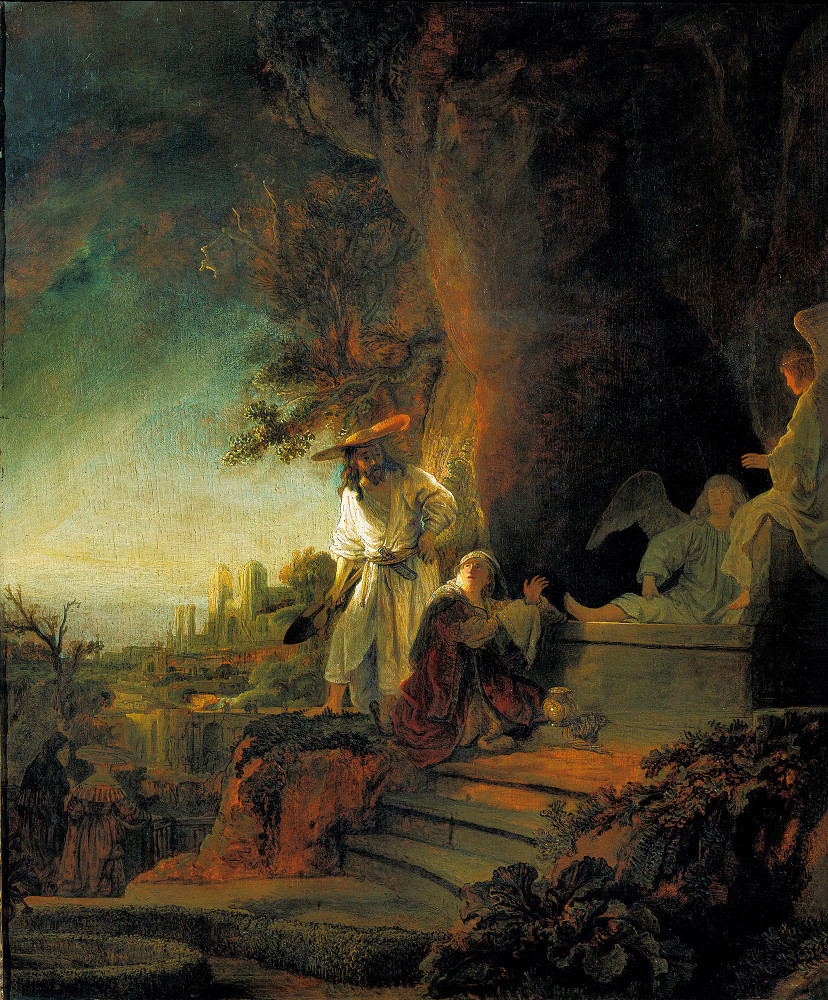
Rembrandt Harmensz. van Rijn: The Risen Christ Appearing to Mary Magdalen

The Risen Christ Appearing to Mary Magdalen, by Rembrandt  (1638)…

*   *   *   *

The Penitent Magdalene is a 1565 oil painting by Titian of saint Mary Magdalene, now in the Hermitage Museum in Saint Petersburg.  Unlike his 1533 version of the same subject, Titian has covered Mary’s nudity and introduced a vase, an open book and a skull as a memento mori.  Its coloring is more mature than the earlier work, using colors harmoni[z]ing with character.  In the background the sky is bathed in the rays of the setting sun, with a dark rock contrasting with the brightly lit figure of Mary.

That is, Titian did a “racier” version in 1533.  See Penitent Magdalene (Titian, 1533) – Wikipedia.

For more on this Mary see also MARY MAGDALENE, Bible Woman: first witness to Resurrection, and What Did Mary Magdalene look like?

Re: Isaac Asimov.  The quotes about Mary Magdalene are from Asimov’s Guide to the Bible (Two Volumes in One),  Avenel Books (1981), at pages 899-902. 

Asimov (1920-1992) was “an American author and professor of biochemistry at Boston University, best known for his works of science fiction and for his popular science books.  Asimov was one of the most prolific writers of all time, having written or edited more than 500 books and an estimated 90,000 letters and postcards.”  His list of books included those on “astronomy, mathematics, the Bible, William Shakespeare’s writing, and chemistry.”  He was a long-time member of Mensa, “albeit reluctantly;  he described some members of that organization as ‘brain-proud and aggressive about their IQs.’”  See Isaac Asimov – Wikipedia.

Re: Magdala Nunayya:  See History & Culture Archives – Tour Magdala, which noted that the term means “Magdala of the fishes,” as opposed to Magdala Gadar The former is the “better known Magdala,” located near Tiberias “on the shores of the Sea of Galilee.”  The latter, Magdala Gadar, is “in the east on the River Yarmouk,” the largest tributary of the Jordan River. 

Re: courtroom evidence:  “The main concept behind correct evidence handling is that the item recovered is the same as that produced in the court room.”

Re: faith and experience.  See Wesleyan Quadrilateral – Wikipedia, referring to “a methodology for theological reflection that is credited to John Wesley, leader of the Methodist movement in the late 18th Century…  This method based its teaching on four sources as the basis of theological and doctrinal development, scripture, tradition, reason, and experience.”  Also, a complete quote:

Apart from scripture, experience is the strongest proof of Christianity…   Wesley insisted that we cannot have reasonable assurance of something unless we have experienced it personally.  John Wesley was assured of both justification and sanctification because he had experienced them in his own life.  What Christianity promised (considered as a doctrine) was accomplished in his soul.  Furthermore, Christianity (considered as an inward principle) is the completion of all those promises.  Although traditional proof is complex, experience is simple: “One thing I know; I was blind, but now I see.”  Although tradition establishes the evidence a long way off, experience makes it present to all persons.  As for the proof of justification and sanctification Wesley states that Christianity is an experience of holiness and happiness, the image of God impressed on a created spirit, a fountain of peace and love springing up into everlasting life.

As noted elsewhere in this blog, Jesus promises – in the most important part of John 6:37 – “I will never turn away anyone who comes to me.

The lower image is courtesy of File: Rembrandt – The Risen Christ Appearing to Mary Magdalen.  See also On Easter Season – AND BEYOND.

On Peter, Paul – and other “relics”

*   *   *   *

“Saints Peter and Paul,” by El Greco

*   *   *   *

June 29 is the Feast of Saints Peter and Paul.  It honors “the martyrdom in Rome of the apostles Saint Peter and Saint Paul” (seen above).  It’s an ancient celebration, and the date is “the anniversary either of their death or of the translation of their relics.”

There’s more on translating relics below, but first:  On January 18 we celebrate the Confession of Peter: “Thou art the Christ, Son of the Living God.”  A week later on January 25 we celebrate the Conversion of St. Paul.  Then comes June 29, when we celebrate both men:

On 29 June we commemorate the martyrdoms of both apostles.  The date is the anniversary of a day around 258, under the Valerian Persecution, when what were believed to be the remains of the two apostles were both moved temporarily to prevent them from falling into the hands of the persecutors.

See St. Peter & St. Paul.  (A link from the Daily Office Lectionary, Satucket.com.)

So on June 29 we commemorate the fact that both men were martyred at about the same time, in Rome, and that the bodily remains of both men were “removed” at about the same time, to keep those bodily remains – “relics” – from being desecrated by unbelievers.

The Peter & Paul article noted that the Bible doesn’t mention the deaths of Peter or Paul, “or indeed any of the Apostles except for James the son of Zebedee.”  (See Acts 12:2.)  But early tradition said they were martyred at Rome at the command of an Emperor, and buried there:

As a Roman citizen, Paul would probably have been beheaded with a sword.  It is said of Peter that he was crucified head downward [as shown below left.  And thus as St. Augustine wrote,]  “even though they suffered on different days, they were as one.  Peter went first, and Paul followed.  And so we celebrate this day made holy for us by the apostles’ blood…”

The Crucifixion of St. Peter, by CaravaggioWhich brings us back to the “translation of relics.”  (Here, “the remains of the two apostles … moved temporarily.”)  The term relics came to include the body parts of people considered especially holy.  The translation of those relics – again – meant moving those body parts from where they were originally buried.  (To a new place, and usually for a “holy purpose.”)  See also Why do we venerate relics: “Relics include the physical remains of a saint (or of a person who is considered holy but not yet officially canonized) as well as other objects which have been ‘sanctified’ by being touched,” by the saint in question.

Thus translating relics is the practice of moving “holy objects from one locality to another (usually a higher status location)…   Translations could be accompanied by many acts, including all-night vigils and processions.”  As Wikipedia also noted, in the really-early church the body parts of saints like Peter and Paul remained undisturbed, where they were originally buried.

Then came the persecutions under Roman emperors…

But it wasn’t until the 8th century – the 700s – that such relics really began to be spread “all over Europe.”  (The image at right shows “St. Corbinian’s relics being moved to Freising from Merano.”)  One big reason was that after the year 787, all new Christian churches “had to possess a relic before they could be properly consecrated.”  See Wikipedia:

New churches, situated in areas newly converted to Christianity, needed relics and this encouraged the translation of relics to far-off places.  Relics became collectible items, and owning them became a symbol of prestige…

So as the Christian Church spread as an institution, more and more such “relics” had to be found.  (Or more precisely, “unearthed.”)  Unfortunately the need for such relics led to abuse.

The situation got so bad that Protestant church leaders came to totally reject this and other “Romish” practices.  That skepticism vis-a-vis such relics continues “even to this day:”

Pope Gregory I [shown below] forbade the selling of relics and the disruption of tombs in the catacombs.  Unfortunately, the popes or other religious authorities were powerless in trying to control the translation of relics or prevent forgeries [and] the abuses and the negative reaction surrounding relics has led many people to this day to be skeptical about relics.

Gregory I - Antiphonary of Hartker of Sankt Gallen.jpg

(See Why venerate relics?)    But we digress!   

We were talking about June 29 as “the Feast of Saints Peter and Paul.”  That article includes a link to and discussion of the Incident at Antioch, involving these two Founding Fathers of the Church.  That dispute also continues “even to this day.”

The dispute ostensibly involved circumcision, as a prerequisite for admission to the new Christian church.  But more precisely, the dispute involved whether all new non-Jewish converts – “Gentile Christians” – had to follow all the laws, rules and regulations of the Jewish faith in order to be a real Christian. (Or put another way, “legalism” versus “grace.”)  And as was noted in the article, Incident at Antioch:

[T]he issue of Biblical law in Christianity remains disputed to this day.  The Catholic Encyclopedia states:  “St. Paul’s account of the incident leaves no doubt that St. Peter saw the justice of the rebuke…”   In contrast, L. Michael White‘s From Jesus to Christianity states:  “The blowup with Peter was a total failure of political bravado, and Paul soon left Antioch as persona non grata, never again to return.”

Wikipedia added,  “The final outcome of the incident remains uncertain resulting in several Christian views of the Old Covenant to this day.”

Put simply:  There’s an ongoing debate on how much of the Old Testament Christians have to follow.  Some think only parts of the Old Testament apply to them.  Others believe that none of the Old Testament rules apply to them.  Then there are “dual-covenant theologians,” who think Old Testament rules are binding only on Jewish people.  And then there are those who believe “all are still applicable to believers in Jesus and the New Covenant.”

Be that as it may, the other dispute at issue here is whether Peter and Paul remained at odds with each other.  Tradition has it that “Peter and Paul taught together in Rome and founded Christianity in that city…  ‘They taught together in like manner in Italy, and suffered martyrdom at the same time.'”  Or as another blogger said, the Incident at Antioch was a case of Peter and Paul resolv[ing] a problem, although some critics act “as if Peter were cowardly before the onslaught of Judaisers and Paul was arrogant in tackling a senior Apostle!”

Then there’s the view of Garry Wills, who referred to the incident as “the Blowup at Antioch.”

Wills noted first that Paul wrote his version of events some 30 years before Luke described the Council at Jerusalem, in Acts 15.  (And thus was presumably more reliable than Luke’s version).  He then noted that Paul’s account of the Jerusalem Council – in Galatians 2 – “could not be more different.  There, Paul is neither summoned by Jerusalem nor sent by Antioch.  He goes there as a result of a vision urging him to go.” (81-82)

Then came Galatians 2 , verses 11-15, where “Paul Rebukes Peter at Antioch:”

When Cephas [Peter] came to Antioch, I opposed him to his face, because he stood self-condemned;  for until certain people came from James, he used to eat with the Gentiles.  But after they came, he drew back and kept himself separate for fear of the circumcision faction.  And the other Jews joined him in this hypocrisy…

As noted below, Paul basically got mad at Peter for being two-faced about the Lord’s Supper.  To Paul, the effect was to “dismember the mystical body of Christ.”

And there’s another aspect of the dispute:  Whether you are “saved” by following a set of rules and regulations, or by faith in Jesus alone.  See The Controversy Over Faith And Works Continues.  While some Christians indicate that you are “saved” by following a set of rules, Paul clearly came down on the side of faith.  See Galatians 2:16:  “know that a person is not justified by the works of the law, but by faith in Jesus Christ.”

But getting back to Garry Wills… He wrote that Paul was furious with Peter because “the Lord’s Meal was the symbol of unity for all the Brothers, Jew or Gentile.”  He added that many later Church Fathers were shocked at the idea that Peter and Paul would “squabble” like that, “unable to accept the fact that great men could differ.”

But for Paul the debate was serious:  Peter’s “backpedaling on Jewish observance” was a denial that the “risen Christ in Antioch in all those baptized into His mystical body.” (Emphasis added.)  To Paul, it was the equivalent of “dismembering the body of Christ.”

Wills went on to say that Paul wrote at great length on the matter in his Letter to the Galatians.  He did so because the members of that later church were “acting as if the matter of food laws were not settled.”  (Emphasis in original.)  More to the point here, Wills said “Paul’s last reported dealings with Peter” were not at Antioch, but rather with a “handshake of peace:”

Peter continued to be an emissary in the Diaspora and ended with Paul in Rome, where they died together as victims of Nero’s mad reaction to the fire that destroyed the city.  The treatment of them as ultimately partners … would thus be justified.  The two great leaders ended up on the same side. (E.A.)

The point being this:  Some Christians seem to think they have to be all “nicey-nicey,” all the &%#$ time, with each other and with non-Christians.  But the Feast of Peter and Paul goes to show it’s okay to have differences of opinion, or even “squabble” from time to time.

(For that matter, it’s okay to argue with God too…)

*   *   *   *

http://www.canvasreplicas.com/images/Two%20Scholars%20Disputing%20Peter%20and%20Paul%20Rembrandt%20van%20Rijn.jpg

“Scholars Disputing (Peter and Paul)” – but they still worked together… 

*   *   *   *

The upper image is courtesy of Saints Peter and Paul by GRECO, El – Web Gallery of Art:

The two saints[,] the most influential leaders of the early Church[, are shown here] engaged in an animated discussion.  The older, white-haired Peter … inclines his head thoughtfully to one side as he looks towards the text being expounded.  In his left hand he holds his attribute, the key to the kingdom of Heaven.  His right hand is cupped as if weighing up an idea.  Paul presses his left hand down firmly on the open volume on the table, his right hand raised in a gesture of explanation as he looks directly at the viewer.

The article noted El Greco painted the two together several times “with remarkable consistency.”  Peter always has white hair and a beard, while “Paul is always shown slightly balding, with dark hair and beard, wearing a red mantle…”  See also Feast of Peter and Paul – Wikipedia, with caption:  “Saint Peter and Saint Paul. Oil on canvas by El Greco. circa 16th-century. Hermitage Museum, Russia.”

Re: the definition of “saint.”  As one website said, “the ‘saints’ are the body of Christ, Christians, the church.  All Christians are considered saints.  All Christian are saints – and at the same time are called to be saints.”  (Citing 1st Corinthians 1:2.)  See What are Christian saints according to the Bible?

The “Corbinian” image is courtesy of Translation (relic) – Wikipedia, with caption:  “St. Corbinian’s relics being moved to Freising from Merano.  From a panel in the crypt of Freising Cathedral.”

The article Why do we venerate relics added that they are “divided into two classes.  First class or real relics include the physical body parts, clothing and instruments connected with a martyr’s imprisonment, torture and execution.  Second class or representative relics are those which the faithful have touched to the physical body parts or grave of the saint.”

Re: relics becoming “collectibles.”  See Wikipedia, which added:  “According to one legend concerning Saint Paternian, the inhabitants of Fano [a city in northeastern Italy] competed with those of Cervia for possession of his relics.  Cervia [some 60 miles up the coast] would be left with a finger, while Fano would possess the rest of the saint’s relics [aka body parts].

The Pope Gregory image is courtesy of Pope Gregory I – Wikipedia, the free encyclopediaNote that he was the pope who originated Gregorian chant, “the central tradition of Western plainchant, a form of monophonic, unaccompanied sacred song of the western Roman Catholic Church.  Gregorian chant developed mainly in western and central Europe during the 9th and 10th centuries…”

As to the skepticism surrounding the value of such relics (“then and now”), see Wikipedia:

With various barbarian invasions, the conquests of the Crusades, the lack of means for verifying all relics and less than reputable individuals who in their greed preyed on the ignorant and the superstitious, abuses did occur.  St. Augustine denounced impostors who dressed as monks selling spurious relics of saints…   [T]he abuses and the negative reaction surrounding relics has led many people to this day to be skeptical about relics.

Re:  the emporer at the time of the death of Peter and Paul.  There is some debate whether it was Nero or Valerian (emperor) See Wikipedia, the free encyclopedia.

The full quote from Galatians 2 , verses 11-15, where “Paul Rebukes Peter at Antioch:”

When Cephas [Peter] came to Antioch, I opposed him to his face, because he stood self-condemned;  for until certain people came from James, he used to eat with the Gentiles.  But after they came, he drew back and kept himself separate for fear of the circumcision faction.  And the other Jews joined him in this hypocrisy … so that even Barnabas was led astray by their hypocrisy.  But when I saw that they were not acting consistently with the truth of the gospel, I said to Cephas before them all, “If you, though a Jew, live like a Gentile and not like a Jew, how can you compel the Gentiles to live like Jews?”

The Garry Wills quotes are from his book, What Paul MeantSpecifically, from the 2007 Penguin Books edition, at pages 79-88, in Chapter 4, “Paul and Peter.”

Re: Faith and works.  See also Sola fide – WikipediaOr just Google “faith works controversy.”

Re: early church fathers “shocked at the idea that Peter and Paul would ‘squabble.'”  Wills noted that according to St. Jerome , the whole incident at Antioch was a “kind of didactic charade,” a way of “dramatizing the truth that external rites are unimportant.”

The Garry Wills image is courtesy of Garry Wills – Department of History – Northwestern University.

The lower image is courtesy of www.canvasreplicas.com/Rembrandt.htm.  See also Two Scholars Disputing by REMBRANDT Harmenszoon van Rijn.

*   *   *   *

On the Nativity of John the Baptist – 2015

Bucking tradition, the prophet Zechariah writes, “My son’s name is John…”

*   *   *   *

June 24 is the Feast Day for the Nativity of St. John the Baptist.

One valuable lesson from his Bible readings is that sometimes you have to bite the bullet

The feast day celebrates the birth of John the Baptist, “a prophet who foretold the coming of the Messiah in the person of Jesus, whom he later baptised.” The Bible readings are Isaiah 40:1-11, Psalm 85, Acts 13:14b-26, and Luke 1:57-80. Luke tells how Elizabeth – cousin of Mary (mother of Jesus) – came to be a mother, and how her husband got  struck dumb.

The time came for Elizabeth to give birth, and she bore a son.  Her neighbors and relatives heard that the Lord had shown his great mercy to her, and they rejoiced…  [T]hey were going to name him Zechariah after his father.  But his mother said, “No; he is to be called John.”  They said to her, “None of your relatives has this name.”  Then they began motioning to his father to find out what name he wanted to give him.  He asked for a writing tablet and wrote, “His name is John…”

The story of Zechariah getting struck dumb started at Luke 1, verses 5-7.  He was a member of the “priestly order of Abijah,” and he and Elizabeth were righteous before God but also old and childless.   Then God sent an angel to tell Zechariah he was about to become a father.  He got struck dumb because he doubted the angel.  (That’s where biting the bullet came in.  Zechariah should have accepted on faith what was, to him, counterintuitive.)

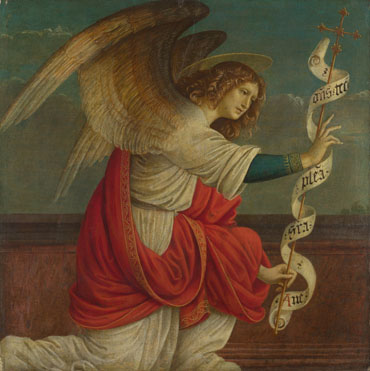
http://www.nationalgallery.org.uk/upload/img/gaudenzio-ferrari-annunciation-angel-gabriel-NG3068.1-fm.jpgThat is, nine months earlier – as Zechariah was doing his priestly duties in the inner sanctuary – the angel Gabriel (at left) appeared and told him Elizabeth would bear a son.  But he doubted:  “How will I know that this is so?  For I am an old man, and my wife is getting on in years.  And that was why he was struck dumb.  As Gabriel told him, “Since you didn’t believe what I said, you will be silent and unable to speak until the child is born.” Luke 1:20.
That came right after Zechariah wrote out, “His name is John.”  See Luke 1:64, saying that right after Zechariah wrote his son’s name, “Immediately his mouth was opened and his tongue freed, and he began to speak, praising God.”  Then – right after that – came the Benedictus (Song of Zechariah), “the song of thanksgiving uttered by Zechariah on the occasion of the birth of his son, John the Baptist” (and – no doubt – his being able to speak again):

The second part … is an address by Zechariah to [his son John], who was to take so important a part in the scheme of the Redemption; for he was to be a prophet, and to preach the remission of sins before the coming or the Dawn from on high.  The prophecy that he was to “go before the face of the Lord to prepare his ways…”  [See Luke 1:76,] an allusion to the well-known words of Isaiah 40:3 which John himself afterwards applied to his own mission (John 1:23), and which all three Synoptic Gospels adopt (Matt 3:3; Mark 1:2; Luke 3:4).

The reading ends with Luke 1:80; the child John “grew and became strong in spirit; and he lived in the wilderness until he appeared publicly to Israel.

Note that Isaiah 40:3 is included in the Old Testament reading for the day, Isaiah 40:1-11.  Isaiah 40:3 says (in one translation):  “A voice cries out in the desert:  ‘Clear a way for the LORD.  Make a straight highway in the wilderness for our God.'”  Thus John the Baptist became that voice crying in the wilderness, as noted in Matthew 3:3This is he who was spoken of through the prophet Isaiah: “A voice of one calling in the wilderness, ‘Prepare the way for the Lord, make straight paths for him.’

Which is another way of saying that  John the Baptist served as a precursor, forerunner or advance man for Jesus. (As in, “News Flash:  Jesus is on the way!“) Or as it says in the Collect: “your servant John the Baptist … sent to prepare the way of your Son our Savior.”

The Collect adds that we too should follow John’s example, and so to “constantly speak the truth, boldly rebuke vice, and patiently suffer for the truth’s sake.”  (See Nativity of St. John.)

For more on how John “grew and became strong in spirit,” see John the Baptist – Wikipedia:

John’s knowledge of Jesus varies…  In the Gospel of Mark, John preaches of a coming leader, but shows no signs of recognizing that Jesus is this leader.  In Matthew, however, John immediately recognizes Jesus and John questions his own worthiness to baptize Jesus.  In both Matthew and Luke, John later dispatches disciples to question Jesus about his status, asking “Are you he who is to come, or shall we look for another?”  In Luke, John is a familial relative of Jesus whose birth was foretold by Gabriel.  In the Gospel of John, John the Baptist himself sees the spirit descend like a dove and he explicitly preaches that Jesus is the Son of God.

See also Who Was John the Baptist? : Christian Courier, which noted that his name derived from “a Hebrew term signifying ‘Jehovah is gracious.'”  The article also noted that “John, therefore, was a key figure in the preparation of the Messiah’s work.”

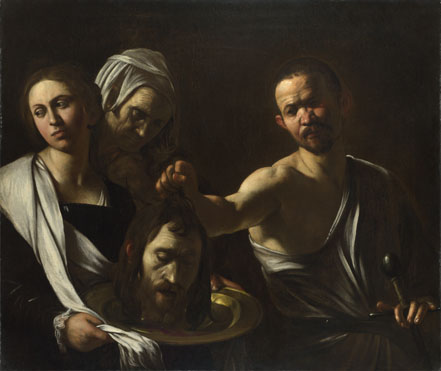
Unfortunately, that “advance work for Jesus” included a gruesome death by beheading, as told in Mark 6:14–29:  “the king sent a soldier of the guard with orders to bring John’s head.  He went and beheaded him in the prison, brought his head on a platter, and gave it to [Salome]…   When his disciples heard about it, they came and took his body, and laid it in a tomb.”

So this June 24th we celebrate the birth of John the Baptist, who in his lifetime performed an invaluable service as forerunner and advance man for Jesus.  His life and especially his gruesome death serves as a reminder that, as one “Christian mystic” said: 

It is to vigor rather than comfort that you are called.”

*   *   *   *

http://www.nationalgallery.org.uk/upload/img/caravaggio-salome-receives-head-saint-john-baptist-NG6389-fm.jpg

“Salome receives the Head of John the Baptist…”

*   *   *   *

The upper image is courtesy of the link – Benedictus (Song of Zechariah) – in the Wikipedia article, Nativity of St. John the Baptist.  The caption:  “Detail of Zechariah writing down the name of his son (Domenico Ghirlandaio, 15th century, Tornabuoni Chapel, Italy).”

The “Gabriel” image is courtesy of www.nationalgallery.org.uk/paintings/gaudenzio-ferrari-the-annunciation:  “The Angel Gabriel announces to the Virgin Mary that she will bear the son of God (Luke 1: 26-8).  His words, ‘Hail Mary full of Grace, the Lord be with you,’ appear in abbreviated form in Latin on the scroll.”   Thus Gabriel appeared to both Elizabeth and Mary.

The “Salome” image is courtesy of www.nationalgallery.org.uk/paintings/caravaggio:  “The subject is from the New Testament [Mark 6, verses 14-29].  Salome had danced so well for King Herod that he swore he would grant her any request.  Her mother, Herodias, who sought revenge on John the Baptist, persuaded Salome to ask for his head.  The old woman behind Salome may be Herodias.”

The “vigor-comfort” quote is from Practical Mysticism, with advice for the “new Christian:”

Hearing now and again the mysterious piping of the Shepherd, you realize your own perpetual forward movement . . . and so are able to handle life with a surer hand.  Do not suppose from this that your new career is to be perpetually supported by agreeable spiritual contacts, or occupy itself in the mild contemplation of the great world through which you move.  True, it is said of the Shepherd that he carries the lambs in his bosom; but the sheep are expected to walk, and to put up with the bunts and blunders of the flock.  It is to vigor rather than comfort that you are called.  (E.A.)

Evelyn Underhill, Ariel Press (1914), at page 177.  See also Evelyn Underhill – Wikipedia.

*   *   *   *

On St. Barnabus’ Day, 2015


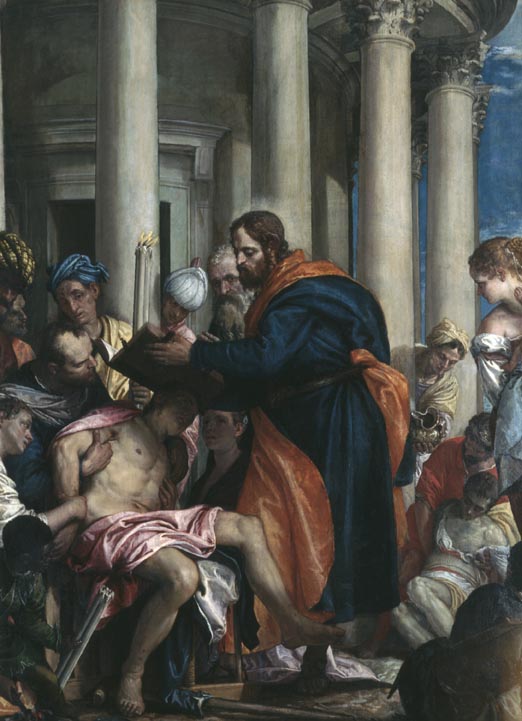
Barnabas curing the sick by Paolo Veronese, Musée des Beaux-Arts de Rouen.

Thursday June 11, 2015, is the Feast Day for Saint Barnabas.

For a more-complete rundown, see last year’s post, On St. Barnabas.

But first, there’s a reader comment to address.  It had to do with The DORs for June 6, 2015.  As edited for content, the comment was:  “A really good post … BUT … Why 2 separate & unrelated subjects??   Giving joyfully & D-day … but good content.”

Here’s the answer:  The trick I tried to pull off was blending two disparate subjects.  Such dichotomies are common in both Western thought and Western literature especially.  See How can we define and explain “dichotomy” in literature:  “dichotomy is a useful literary device which creates drama, causes conflict and adds depth to characters and situations.”  See also Dichotomy – Wikipedia, the free encyclopedia:

Perceived Dichotomies are common in Western thought.  C. P. Snow believes that Western society has become an argument culture (The Two Cultures).  In The Argument Culture (1998), Deborah Tannen suggests that the dialogue of Western culture is characterized by a warlike atmosphere in which the winning side has truth (like a trophy).  Such a dialogue virtually ignores the middle alternatives.  (Emphasis added.)

In the case of June 6, 2015, the theme was supposed to be:  “We kicked Nazi butt in World War II because of American ingenuity.  Because we’re inherently creative and because we constantly ‘ask questions.'”  This was as opposed to certain Bible-thumpers of today who – in the realm of Bible reading – are “trying to create a culture that rewards conformism and stifles creativity.”  That was the dichotomy:  Applying a principle from World War II to Bible Study.

Again, the point was supposed to be that the question-asking, probing method of Bible study is far better for both the individual reader and for American society as a whole.  It’s far better than just saying, “Oh, I’ll take everything that slick-haired televangelist says at face value!

Of course I confess – I do not deny, but confess –  that I may have been a bit too subtle.

So anyway, back to Barnabus.  According to AmericanCatholic.org, Barnabus came “as close as anyone outside the Twelve to being a full-fledged apostle.  He was closely associated with St. Paul (he introduced Paul to Peter and the other apostles) and served as a kind of mediator between the former persecutor and the still suspicious Jewish Christians.” 

See also Barnabas – Wikipedia, and ST. BARNABAS, APOSTLE : Catholic News Agency:

The apostle and missionary was among Christ’s earliest followers and was responsible for welcoming St. Paul into the Church.  Though not one of the 12 apostles . . . he is traditionally regarded as one of the 72 disciples of Christ and [the] most respected man in the first century Church after the Apostles themselves.

Note that the Bible first mentions Barnabas in Acts 4:36:  “Joseph, a Levite, born in Cyprus, whom the apostles called Barnabas (son of encouragement), sold a field he owned, brought the money, and turned it over to the apostles.”  And Barnabas the Apostle – Justus added that even after Paul’s Damascus Road experience, most Christians in Jerusalem “wanted nothing to do with him.  They had known him as a persecutor and an enemy of the Church.  But Barnabas was willing to give him a second chance.”  (Which is pretty much what Jesus is all about.)

To sum up, if it hadn’t been for Barnabas and his willingness to give Paul a second chance – a second chance for the formerly zealous persecutor of the early Church – he might never have become Christianity’s most important early convert, if not the “Founder of Christianity.”

See also On St. Barnabas, from last year.  That post noted that not only did Barnabus give Paul a second chance, he did the same thing with Mark.  Mark in turn “responded well to the trust given him by the ‘son of encouragement,’ since we find that Paul later speaks of him as a valuable assistant (2 Tim 4:11; see also Col 4:10 and Phil 24).”


“So we might just call Barnabas ‘the Apostle of Second Chances.’”


 If it wasn’t for Barnabus, Paul’s Damascus Road experience might have gone for naught


The upper image was borrowed from last year’s post, On St. Barnabas.  In turn it’s courtesy of Barnabas – Wikipedia, the free encyclopedia.

The lower image is courtesy of Conversion of Paul the Apostle – Wikipedia.  The caption:  “The Conversion of Saint Paul, a 1600 painting by the Italian artist Caravaggio.”  See also What happened on the road to Damascus?  That site noted:  “The events that happened on the road to Damascus relate not only to the apostle Paul, whose dramatic conversion occurred there, but they also provide a clear picture of the conversion of all people.”  (E.A.)

Re: Televangelists.  See also Why are there so many televangelist scandals? – GotQuestions, Televangelists – Huffington Post (a list of articles on the subject), and Televangelist – RationalWiki.

Re: “argument culture.”  The full title of Deborah Tannen‘s book is The Argument Culture: Stopping America’s War of Words.  Tannen wrote an earlier book, You Just Don’t Understand: Women and Men in Conversation (1990).  According to Amazon, in that earlier book “Tannen showed why talking to someone of the opposite sex can be like talking to someone from another world.”

On Trinity Sunday, 2015

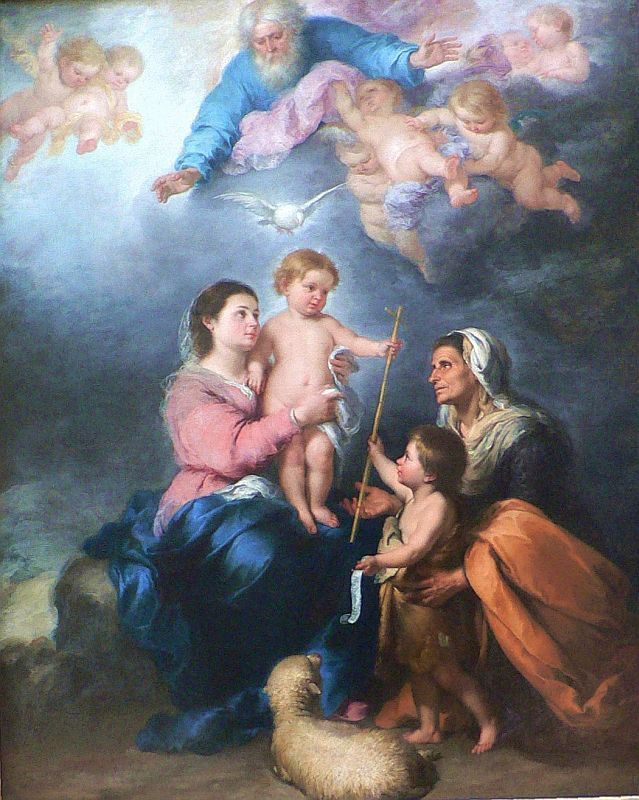
The Trinity, as envisioned by “Bartolomé Esteban Murillo (d. 1682)…”


Last year Trinity Sunday – always the Sunday after Pentecost – came on June 15.  This year it’s celebrated on May 31st.  See Trinity Sunday – Wikipedia, the free encyclopedia:

Trinity Sunday celebrates the Christian doctrine of the Trinity, the three Persons of God:  the Father, the Son, and the Holy Spirit…   The Sundays following Pentecost, until Advent, are numbered from this day.  In traditional Catholic usage, the First Sunday After Pentecost is on the same day as Trinity Sunday…   [T]he Episcopal Church in the United States of America (ECUSA) now follows the Catholic usage…

The link First Sunday after Pentecost will take you to the “RCL” Bible readings for that day:  Isaiah 6:1-8, Psalm 29 or Canticle 2 or 13, Romans 8:12-17, and John 3:1-17.

The first reading – from the Book of Isaiah – is by the prophet who lived in the “8th-century B.C. Kingdom of Judah.”  The book told how God would make Jerusalem the center of His world rule through a Messiah, an “agent who brings about Yahweh’s kingship.”  In general, Isaiah spoke out for the poor and oppressed and “against corrupt princes and judges.”  And Isaiah 44:6 contained the “first clear statement of monotheism,” a model that became “the defining characteristic of post-Exilic Judaism,” as well as of Christianity and Islam.  (See Wikipedia.)

As for the Trinity Sunday reading, Isaiah 6:1-8 told of the prophet – seen at right iconocally – being first “cleansed and commissioned” to be a prophet, in the year “King Uzziah died.”  (Asimov put that at 740 B.C.)  At first he protested that he wasn’t worthy:  “I am a man of unclean lips, and I live among a people of unclean lips.”  But he got cleansed through the act of a seraph, holding a hot coal with a pair of tongs:

The seraph touched my mouth with it and said:  “Now that this has touched your lips, your guilt has departed and your sin is blotted out.”  Then I heard the voice of the Lord saying, “Whom shall I send, and who will go for us?”  And I said, “Here am I; send me!”

Which brings up a note about the whole idea behind Trinity Sunday, to wit:  the Trinity itself.  (That is, both the doctrine of the Trinity and the idea that Isaiah could have his lips “touched” with a hot coal without screaming like a banshee are difficult to comprehend.)

As to the Trinity, see for example All About Trinity Sunday | Prayers, History, Customs:

Trinity Sunday … is one of the few celebrations of the Christian Year that commemorates a reality and doctrine rather than a person or event…   The Trinity is one of the most fascinating – and controversial – Christian dogmas.  The Trinity is a mystery.  By mystery the Church does not mean a riddle, but rather the Trinity is a reality above our human comprehension that we may begin to grasp, but ultimately must know through worship, symbol, and faith.  It has been said that [this] mystery is not a wall to run up against, but an ocean in which to swim.

(Emphasis added.)  And as noted in June 15 [2014] – Part I, the Trinity is so extremely difficult to understand that even a smart guy like Thomas Jefferson couldn’t do it.

To prove my point:  On April 29, 1962, President Kennedy gave a White House dinner to honor Nobel Prize winners “of the Western Hemisphere.”  Attendees included Pearl S. Buck and Robert Frost, as well as a number of lesser-known Nobel laureates listed in the Notes.  (Buck won the 1938 Nobel Prize in Literature.  Frost won four Pulitzer Prizes for Poetry.  In 1960 he was awarded the Congressional Gold Medal for his “poetical works,” and in 1961 he was named Poet laureate of Vermont.)   Kennedy’s conclusion was:

I think this is the most extraordinary collection of talent, of human knowledge, that has ever been gathered at the White House – with the possible exception of when Thomas Jefferson dined alone.”  (E.A.)

The point is this:  If a smart guy like Thomas Jefferson couldn’t comprehend the Christian Trinity, what hope do we “mere mortals” have?  Or as I noted in the post, Readings for June 15 [2014] – Part I, don’t worry:

Neither did Thomas Jefferson, so you’re in good company…  Jefferson questioned key parts of Christianity including Mary’s virgin birth, Jesus’ resurrection and Jesus’ teachings of being the messiah long before his death in 1826.  “As early as 1788, we have a letter where he said he didn’t understand the trinity, and if he didn’t understand the trinity, how could he possibly agree to it?”

The thing is, even though Jefferson was a very smart guy, he fell into a “common error of thinking that he could ever really understand everything there is to know about God.”

But as noted above, “the Trinity is a reality above our human comprehension.”  It’s a reality that we may only begin to grasp.  The same seems to be true of much of the Bible, and especially the “mystical” parts.   (That may be why some choose “literalism.”  It’s ever so much easier…)

Fortunately the New Testament and Gospel readings are a tad easier to understand.

In Romans 8:12-17, Paul wrote that “all who are led by the Spirit of God are children of God,” and thus that we have “received a spirit of adoption.  When we cry, ‘Abba! Father! it is that very Spirit bearing witness with our spirit that we are children of God.”  As the International Bible Commentary put it:  “The Spirit is not one who maintains the frightening, servile conditions of the old era, but gives the confidence that God is a personal Father.” (1331)

And in the Gospel  –  John 3:1-17  –  Jesus had a talk with a “Pharisee named Nicodemus, a leader of the Jews” who was also a follower, but secretly.  And again, even a smart guy like Nicodemus didn’t understand the concept of being “born again.”  His problem?  He took Jesus’ words too literally:  “Nicodemus said to Him, ‘How can anyone be born after having grown old?  Can one enter a second time into the mother’s womb and be born?'”

Jesus answered him, “Are you a teacher of Israel, and yet you do not understand these things?
…  If I have told you about earthly things and you do not believe, how can you believe if I tell you about heavenly things?

Which goes to show that reading the Bible too literally can only take you so far in your spiritual journey.  As Jesus Himself noted, the Bible includes many realities that are simply above our human comprehension:  “How can you believe if I tell you about heavenly things?

See also the end of John’s Gospel, John 21:25, which said there were many other things Jesus did, “which if they were written in detail, I suppose that even the world itself would not contain the books that would be written.”   There’ll be more about this in the next post…

 Painting of Jefferson wearing fur collar by Rembrandt Peale, 1800

As smart a guy as Thomas Jefferson couldn’t comprehend the Trinity


One final note:  The Trinity Sunday Gospel included John 3:16, “one of the most widely quoted verses from the Christian Bible.”  It has been called “the most famous Bible verse,” and also “the ‘Gospel in a nutshell,’ because it is considered a summary of the central theme of traditional Christianity.”  See John 3:16 – Wikipedia, the free encyclopedia.  See also the 3:16 Game – Wikipedia, and “John 3:16” signs that people hold up at football games?   (The “3:16” game was the “AFC Division Wild Card game on Sunday, January 8, 2012, between the Denver Broncos and Pittsburgh Steelers,” noted for “its statistical correlations to John 3:16, the quintessential Bible verse of Christianity.”)

For myself, I prefer to focus on the promise that Jesus made in John 6:37, to wit:  That He would never turn away anyone who came to Him.  See “What’s in it for me?”  That post noted that John 3:16 was “a nice general sentiment,” but doesn’t answer the question, “what’s in it for me?”

Moving on to the credits and references:

The upper image is courtesy of Trinity – WikipediaThe full caption:  “God the Father (top), the Holy Spirit (represented by a dove), and child Jesus, painting by Bartolomé Esteban Murillo (d. 1682).” 

The Isaiah image is courtesy of Isaiah – Wikipedia.  The caption:  “Russian icon of the Prophet Isaiah, 18th century (iconostasis of Transfiguration Church, Kizhi monastery, Karelia, Russia).”

The lower image is courtesy of Thomas Jefferson – Wikipedia, the free encyclopedia.  The caption:  “Thomas Jefferson, Official White House Portrait, by Rembrandt Peale, 1805.”  That article also provided the Jefferson postage stamp image:  “1st Jefferson stamp, 1856 issue.”

Re:  Kennedy on Jefferson.  See also Remarks at a Dinner Honoring Nobel Prize Winners, “…when Thomas Jefferson dined alone.” | The Pavellas Perspective,” and Dinner in Honor of Nobel Laureates.  The latter noted that aside from Ms. Buck and Mr. Frost, other attending Nobel Prize winners included: Chairman of the Department of Biochemistry at Cornell University Medical College, Dr. Vincent du Vigneaud;  physicist from the Institute for Advanced Study, Dr. Chen Ning Yang;  biochemist from the University of California, Berkeley, Dr. Melvin Calvin;  and chemist from the University of California, Berkeley, Dr. William F. Giauque.”

Re:  Thomas Jefferson on the Trinity.   See for example Controversial Thomas Jefferson book pulled over complaints.  See also Jefferson Bible – Wikipedia, the free encyclopedia, which said Jefferson’s book titled The Life and Morals of Jesus of Nazareth began with an account of Jesus’s birth “without references to angels (at that time), genealogy, or prophecy.   Miracles, references to the Trinity and the divinity of Jesus, and Jesus’ resurrection are also absent from his collection.”

One other final note:  I wrote about last year’s Trinity Sunday in The readings for June 15 – Part II.

On Pentecost – “Happy Birthday, Church!”

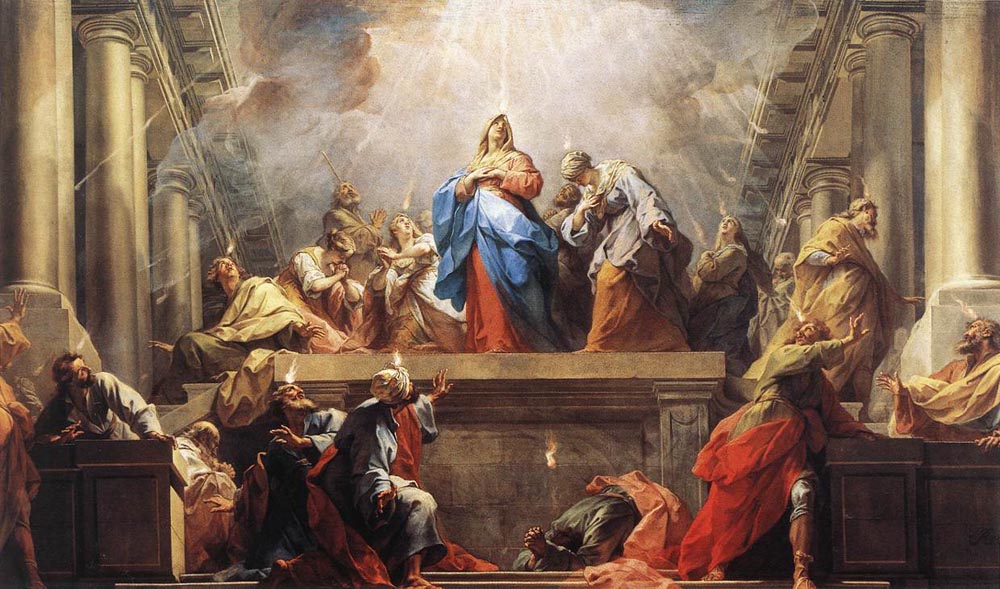
An artist’s depiction of Pentecost – the “birthday of the Church…”

*   *   *   *

Pentecost Sunday is coming up on May 24th.  The word “Pentecost” comes from the Greek for “the 50th day,” and it’s always celebrated 50 days after Easter Sunday.  (That’s “seven weeks plus one day.”)  And it’s been around a long, long time.  See Pentecost – Wikipedia:

Pentecost is the Greek name for the Feast of Weeks, a prominent feast in the calendar of ancient Israel celebrating the giving of the Law on Sinai.  This feast is still celebrated in Judaism as Shavuot.  Later, in the Christian liturgical year, it became a feast commemorating the descent of the Holy Spirit upon the Apostles and other followers of Jesus Christ (120 in all), as described in the Acts of the Apostles [verses 1-13 et seq.].

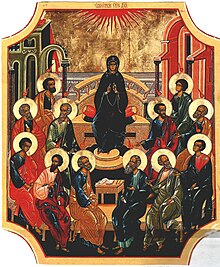
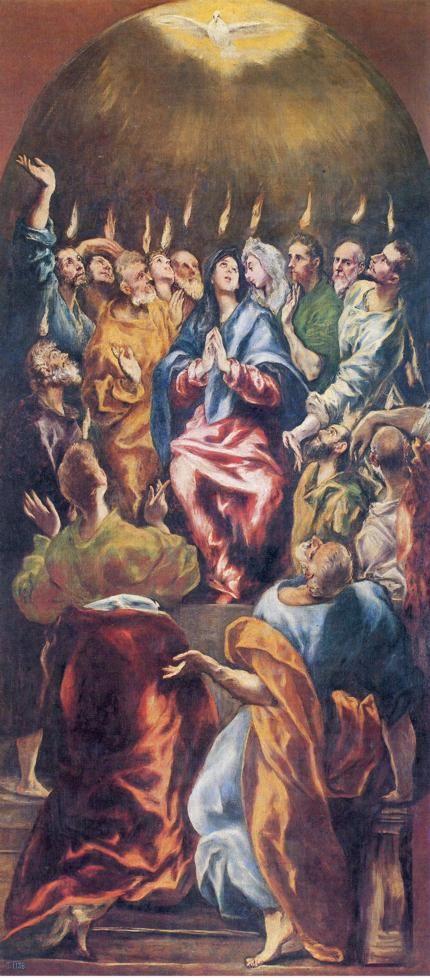
Another name for Pentecost is Tongue Sunday.  For one thing there were the “tongues of fire” that appeared that day, as shown in the El Greco painting below. (See also Acts 2:3.)

The Theotokos & the Twelve Apostles — Fifty Days after the Resurrection of Christ, awaiting the descent of the Holy SpiritFor another thing there was the “speaking in tongues” – also known as glossolalia, as shown at left – that was such a feature of the original Pentecost.  See Acts 2:4, “All of them were filled with the Holy Spirit and began to speak in other tongues as the Spirit enabled them.

That made some onlookers skeptical, even at the time.  As noted in Acts 2:12 and 13, some people who saw the event were amazed, but “others sneered and said, ‘They are filled with new wine!'” 

But as Isaac Asimov noted, the Apostles weren’t just “babbling.”

Instead they spoke in concrete, known languages.  As a result, people from a host of different nations could understand them.  As Asimov put it, “in their ecstasy, they uttered phrases in both languages”  –  i.e., the “marketplace” Koine Greek prominent at the time, or the disciples’ native Aramaic  –   so that “those who listened to them from the various nations … would have understood something.”  (See Readings for Pentecost (6/8/14).)  See also Acts 2, verse 8-11:

“How is it that we hear, each of us, in our own native language?   Parthians, Medes, Elamites, and residents of Mesopotamia, Judea and Cappadocia, Pontus and Asia, Phrygia and Pamphylia, Egypt and the parts of Libya belonging to Cyrene, and visitors from Rome, both Jews and proselytes, Cretans and Arabs – in our own languages we hear them speaking about God’s deeds of power.”

(See also 1st Corinthians 14:19, on the potential abuse of that “gift,” where the Apostle Paul said that while he was glad he could speak in tongues, in church “I would rather speak five intelligible words to instruct others than ten thousand words in a tongue.”)

For another view of this “first Pentecost,” see What is Pentecost?  (Patheos):

Before the events of the first Pentecost … a few weeks after Jesus’ death and resurrection, there were followers of Jesus, but no movement that could be meaningfully called “the church.”  Thus, from an historical point of view, Pentecost is the day on which the church was started.  This is also true from a spiritual perspective, since the Spirit brings the church into existence and enlivens it.  Thus Pentecost is the church’s birthday.

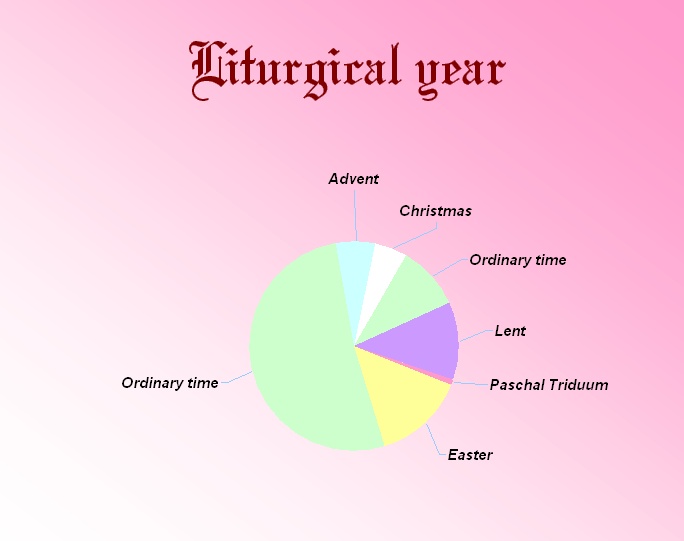
Another thing that Pentecost does is mark the beginning of “Ordinary Time,” as it’s called in the Catholic Church, and shown in the chart at left.
Such “Ordinary Time” takes up over half the church year, though in the Episcopal Church and other “Protestant” denominations, it goes by another name.  That is, in the Anglican liturgy, the Season of Pentecost begins on the Monday after Pentecost Sunday and goes on “through most of the summer and autumn.”  It may include as many as 28 Sundays, “depending on the date of Easter.”  (See also the List of Anglican Church Calendars.)

In other words, this year – 2015 – the Season of Pentecost begins on Monday, May 25, and doesn’t end until Saturday, November 28.   That’s Thanksgiving Weekend, and the day after that – November 29 – marks the First Sunday of Advent, and with it the start of a new liturgical year.

Also, the readings for each Sunday – from June 7 to November 22  – are designated as a given “Sunday after Pentecost,” with a given “Proper” number.  For example, the Bible readings for Sunday August 16 – right about the middle of the Season of Pentecost – are designated as those for the Twelfth Sunday after Pentecost – Proper 15.

But the key point to remember is that it wasn’t only people who were already Christians who saw the Pentecost in Acts as a miracle;  “so did the onlookers … for many were converted to the belief in Jesus as Messiah.”   (Asimov, 1002-1003)  Or as was noted in Acts 2:41, “the same day there were added unto them about three thousand souls.”

To sum up, the Pentecost described in Acts “was a momentous, watershed event.”  For the first time in history, God had empowered “all different sorts of people for ministry.  Whereas in the era of the Old Testament, the Spirit was poured out almost exclusively on prophets, priests, and kings,” on this Day of Pentecost the Holy Spirit had been given to “‘all people.’  All would be empowered to minister regardless of their gender, age, or social position.”  (See What is Pentecost? Why Does It Matter? – Patheos, noted above and emphasis added.)

*   *   *   *

El Greco. Pentecost.

The upper image is courtesy of Pentecost – Wikipedia, with the caption: A Western depiction of the Pentecost, painted by Jean II Restout, 1732.” 

The version at left is courtesy of El Greco. Pentecost – Olga’s GallerySee also El Greco | Hear what the Spirit is saying, with the following notes by Hovak Najarian, on “The Pentecost, Oil on Canvas,” circa1600:

“Its height above floor level would place the seminarians at the lower part of the painting and they would see the subject matter increase in complexity as their gaze moved upward toward Mary, the apostles, and the plumes of fire.  A dove at the top of the painting represents the Holy Spirit; its wings are spread and the light that surrounds it is radiating downward over the gathering. 

“The two men in the foreground at the bottom of a short flight of stairs have lifted their arms and are leaning back slightly in order to look at the dove.  Mary (dressed in red and blue) is seated at the center of the painting with apostles gathered around her; two other women are included in the painting.   

“The woman at Mary’s left shoulder is thought to be Mary Magdalene and the fourth person from the left side may be Martha…  El Greco also included himself in this painting.  His face is second from the right; he is the man with a white beard who seems to be in deep thought and is not looking up toward the dove.

“Although the term, ‘Expressionism,’ did not come into use until the twentieth century, it is an apt term for El Greco’s late paintings.  Expressionism is the result of an artist’s effort to project emotional intensity and inner feelings into a work.  The figures in The Pentecost are not posing for a formal group portrait.  They are an animated informal mix of people who in body language and facial expression are reacting individually, and yet they are part of the collective experience. They are responding with awe and excited emotional involvement as they take part in this miraculous event.”

On the subject of “Propers” in the liturgical year, and especially in the season of Pentecost.  A “proper” definition of the term Proper is far beyond the scope of the themes explored in this blog.  However, those interested in further information on this rather ethereal concept are directed to web articles including but not limited to The Revised Common Lectionary, Proper Ordinary Time | Liturgy, and/or Lectionary #, Proper #, or Sunday after Pentecost?

For more on the issue of speaking in tongues, see On the readings for Pentecost (6/8/14), which noted in part that such “speaking” refers to the “fluid vocalizing of speech-like syllables that lack any readily comprehended meaning, in some cases as part of religious practice. Some consider it as a part of a sacred language. It is a common practice amongst Pentecostal and Charismatic Christianity:”

On the other hand, it could be argued this is another example of some people taking isolated Bible passages out of context, like those who handle snakes based on Mark 16:17-18, or those who have a “quiverfull” of children based on a passage from Psalm 127.  (See Snake handling – Wikipedia, and QuiverFull .com :: Psalm 127:3-5.)

On Ascension Day 2015

 “Jesus’ ascension to heaven,” by John Singleton Copley

 *   *   *   *

“Liturgically speaking,” it was a year ago that I posted On Ascension Day.   More precisely:

Ascension Day is always celebrated on a Thursday, 40 days after Easter.  (In 2014 it falls on May 29).  This major Feast Day – ranking with Easter and Pentecost – commemorates “the bodily Ascension of Jesus into heaven.”

But this year, that 40th day after Easter falls on Thursday, May 14.  (15 days earlier than last year.)  The upshot is that since it hasn’t quite been a year, this isn’t technically an anniversary post.   But “Ascension Daywas one of my first-ever posts, so to me it’s worth commemorating.

But why “40 days after Easter?”  That’s because according to tradition, after Jesus was crucified and rose again, He stuck around on earth for 40 days, before He ascended to Heaven to “sit on the right hand of God.” See Mark 16:19, Resurrection appearances of Jesus – Wikipedia, and Why did Jesus stay around for 40 days after He came back from the grave?

The former noted that these appearances of Jesus “are reported to have occurred after his death, burial and resurrection, but prior to his Ascension.”  The latter noted:

During those 40 days [between Easter and the Ascension], He appeared to various groups … proving beyond doubt to them that he had been raised from the dead by the power of God.  Over two decades later, the Apostle Paul wrote that “he appeared to more than five hundred of the brothers at the same time, most of whom are still living” (1st Cor. 15:6).

But getting back to The Ascension itself:  In the 2014 Ascension Day post, I discussed the whole idea of this “bodily ascension of Jesus into heaven.”  I noted that some people – skeptics – might have a problem with that, or with the “underlying idea that there is indeed ‘life after life,’ for each and every one of us.”  To such skeptics I cited the First law of thermodynamics, that “energy can be transformed from one form to another, but cannot be created or destroyed.”  Put another way, energy is neither created nor destroyed, but simply changes form:

So if the human soul is a form of energy – an idea that seems self-evident – then it too can neither be created nor destroyed, but simply changes form. (E.A.)

The 2014 Ascension Day also cited On arguing with God, for the idea that the name Israel literally translates, “He who struggles with God.”  But in a metaphoric sense, Israel can mean anyone who “struggles with the idea of God.”  (Or with the idea of an afterlife.)

In turn I cited the post on Ascension Day in Jesus in Hell.  That post talked about how 1st Peter 3:19–20 and 1st Peter 4:6 led to the Catholic doctrine of the harrowing of hell:

This is the Old English and Middle English term for the triumphant descent of Christ into hell (or Hades) between the time of His Crucifixion and His Resurrection, when, according to Christian belief, He brought salvation to the souls held captive there since the beginning of the world…   Writers of Old English prose homilies and lives of saints continually employ the subject, but it is in medieval English literature that it is most fully found, both in prose and verse, and particularly in the drama. (E.A.)

See also CATHOLIC ENCYCLOPEDIA: Harrowing of Hell – New Advent.  That in turn led to the idea that “Jesus did really die and through his death for us conquered death and the devil ‘who has the power of death.'”  (Citing Hebrews 2:14, that “through death he might destroy the one who has the power of death, that is, the devil.”)

Or as I put it:  In his First Epistle, Peter was one of the first to advance the “whole concept of ‘life after life.‘”  (See also Raymond Moody – Wikipedia.)    I then added this:

One constant has remained:  “The above views share the traditional Christian belief in the immortality of the soul…”   [See also] Psalm 68:20[, which reads in one version] “God is the Lord, by whom we escape death.”  So all in all, “death” – like New Jersey – would seem to be a pretty good place to [be] from.  In the meantime it’s reassuring to think that Jesus would [literally] “go to hell” on our behalf…

So first Jesus got crucified, for us.  Then He “descended into Hell,” for us.  Then He reappeared on earth and stuck around 40 days, just to make sure His message got through.  Then He ascended to Heaven, to “sit at the right hand of God.”  One possible point being that we too should enjoy our time here on earth, just like He did at the Supper at Emmaus:

The upper image was courtesy of the Wikipedia article, Ascension of Jesus, with the full caption: “Jesus’ ascension to heaven depicted by John Singleton Copley, 1775.”   

The lower image is courtesy of Resurrection appearances of Jesus – Wikipedia, with the caption, “Supper at Emmaus,” in which Caravaggio “depicted the moment the disciples recognize Jesus.”  As Wikipedia noted, “The Road to Emmaus appearance refers to one of the early resurrection appearances of Jesus after his crucifixion and the discovery of the empty tomb.

Re: commemorating.  My 2014 post – On Ascension Day  – was the 25th of 151 I’ve done so far.  (As noted, on or about May 29, 2014.)  My very first post was The Bible – Lectionary Musings and Color Commentary, and was published on April 24, 2014.  That post included information on:

Quasimodo Sunday … not through any connection with Victor Hugo’s character in The Hunchback of Notre Dame.   Instead, the name comes from a Latin translation of the beginning of First Peter 2:2, a traditional “introit” used in churches on this day.    First Peter 2:2 begins – in English and depending on the translation – “As newborn babes, desire the rational milk without guile…”  In Latin the verse reads:  “Quasi modo geniti infantes

I also cited the 2014 post on Ascension Day in On the readings for June 1, which included a painting by Eugène Delacroix, Lion Devouring a Rabbit.  That post cited Peter’s warning in 1st Peter 5:8, and added that “you don’t want to end up like the rabbit in the Delacroix painting.” (E.A.)

The original post included an image, in black and white, of a woodcut, courtesy of Harrowing of Hell – Wikipedia, with the full caption:  “Christ’s Descent into Limbo, woodcut by Albrecht Dürer, c. 1510.”  See also the Jesus in Hell post, which included: Other references of possible interest include: Paradise – Wikipedia, Zohar – Wikipedia, and/or Heaven – Wikipedia.

On singing a NEW song to God…

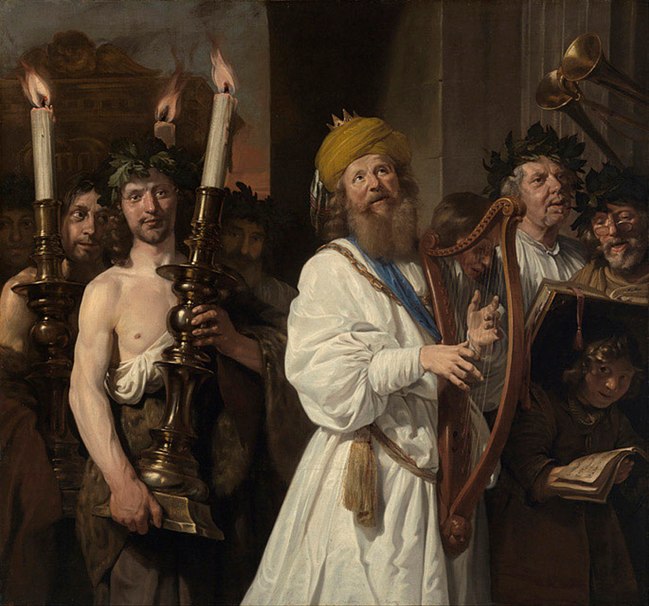
File:David Playing the Harp 1670 Jan de Bray.jpg

“David playing the harp” – and singing a new song to the Lord, as noted below…

*   *   *   *

The Bible readings for next Sunday  –  May 10, 2015  –  are: Acts 10:44-48, Psalm 98, 1 John 5:1-6, and John 15:9-17.  Or see Sixth Sunday of Easter.  Some highlights are below. But first – also coming up, on Friday, May 8 – is the Feast Day of Dame Julian of Norwich.

Norwich – pronounced “NOR-idge,” as in “rhymes with porridge” – is a town in England a bit north and a tad east of London.  See Wikipedia.  Getting back to Dame Julian:

She was born in 1342 and died “about” 1416.  As Wikipedia noted, she was an English anchoress regarded as an important early Christian mystic.   (That clunk you heard was a Southern Baptist having apoplexy over the word “mystic.”)

See On a dame and a mystic, one of the first blog-posts I did.  (Back on May 9, 2014, just after On three suitors (a parable) – including  the image at right –  and just before On dissin’ the Prez.)

Getting back to the readings for Sunday, May 10.

The psalm – Psalm 98 – is one of many Bible passages addressing the theme of “sing to the Lord a new song.”  (Not a stale, warmed-over rehash, like what you tend to get by reading the Bible too literally or “fundamentally.”)  On that note see On the DORs for July 20, which asked:

How can we do greater works than Jesus if we interpret the Bible in a cramped, narrow, strict and/or limiting manner?  For that matter, why does the Bible so often tell us to “sing to the Lord a new song?”   (For example, Isaiah 42:10 and Psalms 96:1, 98:1, and 144:9.)

Psalm 98 begins, “Sing to the LORD a new song, for he has done marvelous things.”  In Latin the first words translate “Cantate domino,” which is also the title of a number of church hymns. See  for example Cantate Domino, Sing a New Song! (SAB ). Or see Cantate Domino – Texts and Translations, which noted that the rest of verse one would read, “canticum novum.”  As in, “Cantate Domino, canticum novum.” (Thus endeth the Latin lesson for the day.) 

See also Psalm 98 – Wikipedia, which noted:

Psalm 98 … is one of the Royal psalms [Psalms 9399], praising God as the King of His people.  [In Judaism it’s] the fourth paragraph of Kabbalat Shabbat [and] Verse 6 is found in the Mussaf Amidah on Rosh Hashanah.  [In Christianity it] may be recited as a canticle in the Anglican liturgy…   The Christmas carol Joy to the World is a lyrical adaptation of Psalm 98 written by Isaac Watts and set … to a tune attributed to George Frideric Handel.

Baptism of cornelius.jpgIn Acts 10:44-48, “the Holy Spirit fell upon all who heard the word,” as Peter spoke.  Peter spoke thus as part of his visit to Cornelius the Centurion. (Shown at left.)  That was prompted in turn by the “vision” that Cornelius had, in Acts 10:1-8.   And in Acts 10:9-16, Peter had a vision of his own, that “what God has cleansed, you must not call uncommon.”  (Or “unclean” in some translations.)

The gist of these readings can be found in Acts 10:34 and 10:35:

Then Peter began to speak to them: “I truly understand that God shows no partialitybut in every nation anyone who fears him and does what is right is acceptable to him.

(Emphasis added.)  Note that Acts 10:34-42 is usually summarized, “Gentiles Hear the Good News.”  The summary for the May 10 readings is: “Gentiles Receive the Holy Spirit.”

In other words, the Good News of Jesus is available to anyone who follows His promise made in John 6:37, that “anyone who comes to me I will never turn away.”  (In other words, the Faith of the Bible is not an exclusive club “for members only,” as some seem to imply.)

The second reading includes 1st John 5:1, which continues that theme:  “Everyone who believes that Jesus is the Christ has been born of God, and everyone who loves the parent loves the child.”  See also Romans 10:9-10:  “If you declare with your mouth, ‘Jesus is Lord,’ and believe in your heart that God raised him from the dead, you will be saved.”  (E.A.)

And the Gospel reading closes with John 15:17, “I am giving you these commands so that you may love one another.”  That’s as opposed to the constant bickering and fault-finding so prevalent these days.  In other words, as a Christian you’re not supposed to go around criticizing others for the “speck” in their eye while ignoring the “beam” in your own.  See On “holier than thou,” which includes a link to The Parable of the Mote and the Beam.

Thus the major theme for this Sunday’s readings is well summarized in Lectionary Scripture Notes, which often includes pithy Biblical exegesis:

It is good to remind ourselves again that the concept of “righteousness” even in an Old Testament context is not to imply that the believer lives in faultless conformity to some moral norm.   It has to do with living in right relationship with God. (E.A.)

That’s important to remember, especially for those who like to stick their noses in other people’s business.  After all, King David was one of God’s Favorites, even though he was hardly a paragon of virtue.  Quite the opposite:  he was merely a real-life “living breathing human being,” with all the “inherent faults and flaws” shared by us mere humans.

*   *   *   *

File:Gerard van Honthorst - King David Playing the Harp - Google Art Project.jpg

Another view of David, playing the harp and “singing a new song…”

*   *   *   *

The upper image is courtesy of Psalms – Wikipedia, with the full caption:  “David Playing the Harp by Jan de Bray, 1670.”

See also the web article King David misunderstood says Yale scholar, with the rest of the headline reading:  “Politician, psalmist, adulterer and more.”  The Old Testament scholar in question is Doctor Joel Baden, whose work – including his The Historical David: The Real Life of an Invented Hero – argued that we’ve “lost sight of David as a real-life ‘living breathing human being’ with all our inherent faults and flaws.”  See also On the psalms up to December 21:

The starting point is the biblical text itself.  I try to understand not only what the biblical authors were saying, but why they were saying it.  That is to say, what was their purpose in writing these stories the way that they did?   I take very seriously what they actually wrote: what they included (and didn’t include)…   The second important step is to view David not as a character in the Bible, but as a living, breathing man in the early first millennium BCE…  The portrayal of David I put forward in the book is thus a combination of these two approaches:  a close reading of the biblical text filled out with the background of the ancient world as we now understand it.   It is an attempt to find the real David moving beneath the veneer of the Bible’s own interpretation of his life. (E.A.)

Which is pretty much the theme of this blog, that the Bible was not written by super-heroes not remotely like us, but by people just like us –  “with all our inherent faults and flaws.”

The lower image is courtesy of File: Gerard van Honthorst – King David Playing the Harp.  The artist (1590-1656) was a “Dutch Golden Age painter” who early in life visited Rome, where he found success “painting in a style influenced by Caravaggio.  Following his return to the Netherlands he became a leading portrait painter.” See Gerard van Honthorst – Wikipedia.

As to the topic David playing the harp in general, see also David – Wikipedia.  The article noted the account of First Samuel, Chapter 16, about Saul, the first king of Israel being tormented by an evil spirit.  It was suggested “he send for David, a young warrior famed for bravery and his lyre playing.  Saul did so, and made David one of his armor-bearers.  From then on, whenever ‘the spirit from God came on Saul, David would take up his lyre and play.  Then relief would come to Saul; he would feel better, and the evil spirit would leave him,’” as illustrated above.

See also On the psalms up to September 28.

Re: “for members only.”  See “Mr. Chan?”  That page noted:  “That promise alone” – in John 6:37 – “is far different than the idea – promoted by many who should know better – that Christianity is some kind of exclusive club, ‘for members only.'”

On St. Mark’s “Cinderella story”

https://arthistoriesroom.files.wordpress.com/2013/12/st-mark-1621.jpg

St. Mark, by Hendrick ter Brugghen

*   *   *   *

April 25 is the Feast Day for Saint Mark.  He wrote the first and shortest of the four Gospels.

“In Christian tradition, Mark the Evangelist, the author of the second gospel is symbolized by a lion – a figure of courage and monarchy.”  (See Wikipedia.)  But that “second Gospel” phrase doesn’t mean his wasn’t the first account of the life of Jesus.  As Isaac Asimov noted:

Matthew is [listed as the] first of the gospels in the New Testament because, according to early tradition, it was the first to be written.  This, however, is now doubted by nearly everyone.  The honor of primacy is generally granted to Mark, which is the second gospel in the Bible as it stands.

(770)  There’s more below on how Mark’s is (or was) the most “dissed” of the Gospels…

But first note that the word “gospel” is from the old Anglo-Saxon “god spell,” meaning “good news.”  The Greek form of the word is “evangelos,” which translates to “bringing good news.”

It should also be noted that the Gospels themselves were predated by one or more “letters” in the New Testament.  (Either Epistle of James or First Epistle to Timothy, depending on the cite.)

The writer of this first-in-time Gospel is generally identified as the same John Mark who “carried water to the house where the Last Supper took place” in Mark 14:13, or the “young man who ran away naked when Jesus was arrested” in Mark 14:51.  (As shown at right.)  See also Acts 12:25:  “Barnabas and Saul returned from Jerusalem when they had completed their service, bringing with them John, whose other name was Mark.

And see Overview Of The Four Gospels – PBS, which said that it was Mark who made the “first attempt to tell the story of the life and the death of Jesus.”  And so it could be said that Mark “began the gospel tradition:”

The gospel of Mark is the second to appear in the New Testament, [but it] was composed first…  The way Mark tells the story suggests that his audience lived outside the homeland [i.e., outside present-day Israel], spoke Greek rather than Aramaic, and was not familiar with Jewish customs.  While there is disagreement about where Mark wrote, there is a consensus about when he wrote:  he probably composed his work in or about the year 70 CE, after the failure of the First Jewish Revolt and the destruction of the Jerusalem Temple at the hands of the Romans.  That destruction shapes how Mark tells his story. (E.A.)

Which brings up the question of what message Mark wanted to convey, to his troubled audience.  The consensus is that he wrote his Gospel right after the First Jewish Revolt and the Roman army’s sack of Jerusalem.  Thus one answer is:  Mark deliberately constructed a “bleak and frightening picture because that was the experience of the people” he was writing to.  In other words he merely reflected the great persecution suffered by his audience.

Then there’s the matter of the Great Commission, generally placed at the end of his Gospel.  (See Mark 16:15, up to verse 18. )   The question is:  Did Mark himself write it at all?

According to some critics … Jesus never speaks with his disciples after his resurrection.  They argue that the original Gospel of Mark ends at verse [8, i.e., Mark 16:8] with the women leaving the tomb (see Mark 16).

http://upload.wikimedia.org/wikipedia/commons/2/21/The_Holy_Women_at_the_Sepulchre_by_Peter_Paul_Rubens.jpgNote that Mark 16:8 says, “they went out and fled from the tomb, for terror and amazement had seized them; and they said nothing to anyone, for they were afraid.”  (As shown at left.)  Which would of course have been a bad place to end a Gospel of hope.

But another scholar – Elaine Pagels – added an interesting twist herself.  She noted that those last words would have been “very bad news” indeed, “if it weren’t that underneath this rather dark story is an enormous hope.”

That is, just as the disciples experienced days of anguish the death of Jesus and Easter morning, there was a rest of the story.  And so it would be for Mark’s audience, even suffering as they did.

In other words, this “terrible anguished [original] ending is nevertheless not the ending:”

That there’s a mystery in it, a divine mystery of God’s revelation that will happen yet.  And I think it’s that sense of hope that is deeply appealing.

See Story Of The Storytellers – The Gospel Of Mark, part of the PBS article above, emphasis added.  And the emphasized word brings up the fact that Christianity has arguably been – all along – a “mystical” religion, full of mysteries; “secret, hidden, not readily known by all.”

For example, see 1st Corinthians 2:7, where Paul spoke of “the word of God in a mystery, even the hidden wisdom.”  He spoke of the “knowledge in the mystery of Christ” in Ephesians 3:4, and of the “fellowship of the mystery” in Ephesians 3:9.  In Ephesians 5:32 he wrote, “This is a great [or “profound”] mystery: but I speak concerning Christ and the church.”  Paul told Christians to “make known the mystery of the gospel” in Ephesians 6:19, and to hold “the mystery of the faith” – or the “deep truths” – in a “pure conscience” in 1st Timothy 3:9.  He said that “great is the mystery of godliness” in 1st Timothy 3:16, and in 1 Corinthians 4:1, Paul said that Christians were to be faithful “stewards of the mysteries of God.”

(And by the way, that “mystery” word doesn’t bode well for those who take the Bible too literally.  But we don’t want to beat that dead horse any more than already done throughout this blog…)

Suffice it to say:  Mark was the first to try to “explain this mystery,” a mystery that baffles many people “even to this day.”  (See 2 Corinthians 3:15, re:  the veil that “covers their hearts.)

So anyway, you can see the full set of Bible readings for the Feast Day at St. Mark.  The readings: Isaiah 52:7-10, Psalm 2, Ephesians 4:7-8,11-16, and Mark 1:1-15 or Mark 16:15-20.

And before closing it should be noted that the Gospel of Mark itself presents a kind of Cinderella story.  As Wills noted in What the Gospels Meant, for many centuries the Early Church Fathers pretty much neglected Mark’s Gospel.  (St. Augustine – being “converted” at right – called Mark “the drudge and condenser” of Matthew.)

For one thing, Mark’s written Greek was “clumsier and more awkward” than the more-polished Matthew, Luke and John.  As a result, Mark’s was the “least cited Gospel in the early Christian period.”  But “this Cinderella got her glass slipper,” beginning in the 19th century.

That’s when Bible scholars finally noticed the other three Gospels all cited material from Mark, but “he does not do the same for them.”  The conclusion?  Mark started the process and set the pattern of and for the other three Gospels.  And as a result of that, since the 19th century Marks’ “has become the most studied and influential Gospel.”

He is long held by the Catholic church to be one of the four living creatures (the lion), along with Matthew (man), Luke (calf), and John (eagle) of Revelation 4/ four main 6 winged Seraphim of Isaiah 6 constantly shouting around the Heavenly Father’s throne “Holy, holy, holy is the Lord of hosts;  The whole earth is full of His glory.”  Mark [is] said to have founded the Church of Alexandria, one of the most important episcopal sees of Early Christianity.  His feast day is celebrated on April 25, and his symbol is the winged lion.

See Mark – Wikipedia.  Now about the lion being his symbol. The lion is traditionally “a figure of courage and monarchy.” See also Lion of Saint Mark, which said the symbolism began with Revelation 4:7, “The first living creature was like a lion, the second was like an ox, the third had a face like a man, the fourth was like a flying eagle.The lion also symbolizes “the power of the Evangelist’s word, the wings symbolize the spiritual elevation, while the halo is the traditional Christian symbol of holiness.”

Which explains some of the symbolism in the Ter Brugghen painting, including the lion at Mark’s elbow and the open book he’s reading.  (The open book can be a symbol of peace, or as a symbol of public justice.  See Lion of Saint Mark, shown at left)  And so to summarize:
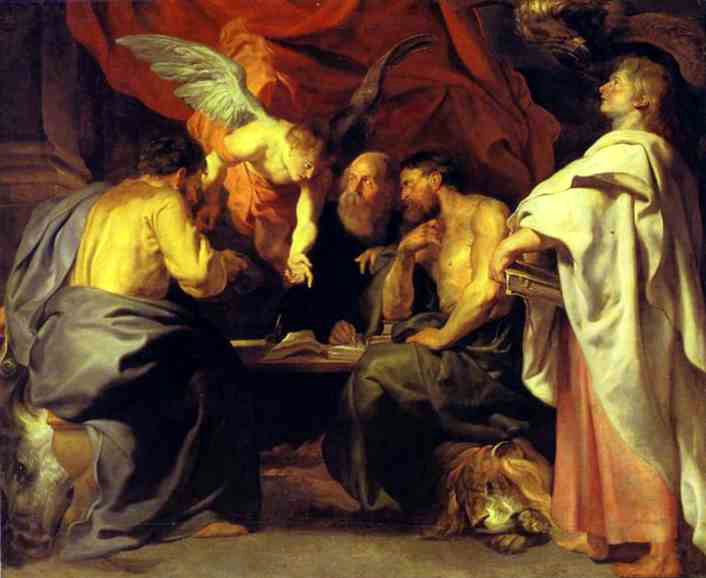
In Christianity, the four living creatures are Cherubim.   A prominent early interpretation has been to equate the four creatures as a tetramorph of the Four Evangelists where the lion represents Mark the Evangelist, the calf [or “ox”] is Luke the Evangelist, the man is Matthew the Apostle, and the eagle symbolizes John the Evangelist.  This interpretation originated with Irenaeus and was adopted by Victorinus.   Its influence has been on art and sculpture and is still prevalent in Catholicism and Anglicanism.

So April 25 celebrates the man the other three Gospel-writers followed and borrowed so freely from.  The man whose work – for 18 long centuries – was largely disregarded and disrespected.  The man who finally – after 1,800 years – got the recognition he deserved.

There’s probably an object lesson there too…

*   *   *   *

The Four Evangelists, by Peter Paul Rubens

*   *   *   *

The upper image is courtesy of Hendrick Ter Brugghen “st. Mark” Painting – Image Results. See also Hendrick ter Brugghen – Wikipedia, about the Dutch painter (1588-1629), a “leading member of the Dutch followers of Caravaggio – the so-called Dutch Caravaggisti.”  Wikipedia added:

His paintings were characteristic for their bold chiaroscuro technique – the contrast produced by clear, bright surfaces alongside sombre, dark sections – but also for the social realism of the subjects, sometimes charming, sometimes shocking or downright vulgar.

For more information on other paintings of “St. Mark,” see FRANS HALS ST MARK – Colnaghi, a PDF file with the full title, “Frans Hals’ St. Mark[:] A Lost Masterpiece Rediscovered.”  The article compared paintings done of St. Mark by Ter Brugghen, Hals and others, as well as their common “painterly conventions.”  For example, the article said Mark is commonly shown “writing on a scroll” and that Mark and John “tend often to be portrayed as the more mystical figures among the Evangelists.”  It also noted the tradition of showing humanist “scholar-saints:”

However the pictorial conventions of the humanist scholar-saint, were easily transferred to the depiction of the Evangelists, and this was particularly true of St. Mark, whose iconography was so similar to that of St. Jerome, both writer saints sharing the common attribute of the lion, that the two were sometimes confused.  Since St. Jerome was a penitent saint, as well as a scholar, he was often shown at prayer accompanied by a skull[, again, as in the upper painting,]  and these penitential aspects of the iconography of St. Jerome in turn become attached also to the figure of St. Mark.  This accounts for the symbols of skull and candle which appear in the Ter Brugghen St. Mark, a version of which is described ambiguously in Slatkes’s monograph as ‘either St. Jerome or St. Mark.’  (E.A.)

Re:  Isaac Asimov.  The quote(s) cited above are from Asimov’s Guide to the Bible (Two Volumes in One),  Avenel Books (1981), at page 770.  And just as an aside, Asimov (1920-1992) was “an American author and professor of biochemistry at Boston University, best known for his works of science fiction and for his popular science books.  Asimov was one of the most prolific writers of all time, having written or edited more than 500 books and an estimated 90,000 letters and postcards.”  His list of books included those on “astronomy, mathematics, the Bible, William Shakespeare’s writing, and chemistry.”  He was a long-time member of Mensa, “albeit reluctantly;  he described some members of that organization as ‘brain-proud and aggressive about their IQs.’”  See Isaac Asimov – Wikipedia.

Re: the order-of-writing of the New Testament.  See Appendix 8: Chronological Order of the Books of the New Testament, which listed James as first to be written, or Bible – In what order were the books in the New Testament written, which listed “1st Timothy and Galatians” as first. 

The “Mark 16:8” image is The Three Marys at the Tomb, by Peter Paul Rubens, courtesy of en.wikipedia.org/wiki/Mary_Magdalene.

Re: Wills’ “Gospels.”  See also What the Gospels Meant – Garry Wills – Book Review – New York Times:

Yet the paradox of modern Christianity is that the growth of biblical scholarship … has done so little to affect the mass of biblical illiterates who proclaim their convictions about what Jesus would do while knowing precious little about what he actually did or, more important, what he meant…   In this sense, Wills is a dangerous man. (E.A.)

Re: The symbolism of the Four Evangelists.  The skull in the upper painting generally symbolizes “the futility of vanity” and/or a “reminder of the certainty of death.”  See Symbols of the Saints – symboldictionary.net, and Vanitas – Wikipedia, the free encyclopedia.

The lower image is courtesy of Peter Paul Rubens: The Four Evangelists, which noted:  “Rubens portrayed the four evangelists while working together on their texts.  An angel helps them…   Each gospel author can be identified by an attribute.  The attributes were derived from the opening verses of the gospels.  From left to right: Luke (bull), Matthew (man [angel]), Mark (lion), and John (eagle).” See also Four Evangelists – Wikipedia, and/or Harry Truman and the next election.

*   *   *   *

On Easter Season – AND BEYOND

*   *   *   *

Rembrandt Harmensz. van Rijn: The Risen Christ Appearing to Mary Magdalen

The Risen Christ Appearing to Mary Magdalen, by Rembrandt  (1638)…

*   *   *   *

Last week’s post was Holy Week – and hot buns.  This post features Resurrection Sunday, a.k.a.  Easter Sunday.  We’ll look at its implications for humanity “and beyond.” 

But first a word about Rembrandt‘s interpretation of Easter morning, shown above:

Mary Magdalen had just found Jesus’ grave empty, and asks a bystander what has happened. In her confusion she thinks the man is a gardener. Only when he replies with “Mary!” does she realize who she’s talking to.  To illustrate Mary’s confusion, Jesus is often depicted as a gardener in this scene.

And then there’s the matter of Easter Sunday as it’s celebrated today, complete with the “Easter Bunny, colorfully decorated Easter eggs, and Easter egg hunts.”  (See What is Easter Sunday?)

In the meantime:

As noted, last week I covered Holy Week – and hot buns.  This week began with Easter Sunday.  You can see the full set of Bible readings at “Easter Day Principal.”  They include Mark 16:1-8:

When the sabbath was over, Mary Magdalene, and Mary the mother of James, and Salome bought spices, so that they might go and anoint Jesus.  And very early on the first day of the week, when the sun had risen, they went to the tomb…   As they entered the tomb, they saw a young man, dressed in a white robe, sitting on the right side; and they were alarmed.  But he said to them, “Do not be alarmed; you are looking for Jesus of Nazareth, who was crucified. He has been raised; he is not here.  Look, there is the place they laid him.  But go, tell his disciples and Peter that he is going ahead of you to Galilee; there you will see him…

And that of course is a subject people have been discussing – and arguing about – ever since.

But first a note about Easter as a full season, and not just a single Sunday of the year.

Eastertide refers to the 50 days from Easter Sunday to Pentecost.  It’s the “festal season in the liturgical year of Christianity that begins on Easter Sunday.” See Eastertide.  Each Sunday in the season after Easter (the Day) is treated as a Sunday of Easter.  For example:  April 12, 2015 is celebrated as the Second Sunday of Easter.  And as noted, the Easter Season ends on Pentecost Sunday.  (Pentecost means “the 50th day.”)

So how did the “Easter Bunny” get mixed up in all this?

The Easter Bunny (also called the Easter Rabbit or Easter Hare) is a symbol of Easter, depicted as a rabbit bringing Easter eggs.  Originating among German Lutherans, the “Easter Hare” originally played the role of a judge, evaluating whether children were good or disobedient…   In legend, the creature carries colored eggs in his basket, candy, and sometimes also toys to the homes of children, and as such shows similarities to Santa Claus or the Christkind, as they both bring gifts to children on the night before their respective holidays.

That’s from the Easter Bunny link, connected to the “bunny” postcard image below.  The accompanying text said that the Easter Bunny custom was first written about 1682.  (On that note see also social control, not unlike that practiced in the season before Christmas.)

And check out the origins of Easter link.  It’s included in the What is Easter link noted above.

The origins of Easter are rooted in European traditions.  The name Easter comes from a pagan figure called Eastre (or Eostre) who was celebrated as the goddess of spring by the Saxons of Northern Europe.  A festival called Eastre was held during the spring equinox by these people to honor her.  The goddess Eastre’s earthly symbol was the rabbit, which was also known as a symbol of fertility…  Today, Easter is almost a completely commercialized holiday, with all the focus on Easter eggs and the Easter bunny being remnants of the goddess worship.

For another interesting article, see Ēostre – Wikipedia.  It referred to the “Germanic divinity” who was the “namesake of the festival of Easter.”  It noted that the “Ēostre” celebration was mentioned by the Venerable Bede in his “8th-century work The Reckoning of Time.”

Bede (circa 673-735) wrote that in the time before he was born, “pagan Anglo-Saxons held feasts in Eostre’s honor” during the equivalent of today’s month of April.  But – he added – the tradition “had died out by his time, replaced by the Christian Paschal month, a celebration of the resurrection of Jesus.”

So it was apparently some time before the 8th century that “Christianity adapted itself to pagan customs” like these, as long as they didn’t “compromise the essential doctrines of the Church.  (See Asimov, 932-33.)

And speaking of The Resurrection by El Greco:” That artist’s interpretation of Easter morning – shown above left – was viewed as “odd at the time,” by his contemporaries.  But these days El Greco’s version “stands out as a work ahead of its time.”  The painting itself shows Jesus – the Risen Messiah – “in a blaze of glory … holding the white banner of victory over death.”

Which is – after all – what Easter Sunday is really all about.

Isaac Asimov went on to note that many people – even to this day – still don’t believe in all this.  That is, they believe that “the tale of the resurrection must be put down to legend.”  But Asimov also noted that if the story had ended with the burial of Jesus – standing alone – it was highly likely “that Jesus’ disciples would gradually have forgotten their old teacher.”  In turn, few new disciples would have been recruited to gather in His memory, as they did in the years following His death.  (As described at length in the Acts of the Apostles – Wikipedia.)

In sum (Asimov noted), the history of the world would be “enormously different:”

However, even if we take the rationalist view that there was no resurrection in reality, it cannot be denied that there was one in the belief of the disciples and, eventually, of hundreds of millions of men – and that made all the difference. (E.A.)

(896-97)  The foregoing was from Asimov’s summary of Matthew’s Gospel (Matthew 27:61-28:3).  (See also Resurrection of Jesus – Wikipedia.)

So Asimov’s point seems to be that even though the “rationalists” among us can’t be persuaded by and through any direct evidence of the Resurrection, they can’t deny the circumstantial evidence(That is, the evidence provided by the millions of lives transformed by their own belief.)

And speaking of such Doubting Thomases:  The original, the prototype of such sceptics – as shown in the painting at left (by Schongauer) – is the subject of the Gospel reading for this upcoming Sunday, April 12.  See Second Sunday of Easter and/or John 20:19-31, and also Thomas the Apostle – Wikipedia, the free encyclopedia.

Then too there’s the fact that this otherwise-obscure former carpenter from Nazareth literally “split time in half.”  (A feat that hasn’t been done before or since.)

In the days before Jesus, people told time by whatever king held power in their particular time and place.  See Matthew 2:1, “Jesus was born in Bethlehem in Judea, during the reign of King Herod.”  See too Jeremiah 1:2, on the Old Testament prophet “to whom the word of the LORD came in the days of Josiah the son of Amon, king of Judah, in the thirteenth year of his reign.” 

So if it hadn’t been for Jesus, this post would have been published on April 8, but not 2015.  The date would have been “in the days of Barack Obama, president of the United States, in the sixth year of his reign.”  The year I was born would be “in the days of Harry Truman, president of the United States, in the sixth year of his reign.”  And I would have graduated from high school “in the days of Richard Nixon, president of the United States, in the first year of his reign.” (All of which would have been extremely confusing.)

So that simplicity-of-numbering alone may have been worth the price of admission

*   *   *   *

“An Easter postcard depicting the Easter Bunny...”

*   *   *   *

The upper image is courtesy of The Risen Christ Appearing to Mary Magdalen – Art and the Bible.

The “Greco” image is courtesy of The Resurrection by GRECO, El – Web Gallery of Art:

Christ is shown in a blaze of glory, striding through the air and holding the white banner of victory over death.  The soldiers who had been placed at the tomb to guard it scatter convulsively.  Two of them cover their eyes, shielding themselves from the radiance, and two others raise one hand in a gesture of acknowledgement of the supernatural importance of the event…   By excluding any visual reference to the tomb or to landscape, El Greco … articulated its universal significance through the dynamism of nine figures that make up the composition [in] one of the greatest interpretations of the subject in art.

See also Resurrection, 1584-94 by El Greco, and El Greco’s Resurrection: Ahead of its Time:  “El Greco considered spiritual expression to be more important than public opinion and it was in this way that he developed a unique style … as one of the great geniuses of Western art.”

The lower image is courtesy of Easter – Wikipedia.

Re: Isaac Asimov.  The quotes – including the summary of the Gospel of Matthew – are from Asimov’s Guide to the Bible (Two Volumes in One),  Avenel Books (1981), at pages 896-97 and 932-33. 

Asimov (1920-1992) was “an American author and professor of biochemistry at Boston University, best known for his works of science fiction and for his popular science books.  Asimov was one of the most prolific writers of all time, having written or edited more than 500 books and an estimated 90,000 letters and postcards.”  His list of books included those on “astronomy, mathematics, the Bible, William Shakespeare’s writing, and chemistry.”  He was a long-time member of Mensa, “albeit reluctantly;  he described some members of that organization as ‘brain-proud and aggressive about their IQs.’”  See Isaac Asimov – Wikipedia.