Category Archives: Not your daddy’s Bible

On arguing with God

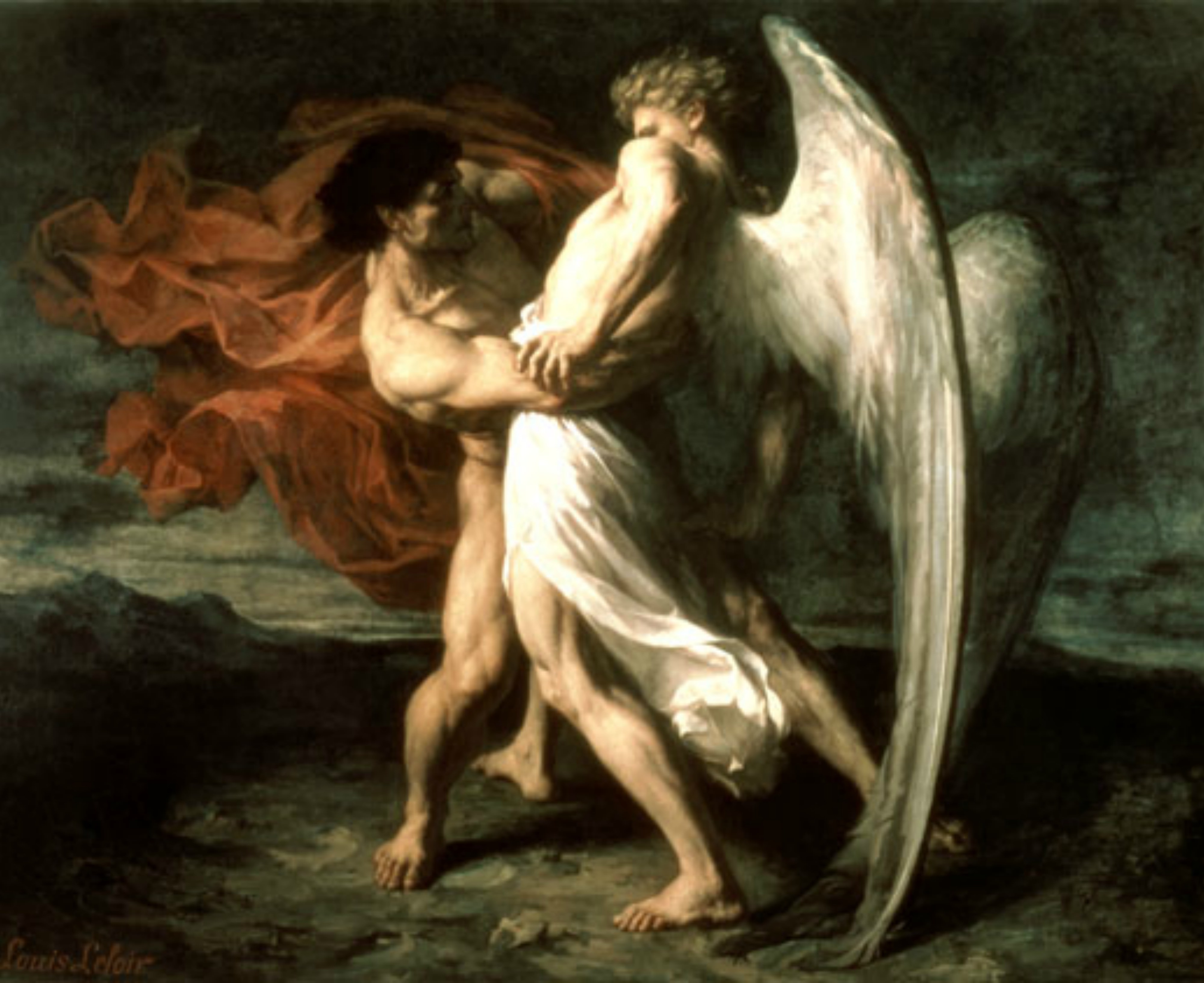
File:Leloir - Jacob Wrestling with the Angel.jpg

Jacob wrestling with the Angel” – as a result of which his name got changed to Israel

 *   *   *   *

The Daily Office Old Testament reading for Monday, May 12, 2014, is Exodus 32:1-20.

That’s where Moses went up on Mount Sinai to get the Ten Commandments.   Meanwhile – back at the base camp – the Children of Israel turned to worshiping a Golden Calf instead of the real God.  The One who delivered them out of slavery. (Which could be a metaphor or something…)

But back on the mountain-top, God – being God – knows what’s going on behind Moses’ back.

So naturally He gets very angry about it.  In the Good News Translation of 32:10, God said to Moses:  “Now, don’t try to stop me. I am angry with them, and I am going to destroy them.  Then I will make you and your descendants into a great nation.” (Emphasis added.)

So God made up His mind to destroy the Israelites.  The same ones He’d gone to all the trouble of delivering out of the aforementioned slavery, which should have been the end of it.  (To a “strict constructionist” anyway.)   God had spoken, He’d made a decision, and God – being God – was neither arbitrary nor capricious, and so was unlikely to change His mind.  But wait!!

Moses pleaded with the Lord his God and said, “Lord, why should you be so angry with your people…  Why should the Egyptians be able to say that you led your people out of Egypt, planning to kill them in the mountains and destroy them completely?  Stop being angry; change your mind…  So the Lord changed his mind and did not bring on his people the disaster he had threatened.

Now about that word “pleaded.”  That’s from the Good News Translation.  The New Living Translation said Moses “tried to pacify God.”  The International Standard Bible said that Moses “implored the Lord.”   But most translations, including the King James Bible – the one that God uses – used the word besought: “Moses besought the LORD his God, and said, LORD, why doth thy wrath wax hot against thy people?”

Besought is a “past tense and a past participle of beseech.”  And beseech in turn means “to ask someone for something in an urgent and sincere way.”

So in plain words, Moses argued with God.  And that’s a concept that many – including most Fundamentalist or conservative Christians – would find highly incongruous.

That is, in asking God to change His mind, Moses gave “reasons or cite[d] evidence in support of an idea, action, or theory, typically with the aim of persuading others to share one’s view.” (Which by the way is something that lawyers do.)   See for example Isaiah 50:8, in the New Jerusalem Bible, “Let us appear in court together,” and Job 23:4, in the New International Version, “I would state my case before Him [God] and fill my mouth with arguments.”

And this wasn’t the only time a father of the church argued with God.  Take Sodom and Gomorrah…  “Please!”   That is, see: Genesis 18:16-33.  That’s where Abraham pleaded with God not to destroy Sodom.  (And quite frankly, he was kind of a pain about, haggling with God not to destroy the city if there were 50 good people in it, down to as few as five good people…) 

I.e., that passage tells of Abraham “arguing” that God shouldn’t destroy Sodom if there were even 50 people in the city who weren’t total dirt-bags.  Then Abraham went down to 45, then to 40, then to 30, and so on – in a manner that was, frankly, quite annoying – until he got God to agree that if even 10 people in the city weren’t total dirt-bags, he wouldn’t destroy the city.

And finally, there’s the ultimate case of “contending with God,” the story of Jacob becoming Israel.   See the full story at Genesis 32:22-32, or you could check Wikipedia, which noted:  “The account includes the renaming of Jacob as ‘Israel,’ literally ‘He who struggles with God.'”

The point of all this is that maybe – just maybe – we today are supposed to “argue with God,” or “wrestle with God,” or even “wrestle with the idea of God.”  Maybe, just maybe, that’s how we get spiritually stronger, by “resistance training” rather than passively accepting anything and everything in the Bible, without question or questioning.

So what kind of Christian would you rather be?

Someone who wrestles with God and keeps getting stronger, spiritually.  Or rather someone whose method of Bible study is either “weak and ineffectual” or “plain and unadventurous?”


 *   *   *   *

Notes:

The upper image, courtesy of Wikipedia, is Jacob Wrestling with the Angel, by Alexander Louis Leloir (1865).  Leloir (1843-1884), was a a French painter specializing in genre and history paintings. His younger brother was painter and playwright Maurice Leloir.

See the full Daily Office readings at The Lectionary – Satucket.com.

Re: Job 23:4.  But see also Job 40:2, “Will the one who contends with the Almighty correct him? Let him who accuses God answer him!”  So there’s definitely a limit to how feisty you can get when arguing with God, but note that after his long “arm-wrestling with God,” Job ended up better off: “the Lord gave Job twice as much as he had before.” (42:10)

“Sodom and Gomorrah…  ‘Please!'”  An allusion to an old Henny Youngman joke.

As to resistance training, see the Wikipedia article on strength training:  “Progressive resistance training dates back at least to Ancient Greece, when legend has it that wrestler Milo of Croton trained by carrying a newborn calf on his back every day until it was fully grown.”

The bottom image is courtesy of Caspar Milquetoast – Wikipedia:

Caspar Milquetoast was a comic strip character created by H. T. Webster…  Because of the popularity of Webster’s character, the term milquetoast came into general usage in American English to mean “weak and ineffectual” or “plain and unadventurous.”  When the term is used to describe a person, it typically indicates someone of an unusually meek, bland, soft or submissive nature, who is easily overlooked, written off, and who may also appear overly sensitive, timid, indecisive or cowardly.
 

On Jesus: Liberal or Fundamentalist?

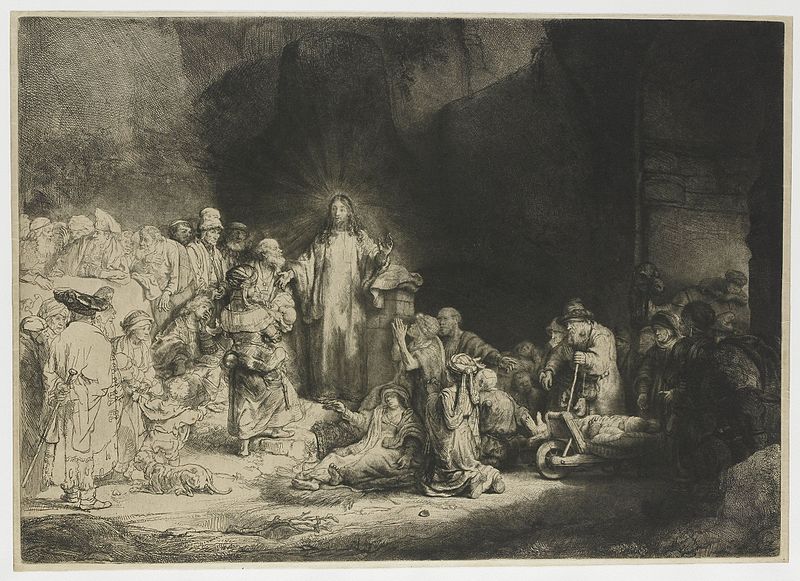
File:Rembrandt The Hundred Guilder Print.jpg

Rembrandt‘s view of Jesus, showing “Biblical events as tender instances of piety and serenity.” 

*   *   *   *

Jesus – seen above – made two main promises:  First, that He would never turn away anyone who came to Him.  Second, He came to Earth so His followers could have life “in all its abundance.” (See John6:37 and 10:10.)  Which raises a question:  Why would anyone want to interpret those promises literally or narrowly?  (See strict construction … Law.com.)

Another question:  If Jesus was a Fundamentalist, why did we need Him?  If Jesus was born both Jewish and a Fundamentalist – favoring a “strict adherence to specific theological doctrines” – why would He create a “new covenant” to replace the old one?

Consider also the apparent contradiction between Mark 9:40 and Matthew 12:30.  In Matthew 12:30 (NEB), Jesus said, “He who is not with me is against me.”  But in Mark 9:40 (NEB), Jesus said, “he who is not against us is on our side.”

Under strict construction – used by Fundamentalists – “ambiguous language is given its exact and technical meaning.”   Under that rule for Matthew, if you aren’t expressly for Jesus, you are against Him.  But in Mark, being “kind of against us” doesn’t put you “outside the pale.” In Mark, if you are not expressly against Jesus, you are for Him and/or for Christianity.

Also, by strictly interpreting those quotes – giving them their exact and technical meaning – you end up with Jesus contradicting Himself.

It also raises the question: What did Jesus do when interpreting Scripture?  Was He strict or “liberal?”  One answer: Both.   See www.kencollins.com/answers/question-43.

The site’s author, Reverend Collins, said that many people try to harmonize the passages “by theorizing that when it comes to Jesus, there is no middle ground. You are either for Him or against Him.” He too was puzzled by the passages until he read an old commentary by a man named Theophylact (who died in 1108).  Theophylact says that if we observe these verses in context and compare them, we see that Jesus is talking about two entirely different situations.”

Collins said that in Mark Jesus talked of men, people, who were doing good works in Jesus’ name, “even if they don’t have the proper credentials.” So if a layman is “conducting a valid ministry where there is a need and no one else to meet it,” the Church shouldn’t stop him, but “find a way to include him. Whoever is not against Jesus is for Him.”

But in Matthew, Jesus was talking about demons. Matthew 12:30 came right after the “house divided” speech (later used by Abraham Lincoln). In 12:22, Jesus was presented with a man possessed by demons. But when Jesus cast out the demons, the Pharisees said He could only do that because He was Satan, prince of demons Himself.

After saying it didn’t make sense for Satan to cast out his own, Jesus moved to how the house of a “strong man” or Satan (translations vary) might be robbed.  He later added, “Anyone who isn’t helping me is harming me.” (Emphasis added.)

Theophylact the Bulgarian.jpgCollins said that at first he thought Jesus was talking about people in Matthew (as “plain meaning” would require).  But he changed his mind after considering “Theophylact” – shown at left – noting that he was “neither a Protestant nor a Catholic;  his native language was the same language that the apostles used to write the New Testament, and he lived in a completely different political, social, and theological context than we do.”   Thus interpreting the two passages “in context,” it seems that Jesus was indeed addressing two different cases.

With demons, Jesus used a strict construction.  If a demon wasn’t expressly for Jesus, he was against Him.  But in the case of people, Jesus used a liberal construction.  By that construction the law was “reasonably and fairly evaluated so as to implement [its] object and purpose.”

So just what is the Bible’s purpose?   The Apostle Paul said in First Timothy 2:1-4 that the Bible’s purpose has always been saving as many as possible:  “I urge that supplications, prayers, intercessions, and thanksgivings be made for all men… This is good, and it is acceptable in the sight of God our Savior, who desires all men to be saved.”  See also Second Peter 3:9, “The Lord is not slow in keeping his promise, as some understand slowness. He is patient with you, not wanting anyone to perish…”  (A goal that arguably can’t be met by being strict or limiting…)

In other words, it makes sense that if a person isn’t expressly against Jesus, He – Jesus – is willing to give that person (and all people), the benefit of the doubt.   But in the case of demons Jesus used a strict interpretation of Scripture.  In both cases He construed the Bible to achieve its self-stated aims.  Which means that Jesus was neither a liberal nor a conservative when it came to interpreting Scripture.  He was right there “in the middle of the road.”

That’s also called the Via media or “Middle Way,” the subject of a future post.

*   *   *   *

Richard Hooker‘s “Ecclesiastical Polity” set out a “Middle Way…” 

*   *   *   *

The upper image is Rembrandt’s “Hundred Guilder Print.”  See Hundred Guilder Print – Wikipedia.

Re:  The “two” great promises of Jesus.  This post-column was last edited on May 11, 2014.  That was before I fully appreciated the Third Great Promise, as told by Jesus in John 14:12:  “Very truly, I tell you, the one who believes in me will also do the works that I do and, in fact, will do greater works than these, because I am going to the Father.”  (Emphasis added.)

The lower image is courtesy of the Richard Hooker link in the article, Via media – Wikipedia.  The caption:  “Statue of Hooker in front of Exeter Cathedral.”  One author noted, ” Hooker’s moderation and civil style of argument were remarkable in the religious atmosphere of his time.”  Also:

Traditionally, he has been regarded as the originator of the Anglican via media between Protestantism and Catholicism.  However, a growing number of scholars have argued that he should be considered as being in the mainstream Reformed theology of his time and that he only sought to oppose the extremists (Puritans), rather than moving the Church of England away from Protestantism.

Another note:  I originally posted this article in May 2014.  I updated it on August 2, 2018.

On “Titanic” and suspending disbelief

File:Kate-winslet titanic movie pencil-drawing.jpg


Here’s another parable, about the 1997 move, Titanic.

To me, that movie is all about the power of suspending disbelief.

You see, there’s one thing that bothered me about the movie.  Those divers found a perfectly preserved charcoal drawing – the one that Jack did of Rose in 1912, on board the Titanic.  They found that perfectly preserved charcoal drawing after 80 years at the bottom of the ocean.

But the unlikelihood of that ever happening doesn’t mean the whole movie was “false.”

There was a factual basis for the movie.  The Titanic did sink in 1912.  But a core premise of the whole movie seemed to be that after 80 years at the bottom of the ocean, those divers found a charcoal drawing like the one shown above.  (In the ship’s safe, along with the huge necklace shown around Rose’s neck).  So even though everything else had turned to mush, that charcoal drawing was “picture perfect” as the night it was drawn.

That’s the problem.

Anyone who knows charcoal drawings knows that even with several coats of fixative – like that shown at right – it won’t last 80 years at the bottom of the Atlantic.  For one thing, even if fixative had been invented, the movie never indicated Jack had any, and certainly not in aerosol form.  And there was no indication that Jack took the time after finishing the drawing to apply fixative.

(It would no doubt have spoiled the mood.)

Thus the question: Since this core premise of the movie seemed patently false – it couldn’t have happened – did that make the whole film without value, not worthy of experiencing?

Again, the Titanic did sink in 1912, with great loss of life.  And many characters were based on real people who were on the ship when it sank.  Still others were composites of several real people.  And still others were pure figments of creative imagination.

So the viewer saw an impression of a real event.  In turn, in making the film some creative minds embellished the plot here and there.  They livened up the story and got certain major points across.  And they left out details that didn’t seem important and would “clog up the plot.”

(Maybe even like John did at the end of his Gospel.  That is, John 21:25 reads:  “There are many more things that Jesus did.  If all of them were written down, I suppose not even the world itself would have space for the books that would be written.”) 

But in the end, the film-writers came up with a story from which many lessons could be learned.

That is, someone who saw the movie with an open mind might come away with a sense of hope.  That hope might be that there is a world beyond the five senses, a world beyond time and death.  Such a viewer might come away thinking love really can transcend everything.  He might even think love can transcend time, death, and even the sordid reality of everyday life.

But there was that troublesome false premise at the core of the story.

The story wasn’t 100% accurate.

But again, consider the viewer watching with an open mind.  He’d be willing to suspend disbelief and not require the movie to be 100% accurate.  In turn that viewer would be treated to a wonderfully intense tale of love overcoming all; logic, time, common sense, even death itself.

He’d come away with a good feeling that might help him endure his mundane, boring life for a few days or weeks.  He might even be prompted to go out and do something nice for someone else, someone less fortunate.  And he might – just might – want to share the movie’s good news.

On the other hand, consider the person who viewed the movie with a closed mind.  A person unwilling – even for a moment – to suspend disbelief.  A person who simply had to believe that everything in the movie had to be 100% accurate.

Wouldn’t that viewer just be short-changing himself?


http://breathedreamgo.com/wp-content/uploads/2012/03/titanic-movie.jpg


The charcoal-drawing image is courtesy of: http://upload.wikimedia.org/wikipedia/en/f/f0/Kate-winslet_titanic_movie_pencil-drawing.jpg.

The “fixative” image is courtesy of www.alvinco.com/_R_/Shop/Products.aspx?IID=971.  As noted in Utrecht Art Supplies Ask the Expert: Fixative Q&A, “Canned spray fixative was introduced in 1948 by Krylon.  Before then, artists relied on the old-fashioned mouth atomizer, which is still available today.”  For more on the disagreeable elements of using such a “mouth atomizer,” see Charcoal Fixative – how to fix your drawing – Art Graphica.

The quote from John is from the Berean Study Bible.  In the King James Bible – the one God uses – the passage reads:  “And there are also many other things which Jesus did, the which, if they should be written every one, I suppose that even the world itself could not contain the books that should be written.  Amen.”

The Jack/Rose image is courtesy of breathedreamgo.com/wp-content…2012/03/titanic-movie.jpg.

The Jack-and-Rose picture also raises the question: Does your way of reading the Bible give you a spiritual “set of wings,” or is it more like a spiritual strait-jacket?


“God will strike you, you whitewashed wall!”

*   *   *   *

*   *   *   *

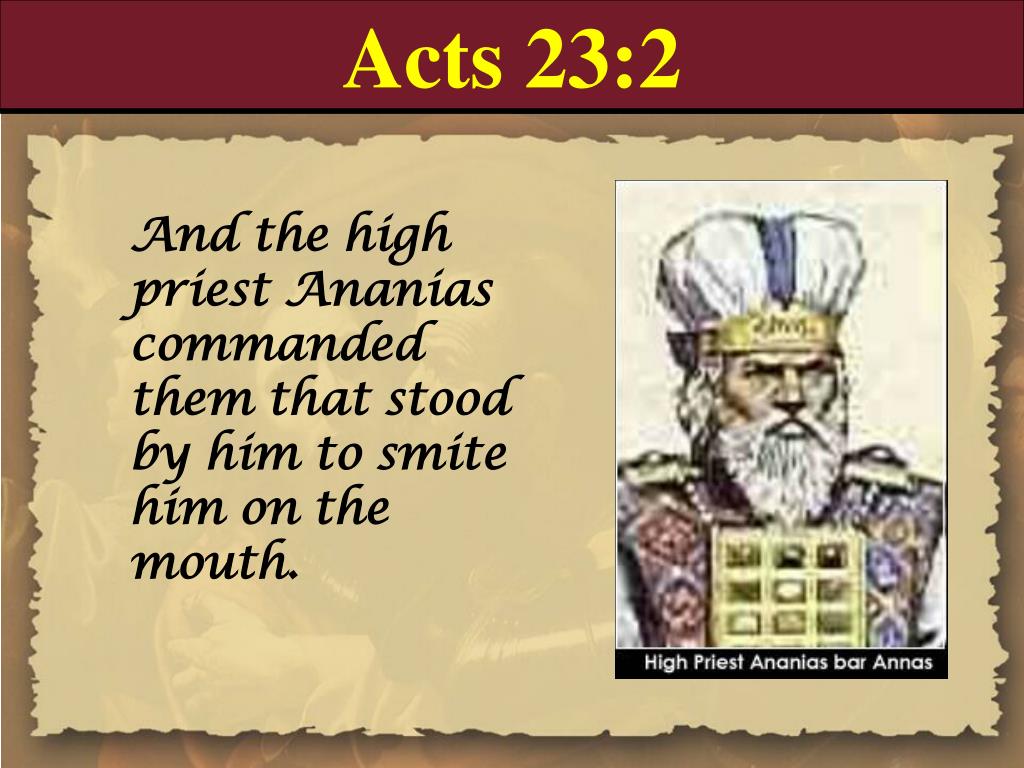
May 6, 2014 – The Apostle Paul said that – about the “whitewashed wall” – at the beginning of Acts 23. The problem was, he said it to a High Priest. That meant he had violated Exodus 22:28: You shall not speak evil of a leader of your people.” Here’s what happened.

Paul was standing trial in Jerusalem before the Sanhedrin. (Basically the Hebrew “Supreme Court.”) He was on trial for preaching the Gospel when high priest Ananais told a guard to “strike him on the mouth.” That’s when Paul made his rash comment:

Those standing nearby said, ‘Do you dare to insult God’s high priest?’   And Paul said, ‘I did not realize, brothers, that he was high priest; for it is written, “You shall not speak evil of a leader of your people.”’

Which brings up Conservative Christians who say the Bible must be interpreted literally.

As the International Bible Commentary noted: “Paul’s stern rebuke was contrary to the letter of Exod. 22:28, and he at once admitted it.  The president [i.e., the high priest Ananias] was a criminal, but the ‘seat’ was sacred.”  (Emphasis added.)  And Exodus 22:28 says, in the New Revised Standard Bible, “You shall not revile God, or curse a leader of your people.”

That in turn brings up Biblical inerrancy, the “doctrinal position that the Bible is accurate and totally free of error.”  That is, “Conservative Christians generally believe that God inspired the authors and redactors of the Bible. Hence, they wrote material that was error-free.”

So if the Bible is “inerrant” – error-free – and must be interpreted literally, then Conservative Christians could be violating the letter of Biblical law.  (If they were – for example – to curse or otherwise criticize a sitting President of the United States…)

Of course there is a way around that.  But the only way around that dilemma is to use a liberal interpretation of the Bible.  As to the differences – between a strict construction, as opposed to a more “liberal” construction – see Strict constructionism – Wikipedia:

Strict construction occurs when ambiguous language is given its exact and technical meaning, and no other equitable considerations or reasonable implications are made…  If the language is plain and clear, a judge must apply the plain meaning of the language and cannot consider other evidence that would change the meaning. If, however, the judge finds that the words produce absurdity, ambiguity, or a literalness never intended, the plain meaning does not apply…

So the question becomes: are the “laws of the Bible” set out in clear and unambiguous language?

If the laws of the Bible are plain and clear, the “plain meaning” rule applies.  But if that language results in a “literalness never intended,” the plain-meaning rule does not apply.  (And Paul did say in 2d Corinthians 3:6, that the letter of the law kills, while its spirit “gives life…”)

Put another way, the plain meaning of Exodus 22:28 and Acts 23:5 seems pretty clear, if you interpret the Bible literally.   On the other hand, consider the potential defense offered conservative Christians through “liberalism:”

Liberal Christianity, broadly speaking, is a method of biblical hermeneutics, an undogmatic method of understanding God through the use of scripture by applying the same modern hermeneutics used to understand any ancient writings…  The word liberal in liberal Christianity denotes a characteristic willingness to interpret scripture without any preconceived notion of inerrancy of scripture or the correctness of Church dogma.  A liberal Christian, however, may hold certain beliefs in common with traditional, orthodox, or even conservative Christianity.

(See Liberal Christianity – Wikipedia.)   So, if the term “leader of your people” must be interpreted literally, then Conservative Christians could be in big trouble if they were – for example – to criticize a sitting President of the United States.

On the other hand, you could “liberally” say that in the United States, ultimate power doesn’t reside in one president who can serve a maximum of eight years.  In America, ultimate political power resides in the Sovereign People, as in “We the people” at the start of the Constitution.

To sum up: Conservative Christians can avoid getting into trouble for violating the letter of Exodus 22:28, but only by using a liberal interpretation.  They can criticize the President all they want, as long as they don’t criticize “the Sovereign People” who elected him.  (A subtle distinction to be sure.)   Put another way, conservative Christians only avoid the penalty for violating the strict letter of Exodus 22:28 by using a liberal interpretation.  That would be ironic

*   *   *   *

*   *   *   *

This post was previously published as “On dissin’ the Prez.” The new upper image is courtesy of Ananias In The Bible High Priest – Image Results. Note that Ananias the High Priest is not to be confused with Ananias of Damascus, “a disciple of Jesus at Damascus … mentioned in the Acts of the Apostles … [on] how he was sent by Jesus to restore the sight of Saul of Tarsus (who later was called Paul the Apostle) and provide him with additional instruction in the way of the Lord.” (Wikipedia.) See also ANANIAS – Who Are The Three Ananias In The Bible?

The lower image is courtesy of Irony Images – Image Results


On three suitors (a parable)


Rabia Basri, female Muslim saint and mystic.


Welcome to the DORscribe website, just chock-full1 of Bible-reading previews, color commentary, and “deep background.”

This morning’s post involves a parable, the kind of story that Jesus used to tell.

“Once upon a time,” there was a woman of great wealth and power. She was courted by three different men, and each wanted to marry her.

She spent time with the first man.  After much urging that he be “totally honest,” the first man made a candid admission: he was on probation, and had been ordered to find a good woman, get married and settle down.  So (the suitor admitted), he wanted to marry the rich woman so he wouldn’t have to go through the hell of prison life.

The woman decided to get to know the second suitor. Again after much urging to be honest, the second man admitted he wanted to marry her so he could be “on easy street.” He was tired of all the garbage of his everyday life.  The main thing he looked forward to (once they were married) was taking things easy and not grubbing for a living, as his “previous life.”

Finally, the woman got to know the third man better. When he got totally honest, he said while he might enjoy sharing the woman’s wealth and power, that didn’t really matter to him; she was special and that was that.  He couldn’t imagine living his life without her, now that he’d gotten to know her. It wouldn’t matter to him if she didn’t have any money, or didn’t want to share what she did have. He’d still love her and want to be with her, even if it meant living in a hovel. He wanted to be near her and share his life with her.

All of which brings up a prayer said to come from the Koran:

O God, if I worship Thee in fear of hell, burn me in hell;  if I worship Thee in hope of Paradise, exclude me from Paradise;  but if I worship Thee for Thine own sake, withhold not Thine everlasting beauty.

That prayer might remind us that maybe there’s more to praying than just asking God for a bunch of goodies (or a Mercedes Benz), like a spoiled child.  And by the way, that prayer apparently didn’t come from the Koran, but came from “a Muslim woman named Rabia in the 8th century.”  One website said the essence of this kind of prayer is “praise rather than petitioning, an attempt to go beyond the requirements of ritual worship by adoring God.”

Which brings us back to the parable of the woman and her three suitors.

First, assume for the sake of the parable that each man told the truth.  (Which many women would say is no small assumption). Then the question would be: which man showed the greater true love? And finally, if you were that woman, which man would you choose?

*   *   *   *

Which brings up some problems in interpreting the Bible.

For one thing, there’s the Hebrew style of writing; in Hebrew there are no vowels, and the letters of a sentence are strung together.   An example:  a sentence in English, “The man called for the waiter.”  Written in Hebrew, the sentence would be “THMNCLLDFRTHWTR.”  But among other possible translations, the sentence could read, in English, “The man called for the water.”

Another problem with interpreting “the law of the Bible” is that most of Jesus’ teachings came in the form of parables, like the one above.

The book Christian Testament said parables are “very much an oral method of teaching,” and that in such an oral tradition, it was up to the listener to decipher the meaning of the parable, to him.   Or as Jesus said on several occasions, “Whoever has ears to hear, let them hear.”

The problem came when these oral-tradition parables were written down, at a minimum some 20 years after the fact, as in Mark’s Gospel.  Quite often, in transposing the parable from oral to written form, it  needed an interpretation added to it.  (In Hebrew the word for such interpretation is nimshal, or the plural, nimshalim.)  That in turn could lead to some uncertainty.

But Christian Testament said  this “uncertainty” doesn’t necessarily present a problem:

The essence of the parabolic method of teaching is that life and the words that tell of life can mean more than one thing. Each hearer is different and therefore to each hearer a particular secret of the kingdom [of God] can be revealed. We are supposed to create nimshalim for ourselves.

(CT, 321)   All of which seems to be one of those ideas that can give a conservative Christian apoplexy; the fact the Bible might mean different things to different people.  Put another way, just as it seems unreasonable to say God died for one person (or one set of people), it seems just as unreasonable to say that the Bible must mean the same thing to everyone, all the time.

Which brings up the Christians who insist that the Bible must be interpreted literally, and only literally.   More to the point, if and when you read the Bible, which style of interpretation would you prefer?   A literal, strict and/or narrow interpretation?  Or would you prefer a more open-minded or even – gasp! – liberal interpretation, so as to implement the object and purpose of the document?   (That intent can arguably be found in John 10:10, where Jesus said, “My purpose is to give life in all its fullness.”)

That in turn raises a couple more questions, like:  How do you “strictly interpret” a parable, or for that matter, how do you strictly interpret “THMNCLLDFRTHWTR?”


File:Scopes trial.jpg

Clarence Darrow (left) and William Jennings Bryan chat in court during the Scopes Trial.”  Image and quote courtesy of Wikipedia, which explained this as a famous 1925 American legal case – also known as the “Monkey Trial” – in which a “substitute high school teacher, John Scopes, was accused of violating Tennessee’s Butler Act, which made it unlawful to teach human evolution in any state-funded school” (which sounds an awful lot like “deja vu all over again.”

Bryan was called in as a special prosecutor, in part at the behest of the World Christian Fundamentals Association.  Darrow volunteered his services to the defendant Scopes.  The trial covered by famous journalists from arund the world, including H. L. Mencken of The Baltimore Sun.  “It was also the first United States trial to be broadcast on national radio.”


 Other references:

According to one online definiton, the term “chock-full” seems to come from the Middle English chokkefull, probably from choken to choke + full, with the “First Known Use: 15th century.”  

The image of Rabia Basris is courtesy of http://sufipoetry.files.wordpress.com/2009/12/rabia.jpg?w=500. See also Rabia Basri – Wikipedia, the free encyclopedia.

As to “a parable [like] Jesus used to tell.”  See Matthew 13:34 (ESV):  “All these things Jesus said to the crowds in parables; indeed, he said nothing to them without a parable.”

As to “in Hebrew there are no vowels.” See Education for Ministry, Year One (Hebrew scriptures) 4th Edition, Charles Winter and William Griffin (1990).

As to “Christian Testament [saying] parables are “very much an oral method of teaching.”  See Education for Ministry Year Two (Hebrew Scriptures, Christian Testament) 2nd Edition by William Griffin, Charles Winters, Christopher Bryan and Ross MacKenzie (1991).


As to the differences between a strict or narrow construction, (as opposed to a more “liberal” construction or interpretation), see: Legal-dictionary.thefreedictionary.com/strict+construction.  Another site that might be of interest:   A Quaker’s Response to Christian Fundamentalism.


On Jesus as a teenager

*   *   *   *

Did you ever stop to wonder when Jesus came up with the idea that He was Jesus.”  That He was “someone special?”  That He was – literally – the Son of God?

Which leads to more questions:  Did He know the very minute He was born?  Did He know – even as an infant – that He was the First-born Son of God, as indicated by Jorg Breu’s painting above?  And did He – even as a newborn child – have a fully formed adult personality?

Some time ago there was a bracelet trend, “WWJD?”  What would Jesus do?  Turning that question around – thinking “outside the box” – the question could be put like this:

What would you do – with a fully formed adult personality, able to see and know all around you – yet you were trapped in the body of a baby?

The traditional view – the accepting, non-questioning “literalist” view – is that Jesus did in fact know every minute of His life just who He was.  (There are for example those medieval portraits of Jesus as a baby, in the manger, with that all-knowing smile, like the one above.)   But that in turn raises some pretty interesting questions.

Again, what would you do if you could only communicate with a smile, a frown, a gurgle or a belch?  To most of us that would be a living nightmare.  It would be a nightmare to be trapped inside the body of an infant, but to have a fully formed adult personality.

But the only rational, alternate view seems to be that Jesus did not know who He was at that very minute He was born.  And if that is true, the question then becomes:  “At what point in His life journey did Jesus find out?”

In modern terms – and borrowing a page from today’s political circles – the question would be, “What did Jesus know, and when did He know it?

If Jesus didn’t know – the minute He was born – that He was the Son of God, He had to find out later in His life.  One take on that idea came from the man who wrote Zorba the Greek

Nikos Kazantzakis also wrote The Last Temptation of Christ.  (In 1955.)   That’s the movie that caused such a stink when it was made into a movie in 1988.  Anyway, in Last Temptation Kazantzakis theorized that at some point in His life, Jesus may have started “to hear voices:”

“I fasted for three months. I even whipped myself before I went to sleep. At first it worked. Then the pain came back. And the voices. They call me by the name: Jesus.”

So according to Kazantzakis, Jesus may not have known the minute He was born who He was. He found out some time later in His life.  Again, that seems to be a rational alternative to the idea that at the moment He was born, Jesus had a fully-formed adult personality.

It also seems to fit in with other people in the Bible, like Abraham, who also seemed to hear a voice that told him to leave his homeland and everything he ever knew in life, and make a thousand-mile trek into “the great unknown.” (See Genesis 12:1 – in the Good News Translation – “The Lord said to Abram,* ‘Leave your country, your relatives, and your father’s home, and go to a land that I am going to show you.’”)

So, in pretty much the same way that Abraham heard The Voice that told him to leave his homeland – at 75 years of age or so – Jesus may have first become aware of His being special by also “hearing a voice,” or voices…

Whatever the merits of such a meditation, it seems pretty clear that throughout the first 30 years of His life, Jesus must have had a world of patience.  And in all likelihood, at no time was that more true than when He was a teenager.

Of course He did have that one chance when he was 12 years old, to impress the elders in Jerusalem.  (See Luke 2:41-50).  But except for that one or two days of “mountaintop experience,” it seems that Jesus still had to endure 30 long years of pure, mundane drudgery.

He had to live quietly and unobtrusively – for 30 long years – before starting His ministry.  And He had to do this before the people around Him started getting the idea who He really was.  (It must have been something like spending all day in a county tag office, multiplied by 10,950.)

Which brings up another compelling question.  What was Jesus like as a teenager?  Suppose – just for the sake of argument – that by the time He was a teenager, Jesus did know that He was in fact the First-born Son of God.  For one thing, He could see into the future.  And He knew, absolutely knew, everything that ever was or ever had been.

So maybe as a teenager, Jesus did know everything there ever was to know, and everything possible that ever could be known.  Yet there He was, stuck in that backwater, hayseed town of Nazareth, far away from any possible excitement, like what He might find in Jerusalem.

And again in all likelihood, probably the worst thing of all for Him was that He had to take orders from older people, people who He knew didn’t know a fraction of what He knew about “real life.”  Of course, since every teenager in the world has felt exactly the same way since the beginning of time, how could the people in Nazareth know that this teenager was any different?

*   *   *   *

As to the “bracelet craze, ‘WWJD’” quote, see the Wikipedia article.

“…what did Jesus know, and when did He know it?” This is one of many phrases – like “Irangate” or “Benghazi-gate” – that can be traced back to the 1972 Watergate scandal. It can be credited to Senator Howard Baker, who famously asked, “What did the President know and when did he know it?” The question was originally written by Senator Baker’s counsel and former campaign manager, future U.S. Senator [and Hollywood star], Fred Thompson. See, en.wikipedia.org/wiki/Howard_Baker, and firstthings.com/blogs/evangel/2011/04/what-did-jesus-know-and-when-did-he-know-it.

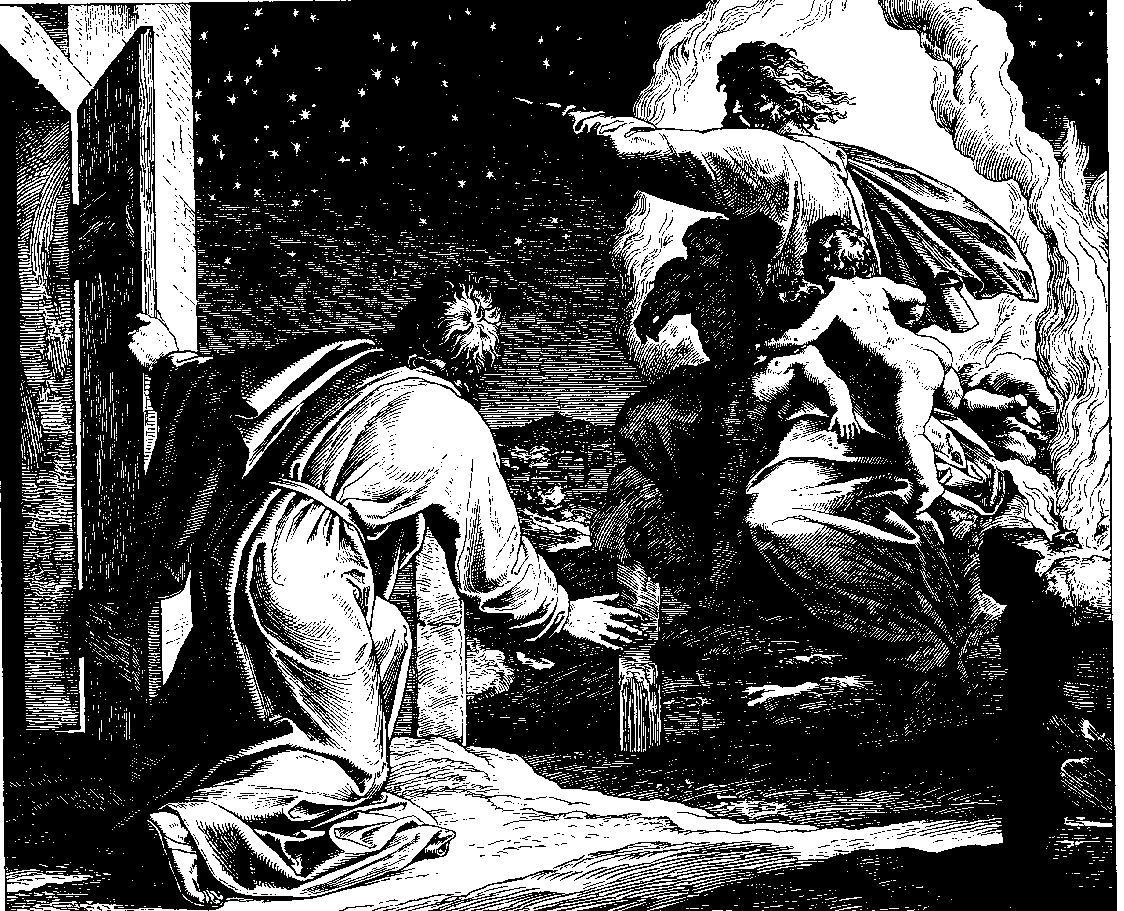
The Abraham image is courtesy of Wikipedia.  The caption:  “The Vision of the Lord Directing Abraham to Count the Stars,” a woodcut “by Julius Schnorr von Carolsfeld from the 1860 Bible in Pictures.”  

“The Lord said to Abram*. . .”   Abram changed his named to Abraham later, in Genesis 17:5, after hearing a Voice telling him to do so.  (A voice which also told him about the covenant of circumcision, in Genesis 17:10, which may have led Abraham to ask, “You want me to do what?”)

*   *   *   *

On the Bible as “transcendent” meditation

*   *   *   *

May 21, 2014 – Remember “Transcendental Meditation?” In case you missed it, the Maharishi Mahesh Yogi first started teaching “TM” in 1958.  Then it got “more popular in the 1960s and 1970s, as the Maharishi shifted to a more technical presentation and his meditation technique was practiced by celebrities.” The kicker was that you had to pay a substantial sum of money, at one point the equivalent of a full week’s salary, for the instruction itself and for your own “personal Sanskrit mantra.”  (A mantra was a word or phrase that you repeated over and over again, for up to 20 minutes, as part of “binding the mind staff in place.”)

 Or you could buy a copy of Lawrence LeShan’s book How to Meditate (1974), “one of the first practical guides to meditation.”   (My first copy cost under $2.00.  And incidentally, LeShan noted that “anyone who gives (or sells) you a mantra designed just for you … is pulling your leg.”)

There’s probably a host of lessons from all this.  However, the focus here is on how reading the Bible on a regular basis can be an ongoing “transcendental” meditation.

For starters, LeShan said that the essence of meditation is trying something you know is impossible.  You try to do what you know you can’t do, yet you try anyway.  So whether you try a mantra meditation, or try to experience the beauty of a rose for 20 minutes, non-verbally, you know ahead of time that you can never get it exactly right.

Again, the goal itself is impossible to reach.  It’s as impossible a goal as – say – as trying to  love the Lord your God with all your heart, with all your strength, and with all your mind.  This is the first and great commandment, and the second is like unto it: you shall love your neighbor as yourself.

But Christians try – and fail – to reach that goal, and week after week they repeat the same “confession” (in many churches anyway).  “We have not loved you with our whole heart; we have not loved our neighbors as ourselves.”)

So what could possibly be the pay-off for all this “trying to do the impossible?”

LeShan cited two main rewards: greater personal efficiency in everyday life, and second, “the comprehension of a different view of reality than the one we ordinarily use.” He said the person meditating develops a capacity to transcend the painful, negative aspects of life, and develops an ability to live with a serene “inner peace.” And that it was characteristic of a practiced meditator to live with joy and love; “The best of mysticism* also provides a zest, a fervor and gusto in life plus a much higher ability to function in the affairs of everyday life.” He cited another goal: Being part of an ongoing  “search for knowledge of his relationship with the universe (and for a very deep sense of union of himself and the All).”

But aren’t those the same things that all Christians should be looking for?  (They use different words of course, but the idea seems to be the same.)  Put another way, Wouldn’t it be great if Bible-reading led to the same results?   Fortunately, it can.

Unfortunately, you’ll eventually have to deal with some of those so-called Christians who love to focus on sin – usually somebody else’s – rather than all the positive aspects the discipline of regular Bible-reading can provide.  LeShan had something to say about that as well.

He wrote of one meditation:  Contemplating a rose and experiencing it only on a non-verbal level.  He said because it was so very hard, the would-be meditator might want to give himself permission to make mistakes.  “You will make them anyway and will be much more comfortable – and get along better with this exercise – if you give yourself permission in advance.”

He said the meditator should treat himself as a “much-loved child that an adult was trying to keep walking on a narrow side-walk.”  (The “straight and narrow path?”)

The child, “full of energy,” keeps running off to explore the world, but each time the meditator should say, “Oh, that’s how children are.  Okay honey, back to the sidewalk.”  Again and again, gently but firmly, the meditator brings himself back to the discipline.  With each slip-up or mistake, “you should say the equivalent of ‘oh, that’s where I am now; back to work,’ and come back looking.”   With the metaphor of “binding the mind staff in place,” LeShan cautioned would-be meditators to “bind ourselves with humor and compassion at our own lack of discipline.”

Might not this description also apply to each Christian “Pilgrim” on his or her quest to reach God, or struggling with the idea of God. Might not the Christian also be better off acknowledging in advance that he’s trying to do something he knows is impossible, physically, emotionally or spiritually? The fact is that no matter how hard we try, we can never, for more than “one brief shining moment,” love God with all our heart, mind and soul.  Nor can we, for more than a moment, fulfill the Second Great Commandment, to love even our most obnoxious neighbors as ourselves.  (And some of those neighbors are pretty obnoxious.)

On the other hand, you might think of regular Bible-reading as panning for gold.  Sure there’s a lot of stuff to go through.  But every once in a while you’ll find a passage you can use, maybe to defend yourself against some of those Christians whose faith seems to border on arrogance.
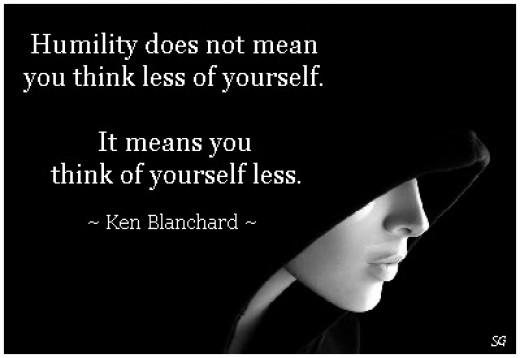
For example, here’s a “gem” I found useful:

Who made you so important?  What have you got that was not given to you?  And if it was given to you, why are you boasting as though it were your own?

That’s 1st Corinthians 4:7, in the New Jerusalem Bible.  To that passage some might respond, “I earned everything I have, with hard work and the sweat of my brow.”  But that raises a question: “Who gave you the brow? And who gave you the sweat?”  See also 1st John 1:9-10(ESV): “If we say we have no sin, we deceive ourselves…  If we say we have not sinned, we make [God] a liar, and his word is not in us.”  And that’s not to mention Romans 2:24, “The name of God is blasphemed among the Gentiles because of you.”

Which is being interpreted:  When it comes to self-defense against those – hopefully few – Christians who focus on criticizing other people for their sins, reading the Bible can be fun!

(And you might be doing them a favor as well…)

*   *   *   *

http://1.bp.blogspot.com/-Db-UUzkzk6Y/T9YMYqc9ojI/AAAAAAAACIs/yox2IffhUF4/s1600/humility.jpg

*   *   *   *

On meditation see the Wikipedia article, which noted, “Meditation has proven difficult to define as it covers a wide range of dissimilar practices in different traditions. In popular usage, the word ‘meditation’ … can include almost anything that is claimed to train the attention of mind or to teach calmness or compassion.” See also Transcendental Meditation – Wikipedia.   

The “humility” photo is courtesy of www.pinterest.com/pc554/leadership-quotes/

The “same ‘confession'” quoted is from the Book of Common Prayer, page 360.  An aside: that form of confession is based on Jesus’ summary of the Two Great Commandments, in Matthew 22:36.  See also The basics.

* As to the “best of mysticism” quote, as noted in the Spiritual boot camp post:  “The words ‘mystic’ or ‘mysticism’ seem to give some Christians apoplexy.  Try it on a Southern Baptist some time!”

But seriously, one online dictionary defines a mystic as ‘a person who seeks by contemplation and self-surrender to obtain unity with or absorption into the Deity or the absolute.’   Again, arguably different words but the same idea…”

*   *   *   *

Another view of Jesus feeding the 5,000

One artistic interpretation of the “miracle of the loaves and fishes…”

*   *   *   *

Most people know the story of Jesus feeding 5,000 people with just a couple of fish and a loaf or two of bread.  If you take the story literally, it’s about the “Son of God” performing a fairly routine feat of magic.  If – on the other hand – you go beyond the fundamentals – beyond the traditional view – you might end up with a story that’s even more of a miracle.

Matthew 14:13-2 has one version of Jesus and His disciples going to a “lonely place apart.” (Apparently He was trying to keep the disciples from getting “burned out;” that is, suffering from a “general wearing out or alienation from the pressures of work.”)

CaravaggioSalomeLondon.jpgThere was also the fact that Jesus and His disciples had just heard that King Herod had beheaded their friend, John the Baptist.  (As shown at left.)  However, when Jesus and the disciples tried to get away, a bunch more other people found out about it, and started following them.

So Jesus took pity on this new bunch of needy people.

He proceeded to heal their physical problems, until it got to be evening.  Then the disciples asked Jesus to send the crowd away.  The place was either deserted and/or “a desert,” and there were no restaurants or convenience stores around.

But when Jesus told the disciples to feed the crowd, they said they only had five loaves of bread and two fish.  So Jesus took the bread and the fish, told everyone to sit down, and started passing out food.  Much to everyone’s surprise, there was enough to feed all 5,000 men.  (This was “besides women and children,” so there were actually far more than 5,000 people who got fed.)

Aside from all that, there was enough to make 12 lunch-boxes of food for a next-day meal.

So far, so good.

In the traditional view, this was a pure miracle, plain and simple.  In that view the miracle can’t be explained rationally, needn’t be explained rationally, and indeed, was never meant to be explained or understood rationally.  Jesus did it, the Bible recorded it, “and there’s an end to it.”

But there is a non-traditional view.

In that view, by sharing what little food they had, Jesus and His disciples “induced many more people” – who had brought food with them, for their own use – to share their food with the less forward thinking, “and so enough was found for all.”

According to this non-traditional theory, the people of that day and age never went far from home without taking a spare loaf of bread – or some other non-perishable food – stashed somewhere in the folds of their robes.  But that non-traditional view seems to threaten the faith of some Bible-readers, and it’s not clear why.

Maybe it’s because to many today, the Bible is the story of a long-ago people, and we aren’t remotely like those people. They were heroes – like those shown at right – and we are not. But that seems just another way of saying the Bible isn’t relevant today.
Maybe the Bible would be far more relevant today if it was about people just like us.  So suppose the Bible was about – and was written by – people just like us today?  What if those Bible-writers had all the faults and failings that we have, yet they somehow managed to personally experience the presence of God, the Force that Created the Universe.

But we digress…

Getting back to the loaves and fishes.  If you view it literally, it doesn’t seem to prove a lot.

It does prove that God or His first-born Son had the power to see that those people – at that time and place – didn’t go hungry.  But that might make some wonder why God can’t do the same thing today.   So one implication from that “literalist” view seems to be that God could feed us all today, but maybe just “doesn’t care.”

So if this story is viewed too literally, it seems to prove only that Jesus could perform a miracle.  It shows Jesus had the power to pull off a fairly routine feat of magic, but that’s pretty much what you would expect of the First-born Son of God.

But what if God didn’t intend this to be just another feat of magic?

Suppose the lesson Jesus intended to teach us was that – by His example – He got a bunch of normally-greedy people to share what they had.  That by His example, Jesus got those normally-greedy people to share so much of their own stuff that no one – in the crowd of “5,000 plus” – went hungry.  And more than that, there was even a surplus.  The question is:

Which would be the greater miracle?

*   *   *   *

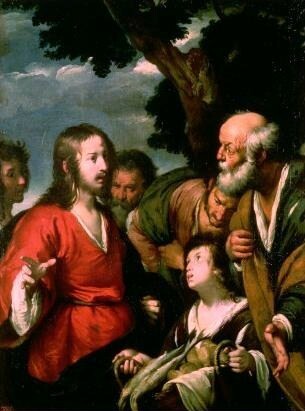
Another interpretation, by “Bernardo Strozzi…” 

*   *   *   *

The upper image is courtesy of The Miracle of the Loaves and Fishes by LOMBARD, Lambert (16th century.”  Lombard (1505-1566) “lived in Rome for two years, and was a passionate archaeologist, art historian and man of letters…  ‘The Miracle of the Loaves and the Fishes’ is generally regarded as one of the most important [of his paintings]. The varied pleats and folds of the costumes derive from the language of form of classical antiquity which inspired Renaissance artists, while the landscape remains firmly in line with Flemish tradition.” 

The “John T. Baptist” image is courtesy of Beheading of St. John the Baptist – Wikipedia.  The caption: “Salome with the Head of John the Baptist by Caravaggio, National Gallery, London, c. 1607–10.”

Re: the “hero” image.  See Hero – Wikipedia.  The caption:  “Batman (Adam West) and Robin (Burt Ward) in the 1966 TV Series Batman.”  The image is located in the article’s section on “the modern fictional hero.”  The article defined a hero as “a person or main character of a literary work who, in the face of danger, combats adversity through impressive feats of ingenuity, bravery or strength, often sacrificing his or her own personal concerns for some greater good.”

The lower image is courtesy of Feeding the multitude – Wikipedia.  The caption:  “Jesus feeding a crowd with 5 loaves of bread and two fish,” by Bernardo Strozzi, circa 1615.

Spiritual boot camp

*   *   *   *

April 27, 2014 – In 1974, Lawrence LeShan wrote How to Meditate, “one of the first practical guides to meditation.” I bought my first copy cost for under $2.00. In the alternative you could spend a week’s salary for a seminar on “Transcendental Meditation,” but that’s a whole ‘nother story. The point is, LeShan said the essence of meditation is trying something you know you can’t do.  You try to do the impossible, yet you try anyway.

Whether you try a mantra meditation, or experience a rose for 20 minutes, non-verbally, you know ahead of time you can never get it exactly right. In fact, it’s as impossible – say – as trying to  love the Lord your God with all your heart, with all your strength, and with all your mind, or trying to love your neighbor as yourself. (Matthew 22:37.) So what’s the pay-off for all this “reaching for the impossible?” (Whether you’re trying to be a would-be guru or a practicing Christian.)

LeShan cited two main rewards: greater personal efficiency in everyday life, and “the comprehension of a different view of reality than the one we ordinarily use.” He added that a meditator develops a capacity to transcend the painful, negative aspects of life, and develops an ability to live with a serene inner peace. (Something like “the peace of God, which passes all understanding?”) He said it’s characteristic of the practiced meditator to live with joy and love; “The best of mysticism* also provides a zest, a fervor and gusto in life plus a much higher ability to function in the affairs of everyday life.”  But aren’t those the same things a Christian should be looking for?  They use different words of course, but the idea seems to be the same.

Put another way, Wouldn’t it be great if Bible-reading led to the same results? Fortunately, it can. Unfortunately, in your personal pilgrimage, sooner or later you’ll run up against those “Christians” who love to focus on sin – somebody else’s – rather than all the positive aspects the discipline of regular Bible-reading can provide. LeShan said something about that as well.

He wrote of one meditation – contemplating a rose non-verbally – that it was hard if not impossible. So hard a would-be meditator should give himself permission to make mistakes. “You will make them anyway and will be much more comfortable – and get along better with this exercise – if you give yourself permission in advance.” (Permission in advance to “fall short.”)

You could say “falling short” is part of the process.

LeShan said a would-be meditator should treat himself as a “much-loved child that an adult was trying to keep walking on a narrow side-walk.”  (The “straight and narrow path?”)  The child, “full of energy,” keeps running off to explore the world, but each time the meditator should say, “Oh, that’s how children are.  Okay honey, back to the sidewalk.”

Again and again, gently but firmly, the meditator brings himself back to the discipline.  With each slip-up or mistake, “you should say the equivalent of ‘oh, that’s where I am now; back to work,’ and come back looking.”  With the metaphor of “binding the mind staff in place,” LeShan cautioned would-be meditators to “bind ourselves with humor and compassion at our own lack of discipline.” (Humor and compassion? How un-Biblical, at least to some people. . .)

But could that idea apply to each and every Pilgrim on his or her quest to reach God, or struggling with the idea of God? Maybe the good Christian should also begin by knowing he’s trying to do what he knows is impossible, physically, emotionally or spiritually.  No matter how hard we try, we can never, for more than “one brief shining moment,” love God with all our heart, mind and soul. Nor can we, for more than a moment, fulfill the Second Great Commandment, to love even our most obnoxious neighbors as ourselves. But we try anyway, and in the process become more adept at living life in all its abundance, just as Jesus promised in John 10:10. You might even say it’s like spiritual boot camp – but with “humor and compassion”. . .

*   *   *   *

Notes:

My first copy of How to Meditate (LeShan) was published by Bantam Books in 1975.

The words “mystic” or “mysticism” seem to give some Christians apoplexy.  Try it on a Southern Baptist some time!  But seriously, one online dictionary defines a mystic as “a person who seeks by contemplation and self-surrender to obtain unity with or absorption into the Deity or the absolute.”  Again, arguably different words but the same idea. . .

*   *   *   *

Some Bible basics – from Vince Lombardi and Charlie Chan

*   *   *   *

Vince Lombardi (seen above) was a fanatic about teaching and relying on the basics of football.

There’s a story about his reaction to his Green Bay Packers losing to a team they should have beaten handily. At practice the next day – after a loss where the team looked “more like whipped puppies” than a pro team – Lombardi said, “This morning, we go back to basics.”  Then, holding up an object for his team, Lombardi said, “Gentlemen, this is a football.”

So, here are some similar basics – for understanding the Bible.  And how reading it can help you become “all that you can be,” like the old Army commercial said.

For starters there’s John 6:37, where Jesus made a promise to each of us, for all time: “anyone who comes to me, I will never turn away.”  That’s a promise we can take to the bank, metaphorically speaking.  We are “saved,” not by being followers of a particular denomination.  (No matter how much some people may say to the contrary.)  Instead we are “saved” by starting that “walk toward Jesus,” by starting down that road to knowing Him better.

And one way to start that walk is by reading the Bible on a regular basis.

Unfortunately, too many people try to read the Bible like a novel, starting at the very beginning and moving on to the end.  But then they tend to bog down in Leviticus, if they get that far.

Jesus may have known that problem would come up, so He did us a favor. He boiled down the message of the Bible into two simple sentences; a kind of “Cliff-Note” summary:

Hear what our Lord Jesus Christ said: “You shall love the Lord your God with all your heart, with all your strength, and with all your mind. This is the first and great commandment, and the second is like unto it: you shall love your neighbor as yourself.  On these two commandments hang all the Law and the Prophets.

That’s Matthew 22:37, where Jesus boiled the whole Bible down to two simple “shoulds.”  You should try all your life to love, experience and get to know “God” with all you have. And to the extent possible, you should try to live peaceably with your “neighbors.”

In plain words, your mission – “should you choose to accept it” – is to become one with the “unified whole” that is our world today.

So, whenever you read something in the Bible that doesn’t make sense, or might mean two different things, or seems contrary to “common sense,” you have this Summary to fall back on. (It also works if you hear something from a slick televangelist that just doesn’t sound right.)

For example, some Christians become “snake handlers,” based on focusing exclusively on Mark 16:17-18, and/or taking that one Scripture-passage out of context: “In my name shall they cast out devils; they shall speak with new tongues. They shall take up serpents; and if they drink any deadly thing, it shall not hurt them; they shall lay hands on the sick, and they shall recover.” (See the Wikipedia article.)

Other Christians work to develop large families – as a way of showing their faith – again based on focusing exclusively on Psalm 127:3-5, and/or taking that one Scripture-passage out of context: “Children are a gift from God; they are his reward. Children born to a young man are like sharp arrows to defend him. Happy is the man who has his quiver full of them.” (See the Wikipedia article on “Quiverfull.”)

On the other hand, you could approach the Bible as presenting a plain, common-sense view of some people in the past who have achieved that “union with a Higher Power,” that is the goal of most religions and/or other spiritual or ethical disciplines.

So what’s the pay-off?

Simply put, the discipline of regular Bible-reading could lead to a capacity to transcend the painful and negative aspects of life, and the ability to live with “serenity and inner peace.”   On the other hand, the discipline could also lead to a your developing a “zest, a fervor and gusto in life plus a much higher ability to function.”

To some people, that flies in the face of the popular view of “Christians,” some of whom seem to revel more in telling others how they should live their lives.  But didn’t Jesus say, “I came that they may have life, and have it abundantly”? (John 10:10, RSV, emphasis added.  Or as translated in The Living Bible, Paraphrased: “My purpose is to give life in all its fullness.”)

So ideally, Bible-reading on a daily basis should not lead to a person who is an intolerant, self-righteous prig, who goes around telling others how to live.  (As the Apostle Peter said, “Don’t let me hear of your … being a busybody and prying into other people’s affairs.” See 1st Peter 4:15, The Living Bible translation.)

Instead, Bible-Reading should lead to one who is well-adjusted, open-minded, tolerant of the inherent weaknesses (including his own) of all people.  A person able to live life “to the full.”

So how do you do that?

The best answer may come from that great philosopher, Charlie Chan, who once said, “Mind like parachute; work best when open.”

*   *   *   *

http://ecx.images-amazon.com/images/I/51smUOfD0aL.jpg

*   *   *   *

The upper image is courtesy of Vince Lombardi – Image Results.  The Lombardi “story” was gleaned from: Insight.org … articles/church/back-to-the-basics.  See also Vince Lombardi – Wikipedia.

The image to the left of the paragraph – beginning “In plain words, your mission” is courtesy of Mission: Impossible – Wikipedia.

The Charlie Chan image is courtesy of amazon.com/Charlie-Collection-Honolulu-Treasure

The “pay-off” references were gleaned from How to Meditate, by Lawrence LeShan, Bantam, 1975.