Category Archives: Personal experience

On an old friend – and his “Bible literalism…”

*   *   *   *

*   *   *   *

September 6, 2020 – I just found out we don’t have any original manuscripts that make up the 27 books of the New Testament. None. No Gospels, no letters or Epistles, and not even any of the Acts of the Apostles. None. What we do have are “copies of copies of copies.”

Which doesn’t make a bit of difference to me. But it should make a difference to someone – like an old friend I last saw several years ago – who told me that he believed the Bible was literally true, and thus “without error.” (See Biblical literalism – Wikipedia.)

Now this old friend – let’s call him “Fred” – was a real rabble-rouser when I first knew him, back in the 1970’s. Back then he was famous for off-color banter. On one weekend camping trip he spoke of hearing “organisms” in the night just past. (Meaning “orgasms.”) For a while he drove a hearse, and one time – stopped by police for a moving violation – calmly said, as the officer unfolded the ticket book, “Yes, I’ll have a cheeseburger, fries and a coke.”

But times change and so did Fred. Like when I visited him – the last time as it turned out – and he turned from the TV news and said that to me. (About the Bible being “literally true.”) I was totally flabbergasted. I didn’t know what to say then, and it’s bothered me ever since. (Saying “What are you, an idiot” seemed a bit harsh, even with, “BTW, that’s a rhetorical question.”)

What brought all this back was a recent lecture on Great Courses Plus, The New Testament, by Bart D. Ehrman, PH.D. This particular lecture was, “Do we have the original New Testament?” The short answer – and to me the surprising answer – turned out to be, “No, we don’t.”

We can say with some confidence that we don’t have the original text of any of the books of the New Testament. … There is no alternative to this situation and there never will be unless by some unbelievable stroke of luck we discover the original text themselves. We do not have the originals of any of the books that were later canonized into the New Testament. What we have are copies of the originals, or better yet, copies of the copies of the copies of the originals – copies made for the most part hundreds of years after the originals themselves.

(Emphasis added.) Which again, doesn’t make a bit of difference to me.

Personally, I believe the Bible “proves itself,” with what I do with it as an individual believer. What I do as a Believer, and how I interact with God in my own life.* In how I have gone through the tests and trials that come to every person, and yet – by and through ongoing Bible study – I came through those trials not only whole, but better for the experience. And in the way that – through reading the Bible and applying it to my own life in my old age – I’ve ended up feeling alive and cheerful. (Despite having “come to the breaking point – and broken.*”)

Alive and cheerful about where I am and where I’m going, and how I can now be the kind of witness that people will listen to. And feeling – with Frank Sinatra – The Best Is Yet to Come.

I’ve written on problems reading the Bible “too literally.” In 2014’s Three suitors (a parable), and in 2015’s True Test of Faith. One problem came from the Hebrew method of writing:

in Hebrew there are no vowels, and the letters of a sentence are strung together. An example:  a sentence in English, “The man called for the waiter.” Written in Hebrew, the sentence would be “THMNCLLDFRTHWTR.” But among other possible translations, the sentence could read, in English, “The man called for the water.”

Another problem came from Jesus’ usual method of teaching, parables. (That is, a short story different from a fable, in that fables use animals as characters, while parables “have human characters.”) In plain words He taught by parables, “a type of metaphorical analogy.”

So one question is: “How do you literally interpret a parable?” Then too – according to the book Christian Testament – parables are “very much an oral method of teaching.” Further, in such a tradition, it was up to the listener to decipher the meaning of the parable, to him:

The essence of the parabolic method of teaching is that life and the words that tell of life can mean more than one thing. Each hearer is different and therefore to each hearer a particular secret of the kingdom can be revealed. We are supposed to create nimshalim* for ourselves.

After which I noted such a thought was one “that can give a conservative Christian apoplexy; the fact the Bible might mean different things to different people.” Like my old friend Fred. Which means that – to me – the choice is up to the individual Bible reader. “They” can use a strict or narrow interpretation, “but for me and my house,” I will use the more open-minded or even – gasp! – liberal Interpretationso as to implement the object and purpose of the document

In other words, I’ll use the interpretation of a God who accepts anyone (who comes Him), and who expects us to do greater miracles than Jesus. And who wants our lives to be “abundant.” (Which I’ve heard before somewhere, with Luke 24:45. And that’s not to mention “adventure…”)

Meanwhile, I now have an answer to what my old friend Fred said when I visited a few years back. Thanks to the years I’ve spent working on this blog, I would respond today that – as far as reading the Bible literally goes – “That’s a very good place to start!

*   *   *   *

Learning the fundamentals is “a very good place to start” – but not to stop

*   *   *   *

The upper image is courtesy of Flabbergasted – Image Results.

Re: The Bible as “without error and therefore completely true.” See Biblical inerrancy – Wikipedia. and – for a view different than mine – Why is it important to believe in biblical inerrancy.)

Also, vis-a-vis missing NT manuscripts: The night before posting I learned – through another Great Courses Bible lecture – that many “puns” in original OT Hebrew were lost in translation. See for example Bible Secrets Revealed, Episode 1: “Lost in Translation,” and Five Mistakes in Your Bible Translation | HuffPost. From the former, “different copies of the same Biblical books from the Dead Sea Scrolls don’t often match, [so] at the time of Jesus, the Hebrew Biblical texts existed in different versions and traditions that were still being sorted out. What this means is that it is very difficult to argue that the Bible is the verbatim ‘Word of God,’ especially when all of the ancient manuscripts contain different words.” From the latter, “In the original Hebrew, the 10th Commandment prohibits taking, not coveting. The biblical Jubilee year is named for an animal’s horn and has nothing to do with jubilation. The pregnant woman in Isaiah 7:14 is never called a virgin.” Also, “Metaphors are particularly difficult to translate, because words have different metaphoric meanings in different cultures. Shepherds in the Bible were symbols of might, ferocity and royalty, whereas now they generally represent peaceful guidance and oversight.” These may be in a future post.

Re: “My old friend Fred.” It wasn’t just me he “flabbergasted.” A mutual friend said he also cut off all communications with his family, and other old friends, who didn’t share his “conservative” views.

Re: Interacting with God in my own life. See for example On my “mission from God,” and “As a spiritual exercise…”

Re: “Christian Testament.” The full reference is Education for Ministry Year Two (Hebrew Scriptures, Christian Testament) 2nd Edition by William Griffin, Charles Winters, Christopher Bryan and Ross MacKenzie (1991). The “nimshalim” quote(s) are from page 321 of my copy.

Re: Despite having ‘come to the breaking point.'” In one of Garry Wills‘ books he uses a translation of the Lord’s Prayer which – instead of “lead us not into temptation” – reads, “and lead us not to the breaking point.” I’ve always found that translation far more applicable to my life…

Re: Nimshalim. See Mashal + Nimshal = Meaning/Teaching | Discipleship Curriculum: “The teaching method was simply brilliant. A fictional story (the mashal) was created by the Rabbi. This was almost always in response to something going on in their immediate world or an important principle they wanted to teach. The story would be crafted in such a way as to disguise it’s intent but also in such a way as to intrigue.” See also Mashal (allegory) – Wikipedia, about a “short parable with a moral lesson or religious allegory, called a nimshal.” (Nimshalim is the plural form.)  

Re: “Me and my house.” The reference is to Joshua 24:15. In the ESV, “choose this day whom you will serve, whether the gods your fathers served in the region beyond the River, or the gods of the Amorites in whose land you dwell. But as for me and my house, we will serve the LORD.

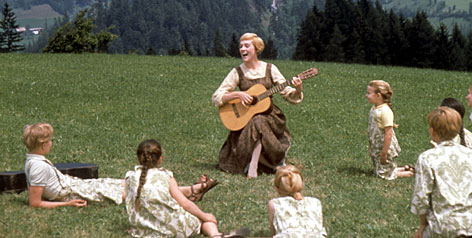
The lower image is courtesy of A Very Good Place Start Sound Music – Image Results. See also Sound Of Music – Do-Re-Mi Lyrics | MetroLyrics. The lesson from this metaphoric parable – from The Sound of Musicis that real Christians will go on to read and write great works, and perhaps create great symphonic masterpieces in music, while the “boot camp Christians” will continue on, endlessly going over their a-b-c’s and do-re-mi’s in an ongoing cycle of repetition. Here are the lyrics at issue:

Let’s start at the very beginning
A very good place to start
When you read you begin with A B C
When you sing you begin with Do Re Mi…

The point? That’s where you begin. But in the case of the Bible, you keep on going, keep on learning, keep on exploring, keep on expanding your mind. As for Literalists, in essence they never go beyond elementary school, and in some cases never beyond first grade…
St. Mary, 2020 – and “Walls of Separation…”

Mary (mother of Jesus) – who heeded God’s call “to set out on a mission of charity…”

*   *   *   *

August 16, 2020 – Finally, I get to do a fun post. Fun because it takes me back to last year’s St. Mary, “Virgin,” and more on Jerusalem. That’s because yesterday – August 15 – was the feast day of St. Mary the Virgin. (As celebrated in the Episcopal Church.) And it’s a reminder that last year I got to visit – among other places – Mary’s spring in Ein Kerem, in Israel. For more on this Mary see August 2014’s St. Mary, Mother, and Mary (mother of Jesus) – Wikipedia:

She is identified [as] the mother of Jesus through divine intervention. Christians hold her son Jesus to be Christ (i.e., the messiah) and God the Son Incarnate. Mary (Maryam) also has a revered position in Islam, where a whole chapter of the Qur’an is devoted to her, also describing the birth of Jesus… [She] is considered by millions to be the most meritorious saint of the Church. Christians of the Catholic Church[,] Anglican Communion, and Lutheran churches believe that Mary, as Mother of Jesus, is the Mother of God and the Theotokos, literally “Bearer of God.”

As for Ein Karem (at right, “in the Jerusalem hills”): According to tradition, it’s where Mary stopped for water while visiting John the Baptist’s parents. In turn, that’s when the soon-to-be born John “leaped” in the womb of his mother, Elizabeth. (Luke 1:41.)

And here’s what I wrote last year about that visit: “Thursday May 16[, 2019] we visited Ein Kerem, the Church of the Visitation and Mary’s spring.” After that we had lunch at the “Tent Restaurant, Beit Sahour” – a really good meal – then visited the Church of the Nativity and the “chapel” – and Cave – of St. Jerome, both in Bethlehem:

The church [including the cave] was both packed and crowded. There we stood a long while, waiting to do a hump-through-a-tunnel extension of the tour. It was then I noticed a fellow pilgrim in danger of getting stressed out by all the crowds and noise. So I did a Good-Samaritan thing – kind of – and persuaded him to join me at the garden restaurant next door – and have a prophylactic Taybeh (Palestinian) beer. 

In other words, you had a choice…

You could bend down and crawl through a small, dark, damp tunnel, with somebody’s rear-end right in front of you – and yours right in front of the face of the person behind you. Or you could do what I did and opt for some liquid refreshment. (In the process helping a stressed-out fellow pilgrim.) Of that episode I wrote later that in such situations you need to “pick your battles.” And that it always seemed to me that finding a spiritual breakthrough usually comes when you’re alone, not “surrounded and jostled by hordes of hot, sweaty and pushy ‘fellow travelers.’”

But we’re going a bit off on a tangent here…

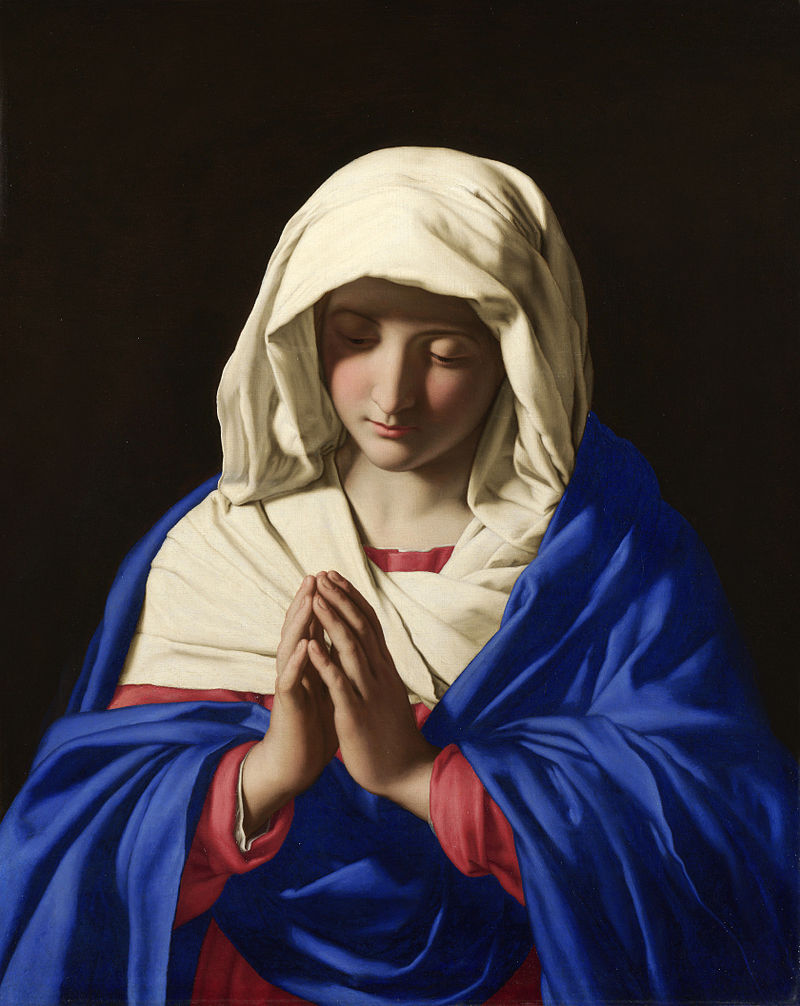
Getting back to 2014’s St. Mary, Mother, it explained why she is often shown wearing blue, as in the top image. “In Renaissance paintings especially, Mary is portrayed wearing blue, a tradition going back to Byzantine Empire, to about 500 A.D., where blue was ‘the colour of an empress.'” Another explanation: In Medieval and Renaissance Europe they got blue pigment from lapis lazuli, “a stone imported from Afghanistan of greater value than gold… Hence, it was an expression of devotion and glorification to swathe the Virgin in gowns of blue.”

In turn the highlight of the day’s Bible readings is the Magnificat, beginning “My soul magnifies the Lord.” In Luke, Mary recites this hymn during her Visitation to her cousin Elizabeth. “In the narrative, after Mary greets Elizabeth, who is pregnant with the future John the Baptist, the child moves within Elizabeth’s womb. When Elizabeth praises Mary for her faith, Mary sings what is now known as the Magnificat in response.”

But of course Mary’s life wasn’t always – or maybe even that oftenjust a bowl of cherries. See for example the Seven Sorrows of Mary, including but not limited to the flight into Egypt, losing Jesus – at 12 years old – in the Temple, meeting Him carrying the cross, the Crucifixion and burial. “When Mary said ‘yes’ to bringing Jesus into the world, she took on both the joys and the pains that came with it. “

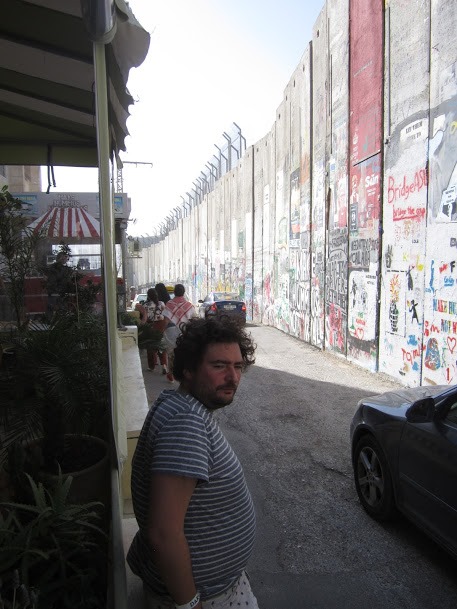
Which brings us back to Bethlehem, where Jesus was born, and to last year’s visit to Israel. And to my photo above left. That is, we ended Mary 16 – the same day we visited Mary’s Spring – at Bethlehem‘s Wall of Separation, also known as the “Israeli West Bank barrier.” And in a bit of sarcasm – or irony – we stopped at the “Walled Off Hotel.”

I took some photos of both the “Walled Off” and the Wall of Separation that runs right by it, and right through the City Of Jesus’ birth. Doing that I caught the expression of the Palestinian in the foreground of the photo above left, and later commented, “That look about says it all.*”

Then there was the irony of Bethlehem as where Jesus was born, and thus where “God’s love, mercy, righteousness, holiness, compassion, and glory” – expressed in Him – were to begin. “But seeing the Walled-off Hotel in His birthplace, I didn’t know whether to laugh or cry.”

And speaking of “Walls That Divide Us,” tomorrow – Monday, August 17 – will begin the Twenty-third full week of the COVID-19 pandemic. Here’s hoping that someday that “wall between us” will come down too, along with all the other walls that divide people, as expressed in Ephesians 2:14. Speaking of the wall that once (?) divided Jews and Gentiles, the Good News Translation reads, “For Christ himself has brought us peace by making Jews and Gentiles one people. With his own body he broke down the wall that separated them and kept them enemies.”

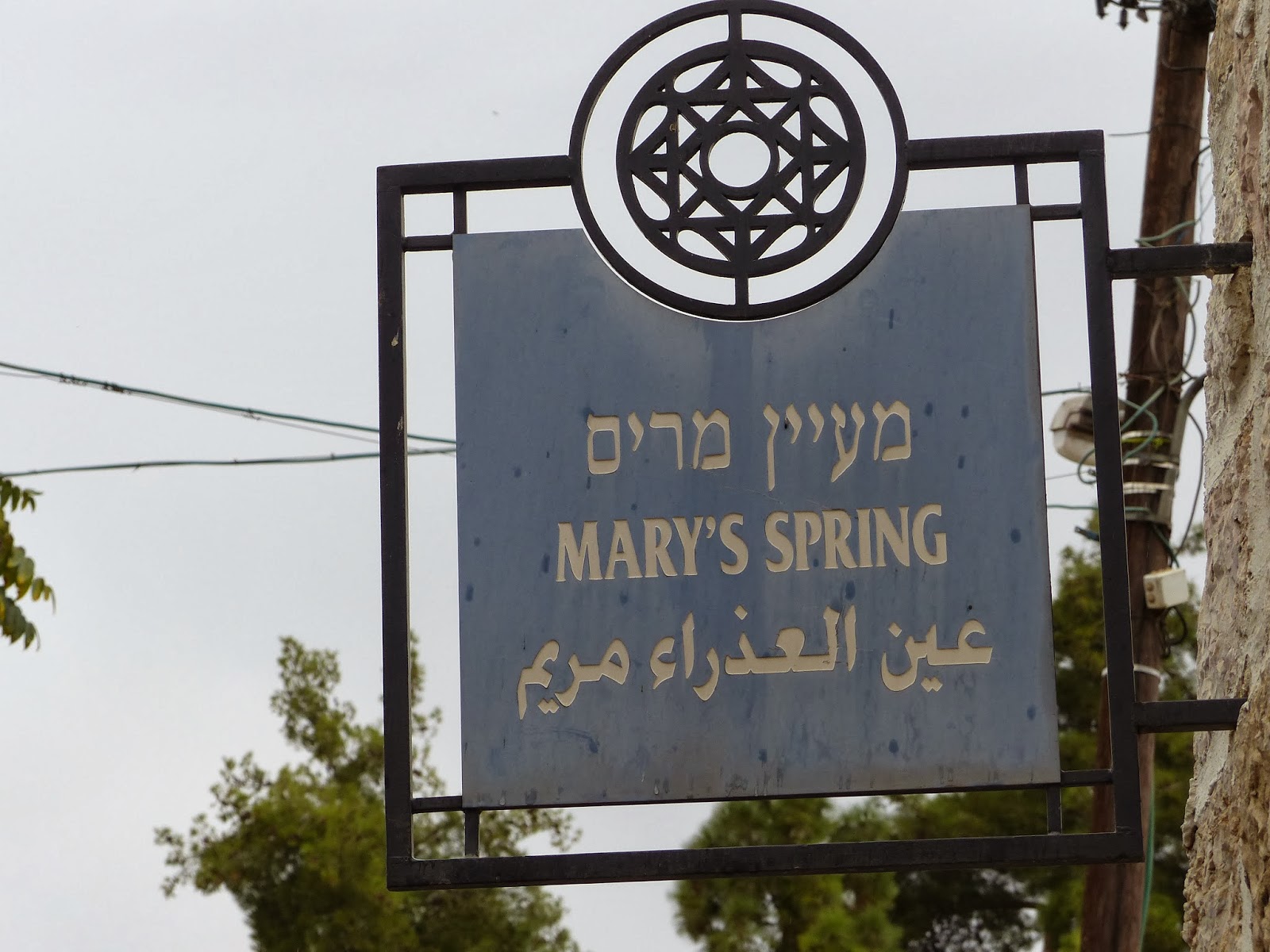
We could use lots more of that. The only problem is, we may have to do a lot of the work ourselves. Meanwhile, here’s my photo of “Mary’s Spring,” from last year:

*   *   *   *

*   *   *   *

The upper image is courtesy of Mary (mother of Jesus) – Wikipedia. See also Mary’s spring in Ein Kerem – BibleWalks.com, and Ein Karem – Wikipedia.

As to weeks of the Covid pandemic, see for example  On St. Philip and St. James – May, 2020. There I explained that, to me, “the pandemic hit full swing – the ‘stuff really hit the fan’ – back on Thursday, March 12,” when the ACC basketball tournament got cancelled, along with other major sports. “So my definition of the ‘First Full Week of the Covid-19 Pandemic’ has it starting on Sunday, March 15 and ending on Saturday the 21st.” Or for my exercise and other weekly-quota routines, starting on Monday, March 16 and ending Sunday night, March 22d.

The lower photo I took myself during that trip to Israel last year. (2019.) And re: “That look about says it all,” here’s a bigger view of the photo:

*   *   *   *

“That look about says it all.”

*   *   *   *

Remembering Monday, May 18, 1992…

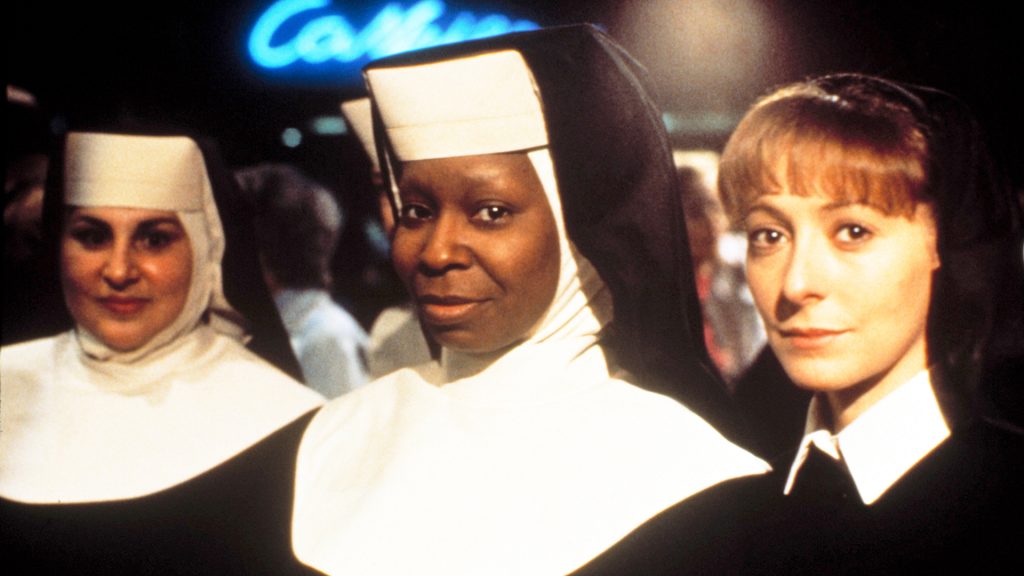
Another event from May 1992: Sister Act released – 11 days after I “started reading the Bible…”

*   *   *   *

This post is on catching up on “skipped Propers” that often happen at the beginning of a new Liturgical Season. And about “going back to my roots.” Back to the day when I first started reading the Bible on a daily basis. Way back on May 18, 1992 – 11 days before Sister Act.

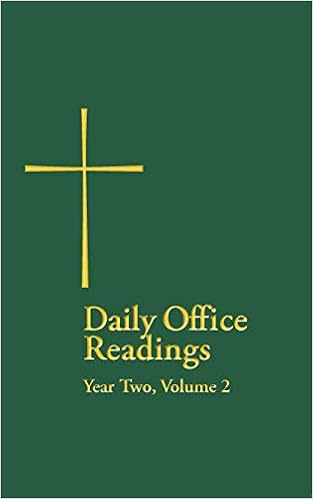
That is, two weeks ago last May 31, 2020, I did the Daily Office reading for Pentecost Sunday. (According to the Daily Office Lectionary – and my copy of “Year 2, Volume 2,” at left – of the four-volume set.)

But then for the next day’s reading, I had to skip ahead some 42 pages, to the reading for the week after “the Sunday closest to June 1.” So from that next Monday-after-Pentecost on, I had to – or really, chose to – read not only the reading for that particular day. In addition, I also had to (chose to) also read some of the “skipped Propers.”

Which means that by Saturday, June 6, 2020, I’d done the scheduled Daily Office readings, plus some skipped Propers. (And according to the Daily Office Lectionary, those Saturday readings were Psalm 55, Psalm 138, and Psalm 139, along with Ecclesiastes 5:8-20Galatians 3:23-4:11, and Matthew 15:1-20.) But also on that Saturday I had to do some more catching up.

That’s because – as noted – Pentecost came on May 31, but after that the daily readings jumped from page 12 to page 54. (Of Year 2, Volume 2.) To explain better, “Proper 1” starts the readings for the weeks of the Season after Pentecost. And it starts with the Sunday closest to May 11. Which means that this year Daily Office readers had to skip ahead to Proper 4, for the week of the Sunday closest to June 1st. But because I’m assiduous, I don’t like to skip those “in-between readings.” (Readings “in between” those listed for Proper 1, up to the start of Proper 4.)

So each morning – that first week of June, 2020 – and after doing the “proper” reading for that particular day, I tried to read one or two of the skipped readings. And so, by that Saturday – June 6, 2020 – I had gotten caught up as far as the reading for the Monday of Proper 2. (For the Week of the Sunday closest to May 18. Which of course had already passed.) And there – on page 25 of Year 2, Volume 2 – I saw my handwritten notation, “5/18/92.”

As it turns out, that date was – as far as I can tell – the day that I first started reading the Bible, on a daily basis, through the discipline of the Daily Office. And the readings for that day – now over 28 years ago – started off with Psalms 1, 2, 3, 4 and 7. (Another note: When I’m in the process of catching up at the beginning of a new liturgical season, I normally skip the day’s psalms.)

Which brings up some of the main readings for that day, over 28 years ago, starting with Proverbs 3:11-2. (That set of proverbs began with “My son, do not despise the LORD’s discipline.”) Those readings also included 1st John 3:18-4:6, starting with “Dear children, let us not love in word and speech but in deed and truth.” (Which seems especially appropriate these days.)

And also Matthew 11:1-6. (Which told of Jesus and John the Baptist – at left – with John in prison, asking if Jesus was “he who is to come?”) Which led in turn to this especially-relevant note, for today: The New Testament reading which included 1st John 4:1.

One version of that passage reads,”Dear friends, do not believe every spirit, but test the spirits to see whether they are from God.” (It continues, “because many false prophets have gone out into the world.”) Which – strange as it may seem – mirrors perfectly what I was trying to say in Pentecost 2020 – “Learn what is pleasing to the Lord.” For example, in that post I cited 1st Thessalonians 5:21.

In the Good News Translation, “Put all things to the test: keep what is good.” And in the Aramaic Bible in Plain English, “Explore everything and hold what is excellent.” 

So the point of that last post was that by such open-minded “exploring,” we real Christians can achieve that rich life experience that Jesus promised. (John 10:10.)  And that – to each individual – is the surest proof that God “is.” The surest proof that there is a God and that “He” is willing to work with us as individuals, to help us grow spiritually.

And as audacious as that claim sounds, it’s part of the Wesleyan Quadrilateral.

That – as noted in Pentecost … “pleasing to the Lord” – is a method of theological reflection. I.e., a spiritual discipline by which we attain personal spiritual growth. It’s credited to John Wesley (at left), who noted four sources of such growth: Scripturetradition, reason, and Christian experience:

Apart from scripture, experience is the strongest proof of Christianity… Wesley insisted that we cannot have reasonable assurance of something unless we have experienced it personally… Although traditional proof is complex, experience is simple… Although tradition establishes the evidence a long way off, experience makes it present to all persons.

Which – as it turns out – is hardly a novel idea. (That is, it’s hardly unique to Christianity.) Consider for example what Gautama Buddha – seen “below” – once explained:

Do not believe on the strength of traditions even if they have been held in honor for many generations… Believe nothing which depends only on the authority of your masters or priests. After investigation, believe that which you yourself have tested and found reasonable, and which is good for your good and that of others.

Which – by the way – is a quote I cited in Jesus Christ, Public Defender. It’s now a Kindle Book but I originally published it in paperback form in 1995. (The Kindle edition was published under the nom de plume “James B. Ford.”) Then too – right after the Buddha quote, in Chapter 8, “The Bible, Yoga and Zen” – I went on to cite 1st Thessalonians 5:21 and 1st John 4:1.

That is, a mere two years after I started reading the Bible on a daily basis, I published my first novel, “Zen in the Art of College Football.” Then in 1995 – one year after “Zen Football” and a mere three years after I started Daily Office reading –  I published Jesus Christ, Public Defender. (Now in its 4th Edition. And for more details on the life-long pilgrimage that followed, see – from February 2019 – the post On my “mission from God.”)

So, can you say to come full circle? But in the good way. Like the Buddhist anecdote: “A child looks at a mountain and sees a mountain. An adult looks at a mountain and sees many things. A Zen master looks at a mountain and sees a mountain.” But the point of all this is: My starting to read the Bible on a daily basis – back in 1992 – turned out to be a life-changing experience.

I’ve been through a lot since then. The death of my first wife in 2006, getting re-married way too soon and to the wrong woman. Which led to a nasty divorce, the loss of my career and my home – and to feeling abandoned by God. (As in, “Lead us not to the breaking point,” but He did, and I broke.) All of which just might be the functional equivalent of the exile that led to the creation of the Old Testament as we know it. See “If I Forget Thee, Oh Jerusalem,” in which talked about my then-upcoming trip to Israel in May 2019.

Which brings up the point that in the past few years I’ve come through and had a number of great adventures. Like that 2019 trip to Israel. And like canoeing 12 miles off the coast of Mississippi for eight days. (See On achieving closure, or type in that search.) Or hiking the Chilkoot Trail, then canoeing 440 miles “down” the Yukon River in Canada in 2016. Or hiking the Camino de Santiago twice, once from Pamplona (2017) and once from Porto, Portugal (2019).

And I’ve been publishing two blogs, and a number of books as well. (For a partial list see For a book version.) In other words, I’ve overcome any number of obstacles and arrived at a rich, fulfilling life. And it all started back on Monday, May 18, 1992…

*   *   *   *

An open-minded Christian can learn even from a “Fat Buddhist…”

*   *   *   *

The upper image is courtesy of May 1992 – Image Results. See also Sister Act – Wikipedia, and Sister Act (1992) – IMDb.

The “liturgical seasons” link is to The Liturgical Seasons of the Catholic Church. But see also Liturgical year – Wikipedia, about the “cycle of liturgical seasons in Christian churches that determines when feast days, including celebrations of saints, are to be observed, and which portions of Scripture are to be read either in an annual cycle or in a cycle of several years.” And List of Anglican Church Calendars, on “my” church’s seasons. “Ordinary time” or the “Time after Pentecost” runs from Pentecost Sunday to the beginning of Advent, which leads to Christmas, and so on…

Re: Handwritten notations. When I do a “daily” reading on the noted day, or within three days thereafter, I put in the relevant date, such as “5/18/92.” That signifies that I have read both the main readings – normally Old Testament, New Testament and Gospel – and the Psalms for that day. But when I can’t do a reading “within three days” – like when I have to “skip some Propers” – I put a check mark. That means I’ve done the main readings but not the Psalms. And according to those dates and check marks, I’m now on my 14th trip through the Bible.

The John the Baptist image is courtesy of Wikipedia. The caption: “‘The Baptism of Jesus Christ,‘ by Piero della Francesca, 1449.”

Re: Monday, May 18, 1992. See Calendar 1992 May – Image Results.

The Buddha quote is courtesy of Lawrence LeShan‘s book How to Meditate: A Guide to Self-DiscoveryBantam Edition, 1975, at pages 101-102. See also On the Bible as “transcendent” meditation. Also, as noted, On my “mission from God.”

The citations to 1st Thessalonians 5:21 and 1st John 4:1 – following the Buddha quote – are at page 53 of the Third Edition paperback version of “JCPD,” in Chapter 8, “The Bible, Yoga and Zen.”

Re: “Come full circle.” See also Alpha and Omega (Freedictionary), or the Wikipedia article.

Re: “Lead us not to the breaking point.” That’s an interpretation from one of Garry Wills‘ books, and it seemed especially appropriate for my life. As in, “I was led to the breaking point, and broke.” See also Luke 11:4 (Bible Hub), which includes the usual translations of the Lord’s Prayer, “And lead us not into temptation, but deliver us from evil.” The Good News Translation reads, “And do not bring us to hard testing.” But for the reasons noted, I prefer “And lead us not to the breaking point…”

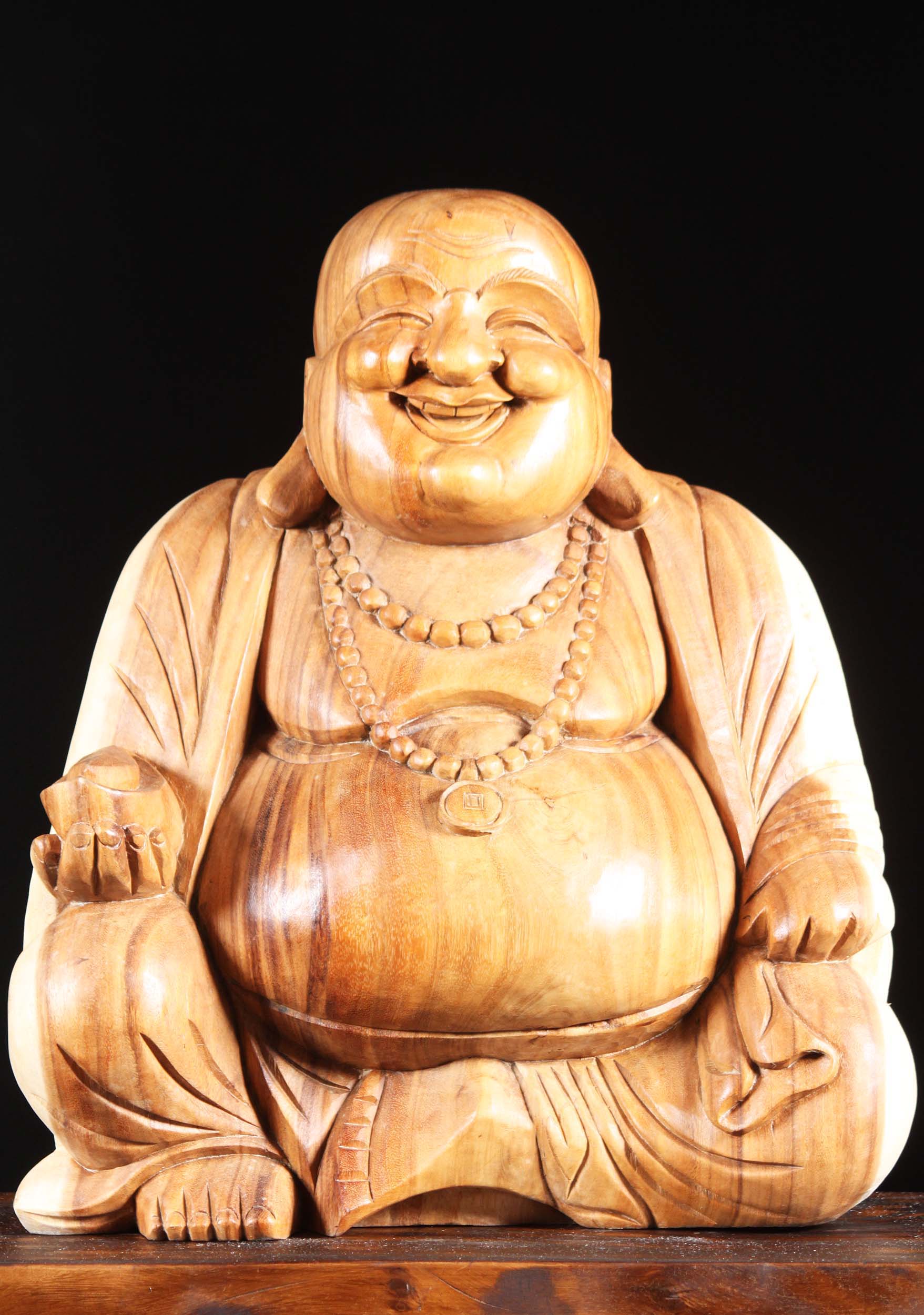
The lower image is courtesy of Fat Happy Buddha – Image Results. But see also Skinny Buddha vs Fat Buddha: Who is the Fat Buddha, noting the Fat Buddha wasn’t “Buddha” at all:

The Laughing Buddha, or the Fat Buddha, was a Zen monk called Budai who lived in China around the 10th century, meaning about 1.600 years after historical Buddha. Budai was as a bold man with a big tummy, big smile, large ears, wearing a simple robe… The fat Buddhist monk was known as a good-hearted, happy and content man of humorous personality, jolly nature, and eccentric lifestyle. Budai was nicknamed the Laughing Buddha because of his big smile and happiness he was spreading around him. Furthermore, Budai … became a famous character of Chinese folktales.

Thus the “Gautama Buddha – ‘below,’” with the “below” in quotation marks.