Category Archives: Daily Office readings

Background and color commentary on highlighted readings from the Daily Office Lectionary

Shadrach “et al.” and the Fiery Furnace

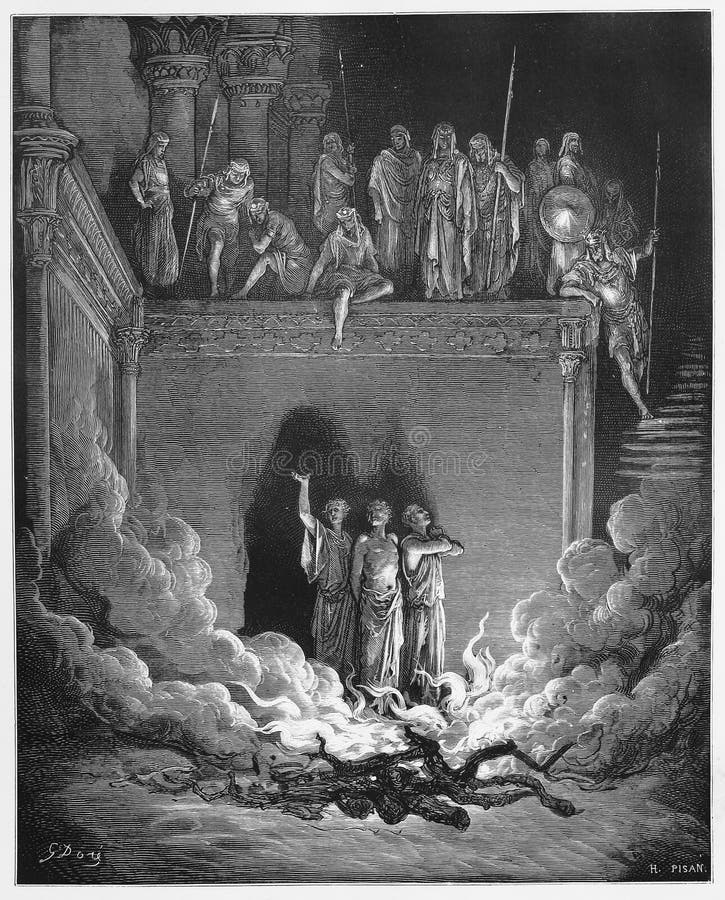
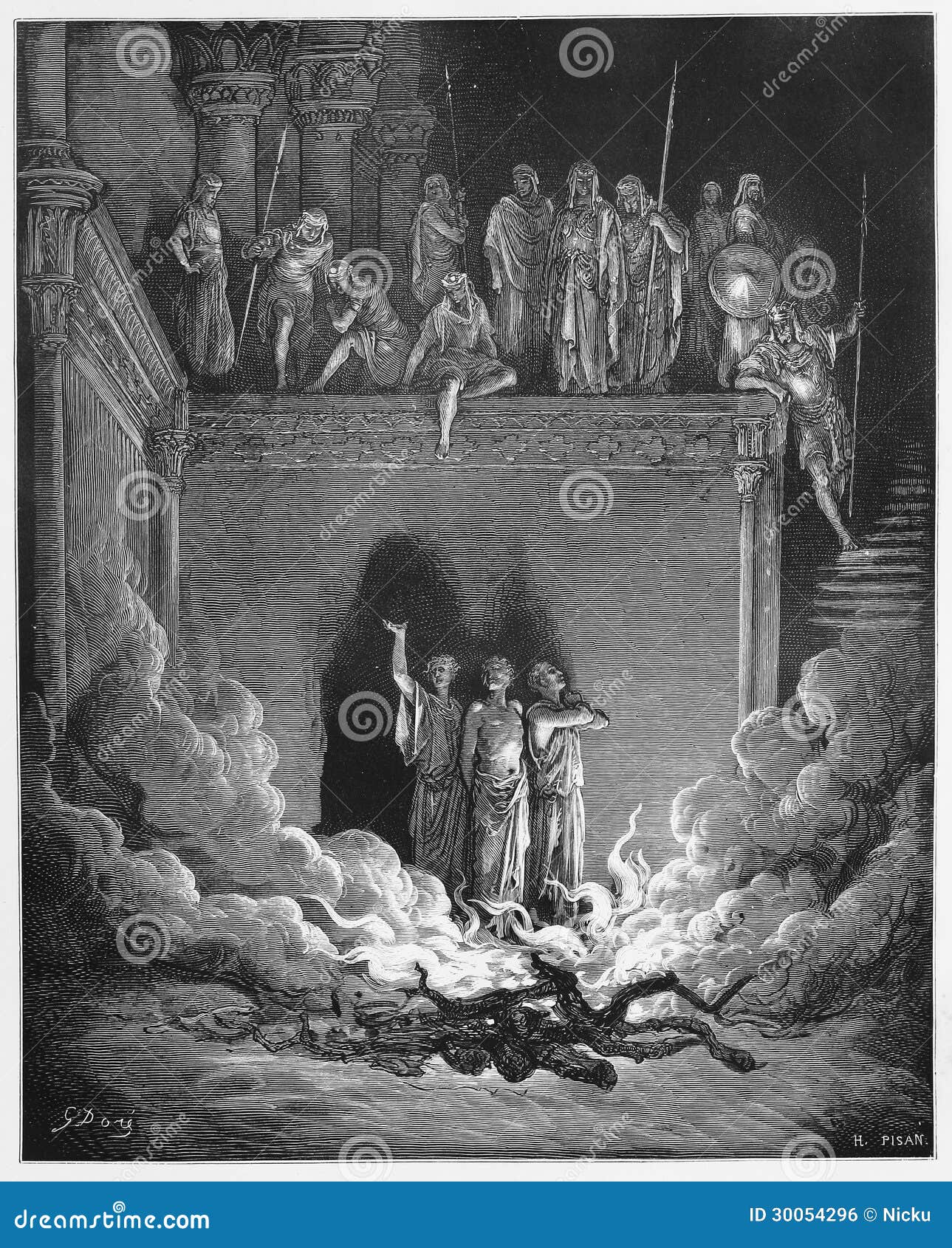
“Shadrach, Meshach and Abednego in the Burning Fiery Furnace…”

*   *   *   *

Friday, April 17, 2015  –  The last time I reviewed a Daily Office Reading was on Friday, March 13.  That post was Jeremiah weeping and Jesus’ “stoning.”  It included this:

The last time I did background and color commentary on Daily Office Readings (DORs) was on February 20.  That post was The True Test of Faith.  It talked about how two different Christians might react if they died, and only then found out that there was no God, no afterlife and no “reward for being good.”

This post is a variation on that theme.  The theme here is:  “What is a true test of faith?” In this post the true test of faith was the threat of getting thrown into a “burning fiery furnace,” while not knowing – or even caring – if God would do anything to stop it…

Starting Monday, April 12, the Old Testament Readings (OTRs) were from the Book of Daniel.  (See Daniel 1:1-21.)   Daniel is best known for getting thrown into a lion’s den, but his book includes lots of other good stuff, including an early apocalypse.  (A better known apocalypse is the Book of Revelation, the last book of the Bible.)

The Old Testament readings from Daniel – for today and tomorrow, April 17 and 18 – tell the story of Shadrach, Meshach, and Abednego.  (See also Daniel 3:1-18, and 3:19-30.)

Here’s what happened.  In 606 B.C., King Nebuchadnezzar of Babylon conquered Judea and its capital Jerusalem.  Then came the first of many Jewish mass deportations, and especially of:

…young men without physical defect and handsome, versed in every branch of wisdom, endowed with knowledge and insight, and competent to serve in the king’s palace;  they were to be taught the literature and language of the Chaldeans.

Daniel 1:4.  See also Babylonian captivity (or exile) – Wikipedia.

That is, the Babylonian Army conquered the “ancient Kingdom of Judah,” and among other things forced a number of highly-educated, upper-class Hebrews into exile.  They were then forced to serve the king in his capital city of Babylon, some 53 miles south of present-day Baghdad.

(Note also “Babylonian” and “Chaldean” are interchangeable, and refer to a tribe of nomads who first lived in now-southern-Iraq.  The map shows the Babylonian Empire at its greatest extent.)

In further words, it was the hoity-toity, the well-educated and/or upper-class Hebrews who got taken away to live in exile in Babylon.  (An exile that many of them found quite surprisingly pleasant.)  In still further words, the riffraff  got left back at home.

So anyway, getting back to the story…   Daniel and his three friends were among the “handsome young men” who got deported to Babylon and taught the literature and language of the Chaldeans.  The three friends were originally named Hananiah, Mishael and Azariah, but by royal decree their original Hebrew names were changed, to Shadrach, Meshach and Abednego.

(Daniel’s name was changed to Belteshazzar, about which more later.)

And the king gave three men prominent positions within his administration.  (They were made “administrators over the province of Babylon.” Daniel 2:49.)  But there’s always a catch…

In this case the catch was that King Nebuchadnezzer had a giant golden statue of himself built.  Then he ordered that all his subjects bow down and worship it – him – whenever they heard “the sound of the horn, pipe, lyre, trigon, harp, drum, and entire musical ensemble.” Daniel 3:5,7.

The king further ordered that “whoever does not fall down and worship shall immediately be thrown into a furnace of blazing fire.” Daniel 3:6.  And so – to make a long story short – Shadrach, Meshach and Abednego refused to fall down and worship a foreign “god,” and especially because Nebuchadnezzar was a mere man himself.

As a result they got thrown into the burning fiery furnace, just as the king had threatened.  But the real kicker in the story comes at Daniel 3:16-18.  There the three men – about to be thrown into the burning, fiery furnace – gave their answer to King Nebuchadnezzer:

Shadrach, Meshach, and Abednego answered the king, “O Nebuchadnezzar, we have no need to present a defence to you in this matter.  If our God whom we serve is able to deliver us, he will deliver us from the furnace of blazing fire and out of your hand, O king.  But if not, be it known to you, O king, that we will not serve your gods and we will not worship the golden statue that you have set up.”

Note the emphasized “But if not…”  So what the three men were really saying was something like this:  “O Nebuchadnezzar, it’s up to God Himself to decide if He’ll deliver us out of your hands from this dreadful, painful and agonizing death.  God certainly has the power to save us, but even if He decides not to, we will still believe in and follow Him…”

*   *   *   *

 Now that is a true test(ament) of faith

*   *   *   *

http://www.canvasreplicas.com/images/Daniel%20in%20the%20Lions%20Den%20Henry%20Ossawa%20Tanner.jpg

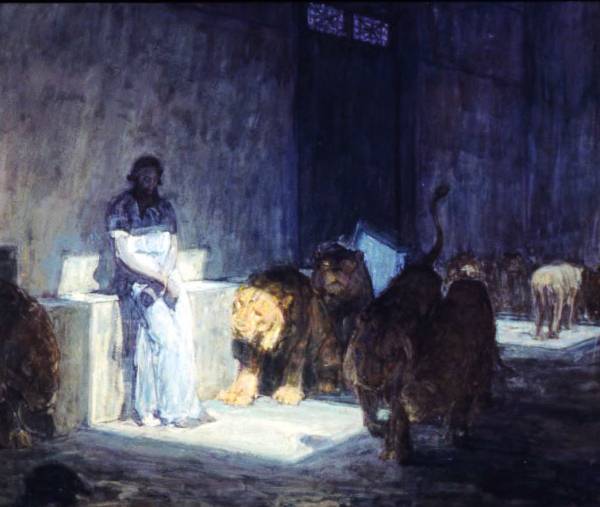
Another guy who gave a “true test(ament) of faith…”

*   *   *   *

The upper image is courtesy of Shadrach Meshach And Abednego Mallord Turner Image – Image Results. The image itself is from the books collection published in 1885, Stuttgart-Germany. Drawings by Gustave DoreSee also Shadrach, Meshach and Abednego in the Burning Fiery Furnace, and the Tate Gallery, or “Tate Britain, Millbank, London SW1P 4RG, United Kingdom.” The Tate Gallery (London) is – by its own admission – the “home of British art from 1500 to the present day.” The full caption of that painting: “Joseph Mallord William Turner[‘s painting:]   Shadrach, Meshach and Abednego in the Burning Fiery Furnace exhibited 1832:”

Turner exhibited this picture in 1832, with a passage from the Bible (Daniel iii, 26).  This told how Shadrach, Meshach and Abednego emerged unharmed from the fiery furnace they had been thrown into for refusing to worship Nebuchadnezzar’s idol (visible in the distance).

In turn, “J. M. W. Turner” (1775-1851) – who did the painting – was an “English Romanticist landscape painter, water-colourist, and printmaker.”   Some contemporaries thought him too controversial, but he’s come to be regarded as “the artist who elevated landscape painting to an eminence rivalling history painting.”  His oil paintings were good, but “Turner is also one of the greatest masters of British watercolour landscape painting.”  He was known as “the painter of light,” and his paintings – oil and watercolor – are seen as a “Romantic preface to Impressionism.” See Wikipedia.

The lower image is courtesy of Daniel and the Lions Den – Hebrew Bible and ArtThe painting itself is by Henry Ossawa Tanner (1859-1937), “the first African-American painter to gain international acclaim.  He moved to Paris in 1891 to study, and decided to stay there, being readily accepted in French artistic circles.   His painting entitled Daniel in the Lions’ Den was accepted into the 1896 Salon.”  The painting itself “uses light to symbolize [G]od’s presence.  It is simple and there is not a lot of detail but it gets the point across.”  See also Wikipedia, the free encyclopedia.

Re: “et al.”  The term is “short for et alia, a Latin phrase meaning and the others,” or in the alternative, “and others.”  The term is often used in the title of legal cases, as in: IN THE MATTER OF VITO J. SETTINERI, ET AL., RESPONDENTS, v. ROBERT J. DICARLO, ET AL., APPELLANTS.

Re: Chaldeans.  They were “an intelligent and sometimes aggressive, warlike people,” who generally lived in “southern Babylonia which would be the southern part of Iraq today:”

Sometimes the term Chaldeans is used to refer to Babylonians in general, but normally it refers to a specific semi-nomadic tribe that lived in the southern part of Babylon.  The land of the Chaldeans was the southern portion of Babylon or Mesopotamia.  It was generally thought to be an area about 400 miles long and 100 miles wide alongside of the Tigris and Euphrates Rivers.

It turned out that in the fullness of time, Babylon ended up being ruled by a string of such Chaldeans, while other tribesmen became members of the ruling elite.  As in, those Chaldeans who “influenced Nebuchadnezzar’s decision to throw Shadrach, Meshach, and Abednego into the fiery furnace (Daniel 3:8).”  See Who were the Chaldeans in the Bible? – GotQuestions.org.

Re: the capital city of Babylon.  See Babylon – Wikipedia, the free encyclopedia:  “The remains of the city are in present-day Hillah … Iraq, about 85 kilometres (53 mi) south of Baghdad, comprising a large tell of broken mud-brick buildings and debris.”

Re: Daniel 3:17.  An alternate translation:   “If our God whom we serve is able to deliver us from the furnace of blazing fire and out of your hand, O king, let him deliver us.” For more on this subject see: What should we learn from the account of Shadrach, Meshach, and Abednego, Shadrach, Meshach, And Abednego – Bible Story Summary, and/or The Burning Fiery Furnace – Wikipedia.

The first article, What should we learn, had this to say:

God does not always guarantee that we will never suffer or experience death, but He does promise to be with us always.  We should learn that in times of trial and persecution our attitude should reflect that of these three young men:  “But even if he does not…”  (Daniel 3:18).  Without question, these are some of the most courageous words ever spoken.

And incidentally, the fire was so hot that the soldiers assigned to throw the three men into the fire got burnt to a crisp. See Daniel 3:22.    (Which surely presents some kind of object lesson…)

Jeremiah weeping and Jesus’ “stoning”

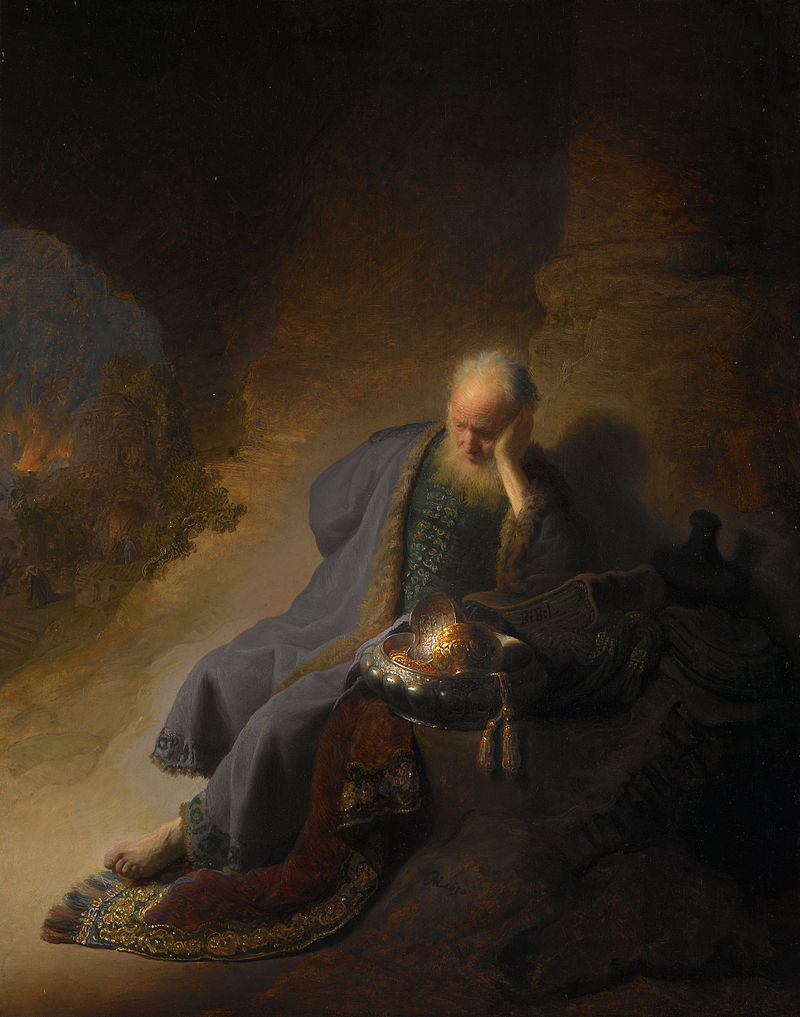
Jeremiah Lamenting the Destruction of Jerusalem…”


Friday, March 13, 2015 – The last time I did background and color commentary on Daily Office Readings (DORs) was on February 20.  That post was The True Test of Faith.  It talked about how two different Christians might react if they died, and only then found out that there was no God, no afterlife and no “reward for being good.”

This post will start off with today’s readings:  Jeremiah 11:1-8,14-20; Romans 6:1-11; and John 8:33-47.  For starters,  Jeremiah was known as “the Weeping Prophet,” as shown above.

He is also credited with writing “the Book of Jeremiah, 1 Kings, 2 Kings and the Book of Lamentations.”  He is considered a major prophet, quoted often in the New Testament.  It has been said that he first “spiritualized and individualized religion and insisted upon the primacy of the individual’s relationship with God.”  (As opposed to having to belong to a special group.)

Of particular interest is Jeremiah 11:19, “I had been like a gentle lamb led to the slaughter,” a victim of those who “plotted against me.”  The International Bible Commentary added this:

In the plot by relatives and neighbors to kill him Jeremiah prefigures Christ who said that a prophet has no honor in his own country and that a man’s foes shall be those of his own household.  (Matthew 10:36 .)

Paul’s Letter to the Romans is the “longest of the Pauline epistles and is considered his ‘most important theological legacy.'”  One scholar considered it his masterpiece:

It dwarfs most of his other writings, an Alpine peak towering over hills and villages…   Not all climbers have taken the same route up its sheer sides, and there is frequent disagreement on the best approach.  What nobody doubts is that we are here dealing with a work of massive substance, presenting a formidable intellectual challenge while offering a breathtaking theological and spiritual vision.  (E.A.)

For today, Romans 6:1-11 spoke of “Dying and Rising with Christ.”  The IBC said of Romans 6:1-14, that it is “easier to consider the passage as a whole rather than verse by verse.”   Paul wrote in part that “all of us who have been baptized into Christ Jesus were baptized into his death.”  The gist of the message is that just as Jesus was raised from the dead, by following him “we too might walk in newness of life.”  The IBC added this about the new (reborn) Christian:

When he is incorporated into Christ on profession of faith, he is given a personal share in the great events of Christ’s work and transferred from his old existence to a new plane of life.

He is “incorporated,” and given a share in the work of Jesus, including performing greater miracles than He did.  (John 14:12.)  The new Christian is thus brought to a new plane of life.

Turning to the Gospel, John 8:33-47 tells about Jesus describing the “true children of Abraham.”  John 8:31 noted that Jesus addressed “the Jews who had believed him.”  He said if they held to His word, they would know the truth “and the truth will set you free.”  One of the best-known verses in the Bible, but not without controversy.   See The Truth Will Set You Free | Psychology Today (August 2014), compared to The Truth Will Not Set You Free | Psychology Today (May 2012).

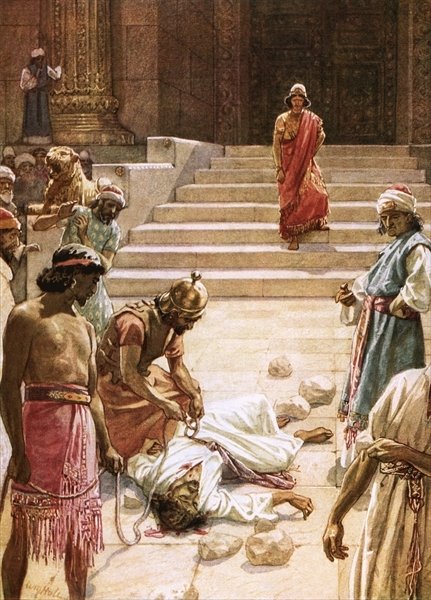
The main reading features some arguable witty banter between Jesus and those who “had believed him,” mostly concerning their kinship to Abraham.  The banter culminated with John 8:58, featured in the Gospel reading for tomorrow, March 14.  That’s where Jesus said, “before Abraham was born, I am!”  In turn, “At this, they picked up stones to stone him, but Jesus hid himself, slipping away from the temple grounds.”  (See also Stoning – Wikipedia.)

Note that in saying “before Abraham was born, I am” (emphasis added), Jesus was harking back to Exodus 3:14.  That was just after Moses had seen the Burning bush, and been told to go back to Egypt to free the Hebrew slaves.  When Moses asked God’s name – knowing the Hebrews would ask that question of him – “God said to Moses, ‘I AM WHO I AM.’  This is what you are to say to the Israelites: ‘I AM has sent me to you.'”

This then was why Jesus kept getting threatened with stoning.  See  John 5:18, “not only was he breaking the Sabbath, but he was even calling God his own Father, making himself equal with God.”  See also Leviticus 24:16, “anyone who blasphemes the name of the LORD is to be put to death.  The entire assembly must stone them.  Whether foreigner or native-born, when they blaspheme the Name they are to be put to death.

*   *   *   *

On a somewhat related note, the New Testament reading for last Friday, March 6 was Romans 2:25-3:18.  A key theme there seemed to be that you aren’t saved by observing the “minutiae” of religious ritual, no matter what the Legalists and/or Fundamentalists say.  See also On “another brick in the wall.”  The International Bible Commentary said this about Romans 2:25-29:

The hearers of God without God may be compared to a traveller who remains standing under the signpost instead of moving in the direction to which it directs him.  The signpost has become meaningless…   Being a “Jew” depends not upon rite, race, or written code, but upon an attitude of heart.

The IBC cited Deuteronomy 10:16, Jeremiah 4:4, and Acts 7:51 for that proposition.  See also the Pulpit Commentary for Acts 7:51, regarding circumcision as an “outward sign of faith:”

Circumcision was never meant to be an end in itself.  The physical mark was meant to be accompanied by a deep spiritual commitment to God.  Where commitment was absent, circumcision soon degenerated into ritualism.  (E.A.)

See also Romans 2:17-29 | Bible.org.   See also the Gospel reading for Saturday February 28, John 4:24“God is spirit, and those who worship Him must worship in spirit and truth.”

That’s what this blog is about.  Trying to get beyond the literal meaning of the Bible, and get to those richer, deeper spiritual meaning of those readings…


ZechBenJeho.jpg


The upper image is courtesy of Jeremiah – Wikipedia, the free encyclopedia.  The caption reads:  “Rembrandt van Rijn, Jeremiah Lamenting the Destruction of Jerusalem, c. 1630.”
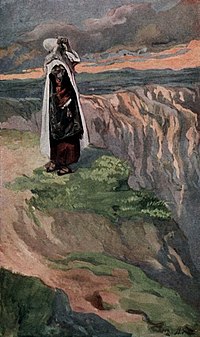
The lower image is courtesy of the Wikipedia article Zechariah ben Jehoiada, contained within the article on Stoning.  Zechariah was the prophet “who denounced the people’s disobedience to the commandments,” as noted in 2 Chronicles 24:21 (See also Matthew 23:35.)  The caption reads: “The Murder of Zechariah by William Brassey Hole.”


On the True Test of Faith…

*   *   *   *

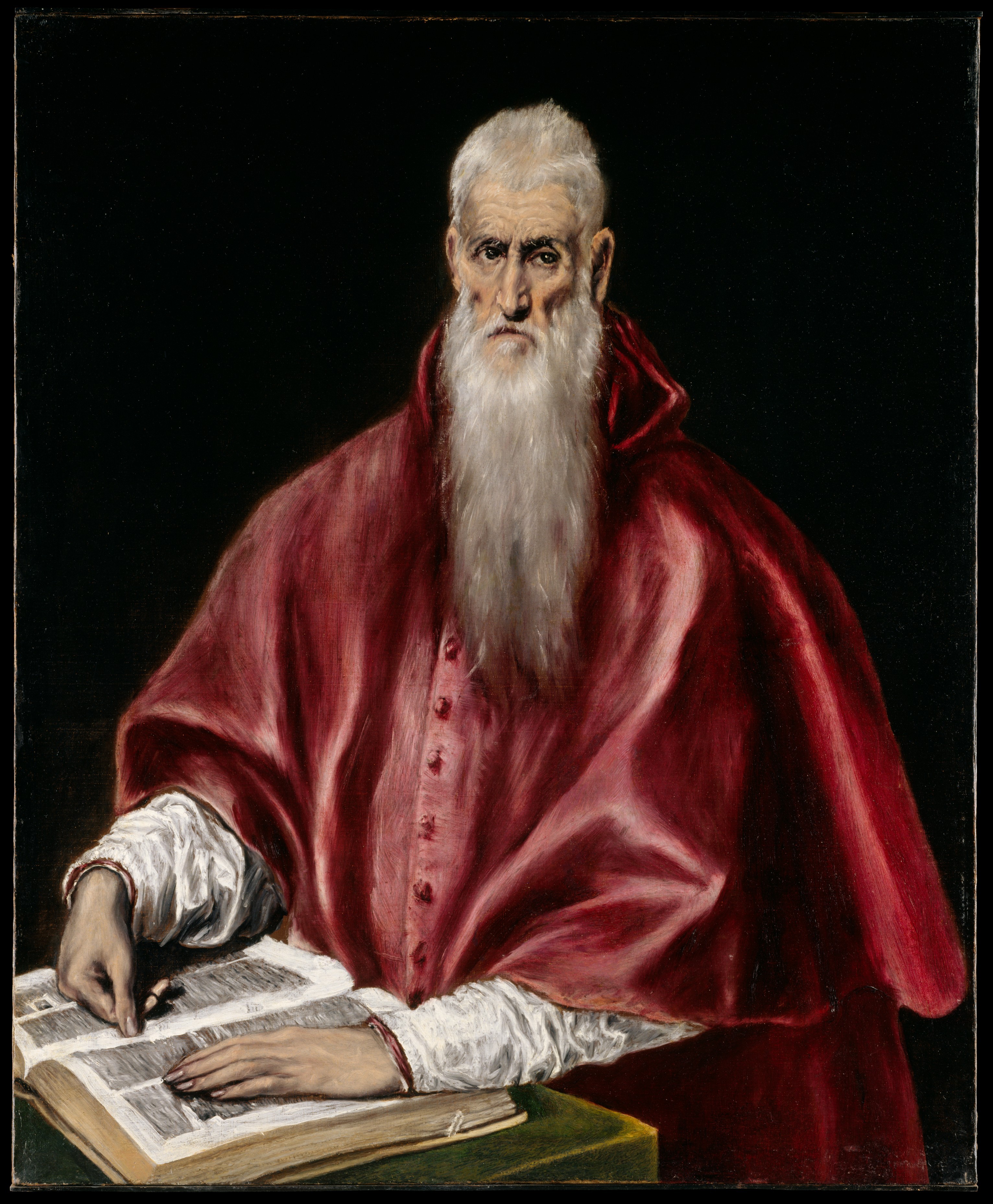
“In the fourth century, St. Jerome struggled to render the Word of God into the language of the day.” 

*   *   *   *

Thursday, February 19, 2015 – To the caption above I would add: “It wasn’t easy then and it isn’t easy now.” But back to the topic: I came up with the idea for this post after reviewing the main Bible readings for Ash Wednesday this year, including Luke 18:9-14. There’s more on Luke’s lesson below, but the key question most people today ask is this: “What do I have to do to be saved?” To get to heaven, achieve Nirvana, whatever. What are the rules?

On the one hand there are the Legalists, the so-called Christians who believe the Bible is one long list of rules to follow, and that if you don’t follow each one “to the letter,” you’re going to hell. Or as one site said, legalism is a “doctrinal position emphasizing a system of rules and regulating the achievement of salvation and spiritual growth. Christians who sway toward this way of thinking demand a strict adherence to rules and regulations.” 

On the other hand there’s this from Lesson 57: Why Jesus Hates Legalism:

There is probably no sin more tolerated or more widespread in the Christian world than legalism. It may surprise you to hear it labeled as sin. Legalists are thought to be a bit overzealous or “uptight,” but they aren’t usually thought of as sinning in the same sense as adulterers, thieves, liars, and the like. To the contrary, legalists seem to be concerned about holiness. Yet the Lord Jesus had more conflicts with the legalists of His day than any other group…

On that note, in 2d Corinthians 3:6 the Apostle Paul said following the Letter of the Law kills, but the Spirit of the Law gives life, gives spiritual growth, gives personal fulfillment. And may even help you perform greater miracles than Jesus did, as He said we should in John 14:12

Then there’s that Luke 18:9-14 reading, on the parable of The Pharisee and the Tax Collector. A Pharisee, “obsessed by his own virtue, is contrasted with a tax collector who humbly asks God for mercy. This parable demonstrates the need to pray humbly.” Or as Jesus concluded, “All who exalt themselves will be humbled, but all who humble themselves will be exalted.”

All of which can cause a lot of confusion – “What do I need to do?” – and which also brings up what might be called “the True Test of Faith.” For starters, imagine two Christians said to be devout. They both die, and they both find out that whole faith-of-the-Bible has been a hoax. They find out there is no God, that there is no afterlife, and that there will be no reward for good behavior during their time here on earth. The first Christian is outraged. “What? You mean I could have spent my life partying? Boozing it up? Chasing women, loose and otherwise?  Boy am I angry, when I think of all the fun things that I could have been doing!”

But the second Christian is a more thoughtful. He remembers the path he’s followed, since he started reading the Bible on a daily basis. He thinks about how his Bible-reading and his path-following have led to unexpected breakthroughs. And he thinks of the time when he got pushed past the Breaking Point. (As in, “bring us not to the Breaking Point, but wrest us from the Evil One,” like it says in the Lord’s Prayer.*)  He things of Peter, at his Breaking Point in Matthew 26:33-35, where he denied Jesus.  And how he failed, just like Peter did…

Then he thinks about the other “testing adventures” he’s had.  Some of those tests he passed, others he failed, but from all he got life lessons to pass on to others. And his life had structure, meaning and purpose, even if only in his own mind. So, after all this thinking the second Christian said, “You know, I wouldn’t change a thing.”

That to me is the true test of faith. Of course I do believe in and follow Jesus, and that there’s a better life than this to come, and that the soul is a form of energy that is neither created nor destroyed but merely changes form. (Like it says in the First law of thermodynamics.) I’m just saying, that’s the kind of faith I’ve trying to develop. And that’s the kind of faith this blog is trying to find, both for you the reader and me the Writer.  It also brings up an ancient prayer:

O God, if I worship Thee in fear of hell, burn me in hell;  if I worship Thee in hope of Paradise, exclude me from Paradise;  but if I worship Thee for Thine own sake, withhold not Thine everlasting beauty.

That’s from On three suitors (a parable), which also discussed problems interpreting the Bible, like the Hebrew style of writing and of interpreting parables in general. On that note, one source said, “We are supposed to create nimshalim for ourselves.” Which all brings up a poetic line, “The Bible was designed to expand your mind.” (To the tune, “If it does not fit, you must acquit.”) But what about those “rules to follow?” What does the Bible itself say about “being saved?”

In closing I’d say the answer lies in John 6:37 and Romans 10:9. In the first Jesus said He would never turn away anyone who comes to Him. In the second the Apostle Paul said if you confess with your mouth that “Jesus is Lord” and believe in your heart that God raised Him from the dead, “you will be saved.” No ifs, ands or buts, and no “legalistic” litmus test. 

And those are promises you can take to the bank, spiritually speaking…

*   *   *   *

Rabia Basri, female Muslim saint and mystic…”

*   *   *   *

The upper image was suggested by St. Jerome: The Perils of a Bible Translator – September 1997, which provided the quote:  “In the fourth century, St. Jerome struggled to render the Word of God into the language of the day.   It wasn’t easy then and it isn’t easy now.”  The image itself is courtesy of El Greco (Domenikos Theotokopoulos) | Saint Jerome as Scholar.

I used the lower image in Three suitors. See also Rabia Basri – WikipediaRabia Basri is credited for the prayer that begins, “O God, if I worship Thee in fear of hell…”

Re:  The Lord’s Prayer and “the Breaking Point.”  See Garry Wills’ What the Gospels Meant, Viking Press (2008), at page 87; Part II, “Matthew,” Chapter 5, “Sermon on the Mount:”

Our Father of the heavens, your title be honored … and bring us not to the Breaking Point, but wrest us from the Evil One.    

The usual translation of the last sentence of the Lord’s Prayer is, “And lead us not into temptation, but deliver us from evil.”  See Wikipedia.  But somehow, based on my own life experience, the term “Breaking Point” seems more appropriate. 

Re:  the Denial of Peter. See also Mark 14:29-31, Luke 22:33-34, John 13:36-38., and Wikipedia.

Re:  problems interpreting the Bible. See also The Parables of Jesus: Recovering the Original Meaning of Matthew’s Parables.


On Amanuenses…

The caption is “Paul Writing His Epistles,” but he really had an amanuensis.  (See Romans 16:22.)


The New Testament reading in the Daily Office for Saturday December 13 is from Paul’s Second Letter to the Thessalonians 3:6-18.  (If you’re puzzled about that see What’s a DOR?)

Here’s what Paul said in 2d Thessalonians 3:17:  “I, Paul, write this greeting with my own hand.  This is the mark in every letter of mine; it is the way I write.”  On that note, here’s what “Pulpit Commentary” said about Paul writing one of the verses in his own hand:

The apostle usually dictated his Epistles to an amanuensis, but wrote the concluding words with his own hand.  Thus Tertius was his amanuensis when he wrote the Epistle to the Romans (Romans 16:22).  [See also (Galatians 6:11), (Philemon 1:19), (1 Corinthians 16:21), and Colossians 4:18)…]   Such authentication was especially necessary in the case of the Thessalonians, as it would seem that a forged epistle had been circulated among them…

See the parallel commentaries in 2 Thessalonians 3:17 I, Paul, write this greeting (emphasis added, with (2 Thessalonians 2:2 cited as to a possible forgery:  “Now we request you, brethren … that you not be … disturbed either by a spirit or a message or a letter as if from us.”)

I briefly discussed amanuenses in the notes to On the readings for August 31- Part II, citing among other sources Amanuensis – Wikipedia, the free encyclopedia.  But it seems that such amanuenses may have played a much larger role in writing the Bible.

See for example Were Some Of The Biblical Books Actually Written By A Scribe, which gave a positive “yes” answer:  “In the ancient world many books were written by a person dictating his thoughts to a scribe.”  The author noted the prophet Jeremiah dictated to his secretary Baruch, and that Paul too dictated his letters, noting the “seal of authenticity” given in 2d Thessalonians 3:17, noted above.  The article then noted that even though Paul himself “did not actually do the physical writing,” that had “nothing to do with the divine inspiration of the finished product…   [T]he key is where did the words originate – not who put them down in written form.”

But see also SamuelMartin: The Amanuensis in Scripture:

It should come as no surprise to us … that not every word purported to appear in certain books was written by the original author whose name may appear on the book.  A very simple example of this concerns the death of Moses, which is referenced in a narrative text found in Deuteronomy 34.  While this text is certainly a part of the Mosaic body literature … it is clear that this text is added by some type of an authorized secretarial figure.  This is just one place where we find this phenomenon taking place. (E.A.)

Martin said it appears “whole books which bear the names of certain persons” were in fact written by others, “known as “amanuenses.”   Then too the article The Authorship of Second Peter | Bible.org says Second Peter is a prime example of so-called pseudepigrapha:

Most conservative evangelicals hold to the traditional view that Peter was the author, but historical and literary critics have almost unanimously concluded that to be impossible…   The result of this debate is that 2 Peter is concluded by most critical scholars to be pseudepigraphal literature.  But the evangelical world rejects the critics’ claims.  Conservatives say this has serious ramifications for the doctrines of inspiration and inerrancy.  The critics, on the other hand, claim this was standard procedure and therefore not dishonest. (E.A.)

See also Pseudepigrapha – Wikipedia, the free encyclopedia, which said the term can apply to either:   1) falsely attributed works, or  2) texts whose claimed author is represented by a separate author, or  3) a work “whose real author attributed it to a figure of the past.”

I talked about the idea that – to some people – every word of the Bible must be taken as literally true in On snake-handling, Fundamentalism and suicide – Part II, in On broadminded, spelled “s-i-n”, and in On dissin’ the Prez.  (The latter post also raises the possible issue of “selective enforcement” by some…)   I also discussed the more reasonable approach – promoted by such scholars as John R. W. Stott – in On Job, the not-so-patient, which noted this:

“…requiring every word of the Bible to be inerrant” brings to mind what Jesus said in Matthew 23:4, as He chastised the scribes and Pharisees.  The Easy-to-Read translation says … that such people “make strict rules that are hard for people to obey.  They try to force others to obey all their rules.  But they themselves will not try to follow any of those rules.”

All of which is another way of saying it’s always easier to follow the letter of any given law, rather than trying to follow its “life-giving spirit,” as people like Isaac Asimov have noted:

The priesthood, then as always, was primarily interested in the minutiae of ritual.  This was something that could easily be followed by anyone and generally presented no difficulties.  It might be a tedious way of gaining God’s favor, but it was not really painful…  The prophets, however, were likely to disdain ritual and to insist, instead, on a high ethical code of behavior, something that could present serious difficulties…  (E.A.)

Asimov wrote about the prophet Isaiah, but other prophets who shared the same idea included one Jesus of Nazareth, as noted in Woes of the Pharisees – Wikipedia, the free encyclopedia:  “The woes mostly criticise the Pharisees for hypocrisy and perjury.  They illustrate the differences between inner and outer moral states.”

Which brings up the question of inspiration and inerrancy, noted above:  Can the Bible inspire you if you must believe – on pain of hellfire and damnation – that every word in that Bible is inerrant  Most people would say “probably not,” which is one of the themes of this blog.

Another theme is that you can get far more out of the Bible by approaching it with an open mind, and on occasion even “suspending disbelief.”  (See On “Titanic” and suspending disbelief:  “Consider the person who viewed the movie [“Titanic”] with a closed mind.  A person unwilling – even for a moment – to suspend disbelief.  A person who simply had to believe that everything in the movie had to be 100% accurate…  Wouldn’t that viewer just be short-changing himself?“)

So one way of wrapping up this post would be to say that for a person of deep faith – a faith based on a personal experience of God working in his life, rather than on some courtroom “inerrancy” – it wouldn’t matter if Peter literally wrote the “second letter” attributed to him, or if someone other than Moses wrote Chapter 34 of the Book Deuteronomy attributed to him.

On a possibly-related note, here’s what Will Durant said about Aristotle, whose list of written works is widely deemed as legendary. (For a complete list see Corpus Aristotelicum):

[I]t is possible that the writings attributed to Aristotle were not his, but were largely the compilations of students and followers who embalmed the unadorned substance of his lectures in their notes…   About this matter there rages a sort of Homeric question, of almost epic scope, into which the busy reader will not care to go, and on which a modest student will not undertake to judge.  We may at all events be sure that Aristotle is the spiritual author of all these books that bear his name: that the hand may be in some cases another’s hand, but that the head and heart are his. (E.A.)

So to sum up:  “Who knows?  In a sense we may all be God’s ‘amanuenses.’  As has been said, ‘The  key is where did the words originate – not who put them down in written form.’   And if that’s true then it doesn’t matter who gets the credit, as long as God gets the glory…”


http://www.catholic-convert.com/wp-content/uploads/SuperStock_1746-1366.jpg

The upper image is courtesy of Epistle to the Romans – Wikipedia, the free encyclopedia, with the caption:  “A 17th-century depiction of Paul Writing His Epistles. [Romans] 16:22 indicates that Tertius acted as his amanuensis.”

The lower image is courtesy of www.catholic-convert.com/blog/2012/01/11/meet-st-paul-as-he-writes-to-the-romans, which included this description of Paul dictating:

Sweat was beading up on his bald head and thick eyebrows. His pointed beard wagged as he paced the stone floor speaking rapidly. His dark eyes flashed, his hands gesticulated in rhythm with his rapid utterance. His quick mind was obviously way ahead of the words that rushed from his mouth.

Tertius struggled to keep up, his quill scratching rapidly across the parchment. After hours of dictation and careful refinement this letter was rolled up and given into the hands of Phoebe who boarded a wooden merchant vessel heading for the hub of the Empire. The words were Greek, written from the Greek city of Corinth, dictated by a Jew of the Hebrew religion and sent to Latin Rome.

– See more at: http://www.catholic-convert.com/blog/2012/01/11/meet-st-paul-as-he-writes-to-the-romans-a-brief-study/#sthash.TMpsPFz1.dpuf

Sweat was beading up on his bald head and thick eyebrows. His pointed beard wagged as he paced the stone floor speaking rapidly. His dark eyes flashed, his hands gesticulated in rhythm with his rapid utterance. His quick mind was obviously way ahead of the words that rushed from his mouth.

Tertius struggled to keep up, his quill scratching rapidly across the parchment. After hours of dictation and careful refinement this letter was rolled up and given into the hands of Phoebe who boarded a wooden merchant vessel heading for the hub of the Empire. The words were Greek, written from the Greek city of Corinth, dictated by a Jew of the Hebrew religion and sent to Latin Rome.

– See more at: http://www.catholic-convert.com/blog/2012/01/11/meet-st-paul-as-he-writes-to-the-romans-a-brief-study/#sthash.TMpsPFz1.dpuf

Sweat was beading up on his bald head and thick eyebrows.  His pointed beard wagged as he paced the stone floor speaking rapidly.  His dark eyes flashed, his hands gesticulated in rhythm with his rapid utterance…   Tertius struggled to keep up, his quill scratching rapidly across the parchment.  After hours of dictation and careful refinement this letter was rolled up and given into the hands of Phoebe who boarded a wooden merchant vessel heading for the hub of the Empire.  The words were Greek, written from the Greek city of Corinth, dictated by a Jew of the Hebrew religion and sent to Latin Rome.

As to the “challenged” authorship of Second Peter, see also Second Epistle of Peter – Wikipedia.

The Asimov quote is from Asimov’s Guide to the Bible (Two Volumes in One),  Avenel Books (1981), at page 527. 

The Durant quote is from The Story of Philosophy by Will Durant, Washington Square Press (“Pocket Books”), 1953, at page 57.  See also Aristotle – Wikipedia:  “His writings cover many subjects – including physics, biology, zoology, metaphysics, logic, ethics, aesthetics, poetry, theater, music, rhetoric, linguistics, politics and government – and constitute the first comprehensive system of Western philosophy.”


On “Y1V1” and the Ten Virgins

Peter striking the High Priests‘ servant Malchus…”


As noted in On the readings for Advent Sunday, Sunday November 30 marked the end of 2014′s Season of Pentecost and started the new church-calendar year, most of which is in 2015.   It also started a new cycle in the Daily Office readings.  As noted in What’s a DOR, rather than flipping back and forth in your Bible to find the various readings for the day, you can buy a four-volume set with all the readings in one place, thus “eliminating much of the work involved.”  If you use that four-volume set – as I do – then on Sunday November 30 you changed over from Year Two, Volume 2 to Year One, Volume 1.  (Thus the “Y1V1” in the title of this post).

Note also that with the changeover to Year One, Volume 1, I began the markings in my Y1V1 book an eleventh trip through the Bible – that’s 11 times – as well as 33 to 40 times through the psalms and Gospels.  (For what that’s worth, but at least it means “I’m familiar…”)

For the complete DORs for the week of November 30 to December 6 (in the New Revised Standard Version), see NRSV.  For highlights from the DOR psalms from Wednesday November 26 to Tuesday December 2, see the successor post to On the Psalms up to November 30, now in the works.   Here are some highlights from the DORs for November 30, which include Isaiah 1:1-9, 2d Peter 3:1-10, and Matthew 25:1-13 (all presented in the  Good News Translation).

The readings from Isaiah 1:1-9 mark the start of this Old Testament book that is at once the one most often quoted in the New Testament – second only to the Psalms – and held in such high esteem in the development of the Christian church that it has been called “the Fifth Gospel.”  See About the psalms, On the readings for Advent Sunday, and On the Psalms up to November 30.  (As you can see, this blog quotes Isaiah a lot as well.)

Isaiah 1:1 begins,  “This book contains the messages about Judah and Jerusalem which God revealed to Isaiah son of Amoz during the time when Uzziah, Jotham, Ahaz, and Hezekiah were kings of Judah.”  (The GNT wrap-up for the passage: “God Reprimands His People.”)  The prophet has God calling “earth and sky” as witness against His Chosen People, a people which has fallen short.  (And according to Isaac Asimov, the time of this “falling short” was between 780 and 692 B.C., that is, between the reigns of kings Uzziah and Hezekiah.)

Isaiah began by saying the nation of Israel was doomed and dragged down by its sins, then compared Jerusalem to two other corrupt cities:  “Jerusalem alone is left, a city under siege[, and i]f the Lord Almighty had not let some of the people survive, Jerusalem would have been totally destroyed, just as Sodom and Gomorrah were.”

Thus the 66 chapters of Isaiah begin on a gloomy note, but as the International Bible Commentary summarized (at page 718), the book as a whole offers hope:

If chs. [chapters] 1-39 above all invite readers to subject themselves to rigorous critical self-examination, and chs. 40-55 above all challenge readers to make a ready response to the summons of God, chs. 56-66 offer modes of thought and patterns of behavior appropriate to every age as the people of God move, however slowly, towards the fulfillment of His purpose and their destiny.  [E.A.]

The Good News Translation (GNT) summary of 2d Peter 3:1-10 reads:  “The Promise of the Lord’s Coming.”  And in response to criticism that God moves way too slowly for some people, Peter answered (in verse 9), “The Lord is not slow to do what he has promised, as some think.  Instead, he is patient with you, because he does not want anyone to be destroyed, but wants all to turn away from their sins.”  (Emphasis added.)

(But as shown in the painting above, Peter himself wasn’t always so patient.  See Malchus – Wikipedia, the free encyclopedia:  “The story is related in all four gospels, in Matthew 26:51, Mark 14:47, and Luke 22:50-51, and John 18:10–11, but the servant and the disciple are named only in John.  Also, Luke is the only gospel that says Jesus healed the ear.”  See also John 18:26, “One of the high priest’s servants, a relative of the man whose ear Peter had cut off, challenged him, ‘Didn’t I see you with [Jesus] in the garden?'”  This was the time when Peter denied knowing Jesus, and probably presents some sort of object lesson…)

And finally, in Matthew 25:1-13, Jesus tells the Parable of the Ten Virgins – Wikipedia, the free encyclopedia, which begins, “the Kingdom of heaven will be like this.  Once there were ten young women who took their oil lamps and went out to meet the bridegroom.  Five of them were foolish, and the other five were wise…”

As Wikipedia noted, “The parable has a clear eschatological theme: be prepared for the Day of Judgment.”   Wikipedia further noted that the parable neither praised “virginity” nor criticized any of the young women for sleeping, “since both groups do that.”  Indeed one interpretation said the parable was “a warning addressed specifically to those inside the professing church who are not to assume that their future is unconditionally assured.” (Emphasis added.)

On that note see On Ecclesiasticus (NOT “Ecclesiastes”), which quoted Ecclesiasticus 5:5 – “Do not be so sure of forgiveness that you add sin to sin” – and also cited “On holier than thou”.


The upper image is courtesy of Saint Peter – Wikipedia, with the caption, “Apostle Peter striking the High Priests‘ servant Malchus with a sword in the Garden of Gethsemane.”  The work is by Giuseppe Cesari (1568-1640), an “Italian Mannerist painter, also named Il Giuseppino and called Cavaliere d’Arpino, because he was created Cavaliere di Cristo by his patron Pope Clement VIII…    chief of the studio in which Caravaggio trained upon the younger painter’s arrival in Rome. 

Re:  “according to Isaac Asimov.”  See Asimov’s Guide to the Bible (Two Volumes in One),  Avenel Books (1981), at page 526, as to the time of Isaiah’s ministry.  See also page 527, as to Isaiah’s being an “unusual” prophet, in that he came from the upper classes, not “from the poor, since the prophets [as a rule] were spokesmen of protest.”  On this page Asimov also noted the general tendency of the Established Priesthood to focus on the “minitiae of ritual,” as an easier-to-follow way of “gaining God’s favor,” rather than the more appropriate focus on “a high ethical code of behavior.”

As to an object lesson, that is defined as an “example from real life that typifies/explains a principle or teaches a lesson,” or “Anything used as an example or lesson which serves to warn others as to the outcomes that result from a particular action or behavior, as exemplified by the fates of those who followed that course.”  See object lesson – Wiktionary.

The lower image is courtesy of Parable of the Ten Virgins (supra), with the caption, “Friedrich Wilhelm Schadow, The Parable of the Wise and Foolish Virgins, 1838–1842 (detail), Städel Museum, Frankfurt am Main.

On the Psalms up to November 2

http://upload.wikimedia.org/wikipedia/commons/6/62/Pattonphoto.jpg


General George Patton, who found comfort in Psalm 63 at a low point in his life…

This regular feature focuses on next Sunday’s psalm, and on highlights from the psalms in the Daily Office Readings (DORs) during the week leading up to that upcoming Sunday.

At this point there may be readers who ask, “What, the psalms again?  Why do you pay so much attention to the Psalms?”    The simple answer is:  See the notes below.

For those who already appreciate the psalms (and rightfully so), my usual practice is to review the next Sunday’s readings on the Wednesday before, including the individual Sunday-psalm noted above, and also to review the psalms from the DORs for the week ending on the Tuesday just before that “prior Wednesday.”

The Lectionary  psalm for Sunday, November 2, is Psalm 34, discussed below.  The Daily Office psalms are from the readings for Wednesday October 22 up to Tuesday October 28.

Here are some highlights from last week.

The DORs for Thursday, October 23, included Psalm 37:14, “The Lord laughs at the wicked, because he sees that their day will come,” one of those psalms that shows God has a sense of humor.  (See also Psalm 104:27, “There move the ships, and there is that Leviathan, which you [God] made for the sport of it.”)  The 10/23 readings also included “The little that the righteous has is better than the great riches of the wicked.”

The DORs for Friday, October 24, included Psalm 35:27, “Great is the Lord, who desires the prosperity of his servant.”  That’s a reminder that God does want “His servants” to succeed in life, for reasons including that they are very much a reflection of Him.  (And no, God is not self-righteous and narrow-minded, thank you very much…)

The DORs for Sunday October 26 included Psalm 63, sometimes called “Patton’s Psalm.”  See On “Patton,” Sunday School teacher, which noted that the general was at a low point in his career during World War II, after the so-called “slapping incident” in Sicily.  He was almost sent home in disgrace, and was ordered – among other things – to make a personal apology to the troops involved.  As he went out to apologize he recited Psalm 63, both “humble and defiant.”

The DORs for Monday October 27 included Psalm 41:1, “Happy are they who consider the poor and needy!  The Lord will deliver them in the time of trouble.”  (Something to remember…)

As to Psalm 34:1-10,22, the consensus on this psalm is that it came about when King David had to make another king – Achish, with whom he sought refuge – think he was crazy as a loon:

Were it not for the superscription to this psalm [below], Psalm 34 could be read as a beautiful response of praise and instruction based upon some unknown incident in which David was delivered from danger.  Our difficulty in understanding the psalm arises from its historical setting:   “A Psalm of David when he feigned madness before Abimelech, who drove him away and he departed.”

See Psalm 34: The Fear of the Lord | Bible.org. (“Abimelech” is generic Hebrew for “king.”  The king’s proper name in this incident was Achish, which can also be a generic term for king.)

Be that as it may,  the International Bible Commentary (IBC) referred to Psalm 34 as “the voice of experience,” adding that despite the title, “there is nothing in the psalm specific to the events of I Sam. 21:10-15.”  But about that consensus, see Psalms 34 – Matthew Henry Commentary:

The title of this psalm tells us both who penned it and upon what occasion it was penned. David, being forced to flee from his country … sought shelter as near it as he could, in the land of the Philistines…   [H]e was brought before the king … called Achish (his proper name), here Abimelech (his title); and lest he should be treated as a spy, [David] feigned himself to be a madman … that Achish might dismiss him as a contemptible man, rather than take cognizance of him as a dangerous man.

At any rate, if you Google “psalm 34 commentary” you’ll see some competing theories, either that the psalm is not about David “feigning madness,” or that David should have been ashamed of himself for his lack of faith, in acting crazy and/or otherwise showing his “feet of clay.”  But those criticisms may well have been leveled by ivory-tower types who’ve never had a brush with death – or worse – like David did, numerous times.  (General Patton – above – had a memorable quote about writers for the Saturday Evening Post being similarly “out of touch with reality…”)

In closing we can assume that David wrote Psalm 34 long after his miraculous escape – by “feigning madness” – and throughout the psalm he is properly grateful to God for “delivering him from evil:”  Psalm 34:1, “I will bless the LORD at all times; his praise shall ever be in my mouth.”  Psalm 34:7, “The angel of the LORD encompasses those who fear him, and he [the angel] will deliver them.”  And finally Psalm 34:22, “The LORD ransoms the life of his servants, and none will be punished who trust in him.”

David Feigning Madness before Achish, King of Gath Giclee Print
The upper image is courtesy of File: Pattonphoto.jpg – Wikimedia Commons, “George S. Patton signed photo by U.S. Army…   Scanned from a file in Patton’s personnel record avaliable at the Military Personnel Records Center.”   As to Patton’s reciting Psalm 63, see George S. Patton slapping incidents – Wikipedia.
The lower image is courtesy of David Feigning Madness before Achish, King of Gath Giclee, with the full caption, “David feigning madness before Achish, king of Gath…   ‘And he changed his behavior before them, and feigned himself mad in their hands, and scrabbled on the doors of the gate, and let his spittle fall down upon his beard.'”
As to the competing terms Abimilech and Achish, see Abimelech – Wikipedia, and also Achish – Wikipedia, which referred to the man “described as ‘Achish the king of Gath,’ with whom David sought refuge when he fled from Saul. (1 Samuel 21:11-15)   He is called Abimelech (meaning ‘father of the king’) in the superscription of Psalms 34.”
Psalm 34: The Fear of the Lord added this about the incident:  “The more one studies 1 Samuel 21:10-15 in context, the more distressing becomes David’s conduct when he was pursued by Saul.  While I had previously viewed this time in David’s life as one of spiritual vitality and personal piety, a more careful study reveals that he was a man with feet of clay.”

Which seems to be another way of saying that “the Bible is the story of a long-ago people, and we aren’t remotely like those people.  They were heroes and we are not.”  See Another view of Jesus feeding the 5,000.  On the other hand, the point of this blog is that the Bible remains relevant today precisely because it was written by people who were just like us:  “What if those Bible-writers had all the faults and failings that we have, yet somehow managed to personally experience the presence of God, the Force that Created the Universe…”

For a good article discussing the origin of the terms “crazy as a loon,” along with “lunatic” and “looney” (as in “Looney Tunes”), see Origin of Loon, Loony And Lunatic – Hartford Courant.
Note too that Psalm 34 is viewed by scholars as being written in conjunction with Psalm 56, which begins “Have mercy on me, O God, for my enemies are hounding me; all day long they assault and oppress me.”  (David is said to have written both psalms based on his experience “feigning madness” before this particular king.)
As to the reason “we” spend so much time on the Psalms:  “The Church” itself spends a lot of time on the psalms, and aside from that, they are critical to spiritual growth.  See Psalms – Wikipedia, which made the following points:  1)  Psalms are and have been used throughout traditional Jewish worship, for millenia. (See also On “originalism”.)   2)  Many Jews complete the Book of Psalms on a weekly or monthly basis.  3)  The reading of psalms is viewed in Jewish tradition as a vehicle for gaining God’s favor.  4)  The Psalms have remained an important part of worship in most Christian Churches.  5)  In the early centuries of the Church, it was expected that any candidate for bishop would be able to recite the entire Psalter from memory (all 150 psalms).  6)  Several conservative Protestant denominations sing only the Psalms, and do not accept the use of any non-Biblical hymns.  7)  The Psalms have always been an important part of Catholic liturgy as well.
In the Anglican tradition, every set of Sunday Bible readings includes a psalm (or portion thereof), along with readings from the Old Testament, New Testament and Gospel.  And in the Daily Office, each day’s set of readings includes three or more psalms.  For more on the Prayer Book’s take, see The Psalter.

See also The Significance of the Psalms | Bible.org, which noted Psalms is one of two Old Testament books most frequently quoted in the New Testament, along with Isaiah.  Further, “In their preaching and writing, the apostles often quoted from the Psalms as biblical proof of the fact that Jesus was the promised Messiah of the Old Testament.  Peter quoted Psalm 16:8-11 as proof that Jesus must be raised from the dead (Acts 2:24-36)…   Any book so prominent in the minds of the New Testament writers should also be important to us.”


On Ecclesiasticus – NOT “Ecclesiastes”

“Solomon” (at upper left) – who did not write Ecclesiasticus – and his “Judgment…” 


Since Friday – 17 October 2014 – the Old Testament readings in the Daily Office have been from the Book of Eccesiasticus, not to be confused with the better-known Book of Ecclesiastes, which inspired the 1965 hit song.  See Turn! Turn! Turn! – Wikipedia and The Byrds – Turn, Turn, Turn – YouTube.   (See also the readings at Lectionary – Satucket.com).  That brings up those old-time “Wisdom Books,” both in and outside the Bible.  See Wisdom literature – Wikipedia:

Wisdom literature is a genre of literature common in the Ancient Near East [using] traditional story-telling [to] offer insight and wisdom about nature and reality…   The most famous examples … are found in the Bible [, including] the Book of JobPsalms, the Book of ProverbsEcclesiastesSong of Songs, the Book of Wisdom (also known as Wisdom of Solomon) and Sirach (also known as Ben Sira or Ecclesiasticus).  (E.A.)

Here’s some wisdom from Ecclesiasticus:  “Do not be so sure of forgiveness that you add sin to sin.(5:5.)  That idea is related to the Unforgivable Sin Jesus noted in Mark 3:28-29; “the sinful things you say or do can be forgiven, no matter how terrible those things are.  But if you speak against the Holy Spirit, you can never be forgiven.  That sin will be held against you forever.”

The June 2014 post “Holier than thou” discussed that concept, along with self-righteousness and hypocrisy in general.  The post then asked, “So how do you know if you’re self-righteous???”

The answer?  “That’s the problem, you don’t.   If you’re self-righteous or are ‘holier than thou,’ you won’t realize it.”   But if you’re worried you may have committed this Biggest Sin, “you probably haven’t.”   Just being aware you may have done it “can assure you that you haven’t.”

Which brings us back to Wisdom Books.  One example is the Wisdom of Solomon, “considered deuterocanonical by some churches such as the Roman Catholic Church[, but not to be] confused with the Wisdom of Sirach, a work from the 2nd century BC, originally written in Hebrew.”  See Sirach – Wikipedia, the free encyclopedia:

The Book of the All-Virtuous Wisdom of Joshua ben Sira … is a work of ethical teachings from approximately 200 to 175 BCE written by the Jewish scribe Shimon ben Yeshua ben Eliezer ben Sira of Jerusalem[,] generally considered the earliest witness to a canon of the books of the prophets, and thus the date of the text as we have it is the subject of intense scrutiny.  The book itself is the largest wisdom book to have been preserved from antiquity.

See also Shimon ben Yeshua, about the guy who wrote  Ecclesiasticus.  Wikipedia said he traveled extensively and spoke “of the perils of all sorts from which God had delivered him;” especially the calumnies of an Egyptian king, possibly Ptolemy V Epiphanes (from 203–181 BC and married Cleopatra I), or Ptolemy VI Philometor, from 181 BC for about 30 years.

The only fact known with certainty, drawn from the text itself, is that Ben Sira was a scholar, and a scribe thoroughly versed in the Law…  (E.A.)

Did I mention that I’ve been through the Bible ten times now?  (See THE SCRIBE, above.)  And on this last trip I ran across some “ancient bits of wisdom.”

For example, the DORs for Saturday October 18 included Ecclesiasticus 3:18, “The greater you are, the more humbly you should behave, and then you will find favor with the Lord.”  That day’s readings also had this, from 3:26; “Whoever loves danger will perish by it.”

The readings for Monday October 20 included Ecclesiasticus 5:5 (Do not be so sure of forgiveness…”), and Thursday October 23 had this, from 10:4:  “The government of the earth is in the hands of the Lord, and over it he will raise up the right man for the time.*”  On that note see On dissin’ the Prez, on the Bible mandate, “do not speak evil of a leader of your people.”

The readings for Friday October 24 included this, “Do not find fault before you investigate; first consider, and then reprove.”  As to the media tendency to do precisely the opposite these days, see On “guilty until proven innocent” and also a lengthy movie review,  On “Gone Girl” and Lazy Cusses – Part I, and On “Gone Girl” and Lazy Cusses – Part II.

Getting back to the main point of this Wisdom Book:

Ecclesiasticus deals with the sin of presumption.  Presumption is to be overconfident in oneself and ability, in theology it is to presume on God’s mercy.  Ecclesiasticus states;  Do not be so sure of forgiveness that you add sin to sin.   And do not say[:]  His compassion is great He will forgive me my many sins.  For with Him are both mercy and wrath and His rage bears heavy on sinners.

See Fr. Gabriel Burke: 20/02/11 – 27/02/11.   And finally, here’s the last verse from the reading for Friday October 24, Ecclesiasticus 11:20, “Grow old in your work.

That’s exactly what I hope to do with the blog…

Now, about that “Cleopatra” noted above.  (Cleopatra I, queen of  Ptolemy V Epiphanes who gave Ben Sira such grief.)   She was not the one celebrated in the movie below.  Elizabeth Taylor played Cleopatra VII (the Seventh), “who, being far better known than all others of that name, is known to history as Cleopatra without qualifications.”  See Cleopatra – Wikipedia.

(Who knew?  Seven different Cleopatras?)


The upper image is courtesy Peter Paul Rubens: The Judgement of Solomon – Statens Museum, which noted, “The painting has a warm and a cold side.  This polarisation concerns both the grouping of the colors and the story itself.  The warm colors – the yellow garments of the true mother, Solomon’s red cloak and golden throne – against the cold hues – the executioner’s blue sash, the false mother’s icily white dress, and the twisted silvery columns behind her.   See also Book of Wisdom – Wikipedia, the free encyclopedia, and the article on Solomon contained therein:  “Although the author’s name is nowhere given in the text, the writer was traditionally believed to be King Solomon because of references such as that found in IX:7-8.”

On the subject at hand, see also What is the “Unforgivable Sin”? | Bible Gateway Blog:  “If you’re worried that you may be guilty of the unforgivable sin, you almost certainly are not,” Rick Cornish aptly points out in his book Five Minute Theologian.  ‘Concern about committing it reveals the opposite attitude of what the sin is.  Those who might be guilty wouldn’t care because they have no distress or remorse over the possibility.’”

As to the asterisk (“*”), some of the translations from Ecclesiasticus came from Ecclesiasticus / Sirach – Chapter 1 – Bible – Catholic Online, which translated Chapter 10 verse 4 as, “The government of the earth is in the hands of the Lord, he sets the right leader over it at the right time.”  

The lower image was courtesy of Cleopatra (1963) – Turner Classic Movies, noting the 50th Anniversary DVD and/or Blu-Ray edition of the original starring Elizabeth Taylor and Richard Burton. See also Cleopatra – Wikipedia, the free encyclopedia.


On “Gone Girl” and Lazy Cusses – Part II

A 19th-century example of vigilante justice… 


Welcome to DORScribe, a blog about reading the Bible with an open mind.

In other words, this blog is different.   (For one thing it includes movie reviews like this to see how “old-timey” Biblical principles can apply to modern culture…)

But mostly this blog says you can get more out of the Bible by reading it with an open mind, and that it was written to liberate people, not shackle them in some kind of “spiritual straitjacket.”

Such ideas run contrary to some common perceptions these days.  For example:

I don’t have a problem with God.  I have a problem with religion.  I’ve chosen to live my life without the certainties of religious faith.

See 10 Questions for Sting – TIME.  (But here’s a news flash:  “If your religion makes you ‘certain,’ you’re missing the point!”  See for example, On a dame and a mystic.)

Sting’s comment gives one example of some common perceptions of Christians today:   1) that too many are close-minded; 2) that too many are way too negative; or 3) that too many Christians think The Faith of the Bible is all about getting you to follow their set of rules, on pain of you “going to hell.”  (See my way or the highway – Wiktionary.)

For more on such thoughts see About this Blog, which talks instead about the Three Great Promises of Jesus, to all people, and about how through those promises we can live full, rich lives of spiritual abundance and do greater miracles than Jesus, if only we open our minds


In the meantime:

 We were talking about vigilante justice, as examined in the movie Gone Girl, and in the Biblical example of the Apostle Paul being nearly “lynched” by a group of rioters in Jerusalem.  (See On “Gone Girl” and Lazy Cusses – Part I.)

As noted, the Daily Office Readings for Saturday, October 11, included Acts 25:13-27, where Paul made his defense before the Roman governor Festus, along with “Agrippa the king” (who ruled as a puppet of Rome).  Again, this all started back when Paul arrived in Jerusalem after this third missionary journey, and got in trouble at the hands of certain “agitatators.”

That is – and as told back in Acts 21:27-32 – some members of the “powers that be” in Jerusalem saw Paul in the Temple accompanied by “infidels,” and totally misconstrued the situation:

They stirred up the whole crowd and seized him, shouting, “Fellow Israelites, help us!  This is the man who … has brought Greeks into the temple and defiled this holy place…  The whole city was aroused, and the people came running from all directions.  Seizing Paul, they dragged him from the temple…  While they were trying to kill him, news reached the commander of the Roman troops that the whole city of Jerusalem was in an uproar.  He at once took some officers and soldiers and ran down to the crowd.  When the rioters saw the commander and his soldiers, they stopped beating Paul.

Sound familiar?  (I mean, except for the part about soldiers rescuing a person accused of a heinous crime from an angry mob?)   And aside from that, there’s a BTW:  Paul had followed the law and purified both himself and his “guests” before entering the holy Temple.  So “the crowd” got it all wrong but didn’t let a trifling thing like the actual facts get in the way of a good riot.

The upshot was that Paul was arrested and made his defense in several tribunals, including the Sanhedrin, but when the Roman authorities learned that some of the rioters had hatched a plan to kill Paul, they had him taken to Caesarea, where – as noted – he eventually made his defense before Festus and King Agrippa, as told in Acts 25:13-2.

This was after Festus went to Jerusalem to consult Paul’s accusers, but as noted in Acts 25:3, “They requested Festus, as a favor to them, to have Paul transferred to Jerusalem, for they were preparing an ambush to kill him along the way.”  But Festus – in a justified abundance of caution – had them come to Caesarea, where he (Festus) brought King Agrippa up to speed:

Festus discussed Paul’s case with the king.  He said: “There is a man here whom [former Roman governor] Felix left as a prisoner.  When I went to Jerusalem, the chief priests and the elders of the Jews brought charges against him and asked that he be condemned.   I told them that it is not the Roman custom to hand over anyone before they have faced their accusers and have had an opportunity to defend themselves against the charges.”

(Acts 25:14-16, emphasis added)   What a concept!  Having a person accused of a heinous crime being able to actually face the person accusing him, and be able to present a defense.  What will they think of next?   (See Sarcasm – Wikipedia, and/or Irony – Wikipedia.)

But seriously, there is cause for concern these days, as explored by the movie Gone Girl.   (And yes – in case I’m being too subtle – I am saying that such media frenzies and/or circuses are indeed a form of modern-day vigilantism…)

There’s a reason why we have things like the Sixth Amendment, which is supposed to guarantee that a person accused of a crime can only be convicted after a public trial “by an impartial jury … and to be informed of the nature and cause of the accusation; to be confronted with the witnesses against him; to have compulsory process for obtaining witnesses in his favor, and to have the assistance of counsel for his defense.”  See Bill of Rights Institute: Bill of Rights.

And by the way, these aren’t “new-fangled pointy-headed liberal” legal protections.  They go back to the Bible times of Paul and beyond.  And there’s one big reason for this Biblical protection:  In way too many cases “the crowd” – or in today’s case the media – simply gets it all wrong, as shown in the image below.  But there’s another big lesson here:  the Bible was designed in large part to protect idiots from their own stupidity! 

That is, in Matthew’s Gospel Jesus said, “Judge not lest ye be judged.”   But more importantly, He added this, in Matthew 7:2 (NIV):  “For in the same way you judge others, you will be judged, and with the measure you use, it will be measured to you.”

So, if you’re prone to make snap judgments based on incomplete information from sources that aren’t always reliable – like today’s mass media – the chances are good that that’s the same method God will use in judging you.  (See also Karma – Wikipedia.)

Now, getting back to the movie being reviewed, Gone Girl:

I don’t want to give away the ironic plot twist or the ending, but here’s a hint:


The upper image is courtesy of Vigilante – Wikipedia, the free encyclopedia, with the full caption, “A lynching carried out by the San Francisco Committee of Vigilance of 1856.”  The article added:

“Vigilante justice” is rationalized by the idea that adequate legal mechanisms for criminal punishment are either nonexistent or insufficient.  Vigilantes typically see the government as ineffective in enforcing the law; such individuals often claim to justify their actions as a fulfillment of the wishes of the community…   In a number of cases, vigilantism has involved targets with mistaken identities.

The lower image is courtesy Dewey Defeats Truman – Wikipedia: “‘Dewey Defeats Truman’ was a famously incorrect banner headline on the front page of the Chicago Tribune on November 3, 1948, the day after incumbent United States President Harry S. Truman won an upset victory over Republican challenger and Governor of New York Thomas E. Dewey in the 1948 presidential election.”   The full caption:  “President-elect Truman holding the infamous issue of the Chicago Tribune, telling the press, ‘That ain’t the way I heard it!’”


As to the subtle difference between a media frenzy and a media circus, see also Media Frenzy Global, a company that apparently specializes in “frenzy manipulation:”

Whether you’re trying to pique interest, incite sales, stir the market, or fan the flames of controversy, one thing is certain – you need to cause a commotion.  Of course, you want to remain cool and composed in the midst of the excitement…   In other words, you want to harness the media frenzy…    We harness the media frenzy by controlling, managing and exploiting the media platforms…

All of which provides an interesting commentary on modern life.

See also Court of public opinion – Wikipedia, the free encyclopedia; “It has been said that the prosecutor in the Duke lacrosse case attempted to try the case in the court of public opinion by making unsupported allegations to the media. In the Kobe Bryant sexual assault case, it was alleged that parties were using court pleadings as press releases.”


“Gone Girl” movie review and Media Frenzy

A still from Gone Girl.   (Note the “askew”camera angle, symbolizing “media frenzy…”)


The movie Gone Girl explores the modern-day phenomenon of media frenzies, and how they can be manipulated by those apparently being manipulated…

As noted in On “Gone Girl” and Lazy Cusses – Part II, this blog is different for reasons including that it has movie reviews like this one, to see how “old-timey” Biblical principles can apply to modern culture.  There’s more on that below, but first let’s begin with this note:

Harry Truman didn’t have much use for the reporters of his day.

“Newspapermen, and they’re all a bunch of lazy cusses, once one of them writes something, the others rewrite it and rewrite it, and they keep right on doing it without ever stopping to find out if the first fellow was telling the truth or not.”

Truman also spoke of plowing a field with a mule as being the “most peaceful thing in the world,” an activity that gave old-time farmers plenty of time for thought.  (Guys like Thomas Jefferson…)   But – Truman added – “there’s some danger that you may, like the fella said, get kicked in the head by a mule and end up believing everything you read in the papers.”

Some 20 years later the president’s feelings were mirrored by a brash young “AFL” quarterback named Joe Namath.   Shortly after Joe signed with the Jets (for a record salary), a wise-guy New York reporter asked what he had majored in, down south at the University of Alabama; “Basket-weaving?”   Joe answered, “No man, I majored in journalism.  It was easier.”

Then in 2014 along came Gone Girl, a film that expresses pretty much the same feelings about “media frenzies” as Harry Truman and Joe Namath, only more so.

*   *   *   *

Which brings up the point that I – the Scribe – did movie reviews for the student newspaper, back in mid-1970s  when I was getting a Bachelor’s degree in Mass Communications.  It seemed like a good way to go on and make a living, doing two things that I loved; watching movies and writing about them.  But alas, God had other plans for me (that’s my story anyway), and you could say my life that followed had enough twists, turns and betrayals to be made into a movie like Gone Girl.   But my point – if I’m being too subtle – is that in the fullness of time, here I am again, writing in a venue (the blog) that didn’t exist back then.  Somehow it’s like “coming home.”

(Oh, and did I mention that I went on to get a Master’s degree in Journalism?)

*   *   *   *

So anyway, Wikipedia said that the film Gone Girl “examines dishonesty, the media, the economy’s effects on marriage, and appearances:”

On the day of his fifth wedding anniversary, Nick Dunne (Affleck) returns home to find that his wife Amy (Pike), is missing.  In the ensuing media frenzy, suspicions arise that Nick murdered her, and his awkward behavior is interpreted as characteristic of a sociopath.

See Gone Girl (film) – Wikipedia (emphasis added).   In other words, the character Nick Dunne was tried in and by the media, who found him guilty, as so often happens these days.  But as it turned out, the process by which he was tried and convicted was “infected by the politicized, media-enabled ‘cult of victimhood.'”  (See the Rothman note below.)

Which in turn brings up the topic of the modern-day media frenzy or media circus:

Media circus is a colloquial metaphor, or idiom, describing a news event where the media coverage is perceived to be out of proportion to the event being covered, such as the number of reporters at the scene, the amount of news media published or broadcast, and the level of media hype.  The term is meant to critique the media, usually negatively, by comparing it to a circus, and is considered an idiom as opposed to a literal observation.  Usage of the term in this sense became common in the 1970s.

See Media circus – Wikipedia.  All of which brings up the New Testament reading in the Daily Office for Saturday, October 11, Acts 25:13-27.  To bring you up to speed, after Paul arrived in Jerusalem after his third missionary journey, he suffered a “media circus” of his own, as shown below in the work by Gustave Dore.  He was arrested and later tried, first in Jerusalem and later in Caesarea, all of which makes for some interesting “compare and contrast.”

For more on that, see “On ‘Gone Girl’ and the Lazy Cusses – Part II.”


http://upload.wikimedia.org/wikipedia/commons/9/93/Paul_Addresses_the_Crowd_After_His_Arrest_by_Gustave_Dor%C3%A9.jpg


The upper image is courtesy of What “Gone Girl” Is Really About, a review in The New Yorker, dated October 8, by Joshua Rothman, which includes this telling tidbit:

[W]e’re fascinated with stories of victimhood – and … especially in tabloid, cable-news culture, we endow victims with specialness, sanctity, and celebrity.   “Gone Girl” asks whether genuine expressions of sympathy or solidarity with victims can ever happen without being infected by the politicized, media-enabled “cult of victimhood.”

Rothman’s review compared the movie with “what I heard” about the book version, and concluded that what’s best about the movie is that it “gets at what is unsettling about coupledom [i.e., marriage or “serious relationships”] : our suspicion that, in some fundamental sense, it necessarily entails victimization.”  See also Gone Girl (film) – Wikipedia, the free encyclopedia.  But as noted herein, Yours Truly thinks that the movie is really about the modern media and its role in contemporary “lynchings,” which to this point have generally been metaphoric.

For other reviews of the movie, see Gone Girl – Rotten Tomatoes.

The lower image is courtesy of Wikimedia and/or http://upload.wikimedia.org/wikipedia/commons/9/93/Paul_Addresses_the_Crowd_After_His_Arrest_by_Gustave_Dor%C3%A9.jpg.  See also Gustave Doré – Wikipedia, the free encyclopedia.


The first quote on reporters is courtesy of Plain Speaking[:]  An oral biography of Harry S. Truman, by Merle Miller, Berkley Publishing NY (1973), at page 251.   The “field-mule” quote is at page 258.

The Namath quote is courtesy of famous alabama football quotes – Angelfire.  See also Joe Namath – Wikipedia, the free encyclopedia, which noted that when Namath signed with the Jets, the NFL and AFL were separate leagues, engaged in a “bidding war” for college players. 


On Hosea and the prostitute

The prophet Hosea, whose wife Gomer was a prostitute…


Beginning on Sunday September 21, the Old Testament Daily Office Readings (DORs) have been from the book of Hosea.  Those readings go on until Monday October 6, but the climax of the book came in the reading for Thursday October 2, with this message from God:

I don’t want your sacrifices – I want your love;
    I don’t want your offerings – I want you to know me.

That’s the Living Bible translation of Hosea 6:6.  The Good News translation – with the heading “The People’s Insincere Repentance” – reads like this, “I want your constant love, not your animal sacrifices.  I would rather have my people know me than burn offerings to me.” 

(Which is pretty much the theme of this blog; that and the idea that the best way to get to know Him is to use the brain that God gave you…)

On that note, think of the wife at home who keeps getting wonderful gifts from her husband, but without either his attention or his love.  He may be rich, and likely is very busy, so whether he’s cheating on his wife or not, he’s too busy to give his partner the attention she wants.

In other words, he takes her for granted, which seems to be how some people treat God.

See also the Lesson of the widow’s mite – Wikipedia, where “Jesus explains to his disciples that the small sacrifices of the poor mean more to God than the extravagant, but proportionately lesser, donations of the rich.”

But maybe it wasn’t the fact that the poor widow “gave all that she had” that mattered to God.  Maybe it was the fact that the poor widow paid more attention to God.

Which  brings us back to Hosea and his wife, Gomer.   The prophet “married the prostitute Gomer, the daughter of Diblaim, at God‘s command.”  (Hosea 1:2-3.)

Hosea used his own experience as a symbolic representation of God and Israel:  God the husband, Israel the wife.   Hosea’s wife left him to go with other men;  Israel left the Lord to go with false gods.   Hosea searched for his wife, found her and brought her back;  God would not abandon Israel and brought them back even though they had forsaken him.

See Hosea – Wikipedia, the free encyclopedia, and also Book of Hosea – Wikipedia, the free encyclopedia, which put it this way:  God told Hosea to “marry a promiscuous woman of ill-repute, and he did so.”  So Hosea’s marriage to this unfaithful woman came to symbolize the “marriage” between God and Israel.  But Israel was unfaithful, “symbolized by a harlot who violates the obligations of marriage.”

Incidentally, Hosea 8:7 is also known for Reap the whirlwind (phrase), a term “derived from the proverbial phrase ‘They that sow the wind, shall reap the whirlwind.'”   An example of the phrase “used in a sentence” comes from World War II:  “It was famously used by Bomber Harris in response to the Blitz of 1940 when he said:

The Nazis entered this war under the rather childish delusion that they were going to bomb everybody else, and nobody was going to bomb them.  At Rotterdam, London, Warsaw, and half a hundred other places, they put that rather naive theory into operation.  They sowed the wind, and now, they are going to reap the whirlwind.'”

See also Reap the whirlwind – Wikipedia, the free encyclopedia.

Some other tidbits:  In English his name would be “Joseph,” and his name is related to “Joshua,” which like the name Hosea translates as “salvation.”   Also:

[F]eminist interpretation regards the story of Hosea and his relations with his wife Gomer as a metaphor for the conflict between a Covenant Theology (Israel violating the covenant relationship with YHWH) and a Creation Theology (YHWH will undo the fertility of the earth in response to Israel following other fertility gods).

See Gomer (wife of Hosea) – Wikipedia.  There was another Gomer in or related to the Bible, “the eldest son of Japheth (and of the Japhetic line), and father of Ashkenaz, Riphath, and Togarmah, according to the ‘Table of Nations’ in the Hebrew Bible.”  See Gomer – Wikipedia.

(Japheth is one of three sons of Noah, “listed in the order ‘Shem, Ham, and Japheth’ in Genesis 5:32, 9:18 and 10:1, but treated in the reverse order in the remainder of chapter 10.”

And finally, “gomer” has a different meaning in the medical field.  See Urban Dictionary: gomer:

Medical slang for a patient who “has lost – often through age – what goes into being a human being” (quote from Samuel Shem’s “The House Of God”).  Typically an old demented noncommunicative patient.  Stands for “Get Out Of My Emergency Room” [as in:]  I wish that gomer in room 3820 would stop moaning.


    So who knew there were so many gomers in the world?


Gomer Pyle, U.S.M.C. - The Complete First Season

“But no, not that Gomer…”


The upper image is courtesy of Hosea – Wikipedia, the free encyclopedia.  See also the blog But Not Yet, and/or www.butnotyet.com/2012/10/being-a-prophet-isnt-all-its-cracked…, the name of which apparently comes from a quote attributed to St. Augustine, “As a youth I prayed, ‘Give me chastity and continence, but not yet…’”  

The post with the upper image – Being a Prophet Isn’t All It’s Cracked Up To Be – included a review of a speech given by Rick Santorum, in which he asked if there was “such a thing as a sincere liberal Christian?”  The blogger noted that the gist of the speech was that “unless you believe exactly as he does, you’re not a Christian.”  See above, “too many think The Faith is about following their rules.”

The lower image is courtesy of Amazon.com, Gomer Pyle, USMC – The Complete First Season.

For further information on the prophet Hosea, see Hosea Facts, information, pictures | Encyclopedia.com …, and/or Overview of Hosea: The Prophet and the Prostitute.