Category Archives: Feast Days

On Holy Week – and hot buns

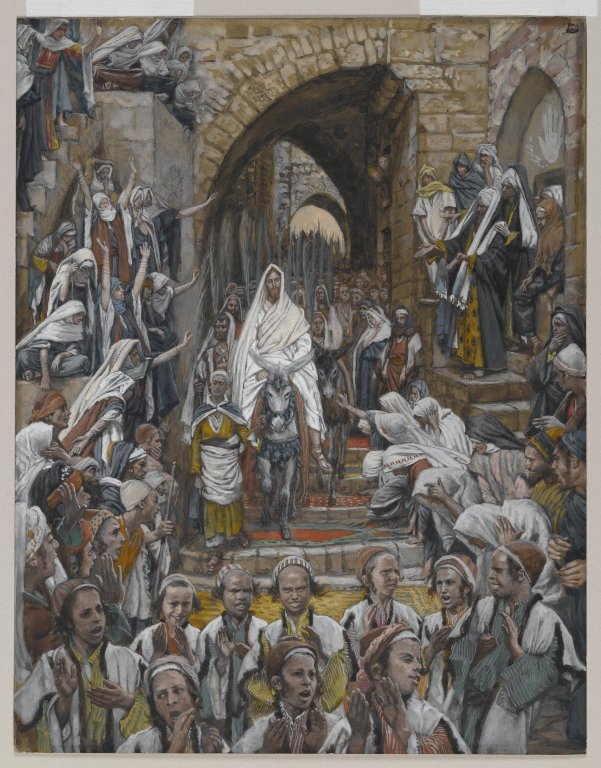
Jesus riding on a donkey in his triumphal entry into Jerusalem …”


Holy Week is upon us.  It’s the last week of Lent and the week just before Easter Sunday.  (This year, April 4.)  It begins with Palm Sunday and includes “Holy Wednesday (Spy Wednesday), Maundy Thursday (Holy Thursday), Good Friday (Holy Friday), and Holy Saturday.”

Notice that Holy Week doesn’t “end” with Easter Sunday.  By definition, Easter Sunday “is the beginning of another liturgical week.”  (Wikipedia, emphasis added.)  That in turn could be a metaphor or object lesson for a whole new beginning, as in a “whole new way of life.”

Which is another way of saying Easter Sunday is the defining moment of the liturgical year…

So Holy Week begins with Palm Sunday, which commemorates “Jesus’ triumphal entry into Jerusalem, an event mentioned in each of the four canonical Gospels.”  The symbolism of Jesus riding into Jerusalem on a donkey comes from Zechariah 9:9.  In turn, the welcoming crowds chanted from Psalm 118:26, “Blessed is he who comes in the name of the LORD.”  Further:

The symbolism of the donkey may refer to the Eastern tradition that it is an animal of peace, versus the horse, which is the animal of war.   A king would have come riding upon a horse when he was bent on war and riding upon a donkey when he wanted to point out he was coming in peace.  Jesus’ entry to Jerusalem would have thus symbolized his entry as the Prince of Peace, not as a war-waging king.  (E.A.)

By the 16th and 17th centuries A.D., Palm Sunday got celebrated by burning a Jack-‘o’-Lent figure.  “This was a straw effigy which would be stoned and abused,” designed to be a “kind of revenge on Judas Iscariot,” who had betrayed Jesus.  “It could also have represented the hated figure of Winter whose destruction prepares the way for Spring.”

Holy Wednesday is also called Crooked Wednesday, Black Wednesday, or “Spy Wednesday:”

The name comes from the Bible passage read in church on that day, which explains the role that Judas Iscariot played in bringing about Jesus’ death…  Although Judas was not a spy in the sense in which we use the word today, spies do perform the same kinds of treacherous acts that Judas did.  In exchange for a sum of money Judas betrayed Jesus’ whereabouts to the religious authorities who sought his death.

See Spy Wednesday – Encyclopedia – The Free Dictionary.

That’s followed by Maundy Thursday, which commemorates the “Last Supper of Jesus Christ with the Apostles.”  The word “Maundy” comes from the Latin mandatum or mendicare, and refers to the washing of feet that Jesus did for His disciples.   (An action consistent with the “hospitality customs of ancient civilizations, especially where sandals were the chief footwear.   A host would provide water for guests to wash their feet, provide a servant to wash the feet of the guests or even serve the guests by washing their feet.”)

In John 13 (verses 1-17), the Last Supper (seen at left) was preceded by Jesus washing “His Followers’ Feet.”  That act by Jesus “served the dual purpose of venerating Passover, the escape of the Jews from slavery in Egypt, and the establishment of a new tradition, Christianity.” 

Another note:  In John’s Gospel, the Last Supper and Crucifixion were not on “Nisan 15 (the first night of Passover),” as in the other Gospels.  John had the events happening on “Nisan 14, when the Passover lambs were slaughtered.  Presumably the author [John] preferred this date because it associated Jesus as the Lamb of God with the sacrificial lambs of Passover.”  (Asimov)

Good Friday commemorates the trial of Jesus before Pontius Pilate, and also His conviction, Crucifixion and death at Calvary.  And just as another aside, Good Friday (in a sense) marks the technical end of Lent.  That is, “Hot cross buns are traditionally toasted and eaten on Good Friday,” in the Anglican countries of the British Commonwealth.

hot cross bun is a “spiced sweet bun made with currants or raisins and marked with a cross on the top.”  The eating of this hot cross bun was designed to mark the end of Lent, with all its disciplines and “giving ups.”  I.e., during Lent, only “plain buns made without dairy products” could be eaten.  That prohibition ended at noon on Good Friday.  Also:

English folklore includes many superstitions surrounding hot cross buns.  One of them says that buns baked and served on Good Friday will not spoil or grow moldy during the subsequent year…   Sharing a hot cross bun with another is supposed to ensure friendship throughout the coming year…  If taken on a sea voyage, hot cross buns are said to protect against shipwreck.  If hung in the kitchen, they are said to protect against fires and ensure that all breads turn out perfectly.

Homemade Hot Cross Buns.jpgSee Hot cross bun – Wikipedia, which includes the image at right.  And as yet another aside, “On Good Friday April 14, 1865, American President Abraham Lincoln was fatally shot by actor John Wilkes Booth.”

Turning to the Crucifixion itself, Asimov said John’s Gospel made a key theological point, that the Crucifixion of Jesus “on the eve of Passover is a new and greater sacrifice.”  (He noted especially John 19:33 and John 19:34.)

That in turn led to the fulfilling of several prophecies about the Messiah in the Old Testament.  For one thing, since Jesus was crucified on Passover, the powers that be didn’t want His body hanging on the cross into and over the Sabbath Day.  That would have been ritually impure:

The next day was a special Sabbath day.  The Jewish leaders did not want the bodies to stay on the cross on the Sabbath day.  So they asked Pilate to order that the legs of the men be broken.  And they asked that the bodies be taken down from the crosses.  So the soldiers came and broke the legs of the two men on the crosses beside Jesus.   But when the soldiers came close to Jesus, they saw that he was already dead. So they did not break his legs.  But one of the soldiers stuck his spear into Jesus’ side.  Immediately blood and water came out.

See John 19:31-34.  Asimov continued that in accordance with Old Testament prophecies about the Messiah, “Not a bone of Jesus was broken but the blood of Jesus had to be seen in accordance with Exodus 12:13 and Exodus 12:46, respectively.  Hence the soldiers did not break Jesus’ legs and did draw blood with the spear.”  (Asimov,992-93)

To explain further, John 19:36 said, “These things happened so that the scripture would be fulfilled: ‘Not one of his bones will be broken.'”  The scripture being fulfilled was Psalm 34:20 (with a “lead-in” from verse 19), “Many are the afflictions of the righteous,  But the LORD delivers him out of them all.   He keeps all his bones, Not one of them is broken.” (E.A.)

John 19:37 said (in the ISV),  “In addition, another passage of Scripture says, ‘They will look on the one whom they pierced.'”  The scripture being fulfilled there was Zechariah 12:10:

And I will pour out on the house of David and the inhabitants of Jerusalem a spirit of grace and supplication.  They will look on me, the one they have pierced, and they will mourn for him as one mourns for an only child, and grieve bitterly for him as one grieves for a firstborn son. (E.A.)
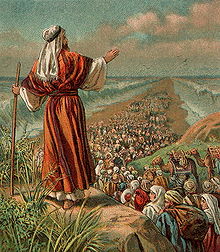
All of which referred back to the First Passover, as told in Exodus, Chapter 12, and especially in Exodus 12:3.   That was when Moses – with considerable help from God – was about to deliver the original Children of Israel from their literal bondage as slaves, in the service of the Egyptian Pharoah.  (As illustrated at left.)  All of which could in turn serve as a possible metaphor for our being freed from  spiritual bondage today:

This month shall be the beginning of months for you; it is to be the first month of the year to you.  Speak to all the congregation of Israel, saying, ‘On the tenth of this month they are each one to take a lamb for themselves, according to their fathers’ households, a lamb for each household…  This is a day to remember.  Each year, from generation to generation, you must celebrate it as a special festival to the Lord.

See Exodus 12: 1-3, and 14.  Thus the Son of God – Jesus – was offering Himself as a “new and greater sacrifice,” as Isaac Asimov noted.  In this He was doing much the same thing that Moses did when he offered up the Bronze Serpent in Numbers 21 (verses 4-9).  See also Nehushtan – Wikipedia, the free encyclopedia.

I’ll be writing more next week about the Nehushtan and it’s metaphorical implications.  (The key point is that “those who look to Christ are healed,” much as the ancient Hebrews – suffering from a plague of snakes – were also healed when they looked at the bronze serpent that Moses held up.  See also Caduceus as a symbol of medicine – Wikipedia.)

And finally, there comes Holy Saturday, “the day before Easter and the last day of Holy Week…  It commemorates the day that Jesus Christ‘s body lay in the tomb.”   ‘Nuff said.

So as noted above, Holy Week ends with Saturday, and Easter Sunday “is the beginning of another liturgical week.”  I’ll take up the subject of Easter next week.


And by the way, Easter is a Season, not just one day…
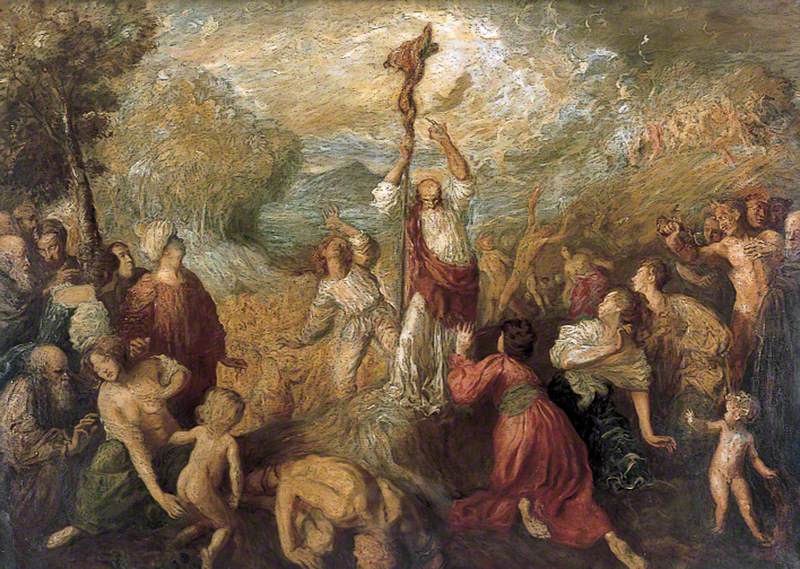
 

http://uploads8.wikiart.org/images/augustus-john/moses-and-the-brazen-serpent-1898.jpg

Moses foreshadowing the sacrifice of Jesus with his “bronze serpent…”


The upper image is courtesy of with Palm Sunday (Wikipedia).  The full caption:  “Jesus riding on a donkey in his triumphal entry into Jerusalem depicted by James Tissot.”

The middle image is courtesy of Last Supper – Wikipedia.  The full caption:  “Last Supper, Carl Bloch. In some depictions John the Apostle is placed on the right side of Jesus, some to the left.”  (Judas Iscariot is seen sneaking off at the lower right.)

The “First Passover” image is courtesy of Wikipedia, the free encyclopedia.  The caption reads:  “Illustration of The Exodus from Egypt, 1907.”

Time-magazine-cover-augustus-john.jpgThe lower image is courtesy of www.wikiart.org/en/augustus-john/moses-and-the-brazen-[or bronze]-serpentAugustus John (1878-1961) was a Welsh painter, draughtsman, and etcher…   His work was favourably compared in London with that of Gauguin and Matisse.  He then developed a style of portraiture that was imaginative and often extravagant, catching an instantaneous attitude in his subjects.”  He is shown at left on the cover of Time magazine:  “‘Artist John,’ on a 1928 Time magazine cover.”

See also Old Testament – How does the Snake in the Desert foreshadow the coming of Jesus, Caduceus – Wikipedia, the free encyclopedia, and/or Nehushtan – Wikipedia, the free encyclopedia.

Re:  Foot washing in the Old Testament.  See Genesis 18:4; 19:2; 24:32; 43:24; and Ist Samuel 25:41

Re: the length of time it took to die from crucifixion.  See Crucifixion – WikipediaOn that note, Crucifixion was intended to provide an especially slow, painful death, and gave rise to the term excruciating, literally “out of crucifying.”  Frequently, “the legs of the person executed were broken or shattered with an iron club,” which act “hastened the death of the person but was also meant to deter those who observed the crucifixion from committing offenses.” 

Death from crucifixion could be caused by: “cardiac rupture, heart failure, hypovolemic shock, acidosis, asphyxia, arrhythmia, and pulmonary embolism,” or a combination thereof.  It could also result from other causes, “including sepsis following infection due to the wounds caused by the nails or by the scourging that often preceded crucifixion, eventual dehydration, or animal predation.”

A theory attributed to Pierre Barbet holds that, when the whole body weight was supported by the stretched arms, the typical cause of death was asphyxiation.  He wrote that the condemned would have severe difficulty inhaling, due to hyper-expansion of the chest muscles and lungs.  The condemned would therefore have to draw himself up by his arms, leading to exhaustion, or have his feet supported by tying or by a wood block.  When no longer able to lift himself, the condemned would die within a few minutes.

Needless to say, if the condemned person’s legs were broken – as detailed in John 19:31-34 above – he or she would be unable to use them to raise himself up to inhale…  (It appears that there were rare instances of women being crucified.  See Were women ever crucified – Answers.com.
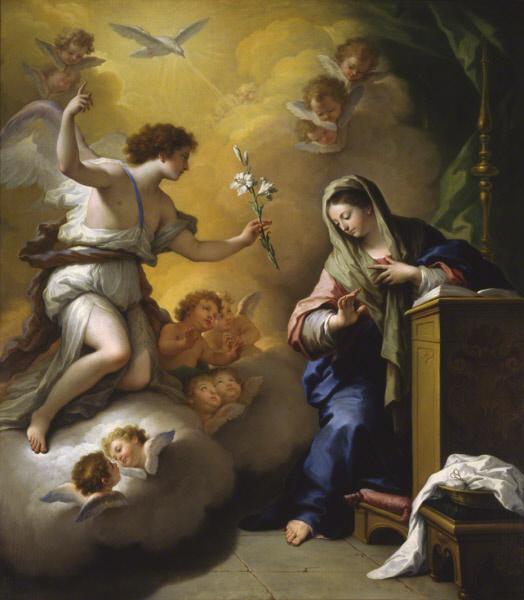
 

The Annunciation “gets the ball rolling”

The “Annunciation…”   (The white lily symbolizes Mary’s purity.)

*   *   *   *

Wednesday, March 25, is the Feast of the Annunciation.

The full title is the Annunciation to the Blessed Virgin Mary, which I discussed back On the readings for December 21.  (And also The original St. Nicholas.)  I did it that way – in that order – as a kind of metaphor.  It’s a good metaphor for how the early Church “figured it backwards.”

It all started with the birth of Jesus.  The early Church Fathers decided first that the celebration would be on December 25. (For reasons explained further below.)  Then they figured backwards, nine months.  Since they said Jesus was born on December 25, He had to have been “conceived” on the previous March 25.  That’s where the Annunciation comes in.

It celebrates “the announcement by the angel Gabriel to the Virgin Mary that she would conceive and become the mother of Jesus, the Son of God, marking his Incarnation.”  (More on Incarnation below.)   Then it’s not much of a leap to conclude that Conception and Annunciation happened the same day.  “She would conceive” became in effect “she did conceive.”

You can see the full set of Bible readings for the day at The Annunciation.  The readings are:  Isaiah 7:10-14, Psalm 45 (or a portion thereof), Hebrews 10:4-10, and Luke 1:26-38.

But first a word on how December 25 got chosen as the date to celebrate the birth of Jesus.

It started back in the olden days.  Nowadays we know all about the winter solstice, which “marks the shortest day and the longest night of the year.”  (In 2014 it was December 22.)  We also know that from that date onward, the days do start getting longer and the nights start getting shorter.

But back in those primitive olden days, “there was never any certainty that the sinking Sun would ever return.”  (As Isaac Asimov noted.)  So about mid-December those old-time people kept worrying that the days would keep getting shorter and  shorter, until there was nothing but eternal night.

But then around December 25 they noted that the cycle had stopped and the days were getting slightly longer.  They always felt great joy and gladness, and  the time when the sun started returning “was the occasion for a great feast in honor of what one might call the ‘birth of the sun.'”  That time of raucous celebration became known as Saturnalia in Roman times.

At the Saturnalia, joy was unrestrained, as befitted a holiday that celebrated a reprieve from death and a return to life…  It was a season of peace and good will to all men… Naturally, the joy easily turned to the extremes of licentiousness and debauchery, and there were, no doubt, many pious people who deplored the uglier aspects of the festival.

Among those “pious people” were the early Church Fathers.  They felt the festival was “a great stumbling block to conversions to Christianity.”  So the early Church “adapted itself to pagan customs” like Saturnalia.  In essence they transmogrified Saturnalia; they said Christians needed only  “to joyfully greet the birth of the Son rather than the Sun.”  (Asimov, emphasis added.)

Note also that the Annunciation pretty much coincides with the “northern vernal equinox:”

An equinox occurs twice a year, around 20 March and 22 September.  The word itself has several related definitions.  The oldest meaning is the day when daytime and night are of approximately equal duration.  The word equinox comes from this definition, derived from the Latin aequus (equal) and nox (night).

https://bearspawprint.files.wordpress.com/2014/03/vernal-sunshine-on-azaleas-march-2014-2014-03-25-013-2.jpgSo the Annunciation is celebrated about the time of the vernal equinox.  (Vernal is from the Latin word for “spring.”  The photo at right is Vernal Sunshine on Azaleas.)  In turn the birth of Jesus is celebrated about the time of the winter solstice.  (The summer solstice is the longest day of the year.)

Which brings up the matter of the Incarnation.  As Wikipedia put it:

The Incarnation … is the belief that [Jesus], “became flesh” by being conceived in the womb of Mary…   [The idea is that the Son of God] took on a human body and nature and became both man and God.  In the Bible its clearest teaching is in John 1:14: “And the Word became flesh, and dwelt among us…”  The Incarnation is commemorated and celebrated each year at Christmas, and also reference can be made to the Feast of the Annunciation; “different aspects of the mystery of the Incarnation” are celebrated at Christmas and the Annunciation.

See also Liturgical year – Wikipedia, the free encyclopedia.  Then there’s a book, The Liturgical Year: The Spiraling Adventure of the Spiritual Life(Which looks to be a pretty interesting read…)

It first noted that technically the liturgical year begins with Advent and goes through next November.  More to the point, the liturgical year “sets out to attune the life of the Christian to the life of Jesus.”  (It’s not just an “arbitrary arrangement of ancient holy days.”)  Instead:

It is an excursion into life from the Christian perspective [and] proposes to help us to year after year immerse ourselves into the sense and substance of the Christian life…   It is an adventure in human growth; it is an exercise in spiritual ripening.

I couldn’t have put it better myself.  On the other hand, you could say that while “technically the liturgical year begins” with Advent, it’s the Annunciation that gets the ball rolling

*   *   *   *

*   *   *   *

The upper image is courtesy of Annunciation – Wikipedia, the free encyclopedia, .  The full caption:  “Annunciation by Paolo de Matteis, 1712.  The white lily in the angel’s hand is symbolic of Mary’s purity  in Marian art.”  De Matteis was an Italian painter (1662-1728), who was  born in Salerno and died in Milan.  While in Rome (1723-25) he “received a commission from Pope Innocent XIII.”

The “winter solstice” – rotating image – is courtesy of the Wikipedia article.  The caption reads:  “Winter solstice in Northern Hemisphere over Asia.” 

See also Solstice and Summer solstice – Wikipedia, the free encyclopedia

The lower image is courtesy of the Wikipedia article on the Incarnation, contained within the article on  the Annunciation.  The caption reads:  “The Incarnation illustrated with scenes from the Old Testaments and the Gospels, with the Trinity in the central column, by Fridolin Leiber, 19th century.”

Re: Isaac Asimov.  The quotes about the “dating” of Christmas and the “olden days” are from Asimov’s Guide to the Bible (Two Volumes in One),  Avenel Books (1981), at pages 930-34. 

Just as an aside, Asimov (1920-1992) was “an American author and professor of biochemistry at Boston University, best known for his works of science fiction and for his popular science books.  Asimov was one of the most prolific writers of all time, having written or edited more than 500 books and an estimated 90,000 letters and postcards.”  His list of books included those on “astronomy, mathematics, the Bible, William Shakespeare’s writing, and chemistry.”  He was a long-time member of Mensa, “albeit reluctantly;  he described some members of that organization as ‘brain-proud and aggressive about their IQs.’”  See Isaac Asimov – Wikipedia.

The “Vernal Sunshine” is courtesy of bearspawprint.wordpress.com/2014/03/26/blooming/vernal.

On St. Paddy and St. Joe

Guido Reni - St Joseph with the Infant Jesus - WGA19304.jpg

Saint Joseph with the Infant Jesus…”

*   *   *   *

We have two Feast Days coming up.  One is major and one is minor.  But the “minor” festival is the far better-known of the two.  (And celebrated more, usually with lots o’ beer…)

That is, March 19, 2015, is the Feast Day for St. Joseph.  That’s the Major Feast Day coming up, but it’s way overshadowed by St. Patrick’s Day, today, March 17.   I figure there’s some kind of object lesson in all of this, but I haven’t quite figured it out yet.

According to Apostles, Major Saints and Feast Days, St. Joseph is third on the list of important figures who have Feast days.  (He comes in third only to Christ the King and Mary.)  St. Patrick on the other hand didn’t even make that list.  But again, his Feast Day far overshadows that of “St. Joe.”  (Who might be called at least the lesser of the two father figures of Jesus:)

Christian tradition places Joseph as Jesus‘ foster father [but] represents Mary as a widow during the adult ministry of her son.  Joseph is not mentioned [at] the Wedding at Cana at the beginning of Jesus’ mission, nor at the Passion at the end.  If he had been present at the Crucifixion, he would under Jewish custom have been expected to take charge of Jesus’ body, but this role is instead performed by Joseph of Arimathea.  Nor would Jesus have entrusted his mother to the care of John the Apostle if her husband was alive.   (E.A.)

Saint Joseph – Wikipedia, which added that Joseph is venerated as a saint by many, including the CatholicAnglican, and Methodist faiths.  In some traditions he is the patron saint of workers.  And, with “the growth of Mariology, the theological field of Josephology has also grown and since the 1950s centres for studying it have been formed.”

See also St. Joseph – Saints & Angels – Catholic Online, which added that he is also patron saint of the dying.”  That’s because, “assuming he died before Jesus’ public life, he died with Jesus and Mary close to him, the way we all would like to leave this earth.”  And finally, this:

The Bible pays Joseph the highest compliment: he was a “just” man…   By saying Joseph was “just,” the Bible means that he was one who was completely open to all that God wanted to do for him. He became holy by opening himself totally to God.

That’s from St. Joseph, Husband of Mary | Saint of the Day.  (And points the way for all of us.)

The full readings for the Feast Day can be found at St. Joseph.  They are:  2 Samuel 7:4,8-16, Psalm 89 (or portions thereof), Romans 4:13-18, and Luke 2:41-52.

Now about St. Patrick.  We don’t know when he was born, but he is said to have died on March 17, now celebrated as his Feast Day.  In Irish his name would be Padraig.  That’s often shortened to “Paddy,” and is seen as a derogatory term for Irish men.  See Saint Patrick – Wikipedia, and also The Free Dictionary.   That in turn  gave rise to the “Paddy wagon:”

The name came from the New York Draft riots of 1863.  The Irish at the time were the poorest people in the city.  When the draft was implemented it had a provision for wealthier people to buy a waiver.  The Irish rioted, and the term Paddy wagon was coined.

Urban Dictionary: paddy wagon, about the “police vehicle used to transport prisoners.”

But we digress!!!

According to legend, St. Patrick was born in Britain but at 16 was captured by Irish pirates.  He was taken as a slave back to Ireland, and lived there for six years before escaping.   He got back to his family, then studied became a cleric, and in the fullness of time returned to Ireland.

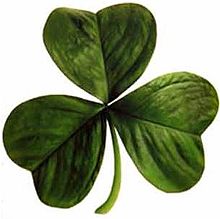
Legend further says Patrick used the native shamrock to illustrate the Holy Trinity to the Irish.  And finally, legend says Patrick “banished all snakes from Ireland,” though there’s debate whether snakes were there in the first place.  An alternate theory: the “snakes” referred to the “serpent symbolism of the Druids.” (Wikipedia.)

See also St. Patrick | Saint of the Day | AmericanCatholic.org:

He suffered much opposition from pagan druids and was criticized in both England and Ireland for the way he conducted his mission.  In a relatively short time, the island had experienced deeply the Christian spirit, and was prepared to send out missionaries whose efforts were greatly responsible for Christianizing Europe. (E.A.)

See also, How the Irish Saved Civilization.  That book argued that the Irish played a “critical role in preserving Western Civilization from utter destruction by the Huns and the Germanic tribes” after the Roman Empire collapsed.  (Those Germanic tribes included Angles and Saxons and Jutes Oh my!)   The book told the story of the “pivotal role” played by members of the Irish clergy in preserving Western civilization, with a “particular focus” on St. Patrick.

How the Irish Saved Civilization.jpgOr as Kenneth Clark put it, “In so far as we are the heirs of Greece and Rome” – after the collapse of the Roman Empire about 500 A.D. – “we got through by the skin of our teeth.”  We were saved in large part by a “group of monks huddled off the coast of Ireland.”
(There they were safe from the rampaging Vandals, Huns and other barbarians from the east.)

Now about that celebration.  See How America Invented St. Patrick’s Day | TIME, which began:   “Immigration and nativism transformed a quiet religious celebration into a day of raucous parades and shamrock shakes.”  That transformation began in America.

In Ireland – up until about 1904 – March 17 was a “quiet day with no parades or public events.”

The first recorded public American celebration came in Boston in 1737.  Around 1766, Irish soldiers in the British Army stationed in New York started holding a parade to honor “the Irish saint” that day.  Then came the end of the Civil War and more and more Irish immigrants:

Facing nativist detractors who characterized them as drunken, violent, criminalized, and diseased, Irish-Americans were looking for ways to display their civic pride and the strength of their identity…    Irish-Americans celebrated their Catholicism and patron saint … but they also stressed their patriotic belief in their new home.  In essence, St. Patrick’s Day was a public declaration of a hybrid identity [including] a strict adherence to the values and liberties that the U.S. offered them.

(See also Anti-Irish sentiment – Wikipedia.) By the 1890s, St. Patrick’s Day was celebrated not only in cities with large Irish populations; Boston, Chicago, and New York. It was also celebrated in cities like New Orleans, San Francisco, and Savannah. The tradition “grew across the U.S. and became a day that was also celebrated by people with no Irish heritage.  By the 20th century, it was so ubiquitous that St. Patrick’s Day became a marketing bonanza.”  (There’s probably a lesson there too…)

The TIME article ended with this:

The holiday also spread by becoming a means for all Americans to become Irish for the day. The shared sense of being Irish, of wearing green and in some way marking March 17, has resulted in St. Patrick’s Day being observed in a similar fashion to July Fourth or Halloween.  It’s the closest thing in America to National Immigrant Day, a tribute not only to the Irish, but to the idea that Americans are all part “other.” (E.A.)

See also St. Patrick’s Day – Facts, Pictures, Meaning & Videos, and St Patrick’s Day 2015: From London to Uganda – the 10 best Irish pubs outside Ireland.  (An FYI:  the list of best Irish pubs includes The Irish Haven in Brooklyn and Finn McCool’s Irish Pub in New Orleans.)

So Here’s to You, St. Joseph, patron saint of all workers and of the dying.

And Here’s to You, St. Patrick, who – among other things – helped to save Western Civilization from those barbarians, including the Angles and Saxons and Jutes.  (Oh my!)

*   *   *   *

*   *   *   *

The upper image is courtesy of Saint Joseph – Wikipedia, which also noted that the “Pauline epistles make no reference to Jesus’ father; nor does the Gospel of Mark.”  The caption for the painting:  “Saint Joseph with the Infant Jesus, Guido Reni (c. 1635).”

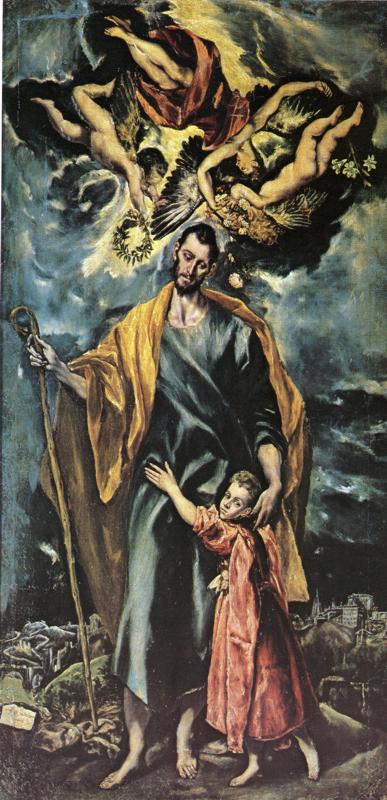
The lower image is St. Joseph and the Christ Child, courtesy of El Greco – WikiArt.org.  See also, On art history: El Greco’s Sensibility: A Painting of Saint Joseph:

Saint Joseph and Christ Child [the one by El Greco] is one of the first Western paintings in which Saint Joseph is the principal protagonist.  We see his enormous figure in the first plan, shown as a walker, and as a figure of trust and protection to the Child Jesus, who embraces the waist of His Father.  [He is] presented as a young man with a crook in his right hand, shows his paternal love toward Jesus, and is crowned by the three [angels] in the [upper] part of the painting.  These angels in full movement bear lilies, which symbolize the purity, and laurel and roses, symbols of triumph and love respectively.  Here we see that the agitated postures of the angels contrast the calmness of the group of St. Joseph and the Infant Christ.  Behind them, a view of Toledo is included.

Re:  the “skin of our teeth,” and/or the Irish saving Western civilization.  See  Civilisation (TV series) – Wikipedia, the free encyclopedia and CIVILIZATION by KENNETH CLARK – Culturism.

One final note, the phrase Here’s to You is generally translated, Bottoms Up, “an expression said as a toast when people are drinking together.”  

On St. Michael’s – Tybee Island

St. Michael, “reaching out to souls in purgatory…


March 11, 2015  –  Back on August 10th I did a post on St. Michael and All Angels.   It was about an Episcopal church  –  “Saint Michael and All Angels”  –  that Mi Dulce and I passed on the way out of Stone Mountain.  (That’s a park east of Atlanta.)

Which led to a question, “Who the heck is this St. Michael guy?

There’s more on St. Michael below.  But first let me say that last Sunday, March 8, “we” attended the 11:00 a.m. service at St. Michael Catholic Church on Tybee Island.  (An island on the coast of Georgia east of Savannah.  The Episcopal Church around the corner had a service at 10:00 a.m., but that was actually 9:00 thanks to the time change, so it was way too early…)

The sanctuary itself was nice and cozy, and the Bible readings were the same as those described in The “Big Ten” and Jesus with a whip.  That is, “Exodus 20:1-17, Psalm 19, 1 Corinthians 1:18-25, and John 2:13-22.  For the full readings see the Third Sunday in Lent.”  (The Catholic Church and Episcopal Church share the same Revised Common Lectionary.)

St. Michael’s has been on Tybee since July 5, 1891, as noted in the Morning News:

Tybee’s Roman Catholic chapel was dedicated yesterday morning (July 5, 1891) by Bishop Thomas A. Becker…  Bishop Becker named the chapel after St. Michael the Archangel, who is known as the rule[r] of the waves.  The name is peculiarly appropriate on account of the chapel being at the seaside.  The 9:30 o’clock train carried down about 200 people to attend the services, and they, together with Tybee residents, filled the little church to overflowing.

See St. Michael, under “About Us” and the parish history.  The history noted that the church on the beach cost the then-whopping sum of $2,000 to build.

Now, about Tybee Island.  It’s a small island and a small city east of Savannah, and the easternmost point in the state of Georgia.  Long known as a “quiet getaway for the residents of Savannah,” it has recently become equally popular for other tourists as well:

It is one of the few locations where the U.S. Air Force dropped an atomic bomb – by accident (during a botched 1958 military training exercise).  Though the “Tybee Bomb” did not detonate … there has been ongoing concern, since the Mark 15 nuclear bomb lost during the mishap was never found…  [On a lighter note,] Tybee Island has had an annual Beach Bum parade … down the main road in Tybee, Butler Avenue, and when parade floats come by onlookers have been known to shoot each other with water-guns.

See Wikipedia, the free encyclopedia.   There’s also The Breakfast Club, a “legendary” way to start a bright Sunday morning, before going to mass at St. Michael’s.  (Just be sure to get there before the line starts forming outside the front door.)

But we digress…

For more about the original St. Michael, see the Book of Revelation at 12:7-10:

[T]here was war in heaven: Michael and his angels fought against the dragon; and the dragon fought and his angels.  And prevailed not…   [T]he great dragon was cast out, that old serpent, called the Devil, and Satan, which deceiveth the whole world; he was cast out into the earth, and his angels were cast out with him.   And I heard a loud voice saying … the accuser of our brethren is cast down, which accused them before our God day and night.

Note that both the Hebrew and Greek words “Satan” (“Satanas” in Greek) translate as “an adversary,” while the root word for devil is “diabolos,” which is Greek for “slanderer.”

Or see Michael (archangel) – Wikipedia, the free encyclopedia, which included this:

Michael ([which translates] “who is like God?” … ) is an archangel in Jewish, Christian, and Islamic teachings.  Roman Catholics, the Eastern Orthodox, Anglicans, and Lutherans refer to him as “Saint Michael the Archangel” and also as “Saint Michael. . .”   In the New Testament Michael leads God’s armies against Satan‘s forces in the Book of Revelation, where during the war in heaven he defeats Satan.

Also, St. Michael has a Feast Day – called Michaelmas Day – on September 29.

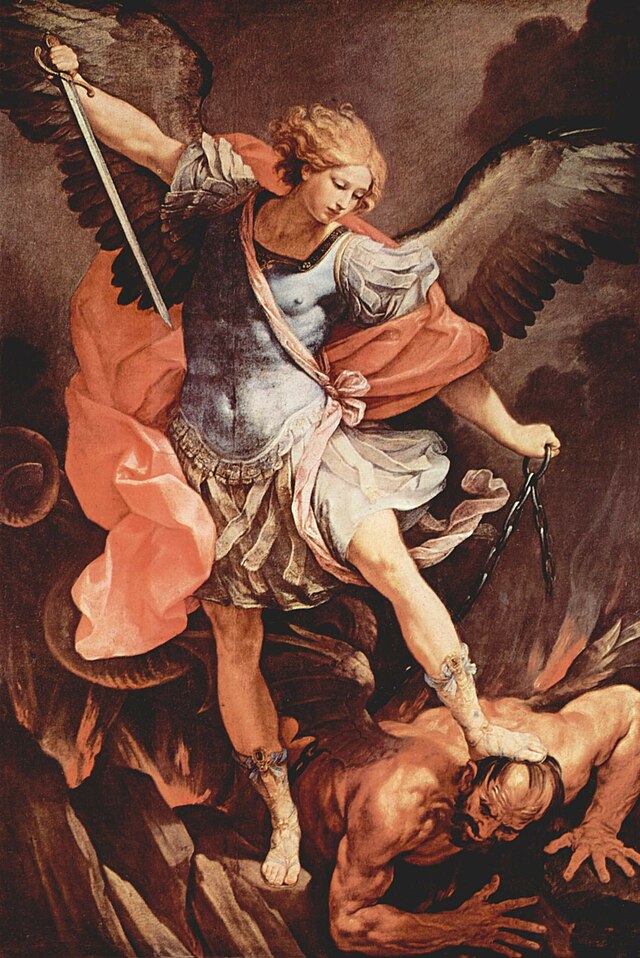
I’ve included two images of St. Michael.  The one below shows him “trampling Satan.”  The upper image shows him in another of his jobs, “reaching out to souls in purgatory.”  That means he might end up being the archangel who saves my own spiritual butt.

On the other hand, there is that part of the Book of Common Prayer which calls the idea a “Romish doctrine.”  But for myself I say, “Hey, I’ll take all the help I can get!


The upper image is courtesy of the Wikipedia article on St. Michael.  The full caption: “Archangel Michael reaching to save souls in purgatory, by Jacopo Vignali, 17th century.”

Dulce is Spanish for “Sweet,” or in the alternative Mi Dulce or “My Sweet.”   (See also the posts On “St. James the Greater”, and On the “Infinite Frog.”)

As to the definitions of Satan and/or the “Slanderer,” see the New International Dictionary of the Bible, Regency Reference Library, 1987, Page 899.

Re:  “shared lectionary.”  Wikipedia noted, “This lectionary was derived from various Protestant lectionaries in current use, which in turn were based on the 1969 Ordo Lectionum Missae, a three-year lectionary produced by the Roman Catholic Church following the reforms of the Second Vatican Council.”

The lower image is also courtesy of the Wikipedia article, with the full caption: “Guido Reni‘s painting in Santa Maria della Concezione, Rome, 1636 is also reproduced in mosaic at the St. Michael Altar in St. Peter’s Basilica, in the Vatican.”

For more information, see the notes for On “St. Michael and All Angels.”


On St. Matthias – and “Father Roberts”

“The Wind River … Indian Reservation, Wyoming,” where Father Roberts preached…

*   *   *   *

Tuesday, February 24, 2015, is the Feast of St. Matthias, the Apostle who came “after” Judas:

[A]ccording to the Acts of the Apostles, [he] was the apostle chosen by the remaining eleven apostles to replace Judas Iscariot following Judas’ betrayal of Jesus and suicide.  His calling as an apostle is unique in that his appointment was not made personally by Jesus, who had already ascended to heaven, and, it was made before the descent of the Holy Spirit upon the early Church.

See Saint Matthias – Wikipedia.  Note also that this St. Matthias is not to be confused with St. Matthew, the Gospel-writer whose Feast Day is September 21.

Or for that matter Mattathias, who rebelled against the occupying power before Rome, just before Jesus.  In turn he fathered Judas Maccabeus, the greatest guerrilla in Jewish history.

But we digress…

We were talking about St. Matthias, also known as “Unremarkable Matthias” or the “Overlooked Apostle.”  See Feast | First Things and The Overlooked Holy Apostle, Matthias.

Isaac Asimov gave a pithy description of how this Matthias became an Apostle:

Peter arranged to have a new individual selected to take the place of Judas Iscariot in order to bring the number of the inner circle back to the mystical twelve that matched the twelve tribes of Israel.  Two were nominated, Joseph Barsabbas and Matthias.  To choose between the two, lots were used: Acts 1:26….  and the lot fell upon Matthias; and he was numbered with the eleven apostles.   Neither Joseph Barsabbas nor Matthias are mentioned anywhere else in the New Testament.

(Asimov, 998)   The problem is there are few if any images available – pictures or paintings – of St. Matthias.  So to get a lead-in and lower image for this post, I had to check the church calendar.  I found a “trial” Feast – February 25 – for Reverend John Roberts (1853-1949).

There’s more about “Father Roberts” below, but first some points about St. Mattathias.

As noted in St. Matthias – Wikipedia, some scholars think he’s really someone else:

Eusebius calls him … not Matthias but “Tolmai,” not to be confused with Bartholomew (which means Son of Tolmai) who was originally one of the twelve Apostles;  Clement of Alexandria says some identified him with Zacchaeus;  the Clementine Recognitions identify him with BarnabasHilgenfeld thinks he is the same as Nathanael in the Gospel of John.

Another site said Peter and the other apostles studied Old Testament Scripture and “found a prophecy of Judas’ betrayal in Psalms 69 and 109.”  (As I wrote back in October 2014, “It pays to know the psalms!”  See also Jesus and the Psalms – Ligonier Ministries.)    Further, “the prophecy in Psalm 109 included the instruction, ‘let another take his office.’”  See Feast | First Things, which added, “We too, should search the Scriptures [especially the Psalms] to find God’s will…”

The Overlooked Holy Apostle agreed that “Matthias was originally Zacchaeus.  Zacchaeus climbed the sycamore tree because he could not see Jesus due to the crowd of people and his short stature (Luke 19:1-10).  He repented of his former life after meeting the Lord.”  This site included a gruesome account of St. Matthias preaching in a city of “man-eaters” – cannibals – and of the trials and tribulations he suffered there.  (See also Zacchaeus – Wikipedia.)

So whether St. Matthias died by being first stoned and then beheaded, or had his eyes gouged out and then “sat for thirty days waiting to be eaten and die,” the point is this:  spreading the Gospel isn’t always a whole lot of fun.  Which brings up a more recent “Gospel spreader” who had a bit more luck, the Reverend John Roberts, “Father Roberts.”

As Wikipedia noted, “John Roberts [1853-1949] is honored with a feast day on the liturgical calendar of the Episcopal Church on 25 February.”  See John Roberts (missionary), which noted he was born in “north Wales” but grew up yearning to be a missionary.  His first mission was to the Bahamas, but among people who “were already Christian.”  He wanted “greater challenges, particularly among American Indians,” and was eventually sent to the Diocese of Colorado and Wyoming.  He asked “for missionary work in the diocese’s most difficult field.”

The site John Roberts, Missionary to the Eastern Shoshone, added some interesting footnotes.

For one thing, there was his memorable eight-day trip out to the Wind River Reservation:  “He took the train to Green River and then traveled the last 150 miles by stage.  This journey came in the midst of a blizzard with temperatures nearing 60 degrees below zero.” (E.A.)

Another note addressed Father Roberts’ befriending Chief Washakie of the Shoshone:

The chief’s son, Jim Washakie, was shot and killed in 1885 by a white man in an argument over a liquor purchase.  When Chief Washakie heard of this, he became distraught and vowed to kill every white man he saw until he himself was dead.  When Roberts heard of this, he …  offered his own life instead.  Washakie reconsidered and said, “I do not want your life.  But I want to know what it is that gives you more courage than I have.”  Roberts used the occasion to talk about his personal faith and converted Washakie to Christianity. (E.A.)

Which brings up the work of missionaries in general.  One definition said a missionary is a “member of a religious group sent into an area to do evangelism or ministries of service, such as education, literacy, social justice, health care and economic development.”  Certainly the last five “ministries of service” have the potential for much good.  On the other hand there are concerns “that missionaries have a perceived lack of respect for other cultures.”  And there is the “potential destruction of social structure among the converts.”  See Wikipedia.

Other web articles are more blunt, saying missionaries in the past have attacked native spiritual ceremonies as “pagan,” adding that among “uncivilised people,” missionaries are “agents of destruction.”  And some say missionaries have destroyed the “bonds of the people to the forests, land and animals,” and spread ideologies and technologies that make native people “slaves to the extractive system which defines colonialism.”  See e.g. Against Missionaries, A Case Against Missionaries, and/or Do Missions Destroy Culture? | RELEVANT Magazine.

On the other hand, see John Roberts, Priest, 1949 | Commission on Liturgy and Music:

Unlike other missionaries who sought to change the culture and lifestyle of Native peoples … Roberts believed it was important to preserve the language, customs, and culture of the people.  Roberts sought to honor and respect the ancient ways of the Native peoples while at the same time proclaiming the Gospel among them, inviting them to faith, establishing congregations, and serving their needs in the name of Jesus. (E.A.)

In this case – it seems – Father Roberts is one missionary who got it right.  He got to know the people he’d be ministering to, and he “learned their language.”   Here’s to his Feast Day.

*   *   *   *

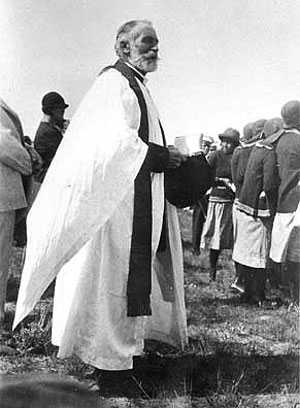
“…never take me away from my Indians”

*   *   *   *

The upper image is courtesy of the link, Wind River Indian Reservation, contained within John Roberts (missionary) – Wikipedia.

The lower image is courtesy of The Reverend John Roberts, Missionary to the Eastern Shoshone and Northern Arapaho Tribes.  The caption: “‘I hope you will never take me away from my Indians,’ the Reverend John Roberts told his bishop.”

Re:  “Mattathias.”  This Mattathias – who died in 165 BC – was “a Jewish priest whose role in the Jewish revolt against the Syrian Greeks is related in the Books of the Maccabees.”  See Mattathias, which said he was perhaps best known for fathering Judas Maccabeus, who in turn is best known for being a leader of the Maccabean Revolt.  In that revolt – from 167 to 160 BC – Judas (or Judah) Maccabee “led an army of Jewish dissidents to victory over the Seleucid dynasty in guerrilla warfare.”  See Wikipedia, the free encyclopedia, which noted that the “Jewish festival of Hanukkah celebrates the re-dedication of the Temple following Judah Maccabee’s victory…”

Re: Isaac Asimov.  The quote is from Asimov’s Guide to the Bible (Two Volumes in One),  Avenel Books (1981), at page 998.  Asimov (1920-1992) was “an American author and professor of biochemistry at Boston University, best known for his works of science fiction and for his popular science books.  Asimov was one of the most prolific writers of all time, having written or edited more than 500 books and an estimated 90,000 letters and postcards.”  His list of books included those on “astronomy, mathematics, the Bible, William Shakespeare’s writing, and chemistry.”  He was a long-time member of Mensa, “albeit reluctantly;  he described some members of that organization as ‘brain-proud and aggressive about their IQs.’”  See Isaac Asimov – Wikipedia.

Re:  Father Roberts’ “personal faith.”  In other words he was “singing his song,” not a warmed-over rehash.  (He was not a “carbon copy Christian.”)  See e.g. “Another brick in the wall.”

For more on Father Roberts, see also John Roberts – Satucket.com:

Assigned to minister to the Shoshone and Arapahos on the Wind River Reservation, he set about his work by learning all he could about Native American customs and beliefs, believing that by knowing the people he hoped to minister to he would be more effective.  He also learned the native languages, eventually translating the gospel for his Native American congregates…  His translation of the Gospel of Luke into Arapahoe is online at Project Gutenberg.  Translations of the Lord’s Prayer, Apostles’ Creed, Ten Commandments, etc., into Arapaho and Shoshone are also online.

For another blog-post on Father Roberts, see The Good Heart: The Rev. John Roberts (1853 – 1949).

*   *   *   *

On the True Test of Faith…

*   *   *   *

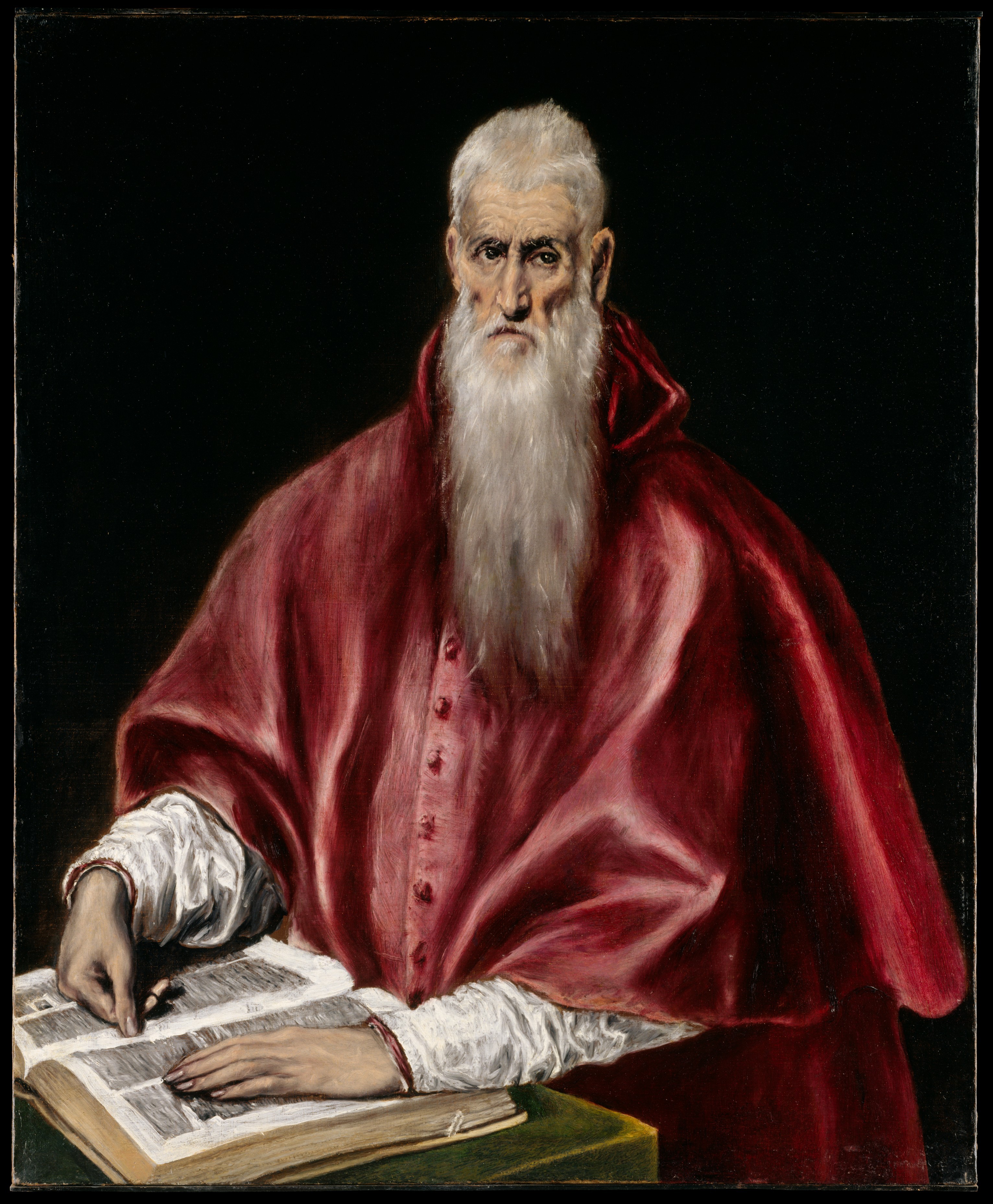
“In the fourth century, St. Jerome struggled to render the Word of God into the language of the day.” 

*   *   *   *

Thursday, February 19, 2015 – To the caption above I would add: “It wasn’t easy then and it isn’t easy now.” But back to the topic: I came up with the idea for this post after reviewing the main Bible readings for Ash Wednesday this year, including Luke 18:9-14. There’s more on Luke’s lesson below, but the key question most people today ask is this: “What do I have to do to be saved?” To get to heaven, achieve Nirvana, whatever. What are the rules?

On the one hand there are the Legalists, the so-called Christians who believe the Bible is one long list of rules to follow, and that if you don’t follow each one “to the letter,” you’re going to hell. Or as one site said, legalism is a “doctrinal position emphasizing a system of rules and regulating the achievement of salvation and spiritual growth. Christians who sway toward this way of thinking demand a strict adherence to rules and regulations.” 

On the other hand there’s this from Lesson 57: Why Jesus Hates Legalism:

There is probably no sin more tolerated or more widespread in the Christian world than legalism. It may surprise you to hear it labeled as sin. Legalists are thought to be a bit overzealous or “uptight,” but they aren’t usually thought of as sinning in the same sense as adulterers, thieves, liars, and the like. To the contrary, legalists seem to be concerned about holiness. Yet the Lord Jesus had more conflicts with the legalists of His day than any other group…

On that note, in 2d Corinthians 3:6 the Apostle Paul said following the Letter of the Law kills, but the Spirit of the Law gives life, gives spiritual growth, gives personal fulfillment. And may even help you perform greater miracles than Jesus did, as He said we should in John 14:12

Then there’s that Luke 18:9-14 reading, on the parable of The Pharisee and the Tax Collector. A Pharisee, “obsessed by his own virtue, is contrasted with a tax collector who humbly asks God for mercy. This parable demonstrates the need to pray humbly.” Or as Jesus concluded, “All who exalt themselves will be humbled, but all who humble themselves will be exalted.”

All of which can cause a lot of confusion – “What do I need to do?” – and which also brings up what might be called “the True Test of Faith.” For starters, imagine two Christians said to be devout. They both die, and they both find out that whole faith-of-the-Bible has been a hoax. They find out there is no God, that there is no afterlife, and that there will be no reward for good behavior during their time here on earth. The first Christian is outraged. “What? You mean I could have spent my life partying? Boozing it up? Chasing women, loose and otherwise?  Boy am I angry, when I think of all the fun things that I could have been doing!”

But the second Christian is a more thoughtful. He remembers the path he’s followed, since he started reading the Bible on a daily basis. He thinks about how his Bible-reading and his path-following have led to unexpected breakthroughs. And he thinks of the time when he got pushed past the Breaking Point. (As in, “bring us not to the Breaking Point, but wrest us from the Evil One,” like it says in the Lord’s Prayer.*)  He things of Peter, at his Breaking Point in Matthew 26:33-35, where he denied Jesus.  And how he failed, just like Peter did…

Then he thinks about the other “testing adventures” he’s had.  Some of those tests he passed, others he failed, but from all he got life lessons to pass on to others. And his life had structure, meaning and purpose, even if only in his own mind. So, after all this thinking the second Christian said, “You know, I wouldn’t change a thing.”

That to me is the true test of faith. Of course I do believe in and follow Jesus, and that there’s a better life than this to come, and that the soul is a form of energy that is neither created nor destroyed but merely changes form. (Like it says in the First law of thermodynamics.) I’m just saying, that’s the kind of faith I’ve trying to develop. And that’s the kind of faith this blog is trying to find, both for you the reader and me the Writer.  It also brings up an ancient prayer:

O God, if I worship Thee in fear of hell, burn me in hell;  if I worship Thee in hope of Paradise, exclude me from Paradise;  but if I worship Thee for Thine own sake, withhold not Thine everlasting beauty.

That’s from On three suitors (a parable), which also discussed problems interpreting the Bible, like the Hebrew style of writing and of interpreting parables in general. On that note, one source said, “We are supposed to create nimshalim for ourselves.” Which all brings up a poetic line, “The Bible was designed to expand your mind.” (To the tune, “If it does not fit, you must acquit.”) But what about those “rules to follow?” What does the Bible itself say about “being saved?”

In closing I’d say the answer lies in John 6:37 and Romans 10:9. In the first Jesus said He would never turn away anyone who comes to Him. In the second the Apostle Paul said if you confess with your mouth that “Jesus is Lord” and believe in your heart that God raised Him from the dead, “you will be saved.” No ifs, ands or buts, and no “legalistic” litmus test. 

And those are promises you can take to the bank, spiritually speaking…

*   *   *   *

Rabia Basri, female Muslim saint and mystic…”

*   *   *   *

The upper image was suggested by St. Jerome: The Perils of a Bible Translator – September 1997, which provided the quote:  “In the fourth century, St. Jerome struggled to render the Word of God into the language of the day.   It wasn’t easy then and it isn’t easy now.”  The image itself is courtesy of El Greco (Domenikos Theotokopoulos) | Saint Jerome as Scholar.

I used the lower image in Three suitors. See also Rabia Basri – WikipediaRabia Basri is credited for the prayer that begins, “O God, if I worship Thee in fear of hell…”

Re:  The Lord’s Prayer and “the Breaking Point.”  See Garry Wills’ What the Gospels Meant, Viking Press (2008), at page 87; Part II, “Matthew,” Chapter 5, “Sermon on the Mount:”

Our Father of the heavens, your title be honored … and bring us not to the Breaking Point, but wrest us from the Evil One.    

The usual translation of the last sentence of the Lord’s Prayer is, “And lead us not into temptation, but deliver us from evil.”  See Wikipedia.  But somehow, based on my own life experience, the term “Breaking Point” seems more appropriate. 

Re:  the Denial of Peter. See also Mark 14:29-31, Luke 22:33-34, John 13:36-38., and Wikipedia.

Re:  problems interpreting the Bible. See also The Parables of Jesus: Recovering the Original Meaning of Matthew’s Parables.


On Ash Wednesday and Lent

*   *   *   *

Tuesday, February 17, 2015 –  Even as we speak … I am doing advance penance for the upcoming season of penance.  I am folding what seems to be an endless stream of church bulletins, one set for the noon service tomorrow and one set for the service at 6:00 p.m.

Which brings up the whole topic of Ash Wednesday and the Season of Lent:

According to the canonical gospels of Matthew, Mark and Luke, Jesus Christ spent 40 days fasting in the desert, where he endured temptation by Satan.  Lent originated as a mirroring of this, fasting 40 days as preparation for Easter.

See Wikipedia.  See also Lent 101 – The Upper Room.  So the “40 days of Lent” are supposed to commemorate the 40 days that Jesus spent “wandering in the wilderness.”  That act by Jesus mirrored the 40 years that the Hebrews – led by Moses – spent also “wandering around.”

In turn, Lent – a season devoted to “prayer, penance, repentance of sins, almsgiving, atonement and self-denial  – is preceded by “Fat Tuesday,” the day before Ash Wednesday.  This year Ash Wednesday is February 18.  That’s preceded by Fat Tuesday, February 17 this year.

The French term for Fat Tuesday is Mardi Gras, now a generic term for “Let’s Party!!”  As Wikipedia put it, “Popular practices on Mardi Gras include wearing masks and costumes, overturning social conventions, dancing, sports competitions, parades, debauchery, etc.”

See also A Brief History of Mardi Gras – Photo Essays – TIME, which noted, “Mardi Gras isn’t all nudity and drunken debauchery (though, yes, there is definitely nudity and drunken debauchery).”  (Emphasis in original.)   But the origin of Fat Tuesday was more spiritual:

In earlier times, people used Lent as a time of fasting and repentance.  Since they didn’t want to be tempted by sweets, meat and other distractions in the house, they cleaned out their cabinets.  They used up all the sugar and yeast in sweet breads before the Lent season started, and fixed meals with all the meat available.  It was a great feast!  Through the years Mardi Gras has evolved (in some places) into a pretty wild party with little to do with preparing for the Lenten season of repentance and simplicity.

Lent 101, emphasis added.  Incidentally, there are actually 46 days between Ash Wednesday and Easter Sunday.  That’s because Sundays don’t count in the calculation.  Sundays in Lent are essentially “days off,” when you can still enjoy whatever it is that you’ve given up for Lent.  (A fact overlooked by the writer/producers of 40 Days and 40 Nights, a “2002 romantic comedy film” which showed the main character “during a period of abstinence from any sexual contact for the duration of Lent.”  As noted, the main character could have “taken Sundays off.”)

Getting back to the subject at hand…   You can see the full set of Bible readings for tomorrow at Ash Wednesday.  The highlight is the Gospel, Matthew 6:1-6,16-21, where Jesus warned of “practicing your piety before others in order to be seen by them.”

On the subject of fasting (and abstinence) –  primary components of the Lenten discipline – Jesus said, “Do not look dismal, like the hypocrites, for they disfigure their faces so as to show others that they are fasting.”  Instead (basically) put on a happy face, “so that your fasting may be seen not by others, but by your Father who is in secret.” (Emphasis added.)

As for almsgiving, Jesus said, “Do not sound a trumpet before you, as the hypocrites do … so that they may be praised by others.”  Instead, “When you give alms, do not let your left hand know what your right hand is doing, so that your alms may be done in secret.”  (Which is where the expression the left hand doesn’t know what the right hand is doing comes from…)

And finally Jesus said this about praying in public (and by extension, school prayer):

Whenever you pray, do not be like the hypocrites; for they love to stand and pray in the synagogues and at the street corners, so that they may be seen by others.  Truly I tell you, they have received their reward.  But whenever you pray, go into your room and shut the door and pray to your Father who is in secret;  and your Father who sees in secret will reward you.

Are we getting the picture here?  The one thing Jesus kept mentioning over and over was hypocrisy, which includes “the false assumption of an appearance of virtue or religion.”

I wrote about this whole controversy in On praying in public.  I concluded with a variation of the classic Henny Youngman one-liner,  “Take school prayer…  Please!

 But we digress…

If you’re interested in more history on Ash Wednesday see The History and Meaning of Ash Wednesday.  That site noted the “pouring of ashes on one’s body” as an “outer manifestation of inner repentance” is an ancient practice.  The earliest mention seems to have come at the end of the Book of Job, “older than any other book of the Bible.”  In Job 42:6, after he is rebuked by God, Job says, “I despise myself and repent in dust and ashes.”  (Not to mention “dressing in sackcloth, a very rough material.”  See also On Job, the not-so-patient.)

And finally see The ‘Splainer: Ash Wednesday and dirty Christian foreheads, about “washing:”

No one is required to keep the ashes on his or her face after the ritual.  But some Christians choose to, perhaps as a reminder to themselves that they are mortal and fallible, while others may choose to leave them on as a witness to their faith in the hope others will ask about them and open a door to sharing their faith.

Here’s wishing you a happy and spiritually-fulfilling Lent!

*   *   *   *

Jesus, tempted in the wilderness during His own “40 days…”
*   *   *   *

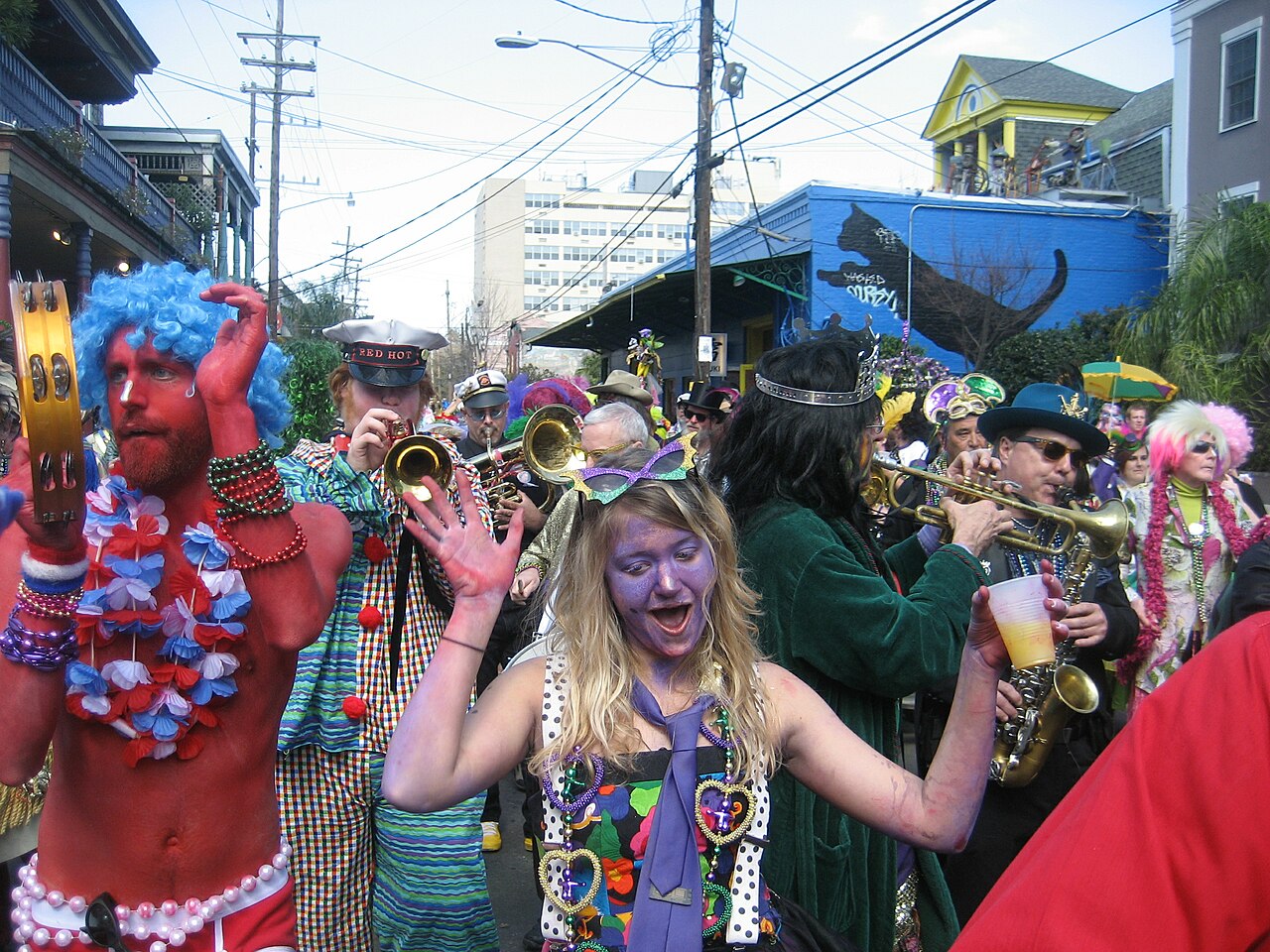
First off, see the article A Brief History of Mardi Gras … TIME, captioned:

Mardi Gras’ reputation as an alcohol-fueled, nudity-filled bacchanal is not completely unearned.  In 1973, a ban was established on Krewe parades in the increasingly rowdy and narrow streets of the French Quarter.  In subsequent years, tourists and other drunken fools descended on the Quarter (especially the particularly saucy Bourbon Street) en masse, and the tradition of showing skin for beads began.  Native New Orleanians despise the reputation, and rarely venture into the Quarter during Carnival season.

Emphasis added, which means “there’s probably some kind of object lesson there…”

The lower image is courtesy of Temptation of Christ – Wikipedia, with the caption, “James TissotJesus Tempted in the Wilderness (Jésus tenté dans le désert) – Brooklyn Museum.”

As to Job being older than any other book in the Bible, see Dating the Book of Job (PDF), which concluded that the book chronicled “events that took place between 1280 and 1270 BC – about 100 years before the Exodus.  As explained in the below excerpt, it is also evident from the text of the book of Job itself that it is older than any other book of the Bible.”

*   *   *   *

On The Presentation of Our Lord

KosmicFrenchmenPurpleFaceMardiGras2009.JPG

 “Revelers” at Mardi Gras…

*   *   *   *

February 4, 2015 – First the good news.  Mardi Gras is less than two weeks away.  (The image above is captioned “Mardi Gras Day, New Orleans: Krewe of Kosmic Debris revelers on Frenchmen Street.”)  The bad news – as some people say – is that Mardi Gras is followed immediately by Lent, a “solemn religious observance” involving some 40 days of “prayer, penance, repentance of sins, almsgiving, atonement and self-denial.” (Wikipedia.)

And incidentally, that’s not 40 days straight of “self-denial.”  You get Sundays off to enjoy whatever it is you’ll be giving up for Lent.  (Chocolate, rye whiskey, two dollar cigars, whatever.)  That will be explained in a later post during Lent itself…

In the meantime (again), I haven’t done a post on Sunday Bible readings for awhile.  Aside from Jesus “cracking wise” and Jonah and the bra-burners, the last one I did was On the Bible readings for January 18.   That last post noted the end of the 12 Days of Christmas, on January 6th.  January 6 also marked the start of the Season of Epiphany.  See Christian Resource:

For many Protestant church traditions, the season of Epiphany extends from January 6th until Ash Wednesday, which begins the season of Lent leading to Easter.  Depending on the timing of Easter, this longer period of Epiphany includes from four to nine Sundays.  Other traditions, especially the Roman Catholic tradition, observe Epiphany as a single day, with the Sundays following Epiphany counted as Ordinary Time

As I noted in January 18, “That means the Bible readings for Sundays from now until February 15 will be those readings ‘after the Epiphany.'”  There are some exceptions however, and one of those celebrates the Presentation of Jesus at the Temple.

This Feast Day – which actually falls on February 2 – celebrates the episode in Jesus’ life described in the Luke 2:22–40.   Luke indicated that “Mary and Joseph took the Infant Jesus to the Temple in Jerusalem . . . to complete Mary’s ritual purification after childbirth.” They were also there “in obedience to the Torah (Leviticus 12, Exodus 13:12–15.”

Luke explicitly says that Joseph and Mary take the option provided for poor people (those who could not afford a lamb) (Leviticus 12:8), sacrificing “a pair of turtledoves, or two young pigeons.”  Leviticus 12:1–4 indicates that this event should take place forty days after birth for a male child, hence the Presentation is celebrated forty days after Christmas.

See Presentation of Jesus at the Temple – Wikipedia, the free encyclopedia.  But by church rule, a Feast Day can’t be  moved back, it can only be moved ahead.  So the February 2d Presentation couldn’t be moved back to Sunday February 1.  It had to be moved forward, to February 8.

Accordingly, the Bible readings for Sunday February 8 are those for the Presentation, not the Fifth Sunday after the Epiphany.  Those readings are:  Malachi 3:1-4, Psalm 84 (or Psalm 24:7-10), Hebrews 2:14-18, and – as noted – Luke 2:22-40:

Forty days after the birth of Jesus, the Holy Family travels to Jerusalem to initiate the child into the service of God at the Temple and to offer a modest sacrifice:  the caged pigeons or turtledoves held here by Joseph [shown below, a la James Tissot].  Taking the infant into his arms, the aged priest Simeon acknowledges the child as the Christ, or Messiah.

See Brooklyn Museum: European Art: The Presentation of Jesus.  See also Feast of the Presentation of the Lord – February 02, 2015, which told of the Old Testament reading – Malachi 3:1-4 – foretelling the coming of John the Baptist:  “I am sending my messenger to prepare the way before me.”  Note also that the New Testament reading – Hebrews 2 – said that through His death on the Cross Jesus would “destroy the one who has the power of death … and free those who all their lives were held in slavery by the fear of death.”  (Something else to think about.)

In the meantime (a third time), there’s the upcoming season of Lent to think about.  It starts with Ash Wednesday, February 18, and as I noted in On the readings for Advent Sunday:

… for a time – starting about 300 A.D. – Advent was “kept as a period of fasting as strict as in Lent.”  And just as Lent today is preceded by the celebration of Mardi Gras, so back in the olden days … Advent was preceded by the “feast day of St. Martin of Tours,” in many places “a time of frolic and heavy eating, since the 40-day fast began the next day.”

As Wikipedia noted, tradition says that Lent lasts 40 days “in commemoration of the forty days” that Jesus spent, “before beginning his public ministry, fasting in the desert, where he endured temptation by the Devil.”  But again, that Lenten period of fasting and penance is preceded by the “blow-out” of Mardi Gras, thus reflecting the “rhythmic movement between the poles of fast and feast, Lent and Easter, renunciation and affirmation.”  See To Fast Again by Eamon Duffy.

Or in the words of an old-timey (1962) hit tune:  “To every thing there is a season…  A time to weep, and a time to laugh.  A time to mourn, and a time to dance…

*   *   *   *

The upper image is courtesy of  Mardi Gras – Wikipedia:

Mardi Gras is French for “Fat Tuesday”, reflecting the practice of the last night of eating richer, fatty foods before the ritual fasting of the Lenten season…  Popular practices on Mardi Gras include wearing masks and costumes, overturning social conventions, dancing, sports competitions, parades, debauchery, etc.

The original post had a lower image  courtesy of Brooklyn Museum: European Art: The Presentation of Jesus in the Temple, which added a commentary on some predecessors including Tintoretto:

Throughout his commentaries, Tissot refers to both historical and modern sources to demonstrate his extensive knowledge of the Temple precinct in ancient Jerusalem.  He locates the Presentation at the top of the steps that led to the altar of burnt sacrifice.  Further, he takes to task the sixteenth-century Venetian painter Tintoretto, one of his most illustrious art-historical predecessors, for inaccurately rendering the stairway, instead insisting very specifically on a shallow rise for the individual steps, as documented by the historical writers he consulted.

Re: Old-timey hit tune.  See Turn! Turn! Turn! – Wikipedia, the free encyclopedia, describing the 1962 hit by the “American folk rock band The Byrds…   The lyrics are taken almost verbatim from the Book of Ecclesiastes (late 3rd century BC), as found in the King James Version (1611) of the Bible (Ecclesiastes 3:1-8), though the sequence of the words was rearranged for the song.”  See also TURN! TURN! TURN! (Lyrics) – THE BYRDS – YouTube.

*   *   *   *

On St. Agnes and 12-year-old girls

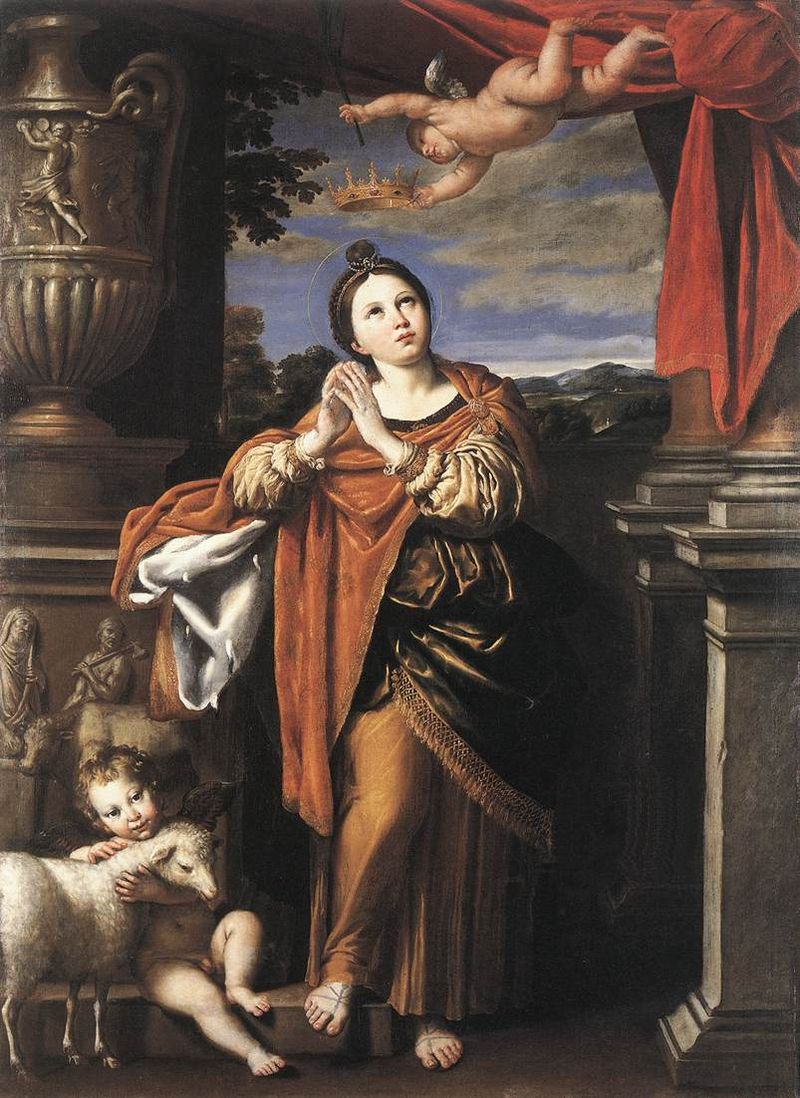
2872-saint-agnes-domenichino.jpg

Saint Agnes by Domenichino


Today – January 21st – is the Feast Day of St. Agnes, “martyred at Rome.”   She’s one of the lesser-known saints, but her story deserves some notoriety, in a good way.

Agnes was born into a wealthy Roman family in 291 and was martyred when she was 12 or 13. (The dates are a little iffy.)   This happened in large part because her wealthy Roman family was secretly Christian.  At the time, Christianity was an illegal “cult.”

(At least it was a cult to the powers that be; the authorities of the Imperial Roman Empire.  It wasn’t until 313 – some 22 years later – that the new Emperor Constantine converted and then issued “the Edict of Milan decriminalizing Christian worship.”)

But Agnes was also martyred in part because she wouldn’t “put out” for the local hotspurs:

Agnes, whose name means “chaste” in Greek, was a beautiful young girl of wealthy family and therefore had many suitors of high rank…  [T]he young men, slighted by Agnes’s resolute devotion to religious purity, submitted her name to the authorities as a follower of Christianity.

See Agnes of Rome – Wikipedia.  But that wasn’t the worst part.

The worst part was the “Prefect Sempronius condemned her to be dragged naked through the streets to a brothel,” where the local Roman troops would have their way with her.   But one legend said “as she prayed, her hair grew and covered her body.”  In another legend all the men who tried to “rape her were immediately struck blind.”  Then for some reason Sempronius excused himself, and another judge sentenced her to die.  Then this happened:

[S]he was tied to a stake, but the bundle of wood would not burn, or the flames parted away from her, whereupon the officer in charge of the troops drew his sword and beheaded her, or, in some other texts, stabbed her in the throat.

So for reasons that by now should be readily apparent, the 12-year-old Agnes was deemed the patron saint of [chaste] young girls.  “Folk custom called for them to practice rituals on Saint Agnes’ Eve (20–21 January) with a view to discovering their future husbands.

This superstition has been immortalised in John Keats‘s poem, ‘The Eve of Saint Agnes.'”

Incidentally, the article on Keats’ poem added an interesting twist (shown in the painting below):

Keats based his poem on the superstition that a girl could see her future husband in a dream if she performed certain rites on the eve of St. Agnes;  that is she would go to bed without any supper, undress herself so that she was completely naked and lie on her bed with her hands under the pillow and looking up to the heavens and not to look behind.  Then the proposed husband would appear in her dream, kiss her, and feast with her.

All of which is fascinating, but we digress…

The fact that Agnes is one of the lesser-known leads to a reasonable question.  What’s all this patron-saint business anyhow?  On that note see Patron saint – Wikipedia:

A patron saint [is] regarded as the tutelary spirit or heavenly advocate of a nation, place, craft, activity, class, clan, family, or person…  [A]lready transcended to the metaphysical, [they] are able to intercede effectively for the needs of their special charges.

See also Patron Saints – American Catholic:  “Certain Catholic saints are associated with certain life situations.  These patron saints intercede to God for us.  We can take our special needs to them and know they will listen to our prayers, and pray to God with us.”  (Wikipedia said such practices are deemed “a form of idolatry” by “branches of Protestantism such as Calvinism.”)

Be that as it may, patron saints are remembered each year by celebrating Feast Days:

The calendar of saints is [a] Christian method of organizing a liturgical year by associating each day with one or more saints and referring to the day as the feast day or feast of said saint.  (The word “feast” [here] does not mean “a large meal, typically a celebratory one”, but instead “an annual religious celebration, a day dedicated to a particular saint”.)

See also CATHOLIC ENCYCLOPEDIA: Ecclesiastical Feasts:  “Feast Days, or Holy Days [‘holidays’] are days [commemorating] the sacred mysteries and events recorded in the history of our redemption…   A feast not only commemorates an event or person, but also serves to excite the spiritual life by reminding us of the event it commemorates.”

Which is also what this blog tries to do:  “excite the spiritual life.”

In today’s case we remember Saint Agnes, patron saint of young girls.  (In folk custom, young girls lying abed, awaiting a vision of their future husbands…)


Madeleine undressing, painting by John Everett Millais…”


The upper image is courtesy of Agnes of Rome – Wikipedia.

Re: “hotspurs.”  See Henry Percy (Hotspur) – Wikipedia, which noted: “Henry Percy, ‘Hotspur’, is one of [William] Shakespeare’s best-known characters,” based on a real-life “Sir Henry Percy KG (1364-1403), commonly known as Sir Harry Hotspur, or simply Hotspur.”  Sir Henry was known as “one of the most valiant knights of his day, and was a significant captain during the Anglo-Scottish wars.  He later led successive rebellions against Henry IV of England, and was slain at the Battle of Shrewsbury in 1403 at the height of his career.”

Today a hotspur is generally defined as “an impetuous or fiery person  an impetuous or reckless person; a hothead,” or someone “who is rash, impetuous or impulsive.”  In other words, “a typical [young] guy.”  There is also the Tottenham Hotspur, an “English football club whose home ground is at White Hart Lane in the north London district of Tottenham.  It was established in 1882 and has had many successes. In 1961 it became the first club in the 20th century to win both the League Championship and the FA Cup in the same season. It has won the FA Cup eight times and the League Championship twice.”

The lower image is courtesy of in “John Keats‘s poem, ‘The Eve of Saint Agnes.'”  The latter site provided the caption, referring to Madeline, one of the two main characters in the poem.  “Madeline pines for the love of Porphyro, sworn enemy to her kin…  In the original version of his poem, Keats emphasized the young lovers’ sexuality, but his publishers, who feared public reaction, forced him to tone down the eroticism.”


On the 12 Days of Christmas

“Twelfth Night (The King Drinks)…”


The Scribe left town at 5:00 on the afternoon of Sunday December 21, thinking that he had already published this post on the “12 Days of Christmas.”  But somewhere along the line he dropped the ball – metaphorically or otherwise – and here it is, Sunday, January 4th.

So here in its original form is the post I planned to publish two weeks ago…

*   *   *   *

I’m heading north to face the icy arctic blasts of Yankee-land for Christmas.  I need to cover the week or so until my return, so here’s an ode to the “12 days of Christmas.”  That’s both a festive Christian season and title of a host of songs and spin-offs (including one on a Mustang GT):

The Twelve Days of Christmas is the festive Christian season, beginning on Christmas Day (25 December), that celebrates the birth of Jesus Christ, as the Son of God.  This period is also known as Christmastide…   The Feast of the Epiphany is on 6 January [and] celebrates the visit of the Wise Men (Magi) and their bringing of gifts to the child Jesus.  In some traditions, the feast of Epiphany and Twelfth Day overlap.

See Twelve days of Christmas, which is included within the article The Twelve Days of Christmas (song) – Wikipedia.  The song began as an English Christmas Carol – thought to be of French origin – first published in 1780.  It’s a “cumulative song,” meaning each verse “is built on top of the previous verses.”   Each verse describes a gift from “my true love” on one of the 12 days of Christmas.   And as most people know – by hearing them ad nauseum starting weeks before Thanksgiving – there are “many variations in the lyrics.”

One common theory is that the original lyrics were part of a “secret Catholic code:”

In 1979, a Canadian hymnologist, Hugh D. McKellar, published an article, “How to Decode the Twelve Days of Christmas”, claiming that [the] lyrics were intended as a catechism song to help young Catholics learn their faith…  McKellar offered no evidence for his claim and subsequently admitted that the purported associations were his own invention.  The idea was further popularized by a Catholic priest, Fr. Hal Stockert, in an article he wrote in 1982…   In 1987 and 1992, Fr. James Gilhooley, chaplain of Mount Saint Mary College of Newburgh, New York, repeated these claims.   None of the enumerated items would distinguish Catholics from Protestants, and so would hardly need to be secretly encoded.

See Twelve Days (above), and also 12 Things You Might Not Know About “The Twelve Days”.  The latter noted the story that “from the 16th to the 19th century, when being a Catholic was a crime in Protestant England,” Catholic children used the song to learn their faith.

But for one thing, all 12 gifts in the code – “the books of the Bible, the six days of creation, etc.” – were revered by Protestants as much as they were by Catholics.  “For another thing, this rumor seems to have popped up in the last 25 years, and then spread like wildfire, as such things do, on the interwebs [sic], without reference to any original sources.”  (On a related noted, see On “Gone Girl” and Lazy Cusses – Part I, about things “spreading like wildfire” in today’s media, with the Biblical example of the Apostle Paul almost being lynched by rioters in Jerusalem.)

I discussed the festival of the 12 Days of Christmas back on November 21, in On coming home from a pilgrimage and the coming holidays.  That post included such topics as the “old-time winter festival that started on Halloween and ends on January 6, also called Plough Monday.”  It also discussed the fact that Shakespeare’s play Twelfth Night “expanded on the musical interludes and riotous disorder expected of the occasion,” that is, the “occasion of the ‘drunken revelry’ of 12th Night,” as shown by the King drinks painting above.


So here’s wishing you a happy and prosperous 12th Night, Plough Monday, and/or whole New Year!


“Plough Monday,” which ends the full Season of Christmas, on January 6…


The upper image is courtesy of The Twelve days of Christmas, with caption, “Twelfth Night (The King Drinks) by David Teniers c. 1634-1640.”

The lower image is courtesy of Plough Monday – The Hymns and Carols of Christmas.  See also Plough Monday – Wikipedia.

*  On the subject of meditating on the Bible, see for example Psalm 1:2, “Their delight is in the law of the Lordand they meditate on His law day and night;”  Psalm 77:12, “I will consider all your works and meditate on all your mighty deeds;”  Psalm 119:15, “I meditate on your precepts and consider your ways;”  Psalm 119:23, “The evil have been sitting and plotting against me, but I have been meditating upon your commandments;”  and Psalm 119:48, “I will lift up my hands toward your commandments, which I love, and I will meditate on your statutes.”

Incidentally, Psalm 119 – where three of the five quotes above came from – “is the longest psalm as well as the longest chapter in the Bible…    It is the prayer of one who delights in and lives by the Torah, the sacred law.  With its 176 verses, Psalm 119 has more verses than 14 Old Testament Books and 17 New Testament Books.”  See Psalm 119 – Wikipedia.


Sources for this post include Twelve Days of Christmas (song) – Wikipedia and The Twelve days of Christmas added that many different saint feast days fall within the twelve days of Christmas, “but they are not part of the Twelve Days themselves…   St. Stephen’s Day, for example, is 26 December in the Western Church and 27 December in the Eastern Church.  28 December is Childermas/Feast of the Holy Innocents.”  In Great Britain and it’s “former colonies, 26 December is also known as Boxing Day, a secular holiday.”  Finally, the “12 Days” are celebrated differently throughout the world:  “Some give gifts only on Christmas Day, some only on Twelfth Night, and some each of the twelve nights.” 

See also December solstice – Time and Date:  “Even Christmas celebrations are closely linked to the observance of the December solstice.”  For example, “Although winter was regarded as the season of dormancy, darkness and cold, the coming of lighter days after the winter solstice brought on a more festive mood.  To many people, this return of the light was a reason to celebrate that nature’s cycle was continuing.”  Further, “Some believe that celebrating the birth of the ‘true light of the world’ was set in synchronization with the December solstice because from that point onwards, the days began to have more daylight in the Northern Hemisphere.”  Note too that the term Yule “may have derived from the Norse word jól, referring to the pre-Christian winter solstice festival.”

And finally – for the sake of completeness – see Jeff Foxworthy – Redneck 12 Days Of Christmas Lyrics, and/or 12 Redneck Days of Christmas by Jeff Foxworthy – YouTube.