Author Archives: dorscribe@aol.com

John the Baptist, ’24 – and “Christian First Graders…”

*   *   *   *

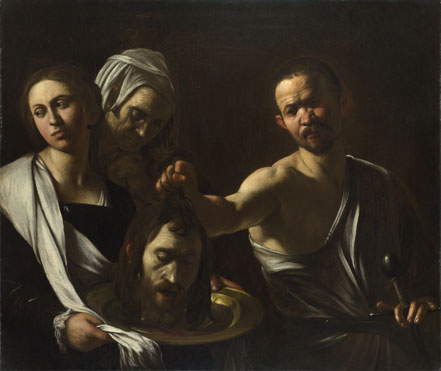
“Salome receives the Head of John the Baptist” – the man crying out in the Wilderness

*   *   *   *

June 21, 2024 – “The Bible was designed to expand your mind.”

That’s the new theme for this blog. Or rather, it’s the new restatement of the theme. And by the way, that restatement can be said to the tune, “If It Doesn’t Fit, You Must Acquit.” (Which will be hilarious for “people of a certain age.”) Another restatement? The idea of “Christian first-graders.” As in, Christians who never go beyond first grade when it comes to reading, studying and interpreting the Bible. Which to me applies to those Literalists and Fundamentalists who both cheat themselves and drive away new recruits in droves – especially the young.

On the contrary, John 4:24 says “God is Spirit, so those who worship him must worship in spirit and in truth.” And 2d Corinthians 3:6 says that in and through Jesus, God “hath made us able ministers of the new testament; not of the letter, but of the spirit: for the letter killeth, but the spirit giveth life.” (That’s from the King James Bible, the one God uses.) And finally there’s Romans 2:29, where Paul distinguished people who conform outwardly but miss the point “in their innards.” Using an allegory from his former life – before the Damascus Road experience changed that life – Paul said, “Rather, a person is a Jew who is one inwardly, and real circumcision is a matter of the heart – it is spiritual and not literal.” (Emphasis added.)

Incidentally, I ran across that Romans 2:29 quote while reading the Daily Office the day I posted this. (Coincidence?) But back to the subject at hand. I’ll be writing more about Christian First Graders in the future, but this post is supposed to be about John the Baptist, who literally had his head handed to him on a plate. (As shown in the painting above.)

Specifically, today is the Feast Day for the Nativity of John the Baptist. It celebrates the birth of the one “who foretold the coming of the Messiah in the person of Jesus, whom he later baptised.” The Bible readings: Isaiah 40:1-11Psalm 85Acts 13:14b-26, and Luke 1:57-80. Luke tells of Elizabeth – cousin of Mary (mother of Jesus) – and how her husband got struck dumb.

The time came for Elizabeth to give birth, and she bore a son.  Her neighbors and relatives heard that the Lord had shown his great mercy to her, and they rejoiced…  [T]hey were going to name him Zechariah after his father.  But his mother said, “No; he is to be called John.”  They said to her, “None of your relatives has this name.”  Then they began motioning to his father to find out what name he wanted to give him.  He asked for a writing tablet and wrote, “His name is John…”

The story of Zechariah getting struck dumb starts at Luke 1, verses 5-7. He was a member of the “priestly order of Abijah,” and he and Elizabeth were righteous before God but also old and childless. Then God sent an angel to tell Zechariah he was about to become a father. He got struck dumb because he doubted the message from God. (He should have accepted on faith what was, to him, counterintuitive. “A lesson for all you young kids out there!”)

That is, nine months earlier – as Zechariah was doing his priestly duties in the inner sanctuary – the angel Gabriel appeared and told him Elizabeth would bear a son. But he doubted:  “How will I know that this is so?  For I am an old man, and my wife is getting on in years.“  And that was why he was struck dumb.  As Gabriel told him, “Since you didn’t believe what I said, you will be silent and unable to speak until the child is born.” Luke 1:20.

The result? Zechariah wrote out, “His name is John.” Then came Luke 1:64, saying right after he wrote his son’s name, “Immediately his mouth was opened and his tongue freed, and he began to speak, praising God.” Right after that came the Benedictus, Zechariah’s “song of thanksgiving … on the occasion of the birth of his son.” (And – no doubt – on being able to speak again):

The second part … is an address by Zechariah [to John], who was to take so important a part in the scheme of the Redemption; for he was to be a prophet, and to preach the remission of sins before the coming or the Dawn from on high. The prophecy that he was to “go before the face of the Lord to prepare his ways” [Luke 1:76,] was an allusion to the well-known words of Isaiah 40:3 which John himself afterwards applied to his own mission (John 1:23).

Luke 1:80 then says the child “grew and became strong in spirit; and he lived in the wilderness until he appeared publicly to Israel.” In turn John was a “key figure in the preparation of the Messiah’s work.” Unfortunately, that advance work included a gruesome death by beheading, as told in Mark 6:14–29: “the king sent a soldier of the guard with orders to bring John’s head. He went and beheaded him in the prison, brought his head on a platter, and gave it to [Salome]… When his disciples heard about it, they came and took his body, and laid it in a tomb.”

But we’re getting ahead of ourselves. On this June 24th we celebrate the birth of John the Baptist, who in his lifetime performed an invaluable service as forerunner and advance man for Jesus. May we too perform such “invaluable service,” as for example by bringing more people to Jesus. Especially those put off by Christian First Graders who ignore the message that the “the Bible was designed to expand your mind.” (It was not designed to lord political power over those who dare disagree with us.) Of course all this while keeping in mind that John’s life and especially his gruesome death serve as a reminder that, as one Christian mystic said:

It is to vigor rather than comfort that you are called.”

*   *   *   *

Salome – who beguiled her dad (Herod II) into beheading John the Baptist…

*   *   *   *

The upper “Salome” image is courtesy of nationalgallery.org.uk/paintings/caravaggio: “The subject is from the New Testament [Mark 6, verses 14-29]. Salome had danced so well for King Herod that he swore he would grant her any request. Her mother, Herodias, who sought revenge on John the Baptist, persuaded Salome to ask for his head.  The old woman behind Salome may be Herodias.”

The Book of Common Prayer reference: The “corporate-mystical” prayer is on page 339, the post-communion prayer for Holy Eucharist, Rite I.

“Feast days” are designated days on the liturgical (church) calendar “set aside to commemorate events, saints, or doctrines that are important in the life of the Church. These can range from Solemnities, which are the highest-ranking feast days like Easter and Christmas, to optional memorials that celebrate lesser-known saints.” Feast Days: Celebrating the Church’s Calendar.

For this post I borrowed from On the Nativity of John the Baptist – 2015, John the Baptist, Peter and Paul – 2016, On “John T. Baptist,” Peter and Paul – 2021, and On John “T. Baptist” – 2023 (et alia).

Re: “Innards.” The link points to the term as from the Old English inweard “inmost; sincere; internal, intrinsic; deep.” (Which I didn’t know before doing this.)

The “vigor-comfort” is from Practical Mysticism, with advice for the Christian First Graders:”

Hearing now and again the mysterious piping of the Shepherd, you realize your own perpetual forward movement . . . and so are able to handle life with a surer hand.  Do not suppose from this that your new career is to be perpetually supported by agreeable spiritual contacts, or occupy itself in the mild contemplation of the great world through which you move.  True, it is said of the Shepherd that he carries the lambs in his bosom; but the sheep are expected to walk, and to put up with the bunts and blunders of the flock.  It is to vigor rather than comfort that you are called.  (E.A.)

Evelyn Underhill, Ariel Press (1914), at page 177. See also Evelyn Underhill – Wikipedia.

The lower image is courtesy of Salome – Wikipedia. The caption: “‘Salomé,’ by Henri Regnault (1870).” The article added that this Salome (III) was…

…a Jewish princess, the daughter of Herod II, who was the son of Herod the Great, with princess Herodias. She was granddaughter of Herod the Great, and stepdaughter of Herod Antipas. She is known from the New Testament, where she is not named, and from an account by Flavius Josephus. In the New Testament, the stepdaughter of Herod Antipas demands and receives the head of John the Baptist.

*   *   *   *

June ’24, St. Barnabas and second chances…

*   *   *   *

Can we still “grow” after death? Even not quite in heaven? Do we get a “second chance?”

*   *   *   *

June 12, 2004 – As noted in the last post, we are now in what Catholics call Ordinary Time. Others – including myself – call it the Season of Pentecost. That long church season – it can take up half a year – starts on Pentecost Sunday (last May 19). It isn’t over until the First Sunday of Advent. (This year, December 1.) So in the Revised Common Lectionary (what I use) we are now in “Proper 5,” the week of the Sunday closest to June 8. And on June 11 of this week, we remember the Feast Day of Saint Barnabas, who we may call “Apostle of Second Chances.”

Which – when it comes to God’s final judgment – can offer some good hope. As does the idea of Purgatory, even though my – the – Episcopal church rejects that idea as a “Romish Doctrine.” But me? I’m all for it. I hope it’s true. “Hey, I’ll take all the help I can get!”

There’s more on Purgatory-as-second-chance below, but first, back to Barnabas.

The Bible first mentions him in Acts 4:36:  “Joseph, a Levite, born in Cyprus, whom the apostles called Barnabas (son of encouragement), sold a field he owned, brought the money, and turned it over to the apostles.” And the site Barnabas the Apostle – Justus added that even after Paul’s Damascus Road experience, most Christians in Jerusalem “wanted nothing to do with him. They had known him as a persecutor and an enemy of the Church. But Barnabas was willing to give him a second chance.” (Which is pretty much what Jesus is all about.)

In short, if it hadn’t been for Barnabas willing to give Paul a second chance – Paul, once the most zealous persecutor of the early Church – he might never have become that Church’s most important early convert, if not the “Founder of Christianity.” But then came an ironic twist, after Barnabas gave that new “Apostle Paul” his Second Chance:

Paul and Barnabas went on a missionary journey together, taking Mark with them. Part way, Mark turned back and went home. When Paul and Barnabas were about to set out on another such journey, Barnabas proposed to take Mark along, and Paul was against it, saying that Mark had shown himself undependable. Barnabas wanted to give Mark a second chance [again] and so he and Mark went off on one journey, while Paul took Silas and went on another. Apparently Mark responded well to the trust given him by the “son of encouragement,” since we find that Paul later speaks of him as a valuable assistant (2 Tim 4:11; see also Col 4:10 and Phil 24) .

So again, we might just call Barnabas “the Apostle of Second Chances.”

Which raises a question: If Barnabas – as God’s servant – was willing to give both Paul and Mark a second chance, why wouldn’t God do the same thing for us? Which brings up the idea of Purgatory. (Even though some refer to it a “Romish doctrine.”)

I did some new research on the subject (listed in the Notes), and from what I can glean the Episcopal opposition stems from two offshoots. First, the idea that purgatory necessarily involves a lot of pain, suffering and anguish. And second, that people in the Middle Ages could get their dear-departed relatives released from such pain, suffering and anguish – and on to the blessings of heaven – by paying substantial sums of money to the Catholic Church. (Indulgences, the abuse of which led to Martin Luther’s Ninety-five Theses.)

Which is why my two favorite – and comforting – Bible passages are John 6:37 and Romans 10:9. In the first Jesus promised that He would never turn away anyone who comes to Him. In the second Paul said, “if you confess with your mouth that Jesus is Lord and believe in your heart that God raised him from the dead, you will be saved.” No ifs, ands, or buts.

In the meantime that idea of Purgatory-as-second-chance is just one of many mysteries we can’t fully understand. (Yet.) Still, there are some Christians who hate that sense of uncertainty, of “having to totally rely on an Unseen Force” that is such a part of a real Christian’s life. Those “other Christians” choose to act as if they know all there is to know about the Bible. “The Bible says it, I believe it, and that settles it.” To them I would say, “Consider Thomas Jefferson.”

As smart as he was, Jefferson never could comprehend the Trinity [a]s God in three Persons. But it seems that he – like many of us – fell into a common error: Thinking he could ever “really understand everything there is to know about God.” But like many parts of the Bible, the Trinity is simply beyond our ability to comprehend, fully. “It’s a reality we may only begin to grasp.” 

On that note, consider John’s Gospel, 21:25: “Jesus also did many other things. If they were all written down, I suppose the whole world could not contain the books that would be written.” Or Psalm 40:5, in various translations, basically saying God’s wonderful deeds “are more than can be told.” Or Isaiah 55:8. In the NLT: “’My thoughts are nothing like your thoughts,’ says the LORD. ‘And my ways are far beyond anything you could imagine.’” Or as one professor put it, “in the final analysis, our human minds are just too limited to ever fully understand ‘God:’”

We are simply not up to the task, not wired for such an overload.  We are no more prepared to comprehend an answer than – to make use of a memorable example – cats are prepared to study calculus.  It’s just not in our nature.

In sum, the early Church benefited greatly because Barnabas gave both Paul and Mark a second chance, and if only for that we celebrate his life on June 11. Which leads to a reasonable guess that God is willing to give us some second chances – maybe even seventy times seven. (Though I wouldn’t want to bet my life on that.) And maybe even in the form of Purgatory as a halfway house to heaven. But in the meantime, all we can do is keep remembering men like Barnabas, and trying to understand God and His mercy, like a “cat studying calculus…”

*   *   *   *

*   *   *   *

The upper image is courtesy of Spiritual Growth – Image Results. Morihei Ueshiba (1883-1969), was the Japanese martial artist who founded aikido. In his lifetime he had three transforming spiritual experiences. The second came in 1940 “when engaged in the ritual purification process of misogi.”

Around 2 a.m., I suddenly forgot all the martial techniques I had ever learned. The techniques of my teachers appeared completely new. Now they were vehicles for the cultivation of life, knowledge, and virtue, not devices to throw people with.

Wikipedia. See also ‘Be Clean’: Jesus and the World of Ritual Impurity and Ritual purification – Wikipedia. Also John 10:16, “I have other sheep that are not of this fold. I must bring them too.”

The Book of Common Prayer reference: The “corporate-mystical” prayer is on page 339, the post-communion prayer for Holy Eucharist, Rite I.

“Feast days” are designated days on the liturgical (church) calendar “set aside to commemorate events, saints, or doctrines that are important in the life of the Church. These can range from Solemnities, which are the highest-ranking feast days like Easter and Christmas, to optional memorials that celebrate lesser-known saints.” Feast Days: Celebrating the Church’s Calendar.

For this post I borrowed from On St. Barnabas (2014), On D-Day and St. Barnabas – 2021, and from 2022, Catching up from my “Big Apple” trip.

On purgatory as a “Romish doctrine.” See page 872 of the Book of Common Prayer:

The Romish Doctrine concerning Purgatory, Pardons, Worshipping and Adoration, as well of Images as of Relics, and also Invocation of Saints, is a fond thing, vainly invented, and grounded upon no warranty of Scripture, but rather repugnant to the Word of God.

That’s “XXII” of the Articles of Religion, established “on the twelfth day of September, in the Year of our Lord, 1801.” On the other hand, in doing this post I found the link In Search of the “Romish Doctrine” of Purgatory. The article indicated the rejection came because of “Romish” abuses like the selling of Indulgences and the idea that such a state necessarily involved suffering and punishment. (Which could be relieved by the living paying money to the church on behalf of the departed.) The “‘Romish doctrine concerning purgatory’ … is rejected by the Article, as are its consequent abuses… Yet, as mentioned in the previous commentary, a number of Anglican authors have acknowledged the possibility of spiritual growth among the faithful departed.” (Which I certainly look forward to.) In sum, “the Article can plausibly be unde[r]stood as excluding only ‘the Romish doctrine concerning purgatory,’ rather than any and all doctrines of spiritual purification among the faithful departed.”

All of which is one of those Rabbit Trails I so dearly love, writing and blogging. (On the negative side see How To Avoid Rabbit Trails – Laura Earnest. As if they were a bad thing?) See also Thanksgiving 2023 – and an “epileptic Rabbit Trail,” where I wrote about my tendency to follow them:

I do a lot of that in my writing. That’s why my family and others say my writing “goes all over the place.” Like, sometimes I go “off on a crazy tangent” or make crazy turns in writing. But I like rabbit trails, even as I try to follow that rule about Unity and Coherence in Writing

On Paul as founder of Christianity. See Who Is the Founder of Christianity – Beliefnet, or Google “paul as founder of Christianity.”

I mentioned the cats and calculus in The wisdom of Virgil – and an “Angel,” from Timothy Shutt‘s Lecture 11 in his course, Hebrews, Greeks and Romans:  Foundations of Western Civilization

The lower image is courtesy of Cat Studying Calculus … Image Results. Note that the cat is actually studying physics, not calculus. See also Your Cat Probably Understands Physics – Business Insider.

*   *   *   *

On a related note, I’m researching an update on comparing Bible Literalists, Fundamentalists (etc.) to “Boot camp Christians,” as noted above. I’m thinking a more effective allegory would talk about Christians who choose – Biblically speaking – not to go beyond elementary school, or maybe even First grade. See Wikipedia, and The Guide to 1st Grade – Scholastic. “First grade is packed with important and exciting transitions as children leave behind much of the play of preschool and kindergarten, and begin to develop more academic skills.”

Your child will also go through a significant transition to more extensive learning. As your child adjusts, they may get tired at the end of the day or have trouble focusing as the day progresses — that’s normal… Most importantly, prime your child for success by continuing the learning process at home with enriching books and activities that support what they’re learning in class.

All of which seems pregnant with possibilities for further allegorical exploration. And by the way, that and the above reference refer to Galatians 4:24, “The women [Sarah and Hagar] represent two covenants. One covenant is from Mount Sinai and bears children who are to be slaves: This is Hagar.” Which raises the question: “How do you literally interpret an allegory? Or for that matter a parable?”

On Pentecost Sunday – 2024

*   *   *   *

“Commemorating the descent of the Holy Spirit – the very first Pentecost Sunday

*   *   *   *

Before this week’s post on Pentecost Sunday, I reviewed two posts from the distant past. I updated and revamped them on Friday, May 17. First, On Jonah and the bra-burners, from January 2015, then The True Test of Faith, from February 2014. And they needed updating…

The Jonah post talked of the whale in the story as an “attention getter” that got out of hand, like feminists burning bras at 1968’s Miss America pageant. That got attention, but ended up a trivializing “negative and trite association.” (The post added that the real message of Jonah is that God’s love is universal.) The “true test” post talked of how some might handle dying and finding out there is no God. (And how I got assured by the First law of thermodynamics.)

Now it’s time to move on to Pentecost Sunday, 2024, but first a story of my own.

I graduated high school in 1969 and went off to college. Like many young people who do that I stopped going to church. That lasted until 1987 when I met Karen, the lady who became my first wife. She died in 2006, after 19 years together, but in 1987 she was looking for a church to call home. She tried many, and I started going to these different churches with her.

She found a place, “Faith Community” south of Largo (FL), and soon her daughter Candy started going too. One Sunday Karen and I got there after the service started. We entered the front hallway and heard a strange murmuring from inside the main auditorium. Then Candy burst out and announced, “these people are crazy!” It seems every one of the 200 or so people inside were “speaking in tongues.” It freaked Candy out, and I wasn’t too crazy about it either. And it wasn’t long after that I said to Karen, “I have an idea. Why don’t we try the church I grew up in. St. Dunstan’s here in Largo.” We tried it and she loved it. We got married there on Valentine’s Day, 1993, and Bishop Harris confirmed her the following February 28.

The point? I may not have returned to “the church of my yoot” if it hadn’t been for the babblers – those “speakers in tongues” – back in 1987. The connection is that Pentecost is also called “Tongue Sunday.” That’s partly because of those Tongues of Fire discussed further below, and because some onlookers expressed the functional equivalent of “those people are crazy!” Just like Karen’s daughter Candy did in 1987, hearing people ostensibly speaking in tongues. (The Lord does indeed work in mysterious ways.)

Back on track: First of all, “Pentecost” comes from the Greek for “50th day.” It always comes 50 days after Easter Sunday.  (Seven weeks plus one day.) And it’s been around a long, long time. (Wikipedia said the feast in Judaism is called Shavuot, and celebrates the giving of the Law on Sinai.) Yet another name for Pentecost is Tongue Sunday, as noted.

There were the “tongues of fire,” but also the disciples “spoke in tongues.” (Glossolalia.) As it says in Acts 2:4, “All of them were filled with the Holy Spirit and began to speak in other tongues as the Spirit enabled them.“ That made some onlookers skeptical. As noted in Acts 2:12 and 13, some who saw the event were amazed, but “others sneered and said, ‘They are filled with new wine!’” But as Isaac Asimov noted, the Apostles weren’t just “babbling.”

They spoke in known languages. People from different nations understood. Asimov wrote: “In their ecstasy, they uttered phrases in a number of languages,” including the marketplace Koine Greek used in the Roman Empire as well as the disciples’ native Aramaic. Those “who listened to them from the various nations … would have understood something.” Acts 2, verse 8-11:

“How is it that we hear, each of us, in our own native language?  Parthians, Medes, Elamites, and residents of Mesopotamia, Judea and Cappadocia, Pontus and Asia, Phrygia and Pamphylia, Egypt and the parts of Libya belonging to Cyrene, and visitors from Rome, both Jews and proselytes, Cretans and Arabs – in our own languages we hear them speaking about God’s deeds of power.” (Emphasis added.)

Of course all that is well and good, but the important thing about Pentecost Sunday as described in Acts is that it was a “momentous, watershed event.” For the first time in history, God empowered “all different sorts of people for ministry.” That was drastically different from Old Testament times, when “the Spirit was poured out almost exclusively on prophets, priests, and kings.” But on this first Pentecost Sunday the Holy Spirit was given to all people. All of us, from that day forward, were “empowered to minister regardless of their gender, age, or social position.” (What is Pentecost? Why Does It Matter? – Patheos.)

And finally, Pentecost Sunday is when we get to say, “Happy Birthday, Church!”

Before the events of the first Pentecost – a few weeks after Jesus’ death and resurrection – there were followers of Jesus, but there was no movement that could be meaningfully called “the church.” So, from a historical standpoint, Pentecost is the day when the Church as we know it was started. (“The Spirit brings the church into existence and enlivens it.”) 

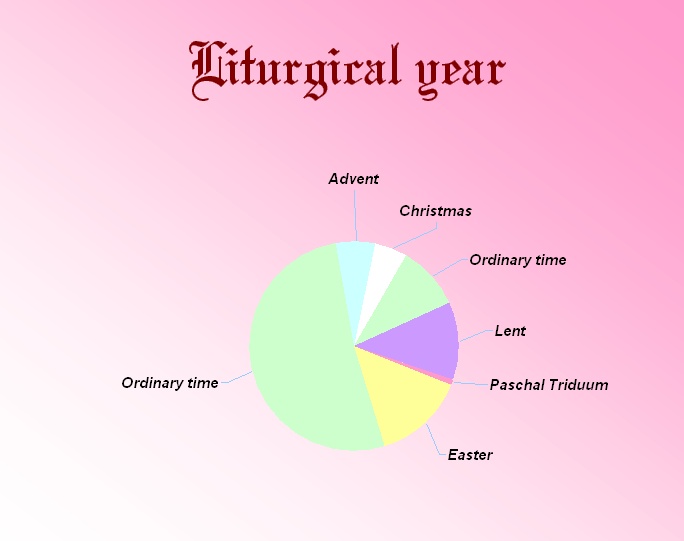
So here’s wishing you a “Happy Birthday, Church,” and also a Happy Pentecost, both the day and the season. (A season that can take up half the church year, as shown below.)

*   *   *   *

Ordinary Time” – Pentecost Season – can take up half the Church year…

*   *   *   *

The upper image was originally courtesy of Pentecost Sunday Images – Image Results. But see also El Greco – Pentecost, 1610 at Prado Museum Madrid Spain, which I went on to “glean.” The caption is from the Wikipedia article, gleaned from the following: “The Christian High Holy Day of Pentecost is celebrated on the 50th day (the seventh Sunday) from Easter Sunday. It commemorates the descent of the Holy Spirit upon the Apostles and other followers of Jesus Christ while they were in Jerusalem celebrating the Feast of Weeks, as described in the Acts of the Apostles (Acts 2:1–31).”

The Book of Common Prayer reference: The “corporate-mystical” prayer is on page 339, the post-communion prayer for Holy Eucharist, Rite I.

“Feast days” are designated days on the liturgical (church) calendar “set aside to commemorate events, saints, or doctrines that are important in the life of the Church. These can range from Solemnities, which are the highest-ranking feast days like Easter and Christmas, to optional memorials that celebrate lesser-known saints.” Feast Days: Celebrating the Church’s Calendar.

For this post I borrowed from On Pink Floyd and Pentecost Sunday – 2021, Pentecost 2020 – “Learn what is pleasing to the Lord,” and – from 2015, On Pentecost – “Happy Birthday, Church!”

Confirmation in the Episcopal Church is the sacramental rite in which the confirmands “express a mature commitment to Christ, and receive strength from the Holy Spirit through prayer and the laying on of hands by a bishop.”

Re: “Church of my yoot.” Referring to what I call the My Cousin Vinny psalm. Psalm 25:6 reads, “Remember not the sins of my youth.” Or “yoot,” as in “Dese two yoots.”

Also, the “more boring detail” follows these standard notes, separated by another four asterisks.

The lower image is courtesy of Liturgical year – Wikipedia. See also Ordinary Time – Wikipedia.

*   *   *   *

Here’s that “more boring detail,” some of which I may use in future posts. For one thing I researched this speaking-in-tongues business and found 1st Corinthians 14, where the Apostle Paul talked a lot about it. In verse 19, “in the church I would rather speak five intelligible words to instruct others than ten thousand words in a tongue.” Verse 23, “if the whole church comes together and everyone speaks in tongues, and inquirers or unbelievers come in, will they not say that you are out of your mind?”

Also, “babbling” can mean the “sound of people talking simultaneously,” or to “talk rapidly and continuously in a foolish, excited, or incomprehensible way,” or to utter meaningless or foolish words or sounds.

Another thing Pentecost does is mark the beginning of “Ordinary Time,” as it’s called in the Catholic Church. “Ordinary Time” takes up over half the church year, though in the Episcopal Church and other Protestant denominations, it goes by another name. In the Anglican liturgy, the Season of Pentecost begins on the Monday after Pentecost Sunday and goes “through most of the summer and autumn.” It may include as many as 28 Sundays, “depending on the date of Easter.”

*   *   *   *

On Bra-burners and the True Test of Faith…

*   *   *   *

“Jonah and the Whale” – an attention getter that became a negative and trite association…

*   *   *   *

Friday, May 17, 2024 – Before this weekend ends I’ll do a post on Pentecost Sunday – 2024. But first I wanted to review two past posts I just revamped: Jonah and the bra-burners, and The True Test of Faith. The Jonah post talked of how the whale in the account became a distracting attention-getter, like feminists “burning bras” at the Miss America pageant on September 7, 1968. That story – tweaked by a creative reporter – did get attention. But in the end it became a “negative and trite association” with a net effect of trivializing serious feminists working at equal rights for women. (In 1968 women couldn’t get a credit card, serve on a jury, or get birth control, and faced discrimination in the workplace, like being fired for getting pregnant.)

By the way, the real message in the Book of Jonah is that God’s love is universal.

In Jonah’s case, that love of God extended even to the people of Nineveh, Israel’s arch-enemy and arch-tormentor. (An idea of God’s love that Jonah hated.) For more details see the post itself, but now it’s time to move on to The True Test of Faith. It talks about two Christians who die and find out there is no God, no “life after life,” no reward for good behavior or punishment for bad behavior. And how one gets irate because of all the fun he could have had, while the other says, “You know, I wouldn’t change a thing.” And how that’s the kind of faith I’m working on.

And how there is “probably no sin more tolerated or more widespread in the Christian world than legalism.” And how the answer to being saved is found in John 6:37 and Romans 10:9.

One final thought: In the notes below I say that too-literal Christians are like soldiers who enlist in the Army but never go beyond boot camp. (They never do more than “learn the basics, the fundamentals.”) But a more telling image would be of students who never go beyond elementary school. I’ll keep working on that idea, as well as the idea that “the Bible is designed to expand your mind.” (To the tune, If It Doesn’t Fit, You Must Acquit.”)

But now it’s time to move on to Pentecost Sunday!

*   *   *   *

The descent of the Holy Spirit – the very first “Pentecost Sunday…”

*   *   *   *

The upper image is courtesy of “elijah taken up in a chariot of fire – images.” This image came with a page on “Pieter Symonsz. Potter.” See also Wikipediaon the prophet Elijahand on “Pieter Symonsz Potter” (1597-1652), a Dutch Golden Age painter.

The Book of Common Prayer reference: The “corporate-mystical” prayer is on page 339, the post-communion prayer for Holy Eucharist, Rite I.

“Feast days” are designated days on the liturgical (church) calendar “set aside to commemorate events, saints, or doctrines that are important in the life of the Church. These can range from Solemnities, which are the highest-ranking feast days like Easter and Christmas, to optional memorials that celebrate lesser-known saints.” Feast Days: Celebrating the Church’s Calendar.

Re: Women’s status in 1968-1970. See 5 things women couldn’t do in the 1960s | CNN, and 40 Basic Rights Women Did Not Have Until The 1970s.

The lower image was originally courtesy of Pentecost Sunday Images – Image Results. But see also El Greco – Pentecost, 1610 at Prado Museum Madrid Spain, which I went on to “glean.” The caption is from the Wikipedia article, gleaned from the following: “The Christian High Holy Day of Pentecost is celebrated on the 50th day (the seventh Sunday) from Easter Sunday. It commemorates the descent of the Holy Spirit upon the Apostles and other followers of Jesus Christ while they were in Jerusalem celebrating the Feast of Weeks, as described in the Acts of the Apostles (Acts 2:1–31).”

*   *   *   *

On Ascension Day, 2024…

*   *   *   *

The prophet Elijah, ascending up to Heaven – with the help of a chariot of fire…

*   *   *   *

Ascension Day always comes on a Thursday, 40 days after Easter. (In 2024, that was on May 9.) It’s a major Feast Day – ranking right up there with Easter and Pentecost – and commemorates the bodily Ascension of Jesus into heaven. The Gospel reading for the day is Luke 24:44-53:

Jesus said to his disciples, “These are my words that I spoke to you while I was still with you… Then he opened their minds to understand the scriptures, and he said to them, “Thus it is written, that the Messiah is to suffer and to rise from the dead on the third day…”   Then he led them out as far as Bethany, and, lifting up his hands, he blessed them. While he was blessing them, he withdrew from them and was carried up into heaven

Note the words that Jesus “opened their minds to understand the scriptures,” followed by the words saying that the disciples “returned to Jerusalem with great joy.” That’s Good News!

(“Good news” being the Old English translation of the Greek word for Gospel…)

And speaking of the great joy that can come when you let Jesus open up your mind… (As in, “the Bible was designed to expand your mind.”) In my 2014 post on the day I noted some people have a problem with such Bible miracles in general. That includes the Ascension, but it also includes the whole idea that there is “life after life.” I too had a big problem with that idea – “Is there really life after death?” – after a grueling event years ago. My nephew was riding in a car, the car plunged into the Chattahoochee River north of Atlanta, and he was trapped inside.

That tragic death shook my faith, it made me wonder. The usual platitudes offered no comfort at all, but eventually I did find some comfort in the First law of thermodynamics. That law of physics says that “energy can be transformed from one form to another, but cannot be created or destroyed.” Put another way, energy is neither created nor destroyed, but simply changes form. So I figured that if the human soul is a form of energy – which seems self-evident – then it stands to reason that it is neither created nor destroyed, but simply “changes form.”

Which brings up another question, “Where was my soul before I was born?” (As in Jeremiah 1:5, where God said to the prophet, “Before I formed you in the womb I knew you.”) That’s one of those Rabbit Trails I love exploring, but they are said to detract from that Unity & Coherence rule that writers are supposed to follow. So, back to the Ascension of Jesus…

I found two good articles on the subject, Why Does the Ascension of Jesus Matter? – BibleProject, and The Ascension of Jesus – What was the Meaning and Significance? But then there’s the Wikipedia article, Ascension of Jesus. It refers to the Apostle’s Creed, which says in part that Jesus “ascended into heaven, and is seated at the right hand of God the Father almighty.” This idea “provided an interpretative frame for Jesus’ followers to make sense of his death and the resurrection appearances.” Or as theologian Justus Knecht wrote:

Our Lord went up Body and Soul into heaven in the sight of His apostles, by His own power, to take possession of His glory, and to be our Advocate and Mediator in heaven with the Father. He ascended as Man, as Head of the redeemed, and has prepared a dwelling in heaven for all those who follow in His steps.

In other words, if Jesus hadn’t “ascended to Heaven,” we wouldn’t have a place to stay when we get there. (By faith, expressed in Romans 10:9, “If you declare with your mouth, ‘Jesus is Lord,’ and believe in your heart that God raised him from the dead, you will be saved.” Period.)

And speaking of ascensions, the Daily Office for the Eve of Ascension includes Second Kings, 2:1-15. That tells the story of Elijah being “taken up” in a chariot of fire. He was traveling with Elisha, and knew he was about to be taken up. Elisha asked that Elijah grant him a “double portion of your spirit.” Meaning how Elijah got taken up may have been for Elisha’s benefit:

In taking Elijah to heaven, God foreshadowed Christ’s ascension Perhaps those who saw Jesus taken up from the Mount of Olives and hidden in a cloud would have been reminded of Elijah’s departure (Acts 1:6–9). Those disciples who witnessed Jesus’ ascension served God with dedication the rest of their lives, just as Elisha did.

Which is another way of saying that Jesus wasn’t “taken up” on Ascension Day for His benefit. Instead it happened before witnesses so they could share the story. Because of their testimony, we – over two thousand years later – can benefit from it in such a way as to “expand our mind from the Bible as designed.” (Instead of trying to shape God in our image rather than the other way around, thus turning Genesis 1:17 on its head.) Happy Ascension Day!

*   *   *   *

Jesus’ ascension to heaven,” by John Singleton Copley

*   *   *   *

The upper image is courtesy of “elijah taken up in a chariot of fire – images.” This image came with a page on “Pieter Symonsz. Potter.” See also Wikipedia, on the prophet Elijah, and on “Pieter Symonsz Potter” (1597-1652), a Dutch Golden Age painter.

The Book of Common Prayer reference: The “corporate-mystical” prayer is on page 339, the post-communion prayer for Holy Eucharist, Rite I.

“Feast days” are designated days on the liturgical (church) calendar “set aside to commemorate events, saints, or doctrines that are important in the life of the Church. These can range from Solemnities, which are the highest-ranking feast days like Easter and Christmas, to optional memorials that celebrate lesser-known saints.” Feast Days: Celebrating the Church’s Calendar.

“’Good news’ being the Old English…” Per Wikipedia.

Re: “The Bible was designed to expand your mind.” (To the tune of, “If it does not fit, you must acquit.”) For a more serious note, see These Zen Buddhist Koans Will Open Your Mind – HuffPost. Also John 10:16, where Jesus said, “I have other sheep that are not of this fold. I must bring them also.”

For this post I borrowed On Ascension Day, from 2014, Ascension Day 2017 – “Then He opened their minds,” and from 2023, “Her spirit returned” – and Ascension Day. The 2023 post talked about Jesus raising the daughter of Jairus from the dead, set out in Mark 5:21-43, Matthew 9:18-26, and Luke 8:40–56. In Luke 8:54-55, Jesus took the daughter by the hand, told her to get up, “and her spirit returned.” But returned from where? Where had it been?

And a note on Genesis 1:27, “God created mankind in his own image, in the image of God he created them; male and female he created them.” Which leads me to see God not as an Old Man with a Long Flowing Beard, but rather as “the Ultimate Married Couple.” Which could explain why men and women spend so much effort trying to “get together.” (You know, that and the hormones…)

The lower image is courtesy of the Wikipedia article, Ascension of Jesus

*   *   *   * 

On St. Mark – 2024

*   *   *   *

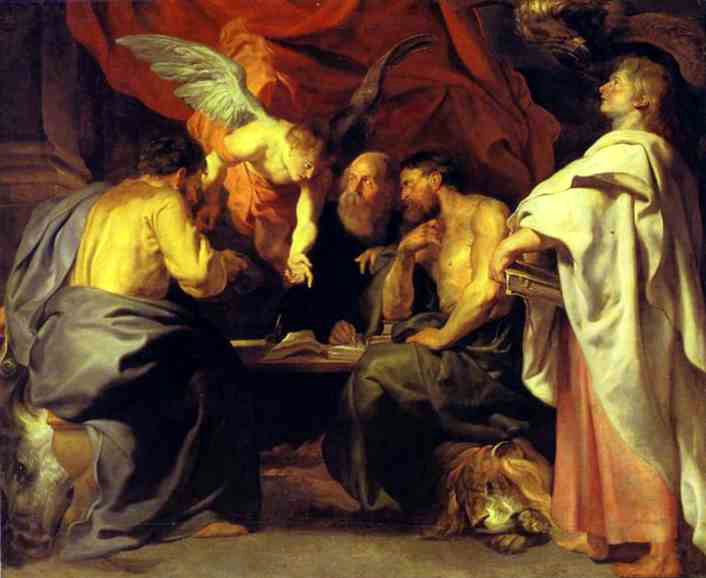
St. Mark, second from the right.  (His symbol – a lion – sleeps in the right foreground…) 

*   *   *   *

Thursday, April 25 was the Feast Day for St. Mark, and – just to set the record straight – he wrote the first of the four Gospels. So why is he listed second, behind Matthew? It’s a story of his being “dissed” – disrespected – but eventually getting recognized for his singular contribution. That was thanks to Bible scholars who turned open-minded enough to “dig deeper.”

So you could say his is a “Cinderella story,” of success after a lowly beginning.

One reason for the early “diss” might be that his was the shortest Gospel. Another might be that his Greek was clumsy, not at all elegant. (“Short and clumsy” are hard to overcome.) And early on in Church history St. Augustine called Mark “the drudge and condenser” of Matthew. And since Mark’s written Greek was “clumsier and more awkward” than the more-polished writing of Matthew, Luke and John, his was the “least cited Gospel in the early Christian period.” 

But Mark is a Cinderella story, and “this Cinderella finally got the glass slipper,” even though that had to wait until the 19th century. That’s when Bible scholars finally noticed that the other three Gospels all cited material from Mark, but “he does not do the same for them.” Their conclusion? Mark started the process and set the pattern of and for the other three Gospels.  In turn, since that time Mark’s Gospel “has become the most studied and influential.”

As to Mark the author, he is generally identified as the same John Mark who “carried water to the house where the Last Supper took place” in Mark 14:13, or as the “young man who ran away naked when Jesus was arrested” in Mark 14:51. See also Acts 12:25:  “Barnabas and Saul returned from Jerusalem when they had completed their service, bringing with them John, whose other name was Mark.” As to when he wrote his Gospel, the consensus is: Right after the First Jewish Revolt, which ended with Roman armies sacking Jerusalem. That explains why he wrote such a “bleak and frightening picture.” It reflected the persecution his target audience was going through. That included – but was not necessarily limited to – the Church of Alexandria, in Egypt, “one of the most important episcopal sees of Early Christianity.”

On the other hand, there’s some debate about where Mark’s Gospel really ends. In other words, is the Great Commission at the end of his Gospel authentic? (See Mark 16:14–18.)

According to some critics … Jesus never speaks with his disciples after his resurrection. They argue that the original Gospel of Mark ends at [16:8] with the women leaving the tomb.

To review, Mark 16:8 says the women – Mary Magdalene, Mary the mother of James, and Salome – “fled from the tomb, for terror and amazement had seized them; and they said nothing to anyone, for they were afraid.” That could be a bad place to end a Gospel of hope, so some scholars think a later redactor added more after Mark 16:8.

One scholar said that if the Gospel really ended at 16:8, Mark had painted a “bleak and frightening picture.” But he did so – the scholar said – because that was just what Mark’s main audience was going through at the time. In turn, ending his Gospel at 16:8 merely reflected that great persecution. In other words, Mark didn’t candy coat the trials and tribulations that all followers of Jesus can expect to go through. He didn’t pull his punches, but talked about life as it really was at the time, and a dose of reality is healthy if you’re going to get on in this world.

So what’s the Good News, the full Gospel? For one thing there’s John 6:37, where Jesus said He would never turn away anyone who came to Him. Then there’s Romans 10:9, where the Apostle Paul said, “If you declare with your mouth, ‘Jesus is Lord,’ and believe in your heart that God raised him from the dead, you will be saved.” (No ifs, ands, or buts.)

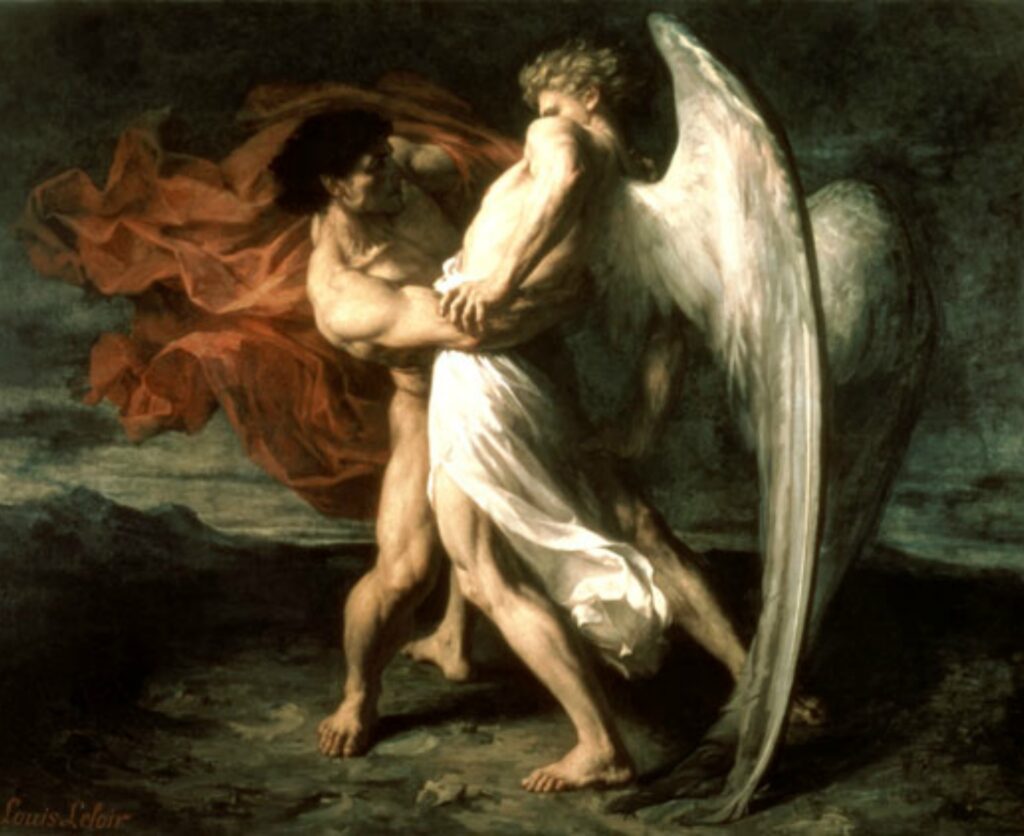
And that applies even if sometimes you do end up arguing with God

*   *   *   *

Jacob wrestling with the Angel” – arguing with God – and so became a new creation

*   *   *   *

The upper image is courtesy of Peter Paul Rubens: The Four Evangelists, which noted:  “Rubens portrayed the four evangelists while working together on their texts.  An angel helps them…   Each gospel author can be identified by an attribute.  The attributes were derived from the opening verses of the gospels.  From left to right: Luke (bull), Matthew (man [angel]), Mark (lion), and John (eagle).”

The Book of Common Prayer reference: The “corporate-mystical” prayer is on page 339, the post-communion prayer for Holy Eucharist, Rite I.

“Feast days” are designated days on the liturgical (church) calendar “set aside to commemorate events, saints, or doctrines that are important in the life of the Church. These can range from Solemnities, which are the highest-ranking feast days like Easter and Christmas, to optional memorials that celebrate lesser-known saints.” Feast Days: Celebrating the Church’s Calendar.

Re: Mark’s inelegant Greek. Garry Wills, in his book “What Jesus Meant,” said Mark’s original Koine was a rough-hewn, “pidgin” or marketplace Greek, often clumsy and muddled so much that translators invariably “try to give more churchiness to the evangelists.” Pages xi to xii, “Note on translation:”

In koine, as in any pidgin language, niceties tend to be lost. Words are strung together, often without connectives, to get across a basic meaning… When the meaning is obscure in such a simple language, it is less often because of any sublime meaning conveyed than from mere linguistic clumsiness.

In writing this post I borrowed from past posts, including: From 2015, On St. Mark’s “Cinderella story,” from 2016. (See also Cinderella story – Idioms.) After that, More on “arguing with God” – and St. Mark as Cinderella, from back at the beginning of COVID, On St. Mark, 2020 – and today’s “plague,” and from last year, On Saints Mark, Philip and James – 2023.

The lower image, courtesy of Wikipedia, is Jacob Wrestling with the Angel, by Alexander Louis Leloir (1865). Leloir (1843-1884), was a a French painter specializing in genre and history paintings. (As to the “new creation,” in the course of wrestling, the angel – representing God – changed Jacob’s name to Israel. Genesis 32:22-31 CEV.)

*   *   *   *

On Doubting Thomas Sunday, 2024 – and More?

*   *   *   *

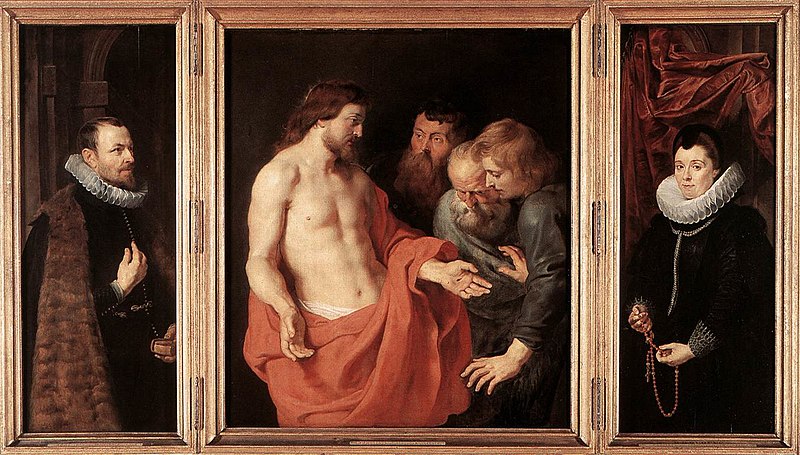
The Rockox Triptych” – The central panel shows the original Doubting Thomas…  

*   *   *   *

April 14, 2024 – Last Sunday, April 7, went by the name “Second Sunday of Easter.” Or the second Sunday of the Easter Season. (Eastertide, the church season that runs the 50 days from Easter Sunday to Pentecost Sunday.) But that Second Sunday also goes by a number of other names. Like “Low Sunday,” because of the normally-low church attendance after the high attendance of Easter Day. Yet another (and more exotic) name is “Quasimodo Sunday.” But that’s not because of Quasimodo, the guy known as the “Hunchback of Notre Dame:”

Instead, the name comes from a Latin translation of the beginning of First Peter 2:2 , a traditional “introit” used in churches on this day. First Peter 2:2 begins – in English and depending on the translation – “As newborn babes, desire the rational milk without guile…” [Or, “pure spiritual milk, so that by it you may grow up in your salvation.”] In Latin the verse reads: “Quasi modo geniti infantes…” 

So an introit is – in one definition – part of the usual opening for a church service on the Second Sunday of Easter. And (to give some background), that introduction follows the call in First Peter Chapter 1 to “be holy,” since we have been “born again, not of perishable seed, but of imperishable.” (Through faith in Jesus.) And the first two verses of First Peter Chapter 2 read – to give an even fuller background – “Therefore, rid yourselves of all malice and all deceit, hypocrisy, envy, and slander of every kind. Like newborn babies, crave pure spiritual milk, so that by it you may grow up in your salvation.” (With verse 3, “now that you have tasted that the Lord is good.”)

Latin was the language of western churches for centuries, and for Catholics some 1,900 years – until the middle of the 20th century. And in the Latin “geniti” translates as “newborn,” while the translation of “infantes” seems self-evident. Thus here “quasi modo” roughly translates, “As if in the manner” of newborn babes. Meaning in turn that just we expect babies to grow up, we should also expect baby Christians to do the same. God doesn’t want you stay an “infant in Christ,” as Paul noted in 1st Corinthians 3:2. You don’t want to stay a boot-camp Christian, a Biblical literalist who never learns anything about the Bible “beyond the fundamentals.”

Which brings us back to the Second Sunday of Easter, also called Doubting Thomas Sunday. That’s because the Gospel reading is always John 20:19-31, which “recounts the story of Christ appearing to the Apostle Thomas in order to dispel the latter’s doubt about the Resurrection.” But we shouldn’t be too hard on Thomas for his doubting. In a sense most if not all Christians face their own “doubting moments” in their lives. But as I said last year on the same subject, “there’s something to be said for having doubts and then overcoming them.”

You could think of it as a form of resistance training. A Blind Faith Christian doesn’t like “resistance,” doesn’t like the uncertainty that comes with doubting, or asking questions. But to me a healthy Christian welcomes such resistance, because that’s how we grow spiritually. Asking deep and probing questions can lead to doubt, but in the process your faith grows stronger.

One of my past posts had a link, If you doubt and question … answers.yahoo.com. It asked, “If you doubt and question your faith will it become stronger?” Unfortunately that link won’t take you there now, but back then the “Best Answer” to the Yahoo question included this:

Remember Thomas, the disciple, who wouldn’t believe in Christ’s resurrection until he put his hand into Jesus’s wounds. He went on to die spreading the gospel in Persia and India. God gave us free choice, He doesn’t want us to be robots, He could have made us like that, but wanted us to choose for ourselves. You learn and grow by questioning. 

In other words, there seem to be Christians who see The Faith of the Bible as a spiritual strait-jacket, a pre-shaped form into which “we” have to mold ourselves. This type of Christian also seems to believe that St. Peter will have some kind of checklist at the Pearly Gates, so that if you don’t answer every litmus test question exactly right you won’t get in. But aside from Jesus’s promise in John 6:37 – that He will never turn away anyone who comes to Him – there’s also Romans 10:9. That’s where Paul said that if you “declare with your mouth, ‘Jesus is Lord,’ and believe in your heart that God raised Him from the dead, you will be saved.” 

So much for litmus tests, so go out and experience life in all its fullness, like Thomas. And keep reading the Bible with an open mind. “The Bible was designed, to expand your mind…”

*   *   *   *

Which brings us finally to a quirk in this year’s Bible readings. Normally the Annunciation is celebrated on March 25, which is back when I did the Daily Office reading for that Feast day. But strangely enough, the online Lectionary Page has that feast day listed for Monday, April 8, the day after the Second Sunday of Easter. It had been “transferred.”

So why the transfer? “Liturgically the solemnity of the Annunciation was moved to April 8 this year, as March 25 was during Holy Week and the focus was on Jesus’ Passion instead.” (See Why the Annunciation was moved to April 8 this year – Aleteia.) But I have some good excuses. Like noting beforehand March 25 as the day I should do those readings. Also, this year I got back from a canoe trip five miles off the coast of Mississippi on March 23, the day before Palm Sunday. Then came Holy Week, which is always a busy time.

But you could say it worked out for the best. I was so busy getting ready for the canoe trip that I didn’t have time to do my usual post on the Annunciation. Since this year it came the day after “Second Sunday,” I now have a good excuse for doing that missed post next time.

Which I will do next time, so stay tuned!

*   *   *   *

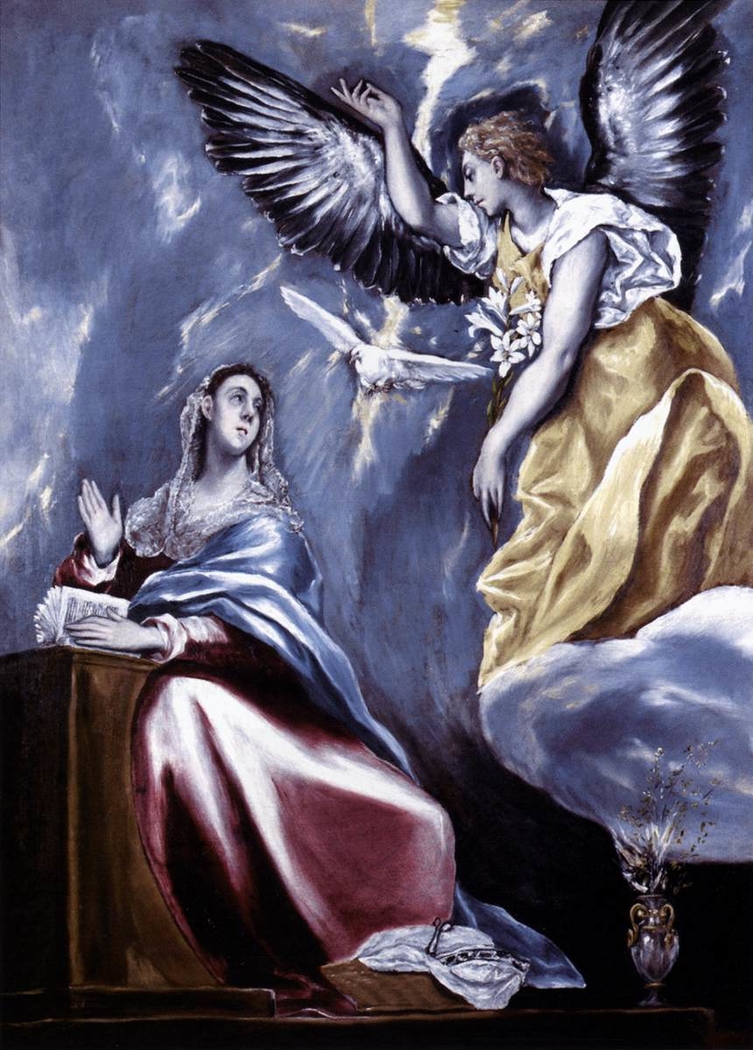
El Greco’s view of the Annunciation of the Virgin Mary

*   *   *   *

The upper image is courtesy of The Rockox Triptych – Wikipedia. I used it in my second-ever post, in 2014, First musings – The readings for “Doubting Thomas” Sunday. I’m leaving it in its original form and format, which had no separate section for notes. The full caption I put in: ‘The Incredulity of St Thomas, or The Rockox Triptych, after the name of the donors, by Peter Paul Rubens (circa 1614),’as it relates to the Gospel reading for 4/27/14.I’ve also listed the following posts about Doubting Thomas Sunday, also known as Low Sunday and/or the Sunday after Easter Sunday: From 2015, Doubting Thomas’ “passage to India” from 2016, Doubting Thomas – and Peter Restored, On “Saint Doubting Thomas” – 2017, and On “Doubting Thomas Sunday” – 2017, from 2019, On Easter, Doubting Thomas Sunday – and a Metaphor, and from last year, On Doubting Thomas Sunday – 2023. My first-ever post – on the same subject and posted the same day as “First musings” – was The Bible – Lectionary Musings and Color Commentary. (Interesting reading for me.)

The Book of Common Prayer reference: The “corporate-mystical” prayer is on page 339, the post-communion prayer for Holy Eucharist, Rite I.

A note: This “Second Sunday” is also called – aside from names noted above – the Octave of Easter, the eight-day period starting on Easter Sunday and running to the Sunday following Easter.

On the Western Church and Latin, see The Evolution of Catholic Mass: From Latin to Vernacular.

Re: “Hunchback.” Incidentally, the character in the book Hunchback of Notre-Dame was named after those opening words of First Peter 2:2. (In the New International Version it reads, “Like newborn babies, crave pure spiritual milk, so that by it you may grow up in your salvation.”)

The lower image is courtesy of Annunciation Mary El Greco Painting – Image Results. It came with a page saying that in this painting…

…the interior of the room is filled with clouds and flashing lights, in a way that the objects surrounding the Virgin – the simple prie-dieu, the book opening like a fan, the sewing-basket and the vase – are removed from real space and saturated with mystic significance. The wide, emphatic arc of the drapery covering the Virgin’s knees seems only to make her small head and narrow, transfigured face appear as distant from us and as close to the heavenly messenger as possible.

*   *   *   *

Happy “Eostre” – 2024!

*   *   *   *

 The Germanic goddess Ēostre – or “Ostara” – who gave us the name of “Easter..”

*   *   *   *

It’s that time of year again. After 46 days of Lent – 40 days mirroring the ones Jesus spent in the Wilderness, plus six Sundays “off*” – it’s time to celebrate another Happy Easter. But you may wonder, “Where and when did all this start?” In the biggest sense of course it all started with Jesus being raised from the dead after being crucified. But the name “Easter” itself has more worldly origins. And it all had to do with how good early Christians were at adapting to the circumstances around them. In other words, applying the Bible with an open mind

In further words, how did we get from Jesus and His resurrection to the “Easter Bunny, colorfully decorated Easter eggs, and Easter egg hunts?” It seems to have started around 1682:

The Easter Bunny (also called the Easter Rabbit or Easter Hare) is a symbol of Easter, depicted as a rabbit bringing Easter eggs. Originating among German Lutherans, the “Easter Hare” originally played the role of a judge, evaluating whether children were good or disobedient…  In legend, [he] carries colored eggs in his basket, candy, and sometimes also toys to the homes of children, and as such shows similarities to Santa Claus or the Christkind, as they both bring gifts to children on the night before their respective holidays.

Then there’s the name “Easter” itself, which comes from Ēostre (or Eastre, or Ostara). She’s the pagan goddess of spring, celebrated by the Saxons of Northern Europe. They held a festival to honor her called Eastre during the spring equinox. Her “earthly symbol was the rabbit, which was also known as a symbol of fertility.” But unfortunately – as one site noted – Easter today has become “almost a completely commercialized holiday, with all the focus on Easter eggs and the Easter bunny being remnants of the goddess worship.” But that’s where we devout practicing Christians come in. To remind people of the real “reason for the season.”

Which brings us back to Jesus, and Easter Sunday. That’s the day we celebrate His resurrection from the dead, “described in the New Testament as having occurred on the third day of his burial after his crucifixion,” at Calvary, around 30 AD.  “It is the culmination of the Passion of Jesus, preceded by Lent (or Great Lent), a forty-day period of fasting, prayer, and penance.”

In other words it’s one of many alternating rhythms of “feasting and fasting” in the church year. All of which reminds us that “life is not all fun and games.” In further words, to have a mountaintop experience you have to climb the mountain. (Then once it’s over you have to climb back down again, to the slings and arrows of everyday life. That’s how you make spiritual progress, it seems to me.) In this case, the Disciples and other followers of Jesus had seen all their hopes dashed. They’d believed in Him, yet He ended up in a painful and humiliating death.

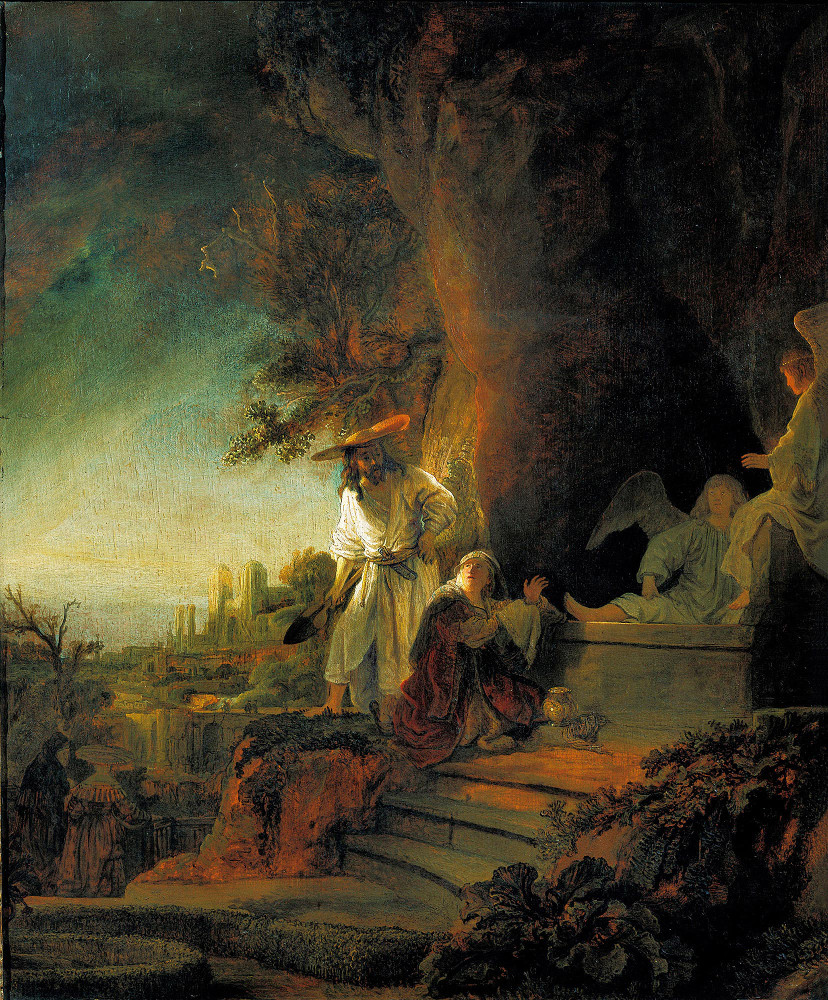
But in this case, Jesus “kicked death’s butt,” which was of course hard to believe at first, as shown by Rembrandt‘s painting, “The Risen Christ Appearing to Mary Magdalen.”

Mary Magdalen had just found Jesus’ grave empty, and asks a bystander what has happened. In her confusion she thinks the man is a gardener. Only when he replies with “Mary!” does she realize who she’s talking to. To illustrate Mary’s confusion, Jesus is often depicted as a gardener in this scene.

(Which you can check on your own, as illustrating Mark 16:1-8 and other Gospel accounts.)

And to support the claim that Jesus “kicked death’s butt,” see El Greco‘s painting – just below – of The Resurrection. It shows the Risen Jesus “in a blaze of glory … holding the white banner of victory over death.” In plain words, those of us who believe celebrate this day not because of Easter eggs or chocolate bunnies. We celebrate because by His sacrifice Jesus gave us all the power to become children of God.  And that ain’t exactly chopped liver

*   *   *   *

Christ “in a blaze of glory,” finally victorious over death...

*   *   *   *

The upper image is courtesy of Ēostre – Wikipedia. The caption: “Ostara (1884) by Johannes Gehrts. The goddess flies through the heavens surrounded by Roman-inspired putti, beams of light, and animals. Germanic people look up at the goddess from the realm below.”

The Book of Common Prayer reference: The “corporate-mystical” prayer is on page 339, the post-communion prayer for Holy Eucharist, Rite I.

For this post I borrowed: From 2015 (mostly), On Easter Season – AND BEYOND. Also, from 2016, On Eastertide – and “artistic license.” From 2017, Frohliche Ostern – “Happy Easter!” From 2019, On Easter, Doubting Thomas Sunday – and a Metaphor. And finally, Happy Easter – April 2020!

Re: Jesus and the 40 days. Known as the Temptation of Christ: During His 40 days and nights of fasting in the Judaean DesertSatan came and tried to tempt Him. When Jesus “refused each temptation, Satan then departed… During this entire time of spiritual battle, Jesus was fasting.” Wikipedia.

Re: Days off during Lent. See 40 Days and 40 Nights [film] – Wikipedia, the 2002 film about “a San Francisco web designer who has chosen to abstain from any sexual contact for the duration of Lent.” As noted below, he could have had sex by virtue of the “Sundays off” aspect of Lent. See Why Sundays Don’t Count During Lent | Guideposts.

Re: The Rembrandt painting. The full link is “The Risen Christ Appearing to Mary Magdalen” – Art and the Bible. See also Rembrandt – Wikipedia, and/or Rembrandt van Rijn: Life and Work

Re: “Those of us who believe.” The citation is to 1st Corinthians 1:18, that the “message of the cross is foolishness to those who are perishing, but to us who are being saved it is the power of God.”

The lower image is courtesy of “The Resurrection by El Greco,” and the Web Gallery of Art:

Christ is shown in a blaze of glory, striding through the air and holding the white banner of victory over death.  The soldiers who had been placed at the tomb to guard it scatter convulsively.  Two of them cover their eyes, shielding themselves from the radiance, and two others raise one hand in a gesture of acknowledgement of the supernatural importance of the event…   By excluding any visual reference to the tomb or to landscape, El Greco … articulated its universal significance through the dynamism of nine figures that make up the composition [in] one of the greatest interpretations of the subject in art.

See also Resurrection, 1584-94 by El Greco, and El Greco’s Resurrection: Ahead of its Time:  “El Greco considered spiritual expression to be more important than public opinion and it was in this way that he developed a unique style … as one of the great geniuses of Western art.”

*   *   *   *

More Lenten meditation – 2024

*   *   *   *

One of many thought-provoking ideas – I hope – for this Lent 2024…

*   *   *   *

As part of my ongoing 2024 meditation, Lent as Pilgrimage, I went back and checked some older posts on the subject. I typed “Lent contemplation” in the search box above right, and found this post from December 2015: Develop your talents with Bible study.

I’m not sure what the connection was between that near-Christmas 2015 post and Lenten contemplation, but maybe it was the theme, “opening your mind with Bible study and developing your talents.” And those two subjects certainly seem worthy of contemplation during this Lent.

The post started with Matthew 25:14-30 and the Parable of the talents. The lesson?

Develop your talents! That’s the point: That you can’t be a “good and faithful servant” unless you give back to God more than what He originally gave you. And you can’t do that by being too literal, too focused on “avoiding sin.”

It went on to talk about how humans will always make mistakes and that maybe “the concepts of sin, repentance and confession are simply tools to help us realize the purpose Jesus had for us.” Also about not developing a “holier than thou” attitude, and not becoming just another “Carbon Copy Christian.” (Instead, “Sing to the LORD a new song.”)

But mostly it was about developing your talents, as a way of “obtaining unity with God, through Christ.” In other words, becoming someone “who seeks by contemplation and self-surrender to obtain unity with or absorption into the Deity or the absolute.”

Which is the definition of a mystic, one who “attempts to be united with God through prayer.” I also noted the term “mystic” seems to throw Southern Baptists and other conservatives into apoplexy, adding, “Try it sometime!!!” But of course, that was only joking…

The post also noted the story of Shadrach and the Fiery Furnace. That’s when he and his buddies – Meshach and Abednego – were about to be thrown into a burning fiery furnace. Those three men knew that God could save them if He wanted to, but they also knew that might not fit in with His (God’s) purpose. Thus their response to the king in Daniel 3 (16-18):

Shadrach, Meshach, and Abednego answered the king, “O Nebuchadnezzar…  If our God …  is able to deliver us, he will deliver us…  But if not, be it known to you, O king, that we will not serve your gods and we will not worship the golden statue that you have set up.”

Note the emphasized “But if not…” The three men were really saying something like this: “O Nebuchadnezzar, it’s up to God Himself to decide if He’ll deliver us… God certainly has the power to save us, but even if He decides not to, we will still believe in and follow Him…”

Definitely a great lesson for this 2024 year of political turmoil and polarization.

And finally, the Notes in that 2015 post had a link to an earlier post, from May 2014, The Bible as “transcendent” meditation. That post also talked about “so-called Christians” who focus on sin – usually someone else’s – rather than all the positive things that regular Bible-reading can give you. (A discipline like the one Paul mentions in Hebrews 12:11, that “produces a harvest of righteousness and peace.”) And it should be a gentle but persistent discipline. As one writer said, the would-be meditator (or “work-in-progress” Christian) should give himself permission to make mistakes. “You will make them anyway and will be much more comfortable – and get along better with this exercise – if you give yourself permission in advance.”

Or as Jesus said in Matthew 11:30, “My yoke is easy and My burden is light.” Which may not always seem true, especially when you’re going through a trial. However, with faith you’ll know, “God will save us. He will see us through this trial, so we come out stronger when it’s over.”

Another not-bad set of lessons to ponder this Lent…

*   *   *   *

*   *   *   *

The upper image is courtesy of www.pinterest.com/pc554/leadership-quotes/

The Book of Common Prayer reference: The “corporate-mystical” prayer is on page 339, the post-communion prayer for Holy Eucharist, Rite I.

Re: “Carbon copy Christian.” The link is to “Another brick in the wall,” from February 2015. Which is another term for such a Christian, and that post was pretty close to Lent in 2015.

On singing new songs. Isaiah 42:10 and Psalms 98:1 and 144:9, from [S]inging a NEW song to God.

Re: The discipline of Bible-reading producing “a harvest of righteousness and peace.” It can also give your life structure and purpose, things many people seem to be missing these days.

Re: Matthew 11. For the full reading see Matthew 11:28-30. In the King James Version (the one God uses), it reads, “Come unto me, all ye that labour and are heavy laden, and I will give you rest. Take my yoke upon you, and learn of me; for I am meek and lowly in heart: and ye shall find rest unto your souls. For my yoke is easy, and my burden is light.” (For some reason I remember the first part reading, “Come unto me, all ye that travail and are heavy laden…” Travail meaning “work especially of a painful or laborious nature.”)

The lower image is courtesy of Jesus Yoke Is Easy Burden Is Light – Image Results. It comes with a page, My Burden Is Light – Love, Grief and Healing, worth reading.

*   *   *   *

On Lent as a Pilgrimage – 2024

*   *   *   *

A visual metaphor of Lent – for example – as a pilgrim path toward Jesus, per John 6:37… 

*   *   *   *

Not long ago I published an eBook, 30 Years’ Feedback from God. Which has nothing directly to do with this post, but finishing it up freed me to start on my next book. For now I’m calling it, “My 2023 Hike on the Stevenson Trail in France.” (What the French call the GR 70.) Which got me thinking about past pilgrimages I’ve made – like hikes on the Camino de Santiago.

Which also got me thinking about “Lent as a Pilgrimage.” That’s when I found out I wasn’t alone in that thought. I’ve included four links in the Notes – from which I’ll borrow here – and they all point to the wisdom of Psalm 84:5, that happy are those whose “hearts are set on the pilgrims’ way.” And here are some nuggets from those links: First, that “pilgrimage” is not some abstract idea or concept. Instead it’s a “deeply fitting idea for this time of Lent:”

A pilgrim is someone on a journey – a journey away from a place of comfort and familiarity on the way toward unknown places of both possibility and challenge. 

For many of us, Lent is definitely a time of challenge, discomfort and the unfamiliar. (Though for some reason I’ve come to enjoy the idea of Lent.) On that note, in Lent we “intentionally break away from our normal routine of daily life” – with all its trivialities – and focus on the spiritual. “In other words, Lent is a pilgrimage – a spiritual pilgrimage to the Cross.”

Which you could say describes every Christian pilgrimage.

Which brings up some of the Christian-pilgrim hikes that I’ve done so far; five of them now. (The latest was that 2023 hike on the Stevenson Trail in France.) So for this installment of “Lent 2024” I offer up the following past posts, in reverse order, On St. James (2023), Pilgrimage, and “Maudlin’s Journey,” from July 2023, St. James – and “my next great pilgrimage,” from August 2019, and I’m back from my Rideau pilgrimage, from September 2018.

The first post said James, son of Zebedee – also called “St. James the Greater” – is the Patron Saint of Pilgrims. And he is the St. James – Sant Iago – whose remains (“relics”) are the focus for thousands of peregrinos who hike the Camino de Santiago. Here’s what Satucket said:

Tradition has it that [James] made a missionary journey to Spain, and that after his death his body was taken to Spain and buried [at] Compostela… His supposed burial place there was a major site of pilgrimage in the Middle Ages, and the Spaniards fighting to drive their Moorish conquerors out of Spain took “Santiago de Compostela!” as one of their chief war-cries.

Which is another way of saying that James’ name itself had magical powers in the past. And speaking of a pilgrim path, you could say every Christian uses some of that magic in following John 6:37, where Jesus said He would never turn away anyone who comes to Him. Meaning that from the time you “take the pledge,” your life is one long journey on the road toward Jesus.

On a related note see Feast of Saint James the Apostle in Spain – timeanddate.com:

Many people in Spain celebrate the life and deeds of James, son of Zebedee, on Saint James’ Day (Santiago Apostol), which is on July 25.  Saint James was one of Jesus’ first disciples. Some Christians believe that his remains are buried in Santiago de Compostela in Spain.

The article noted that July 25 is a public holiday in “Basque Country, Cantabria, and Galicia, where it’s a day off for the general population, and schools and most businesses are closed.”  (A side note: The “autonomous community” – or province – of Galicia, is in northwestern Spain, and that’s where Santiago de Compostela lies, as the “provincial” capital.) 

The article added that according to Christian tradition: 1) this James the Greater may have traveled to the area now called Santiago;  2) this James was beheaded in Judea in 44 CE, but also; 3) that his disciples carried his body by sea to Padrón, on the Galician coast. Then they  buried his body “under what is now the cathedral in Santiago de Compostela.”

Then there’s the Back from Rideau pilgrimage post from 2018. For the unfamiliar, the Rideau Canal is a 125-mile canoe route, in our case from Kingston, on the shore of Lake Ontario, up to Ottawa. But it’s not really a “canal.” There are canals and locks to go through, but mostly it’s a bunch of “big-ass lakes,” as one wag put it. Including but not limited to Newboro Lake, Upper and Lower Rideau lakes, and Big Rideau Lake. (With the emphasis on Big.)

Colonel By Island is somewhere in the middle of Big Rideau Lake, and my brother Tom and I reached it the afternoon of Tuesday, August 21, 2018, after “paddling through a veritable monsoon.” That morning we had paddled 10 miles, but in the afternoon we made a mere four miles. (After leaving Narrows (Lock 35.)) Which is why we decided to camp at ”Colonel By” instead of proceeding further. “But wait, there’s more!” We got up the next morning, after trying to sleep through another violent rainstorm, only to find that raccoons had broken into our food containers and taken much of our supplies of breakfast bars, crackers and trail mix. 

Which leads to it being said that all true pilgrimage calls for “discipline, patience, perseverance, leading to the discovery of the self within.” More to the point, a pilgrimage – like our 11-and-a-half-day canoe trip on the Rideau canoe trail – “may be described as a ritual on the move.” Further, through “the raw experience of hunger, cold, lack of sleep” – not to mention veritable monsoons and raccoon raids – we quite often find a sense of our fragility as “mere human beings.” And finally, such a pilgrimage – like such a true Lenten discipline – can be  “one of the most chastening, but also one of the most liberating” of personal experiences.

I’ve experienced some definite “chastening” on past pilgrimages, but I’ve also experienced a whole lot of beautifully liberating moments too. Like getting up at 4:00 in the morning – to avoid contrary winds – and getting to see the sun rise in the east over a nice calm “big-ass lake.”

Here’s wishing you both a chastening and a liberating Lenten pilgrimage…

*   *   *   *

*   *   *   *

The upper image is courtesy of Pilgrimage – Image Resultswhich led me to Why the Oldest Form of Travel Could Be the Most Popular in a Post=COVID World: “Pilgrimages are the oldest form of travel,” from the start to go to shrines or temples and leave offerings, and/or connect to God or ancestors. Also defined as a “hyper-meaningful journey” or sacred endeavor, making it different from regular forms of travel or leisure; “it is the meaning or transformation that occurs.”

One pilgrimage that has exploded is the Camino de Santiago pilgrimage routes in Europe. There are many pathways, but one of the main pathways is the Camino Frances, which is a trail that goes from France to the Santiago de Compostela Cathedral in Santiago, Spain. 

The Book of Common Prayer reference. The “corporate-mystical” prayer is on page 339, the post-communion prayer for Holy Eucharist, Rite I.

“Feedback.” The full title, 30 Years’ Feedback from God: Or “A Look Back at FSU’s 1993 Championship Season – and Its Impact on 2023.” 

The full reading of Psalm 84:5, “Happy are the people whose strength is in you! Whose hearts are set on the pilgrims’ way.”

Other past posts of interest, and for possible in a future “Lent 2024” post: An update – “Feast Days in France,” from September 9, 2023, and my February 2015 post, On donkey travel – and sluts. Those four links supporting the idea of Lent-as-pilgrimage: Lent as a pilgrimage on which we are not alone – Catholic Philly, The Pilgrim Way of Lent – Washington National Cathedral, Our Pilgrimage Through Lent | Christianity Today, and A Reflection on Lent as Pilgrimage – Verso Ministries.

More on ritual, and pilgrimage as “ritual on the move:” In one definition a pilgrim is someone on a quest to “find himself.” (See Self-discovery – Wikipedia.)  And one way of finding yourself is through a healthy sense of ritual, as noted in the book Passages of the Soul:  Ritual Today, by James Roose-Evans. That book provided the “all true ritual” quote It also noted that a healthy sense of ritual “should pervade a healthy society, and that a big problem now is that we’ve abandoned many rituals that used to help us deal with big change and major trauma.”

I took the lower-image photo, on one of those early-morning paddles:

[T]o avoid the often-contrary prevailing winds, we started getting up at 4:00 a.m. (Which would be – to most people anyway – a “raw experience” in the form of a lack of the usual number of hours of sleep. Not to mention having to stumble around in the dark while breaking camp.) On the other hand, getting up that early led to the picture … of one of the benefits of getting up at 4:00 a.m. Aside from the fact that the water is usually much smoother at that hour – especially important on those “big-ass lakes” in the first half of the trip – it also led to us seeing some beautiful sunrises. 

*   *   *   *