Category Archives: Feast Days

On Ash Wednesday – 2022

*   *   *   *

Tuesday, March 2, is Mardi Gras, or “Fat Tuesday.” Next day is Ash Wednesday, the start of Lent…

*   *   *   *

March 2, 2022, is Ash Wednesday. It marks the beginning of Lent, and I last wrote about it on February 25, 2020, in Ash Wednesday and the start of Lent – 2020. I said the next Feast Day (after St Matthias, Apostle), was Ash Wednesday, which that year came on February 26.

Note that two weeks after that 2020 Ash Wednesday, the COVID pandemic hit:

…to me, “the pandemic hit full swing – the ‘stuff really hit the fan’ – back on Thursday, March 12,” when the ACC basketball tournament got cancelled, along with other major sports. “So my definition of the ‘First Full Week of the Covid-19 Pandemic’ has it starting on Sunday, March 15 and ending on Saturday the 21st.”

But of course, Ash Wednesday comes right after “Fat Tuesday,” also called Mardi Gras, or “Pancake Day,” or Shrove Tuesday. (From the word shrive,* meaning “to administer the sacrament of confession to; to absolve.”) Which is a pretty good metaphor for the kind of absolution some people may feel we need – because of all the calamities that have befallen us since that long-ago Ash Wednesday, 2020. (That long-ago time of innocence, before “the stuff hit the fan.”)

On the other hand there’s Job 5:7, a reminder that “man is born to trouble as surely as sparks fly upward.” (And that before the COVID we had a pretty good run of “not so bad.”)

But back on topic, to wit: Ash Wednesday and the Season of Lent:

According to the canonical gospels of MatthewMark and LukeJesus Christ spent 40 days fasting in the desert, where he endured temptation by SatanLent originated as a mirroring of this, fasting 40 days as preparation for Easter.

See Wikipedia, and also On Ash Wednesday and Lent. The latter post explained a bit about the “Fight Between Carnival and Lent,” as shown in a famous painting by Pieter Bruegel the Elder. The point is, Ash Wednesday always comes after Fat Tuesday. And as an aside, the French term for Fat Tuesday is Mardi Gras, which has now become a generic term for “Let’s Party!!” 

As Wikipedia said, “Popular practices on Mardi Gras include wearing masks and costumes, overturning social conventions, dancing, sports competitions, parades, debauchery, etc.” But that debauchery is always – in the church calendar – followed by Lent. Lent in turn is a season devoted to “prayerpenancerepentance of sins, almsgivingatonement and self-denial.

And by the way, you do get days off in Lent. There are actually 46 days between Ash Wednesday and Easter Sunday. Sundays don’t count in the calculation. They’re essentially “days off,” when you can still enjoy whatever it is you’ve “given up.” But back on topic…

As noted in My Lenten meditation – from 2016 – most people have traditional Lenten Disciplines that involve giving up something. (Preferably something they really enjoy.) On the other hand, some choose to add a discipline, a discipline that will “add to my spiritual life.”  

For example, I spent the 2016 Lenten period “contemplating on how and when Moses wrote those first five books;” that is, the first five books of the Bible, the Torah. But this Lent I’ll be going back and revising an eBook I published in 2018, “There’s No Such Thing as a Conservative Christian.” As you can tell by the title, it was way too militant. (As in having a “combative character; aggressive, especially in the service of a cause.)

I’ll be writing more about such Lenten practices in the near future. But for this Lenten 2022 discipline “adding to my spiritual life,” I’ll be revising and rewriting that 2018 book. It to be less militant, less confrontational, and “more Christian.” So wish me luck, but in the meantime:

Have a Happy Ash Wednesday!

*   *   *   *

*   *   *   *

“Book of Common Prayer.” The passage is at page 339, Holy Eucharist Rite I post-communion prayer.

The upper image is courtesy of Mardi Gras – Wikipedia. Captioned: “Mardi Gras Day, New Orleans: Krewe of Kosmic Debris revelers on Frenchmen Street.”

Re: St. Matthias. See also St. Matthias, Zacchaeus, and the tough life of an Apostle.

Re, Full weeks of COVID. See On St. Philip and St. James – May, 2020, and also On Mary Magdalene, 2020 – and Week 19 of “the Covid,” from July 2020.

Re: “Shrive.” See also SHRIVE | meaning in the Cambridge English Dictionary, “(of a priest) to listen to someone’s confession about what they have done wrong, and offer forgiveness.”

Re: Painting by Pieter Bruegel the Elder. See The Fight Between Carnival and Lent.”

“46 days of Lent.” See Is Lent 40 or 46 Days Long and When Does it End? – Lent.

Re: “No such thing” book. The full title, “There’s No Such Thing as a Conservative Christian”: and Other Such Musings on the Faith of the Bible. But just for giggles and grins, you can also search “no such thing as a conservative Christian” for some interesting results.

The lower image is courtesy of Ash Wednesday – Wikipedia. Caption: “Ashes imposed on the forehead of a Christian on Ash Wednesday.”

*   *   *   *

St. Matthias, Zacchaeus, and the tough life of an Apostle…

Was Saint Matthias really Zacchaeus, who fell from a sycamore tree?

*   *   *   *

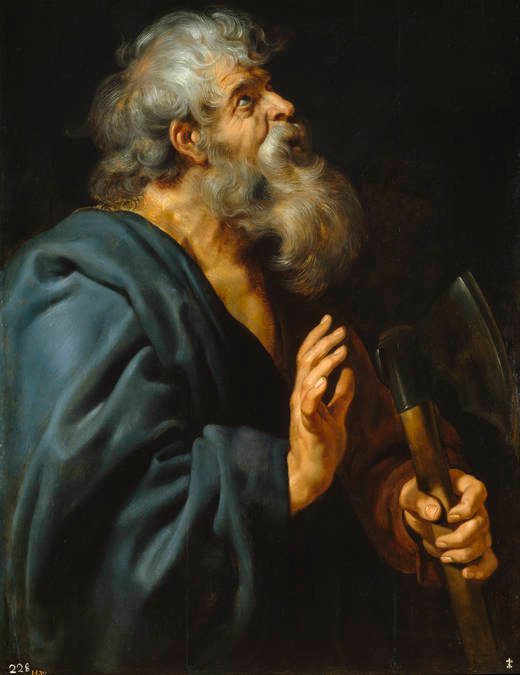
We are still in the Season of Epiphany, running from January 6 – the day of Epiphany – to Ash Wednesday. This year Ash Wednesday comes on March 2, and it marks the beginning of Lent. But as far as Feast Days go, the next relatively major one comes on Thursday, February 24. That’s the Feast of St. Matthias, the Apostle who took the place of Judas:

…according to the Acts of the Apostles, [he] was the apostle chosen by the remaining eleven apostles to replace Judas Iscariot following Judas’ betrayal of Jesus and suicide. His calling as an apostle is unique in that his appointment was not made personally by Jesus, who had already ascended to heaven, [and] before the descent of the Holy Spirit

See Saint Matthias – Wikipedia. Note also this St. Matthias is not to be confused with St. Matthew, the Gospel-writer whose Feast Day is September 21. I wrote about this “overlooked apostle” – not to mention unique – in February 2015’s On St. Matthias – and “Father Roberts.”

“Father Roberts” (1853-1949) was a missionary to Native American tribes including the Shoshone. But this John Roberts was different. Many Christian missionaries tried to change the culture and lifestyle of Native peoples. But Father Roberts believed it was important to preserve the language, customs, and culture of the people. Thus he tried to “honor and respect the ancient ways of the Native peoples while at the same time proclaiming the Gospel among them.” And that may be why he got his own feast day – in the Daily Office – on February 25.

There’s more on this fascinating missionary in the February 2015 post, but let’s get back to St. Matthias. His story is also fascinating. Like the fact he was also known as “Unremarkable Matthias” or the “Overlooked Apostle.” See The Overlooked Holy Apostle, Matthias. Also, Isaac Asimov gave a pithy description of how Matthias became an Apostle:

Peter arranged to have a new individual selected to take the place of Judas Iscariot in order to bring the number of the inner circle back to the mystical twelve that matched the twelve tribes of Israel. Two were nominated, Joseph Barsabbas and Matthias. To choose between the two, lots were used: Acts 1:26 … and the lot fell upon Matthias; and he was numbered with the eleven apostles. Neither Joseph Barsabbas nor Matthias are mentioned anywhere else in the New Testament.

So while we can be sure he was “numbered with the eleven,” some confusion remains about who he really was. For example, The Overlooked Holy Apostle said that “Matthias was originally Zacchaeus.” He was the tax collector Zacchaeus, who climbed a sycamore tree* because he couldn’t see Jesus, both as he was short and because of the crowd of people.

See the full story of Zacchaeus at Luke 19:1-10, and the Wikipedia article. The latter said Zacchaeus was an example “of Jesus‘s personal, earthly mission to bring salvation to the lost.” In this case, the “lost” included tax collectors, who were despised as traitors – “working for the Roman Empire, not for their Jewish community” – and for being corrupt. But Zacchaeus – after seeing Jesus – “repented of his former life after meeting the Lord.” 

Getting back to St. Matthias: The article Overlooked Holy Apostle goes into great detail about his sufferings – and ultimate death. It said Matthias preached in Macedonia and Ethiopia, where “the heathen dragged him over the ground, beat him, hung him from a pillar and tore his stomach with an iron blade and burned him with fire.” Another town he preached in was a “city of the man-eaters,” cannibalism. When Matthias entered the town, “the men of that city took hold of him and thrust out his eyes and made him drink poison and sent him to the prison where he sat for thirty days waiting to be eaten and die.” 

But the Lord appeared to him and got his eyesight back for him, as well as other prisoners who’d suffered the same fate. The site also said Matthias was rescued by the Apostle Andrew; “as Andrew approached the gates of the prison, the doors opened of their own accord.”

But wait, there’s more!

Eventually Matthias returned to Galilee, where he was stoned to death. “The Jews, filled with malice and anger, seized Matthias and presented him to the High Priest, Annas.” The High Priest, who “hated all Christians and was responsible for the death of James, the first bishop of Jerusalem, ordered that Matthias be stoned.” One point of note: Overlooked Holy Apostle said that when Matthias was taken to be stoned, he cried out, “You hypocrites, rightly did the Prophet David speak to those like you: ‘they shall hunt down the soul of the righteous man, and the innocent blood shall they condemn,'” citing “Psalm 93:21.”

The problem is, Psalm 93 has six verses. The actual citation is apparently to Psalm 94:21. In the NIV, “The wicked band together against the righteous and condemn the innocent to death.”

It pays to double-check!

After Matthias spoke these words, two witnesses who claimed he’d blasphemed picked up stones to be the first to stone him. But first, Matthias asked that these stones be buried with him as a testimony of his suffering for the Lord. So they stoned him to death, and as an added insult, also beheaded him to express that he was an enemy of Rome. So whether St. Matthias died by being first stoned and then beheaded, or had his eyes gouged out, then “sat for thirty days waiting to be eaten and die,” the lesson is: Being an apostle was no piece of cake!

*   *   *   *

*   *   *   *

“Book of Common Prayer.” The passage is at page 339, Holy Eucharist Rite I post-communion prayer.

The upper image is courtesy of the Wikipedia article on Zacchaeus. The caption: “‘Zacchaeus’ by Niels Larsen Stevns. Jesus calls Zacchaeus down from his height in the tree.”

Sycamore tree.” For more information see Zacchaeus Sycamore Tree, Jericho | Bein Harim Tours or Zaccheus’ Tree (Jericho) – 2022 All You Need to Know.

Re: Isaac Asimov. The quote is from Asimov’s Guide to the Bible (Two Volumes in One), Avenel Books (1981), page 998. Asimov (1920-1992) was “an American author and professor of biochemistry at Boston University, best known for his works of science fiction and for his popular science books. Asimov was one of the most prolific writers of all time, having written or edited more than 500 books and an estimated 90,000 letters and postcards.” His list of books included those on “astronomymathematics, the BibleWilliam Shakespeare’s writing, and chemistry.” He was a long-time member of Mensa, “albeit reluctantly; he described some members of that organization as ‘brain-proud and aggressive about their IQs.’” See Isaac Asimov – Wikipedia.

The lower image is courtesy of  Saint Matthias – Wikipedia. The caption: “‘St Matthias’ (c. 1611) by Peter Paul Rubens.

*   *   *   *

On the Presentation of Jesus – 2/2/22

The first “Presentation of Jesus” (as a baby) – His second one came on Good Friday

*   *   *   *

Wednesday, February 2, 2022 was the Feast of the Presentation of Jesus at the Temple. Presenting Jesus – as a baby, 40 days after Christmas – followed a 1,000-year-old custom that began with Moses. In Exodus 13:2, God said, “Consecrate to me every firstborn male:”

Counting forward from December 25 as Day One [for Jesus], we find that Day Forty is February 2. A Jewish woman is in semi-seclusion for 40 days after giving birth to a son, and accordingly it is on February 2 that we celebrate the coming of Mary and Joseph with the infant Jesus to the Temple at Jerusalem.

That’s from my post back on February 3, 2017, On the FIRST “Presentation of the Lord.” One point of that long-ago post was that from the time Jesus was “first presented” – at just over a month old – His life became “one long journey to the Second Presentation.” That second “Presentation” happened on Good Friday, when Jesus was about to be crucified.

This year it takes 72 days to cover the journey Jesus took 33 years* to get through. That includes most of Epiphanytide; it started on January 6 and ends on Ash Wednesday. After the night-before Mardi Gras (Shrove Tuesday) comes Ash Wednesday. So March 2 this year starts the Season of Lent. And that ends with Easter Sunday, this year on April 17. (Thus the 72 days.)

That 2017 post also discussed the “once-prevalent custom” in America of churching new mothers, possibly as late as 1979. That too came 40 days after a child was born, and was also called “the churching of Women.” It started – as far as we can tell – back in the Middle Ages, and was still offered by the Catholic Church until the 1960s, then discontinued.

The Anglican Church – back in England – still offers the service, but it seems rarely used.

In America, the old 1928 Book of Common Prayer included the service, but the 1979 Revision of the Book of Common Prayer left it out. Page 305 of the 1928 BCP is titled “The Thanksgiving of Women after Child-birth, (‘Commonly called the Churching of Women’).” The directions call for the new mother to “come into the Church decently apparelled,” and to kneel “in some convenient place.” The Minister would then begin:

Forasmuch as it hath pleased Almighty God, of his goodness, to give you safe deliverance, and to preserve you in the great danger of Child-birth [sic]; you shall therefore give hearty thanks unto God, and say…

The new mother would then recite “Dilexi, quoniam, Psalm cxvi,” which we now know as Psalm 116. Which all brings up two thoughts. One, about just how dangerous it was for women to have babies “back in the good old days,” and two, about just how old I am. I still have the 1928 Prayer Book that my grandmother gave me, for Confirmation, on December 22, 1963.

But enough obscure history. I also wrote about this Feast Day three years ago in “The LORD is a God of knowledge” – The Presentation, 2019. That post talked about Jesus being presented – at the Temple in Jerusalem – “to officially induct him into Judaism.” And that as celebrated by many Christian churches today, it’s also known as Candlemas. Then came these thoughts:

There’s more later, but first a word about one of the Daily Office Readings for this February 2 Feast. [Like] 1st Samuel 2:3, “For the LORD is a God of knowledge.” Which – taken together with Isaiah 27:11 – means that “therefore mercy is to be denied to him who has no knowledge.” And that’s a bit of Bible law that may well affect the many today who label anything they disagree with – or that contradicts some cherished beliefs – as “Fake News.”

In hindsight, it seems that I – like many other Christians – was a lot more confrontational back in 2019. But since then I’ve tried to amend my ways. (Can you say “He’s Still Working on Me?”)

Or maybe a work in progress, like the English language…

Then I posted The “Presentation of our Lord” – 2020. And a note, that post came some 42 days “B.C.” As updated, that would be “42 days Before COVID.” As explained in the notes, I calculate the first full week of the COVID as beginning on Sunday, March 15, 2020. (A time of innocence and crowd-gathering that now seems so “long ago and far away…”)

But we digress…

Back to The Presentation … 2020. It talked a bit about Mardi Gras, or Shrove Tuesday, which comes this year on March 1. (The day before Ash Wednesday.) One point? That way too many see Mardi Gras as just another excuse to party, with no connection to religion or spirituality.

The bad news – to some – is that Mardi Gras is followed immediately by Lent, a “solemn religious observance,” 40 days of atonementprayerpenancerepentancealmsgiving and self-denial. And incidentally, that’s not 40 days straight of “self-denial.”  You get Sundays off to enjoy whatever it is you’ll be giving up for Lent.

As to that last assertion, see OMG! Is it time for Lent again? That is, there are actually 46 days of Lent: 46 days between Ash Wednesday and Easter Sunday, not 40. That’s because Sundays in Lent are essentially “days off,” when you can still enjoy whatever it is you’ve “given up.”

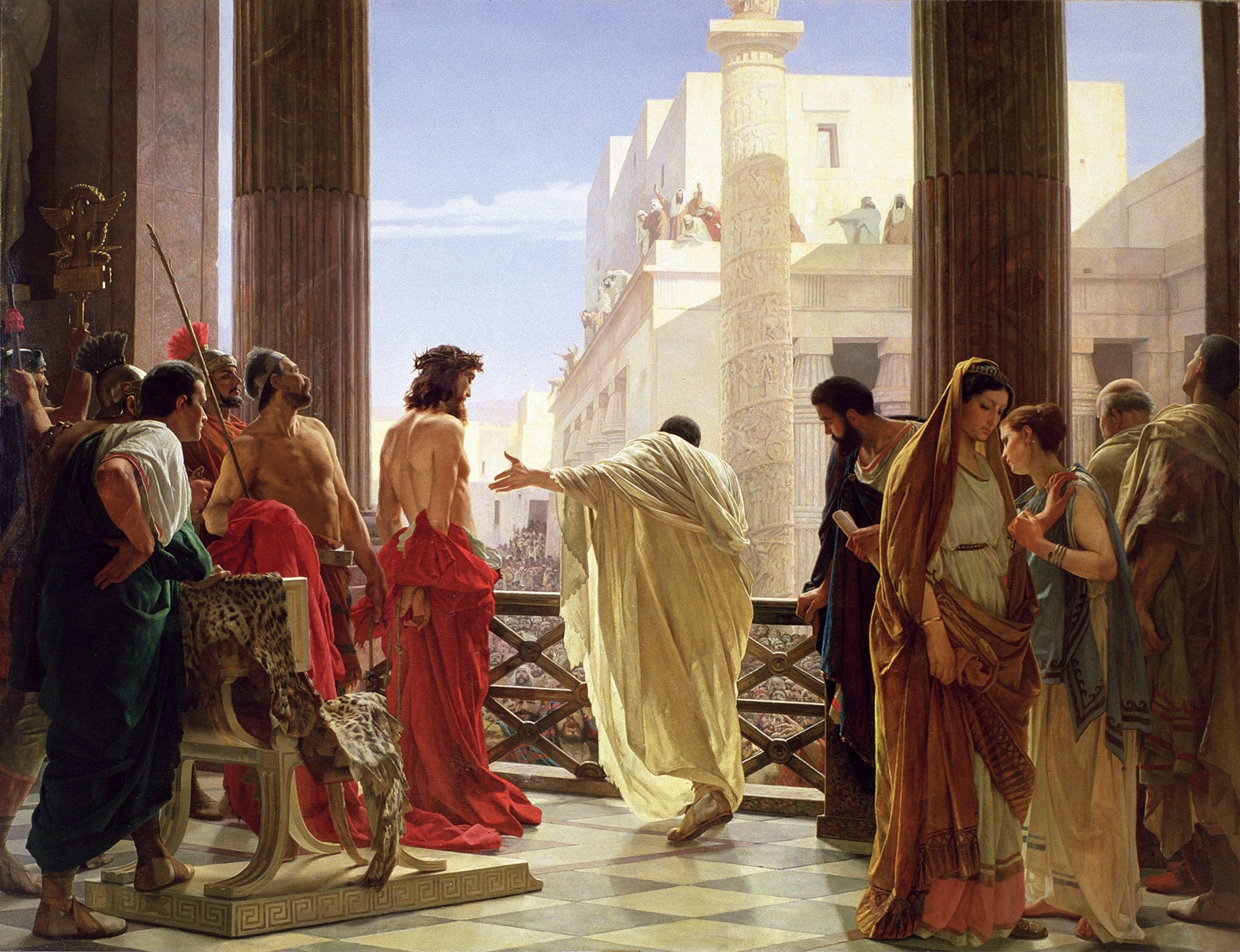
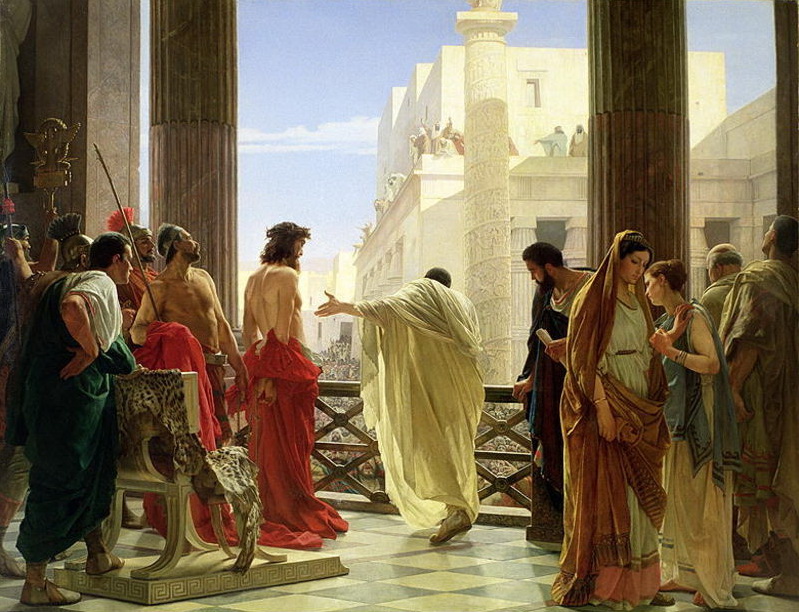
Which leads to a final note of interest: That generally the February 2d “Presentation” comes roughly halfway into the Season of Epiphany. Which this year ends with Ash Wednesday, on March 2. Which leads – as noted – to both Lent and Easter. And that also leads to what could be called the “Second Presentation of Jesus.” That is, Ash Wednesday leads to Good Friday, with Jesus about to be crucified – for us and our shortcomings – as illustrated below…

Which is all part of the Christian pilgrimage, with cycles of both fasting and feasting. “In further words, by reading and studying the Bible on a regular basis, the good Christian can both relish the good things that come along in life, and get through the challenging parts as well.”

*   *   *   *

The second “Presentation,” Pilate presenting a scourged Jesus” on Good Friday...

*   *   *   *

The upper image is courtesy of Presentation of Jesus in the Temple – Image Results. It accompanies an article from the Česká katolická misie v Kalifornii, translated as the “Czech Catholic Mission in California.” The article discussed “Candlemas, also known as the Feast of the Purification of the Blessed Virgin Mary and Feast of the Presentation of our Lord Jesus, is a Christian holiday commemorating the presentation of Jesus at the Temple.” It did not identify the painting. 

Re: The date of Good Friday this year. See Good Friday 2022 – Calendar Date.

Re: Jesus and 33 years. See A Jesus year birthday at 33 | Guideposts, but also How old was Jesus when He died? | GotQuestions.org: “The Bible does not say how old Jesus was when He died. Further, the Bible does not give the date of Jesus’ birth or the date His death.” But the article concluded that Jesus was likely born “between 6 and 4 BC. The same comparison leads us to believe that Jesus was likely crucified in AD 30, although it is also possible that Jesus was crucified in AD 33.” Thus the estimate that Jesus was in His 30s – “somewhere between 33 and 39 years old” – when He died. See also La symbolique du nombre 33 – Metaphi News, supporting the assertion that 33 is “l’age du Christ.”

Another note: I ended the “72 days” at Good Friday, not Easter Sunday.

The standard 1928 Book Of Common Prayer, including my 1963 copy, measures a pocket-sized 4-by-6 inches. Despite the inherent small type, it’s still easy to read. (If you like Shakespearean English.)

Re: First full week of COVID. See On St. Philip and St. James – May, 2020. There I explained that, to me, “the pandemic hit full swing – the ‘stuff really hit the fan’ – back on Thursday, March 12,” when the ACC basketball tournament got cancelled, along with other major sports. “So my definition of the ‘First Full Week of the Covid-19 Pandemic’ has it starting on Sunday, March 15,” 2020.

Re: “Fasting and feasting.” See On the Epiphany SEASON – 2022.

The lower image, courtesy of Pontius Pilate – Wikipedia, was featured in The “Presentation of our Lord” – 2020. The Wikipedia caption: “Ecce Homo (‘Behold the Man’), Antonio Ciseri‘s depiction of Pilate presenting a scourged Jesus to the people of Jerusalem.”

*   *   *   *

On the 12 DAYS of Christmas – 2021-22

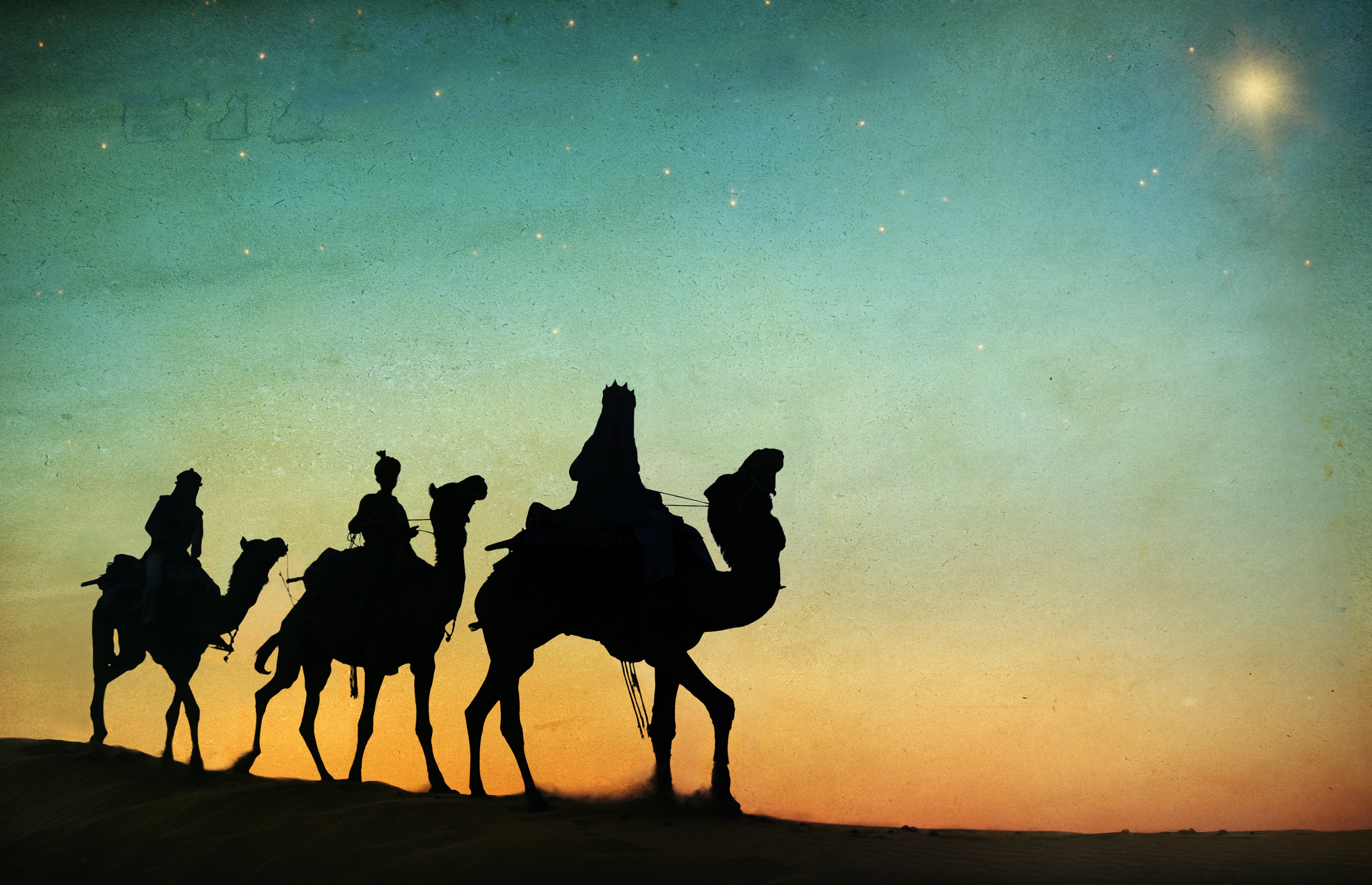
Technically, “Christmas” isn’t over until January 6, Epiphany, when Three Wise Men came… 

*   *   *   *

I’ll talk about the 12 Days of Christmas in a bit, but first a note about 1st Kings 17:21. There’s a story there about the prophet Elijah bringing back to life a boy who had died. The interesting part is where he prays, “O LORD my God, I pray, let this child’s soul come back to him.”

That was the Old Testament reading for Thursday, December 30,* and when I read that it raised some questions. Like, “Where did the boy’s soul go? Where did it come back from? And does that passage have an effect on any of the pressing hot-button political issues of today?” Note too that many translations say “let this child’s life come back to him.” However, the King James Version – the one God uses – has the term “soul,” and that’s good enough for me.*

Another good passage I just ran across – in the readings for Christmas Day – was 1st John 4:8. The translation I like best is the Contemporary English Version, “God is love, and anyone who doesn’t love others has never known him.” Which can be a good response to those Facebook users who seem to revel in spreading hate. (“Are you acting out of love? Like Billy Graham?”)

But enough of that. Back to the 12 days of Christmas.

For starters, let’s go back before the Covid to The 12 days of Christmas, 2018-2019. That post noted that those 12 days of Christmas don’t end until “next year,” on January 6:

The Twelve Days of Christmas is the festive Christian season [including “Twelfth Night”] beginning on Christmas Day … that celebrates the birth of Jesus Christ, as the Son of God. This period is also known as Christmastide… The Feast of the Epiphany is on 6 January [and] celebrates the visit of the Wise Men (Magi) and their bringing of gifts to the child Jesus. In some traditions, the feast of Epiphany and Twelfth Day overlap.

Then there’s the post from January 2015, on the same 12 Days of Christmas, which also noted that people apply a number of different names to this 12th day, January 6. For example, aside from The Epiphany, it and those days close to it are also known as Plough Monday. Three Kings Day (as in, “We Three Kings of Orient are”), and Twelfth Night.

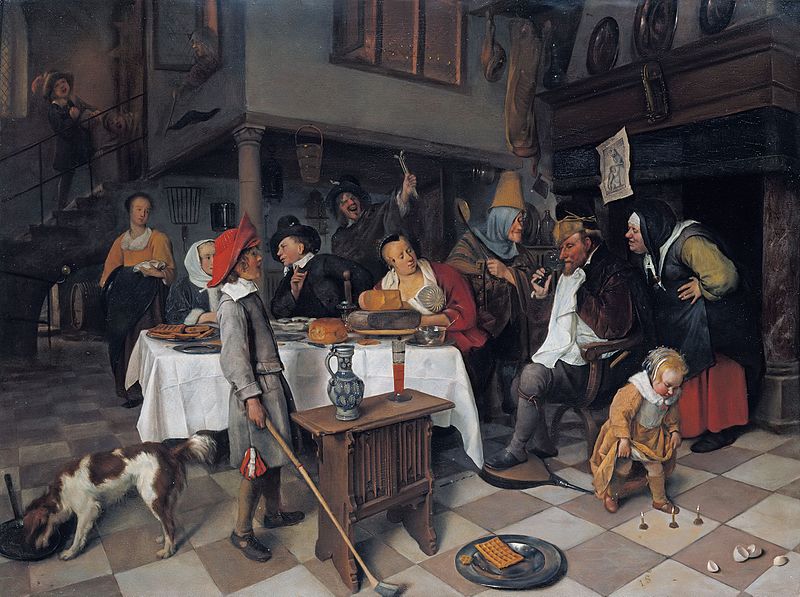
The latter feast day was immortalized by artists including Jan Steen, whose painting “The King drinks” is shown below. In fact, the custom of eating and especially drinking too much became such a problem it was banned in some places: “Twelfth Night in the Netherlands became so secularised, rowdy and boisterous that public celebrations were banned from the church.”

For more on these topics, check Epiphany, circumcision, and “3 wise guys,” and To Epiphany – “and BEYOND!” The “Three Wise Guys” posted noted that in its original sense – circa 600 A.D. – the term Magi meant “followers of Zoroastrianism or Zoroaster.” Also, the tradition that there were three kings started because they brought three gifts: Goldfrankincense, and myrrh.

Then there’s the tradition that the Three Wise Men got to the manger-scene just after Jesus was born, but the truth seems harder to pin down. Some say they arrived the same winter Jesus was born, while others say they came two winters after his birth. That would explain Herod’s order – see Matthew 2:16–18 – that his soldiers kill “all the male children that were in Bethlehem, and in all the borders thereof, from two years old and under.” (Known to history as the “Massacre of the Innocents,” noted every December 28.)

Finally – recalling events from this past year – there’s “Gleaning” on the Epiphany – 2021. For the calendar-challenged, that was 11 months ago, when Epiphany coincided with the day Congress (was supposed to) Count Electoral Votes. (The link is to an article dated January 5, 2021.) Which made 2021’s Epiphany “yet another ‘like no other’ in American history.”

In that post – from last year near this time – I picked “three earlier posts to glean from,” along with a reflection on how “gleaning” came to have multiple meanings. Along with a reflection on a mid-winter trip I took the year before, three months before the Covid pandemic “hit the fan.” Referring back to a post from January 17, 2020, My recent Utah trip noted this:

[T]he end of an old year and beginning of a New Year is also a time to recall the events of that past year gone by, and 2019 was definitely a year of pilgrimage for me. Like my trip last May to Jerusalem and the Holy Land. (See “On to JerusalemOn my first full day in Jerusalem, or type in “Jerusalem” in the search box above right.)

Which is another way of saying that 2019 was a “pilgrimage-filled year,” ending with a 15-day solo road trip “out to and back from my brother’s house in Utah.*” All of which brought back fond memories – of “before Covid” – with recalling that “This too shall pass.”

I ended that “Gleaning” … 2021 post with this thought: “Here’s hoping for a much better 2021.” So now I’ll close this post by saying, “Here’s hoping for a much better 2022.” And I’m going to keep saying it, updating it every year, until that much-better year finally happens…

*   *   *   *

“Twelfth Night,” on the evening before the Epiphany, a time to revel and celebrate…

*   *   *   *

The upper image is courtesy of Epiphany – Image Results. See also Epiphany (holiday) – Wikipedia.

Re: Old Testament reading for Thursday, December 30, 2021. That’s according to the two-year course of daily Bible readings set out at pages 934 to 1000 at the back of the Book of Common Prayer. See Daily Office Lectionary – The Online Book of Common Prayer, and/or What’s a DOR?

Re: The King James Version of 1 Kings 17:21 using the word “soul.” The Revised Standard Version also uses the term “soul” rather than “life.”

Re: Acting out of love “like Billy Graham.” I wrote about him in the post, A Soldier of Christ – “and BEYOND!” I first listened to a book-on-CD version of The Preacher and the Presidents: Billy Graham in the White House. (Nancy Gibbs and Michael Duffy.) Then I got a copy of the book itself, through which I learned that as he grew in age, Graham “also grew in grace.” (See 2d Peter 3:18.)

In fact, Graham eventually grew in grace so much that he came to say that God loves all people – even Liberals. Which led some Fundamentalists to criticize him “for his ecumenism, even calling him ‘Antichrist.’” 

I recently started re-reading portions of the book, which convinced me that I should try to be more like Billy, in the purity and inclusiveness of his faith. (Instead of referring to Right-wing Wackos as – well, “Right-wing Wackos.”) On a related note, in 2018 I published an eBook, There’s No Such Thing as a Conservative Christian”: and Other Such Musings on the Faith of the Bible. In light of my determination to be “more like Billy,” I’ll be revamping that book for a new version tentatively titled, “There ARE still some open-minded, tolerant and caring Christians… (‘You know, the REAL ones?’)” Or something less confrontational like that. And toning it down a bit.

Re: January 6 having many names. See also Happy Epiphany – 2018, which noted this Feast Day‘s names include Epiphany proper, which “celebrates the revelation of God incarnate as Jesus Christ.” It’s also known as the last of the Twelve Days of Christmas, and it’s the evening of January 5 that’s called Twelfth Night.)  

A note: 2019 included, in September, a 160-mile hike on the Portuguese Way (of the Camino de Santiago), from Porto to Santiago. The mid-winter road trip to Utah included “getting snowed in at a Motel 6 in Grand Island, Nebraska, with a view of a near-frozen North Platte River,” but which also included “a great burger and two draft beers at the Thunder Road Grill at the truck stop next door.”

The lower image is courtesy of File:A Twelfth Night Feast – ‘The King drinks’, by Jan Steen.

*   *   *   *

Welcome to Christmas, 2021!

For way too many people anyway. (2021.) Although for me the past year wasn’t all that bad*…

*   *   *   *

Like the headline says, “Welcome to Christmas, 2021.” Which means – among other things – that it’s time to look back on this past year. I suppose the biggest and most heartbreaking news is that – as of last December 5 – our version of the COVID and its variants has claimed the lives of some 803,045 Americans. Which leads us back to this time last year.

That’s when I posted 2020 – A Christmas like no other? It asked bluntly, “Is our Christmas Day in this crazy, pandemic-plagued year of 2020 truly one ‘like no other?’” As it turned out, the answer was “No.” There was that Christmas celebrated during the 1918 Spanish Flu:

To help curb its spread, health departments [in 1918] ordered the closures of schools, theaters, bars, and churches. Christians were unable to celebrate Christmas by gathering to worship, to hear or participate in choir concerts, and other well-loved and important traditions used to mark the holiday by many.

But of course, we thought we’d be over all that by now…

That is, many Americans during Christmas back in 2020 no doubt figured that by now – a full year later – we would have the Covid problem largely fixed. Then too, I noted that the Spanish Flu pandemic started in February 1918, and lasted two years and two months, until April 1920. On that note, according to my calculations, we are now in the 93d full week of COVID, or 23 months and one week.* Which might have meant that the end of this plague was near, except for that new and more-transmissible “Covid in town,” the Omicron variant.

Getting back to “2020 Christmas,” that post noted that 1918 people had some advantages over us today. For one thing, Americans then were “much more familiar with epidemic disease:”

[E]pidemic disease was very familiar to the early 20th century public. Families, many of which had lost a child to diphtheria or watched a loved one suffer from polio, were generally willing to comply with some limitations on their activities. Most public health departments wore badges and had police powers, and this was generally uncontroversial. “They could forcibly quarantine you or put you on a quarantine station on an island.”

That willingness to comply with “limitations on their activities” is a lesson some Americans today seem unwilling to learn. Then too – aside from describing the progress of that plague (from “where it started”) – that 2020 post talked about the pandemic’s “waves.” For example, the number of cases went down in mid-1918, only to rise again when – in November – Americans gathered in large numbers to celebrate the end of “The Great War.”

There was also a note on “bad things happening to good people,” with one silver lining:

There is much we can do to alleviate each other’s suffering when adversity strikes. Our support and empathy toward our fellow human beings in their time of need helps them not only materially but demonstrates to them that they matter… When we act kindly, it also gives meaning to our own life, as we see that we matter to others.

Which I thought was pretty much what Christians are supposed to do anyway. (Show empathy, and try to alleviate the suffering of others.) And which was pretty much the point of my post, Another view of Jesus feeding the 5,000. That rather than waiting on God to perform miracles, we should get to work on the problems ourselves. Which brings up the “Christmas spirit.”

Googled “what is the Christmas spirit” and got 4,180,000 results. And here’s one answer that I really liked, from What is Christmas Spirit? – Scientific American Blog Network:

The code of generosity, kindness, and charity toward others is enforced by no one other than ourselves. There are places where this code is strong, and these places (or people) are said to have strong Christmas spirit… After all, we are the sum of the individuals around us who generate the collective force that governs and organizes our social structure… When we “act out” Christmas spirit, we’re making visible this collective force, and we give it power.

Meanwhile, for a view of what Christmas used to mean, pre-Covid, see On the 12 days of Christmas, 2018-2019. One note: Christmas is not just a day, it’s a season. See 12 Days of Christmas, which end on January 6, with The Epiphany.

For a brief summary, the Twelve Days of Christmas begin on Christmas Day and ends on “Twelfth Night.” The season is also known as Christmastide, which ends on January 6, the Feast of the Epiphany. And a head’s up: January 6 is also known as Three Kings Day. (As in, “We Three Kings of Orient are.”) I hope to write more on the full Season of Christmas after this weekend, but in the meantime, it’s almost time to make that leap of faith into 2022…

*   *   *   *

*   *   *   *

The upper image is courtesy of Christmas 2021 Images – Image Results. It came with an advertisement – touting the unique Christmas ornament – but when I clicked on the link I got this notice: “Sorry, this item and shop are currently unavailable.” Maybe they sold out?

As for 2021 being “not all that bad” for me, among other things – and for most of this past September – I got to travel to France and Spain, for another hike on the Camino de Santiago. See I just got back from “Camino 2021.”

Re: My “93d full week of COVID” calculations. See On St. Philip and St. James – May, 2020. There I explained that, to me, “the pandemic hit full swing – the ‘stuff really hit the fan’ – back on Thursday, March 12,” when the ACC basketball tournament got cancelled, along with other major sports. “So my definition of the ‘First Full Week of the Covid-19 Pandemic’ has it starting on Sunday, March 15 and ending on Saturday the 21st.”

Re: People back in 1918 having some advantages over us. See A Look Back at Christmas During the Spanish Flu Pandemic.

Re: Bad things happening to good people. See December 2020 – and “Bad things to good people?” With a link to Bad Things to Good People? | Psychology Today. One “scientific” answer: “The universe has no inherent purpose or design.” With which I took issue…

The lower image is courtesy of New Year Images 2022 – Image Results. It came with another advertisement, “Happy New Year 2022 Picture, Images and Wallpapers HD Download.”

*   *   *   *

On Thanksgiving – 2021

If only we could go back to when life was so much better.” (Or is that a Golden Age Fallacy?)

*   *   *   *

November 24, 2021 – In case you didn’t realize it, the next major feast day is Thanksgiving, on November 25. As noted in the Thanksgiving link, that national holiday dates back to 1621, when “Plymouth colonists and the Wampanoag [Native Americans] shared an autumn harvest feast that is acknowledged today as one of the first Thanksgiving celebrations in the colonies.”

On the subject of such feast days, see also Calendar of saints – Wikipedia:

The calendar of saints is the traditional Christian method of organizing a liturgical year by associating each day with one or more saints and referring to the day as the feast day or feast of said saint. The word “feast” in this context does not mean “a large meal, typically a celebratory one,” but instead “an annual religious celebration, a day dedicated to a particular saint.”

The last time I did a post on Thanksgiving was in 2019; Thanksgiving 2019. Which means for some reason I didn’t do such a post in 2020. For one thing there was a disputed election. (Which wasn’t settled until January 6, 2021, and in some minds remains unsettled “even to this day.”) Then there was COVID-19… And a reminder: That 2019 post came before the pandemic hit, so “let’s go back and see what life was like back then, in ‘B.C.'” (Before Covid.)

*   *   *   *

For starters, here’s my original caption for the lead painting above: “The Mayflower Pilgrims, leaving behind their homeland – for a ‘whole New Wo-o-o-orld…‘” (The latter referred to the song from “Aladdin.”) And the title and artist of the painting, “‘The Embarkation of the Pilgrims[‘] (1857) by the American painter Robert Walter Weir.”

Back on Thanksgiving 2019 my main – mundane – concerns were 1) just getting back from a 19-day 160-mile hike on the Portuguese Camino, 2) being hired back as a supervisor at the local Keep America Beautiful, and 3) reurning home in the middle of the “High Holy Season.” (The season of college and pro football. See Moses at Rephidim: ‘What if?’)

Back in that time of relative innocence – considering the challenges about to rear their ugly heads – I waxed poetic about how we might “live in harmony with one another,” so that together we might “with one voice glorify the God and Father of our Lord Jesus Christ.”

We’re still waiting for that one to happen.

But as with any great pilgrimage like ours – on a national scale – there’s always a need for a reality check every so often. Like this one about that much-celebrated First Thanksgiving:

102 [Pilgrims] landed in November 1620 [at Plymouth Rock].  Less than half survived the next year.  (To November 1621.)  Of the handful of adult women – 18 in all – only four survived that first winter in the hoped-for “New World…”  The point is this[:  T]he men and women who first settled America paid a high price, so that we could enjoy the privilege of stuffing ourselves into a state of stupor.

In other words freedom – like Enlightenment – “isn’t free.” Which should remind us that any true pilgrimage – or any spiritual journey worth its salt – involves a lot of disciplined, persevering work. And which – to me, in 2019 – served as a reminder that whatever “Dark Age”we may have to go through, both during and after “this fine but politically-hectic November of 2019:”

“This too shall pass…

*   *   *   *

And so it shall. On another positive note, I just published a new E-book. You can check it out by clicking on Will I REALLY live to 120?: On Turning 70 in 2021 – and Still Thinking “The Best is Yet to Come.” (Written and published under my Nom De Plume, “James B. Ford.”) And that’s not to mention Jesus Christ, Public Defender, published back in January 2019. One theme: “You DON’T have to be a way-too-conservative Fundamentalist to be a real Christian,” and in fact, “you’ll get much more from the Bible if you aren’t.” (See more details at For a book version.)

And speaking of civil wars, the sketch below illustrates one of the first Thanksgivings to be celebrated on a national level in this country. In the meantime, here’s wishing you a…

Happy Thanksgiving – 2021!

*   *   *   *

Thanksgiving Day, 1863 – celebrated in the middle of that other American Civil War

*   *   *   *

The upper image is courtesy of Pilgrim Fathers – Wikipedia, with a fuller caption, “‘The Embarkation of the Pilgrims’ (1857) … at the Brooklyn Museum in New York City.” And the full link to the song from “Aladdin:” Aladdin – A Whole New World [High Quality] – YouTube.

Re: Moses at Rephidim: ‘What if?’ That post referred to the disappointing Atlanta Falcons 2017 Super Bowl loss to the New England Patriots, whose quarterback at the time was Tom Brady. Thus causing me to “hate” Brady even more than I did before. But then in the 2020 Super Bowl that same Tom Brady quarterbacked my beloved Tampa Bay Buccaneers to their first Super Bowl since 2002. “He has redeemed himself!” And BTW: I lived in the Tampa Bay area for 50 years, so the Buccaneers are my favorite NFL team. But since I moved to the Atlanta area, the Falcons come in a close second.

Re: “Jesus Christ, Public Defender.” The full link is Jesus Christ, Public Defender: and Other Meditations on the Bible, For Baby-boomers, “Nones” and Other Seekers.

The lower image is courtesy of Thanksgiving U.S. – Wikipedia. Caption: “Sketch by Alfred Waud of Thanksgiving in camp (of General Louis Blenker) during the U.S. Civil War in 1861.” The article noted, “In the middle of the American Civil War, President Abraham Lincoln, prompted by a series of editorials written by Sarah Josepha Hale, proclaimed a national Thanksgiving Day,” to be celebrated on the final Thursday of November, 1863. “Since 1863, Thanksgiving has been observed annually” in the U.S.

See also the “Hymn of Thanksgiving” image, captioned:  “‘A Hymn of Thanksgiving’ sheet music cover – November 26, 1899.”

*   *   *   *

On the Hallowe’en “Triduum” – 2021

As I said last year at this time:Can you say, “Truer words were never spoken?

*   *   *   *

I have to say it: I hate Halloween. I’m always glad when it’s over, and we can get to the “fall festival” atmosphere leading up to Thanksgiving. But the Halloween triduum – a religious observance lasting three days – is important in the life of the Church, so I need to talk about it.

I’ve done numerous posts on the subject, and the most recent ones are – from 2018 – On the THREE days of Hallowe’en. After that I did The Halloween Triduum – 2019, just before the Covid hit. That was followed by Halloween 2020 – “Scariest ever?” And a reminder, Halloween 2020 came right before the elections, including the presidential election.

Which means we survived one national nightmare, but since then a number of other nightmares have taken shape, and continue “even to this day.” Or as Job 5:7 says, “man is born to trouble as surely as sparks fly upward.” (On the other hand, by following the Faith of the Bible, you too can develop “the peace of God which passes all understanding.” Philippians 4:7.)

But we digress. Looking back to last year at this time, we had a Halloween like we’ve never seen, including a rare Blue Moon – also called a “Hunter’s Moon” – and a warning:  CDC says no trick-or-treating amid COVID. But it also included some basic background, including that the word “Hallowe’en” came from the Old English word for “saint,” halig.

The word “halig” became “hallow,” and November 1 is what we now call All Saints Day. But November 1 was originally called “All Hallow’s Day,” and the evening before that day was “All Hallows Evening.” That was then shortened to “All Hallow’s E’en.” Eventually the “All” was dropped and we were left with “Hallow’s E’en,” then shortened to Halloween.

But as noted, this religious observance lasted three days, and – as Wikipedia said – this three-day period is a “time to remember the dead.” That includes “martyrssaints, and all faithful departed Christians.” And the main day of the three was and is November 1. It’s now “All Saints Day,” and was once called All Hallow’s Day, and also referred to as Hallowmas

The thing is, back in the real old days, people thought the barrier between the living and the dead was most open – most permeable – the night of October 31. So they wore masks and costumes to fool the evil spirits. And there was a warning about safe travel.

If you were out traveling from 11:00 p.m. to midnight on All Hallow’s E’en, your had to be very careful. (This was back in the day when candles were pretty much the only light available for travelers.) That is, if your candle kept burning, that was a good omen.(The person holding the candle would be safe in the upcoming winter “season of darkness.”) But if the candle went out, that was “bad indeed.” (The thought was the candle was blown out by witches…)

Another thing they did was build bonfires. Literally bonefires, “fires in which bones were burned.” (Shown in the photo below.)  The original idea was that evil spirits could be driven away with noise and fire. But that evolved into an additional thought: The “fires were thought to bring comfort to the souls in purgatory and people prayed for them as they held burning straw up high.” Which led to the second of the three days.

November 1, All Saints Day, honors “all the saints and martyrs, both known and unknown” who have gone on before us. That referred to “special people in the Church” but the third day of the three honors “the rest of us poor schmucks.” (Those who died but weren’t remembered, except by their friends and family.) So November 2 – All Souls’ Day – honors “all faithful Christians … unknown in the wider fellowship of the church, especially family members and friends.*’” That is, on the third day of the Triduum – November 2, or All Souls’ Day – observing Christians typically remember deceased relatives. And in many churches, the following Sunday service includes a memorial for all who died in the past year.

There’s more detail in the three posts from 2018 to 2020, including the story behind those carved pumpkins – also called a jack-o’-lantern or Will-o’-the-wisp – which tied in with the strange ghostly light known as ignis fatuus.  (From the Medieval Latin for “foolish fire.”) That was the “atmospheric ghost light seen by travelers at night, especially over bogs, swamps or marshes.” The light, like a flickering lamp, was said to recede if approached:

Tradition had it that this ghostly light – seen by travelers at night and “especially over bogs, swamps or marshes – resembled a flickering lamp.  The flickering lamp then receded if you approached it, and so it “drew travelers from their safe paths,” to their doom…

 But don’t worry: We faithful have that “peace of God which passes all understanding.”

Have a Happy Halloween Triduum!

*   *   *   *

*   *   *   *

The upper image is courtesy of Halloween 2020 – Image ResultsThe image accompanies an article, posted on October 24, “Man thinks of ‘the scariest thing’ for his Halloween 2020 decor.” Which led to an article about the “blue moon,” the one that could be seen at this time last year:

Get ready, witches and warlocks. This October 31, there’s a full moon occurring in Taurus, and it’s extra special. This lunar event is called a “blue moon” because it’s the second full moon we’ll experience in the month of October. Not, it won’t actually appear blue, but it’s rare — hence the phrase “once in a blue moon” — and astrologically, very powerful.

Re: The third day of the Halloween Triduum, November 2. Now All Souls’ Day, it was designed to remember the souls of “the dear departed.”

The lower image is courtesy of the Wikipedia article on bonefires.

*   *   *   *

On Saints Luke, and James of Jerusalem – 2021

Saint Luke painting the Virgin and Child” – as one of the first icon painters?

*   *   *   *

The best way to live abundantly and do greater miracles than Jesus is: Read, study and apply the Bible with an open mind. For more see the notes or – to expand your mind – see the Intro.

In the meantime:

A month ago – last September 24 – I flew back home from Madrid, after a month in France and Spain. First I flew into Paris on August 25, spent four days there, then joined up with three other family members. From there we took a train down to Saint-Jean-Pied-de-Port. (In French, “port” means “pass.”) From there, the four of us “hiked over the daunting Pyrenees.” (Seen below.)

For me the adventure ended 17 days later, after hiking 177 miles from Saint-Jean to Burgos. The other three are still hiking, toward Santiago, but meanwhile I had accomplished what I set out to do. (Correct a wimp-out from an earlier hiking adventure. See 2017’s “Hola! Buen Camino!”)

And speaking of wimp-outs – or other mistakes – I meant to publish Saint James the Pilgrim – and “Transfiguration 2021before I left for Paris. (As kind of a prelude.) But somehow I got caught up in making preparations for the trip, and so ended up posting that “prelude” after the first one about the hike, Just got back from “Camino 2021.” That latter post has the beginnings of the section of the Camino de Santiago I hiked this year. (I’d already hiked and biked the 450-mile part from Pamplona to Santiago, and this year just wanted to finish the Pyrenees portion I wimped-out on in 2017.)

In Just got back I covered the trip’s first four days, in Paris, including a visit to the being-rebuilt Notre-Dame Cathedral. And my companion blog has a new post, Hiking over the Pyrenees, in 2021 – finally! (And an earlier Post-trip post mortem for “Paris – 2021.”) I’ll write more on my just-finished 2021 Camino trip in future posts, but for now it’s time to get back on track.

Specifically, with a Feast Day from last October 18, and one just coming up on October 23. 

October 18 was the Feast Day for St. Luke, and October 23 is the Feast for James, brother of Jesus. I wrote of these two saints in Saints James, Luke – and the lovelies of Portugal.* There’s more detail on St. Luke in 2014’s St. Luke – physician, historian, artist, or On St. Luke – 2015. (Or – from 2018 – On Luke and the “rich young man.”) And October 23 is the Feast Day for James, brother of Jesus. The latter is one of several “Jameses” in the New Testament…

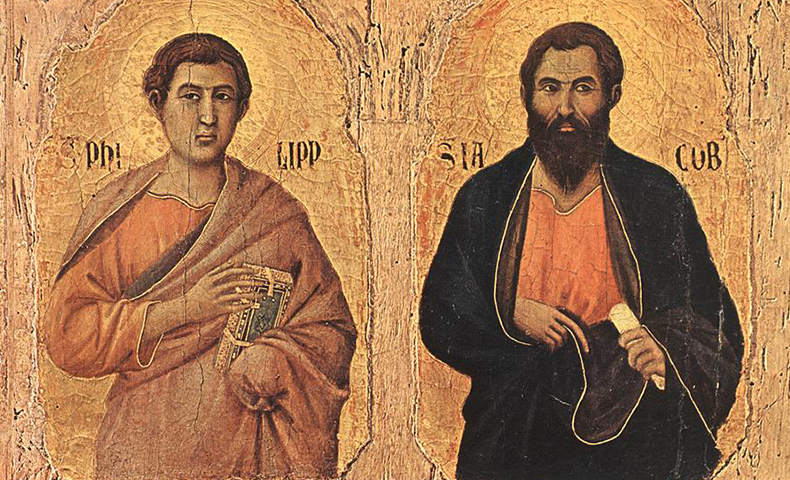
About which there seems to be some confusion, not least of all on my part. He’s sometimes confused with James, the son of Zebedee, also called James the Greater, “to distinguish him from James, son of Alphaeus (James the Less) and James the brother of Jesus,” also known as “James the Just.”

See On St. James (“10/23”) – and the 7 blind men, which clarifies some of that confusion on my part. There I confused the “Brother of Jesus” – whose icon is seen at left – with “St. James the Greater,” whose feast day is July 25. (And among other things, James the Greater is the “patron saint of pilgrims,” especially Camino pilgrims.)

For more enlightenment on this topic see Men Named James in the New Testament – Agape Bible Study, detailed in the notes. More to the point, the James remembered on October 23 is said to be the author of the Epistle of James. Other New Testament books – the Pauline epistles and Acts of the Apostles  – show him as key to the Christians of Jerusalem.

When Paul arrives in Jerusalem to deliver the money he raised for the faithful there, it is to James that he speaks, and it is James who insists that Paul ritually cleanse himself at Herod’s Temple to prove his faith…  Paul describes James as being one of the persons to whom the risen Christ showed himself … and in Galatians 2:9 Paul lists James with Cephas (better known as Peter) and John the Apostle as the three “pillars” of the Church.

There’s also confusion on how he died. “According to Josephus James was stoned to death by Ananus ben Ananus.” But “Clement of Alexandria relates that ‘James was thrown from the pinnacle of the temple, and was beaten to death with a club.’” Either way, he was important.

Which is also true of St. Luke.

The noted Catholic writer Garry Wills – in his book What the Gospels Meant – noted that Luke wrote the longest of the four Gospels.  He added that Acts of the Apostles is almost as long, and that these two of Luke’s books together “thus make up a quarter of the New Testament.”  (And they’re longer than all 13 of Paul’s letters.)  He said Luke is rightly considered the most humane of the Gospel writers, and quoted Dante as saying Luke was a “describer of Christ’s kindness.”

Thus Luke’s Gospel was – to Wills and many others – the most beautiful book that ever was.” Which means that Luke’s version of the Jesus story is one to which we should pay special attention.  And especiallto being “humane” and active practitioners of “Christ’s kindness.”

We could use a lot more of that Christian kindness these days…

*   *   *   *

*   *   *   *

The upper image is courtesy of File: Maarten van Heemskerck – St Luke Painting the Virgin, and/or “Wikimedia.”  See also Maarten van Heemskerck – Wikipedia, which noted that the artist (1498-1574) was a “Dutch portrait and religious painter, who spent most of his career in Haarlem,” and did the painting above in or about 1532.

A reminder: I published my last post, On Saint James the Pilgrim – and “Transfiguration 2021,” out of order, or in the wrong order. I’d gotten it ready to publish before I left for Paris, but in the rush and uncertainty of packing, forgot to actually publish it.

Re: The lovelies of Portugal. I published that post on October 23, 2019:

It’s been a month since I got back from last September [2019]’s 160-mile, 19-day hike on the Camino de Santiago that runs through Portugal. See Just got back – Portuguese Camino! Which means it’s time to start moving on from that pilgrimage and back to this blog’s main themes.

Re: Men Named James in the New Testament. The site listed the following men named James in the New Testament:  1) James the son of Zebedee and brother of the Apostle St. John (James the Greater);  2) James the “brother” of Jesus (whose Feast Day is October 23);  3) the Apostle James, “son of Alphaeus;”  and 4) James, the father of the Apostle Jude. Other sources indicate there were as many as six “Jameses” in the Bible.

The lower image is courtesy of Christian Kindness Image – Image Results. See also Ephesians 4:32 “Be kind and tenderhearted to one another.” Not to mention my post, On Oscar Wilde and Psalm 130, on Wilde’s “fall from grace, his being sentenced to hard labor and ultimately writing “De Profundus.” That’s the Latin title of Psalm 130, which begins, “Out of the depths I cry to you, O Lord. “

On Saint James the Pilgrim – and “Transfiguration 2021”

As I wrote back on August 25, before I left for Paris, I’d “soon be hiking over the Pyrenees

*   *   *   *

I said in my last post – on September 30 – that I had “last posted on July 26, 2021, over two months ago.” (See I just got back from “Camino 2021.”) Which made me wonder: Why such a big gap between posts? The answer: There wasn’t supposed to BE such a big gap.

I had prepared and pretty much written the following post, on St. James – Patron saint of Camino pilgrims – and on the Transfiguration of Jesus. (The last major feast day in August before I left for Paris on the 25th.) But while I’d “prepared and pretty much written the post,” I never actually PUBLISHED it. (I was probably too caught up getting ready for the trip, all while wondering if it would actually HAPPEN, because of Covid and its restrictions on travel.)

The month-long trip DID happen, but more to the point, in reviewing this yet-to-be-published post, I thought it sounded pretty good. So even thought it’ll be published out of order and “after the fact,” I’m offering it for your consideration. Later, down in the notes, I’ll make some after-the-fact observations about what actually happened…

*   *   *   *

Last July 25, 2021, was the feast day for James, son of Zebedee. He was one of the 12 Apostles, and tradition says he was the first apostle to be martyred, some time around 44 A.D.

He was a son of Zebedee and Salome, and brother of John the Apostle. He is also called James the Greater … to distinguish him from James, son of Alphaeus.

That’s what I noted back in 2019, in St. James – and “my next great pilgrimage.” Which is fitting, because this year – 2021 – I have another great pilgrimage on tap. On September 1st I’m scheduled to go back to the Camino de Santiago – for the third time – but with some differences… For one thing, this year I’ll be flying into Paris, not Madrid or Lisbon. For another I’ll be hiking as part of a group of four. And finally, this year I’ll hike over the Pyrenees Mountains.

Incidentally, that’s the same section of the Camino where the Martin Sheen character’s son died in the 2010 film, The Way. The central premise of the film is that an old, out of shape Beverly Hills eye doctor “goes to France following the death of his adult son, Daniel, killed in the Pyrenees during a storm while walking the Camino de Santiago (the Way of St. James), a Christian pilgrimage route.”

As if that wasn’t enough to give a reasonable person second thoughts about hiking over the Pyrenees, there was a recent news story, Human remains found in Pyrenees confirmed as those of missing hiker Esther Dingley.

“Ms Dingley, 37, had been walking solo in the mountains near the Spanish and French border and was last seen on Nov 22 last year.” The story added that there was “no sign of equipment or clothing in the immediate area … and the details of what happened and where still remain unknown.” Which is scary, but on the other hand, I won’t be hiking alone…

And once I do get over the Pyrenees I’ll be entering Spain – for the third time since 2017. And people in Spain take St. James the Pilgrim – he’s the patron saint of all pilgrims – very seriously. See for example Feast of Saint James the Apostle in Spain – Time and Date:

Many people in Spain celebrate the life and deeds of James, son of Zebedee, on Saint James’ Day (Santiago Apostol), which is on July 25. Saint James was one of Jesus’ first disciples. Some Christians believe that his remains are buried in Santiago de Compostela in Spain.

You can read more about this saint in 2014’s “St. James the Greater,” and 2016’s On St. James, Steinbeck, and sluts. (And others, listed in the notes.) But there is one thing about a pilgrimage that should be noted: If it’s a good one, you’ll find yourself transformed.

Which brings up the Transfiguration of Jesus.

That’s the New Testament episode where Jesus is “transfigured and becomes radiant in glory upon a mountain.” (See the connection?) I’ve written about this event in Transfiguration – 2020, The Transfiguration of Jesus – 2016, and in 2015, Transfiguration – The Greatest Miracle in the World. And that feast day was last August 6.

The 2020 post led off with a photo of an empty interstate, looking to a sky-scrapered city skyline, captioned, “The Coronavirus – A ‘Blessing In Disguise For Humanity,’ and maybe a metamorphosis?” Along with a note that we were “now in Week 21 of the COVID-19 pandemic.” (We’re now in week 75 or so, per my calculations.*) The key point: That “in the current plague we are surely going through a metamorphosis.” Or a change in circumstance that could seem, “to many, to have occurred by supernatural means.”

In other words, maybe God was and is trying to tell us something.

In further words, in the Transfiguration both Jesus and His disciples had to go through “a pivotal moment.” A moment in which Jesus met with Moses and Elijah, but which was also terrifying to Peter. (See Mark 9:6 “For they were all so terrified that Peter did not know what else to say.”) But despite Peter’s terror, this was a point “where human nature meets God: the meeting place for the temporal and the eternal, with Jesus himself as the connecting point.”

And you could say the same thing about COVID-19. It too is terrifying, but it could also be another moment “where human nature meets God.” It could be a moment where we turn on each other and start “Finger-Pointing,” or it could be a moment where we work together and overcome the challenge in the way God wants us to. And it could just be – if we play our cards right – where we can reconnect with Jesus in a way we couldn’t have before.

Unfortunately, there are signs that in this crisis we are being “weighed in the balances and found wanting.” (In other words, we seem to be ending up like Belshazzar, in Daniel, Chapter 5.) Or we could be “transformed.” And to continue that thought, to be transfigured – as Jesus was – is to experience a change in form or appearance, that is, a metamorphosis.

The term is also defined as to experience an exalting, glorifying or spiritual change. And one example of such a metamorphosis is the “transformation of a maggot into an adult fly.” Or for a better example, we could change from a caterpillar into a butterfly. So – in our journey through the present Covid crisis – do we want to remain maggots or get turned into butterflies? (To mix a few metaphors.) And such transformation is pretty much what the Faith is all about.

See for example Bible Verses about Transformed into His Likeness, which includes 2d Corinthians 3:18, which says that we true Christians “are being transformed into the same image from glory to glory, just as by the Spirit of the Lord.” Or Philippians 3:21, which talks of the power of Jesus, “who will transform our lowly body that it may be conformed to His glorious body.” Or 2 Corinthians 5:17: “Therefore, if anyone is in Christ, he is a new creation.”

Which is also what could happen to those who go on a pilgrimage. (Like hiking over the Pyrenees part of the Camino de Santiago?) In such a journey “a person goes in search of new or expanded meaning about their self, others, nature, or a higher good, through the experience. It can lead to a personal transformation, after which the pilgrim returns to their daily life.”

Or as it says in Psalm 84:5, “Happy are the people whose strength is in you! whose hearts are set on the pilgrim’s way.” So maybe when I get back I’ll find that we Americans are no longer “weighed in the balances and found wanting.” (As shown below.) Maybe the country will experience such a transfiguration that God will say, “Well done, good and faithful servant(s)!”

It COULD happen…

*   *   *   *

*   *   *   *

Well, it didn’t happen. It seems our country is still “weighed in the balances and found wanting.” And a lot of it has to do with Facebook and the amount of tribal political warfare that goes on there. So maybe that six-hour Facebook outage last October 4 was a sign from God. Instead of saying “well done, good and faithful servant(s),” He might have been telling us, “Stop obsessing with Facebook, and stop putting all that garbage in it!”

(Of course, I’m just guessing, you understand…*)

*   *   *   *

The upper image is courtesy of Camino Hiking Over Pyrenees – Image Results. With a page and caption, “The walk to Roncesvalles, Spain, from St Jean Pied de Port took us over the Pyrenees. Blessed with good weather…”

Re: 2016’s On St. James, Steinbeck, and sluts. The “sluts” part of the post noted that the word had a different meaning for Robert Louis Stevenson in 1879, when he published Travels with a Donkey in the Cévennes. (For more on the book see also the prior post, On donkey travel – and sluts.) Back then “slut meant roughly what one sense of slattern means today: a slovenly, untidy woman or girl.”  It could also refer to a kitchen maid.

Re: Weeks of Covid. As of Monday, October 11, 2021, we are now in the 83d full week of Covid, 20 months and three weeks, according to my calculations. See On St. Philip and St. James – May, 2020. To me, “the pandemic hit full swing – the ‘stuff really hit the fan’ – back on Thursday, March 12,” when the ACC basketball tournament got cancelled, along with other major sports. “So my definition of the ‘First Full Week of the Covid-19 Pandemic’ has it starting on Sunday, March 15 and ending on Saturday the 21st.”

The Psalm 84:5 translation is from my mother’s Book of Common Prayer, “Proposed,” and published in 1977. (As certified by Charles Mortimer Guilbert.) My mother died in 1984, and for a time it was used by my late wife Karen, who died in 2006. I now use it on a daily basis, for the psalms in each day’s set of Daily Office Readings. (Currently Year One, Volume 2.)

The lower image is courtesy of the Belshazzar link to the Wikipedia article. The caption: “RembrandtBelshazzar’s Feast, 1635, (National Gallery, London). The message is written in vertical lines starting at the top right corner, with ‘upharsin’ taking two lines.”

And the quote “just guessing, you understand,” came from She Wore a Yellow Ribbon (1949) Script – TV & Movie Transcripts. As spoken by Ben Johnson as Sergeant Tyree, talking to John Wayne as Captain Nathan Brittles. Image courtesy of She Wore A Yellow Ribbon – Image Results. (My other favorite Sgt. Tyree quote is, “That ain’t my department, sir!”

On “Saint” Mary Magdalene – 2021

St. Mary of Magdala: Despite a bad reputation, she is the “Apostle to the Apostles…”

*   *   *   *

Last Thursday, July 22, was the Feast Day for Mary from Magdala. She is a saint, and the only reason I put the word in quotes is that she ended up a saint despite the best efforts of jealous male disciples. (Because she showed more courage than they did when it counted.)

And that “showing more courage” seems to be why she got the reputation for a “sordid past.” On the other hand, there’s the opinion of St. Augustine, who referred to her as the “Apostle to the Apostles.” On that note see also Mary of Magdala | FutureChurch:

Mary of Magdala is perhaps the most maligned and misunderstood figure in early Christianity… Since the fourth century, she has been portrayed as a prostitute and public sinner… Paintings [of her], some little more than pious pornography, reinforce the mistaken belief that sexuality, especially female sexuality, is shameful, sinful, and worthy of repentance. Yet the actual biblical account of Mary of Magdala paints a far different portrait than that of the bare-breasted reformed harlot of Renaissance art.

The one indisputable fact seems to be that Mary Magdalene was both the first person to see the empty tomb of Jesus, and one of the first – if not the first – to see the risen Jesus. 

As for the Crucifixion itself, only one Gospel had a male disciple at the scene, John. (In “his*” Gospel, Ch. 19. Or see Who Was Present at the Cross?) But many women were there, as noted in Mark 15:40: “Some women were watching from a distance. Among them were Mary Magdalene, Mary the mother of James the younger and of Joseph, and Salome.”

And John, Chapter 20 tells the full story of Mary Magdalene being both the first to see the empty tomb and the first to see the Risen Jesus, as shown in the painting below.

For starters, see John 20:1: “Early on the first day of the week, while it was still dark, Mary Magdalene went to the tomb and saw that the stone had been removed from the entrance.” She went to tell Peter and John, who checked the tomb, then “went back to where they were staying.” But Mary – faithful Mary, of the lousy reputation – stayed, as noted in John 20:11-18.  She saw two angels, then turned to see another man she took to be a caretaker:

Supposing him to be the gardener, she said to him, “Sir, if you have carried him away, tell me where you have laid him, and I will take him away.”  Jesus said to her, “Mary!” She turned and said to him in Hebrew, “Rabbouni!” (which means Teacher). Jesus said to her, “Do not hold on to me, because I have not yet ascended to the Father. But go to my brothers and say to them, I am ascending to my Father and your Father, to my God and your God.’” Mary Magdalene went and announced to the disciples, “I have seen the Lord;” and she told them that he had said these things to her.

Which is why this Mary – from Magdala – is rightly known as the “Apostle to the Apostles.”

*   *   *   *

“The Risen Christ Appearing to Mary Magdalen…”

*   *   *   *

I gleaned the text and two illustrations from past posts: Mary Magdalene, “Apostle to the Apostles” (2015), Mary of Magdala and James the Greater, Saints (2017), Mary Magdalene, and “conserving talents…” (2018), Mary Magdalene – and all those “rules and regulations…” (2019), and from last year at this time, Mary Magdalene, 2020 – and Week 19 of “the Covid.”

More specifically, the lower image is courtesy of Rembrandt – The Risen Christ. The full caption: “The Risen Christ Appearing to Mary Magdalen, by Rembrandt (1638).” And speaking of “racy,” Titian did two versions of Mary. For the “racy” (1533) version see Penitent Magdalene (Titian, 1533) – Wikipedia.

The Penitent Magdalene is a 1565 oil painting by Titian of saint Mary Magdalene, now in the Hermitage Museum in Saint Petersburg.  Unlike his 1533 version of the same subject, Titian has covered Mary’s nudity and introduced a vase, an open book and a skull as a memento mori.  Its coloring is more mature than the earlier work, using colors harmoni[z]ing with character.  In the background the sky is bathed in the rays of the setting sun, with a dark rock contrasting with the brightly lit figure of Mary.