Category Archives: Not your daddy’s Bible

Did Jesus write the Gospels?

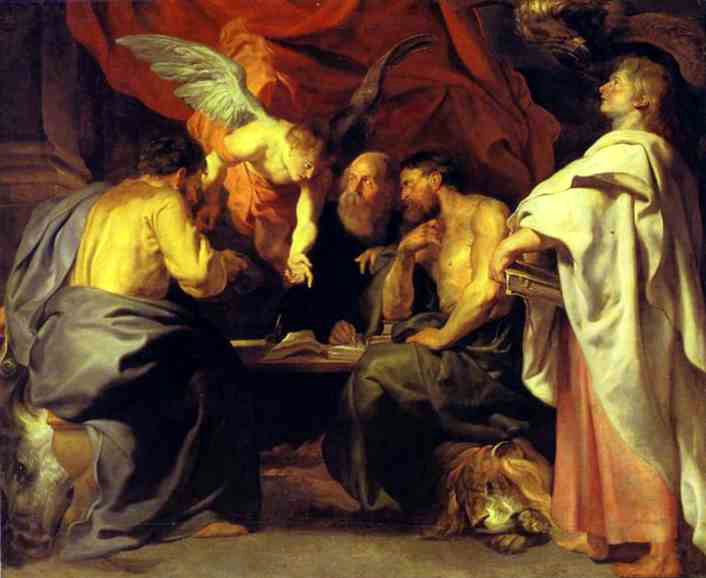
Luke, Matthew, Mark and John, each of whom did write a Gospel


As noted in earlier posts, my Lenten discipline is a formal contemplation – some deep profound thinking – about exactly how and when Moses put the first five books of the Bible – the Torah – into writing.

One thing I’ve learned:  Moses may have relied heavily on oral tradition.

It wasn’t until Moses’ lifetime that writing as we know it got used at all. (And then only among the “learned classes.”)  And as late as 700 years after Jesus, even Charlemagne – lord and ruler of the Holy Roman Empire – couldn’t read or write.

And Moses lived a thousand years before Jesus.  (And two millennia before Charlemagne.)

Another thing I learned:  Moses may have gotten the “One God” idea from a Pharaoh who ruled 100 years before him.  (That would be Akhenaten.  Egyptians later called him the “heretic king” for messing with traditional Egyptian polytheism.  See Moses, the Burning Bush, “et alia.”)

Of course you may find that a bit hard to swallow.  (That Moses got “One God” from an Egyptian.)

But consider this new evidence from the Daily Office Readings for Saturday, February 27.

In Genesis 43:16-34, Moses continued the story of how the Hebrews came to be in Egypt.  For starters,  Joseph was the son of Jacob, whose name got changed to Israel by God.  And basically, Joseph ended up in Egypt after being kidnapped and sold into slavery by his jealous brothers.

So Joseph ended up in Egypt as a slave, but that was a good thing.  (As it turned out.)
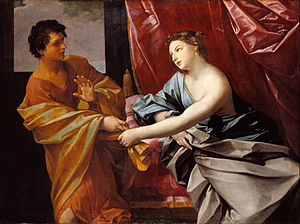
And aside from being a slave, Joseph also had to become pretty much a convicted felon.  That is, he got “convicted” after Potiphar’s wife – seen at right – falsely accused him of rape.  But then he ended up so well rehabilitated that Pharaoh made him his right-hand man.  (Pharaoh seems to have given Joseph the functional equivalent of a pardon.)  

In the meantime, Joseph’s family back in Canaan was going through a devastating famine. So Jacob – alias “Israel” – sent most of his sons down to Egypt to negotiate for some food.

In turn, the reading for Saturday, February 27, had Joseph invite his brothers to dinner.  Of course the kicker was that his brothers didn’t recognize the guy who invited them to dinner as their “dead brother.”  (Joseph was “dressed as an Egyptian ruler,” and the the last thing the brothers expected was to “find the brother they had sold into slavery.”)

The point of all this:  According to Genesis 43:32 the Hebrews were unclean to the Egyptians:

The waiters served Joseph at his own table, and his brothers were served at a separate table. The Egyptians who ate with Joseph sat at their own table, because Egyptians despise Hebrews and refuse to eat with them. (E.A.)
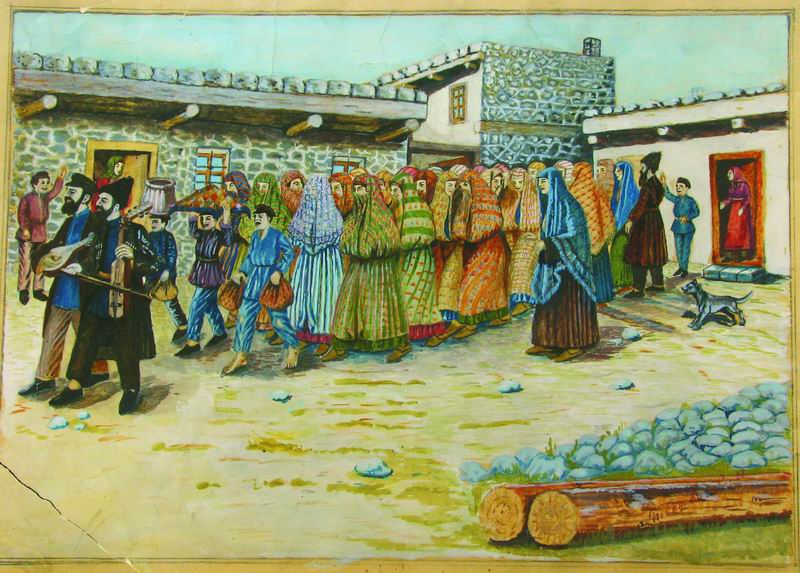
According to the Pulpit CommentaryEgyptians couldn’t “break bread” with Hebrews, basically because they were ritually unclean.  (The ritual painting at right is of “taking the bride to the bath house.”)  

In turn, the Hebrews – after Moses – went on to develop their own tradition of refusing to eat with, come in contact with, or even visit “Gentiles.”  See for example Salvation of the Gentiles, Part 1:

A strict Jew wouldn’t allow himself to be a guest in a Gentile house, neither would he invite one to be a guest in his own home…  The Jews viewed Gentiles as unclean, and that had great ramifications.  For example, milk that was drawn from a cow by Gentile hands was not allowed to be consumed by Jews…  No Jew would ever eat with a Gentile. (E.A.)

So it would seem that the Hebrews “borrowed” this idea of ritually unclean foreigners from the Egyptians.  In turn it seems well within the realm of possibility that – in the same way – Moses borrowed the idea of “One God.”  (From the “heretic” Egyptian king, Akhenaten.)  But note that Moses did a much better job than Akhenaten.  He literally changed history, in such a way that it can be said, “His burning bush still lights our world.”   (Moses, the Burning Bush, “et alia.”)

But we were talking about about exactly how and when Moses put the first five books of the Bible into writing.  And to that end, we were discussing the related topic of whether Jesus Himself personally “wrote” the four Gospels found in the New Testament.

Of course the short answer is No, Jesus didn’t personally write any of the Gospels.

In turn the fact that He left that task to His disciples – and/or followers – seems rarely to have been debated in history.  (Of course one “atheist” answer is that Jesus didn’t write His own Gospel because He was, “as a Galilean peasant, most probably illiterate.”)

Then too, it seems to have been commoAristotle Altemps Inv8575.jpgn practice back then for really smart people to have their students – and followers – take down what they said.  For example, consider what Will Durant wrote about Aristotle, who lived from 384 to 322 “before Jesus.”  (And so well after Moses):

…it is possible that the writings attributed to Aristotle were not his, but were largely the compilations of students and followers who had embalmed the unadorned substance of his lectures in their notes…  Even the unity of style that marks Aristotle’s writings, and offers an argument to those who defend his direct authorship, may be, after all, merely a unity given them through common editing…  About this question there rages a sort of Homeric Question…  We may at all events be sure that Aristotle is the spiritual author of all these books that bear his name:  that the hand in some cases [may be] another’s hand, but that the head and heart are his. (E.A.)

In turn it could easily be said that Jesus “spiritually authored” the four Gospels.  But might the same thing be said of Moses?  Once again, there seems no certain answer.

“Boot camp” Christians say that of course Moses personally hand-wrote all first five books of the Bible.  (See Don Stewart :: When Did Moses Write, or Compile, the Book.)  Others point out various anachronisms and/or “chronological inconsistencies” that seem to prove otherwise.  (See Why Moses Did Not Write the Torah – Mesa Community College.)

But couldn’t Moses too have had his own “students and followers,” just like Aristotle?

Those students and followers might well have “embalmed the unadorned substance” of Moses’ “lectures.”  After all, what else was there to do on those long dark nights during 40 years of wandering in the wilderness?  And those students and followers might well have numbered in their “hundreds, fifties and tens.”  (Just like the other “leaders over groups” noted in Exodus 18:21.)  And just what was Moses trying to do during those 40 long years?

Mainly Moses was trying to forge a disciplined army – from a bunch of former slaves – capable of bringing down the walls of Jericho, on the way to re-conquering the Promised Land.

(As alluded to in the Old Testament reading for the Fourth Sunday in LentJoshua 5:9-12.)

But we’re getting ahead of ourselves.  And unfortunately we’ve gone beyond the ideal length of blog posts, meaning this Homeric Question will remain unresolved a while longer…
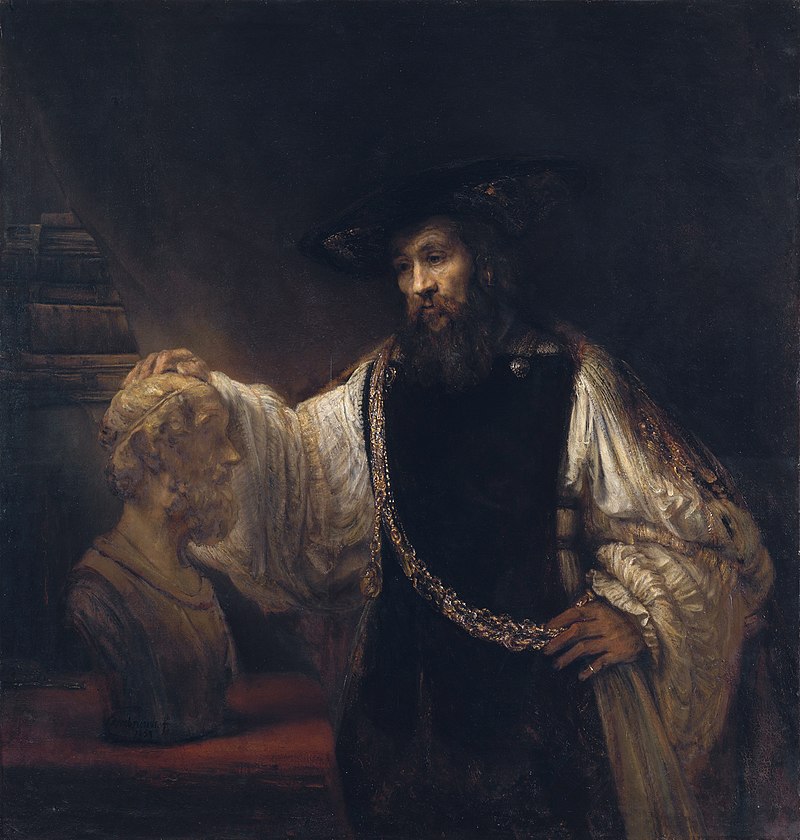
 

 Aristotle [contemplating] a bust of Homer, by Rembrandt

*   *   *   *

The upper image is courtesy of Four Evangelists – Wikipedia, the free encyclopedia.  For the four listed in order of appearance, see Peter Paul Rubens: The Four Evangelists – Art and the Bible:

Rubens portrayed the four evangelists while working together on their texts.  An angel helps them…  Each gospel author can be identified by an attribute.  The attributes were derived from the opening verses of the gospels.  From left to right:  Luke (bull), Matthew (man [angel]), Mark (lion), and John (eagle).

Re:  “Boot-camp Christians.”  There’s more on that concept at the end of these notes.  See also 2d Timothy 2:3-4, where Paul wrote,  “Join with me in suffering, like a good soldier of Christ Jesus.” 

Buckprivatesposter.jpgAlso re: “buck private.”  See Buck Privates – Wikipedia, on the “1941 comedy/World War II film that turned Bud Abbott and Lou Costello into bona fide movie stars.”  (A poster for which is seen at right.)

The image of Potiphar’s wife and Joseph is courtesy of Potiphar – Wikipedia, captioned:  “Joseph and Potiphar’s Wife, by Guido Reni 1630.”

On Joseph becoming “Israel.”  See On arguing with God.

Re: brothers not recognizing. See Why didn’t Joseph’s brothers … Answers.

Re: Egyptians refusing to eat with Hebrews.  See the full Pulpit Commentary on Genesis 43:32:

Because the Egyptians might not eat bread with the Hebrews.  Herodotus (2:41) affirms that the Egyptians would neither use the knife, spit, or basin of a Grecian, nor taste the flesh of a clean cow if it happened to be cut with a Grecian knife.  For that is an abomination unto the Egyptians.  The reason for this separation from foreigners being that they dreaded being polluted by such as killed and ate cows, which animals were held in high veneration in Egypt.

The Durant quote on Aristotle is from The Story of Philosophy: The lives and opinions of the world’s greatest philosophers from Plato to John Dewey.  Specifically, from the 1953, Washington Square Press “Pocket Books” edition, at page 57, from Chapter II, “Aristotle and Greek Science,” sub-section II, “The Work of Aristotle.”

Note also that – strictly speaking – a Homeric Question “concerns the doubts and consequent debate over the identity of Homer, the authorship of the Iliad and Odyssey, and their historicity…” 

The lower image is courtesy of Aristotle – Wikipedia.

Conservative Christian – “Career buck private?”

A drill sergeant posing before his company

An Army Drill Sergeant, ready to teach new recruits “the fundamentals of being a soldier…” 

*   *   *   *

As noted in My Lenten meditation, I’m not giving up anything this 40 days of Lent.

Instead I plan to spend this time “contemplating on how and when” Moses wrote the first five books of the Bible.  (The Torah.)  But first, here’s a note about the “lead-in paragraphs.”

(The ones above “In the meantime.”)

Up to this point, those paragraphs have said the blog is about exploring “the mystical side of Bible reading.”  That’s an accurate statement, but a trifle vague.  On the other hand, help in curing that vagueness came to me in the form of some recent see Daily Office Readings.

Specifically, help came from one of the “gap readings,” between February 6 and 7.  That reading is 2d Timothy 2:3-4:
 Join with me in suffering, like a good soldier of Christ Jesus.  No one serving as a soldier gets entangled in civilian affairs, but rather tries to please his commanding officer. (E.A.)

(Saint Timothy is shown at right, with his grandmother.)  On that note, see also On reading the Bible.   That’s a post I originally published in July 2014, but recently “tweaked.”  Near the end of the update, I took issue – again – with Biblical literalists.

Such literalism means “adherence to the exact letter or the literal sense” of the Bible.  But to me, “literalness” doesn’t give full effect to the Bible’s frequent use of metaphor and parable.  (See also On three suitors (a parable), on the “essence of the parabolic method of teaching.”)

Accordingly, I agree there is a time and place for fundamentalism, “learning the fundamentals.”

I also agree that the best place to start your “Bible training” is to take it literally:

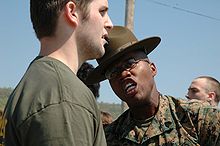
Just like Army Basic Training, the best place to start is with the fundamentals:  “This is where individuals learn about the fundamentals of being a soldier…”  But no good soldier wants to be stuck as a buck private [during] his whole time “in service.”  (Although there are some few [“soldiers of Christ”] who enjoy having no additional responsibility…)

In turn I concluded that this blog is for and about those Christians who want to develop into something “more than just someone who knows the bare ‘fundamentals.’”

See also Spiritual boot camp, which talked about the words “mystic” and “mysticism,” and how they affect some people:

The words “mystic” or “mysticism” seem to give some Christians apoplexy.  Try it on a Southern Baptist some time!  But seriously, one online dictionary defines a mystic as “a person who seeks by contemplation and self-surrender to obtain unity with or absorption into the Deity or the absolute.”  Again, arguably different words but the same idea…

All of which is a good reason to switch to Paul’s “soldier metaphor…”

There’s more on that metaphor later, but first some notes about that Lenten discipline.

I’ve noted that in writing the Torah, Moses had to be extremely careful.  He had to be extremely careful because if his audience took his message the wrong way – or weren’t ready for it – he’d likely be killed.  (As by getting thrown off a cliff or stoned.  See Moses getting stoned.)

Jesus faced the same risk of stoning – a number of times – as shown by other recent Daily Office Readings.  For example, John 8:59:  “At this, they picked up stones to stone him, but Jesus hid himself, slipping away from the temple grounds.”  And again in the NLT version of John 10:31:  “Once again the people picked up stones to kill him.”

And Jesus Himself noted the danger – in the Gospel for February 21, the Second Sunday in Lent:  “O Jerusalem, Jerusalem, who kills the prophets and stones to death those who have been sent to her!”  (Luke 13:34.)  And that’s not to mention Paul’s recital in Hebrews 11:36-37 (NIV):

Some faced jeers and flogging, and even chains and imprisonment.  They were put to death by stoning;  they were sawed in two;  they were killed by the sword.

The point of all this is that anyone – up to and including Jesus – had to be extremely careful in putting forth “the Word” to people who weren’t ready to receive its full implications yet.

And of those potential prophets, Moses – shown at right – was arguably the one who faced the greatest danger of all.  He was after all “the First.”  He was the original “prophet,” the man who single-handedly had to meld a huge group of former slaves into an army able to enter and conquer their own particular Promised Land.

But getting back to the Lenten meditation…

It turns out that there’s a number of theories on when, how, or even if Moses wrote the first five books of the Bible.

For example, according to Mosaic authorship – Wikipedia, “The Talmud discusses the authorship of all the books of the Hebrew Bible and assigns all but the last eight verses of Deuteronomy, which describe the death of Moses, to Moses himself.”

Then there’s Did Moses Write Genesis? | Answers in Genesis.  After noting the “Documentary (or JEDP) Hypothesis” – which the author rejected – he came to this conclusion:

There is abundant biblical and extra-biblical evidence that Moses wrote the Pentateuch during the wilderness wanderings after the Jews left their slavery in Egypt and before they entered the Promised Land…  Contrary to the liberal theologians and other skeptics, it was not written after the Jews returned from exile in Babylon (ca. 500 BC)…   It is the enemies of the truth of God that are failing to think carefully and face the facts honestly.  As a prophet of God, Moses wrote under divine inspiration, guaranteeing the complete accuracy and absolute authority of his writings. (E.A.)

For the sake of argument, I’m assuming as well that “Moses wrote the Pentateuch during the wilderness wanderings.”  But note also that the author of Did Moses Write Genesis seems to be one of those Biblical literalists I frequently take issue with.

Then there’s From What Did Moses Compose Genesis?  That article claims Moses had access to material written by “Abraham, Jacob, Noah, and even Adam.”  For myself, I’m inclined to think Moses got those materials, but through oral tradition, as noted in My Lenten meditation.

Finally – for now – there’s When did Moses write Genesis:

The Book of Genesis is traditionally attributed to Moses, writing around 1400 BCE.  However, scholars now say that the Book of Genesis was really written in stages over a period of several centuries during the first millennium BCE.

I should note there’s a pretty good chance that statement – that Genesis was written by somebody other than Moses – will likely “give some Christians apoplexy.”  

That in turn makes this a good stopping point.  Except to say that after Basic Training, the good soldier – and by extension the “Good Soldier of Christ” – has a chance to go on to Advanced Individual Training, “where new soldiers receive specific training in their chosen MOS.”

For example, a new soldier could go to the Field Artillery Center at Fort Sill Oklahoma.  (With all of the Freudian implications appertaining thereto.)

Or to the Aviation School at Fort Rucker Alabama.

Or even to the Army Intelligence Center at Fort Huachuca, Arizona.

On the other hand, a ” Not-so-good Soldier of Christ” could choose to remain a buck private for the duration.  But I seriously doubt if that would “please his commanding officer…”


Re:  “‘Gap readings’ between February 6 and 7.”  The dates for Lent and Easter shift each year.  (It’s a “moveable feast.”  See How Is the Date of Easter Calculated?)  So, most lectionaries include Daily Office Readings for a Season of Epiphany that can last up to eight weeks.  But in 2016, Lent started early.  Thus the “Week of the Last Sunday after the Epiphany” – which includes Ash Wednesday –  came on February 7.  But the readings for the week before February 7 were for the Week of the Fourth Sunday after the Epiphany.  That means there’s a “gap,” in which the readings for the Fifth, Sixth Seventh, and Eighth Sunday after  the Epiphany go unread in a year like 2016.  On the other hand, there are other – more assiduous – “Daily Office Readers” (like me), who do all the readings, regardless of any gap.  And it was from just that practice that I “re-discovered” 2d Timothy 2:3-4 – and it’s “soldier metaphor” – in such a timely manner.

Re:  Biblical literaiism.  See also Biblical Literalism – Huffington Post.

The image to the left of the “spiritual boot camp” paragraph is courtesy of the link, “United States Marine Corps Recruit Training,” in the Wikipedia article on Army Basic Training.  The full caption:  “A Drill Instructor provides an example of boot camp instructional style to a Marine Corps poolee, before the poolee’s departure for boot camp.”

The “Moses” image is courtesy of Moses – Wikipedia.  The caption:  “Moses holding up his arms during the battle, assisted by Aaron and Hur; painting by John Everett Millais.”  For more on the Battle of Rephidim, see Was Moses the first to say “it’s only weird if it doesn’t work?”

The “Moses writing” image is courtesy of: 
theosophical…evidence-that-some-of-genesis-was-not-written-by-moses.

The “Sad Sack” image is courtesy of www.coverbrowser.com/covers/sad-sack/2.  See also Sad Sack – Wikipedia, an article about the fictional World War II-era soldier, an “otherwise unnamed, lowly private experiencing some of the absurdities and humiliations of military life.”

Note that I originally planned to end this post with the image below, with the caption:  “An Admiral speaks to the remaining Navy SEAL trainees “at the end of ‘Hell Week.’”

That image is courtesy of United States Navy SEAL selection and training – Wikipedia.  The full caption is this:  “First Phase [of training:]  Then-Chief of Naval Operations (CNO) Adm. Mike Mullen addresses the remaining trainees of Class 266 at the end of ‘Hell Week:'”  (See also United States Navy SEALs – Wikipedia.)  As to the “Hell Week” in Navy SEAL training:

The first two weeks of basic conditioning prepare candidates for the third week, also known as “Hell Week.”  During Hell Week, candidates participate in five and a half days of continuous training.  Each candidate sleeps at most four hours during the entire week, runs more than 200 miles, and does physical training for more than 20 hours per day.

But then I would have had to note also that the U.S. Army equivalent of Navy Seal training would be held at the John F. Kennedy Special Warfare Center and School at Fort Bragg, Fayetteville, North Carolina.  “However, the latter site did not offer a suitable image for this post.”  

Then too the point of that “Navy SEAL” image would have been to contrast the truly-zealous “Good Soldier of Christ” – volunteering for such training – with the slacker content to get by with just learning “the fundamentals.”

*   *   *   *

And finally – really, really this time – note other articles of interest, to be addressed in a later post:  Don Stewart :: When Did Moses Write, or Compile, the BookWhy Moses Did Not Write the Torah – Mesa Community College, and Tablets of Stone – Wikipedia.

My Lenten meditation…

*   *   *   *

We’re now well into Lent, which means doing Lenten Disciplines.  For many, that means giving up something.  On the other hand, some people choose to add a discipline “that would add to my spiritual life.”  (See Lenten disciplines: spiritual exercises or ego trip?)

For my part, I’ve always wondered just when, where and how Moses came to write the first five books of the Bible. (The Torah.)  So I’ve decided that – aside from Bible-reading on a daily basis, which I already do anyway – I’ll spend this Lent “meditating” on this topic.

More precisely, I plan to spend this Lent contemplating on how and when Moses wrote those first five books.  And as Wikipedia explained, contemplation means “profound thinking about something.”  Further, “In a religious sense, contemplation is usually a type of prayer or meditation.”  And finally there’s this:

Within Western Christianity contemplation is often related to mysticism as expressed in the works of mystical theologians such as Teresa of Avila and John of the Cross as well as the writings of Margery Kempe, Augustine Baker and Thomas Merton.

So in so “contemplating,” I’d be in pretty good company.

And aside from all that, there’s the matter of “reaching the unreached.”

Put another way, from 1972 to 1985 there was a British sitcom on PBS called “Are You Being Served?”  Which brings up an interesting fact these days.  That fact is that there’s a whole segment of possible converts to Christianity who aren’t being served.

They are the potential Christians who’d like to find out more about the Bible.  However, they don’t want to develop the faith of a narrow-minded pinhead. (Mere rhetoric hyperbole.)

Take for example the sentiment expressed by Gordon Sumner, known to his fans as Sting:

I don’t have a problem with God.  I have a problem with religion.  I’ve chosen to live my life without the certainties of religious faith.

But as noted below, “If your religion makes you ‘certain,’  you’re missing the point!” That is, maybe – just maybe – if I could figure out a common-sense explanation to some of these Biblical mysteries, I might be able to “convert” Sting and others like him…

But getting back to the meditation-contemplation.  The key question:  “What did Moses know, and when did he know it?”  For example, did Moses know the full story about the “big bright thing in the sky?”

Did Moses know – far in advance of his fellow human beings – that the “earth” revolves around the “sun?”

On the other hand, there’s some pretty good evidence that if Moses did know that, he’d have been well advised not to share that information.  He would have been “well advised” on pain of being stoned to death, for “heresy.”  As it was, on more than one occasion Moses came close to being killed by the very tribe of Habiru he was ostensibly leading.  (See On Moses getting stoned.)

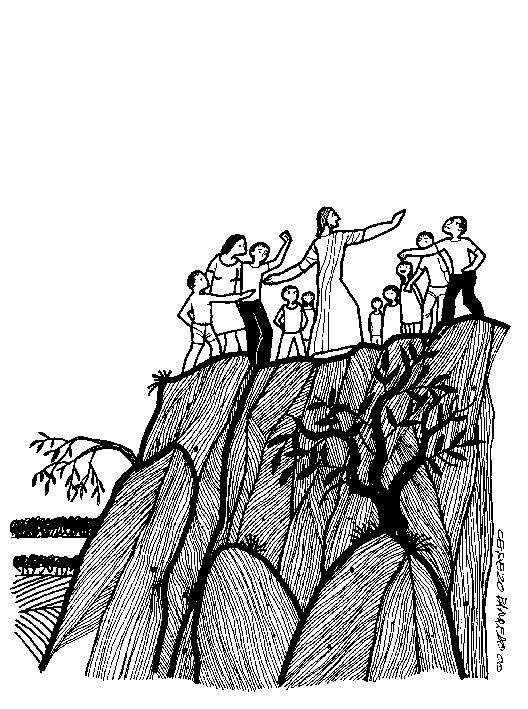
And something like that almost happened to Jesus, in the Gospel reading for the Fourth Sunday after the Epiphany. (That is, last January 31st.)  But in Luke 4:21-30, Jesus wasn’t threatened by stoning, as Moses was.  Instead, “the people” wanted to throw Him off a cliff.
When they heard this, all in the synagogue were filled with rage.  They got up, drove him out of the town, and led him to the brow of the hill on which their town was built, so that they might hurl him off the cliff.  But he passed through  the midst of them and went on his way.

As Wikipedia noted, “Throwing or dropping people from great heights has been used as a form of execution since ancient times.”  And in what may well be overstating the obvious:  “People executed in this way die from injuries caused by hitting the ground at high velocity.”

Another aside: The article noted that in “pre-Roman Sardinia, elderly people who were unable to support themselves were ritually killed.  They were intoxicated with a neurotoxic plant … then dropped from a high rock or beaten to death.”

But we digress…  Getting back to Moses, tradition says he wrote the first five books of the Bible. (The Torah.)  Of those first five books, the last four – ExodusLeviticus,  the Book of Numbers, and Deuteronomy – are all pretty much autobiography.  Moses wrote about his life, and his role in leading the Hebrews out of slavery and into their Promised Land.  (In doing so he referred to himself in the third person, a literary device called illeism.  See also On Moses and “illeism.”)

But in writing Genesis, Moses had to go back to the origins of time itself.  He had to go back to the Creation of the World itself.   And in doing so, he almost certainly had to rely on oral tradition.   (Referring to “cultural material and tradition transmitted orally from one generation to another.”)  Note also that from Sunday, January 10, up to Saturday, February 6, the Old Testament Daily Office Readings have been from the Book of Genesis.

Beyond that, the readings from Genesis resumed on Monday, February 15, with the story of Jacob[:] Father of the 12 Tribes of Israel.  Those OT Daily Office Readings will continue until Wednesday, March 9.  (After that the DOR‘s from the OT will be from the Book of Exodus.)

So the subject of the Book of Genesis – as arguably written by Moses after the fact – is definitely topical. And for starters, there’s the question whether Moses “wrote” the Torah at all. On the matter of “Semitic writing,” see History of writing – Wikipedia;

The first pure alphabets … emerged around 1800 BC in Ancient Egypt, as a representation of language developed by Semitic workers in Egypt…  These early abjads remained of marginal importance for several centuries, and it is only towards the end of the Bronze Age that the … Proto-Canaanite was probably somehow influenced by the undeciphered Byblos syllabary, and in turn inspired the Ugaritic alphabet (ca. 1300 BC).

Since Moses apparently lived from about 1392 to 1272 – see Answers.com – writing as we know it was just beginning.  Which is why – it seems – Moses probably had to rely on oral tradition

Then there’s the question whether Moses actually dictated the Torah to an amanuensis, rather than actually “writing” it himself.  (See On Amanuenses, about Paul and his “person employed to write … what another dictates.”)  Did Moses dictate the first five books of the Bible to another person, in the manner of Peter dictating to Mark?  (And as shown below.)

To be continued

*   *   *   *

The Apostle Peter dictates to Mark the Evangelist

*   *   *   *

The upper image is courtesy of Mark the Evangelist – Wikipedia.  The caption:  “Saint Mark the Evangelist Icon from the royal gates of the central iconostasis of the Kazan Cathedral in Saint Petersburg, 1804.”   The lower image is also from that article:  “Saint Mark writes his Evangelium at the dictation of St. Peter, by Pasquale Ottino, 17th century, Beaux-Arts, Bordeaux.”

Re: “Sting.”  See 10 Questions for Sting – TIME.  And re:  “If your religion makes you ‘certain,’ you’re missing the point!”  See On a dame and a mystic. The comment by Sting exemplifies some common perceptions today:   1) that too many Christians are too close-minded; 2) that too many are way too negative; or 3) that too many think The Faith of the Bible is all about getting you to follow their rules, on pain of you “going to hell.”  (See also my way or the highway – Wiktionary.)

“…what did Moses know, and when did He know it?”  One of many phrases – like “Irangate” or “Benghazi-gate” – traceable back to the 1972 Watergate scandal.  It can be credited to Senator Howard Baker, who famously asked, “What did the President know and when did he know it?”  The question was originally written by Senator Baker’s counsel and former campaign manager, future U.S. Senator [and Hollywood star], Fred Thompson.  See, wikipedia.org/wiki/Howard_Baker, and firstthings.com/blogs/evangel/2011/04/what-did-jesus-know-and-when-did-he-know-it.

The “cliff” image is courtesy of thatpreacherwoman.blogspot.com/2013/02/a-real-cliffhanger-sermon-that-did-not-go-well.  The article noted that the “people” – the ones Jesus spoke to in Luke 4:21-30 – “hadn’t really grasped the radical reforming he had in mind in order to bring good news to the poor and imprisoned and blind and oppressed.”  In other words they weren’t ready for it yet…

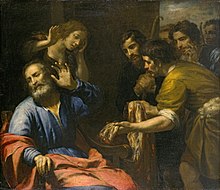
The “Jacob” image is courtesy of Jacob – Wikipedia.  The caption: “Joseph’s Coat Brought to Jacob
by Giovanni Andrea de Ferrari, c. 1640.”  The story of Joseph being thrown into a pit began in the DOR’s for February 15, with his brothers being jealous.  (Gen. 37:1-11.)  On Tuesday, February 16, the brothers throw Joseph into a pit as an alternative to killing him.  (Gen. 37:12-24.)  On Wednesday, February 17, the brothers Joseph’s coat in goat’s blood, then show it to their father, as shown in the Ferrari painting.  From there he went into slavery in Egypt…

Re: “To be continued.”  See Cliffhanger – Wikipedia, which noted that a “cliffhanger is hoped to ensure the audience will return to see how the characters resolve the dilemma.”  See also the image below, courtesy of  Did Back to the Future Originally Not End With ‘To be continued?’

*   *   *   *

2015-10-21-1445410698-8403632-futurecontinued.jpg

On Moses getting stoned…

*   *   *   *

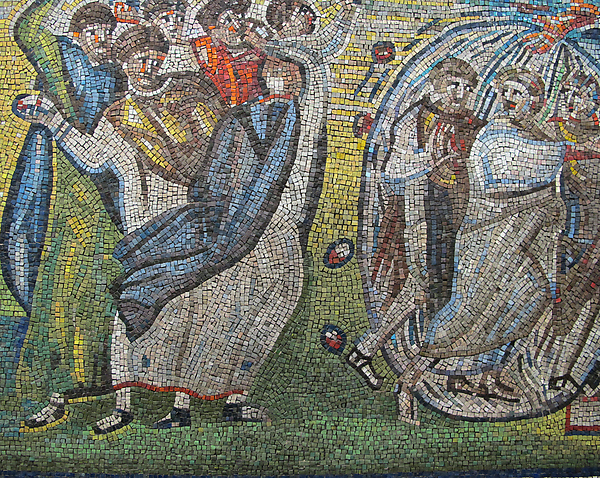
Stoning of Moses, Joshua and Caleb

One time when Moses almost got stoned – to death – along with Joshua and Caleb…

*   *   *   *

Here’s an update on some recent Dally Office Readings.

The Old Testament reading for last Sunday – January 10, 2015 – was Genesis 1:1, up to Chapter 2:3.  That story of the creation of the world begins – and ends – like this:

In the beginning God created the heavens and the earth.  Now the earth was formless and empty, darkness was over the surface of the deep, and the Spirit of God was hovering over the waters…  And on the seventh day God finished the work that he had done, and he rested on the seventh day from all the work that he had done.  So God blessed the seventh day and hallowed it, because on it God rested from all the work that he had done in creation.

In turn, that account causes a lot of non-believers to scoff.

They scoff because the person who wrote it – presumably Moses – didn’t put forth a “carefully constructed treatise, reflecting a well-thought-out plan.”  They scoff because Moses said the earth was created in seven days.

And they scoff because Moses didn’t tell his audience that the earth was some billions of years old by that time.  Or that there’d been “dinosaurs” roaming the earth millions of years before the Israelites became slaves in Egypt.

Or that that the terra firma on which they stood actually revolved around that “big bright round thing in the sky.”  (And not the other way around.)

What those scoffers fail to realize is that if Moses had mentioned any such things, he would have been stoned to death.  (At yet another time and for yet another reason;  one such incident is shown in the image at the top of the page.)

In other words, what those scoffers fail to realize is that at the time he was writing, Moses was addressing an audience of the largely “unwashed.”  That is, illiterate men and women who had been trained since birth to be “mindless, docile slaves.”

So again, if Moses had mentioned any of the things above, he would have certainly been “stoned,” there in the Wilderness.  (And not in a good way.)  And by the way, Jesus noted a similar problem in John 3:12, where He told His disciples, “If you don’t believe me when I tell you about things on earth, how will you believe me when I tell you about things in heaven?

Which is another way of saying that our puny little human minds are simply incapable of fully understanding God and all that “He” – anthropomorphism – is.  And this was especially true of the main audience Moses addressed when he wrote the First Five Books of the Bible.

Suppose Moses had mentioned dinosaurs in his writings.  Or how “we” revolve around that “big bright thing in the sky.”  The result would have been similar to what nearly happened in the Old Testament reading for January 8 – 2016 – Exodus 17:1-7.  In Exodus 17:4, “Moses cried out to the LORD, ‘What should I do with these people?  They are ready to stone me!'”

That was the incident at Mount Horeb, where God responded to the Israelites’ whining about being thirsty.  (By telling Moses to “strike the rock,” out of which came a stream of water.)

And that’s not to mention Numbers 14:10, “The whole assembly talked about stoning them.”  That was also part of “the people rebelling” – while Wandering in the Wilderness – told in Numbers 14.  In this case, the Bible noted “the people” were ready to stone not just Moses and Aaron, but also Joshua and Caleb.  (Who tried to defend them.)  In turn, God told Moses He was ready to “strike them down with a plague and destroy them,” that is, the Whiners.  But fortunately, Moses was able to persuade God not to do that.  (See also On arguing with God.)

So here’s what the Pulpit Commentary said about that incident:

This is the first which we hear of stoning as a punishment.  It is naturally one of the easiest modes of wreaking popular vengeance on an obnoxious individual, and was known to the Greeks as early as the time of the Persian War

A couple of notes:  The reference to the Persian War (or “Wars”) means the ancient Greeks were also familiar with stoning-as-punishment, apparently somewhere around 470 B.C.  And that wreaking “popular vengeance on an obnoxious individual” has also been around awhile.

(Not making any suggestions about our current political situation…)

But getting back to the problem Moses faced, writing the Pentateuch

In plain words, “Moses was forced by circumstance ‘to use language and concepts that his ‘relatively-pea-brained contemporary audience’ could understand.'” (See On the readings for June 15 – Part I.)  And to the extent he was writing for a future audience, he probably expected that future audience to understand those circumstances, and take them into account.

But getting back to the point, “our puny little human minds are simply incapable of fully understanding God:”  On that note the DORs for January 11 included Isaiah 55:8 and 9:

For my thoughts are not your thoughts, neither are your ways my ways,” declares the Lord. “As the heavens are higher than the earth, so are my ways higher than your ways and my thoughts than your thoughts.”

Gill’s Exposition of the Bible said that this passage denotes “the heavenliness of the ways and thoughts of God, the eternity and unsearchableness of them, and their excellency and preciousness; as well as the very great distance between [God’s] ways and thoughts and men’s [ways and thoughts] which this is designed to illustrate.”

All of which is another way of saying that “our puny little human minds are simply incapable of fully understanding God.”  Or as one professor put it – on our inability to understand God:

We are simply not up to the task, not wired for such an overload.  We are no more prepared to comprehend [God] than – to make use of a memorable example – cats are prepared to study calculus.  It’s just not in our nature. (E.A.)

So to sum up, if Moses had mentioned dinosaurs – or the earth being billions of years old, or our earth revolving around that “big bright round thing in the sky – in the first five books of the Bible, “the people” would have thought he was crazy, or worse.  They probably would have stoned him to death – as a heretic – or burnt him at some nearby convenient stake.

At the very least, Moses would have faced some sort of Inquisition – like Galileo did, some 2,800 years after Moses.  (For holding a view ostensibly “contrary to Scripture,” that the earth revolved around the sun, and as shown below.)   Which leads to one final comment:

It was never “contrary to Scripture” that the earth revolved around the sun.  It was only contrary to a narrow-minded, pigheaded, too-literal reading of the Scripture…

*   *   *   *

*   *   *   *

The upper image is courtesy of Stoning of Moses, Joshua and Caleb | Byzantine | The Metroplitan Museum of Art.  (It’s a mosaic from the 5th century.)  See also Stoning – Wikipedia, the free encyclopedia, which includes another painting of the incident. The caption to that painting, under Punishment of the Rebels:  “The Punishment of Korah and the Stoning of Moses and Aaron (1480–1482), by Sandro Botticelli, Sistine Chapel, Rome.”  See also Heresy – Wikipedia

The stoning article said this of a “Korah” painting of the incident:

The painting … tells of a rebellion by the Hebrews against Moses and Aaron.  On the right the rebels attempt to stone Moses after becoming disenchanted by their trials on their emigration from Egypt.  Joshua has placed himself between the rebels and Moses, protecting him from the stoning

Which raises anew the question:  “What would those backward, ignorant, sons-of-the-desert have done to Moses if he’d told them the truth about that ‘big bright round thing in the sky?’”

*   *   *   *

Re:  The Creation Story.  See also The Creation Story – Bible Story Summary and/or Creation Stories (from around the World) – University of Georgia.

The “dinosaurs” image is courtesy of Dinosaur – Wikipedia.  The caption:  “Artist’s impression of six dromaeosaurid theropods:  from left to right Microraptor, Dromaeosaurus,Austroraptor, Velociraptor, Utahraptor, and Deinonychus.”

The “Moses striking the rock” image is courtesy of BLB Image Gallery :: Moses Striking the Rock.

The “wandering in the wilderness” map is courtesy of davidblum61 … /2012/01/09/bible-maps-2.

Re:  The DORs for January 11.  The four-volume book version of the Daily Office has readings specified for a specific day in January – January 7 through 12 – beginning with the “Epiphany and following,” up to the “Eve of 1 Epiphany.”  However, in the online Satucket website, the reading for January 11 is listed as for the Monday after the First Sunday of Epiphany.  The net effect is to require the assiduous Daily Office reader to have two sets of readings for the days in January from the 7th to the 12th. 

Re:  the “cats-calculus” quote.  See On “Job the not patient” – REDUX, citing Professor Timothy Shutt of Kenyon College, author of Hebrews, Greeks and Romans:  Foundations of Western Civilization.

The lower image – Cristiano Banti‘s 1857 painting Galileo facing the Roman Inquisition” – is courtesy of the article, Heresy – Wikipedia:

Galileo Galilei was brought before the Inquisition for heresy, but abjured his views and was sentenced to house arrest, under which he spent the rest of his life. Galileo was found “vehemently suspect of heresy,” namely of having held the opinions that the Sun lies motionless at the centre of the universe, that the Earth is not at its centre and moves, and that one may hold and defend an opinion as probable after it has been declared contrary to Holy Scripture.  He was required to “abjure, curse and detest” those opinions. (E.A.)

*   *   *   *

 And here’s more on the  ostensible “Bible contradictions,” alluded to above.  See the notes for The Bible readings for September 27.  They cited the For or against link at the Secular Web site.  (Owned and operated by Internet Infidels, Inc.)  The site included this:  “The Bible is riddled with repetitions and contradictions, things that the Bible bangers would be quick to point out in anything that they want to criticize.”  The website also took the Bible to task for not creating a “carefully constructed treatise, reflecting a well-thought-out plan.” 

I addressed such criticisms in posts like The readings for June 15 – Part I.  I pointed out that Moses – for example – in writing the first five books of the Bible, was limited by “his audience’s ability to comprehend.”   The audience he “wrote” for was almost wholly illiterate – not to mention ignorant by present-day standards – and had been trained since birth only to be mindless, docile slaves.  Thus Moses was forced by circumstance “to use language and concepts that his ‘relatively-pea-brained contemporary audience’ could understand.” 

In further words, if Moses had written the “carefully constructed treatise” suggested by the “Infidels,” he almost certainly would be burned at the stake or stoned to death.  (Or both.)  See also Reflections on Volume 3 – Part II, which includes “The Stoning of Moses and Aaron.”

Then too, those “Bible bangers” are just the type of people inclined to give a “narrow-minded, pigheaded, too-literal reading of the Scripture.”

*   *   *   *

A final note:  The DOR Gospel reading for Saturday, January 16 – the day this was posted – was John 2: 13-22.  That included verses 19-22, where Jesus was asked about his “authority:”

 Jesus answered them, Destroy this temple, and I will raise it again in three days.”  They replied, “It has taken forty-six years to build this temple, and you are going to raise it in three days?”   But the temple he had spoken of was his body.

Which leads to another reason not to read the Bible too literally:  Jesus often spoke in metaphors, not to mention “parables.”  See for example, On three suitors (a parable)

*   *   *   *

On St. Nick and “Doubting Thomas”

*   *   *   *

Saint Nicholas” – the bearded guy in the middle – “saves three innocents from death…”

*   *   *   *

The next major feast day – not counting the Hanukkah “festival of lights” – is December 21, for St. Thomas, Apostle.  (The link is to the day’s Bible readings.)  He’s known as the original Doubting Thomas, because he initially refused to believe that Jesus had risen from the dead.

But there is one big problem.  December 21st falls right in the middle of the Season of Advent.

LHS sunstones.jpg(Not to mention it’s the shortest day of the year, as shown at right.)

So to avoid conflict, his day got changed to July 3.  (Though us traditionalists still celebrate his day on December 21.)  And of his four readings, John 20:24-29 gave the nutshell:

Thomas … was not with the other disciples when Jesus came.  So the other disciples told him, “We have seen the Lord.”  But he said to them, “Unless I see the mark of the nails in his hands, and put my finger in the mark of the nails … I will not believe…”  A week later [Thomas was there when  Jesus came and said], “Peace be with you.”  Then he said to Thomas, “Put your finger here and see my hands.  Reach out your hand and put it in my side.  Do not doubt but believe.”  Thomas answered him, “My Lord and my God!

Jesus then noted that while Thomas believed because he had actually seen Him, “Blessed are those who have not seen and yet have come to believe.”

Which of course means us.

(And BTW, I covered Hanukkah in “Ordinary?” Maccabees?  That festival of light “commemorates the victory of the ancient Israelites over the Syrian Greek army.”  Those Israelites were the Maccabee family and followers, “Jewish Freedom Fighters, a century or two before Jesus was born.”)

So anyway, for more on Thomas, see Doubting Thomas’ “passage to India.”  That post noted that “even to this day many people still don’t believe,” in Jesus or the Faith.  (To such people, “the tale of the resurrection must be put down to legend.”)  But if the story had ended without the Resurrection, the Christian Faith wouldn’t have grown as it did:

[E]ven if we take the rationalist view that there was no resurrection in reality, it cannot be denied that there was one in the belief of the disciples and, eventually, of hundreds of millions of men – and that made all the difference. (E.A.)

In other words, if it hadn’t been for the millions upon millions of people who came to believe, “the history of the world would be ‘enormously different.'”  On that note, “even some atheists admit that – taken as a whole – Christianity has had a positive influence on history.”
As for how Thomas ended up:  Tradition says he got sold into slavery, in India.  (Like Saint Patrick, he became a literal slave.)  But despite the setback, he ultimately got free and carried “the Faith to the Malabar coast, which still boasts a large native population calling themselves ‘Christians of St. Thomas:'”

St. Thomas is especially venerated as The Apostle in India [and is]  upheld as an example of both doubter and a staunch and loyal believer in Christ…   After all, each of us has both of these characteristics residing deep within ourselves – both moments of doubt and those of great spiritual strength…

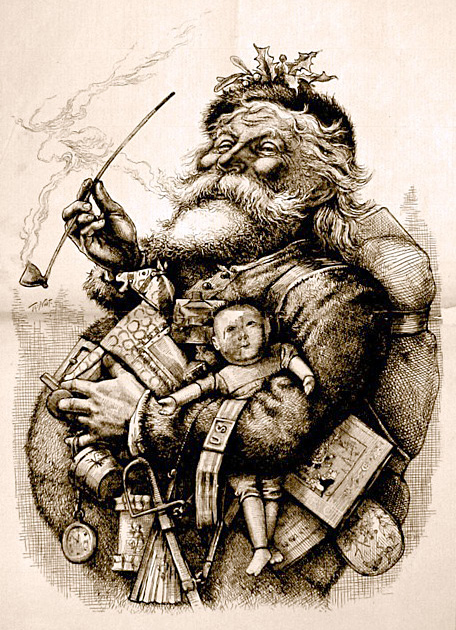
And then of course there’s good old “Santa Claus.”  He was originally “Nikolaos the Wonder-worker.”  See The original St. Nicholas.  (From which the upper image was borrowed):

Saint Nicholas, also called Nicholas of Bari or Nicholas of Myra [is] one of the most popular minor saints commemorated in the Eastern and Western churches and now traditionally associated with the festival of Christmas.  In many countries children receive gifts on December 6, Saint Nicholas Day.

In other words, our Santa Claus is based on a “historic 4th-century Christian saint and Greek Bishop of Myra.”  (“Original St. Nicholas” also explored the question why we celebrate Christmas on December 25, “if Saint Nicholas Day is December 6.”)
As to the image at the top of the page, here’s how the original St. Nicholas saved three innocents from death:

Nicholas was visiting a remote part of his diocese [when he heard of the “three innocents.”  He set out for home and] found a large crowd of people and the three men kneeling with their arms bound, awaiting the fatal blow.  Nicholas passed through the crowd, took the sword from the executioner’s hands and threw it to the ground, then ordered that the condemned men be freed from their bonds.  His authority was such that the executioner left his sword where it fell…

So like St. Ambrose of Milan, the original “St. Nick” was both a real person and personally brave. (See An early Advent medley.)  And that’s not to mention generous.

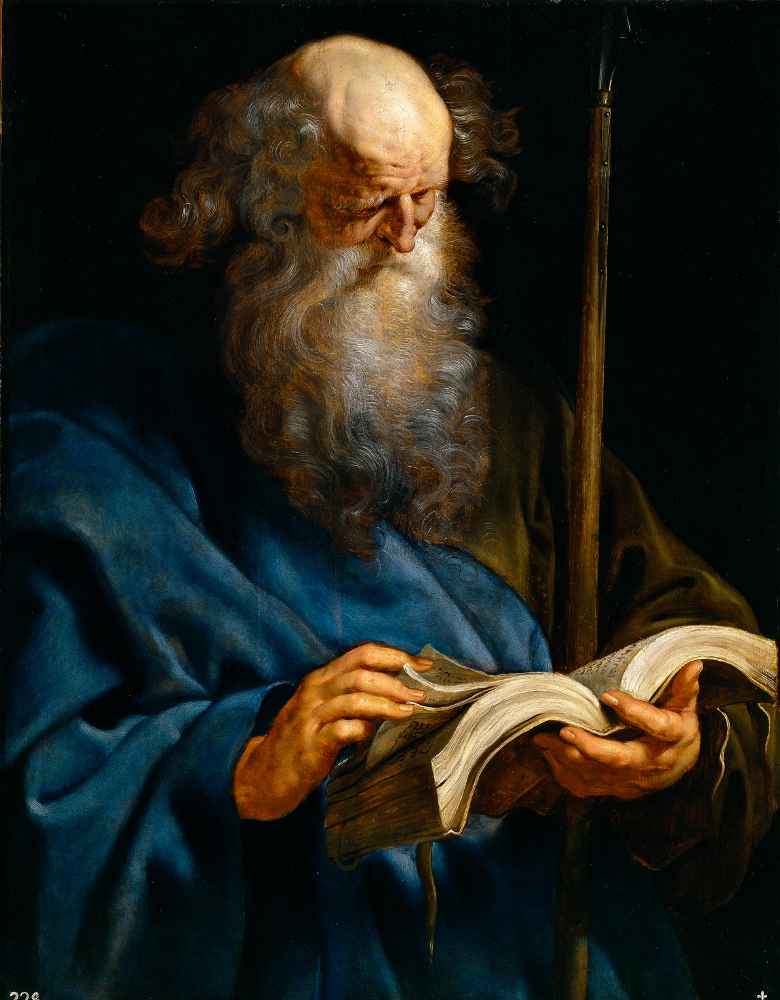
So for today’s post we remember both St. Nicholas and “Doubting Thomas.”  (Who apparently lived to a ripe old age, as shown in the image below…)

*   *   *   *

Peter Paul Rubens: St Thomas

St. Thomas by Peter Paul Rubens

*   *   *   *

The upper image is courtesy of Saint Nicholas – Wikipedia, with the caption:  “Saint Nicholas Saves Three Innocents from Death (oil painting by Ilya Repin, 1888, State Russian Museum).”   See also St. Nicholas Center … Saint Who Stopped an Execution:

Re: “Hanukkah.”  See also Hanukkah 2015 – My Jewish Learning, which noted that Hanukkah 2015 began at sunset on Sunday, December 6, and ended – at sunset – on Monday, December 14.  That’s because a Jewish “day” begins and ends at sunset, not midnight.  See Judaism 101.

Re:  Thomas the Apostle.  See also “Doubting Thomas” Sunday, and Wikipedia:  

When the feast of Saint Thomas was inserted in the Roman calendar in the 9th century, it was assigned to 21 December.  The Martyrology of St. Jerome mentioned the apostle on 3 July, the date to which the Roman celebration was transferred in 1969 [to avoid interference with] Advent.  3 July was the day on which his relics were translated from Mylapore [to] Mesopotamia.  Traditionalist Roman Catholics …  and many Anglicans … still celebrate his feast day on 21 December.

Re: Other readings for his day.  They are Habakkuk 2:1-4, Psalm 126, and Hebrews 10:35-11-1

The image below the winter solstice “miniature” is courtesy of Resurrection of Jesus – Wikipedia.  The caption:  “The Chi Rho” – one of the earliest forms of christogram – “and with a wreath symbolizing the victory of the Resurrection, above Roman soldiers, ca. 350.”

The lower image is courtesy of Thomas the Apostle – Wikipedia.

“Bible basics” revisited

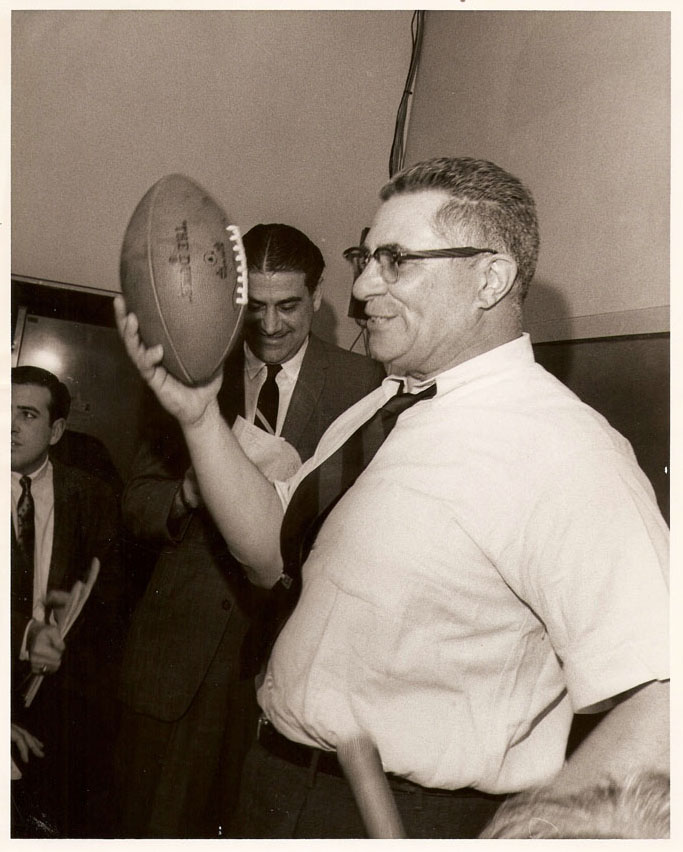
Vince Lombardi on The basics:  “Gentlemen, this is a football!”

                                                                     *   *   *   *

This is a reprise of a post I did back in April 2014:  Some Bible basics from Vince Lombardi and Charlie Chan.  It started a couple days ago when I went back to check some of the first posts I did for this blog.  In this one, I saw that the images I’d put in were no longer there.

So, rather than fool around looking up new images for an old post, I figured I’d do what Jesus suggested in Mark 2:21-22:
“No one sews a patch of unshrunk cloth on an old garment…  And no one pours new wine into old wineskins…”

So this “new wineskin” will begin with Vince Lombardi – in the upper image – being a fanatic on teaching the basics of football.  It starts with a story about Vince’s reaction to his Green Bay Packers losing to a team they should have beaten handily.  (A loss where the team looked “more like whipped puppies.”)  At practice the following Monday, Lombardi began by saying, “This morning, we go back to basics.”

Then – holding up an object for the team to see – Lombardi said, “Gentlemen, this is a football!

So, here are some basics for understanding the Bible.  And on how reading the Bible can help you become “all that you can be,” like the old Army commercial said.

For starters there’s the second part of John 6:37.  That’s where Jesus made a promise to each one of us, for all time: “Anyone who comes to me, I will never turn away.”  That’s a promise we can take to the bank, metaphorically and otherwise.

That is, we are aren’t “saved” by being members of a particular denomination.  (No matter how much they may tell you to the contrary.)  We are saved by starting that John 6:37 “walk toward Jesus.”  We start the interactive process of walking down that road to knowing Him better.

And the best way to start that walk is by reading the Bible on a regular basis.

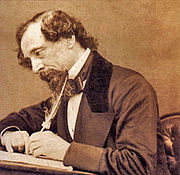
Unfortunately, many people start reading the Bible as if it were a novel.  (Like one by Charles Dickens, seen at right.)  They start at the very beginning and move toward the end.  But they tend to bog down in Leviticus.  (If they get that far.)

Jesus may have known the problem would come up, so He did us a favor. He boiled down the message of the entire Bible into two simple sentences.  (A kind of “Cliff-Note” summary):

Hear what our Lord Jesus Christ said:  “You shall love the Lord your God with all your heart, with all your strength, and with all your mind. This is the first and great commandment, and the second is like unto it: you shall love your neighbor as yourself.  On these two commandments hang all the Law and the Prophets.”

That’s Matthew 22:37-39, where Jesus boiled the whole Bible down to two simple “shoulds.” You should try all your life to love, experience and get to know “God” with all you have. And to the extent possible, you should try to live peaceably with your “neighbors.”

In plain words, your mission, should you choose to accept it, is to become one with the “unified whole” that is our world today.  (A big part of which is God, who started the whole thing…)

So, whenever you read something in the Bible that doesn’t make sense, or might mean two different things, or seems contrary to “common sense,” you have this Summary to fall back on. (It also works if you hear something from a slick televangelist that just doesn’t sound right.)

For example, some Christians become snake handlers. (Like “Stumpy,” at left.)  They do this based on a literal interpretation of Mark 16:18.  In other words, taking an isolated passage from the Bible out of context:

“In my name shall they cast out devils; they shall speak with new tongues. They shall take up serpents; and if they drink any deadly thing, it shall not hurt them; they shall lay hands on the sick, and they shall recover.”

(But see also On snake-handling, Fundamentalism and suicide, Part I and Part II.)

Other Christians work to develop large families – as a way of showing their faith – again based on focusing literally on Psalm 127:3-5, taking that one passage out of context: “Children are a gift from God; they are his reward.  Children born to a young man are like sharp arrows to defend him.  Happy is the man who has his quiver full of them.”  (See Quiverfull – Wikipedia.)

On the other hand, you could approach the Bible as presenting a plain, common-sense view of some people in the past who have achieved that “union with a Higher Power.”  (Which is of course the goal of most religions and/or other spiritual or ethical disciplines.)

So what’s the pay-off?

Simply put, the discipline of regular Bible-reading can lead to a capacity to transcend the painful and negative aspects of life.  It can also lead to the ability to live with “serenity and inner peace.”   On the other hand, the discipline could also lead to a your developing a “zest, a fervor and gusto in life plus a much higher ability to function.”

To some people, that flies in the face of the popular view of “Christians.”  (Some of whom seem to revel more in telling others how they should live their lives.)   Which leads to the question:  “Do you have to be grumpy to be a Christian?”  The answer is:  “Probably not.”

For example, someone asked Thomas Merton (American Trappist Monk) this question:  “How can you tell if a person has gone through inner, spiritual transformation?”  Merton smiled and said, “Well it is very difficult to tell but holiness is usually accompanied by a wonderful sense of humor…”

Then too, Jesus Himself said, “I came that they may have life, and have it abundantly.”  (See the second part of John 10:10, in the RSV, emphasis added.  Or as translated in The Living Bible (Paraphrased): “My purpose is to give life in all its fullness.”)  So what’s not to be happy about?

Which means that ideally, one who reads the Bible on a daily basis should not become an intolerant, self-righteous prig.  (Going around telling others how to live.)  Or as Saint Peter said, “Don’t let me hear of your … being a busybody and prying into other people’s affairs.”  (See 1st Peter 4:15, in The Living Bible translation.  And note that in most other translations, “meddlers” and “busybodies” are ranked right up there with murderers, thieves and evil-doers.)

Instead, such Bible-Reading on a regular basis should lead to a well-adjusted and open-minded person.  And also one who is tolerant of the inherent weaknesses – including his own – of all people.  In other, a person able to live life “in all its fullness.”

So how do you do all that?

One of the best ways to begin may be from one of the great philosophers of our time:

                                                                   *   *   *   *

                                                                   *   *   *   *

The upper image is courtesy of  PACKERVILLE, U.S.A.: “Gentlemen, this is a football.”

The wineskin image is courtesy of firesetternews.blogspot.com/2012/09/wineskins.

The GIST (Part II)

atticus finch

We were talking about the “GIST of the matter,” and how to get your own own “Atticus Finch…”


This post continues The GIST of the matter.  (With gist defined as “the main or essential part.”)

So once again, here are some thoughts as to the gist of this blog.

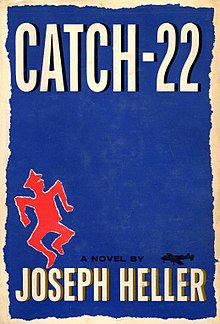
Catch22.jpgWe left off – at the end of “Part I” – by discussing the Catch 22 of getting JCPD appointed to your case.  “The catch is that you have to ask for this special Public Defender before you die.   If you wait until after you die it may be too late!  (So, why take the chance?)”

(See also Catch-22 – Wikipedia, as illustrated at left.)

Then there was a quote from Isaiah 50:8, “Let us appear in court together.”

So now to extend the metaphor:  Once you ask God – ahead of time – for JCPD as your court-appointed defense attorney, you get put on the functional equivalent of pre-trial diversion:

Pretrial diversion (PTD) is an alternative to prosecution which seeks to divert certain offenders from traditional criminal justice processing into a program of supervision…  Participants who successfully complete the program will not be charged or, if charged, will have the charges against them dismissed…

See USAM 9-22.000 Pretrial Diversion Program and/or Diversion program – Wikipedia.

See also John 5:24 (in the TLB):  “Anyone who listens to my message and believes in God who sent me has eternal life, and will never be damned for his sins” – or shortcomings – “but has passed out of death into life.”

In turn, your pre-trial supervision includes reading the Bible.  (In part for the counseling.)

So to repeat:  Your first step is to realize that Jesus won’t turn away anyone who asks for His help, as it says in John 6:37.  Your next step is to try and follow the Cliff’s Note summary of the entire Bible.  (The one that Jesus gave in Matthew 22:37-40.)

Your third step is to realize how much counseling is available.

That is – metaphorically – your pre-trial diversion guidebook is the Bible.  In turn there’s a PTD “counselor” available:  the Holy Spirit.  See John 14:26, as interpreted in the Complete Jewish Bible, :

But the Counselor, the Ruach HaKodesh, whom the Father will send in my name, will teach you everything;  that is, he will remind you of everything I have said to you.”

Also John 16:7, I tell you the truth, it is to your advantage that I go away; for if I don’t go away, the comforting Counselor will not come to you.  However, if I do go, I will send him to you.”

In other words this Great Spirit is the third “person” in the Trinity.  First there’s God the Father as Ultimate Judge.  Then there’s Jesus as Ultimate Defense Lawyer.  And last but not least, there is the Holy Spirit – the Ruach HaKodesh – as the Ultimate Pre-trial Diversion Counselor.

the-universe(And if all that isn’t enough to get you reading the Bible on a regular basis, consider the post by Mike Mooney, Why I’d Still Believe In God Even if the Bible was a Fairytale, featuring the image at right.)

*   *   *   *

So what exactly happens when you start reading the Bible on a regular basis?

You could say this spiritual discipline amounts to an ongoing “transcendental” meditation

For example, see The Bible as “transcendent” meditation.  The basic message there is that – as in all true meditation – what you’re trying to do is literally impossible.  You can’t ever literally adhere to the mandate of Matthew 22:36-40.   You can never, ever love God with all your heart and strength and mind, or – and this is especially hard – love your neighbor “as yourself.”

But there is a payoff, or rather any number of payoffs to this spiritual discipline:

Greater efficiency in everyday life;  getting in touch with a different view of reality than the one we ordinarily use;  the ability to transcend the painful, negative aspects of life;  living with a serene inner peace;   and/or living with “a zest, a fervor and gusto in life plus a much higher ability to function in the affairs of everyday life.”

Put another way, you could say that starting your pilgrimage – through the discipline of regular Bible-reading – is a bit like spiritual water-skiing.

To extend this metaphor further:  Starting this interactive process of “walking toward Jesus” can become a bit like grabbing the handle of a rope connected to some metaphoric Big Motorboat in the Sky.  Once you grab on, your main job is simply to hang on to the rope for dear life.

Which raises another question:  What kind of ride can we expect once we grab onto the handle?  And what do we do if our “hands” get so tired that we let go of the handle?

That’s what this blog is all about.


Again, the upper image is courtesy of gospelcoalition.org/blogs … atticus finch

The “counselor” image is courtesy of school-counselor.org/topics/new-school-counselor.

Re: “Ruach HaKodesh.”  See also Holy Spirit (Judaism) – Wikipedia:  “The Holy Spirit in Judaism generally refers to the divine aspect of prophecy and wisdom.  It also refers to the divine force, quality, and influence of God Most High … over the universe or over God’s creatures…”

Re:  Why I’d Still Believe In God Even if the Bible was a Fairytale.  That post ends: 

Sure, it’s irrational to believe in ancient religious narratives – that is a matter of faith – but to believe there is a Higher Power that designed and implemented the universe is not irrational, not when the only other option we have is that the universe just happened by fluke, right?


The GIST of the matter…

atticus finchAccept Jesus and get your own “Atticus Finch” as Ultimate Defense Attorney


The gist is defined as “the main or essential part of a matter.”  So here’s the gist of this blog.

It’s based on the idea of God as Ultimate Judge.  In turn, the Bible shows that God’s son – Jesus – is the Ultimate, Court-appointed Defense Attorney.  (As will be shown below.)

The best part of the deal is that because He is the Judge’s Son, JCPD – Jesus Christ, Public Defender – can cut you a deal that only a moron would turn down.

But first, a word about the Process.  As noted elsewhere, the process of your salvation begins when you accept the promise of Jesus in John 6:37.  (That He will never turn away anyone who comes to Him.)  From that point, you head “down the road toward Jesus.”

That is, you begin the interactive process of walking to Jesus, by reading the Bible on a regular basis.  And you start shaping your life via the “CliffsNotes” summary of the Bible that Jesus gave in Matthew 22 – verses 36 through 40. That’s where Jesus responded to a wise-guy lawyer trying to trap Him by asking, “Teacher, which is the greatest commandment in the Law?”

Jesus answered, “‘Love the Lord your God with all your heart, with all your soul, and with all your mind.’    This is the greatest and the most important commandment.    The second most important commandment is like it: ‘Love your neighbor as you love yourself.’    The whole Law of Moses and the teachings of the prophets depend on these two commandments.”

(Emphasis added.)  Which brings up the metaphor of Super Mario Brothers.

That is, the interactive process of walking toward Jesus is much like that “1985 platform video game,” developed and published by Nintendo.  In other words, the days and weeks of your life will pass by, and you will read the Bible more and more. But then – every once in a while – you’ll come across a golden nugget, a  passage from the Bible that puts your life into focus.

As the caption to the image above right reads:  “The player controls Mario throughout the Mushroom Kingdom.  Mario’s abilities can be changed by picking up certain items; for example, Mario is able to shoot fireballs if he picks up a Fire Flower.”

The game world has coins scattered around it for Mario to collect, and special bricks marked with a question mark (“?”), which when hit from below by Mario, may reveal more coins or a special item.  Other “secret,” often invisible, bricks may contain more coins or rare items.  If the player gains a red and yellow Super Mushroom, Mario grows to double his size and can take one extra hit from most enemies and obstacles…

See Wikipedia, the free encyclopedia.  So metaphorically, something like that can happen when you read the Bible on a regular – preferably daily – basis.  Put another way, the clues you pick up in your Bible-reading are like those coins of great value in Luke’s parable.

The bottom line is that those Bible-nuggets can give you the power to decode your own unique life-script.  (And maybe even “shoot fireballs,” metaphorically or otherwise.)

http://jobdescriptions.net/wp-content/uploads/2013/05/Probation_cartoon.jpgAnd as explained below, when you accept JCPD, you get put on a kind of “pre-trial diversion” or probation.  As part of that “PTD,” you’re expected to make a good-faith effort to love, learn about, and get to know God with all you have.
And as far as possible, you’ll be expected to live at peace with your neighbors. (Again, see Matthew 22:36-40.)  And you’ll also be expected to read and apply the Ultimate Pre-trial Diversion Handbook, to wit:  the Bible.

It’s really that simple…

But getting back to the metaphors of God as Ultimate Judge and JCPD…

*   *   *   *

Imagine meeting God as Ultimate Judge.   You’ve led an okay life.  You’re not a serial killer or child molester.  You attend church.  (From time to time.)  You give to some charities, from time to time.  But then – into the courtroom – comes The Ultimate Prosecutor.

Note that “Satan” comes from the Hebrew and Greek.  (“Satanas” in Greek.)  Both words translate literally as “adversary.”  (Note too that the root word for devil is “diabolos,” Greek for “slanderer.”)   So – like any good prosecutor – the Ultimate Prosecutor (Satan) will try to get you convicted, by “slandering the accused.”   (In this case, you.)

That’s when this Ultimate Prosecutor will point out things like James 2:10, “Whoever keeps the whole law and yet stumbles at just one point is guilty of breaking all of it.

So you’re sunk, right?  Who could you get to speak up for you?

Who else but that Ultimate Court-Appointed Defense Attorney, Jesus Christ, Public Defender. 

As it says in 1st John 2:1, “If any man sin, we have an advocate with the Father, Jesus Christ the righteous.”  And “advocate” is just another term for lawyer; someone who puts in a good word for you.  “One who argues for a cause or person; a supporter or defender.”

On that note, consider the story Sam Ervin – at right – once told of an old North Carolina lawyer.  The old lawyer was asked how he could justify arguing for a client he knew was guilty:
Someday[, he said] I shall stand before the Bar of Eternal Justice to answer for deeds done by me in the flesh.  I shall then have an advocate in the person of our Lord [Jesus], who will certainly be pleading for a very guilty client.

But getting back to  JCPD.  He isn’t just any old overworked, underpaid, hack public defender.  Just like the Ultimate Judge and the Ultimate Prosecutor, Jesus is The Ultimate Public Defender.  And again, because He’s personally related to the Judge – Jesus is the “Judge’s” son – He can get you a super deal.  In fact, it’s a deal only a moron would turn down.

Here’s the deal:  If you get JCPD appointed to your case, He can “grease the right palms.”  He can see to it that you don’t have to go to “court” (judgment) at all.   Instead of going to “Court “- at all – JCPD can see to it that you go immediately into the “Ultimate Pre-trial Diversion Program.”

But there’s a catch…

The catch is that you have to ask for this special Public Defender before you die.   If you wait until after you die it may be too late!  (So, why take the chance?)

Or as it says in Isaiah 50:8, “Let us appear in court together.”

To be continued…

*   *   *   *

With “JCPD,” you’ll go into court with a defense attorney who’s the Judge’s son

*   *   *   *

The upper image is courtesy of www.thegospelcoalition.org/blogs/erikraymond/2015/06/03/atticus finch.  The review added:  “I was intrigued by Atticus Finch.  At every turn he seemed to give people the benefit of the doubt and even (perhaps to a fault) willing to cover character defects with loving understanding.”  The reviewer – Erik Raymond – then added this:

The character in Harper Lee’s story helped me to become uncomfortable enough to ask questions about myself.  You might say he cross examined me when I didn’t know I was even on the stand.  This is a pleasure of reading, sometimes the book you are reading begins to read you.  As a Christian everything is a tool that can aid in the heart work of sanctification.  (Emphasis added.)

The reader may also find these websites of interest: Transformed Public Defender « Power to Change, and Jesus, my public defender | Wisconsin Evangelical Lutheran Synod.

Re: Public defenders.  See also Hightower v. State, 592 So.2d 689 (Fla. 3rd DCA 1991):

Public defenders stand alone, armed only with their wits, training and dedication.   Inspired by their clients’ hope, faith and trust, they are the warriors and valkyries of those desperately in need of a champion.   Public defenders, by protecting the downtrodden and the poor, shield against the infringement of our protections, and in reality, protect us all.

Re: God as “Ultimate Judge.”  Cruden’s Complete [Bible] Concordance has a number of citations, like “God is a righteous judge; God sits in judgment every day.” (Psalm 7:11.)  See also 76 Bible verses about God, As Judge – Knowing Jesus.  But this metaphor isn’t limited to Judeo-Christian tradition.  It was shared by the ancient Egyptians, who believed after death a person could expect “judgment before Osiris; if the verdict was favorable, he would live in Osiris’ kingdom, if not, he was abandoned to a monstrous destroyer, part crocodile, part hippopotamus.”  See Roberts, J.M. The Pelican History of the World, Penguin Books (1980), at page 90.

Re: the “interactive process.”  See On St. Matthew – 2015:  “A third thing you can do is realize the process is both interactive and ongoing.  (The more you do it the better you get at it.)”

Re: definitions of “Satan,” etc.  See New International Dictionary of the Bible, Regency Reference Library, 1987, Page 899.  See also Revelation 12 KJV, verses 7-10:

And there was war in heaven:  Michael and his angels fought against the dragon; and the dragon fought and his angels.  And prevailed not… [T]he great dragon was cast out, that old serpent, called the Devil, and Satan, which deceiveth the whole world; he was cast out into the earth, and his angels were cast out with him.   And I heard a loud voice saying … the accuser of our brethren is cast down, which accused them before our God day and night.  (E.A.)

The probation cartoon is courtesy of jobdescriptions.net/legal/probation-officers-job-description.

The image is Sam Ervin is courtesy of Sam Ervin – Wikipedia, the free encyclopediaThe caption:  “Sam Ervin (right), as chair of the Senate Watergate Committee.”  The Sam Ervin quote is courtesy of Bill Wise, The Wisdom of Sam Ervin, Ballantine Books (1973), at page 136.

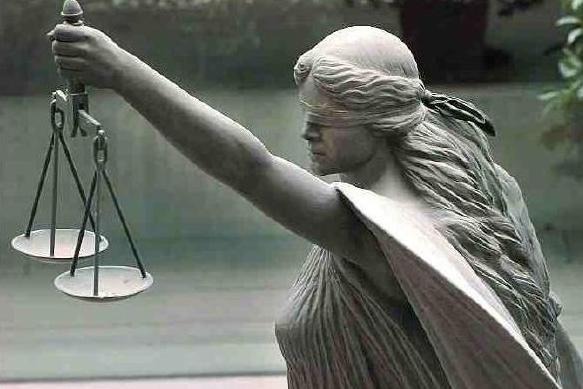
The lower image is courtesy of Lady Justice – Image Results.  See also, for example, the photo at Scopes Trial – Wikipedia, with the caption:  “Clarence Darrow (left) and William Jennings Bryan (right) chat in court during the Scopes Trial.”  Or see On three suitors.

The image above left – also used as a defense-attorney example – shows Sam Sheppard and his defense attorney, F. Lee Bailey.  (Also one of the attorneys who represented O. J. Simpson.)  Sheppard was ultimately acquitted, and the “television series The Fugitive and the 1993 film of the same name has been cited as being loosely based on Sheppard’s story.”  (The film and TV creators have denied that claim.)  Be that as it may, the image is courtesy of law2.umkc.edu/faculty/projects/ftrials/sheppard/sheppard

On those “not-so-good” Samaritans

Vincent van Gogh's Good Samaritan (after Delacroix), The Painting

The Good Samaritan:  Was this a parable about “inclusion?”


Most people know the Parable of the Good Samaritan.  And most such people naturally assume that a “good Samaritan” has always been a person who “selflessly helps others.”  (See Urban Dictionary: Good Samaritan:  “Today a Good Samaritan is usually someone who goes out on a limb to help others, even if they are complete strangers.”)

Is Communism Un-American, by Eugene Dennis (1947). (National Archives)But most people don’t know that calling someone a “Samaritan” in the time of Jesus was pretty much like calling him a “Communist” – or worse – in the America of the 1950s:

Portraying a Samaritan in a positive light would have come as a shock to Jesus’s audience.  It is typical of his provocative speech in which conventional expectations are inverted…   Jesus’ target audience, the Jews, hated Samaritans…  The Samaritans in turn hated the Jews.  Tensions were particularly high in the early decades of the 1st century because Samaritans had desecrated the Jewish Temple at Passover with human bones. (E.A.)

See Wikipedia.  So the Jews hated the Samaritans and the Samaritans hated the Jews.  (Sound familiar?)  Or as Asimov put it (523), these were the “hated and heretical Samaritans.”

I bring all this up because the Daily Office Reading for Monday, September 28, 2015 – the Old Testament reading – described the root of why Jews hated Samaritans so much.  (And by extension, why it was so provocative of Jesus to make a Samaritan a “hero” in His parable…)

But back to the root of the hatred itself.

The article Samaritans – Second-Class Citizens noted that “even worse than publicans* in the estimation of the Jews were the Samaritans…  ‘Thou art a Samaritan and hast a devil’ was the mode in which the Jews expressed themselves when at a loss for a bitter reproach.”

For starters, in Matthew 10:5–6, Jesus told His disciples:  “Do not go among the Gentiles or enter any town of the Samaritans.” (E.A.)  And sometimes other Jews hurled this epithet – at Jesus – as noted above.  See John 8:48:  “The people retorted,  “You Samaritan devil!  Didn’t we say all along that you were possessed by a demon?”  (In the New Living Translation.)

The sentence [- “you’re a Samaritan!” -] is singularly insulting in its tone and form.  We cannot measure the exact amount of insult they condensed into this word, whether it be of heresy, or alienation from Israel, or accusation of impure descent.

(Emphasis added.)  All of which is another way of saying there’s more to this parable than meets the eye.  (The business of “impure descent” – illegitimacy – is a whole ‘nother subject…)

But getting back to that Old Testament Daily Office Reading for Monday, September 28.  As noted, it goes back to why the Jews hated Samaritans so much.

Sargon II and dignitary.jpgThe story goes back to the time of Sargon II, and the year 722 B.C.:

Under his rule, the Assyrians completed the defeat of the Kingdom of Israel, capturing Samaria after a siege of three years and exiling the inhabitants.  This became the basis of the legends of the Lost Ten Tribes.  According to the Bible, other people were brought to Samaria, the Samaritans…  Sargon’s name actually appears [at] at Isaiah 20:1

As Asimov explained it, in the year 725 B.C. the Hebrews – a “stubborn and stiff-necked people” – had rebelled once again against their overlords.  (The Hebrew homeland got conquered quite often in Jewish history.)  But in a twist, when Sargon conquered the northern Kingdom of Israel, he didn’t massacre the inhabitants wholesale.  Instead he deported the native Hebrews and brought in new people – from far away – to colonize Samaria.

This tactic marked the permanent end of that northern Kingdom of Israel, and led to the story of the Ten Lost Tribes.  Asimov estimated that some 27,000 “leading citizens” of Israel were deported; mostly landowners and members of the ruling class.  the “colonists” were brought in from Babylon, some 500 miles away “as the crow flies.”  Those new colonists centered in Samaria, and they and their descendants “are what the Bible refers to as Samaritans.”

Or as the Bible itself put it, in 2d Kings 17, verses 24-41 (“edited for content“):

The king of Assyria transported colonies of people from Babylon [and other areas] and resettled them in the cities of Samaria, replacing the people of Israel…  But they continued to follow the religious customs of the nations from which they came.  And this is still going on among them today…  These colonists from Babylon worshiped the Lord, yes – but they also worshiped their idols.  And to this day their descendants do the same thing.

a map showing the outline of Ireland in the colour green with the capitals of the North and South marked on it

For a contemporary equivalent, think of Northern Ireland and especially The Troubles.  That article described the centuries-old conflict between Catholics and Protestants in Northern Ireland.

The “Troubles” started 500 years ago, in 1609:  “In 1609, Scottish and English settlers, known as planters, were given land confiscated from the native Irish in the Plantation of Ulster.  Coupled with Protestant immigration to ‘unplanted’ areas … this resulted in conflict between the native Catholics and the ‘planters,’ leading in turn to two bloody ethno-religious conflicts.”

And the two parties – Catholics and Protestants – both claimed to be “the true Israel” – in their own way – and that their version of Bible worship followed “the original” more closely, and that their enemies worshiped a “falsified text,” as noted below.

And to paraphrase 2d Kings 17:34, these Irish Troubles are “going on among them today.”  (Or at least until the 1990s, after 30 years of “intense violence during which 3,254 people were killed.”)

But getting back to the root of Jewish hatred of Samaritans:  When they came in to colonize the area, these “Neo-Samaritans” decided to worship both the God of the Hebrews, and also “their own gods.”  (See also “hedging your bets.”)  The resulting Samaritan religion became – in the eyes of native Hebrews – “a kind of Yahvistic heresy.”  In turn the native Judeans would be “more hostile at times to the heretics than to the outright pagan.”

(As Asimov also noted, this too is a recurring phenomenon throughout history.)

Thus again, to the audience Jesus spoke to, these were the “hated and heretical Samaritans.” But the Samaritans in turn thought the same thing of the hostile Hebrews:

The Samaritans claimed that they were the true Israel[, and] that their version of the Pentateuch was the original and that the Jews had a falsified text…  Both Jewish and Samaritan religious leaders taught that it was wrong to have any contact with the opposite group, and neither was to enter each other’s territories or even to speak to one another.  During the New Testament period … Josephus reports numerous violent confrontations between Jews and Samaritans throughout the first half of the first century.

See Samaritans – Wikipedia, which included the image at right:  “Israeli actress from the Samaritan community, Sofi Tzadka…  Born as an Israeli Samaritan, along with her siblings [she] formally converted to Judaism at the age of 18.”  (She also did the voice-over role of “Ella of Frell (played by Anne Hathaway) in the Hebrew dub of the film ‘Ella Enchanted.'”)

I suppose there’s some kind of object lesson in Sofi’s example.  (Perhaps on the healing power of beauty.)  But we were talking about Jewish attitudes toward Samaritans in the time of Jesus.

Jesus clearly wanted to make a point by making the hero of this parable a Samaritan.  The question is:  What was His point?  According to Asimov:  “The point Jesus was making was that even a Samaritan could be a neighbor; how much more so, anyone else.”  Thus to repeat:

The term “good Samaritan” has been used so often … that one gets the feeling that Samaritans were particularly good people and that it was only to be expected that a Samaritan would help someone in trouble.  This loses the point of the story, since to a Jew at the time of Jesus, Samaritans were a hateful and despised people. (E.A.)

And again, there were at least two reasons why the Samaritans were so hated and despised.  Not only did they usurp and colonize territory that had once belonged to the Kingdom of Israel, they had also usurped the Jewish religion itself.  But they didn’t adopt the Jewish faith whole cloth.  Instead – in the eyes of native Jews – the Samaritans had created a hybrid, “hedge-your-bets” and/or “feel good” type of religion that was tantamount to heresy.

And the usual fate of heretics was to be massacred, as shown at left.

But Jesus didn’t want that.  In His parable, first a priest and then a Levite passed by the fellow Hebrew who’d been beaten and robbed.  “They were each learned in the law and undoubtedly knew the verse in Leviticus” – Leviticus 19:18, with its command to love your neighbor as yourself.   “Yet they did nothing.”  Instead, in this parable it was the hated and despised – infidel and heretic – Samaritan who helped.

Asimov said the “flavor of the parable” could be set in modern terms with a “white southern farmer left for dead,” but ignored and passed by by a minister and a sheriff.  In this update of the parable, the white southern farmer would be saved by a “Negro sharecropper.”

In other words, a man is not a “neighbor” because of what he is but because of what he does.  A goodhearted Samaritan is more the neighbor of a Jew, than a hardhearted fellow Jew.  And, by extension, one might argue that the parable teaches that all men are neighbors, since all men could do well and have compassion, regardless of nationality.  To love one’s neighbor is to love all men…  The point Jesus was making was that even a Samaritan could be a neighbor; how much more so, anyone else.

And finally, Asimov noted that only the Gospel of Luke included this parable, which is “among the most popular of all those attributed to Jesus, and which preaches universalism.”

So I suppose you could say this parable was “about ‘inclusion.'”  Which in turn is another way of saying that Jesus will never turn away anyone who comes to Him, as noted in John 6:37.

And besides all that, Luke seems to have been a pretty dang good artist…


Luke paints the Madonna and the Baby Jesus…”


The upper image is courtesy of The Good Samaritan (after Delacroix), by Vincent Van Gogh.

Re: “Inclusion.”  The practice where “different groups or individuals having different backgrounds like origin, age, race and ethnicity, religion, gender, sexual orientation and gender identity and other are culturally and socially accepted and welcomed, equally treated, etc.” 

On that note, see Paul Ryan urges GOP, from August 2014: “Republican congressman and 2012 vice presidential candidate Paul Ryan … says his party is doomed to future defeats unless it broadens its appeal beyond a traditional base of older white voters…  Ryan says his party needs to be more inclusive, spend far more time talking to black and Latino voters, and avoid playing into what he calls a caricature of the ‘cold-hearted Republican.'”  Then there’s Some black conservatives question tea party’s inclusiveness(So apparently “inclusiveness” is a good thing, to most people…)

For a further explanation of the Daily Office, see What’s a DOR?

Re: Isaac Asimov.  The quotes about the Samaritans are from Asimov’s Guide to the Bible (Two Volumes in One),  Avenel Books (1981), at pages 377-382, and pages 943-45.  The quote about the “hated and heretical” Samaritans is from page 523. 

Asimov (1920-1992) was “an American author and professor of biochemistry at Boston University, best known for his works of science fiction and for his popular science books.  Asimov was one of the most prolific writers of all time, having written or edited more than 500 books and an estimated 90,000 letters and postcards.”  His list of books included those on “astronomy, mathematics, theBible,William Shakespeare’s writing, and chemistry.”  He was a long-time member of Mensa, “albeit reluctantly;  he described some members of that organization as ‘brain-proud and aggressive about their IQs.’”  See also Isaac Asimov – Wikipedia.

Re:  “Publicans.”  For more on how much the Jewish people of Jesus’ time hated publicans and tax collectors, see On St. MatthewNo tax collector [at that time was] actually going to be loved, but a ‘publican’ of the Roman sort was sure to be hated above all men as a merciless leech who would take the shirt off a dying child.” 

Re: distance from Babylon to Samaria.  Google Maps puts the driving distance at some 2,600 miles, by a circuitous route including a ferry, tolls, restricted roads and “multiple countries.”

The “massacre” image is courtesy of the Wikipedia Heresy article.  The caption:  “Massacre of the Waldensians of Mérindol in 1545.”

The bottom “Luke paints” image is courtesy of Luke the Evangelist – Wikipedia.  The full caption: Luke paints the Madonna and the Baby Jesus, by Maarten van Heemskerck.”  On that note:

Christian tradition, starting from the 8th century, states that he was the first icon painter.  He is said to have painted pictures of the Virgin Mary and Child…  He was also said to have painted Saints Peter and Paul, and to have illustrated a gospel book with a full cycle of miniatures.

The other Daily Office Readings for Monday, September 28, are Psalm 89:1-18, Psalm 89:19-521st Corinthians  7:25-31, and Matthew 6:25-34.

On the readings for July 26

Artemisia Gentileschi: Bathing Bathsheba

Bathsheba taking a bath –  with David watching  – “from his balcony (top left)…” 

*   *   *   *

The last time I posted on the Bible readings for an upcoming Sunday was for Trinity Sunday.  That was May 27, nearly a month ago.  (Of course it didn’t help that I was on vacation for the first two weeks of July.  See A Mid-summer Travelog.)

And there’s another reason to focus on these particular passages.  I’ll be the lay reader – up front with a microphone – as part of my Anglican Communion authorization “to read some parts of a service of worship.”  So it’ll definitely help to know the background.

Those readings are in The Lectionary under Ninth Sunday after Pentecost – Proper 12.  The Track 1 readings are 2 Samuel 11:1-15, followed by Psalm 14, then the New Testament, Ephesians 3:14-21.  (The Gospel – that the priest reads – is John 6:1-21.)

2d Samuel 11:1-15 tells of David – when he was King of Israel – seeing Bathsheba, taking a bath “in the altogether,” as seen at the top of the page.  It also tells what David did to Uriah the Hittite, Bathsheba’s husband.  (After he – David – got her pregnant.)   When Bathsheba told him about that, David had Uriah brought back from the war and tried to trick him into knowing her in the Biblical sense.  (That way, Uriah would think that the kid was his.)

When that didn’t work, David basically had Uriah killed.  (But he made it look like an accident.) And it was because of all this that David wrote Psalm 51, “by any measure, one of the best-known and most often read penitential texts” in the Bible.  See Psalm 51 Commentary.

See also Repentance for the Soul (Psalm 51) | Bible.org:

Psalm 51 is one of seven penitential psalms.  David threw himself on the mercy of God after committing adultery and murder.  That’s right: King David messed up “royally.”  His two-fold repentance provides a model that we should follow when we choose sin…

So anyway, 2d Samuel 11:1-15 begins:  “In the spring of the year, the time when kings go out to battle, David sent Joab with his officers and all Israel with him;  they ravaged the Ammonites, and besieged Rabbah. But David remained at Jerusalem.”  That’s when the trouble began.

David Bathsheba.jpgBut first, a telling detail in 2 Samuel 11:4, in parentheses:  “(Now she was purifying herself from her monthly uncleanness.)”   That’s another way of saying that the reason she was taking a bath in the first place was that she’d just finished her monthly period.  Which means in turn that Bathsheba was required to bathe, according to Leviticus 15:19:  “When a woman has her regular flow of blood, the impurity of her monthly period will last seven days…”   (“Et Seq.,” including various other situations requiring one to “wash your clothes and bathe yourself in water.”)  See also Ritual purification – Wikipedia.

There’s another aspect of this “telling detail.”  It was the writer’s way of making sure we knew the child had to be David’s.   (Without that detail some old-time spin doctor might say:  “Hey!  How do we know Uriah didn’t ‘know Bathsheba Biblically‘ before he left for the wars?”)

Other – related – highlights include 2d Samuel 11:8, where David brought Uriah back from the battle-front and told him, “Go down to your house, and wash your feet.”  (That’s a euphemism for “Relax!  Go home and have sex with your wife!”  See Hebrew – How does the act of “foot washing” lead to “sexual intercourse?”)  But Uriah had a problem.  He was both too pure and too good a soldier.  See 2d Samuel 11:9.  So Uriah didn’t go home to Bathsheba and “wash his feet.”  Instead he “slept that night at the palace entrance with the king’s palace guard.”

All of which may well be some kind of object lesson, but we digress…

The reading ended with David trying to get Uriah drunk again, and when that didn’t work he sent a letter to Joab, his army commander.  “In the letter he wrote, ‘Set Uriah in the forefront of the hardest fighting, and then draw back from him, so that he may be struck down and die.'”

(And just a note:  The Old Testament reading for next week skips over verses 16-25 of Samuel 11, and starts off with Bathsheba first hearing that her husband Uriah has been killed.)

Moving on to Psalm 14, it starts:  “The fool has said in his heart, ‘There is no God.’  All are corrupt and commit abominable acts; there is none who does any good.”  What follows is a “description of the depravity of human nature, and the deplorable corruption of a great part of mankind.”  See Psalm 14 – Matthew Henry’s Commentary.  But as usually happens, Psalm 14 ends with a note of hope:  “when the LORD restores the fortunes of his people, Jacob will rejoice and Israel be glad.”  (“Jacob” and “Israel” are the same person.  See Genesis 32:22-32 – Jacob Wrestles With God, and also On arguing with God.)

File:StPaul ElGreco.jpgThe New Testament lesson is Ephesians 3:14-21, written by the Apostle Paul.  (Seen at right.)  Mainly the letter is about “Paul’s Hopes and Prayers for the Ephesians.”  This part was preceded by Paul telling about the hidden mystery that the Gentiles should be saved, and that it was to him – Paul – that grace given, that he should preach it.  In verse 13, Paul had just told the Ephesians not to be discouraged over his tribulation.  In this reading he prays that they may perceive the great love of Christ toward them.

Moving on to Gospel, John 6:1-21 will be read by the priest.  But as always, it pays to know something of the background of the reading beforehand.

The reading starts off with the story of Jesus  feeding the multitude:

Feeding the multitude is the combined term used to refer to two separate miracles of Jesusreported in the Gospels.  The first Feeding Miracle, “The Feeding of the 5,000” is the only miracle (apart from the resurrection) which is present in all four canonical GospelsMatthew 14:13-21, Mark 6:31-44, Luke 9:10-17 and John 6:5-15.  The second miracle, “The Feeding of the 4,000” with seven loaves of bread and fish is reported by Matthew 15:32-16:10 and Mark 8:1-9, but not by Luke or John.

For a non-traditional view of this miracle, see Another view of Jesus feeding the 5,000.

This part of the Gospel reading ends with the people saying that Jesus “is indeed the prophet who is to come into the world,” and trying to “take him by force to make him king.”  That’s when he withdrew “to the mountain by himself.”  All of which led to the last part of the Gospel reading, the story of Jesus walking on the water, toward His disciples:

The sea became rough because a strong wind was blowing.  When they had rowed about three or four miles, they saw Jesus walking on the sea and coming near the boat, and they were terrified.  But he said to them, “It is I; do not be afraid.”

Wikipedia noted a number of alternate, competing and/or “scientific” theories about this miracle, and it’s probably a very good idea for us to explore them all.   After all, in John 14:12 Jesus did tell His followers, “whoever believes in me will do the works I have been doing, and they will do even greater things than these…”   (See also “What’s in it for me?”)

Which may mean it’s high time for us to get cracking on that  “mystical side of Bible reading…”


Jesus walks on water, by Ivan Aivazovsky(1888)…”


The upper image is courtesy of David and Bathsheba – The Life and Art of Artemisia Gentileschi.  The painting was done in 1650.  The full caption:  

Pretty Bathsheba has finished her bath.  She is fixing her hair, using the mirror held by a servant…   Perhaps she has already received King David’s message.  David has been watching her from his balcony (top left) and asks her to pay him a visit.

Gentileschi (1593-1656) was a woman artist in an “era when women painters were not easily accepted by the artistic community or patrons.”  She was the first woman to become a member of the Accademia di Arte del Disegno in Florence, and painted “many pictures of strong and suffering women from myth and the Bible – victims, suicides, warriors.”  

Her best-known work is Judith Slaying Holofernes, which is pretty gruesome.  It shows her decapitating Holofernes, in a “scene of horrific struggle and blood-letting.”  She – Gentileschi – was raped earlier in life, which apparently wasn’t that unusual at the time.   What was unusual was that she “participated in prosecuting the rapist.”  For many years that incident overshadowed her achievements as an artist, and she was “regarded as a curiosity.”  But today she is seen as “one of the most progressive and expressionist painters of her generation.”

The “stupendous” image is courtesy of David and Bathsheba (film) – Wikipedia, the free encyclopedia.

http://www.toywonders.com/productcart/pc/catalog/aw30.jpg

Re:  “all that you can be.”  See Slogans of the United States Army – Wikipedia, re: the recruiting slogan from 1980 to 2001. The image at left is courtesy of www.toywonders.com/productcart/pc/catalog/aw30.jpg.

*  Re: “mystical.”  As originally used, the term mysticism “referred to the Biblical liturgical, spiritual, and contemplative dimensions of early and medieval Christianity.”  See Mysticism – Wikipedia, the free encyclopedia, and also the post On originalism.

Re: Psalm 51.  For more see Psalm 51 – WikipediaDavid’s Psalms of Repentance (Psalms 51 and 32), and/or Psalm 51: A Model Of Genuine Repentance | Answers From The Book.

The image of St. Paul is courtesy of St. Paul El Greco.jpg – Wikimedia Commons.

The lower image is courtesy of Jesus walking on water – Wikipedia, the free encyclopedia.