“If only we could go back to when life was so much better.” (Or is that a Golden Age Fallacy?)
* * * *
November 24, 2021 – In case you didn’t realize it, the next major feast day is Thanksgiving, on November 25. As noted in the Thanksgiving link, that national holiday dates back to 1621, when “Plymouth colonists and the Wampanoag [Native Americans] shared an autumn harvest feast that is acknowledged today as one of the first Thanksgiving celebrations in the colonies.”
The calendar of saints is the traditional Christian method of organizing a liturgical year by associating each day with one or more saints and referring to the day as the feast day or feast of said saint. The word “feast” in this context does not mean “a large meal, typically a celebratory one,” but instead “an annual religious celebration, a day dedicated to a particular saint.”
The last time I did a post on Thanksgiving was in 2019; Thanksgiving 2019. Which means for some reason I didn’t do such a post in 2020. For one thing there was a disputed election. (Which wasn’t settled until January 6, 2021, and in some minds remains unsettled “even to this day.”) Then there was COVID-19… And a reminder: That 2019 post came before the pandemic hit, so “let’s go back and see what life was like back then, in ‘B.C.'” (Before Covid.)
* * * *
For starters, here’s my original caption for the lead painting above: “The Mayflower Pilgrims, leaving behind their homeland – for a ‘whole New Wo-o-o-orld…‘” (The latter referred to the song from “Aladdin.”) And the title and artist of the painting, “‘The Embarkation of the Pilgrims[‘] (1857) by the American painter Robert Walter Weir.”
Back on Thanksgiving 2019 my main – mundane – concerns were 1) just getting back from a 19-day 160-mile hike on the Portuguese Camino, 2) being hired back as a supervisor at the local Keep America Beautiful, and 3) reurning home in the middle of the “High Holy Season.”(The season of college and pro football. See Moses at Rephidim: ‘What if?’)
Back in that time of relative innocence – considering the challenges about to rear their ugly heads – I waxed poetic about how we might “live in harmony with one another,” so that together we might “with one voice glorify the God and Father of our Lord Jesus Christ.”
We’re still waiting for that one to happen.
But as with any great pilgrimage like ours – on a national scale – there’s always a need for a reality check every so often. Like this one about that much-celebrated First Thanksgiving:
102 [Pilgrims] landed in November 1620 [at Plymouth Rock]. Less than half survived the next year. (To November 1621.) Of the handful of adult women – 18 in all – onlyfoursurvived that first winter in the hoped-for “New World…” The point is this[: T]he men and women who first settled America paid a high price, so that we could enjoy the privilege of stuffing ourselves into a state of stupor.
In other words freedom – like Enlightenment – “isn’t free.” Which should remind us that any true pilgrimage – or any spiritual journey worth its salt – involves a lot of disciplined, persevering work. And which – to me, in 2019 – served as a reminder that whatever “Dark Age”we may have to go through, both during and after “this fine but politically-hectic November of 2019:”
And speaking of civil wars, the sketch below illustrates one of the first Thanksgivings to be celebrated on a national level in this country. In the meantime, here’s wishing you a…
Re: Moses at Rephidim: ‘What if?’ That post referred to the disappointing Atlanta Falcons 2017 Super Bowl loss to the New England Patriots, whose quarterback at the time was Tom Brady. Thus causing me to “hate” Brady even more than I did before. But then in the 2020 Super Bowl that same Tom Brady quarterbacked my beloved Tampa Bay Buccaneers to their first Super Bowl since 2002. “He has redeemed himself!” And BTW: I lived in the Tampa Bay area for 50 years, so the Buccaneers are my favorite NFL team. But since I moved to the Atlanta area, the Falcons come in a close second.
The lower image is courtesy of Thanksgiving U.S. – Wikipedia. Caption: “Sketch by Alfred Waud of Thanksgiving in camp (of General Louis Blenker) during the U.S. Civil War in 1861.” The article noted, “In the middle of the American Civil War, President Abraham Lincoln, prompted by a series of editorials written by Sarah Josepha Hale, proclaimed a national Thanksgiving Day,” to be celebrated on the final Thursday of November, 1863. “Since 1863, Thanksgiving has been observed annually” in the U.S.
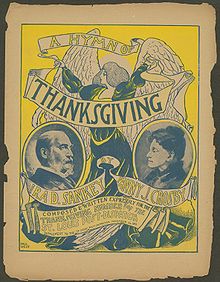
See also the“Hymn of Thanksgiving” image, captioned: “‘A Hymn of Thanksgiving’ sheet music cover – November 26, 1899.”
As I said last year at this time: “Can you say, “Truer words were never spoken?“
* * * *
I have to say it: I hate Halloween. I’m always glad when it’s over, and we can get to the “fall festival” atmosphere leading up to Thanksgiving. But the Halloween triduum – a religious observance lasting three days – is important in the life of the Church, so I need to talk about it.
Which means we survived one national nightmare, but since then a number of other nightmares have taken shape, and continue “even to this day.” Or as Job 5:7 says, “man is born to trouble as surely as sparks fly upward.” (On the other hand, by following the Faith of the Bible, you too can develop “the peace of God which passes all understanding.” Philippians 4:7.)
But we digress. Looking back to last year at this time, we had a Halloween like we’ve never seen, including a rare Blue Moon – also called a “Hunter’s Moon” – and a warning: CDC says no trick-or-treating amid COVID. But it also included some basic background, including that the word “Hallowe’en” came from the Old English word for “saint,” halig.
The word “halig” became “hallow,” and November 1 is what we now call All Saints Day. But November 1 was originally called “All Hallow’s Day,” and the evening before that day was “All Hallows Evening.” That was then shortened to “All Hallow’s E’en.” Eventually the “All” was dropped and we were left with “Hallow’s E’en,” then shortened to Halloween.
But as noted, this religious observance lasted three days, and – as Wikipedia said – this three-day period is a “time to remember the dead.” That includes “martyrs, saints, and all faithful departed Christians.” And the main day of the three was and is November 1. It’s now “All Saints Day,” and was once called All Hallow’s Day, and also referred to as Hallowmas.
The thing is, back in the real old days, people thought the barrier between the living and the dead was most open – most permeable – the night of October 31. So they wore masks and costumes to fool the evil spirits. And there was a warning about safe travel.
If you were out traveling from 11:00 p.m. to midnight on All Hallow’s E’en, your had to be very careful. (This was back in the day when candles were pretty much the only light available for travelers.) That is, if your candle kept burning, that was a good omen.(The person holding the candle would be safe in the upcoming winter “season of darkness.”) But if the candle went out, that was “bad indeed.” (The thought was the candle was blown out by witches…)
Another thing they did was build bonfires. Literally bonefires, “fires in which bones were burned.” (Shown in the photo below.) The original idea was that evil spirits could be driven away with noise and fire. But that evolved into an additional thought: The “fires were thought to bring comfort to the souls in purgatory and people prayed for them as they held burning straw up high.” Which led to the second of the three days.
November 1, All Saints Day, honors “all the saints and martyrs, both known and unknown” who have gone on before us. That referred to “special people in the Church” but the third day of the three honors “the restof us poor schmucks.” (Those who died but weren’t remembered, except by their friends and family.) So November 2 – All Souls’ Day – honors “all faithful Christians … unknown in the wider fellowship of the church, especially family members and friends.*’” That is, on the third day of the Triduum – November 2, or All Souls’ Day – observing Christians typically remember deceased relatives. And in many churches, the following Sunday service includes a memorial for all who died in the past year.
There’s more detail in the three posts from 2018 to 2020, including the story behind those carved pumpkins – also called a jack-o’-lantern or Will-o’-the-wisp – which tied in with the strange ghostly light known as ignis fatuus. (From the Medieval Latin for “foolish fire.”) That was the “atmospheric ghost light seen by travelers at night, especially over bogs, swamps or marshes.” The light, like a flickering lamp, was said to recede if approached:
Tradition had it that this ghostly light – seen by travelers at night and “especially over bogs, swamps or marshes – resembled a flickering lamp. The flickering lamp then receded if you approached it, and so it “drew travelers from their safe paths,” to their doom…
But don’t worry: We faithful have that “peace of God which passes all understanding.”
Have a Happy Halloween Triduum!
* * * *
* * * *
The upper image is courtesy ofHalloween 2020 – Image Results. The image accompanies an article, posted on October 24, “Man thinks of ‘the scariest thing’ for his Halloween 2020 decor.”Which led to an article about the “blue moon,” the one that could be seen at this time last year:
Get ready, witches and warlocks. This October 31, there’s a full moon occurring in Taurus, and it’s extra special. This lunar event is called a “blue moon” because it’s the second full moon we’ll experience in the month of October. Not, it won’t actually appear blue, but it’s rare — hence the phrase “once in a blue moon” — and astrologically, very powerful.
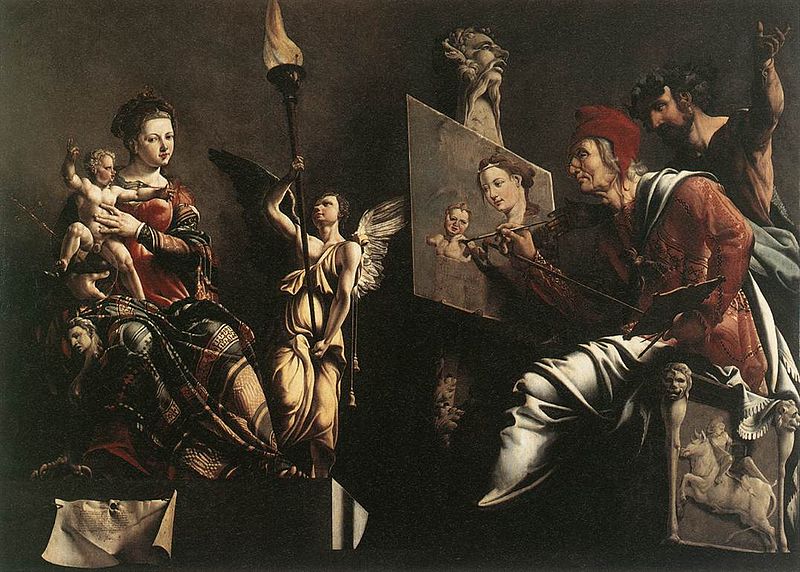
“Saint Luke painting the Virgin and Child” – as one of the first icon painters?
* * * *
The best way to live abundantlyanddo greater miracles than Jesus is: Read, study and apply the Bible with an open mind. For more see the notes or – to expand your mind – see the Intro.
In the meantime:
A month ago – last September 24 – I flew back home from Madrid, after a month in France and Spain. First I flew into Paris on August 25, spent four days there, then joined up with three other family members. From there we took a train down to Saint-Jean-Pied-de-Port. (In French, “port” means “pass.”) From there, the four of us “hiked over the daunting Pyrenees.” (Seen below.)
For me the adventure ended 17 days later, after hiking 177 miles from Saint-Jean to Burgos. The other three are still hiking, toward Santiago, but meanwhile I had accomplished what I set out to do. (Correct a wimp-out from an earlier hiking adventure. See 2017’s “Hola! Buen Camino!”)
And speaking of wimp-outs – or other mistakes – I meant to publish Saint James the Pilgrim – and “Transfiguration 2021” before I left for Paris. (As kind of a prelude.) But somehow I got caught up inmaking preparationsfor the trip, and so ended up posting that “prelude” after the first one about the hike, Just got back from “Camino 2021.” That latter post has the beginnings of the section of the Camino de Santiago I hiked this year. (I’d already hiked and biked the 450-mile part from Pamplona to Santiago, and this year just wanted to finish the Pyrenees portion I wimped-out on in 2017.)
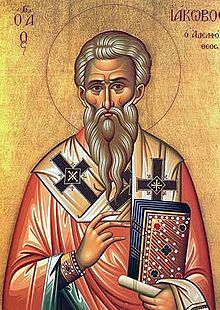
See On St. James (“10/23”) – and the 7 blind men, which clarifies some of that confusion on my part. There I confused the “Brother of Jesus” – whoseiconis seen at left – with “St. James the Greater,” whose feast day is July 25. (And among other things, James the Greater is the “patron saint of pilgrims,” especially Camino pilgrims.)
When Paul arrives in Jerusalem to deliver the money he raised for the faithful there, it is to James that he speaks, and it is James who insists that Paul ritually cleanse himself at Herod’s Temple to prove his faith… Paul describes James as being one of the persons to whom the risen Christ showed himself … and in Galatians 2:9 Paul lists James with Cephas (better known as Peter) and John the Apostle as the three “pillars” of the Church.
There’s also confusion on how he died. “According to Josephus James was stoned to death by Ananus ben Ananus.” But “Clement of Alexandria relates that ‘James was thrown from the pinnacle of the temple, and was beaten to death with a club.’” Either way, he was important.
Which is also true of St. Luke.
The noted Catholic writer Garry Wills – in his book What the Gospels Meant – noted that Luke wrote the longest of the four Gospels. He added that Acts of the Apostles is almost as long, and that these two of Luke’s books together “thus make up a quarter of the New Testament.” (And they’re longer than all 13 of Paul’s letters.) He said Luke is rightly considered the most humane of the Gospel writers, and quoted Dante as saying Luke was a “describer of Christ’s kindness.”
Thus Luke’s Gospel was – to Wills and many others – “the most beautiful book that ever was.” Which means that Luke’s version of the Jesus story is one to which we should pay special attention. And especially to being “humane” and active practitioners of “Christ’s kindness.”
We could use a lot more of that Christian kindness these days…
A reminder: I published my last post, On Saint James the Pilgrim – and “Transfiguration 2021,” out of order, or in the wrong order. I’d gotten it ready to publish before I left for Paris, but in the rush and uncertainty of packing, forgot to actually publish it.
It’s been a month since I got back from last September [2019]’s 160-mile, 19-day hike on the Camino de Santiago that runs through Portugal. See Just got back – Portuguese Camino! Which means it’s time to start moving on from that pilgrimage and back to this blog’s main themes.
Re:Men Named James in the New Testament. The site listed the following men named James in the New Testament: 1) James the son of Zebedee and brother of the Apostle St. John (James the Greater); 2) James the “brother” of Jesus (whose Feast Day is October 23); 3) the Apostle James, “son of Alphaeus;” and 4) James, the father of the Apostle Jude. Other sources indicate there were as many as six “Jameses” in the Bible.
I said in my last post – on September 30 – that I had “last posted on July 26, 2021, over two months ago.” (See I just got back from “Camino 2021.”) Which made me wonder: Why such a big gap between posts? The answer: There wasn’t supposed to BE such a big gap.
I had prepared and pretty much written the following post, on St. James – Patron saint of Camino pilgrims – and on the Transfiguration of Jesus. (The last majorfeast day in August before I left for Paris on the 25th.)But while I’d “prepared and pretty much written the post,” I never actually PUBLISHED it. (I was probably too caught up getting ready for the trip, all while wondering if it would actually HAPPEN, because of Covid and its restrictions on travel.)
The month-long trip DID happen, but more to the point, in reviewing this yet-to-be-published post, I thought it sounded pretty good. So even thought it’ll be published out of order and “after the fact,” I’m offering it for your consideration. Later, down in the notes, I’ll make some after-the-fact observations about what actually happened…
* * * *
Last July 25, 2021, was the feast day for James, son of Zebedee. He was one of the 12 Apostles, and tradition says he was the first apostle to be martyred, some time around 44 A.D.
That’s what I noted back in 2019, in St. James – and “my next great pilgrimage.” Which is fitting, because this year – 2021 – I have another great pilgrimage on tap. On September 1st I’m scheduled to go back to the Camino de Santiago – for the third time – but with some differences… For one thing, this year I’ll be flying into Paris, not Madrid or Lisbon. For another I’ll be hiking as part of a group of four. And finally, this year I’ll hike over the Pyrenees Mountains.
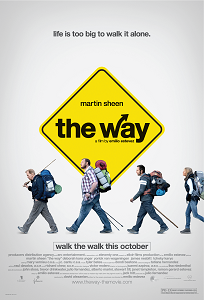
Incidentally, that’s the same section of the Camino where the Martin Sheen character’s son died in the 2010 film, The Way. The central premise of the film is that an old, out of shape Beverly Hills eye doctor “goes to France following the death of his adult son, Daniel, killed in the Pyreneesduring a storm while walking the Camino de Santiago (the Way of St. James), a Christianpilgrimage route.”
“Ms Dingley, 37, had been walking solo in the mountains near the Spanish and French border and was last seen on Nov 22 last year.” The story added that there was “no sign of equipment or clothing in the immediate area … and the details of what happened and where still remain unknown.” Which is scary, but on the other hand, I won’t be hiking alone…
Many people in Spain celebrate the life and deeds of James, son of Zebedee, on Saint James’ Day (Santiago Apostol), which is on July 25. Saint James was one of Jesus’ first disciples. Some Christians believe that his remains are buried in Santiago de Compostela in Spain.
You can read more about this saint in 2014’s “St. James the Greater,” and 2016’s On St. James, Steinbeck, and sluts. (And others, listed in the notes.) But there is one thing about a pilgrimage that should be noted: If it’s a good one, you’ll find yourself transformed.
The 2020 post led off with a photo of an empty interstate, looking to a sky-scrapered city skyline, captioned, “The Coronavirus – A ‘Blessing In Disguise For Humanity,’ andmaybe a metamorphosis?” Along with a note that we were “now in Week 21 of the COVID-19 pandemic.” (We’re now in week 75 or so, per my calculations.*) The key point: That “in the current plague we are surely going through a metamorphosis.” Or a change in circumstance that could seem, “to many, to have occurred by supernatural means.”
In other words, maybe God was and is trying to tell us something.
In further words, in the Transfiguration both Jesus and His disciples had to go through “a pivotal moment.” A moment in which Jesus met with Moses and Elijah, but which was also terrifying to Peter. (See Mark 9:6 “For they were all so terrified that Peter did not know what else to say.”) But despite Peter’s terror, this was a point “where human nature meets God: the meeting place for the temporal and the eternal, with Jesus himself as the connecting point.”
And you could say the same thing about COVID-19. It too is terrifying, but it could also be another moment “where human nature meets God.” It could be a moment where we turn on each other and start “Finger-Pointing,” or it could be a moment where we work together and overcome the challenge in the way God wants us to. And it could just be – if we play our cards right – where we can reconnect with Jesus in a way we couldn’t have before.
The term is also defined as to experience an exalting, glorifying or spiritual change. And one example of such a metamorphosis is the “transformation of a maggot into an adult fly.” Or for a better example, we could change from a caterpillar into a butterfly. So – in our journey through the present Covid crisis – do we want to remain maggots or get turned into butterflies? (To mix a few metaphors.) And such transformation is pretty much what the Faith is all about.
See for example Bible Verses about Transformed into His Likeness, which includes 2dCorinthians 3:18, which says that we true Christians “are being transformed into the same image from glory to glory, just as by the Spirit of the Lord.” Or Philippians 3:21, which talks of the power of Jesus, “who will transform our lowly body that it may be conformed to His glorious body.” Or 2 Corinthians 5:17: “Therefore, if anyone is in Christ, he is a new creation.”
Which is also what could happen to those who go on a pilgrimage. (Like hiking over the Pyrenees part of the Camino de Santiago?) In such a journey “a person goes in search of new or expanded meaning about their self, others, nature, or a higher good, through the experience. It can lead to a personal transformation, after which the pilgrim returns to their daily life.”
Or as it says in Psalm 84:5, “Happy are the people whose strength is in you! whose hearts are set on the pilgrim’s way.” So maybe when I get back I’ll find that we Americans are no longer “weighed in the balances and found wanting.” (As shown below.) Maybe the country will experience such a transfiguration that God will say, “Well done, good and faithful servant(s)!”
It COULD happen…
* * * *
* * * *
Well, it didn’t happen. It seems our country is still “weighed in the balances and found wanting.” And a lot of it has to do with Facebook and the amount of tribal political warfare that goes on there. So maybe that six-hour Facebook outage last October 4 was a sign from God. Instead of saying “well done, good and faithful servant(s),” He might have been telling us, “Stop obsessing with Facebook, and stop putting all that garbage in it!”
(Of course, I’m just guessing, you understand…*)
* * * *
The upper image is courtesy of Camino Hiking Over Pyrenees – Image Results.With a page and caption, “The walk to Roncesvalles, Spain, from St Jean Pied de Port took us over the Pyrenees. Blessed with good weather…”
Re: 2016’s On St. James, Steinbeck, and sluts. The “sluts” part of the post noted that the word had a different meaning for Robert Louis Stevenson in 1879, when he published Travels with a Donkey in the Cévennes. (For more on the book see also the prior post, On donkey travel – and sluts.)Back then “slut meant roughly what one sense of slattern means today: a slovenly, untidy woman or girl.” It could also refer to a kitchen maid.
Re: Weeks of Covid. As of Monday, October 11, 2021, we are now in the 83d full week of Covid, 20 months and three weeks, according to my calculations.See On St. Philip and St. James – May, 2020. To me, “the pandemic hit full swing – the ‘stuff really hit the fan’ – back on Thursday, March 12,” when the ACC basketball tournament got cancelled, along with other major sports. “So my definition of the ‘First Full Week of the Covid-19 Pandemic’ has it starting on Sunday, March 15 and ending on Saturday the 21st.”
The Psalm 84:5 translation is from my mother’s Book of Common Prayer, “Proposed,” and published in 1977. (As certified by Charles Mortimer Guilbert.)My mother died in 1984, and for a time it was used by my late wife Karen, who died in 2006. I now use it on a daily basis, for the psalms in each day’s set of Daily Office Readings. (Currently Year One, Volume 2.)
The lower image is courtesy of the Belshazzar link to the Wikipedia article. The caption: “Rembrandt, Belshazzar’s Feast, 1635, (National Gallery, London). The message is written in vertical lines starting at the top right corner, with ‘upharsin’ taking two lines.”
Last Thursday, July 22, was the Feast Day for Mary from Magdala. She is a saint, and the only reason I put the word in quotes is that she ended up a saint despite the best efforts of jealous male disciples. (Because she showed more courage than they did when it counted.)
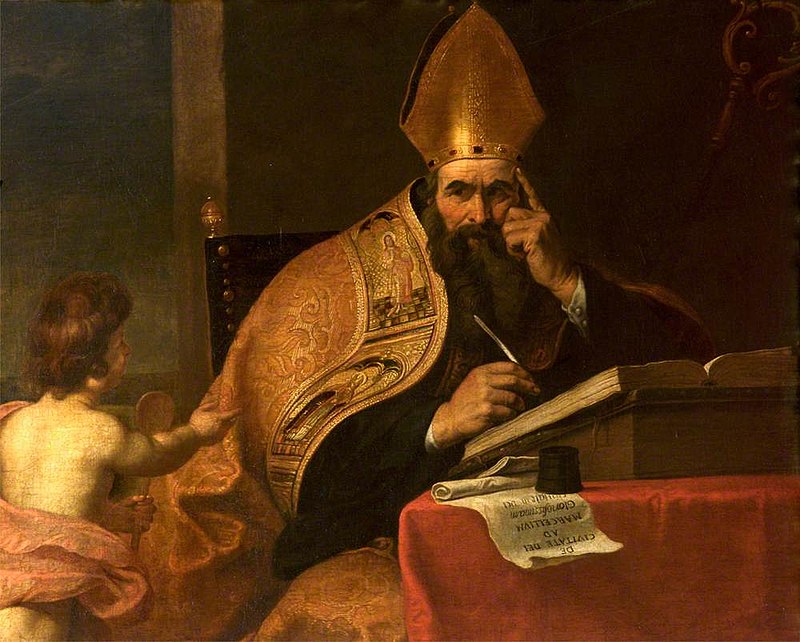
And that “showing more courage” seems to be why she got the reputation for a “sordid past.” On the other hand, there’s the opinion of St. Augustine, who referred to her as the“Apostle to the Apostles.” On that note see also Mary of Magdala | FutureChurch:
Mary of Magdala is perhaps the most maligned and misunderstood figure in early Christianity… Since the fourth century, she has been portrayed as a prostitute and public sinner… Paintings [of her], some little more than pious pornography, reinforce the mistaken belief that sexuality, especially female sexuality, is shameful, sinful, and worthy of repentance. Yet the actual biblical account of Mary of Magdala paints a far different portrait than that of the bare-breasted reformed harlot of Renaissance art.
The one indisputable fact seems to be that Mary Magdalene was both the first person to see the empty tomb of Jesus, and one of the first – if not the first – to see the risen Jesus.
As for the Crucifixion itself, only one Gospel had a male disciple at the scene, John. (In “his*” Gospel, Ch. 19. Or see Who Was Present at the Cross?) But many women were there, as noted in Mark 15:40: “Some women were watching from a distance. Among them were Mary Magdalene, Mary the mother of James the younger and of Joseph, and Salome.”
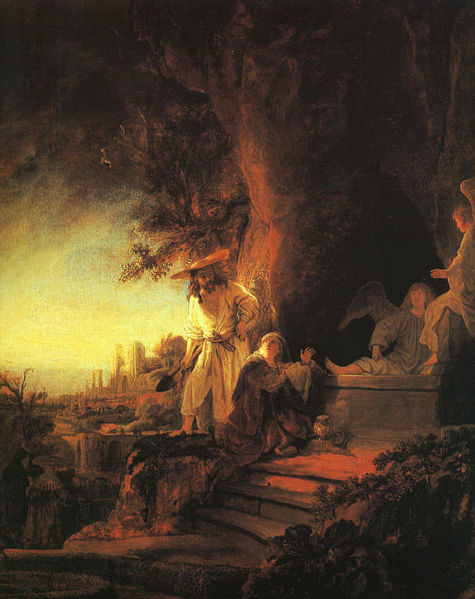
And John, Chapter 20 tells the full story of Mary Magdalene being both the first to see the empty tomb and the first to see the Risen Jesus, as shown in the painting below.
For starters, see John 20:1: “Early on the first day of the week, while it was still dark, Mary Magdalene went to the tomb and saw that the stone had been removed from the entrance.” She went to tell Peter and John, who checked the tomb, then “went back to where they were staying.” But Mary – faithful Mary, of the lousy reputation – stayed, as noted in John 20:11-18. She saw two angels, then turned to see another man she took to be a caretaker:
Supposing him to be the gardener, she said to him, “Sir, if you have carried him away, tell me where you have laid him, and I will take him away.” Jesus said to her, “Mary!” She turned and said to him in Hebrew, “Rabbouni!” (which means Teacher). Jesus said to her, “Do not hold on to me, because I have not yet ascended to the Father. But go to my brothers and say to them, I am ascending to my Father and your Father, to my God and your God.’” Mary Magdalene went and announced to the disciples, “I have seen the Lord;” and she told them that he had said these things to her.
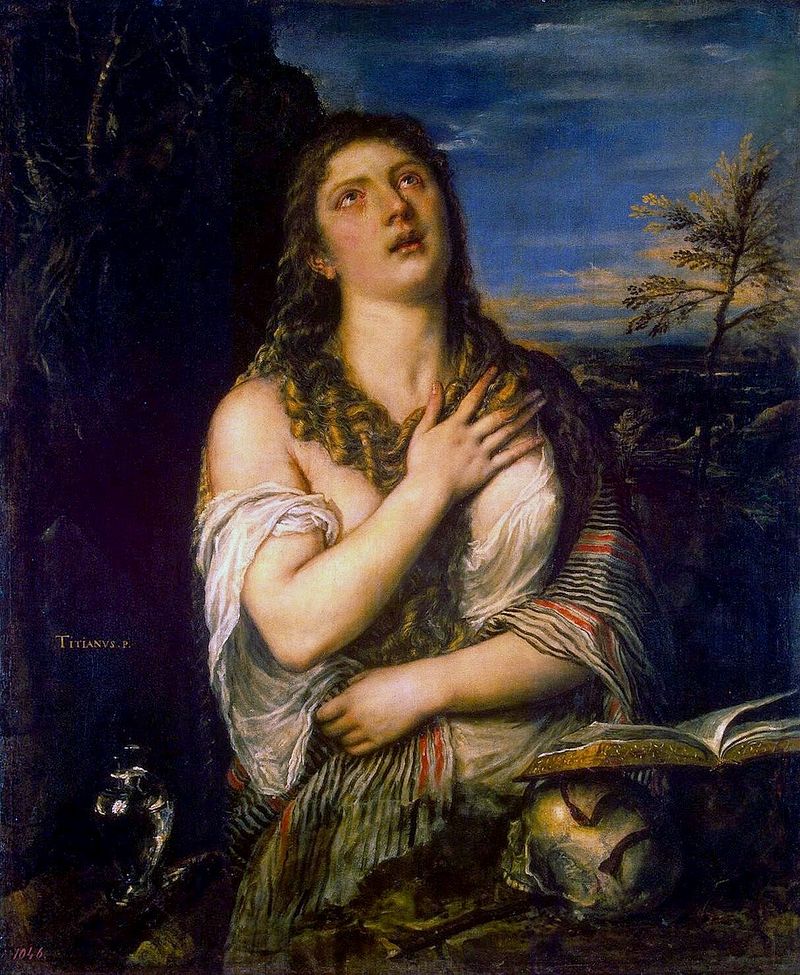
The Penitent Magdalene is a 1565 oil painting by Titian of saint Mary Magdalene, now in the Hermitage Museum in Saint Petersburg. Unlike his 1533 version of the same subject, Titian has covered Mary’s nudity and introduced a vase, an open book and a skull as a memento mori. Its coloring is more mature than the earlier work, using colors harmoni[z]ing with character. In the background the sky is bathed in the rays of the setting sun, with a dark rock contrasting with the brightly lit figure of Mary.
The time came for Elizabeth to give birth, and she bore a son. Her neighbors and relatives heard that the Lord had shown his great mercy to her, and they rejoiced… [T]hey were going to name him Zechariah after his father. But his mother said, “No; he is to be called John.” They said to her, “None of your relatives has this name.” Then they began motioning to his father to find out what name he wanted to give him. He asked for a writing tablet and wrote, “His name is John…”
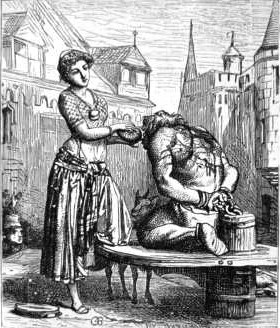
For more on John see The Nativity of John the Baptist, a post from June 2015. That post includes an image and text about John falling victim to Salome. (Illustrated at left.)
The text from Mark 6, verses 14-29 indicates that “Salome had danced so well for King Herod that he swore he would grant her any request. Her mother, Herodias, who sought revenge on John the Baptist, persuaded Salome to ask for his head.”
On another note, John represents “Law, not Grace. Among men born of woman … he has no superior. But anyone who has been born anew in the kingdom of God has something better than what John symbolizes.” That something better is Jesus, who represents grace. (As in “My grace is all you need.”)
Turning to the other feast day, June 29 is the Feast of Saints Peter and Paul, who “died together.*” It honors “the martyrdom in Rome of the apostlesSaint Peter and Saint Paul.” Unfortunately the Bible doesn’t give details about the deaths of Peter or Paul, “or indeed any of the Apostles except for James the son of Zebedee.” (See e.g. Acts 12:2.) But early tradition said that they were martyred at Rome, at the command of the Emperor, and were buried there:
As a Roman citizen, Paul would probably have been beheaded with a sword. It is said of Peter that he was crucified head downward[. And thus as St. Augustine wrote,] “even though they suffered on different days, they were as one. Peter went first, and Paul followed. And so we celebrate this day made holy for us by the apostles’ blood…”
So to me the main point of the Feast of Peter and Paul – togther – is that it’s okay to have a difference of opinion between Christians. Or even to “squabble” from time to time. And for that matter, that it’s okay to argue with God too, if and as necessary. (As long as you pay the proper respect, you could end up a lot stronger, “spiritually and otherwise.”)
* * * *
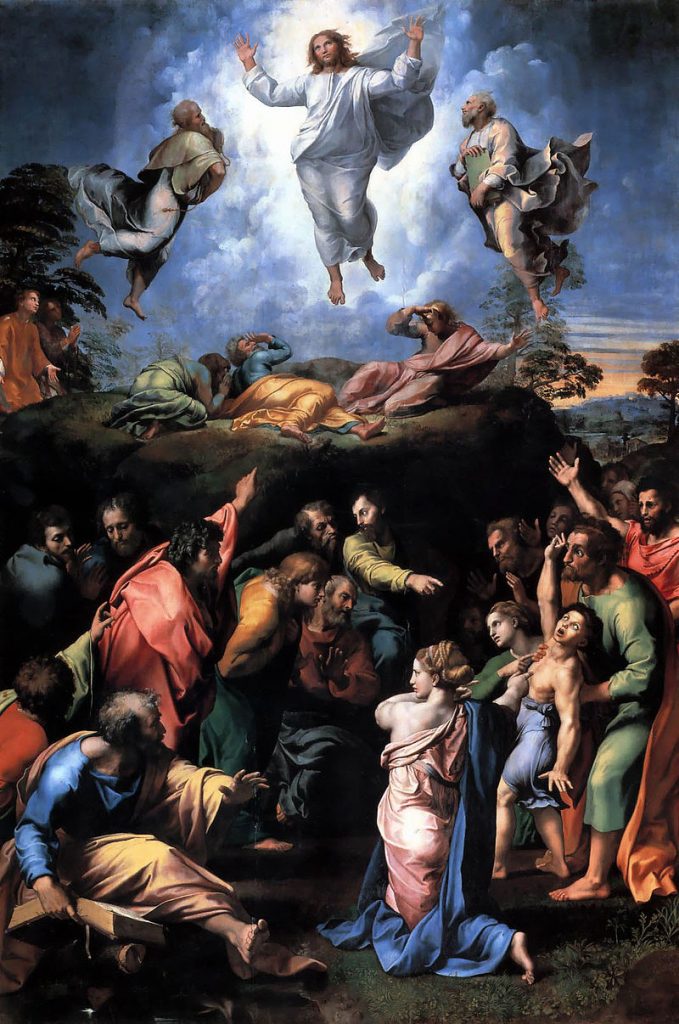
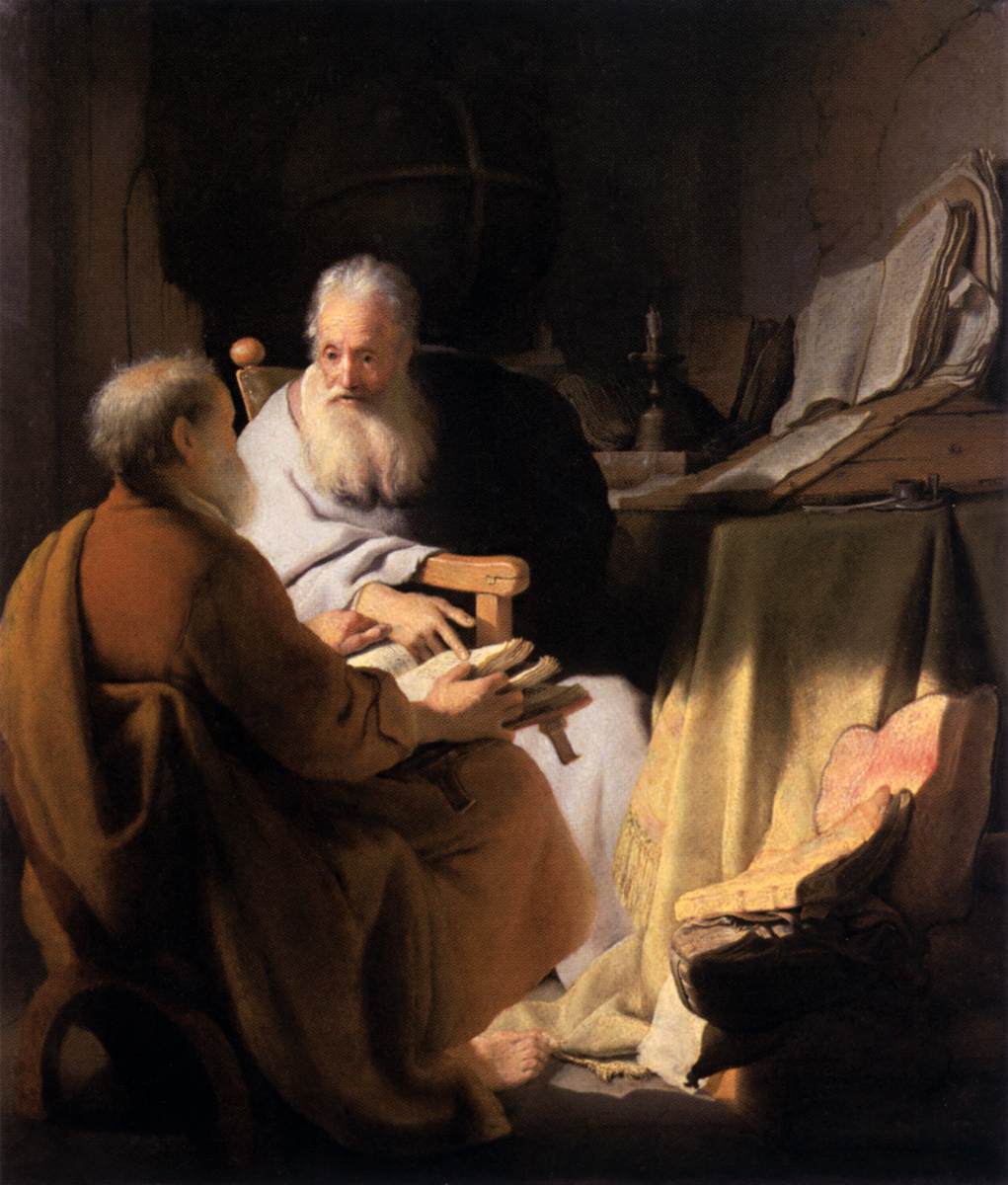
“Scholars Disputing” – a painting of Peter and Paul managing to work together…
On 29 June we commemorate the martyrdoms of both apostles. The date is the anniversary of a day around 258, under the Valerian Persecution, when what were believed to be the remains of the two apostles were both moved temporarily to prevent them from falling into the hands of the persecutors.
In other words, the June 29 feast day is an ancient celebration, as “the anniversary either of their death or of the translation of their relics.”Note too that the “Valerian Persecution” mentioned, of 258, involved the movement of the remains of Peter and Paul – the “relics” – not the date of their deaths. (They would have to have been over 200 years old.)
Re: Arguing with God. See the post, On arguing with God, which said that maybe – just maybe – we are supposed to “argue with God,” or “wrestle with God,” or even “wrestle with the idea of God.” Maybe, just maybe, that’s how we get spiritually stronger, by “resistance training” rather than passively accepting anything and everything in the Bible, without question or questioning.
Rembrandt omits the attributes by which the two apostles were traditionally identified, he relies only on their physical characteristics … and on what they are seen to be doing, that is earnestly discussing a text which the one (St Peter) is explaining to the other.
I just got back from a lightning, one-week mini-vacation. First to Rockville Maryland – for my grandson’s wedding – then on to Pigeon Forge Tennessee for a family get-together. (Including a day-visit to Dollywood, illustrated at left.)
I got back home late last Thursday (6/10/21), and over the long Recuperation Weekend that followed, I checked my blogs. My last post on this blog – “Pink Floyd – and Pentecost Sunday, 2021” – came back on May 29, 2021. So it’s about time another post on this Blog, but lucky me, just last June 11 was the Feast Day for St. Barnabas. And five days before that we – or some of us – remembered D-Day, back during World War II. Which is a reminder that life isn’t always a bowl of cherries.* Or put another way, we are called to vigor – spiritual discipline – not comfort. (See About the Blog, above.)
There’s more on that below, but first a word about St. Barnabas.
The Bible first mentions Barnabas in Acts 4:36: “Joseph, a Levite, born in Cyprus, whom the apostles called Barnabas (son of encouragement), sold a field he owned, brought the money, and turned it over to the apostles.” And Barnabas the Apostle – Justus added that even after Paul’s Damascus Road experience, most Christians in Jerusalem “wanted nothing to do with him. They had known him as a persecutor and an enemy of the Church. But Barnabas was willing to give him a second chance.” (Which is pretty much what Jesus is all about.)
To sum up, if it hadn’t been for Barnabas’ willingness to give Paul a second chance – Paul, the formerly zealous persecutor of the early Church – he might never have become Christianity’s most important early convert, if not the “Founder of Christianity.*”
But what’s all this about “just war” and our annual remembrance of June 6 as D-Day, a key turning point in World War II? Just that the lessons our American armed forces learned in that war can teach us a valuable lesson today about the better way to read and study the Bible.
That is, American armed forces succeeded on D-Day – and contributed greatly in winning World War II – because of our native INGENUITY. (That is, because as Americans we are inherently creative and constantly ask questions.) We constantly look for better ways of doing things. On the other hand there are some “Bible-thumpers” who look at the Faith of the Bible as a way of “trying to create a culture that rewards conformism and stifles creativity.”
In the same way, one theme of this blog is that the very same question-asking, probing method of Bible study is far better for both an individual reader and our society as a whole. It’s far better than just saying, “Oh, I’ll take everything that slick-haired televangelist says at face value!”
My point is that Bible reading should be an adventure. It should help us reach our full potential, as individuals and as a nation. It should help us become happier, more creative and able to find better ways of living lives of abundance. And that’s as opposed to the concept of “sin,” and how some of those same Bible-thumpers seem to relish making other people feel guilty.
Maybe that’s what the Bible and/or the church concepts of sin and confession are all about… When we “sin” we simply fall short of our goals; we “miss the target.” When we “confess,” we simply admit to ourselves how far short of the target we were. And maybe the purpose of all this is not to make people feel guilty all the time… [M]aybe the concepts of sin, repentance and confession are tools to help us get closer to the target “next time out,” even if we know we can never become “perfect.”
Also on that note see On sin and cybernetics, from 2014, which added this: “Maybe the concepts of sin, repentance and confession are simply tools to help us realize the purpose Jesus had for us, to wit: To ‘live life in all its abundance.’” (See John 10:10, above.)
* * * *
You can’t hit the target without “negative feedback…”
* * * *
The upper image is courtesy of Just war theory – Wikipedia: “The purpose of the doctrine is to ensure that a war is morally justifiable through a series of criteria, all of which must be met in order for a war to be considered just.”For more information google “christianity and just war theory.”
Re: Life as a bowl of cherries. (Or not.) See Life is just a bowl of cherries – Idioms by The Free Dictionary. Originally meaning everything was great, the “slangy phrase, often used ironically, gained currency as the title of a song by Ray Henderson,” performed by Ethel Merman in the in the Scandals of 1931. “Today it is nearly always used ironically…”
Re: Vigor, not comfort. FromEvelyn Underhill’s book Practical Mysticism:
Hearing now and again the mysterious piping of the Shepherd, you realize your own perpetual forward movement. . . Do not suppose from this that your new career [as a Christian] is to be perpetually supported by agreeable spiritual contacts, or occupy itself in the mild contemplation of the great world through which you move. True, it is said of the Shepherd that he carries the lambs in his bosom; but the sheep are expected to walk, and to put up with the bunts and blunders of the flock. It is to vigour rather than comfort that you are called.
A final note: Most of this post was gleaned from On St. Barnabas and On St. Barnabus’ Day, 2015.The lower (“arrow”) image is courtesy of “releasetheape.com … 2012/12/arrow-target1-890×556.png.“
That is, the post went on to describe some of the Biblical prophets, like Isaiah. (At left.) And said that those Bible prophets were very much like Pink Floyd, “cited by some as the greatest progressive rock band of all time.” That is, those Bible prophets were “also the ‘spokesmen of protest’ and the ‘radicals of their day.'”
That last statement about “radical protest” led me to google “radical meaning of pentecost.” Which led me to Sermon: The radical roots of the Church at Pentecost | Rev Doc Geek. (Written by Avril Hannah-Jones, and posted on Pentecost Sunday, May 23, 2021.) One of her thoughts? “Pentecost is a story about God’s commitment to human diversity.”
(Or, “God’s commitment to each person open-mindedly developing their full potential?”)
Hannah-Jones spoke of the Disciples and their followers “speaking in other languages” on the original day of Pentecost. (Of which more below.) Then of Peter refuting a claim that the speakers were simply drunk. (“That early in the day.”) But one key feature of that first Day of Pentecost was that very multilingualism, not to be confused with glossolalia. (Or “speaking in tongues,” which according to one definition is the “ecstatic, usually unintelligible speech uttered in a worship service,” or fabricated or non-meaningful speech.)
“Doc Geek” said that act of “speaking in different languages” was itself radical, an “obvious challenge to the Roman Empire,” which wanted everyone to speak a single language, Greek or Latin. (Like too many of today’s so-called Christians, who think their “fundamental” interpretation of the Bible-Faith is the only valid one, on pain of all who disagree “going to hell.”)
But my theory is that unless any good Christian is infallible, he or she cannot know either all the answers or all of the “Ultimate Truth.” (And if that person is infallible, the rest of us can say, “It’s about time. We’ve been waiting for You to come back these past 2,000 years!”)
And that theory itself is pretty radical. (To some people anyway…) But back to somehow bringing together Pink Floyd and Pentecost Sunday, 2021. That effort led me back to “this time last year,” back to last year’s post, Pentecost 2020 – “Learn what is pleasing to the Lord.”
And just as a reminder, the first sentence of that post was, “We’re just starting the 12th full week of the COVID-19 pandemic.” (Illustrated at right. And for the record, we’re now in the sixty-second – 62d – full week of COVID; 15 months and two weeks.)
And – just to review – speaking of Pentecost in the Liturgical year:
In turn, that “learn what is pleasing to the Lord” phrase came from Ephesians 5:10. And alternatives to the word “learn” are the words “test” and “prove,” as in the Berean Study Bible, “Test and prove what pleases the Lord.” One commentary added:
To prove is to ascertain by test and experiment. Our whole walk should be directed to finding out what things are pleasing to Christ… We are not to follow the tradition of our people … we are to prove the matter, to put it to the test.
In other words, we can’t find out how to “please Christ,” personally, as individuals, by merely becoming carbon-copy, “cookie cutter” or Comfort Zone Christians. Instead “we are to prove the matter” of our faith, to “put it to the test.” We are to live our lives fully, without fear…
Which is pretty much one major theme of this blog. And that’s the very same theme that I noted in Pink Floyd – “rigid schooling.” Put another way, that post spoke again of how some people – like “Conservative Christians?” – read, study and apply the Bible to their everyday life “by the book.” That is, way too literally or “fundamentally.” Which is another way of saying that “going by the book isn’t always the best course. It’s always a good place to start, and it’s always easier to do. The problem comes when that’s all you know.”
To put it in more concrete terms, that post used an example from Shakespeare; the part where Juliet tells Romeo, “You kiss by the book.” That is, Juliet meant that Romeo kissed “as if he ha[d] learned how to kiss from a manual.” The web article SparkNotes: Romeo and Juliet: Act 1, scene 5, said the comment could be taken two ways, one involving a “lack of experience.”
Or it could be interpreted like this:
Juliet’s comment that Romeo kisses by the book is akin to noting that he kisses as if he has learned how to kiss from a manual and followed those instructions exactly. In other words, he is proficient, but unoriginal…
(Emphasis added.) Which is pretty much what those so-called Conservative Christians get by and through their style of Bible study. They get “proficient, but unoriginal.” And yet the Bible itself says – repeatedly – that our job is to sing to the Lord a NEW song. (That theme “of singing a new song to the Lord – and not just another stale, old ‘conservative’ or literalist rehash – is repeated again and again in the Bible. Like in Isaiah 42:10, and Psalm 96:1, Psalm 98:1, and Psalm 144:9.”) And speaking of proving and testing, consider what Buddha once said:
Do not believe on the strength of traditions even if they have been held in honor for many generations… Believe nothing which depends only on the authority of your masters or of priests. After investigation, believe that which you yourself have tested and found reasonable, and which is good for your good and that of others.
(Emphasis added.) And that’s the same thing the Bible says in 1st John 4:1, “do not believe every spirit, buttest the spirits to see whether they are from God.” (E.A.)
Which brings us back to 2015’s Pink Floyd and “rigid schooling.” One of the key lyrics to the band’s song The Wall is “We don’t need no education, We don’t need no thought control.” As an adult nearing my 70th summer I’d agree in part and disagree in part. I’d say “these young punks today need some education,” but I’d say they’re right about the thought-control part:
So maybe that’s what Pink Floyd was saying with “We don’t need no thought control.” Teach us how to create out of the basics. Teach us how to become both proficient and original. But don’t try to turn us into “compliant cogs in the societal wheel…”
Which – in my opinion – is pretty much what you’ll become if you read and apply the Bible Faith too literally or too “fundamentally.” And aside from short-changing yourself, you’ll be driving away from Jesus the very people who need Him the most. Which is one reason that now – for the first time in 80 years – Less Than 50% of Americans Formally Belong to a Church. Yet another reason for the decline is that those people just don’t know The Real Good News: That being a real Christian doesn’t mean you have to be just another brick in the wall…
Re: Fallible. See the Free Dictionary: likely to fail or make errors. Used in a sentence. “Everyone is fallible to some degree.” A thought mirrored in Romans 3:10, citing – among other passages – Psalm 14:3 and 1st John 1:8, “If we say we have no sin, we deceive ourselves, and the truth is not in us.”
For now [in this time of imperfection] we see in a mirror dimly [a blurred reflection, a riddle, an enigma], but then [when the time of perfection comes we will see reality] face to face. Now I know in part [just in fragments], but then I will know fully…
Which might be amplified, “Then – and only then – will I know fully.”
Re: “Kissing by the book.” See SparkNotes: Romeo and Juliet: Act 1, scene 5, which said the comment could be taken two ways, one about Juliet’s “lack of experience.” Or it could be interpreted like this:
Juliet’s comment that Romeo kisses by the book is akin to noting that he kisses as if he has learned how to kiss from a manual and followed those instructions exactly. In other words, he is proficient, but unoriginal… (E.A.)
And for future reference on the topic, see Jesus the radical: What Jesus Meant, by Garry Wills, to support the “radical protest” idea. But I found it didn’t fit the general tenor of this post, so I include it here:
Precisely because Jesus is a mysterious, divine figure, however, he is also an iconoclast who escapes ordinary human religious and political categories: “He did not found a church or advocate a politics…” [Wills’] underlying concern seems to be that the “faith-based politics” of the contemporary evangelical Right in the U.S is a form of “idolatry” based on values alien to Jesus” teaching.
As noted in the opening blurb, this blog has four main themes. The first is that God will accept anyone. (John 6:37, with the added-on phrase, “Anyone who comes to Him.”) The second is that God wants us to live abundantly. (John 10:10.) The third is that we should do greater miracles than Jesus. (John 14:12). A fourth theme: The only way to do all that is read the Bible with an open mind. See the Wikipedia article, which talks about its opposite:
…closed-mindedness, or an unwillingness to consider new ideas, can result from the brain’s natural dislike for ambiguity. According to this view, the brain has a “search and destroy” relationship with ambiguity and evidence contradictory to people’s current beliefs tends to make them uncomfortable… Research confirms that belief-discrepant-closed-minded persons have less tolerance for cognitive inconsistency…
See also Splitting (psychology) – Wikipedia, on the phenomenon also called black-and-white thinking, “the failure in a person’s thinking to bring together the dichotomy of both positive and negative qualities of the self and others into a cohesive, realistic whole. It is a common defense mechanism. The individual tends to think in extremes (i.e., an individual’s actions and motivations are all good or all bad with no middle ground).
So anyway, in plain words this blog takes issue with boot-camp Christians. The Biblical literalists who never go “beyond the fundamentals.” But the Bible offers so much more than their narrow reading can offer… (Unless you want to stay a Bible buck private all your life…)Now about “Boot-camp Christians.” See for example, Conservative Christian – “Career buck private?” The gist of that post is that starting the Bible is like Army Basic Training. You begin by“learning the fundamentals.” But after boot camp, you move on to Advanced Individual Training.”And as noted in the opening blurb, this blog has four main themes. The first is that God will accept anyone. (John 6:37, with the added, “Anyone who comes to Him.”) The second is that God wants us to live abundantly. (John 10:10.) The third is that we should do greater miracles than Jesus. (John 14:12). A fourth theme: The only way to do all that is read the Bible with an open mind…
For more about “Boot-camp Christians” see Conservative Christian – “Career buck private?” And as noted in “Buck private,” I’d previously said the theme of this blog was that if you really want to be all that you can be, you need to go on and explore the “mystical side of Bible reading.*” In other words, exploring the mystical side of the Bible helps you “be all that you can be.” See Slogans of the U.S. Army – Wikipedia, re: the recruiting slogan from 1980 to2001. The image below is courtesy of:“toywonders.com/productcart/pc/catalog/aw30.jpg.”*
Re: “mystical.” As originally used, mysticism “referred to the Biblical liturgical, spiritual, andcontemplative dimensions of early and medieval Christianity.” See Mysticism – Wikipedia,and the post On originalism. (“That’s what the Bible was originally about!”)
For an explanation of the Daily Office – where “Dorscribe” came from – see What’s a DOR?
“Keep quiet, work in solitude, outwardly conform, inwardly remain free.” Which as a result of the European wars of religion [in the the 16th century] created a figure new to Europe but “familiar in the great ages of China: the intellectual recluse.” (Which at this point evokes – to the writer anyway – the old Maynard G. Krebs repeated line, “You rang?“)
True Test of Faith talked about two Christians who die, then find out there is no God, no heaven, no afterlife, no reward for good behavior. The first one is outraged. “What? You mean I could have spent my life partying? Boozing it up? Chasing women, loose and otherwise? Boy am I mad, when I think of all those fun things that I could have beendoing!”
The second Christian is a more thoughtful. He thinks of the path he’s followed. He thinks of his reading the Bible on a daily basis, thereby finding comfort and inspiration. He remembers how this process led him into some unexpected life breakthroughs, and on many true-life adventures. He thinks of all the “testing adventures” he’s had; some he passed, some he failed.
And after
all this thinking about his life, his faith and his Bible-reading, the second
Christian ends up saying, “You know, I wouldn’t change a
thing.”
That’s the kind of faith I’m trying to develop. Of course, I do believe in God, and in Jesus. I also believe that “if you declare with your mouth, ‘Jesus is Lord,’ and believe in your heart that God raised him from the dead, you willbe saved.” (Romans 10:9, emphasis added.) I’m just saying, that’s the kind of faith I’m trying to develop.
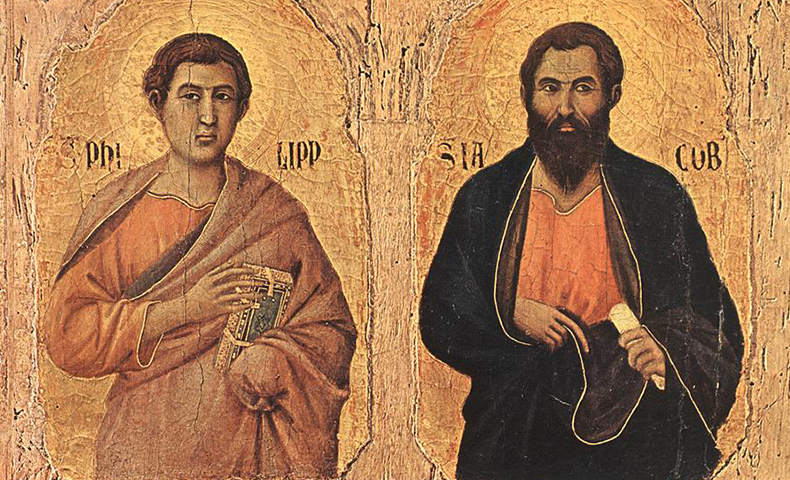
Which includes “the discipline of continuing our Daily Bible Reading.” Like honoring and remembering feast days for Saints like Philip and James the Lesser. (Together with the reason the two are remembered together.*) All of which reminds us of God’s love for all mankind as beinguniversal. (Capable of “reaching even those beyond the pale – if not untouchable.”)
And furthermore, here’s to a loving God whose love is so universal that He is ready and willing to accept anyone. (Who turns to Him. See John 6:37.) Happy St. Philip and St. James day!
The upper image is courtesy of Weather The Storm Images – Image Results. It accompanies an article “How does climate change affect weather? – new briefing paper and podcast,” a 12/19/18 post from the Royal Meteorological Society, “UK’s Professional and Learned Society for weather and climate.”
Re: Last year’s post, St. Philip and St. James – May, 2020. While the instant blog platform listed the publication date as May 8, 2020, I actually posted it late on the previous evening, May 7, 2020.
Re: The 16th century. The quote in the main text is from historian Kenneth Clark‘s 1969 book Civilisation, “about what some people did during a time of great upheaval. (Like today’s.)” And as quoted from last year’s post on Saints Philip and James. See also Wikipedia, on that 16th century.
Re: Recluse, intellectual or otherwise. See Wikipedia, which noted “We live in a society that stigmatizes seclusion, yet has an almost rabid fascination with it at the same time. A survey of history shows that some of the most brilliant thinkers, writers and artists turned their backs on society to embrace a life of voluntary seclusion.”
Re: Why Philip and James are remembered together. See New Daily Compass:
The two apostles Philip and James the Lesser are remembered with a single liturgical feast because their relics, transferred respectively from Hierapolis and Jerusalem, were placed together in the Basilica of the Twelve HolyApostles [“Santi Apostoli“] in Rome.
The Apostle Thomas, in his later years – in India? – after he finally “overcome his doubts…”
* * * *
I last posted on Palm Sunday, March 28. In that post I looked ahead to Easter Sunday, April 4. (See On “Zen in the Art of College Football,” featuring the thought at left.) This post will revisit the Sunday after Easter, to wit: The “Sunday of Many Names.”
You can see one original at On “Doubting Thomas Sunday” – 2017, which notes that today is known as: 1) The Second Sunday of Easter, 2) Low Sunday, 3) Doubting Thomas Sunday, 4) the “Octave of Easter,” and finally 5) “Quasimodo Sunday.” That last is from the Latin translation of First Peter 2:2, “Quasi modo geniti infantes,” as explained below.
For starters, today is officially the Second Sunday ofEaster. Note the “of,” rather than “after.” That’s because Easter is “not just one day, but an entire season.” It’s a full season of 50 days – called Eastertide, “spanning from Easter Sunday to Pentecost Sunday.”
But today is also known – and in many churches is better known – as Low Sunday. That’s mostly because church attendance falls off so drastically that first Sunday “after.” (Compared with the high attendance of Easter Day itself…)
But you can also – as noted – call this day the “Sunday of Many Names.” For example, it’s known as “Doubting Thomas Sunday” … because the Gospel lesson always tells the story of the disciple Thomas. (See e.g. John 20:19-31, “which recounts the story of Christ appearing to the Apostle Thomas in order to dispel the latter’s doubt about the Resurrection.” Which made him in essence the original – the prototype – “Doubting Thomas.”)
And today is known as the Octave of Easter. (In this case the Octave in question is the eight-day period “in Eastertide that starts on Easter Sunday and runs until the Sunday following Easter.”) And finally, it’s known as “Quasimodo Sunday.” But that’s not because of Quasimodo, the guy – shown at right – who is better known as the “Hunchback of Notre Dame:”
That name comes from the Latin translation of the beginning of First Peter 2:2. (A traditional “introit” used in churches this day.) First Peter 2:2 begins – in English and depending on the translation – “As newborn babes, desire the rational milk without guile…” (Or translated as, “pure spiritual milk, so that by it you may grow up in your salvation.”) But in Latin the verse reads: “Quasi modo geniti infantes…” Literally, “quasi modo means ‘as if in [this] manner.’”
So, since “geniti” translates as “newborn” and the translation of “infantes” seems self-evident, the “quasi modo” in question roughly translates, “As if in the manner” (of newborn babes)…
The Coffman Commentaries on the Bible provides some background on this verse. in the King James version the verse reads, “as newborn babes, long for the spiritual milk which is without guile, that ye may grow thereby unto salvation:”
Paul used this same figure in 1 Corinthians 3:2; but Peter here, using the same figure, stresses, not the contrasting diet of infants and adults, but the appetite which all Christians should have in order to grow. All Christians should have a constant and intense longing for the word of God.
Which is pretty much the main theme of this blog: That all true Christians should have a strong “appetite in order to grow.” And a point which Paul seemed to be making in 1st Corinthians 3:2, “I gave you milk, not solid food, for you were not yet ready for it. Indeed, you are still not ready.”
But some people, it seems, are content to remain “babes in Christ.” Or boot-camp Christians, like those “Biblical literalists who never go ‘beyond the fundamentals.’” But how else – you may ask – are we to do “greater miracles than Jesus,” as mandated by John 14:12?
Like that Apostle, “Doubting Thomas,” who ended up making his own “passage to India.” See for example, Doubting Thomas’ “passage to India.” That April 2015 post noted the tradition that Thomas sailed to India in 52 AD, to spread the Christian faith, with details of his martyrdom:
According to tradition, St. Thomas was killed in 72 AD [near] Mylapore near Chennai in India… This is the earliest known record of his martyrdom. Some Patristic literature state[s] that St. Thomas died a martyr, in east of Persia or in North India by the wounds of the four spears pierced into his body by the local soldiers.
One result? India, and especially the Malabar coast, still boasts a large native population calling themselves ‘Christians of St. Thomas,’” as memorialized by the stamp below. (Not bad for a “newborn in Christ” who had to overcome his substantial doubts…)
* * * *
* * * *
Attributions for the upper and lower images – as well as those in the main text – can be found in the “Doubting Thomas Sunday” – 2017 post, and the Wikipedia articles included therein. For example, the lower image is from Wikipedia on the Apostle Thomas.